CREATING SHARED
VALUE:
PARTNERING WITH
THE PRIVATE
SECTOR
Presented by Nardia Simpson, Counsellor (Economic)
Australian Embassy Manila
Wednesday 4 October 2017
DFAT’S INVITATION TO BUSINESS
2
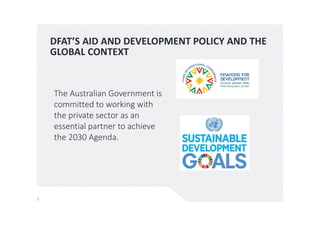
DFAT’S AID AND DEVELOPMENT POLICY AND THE
GLOBAL CONTEXT
3
The Australian Government is
committed to working with
the private sector as an
essential partner to achieve
the 2030 Agenda.
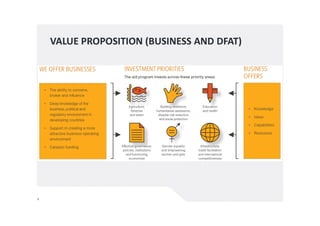
VALUE PROPOSITION (BUSINESS AND DFAT)
4
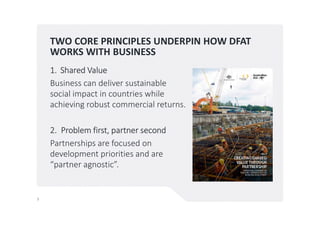
TWO CORE PRINCIPLES UNDERPIN HOW DFAT
WORKS WITH BUSINESS
5
1. Shared Value
Business can deliver sustainable
social impact in countries while
achieving robust commercial returns.
2. Problem first, partner second
Partnerships are focused on
development priorities and are
“partner agnostic”.
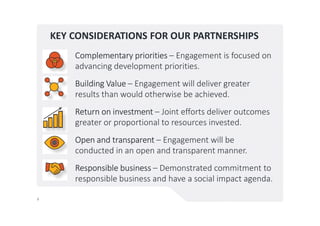
KEY CONSIDERATIONS FOR OUR PARTNERSHIPS
Complementary priorities – Engagement is focused on
advancing development priorities.
Building Value – Engagement will deliver greater
results than would otherwise be achieved.
Return on investment – Joint efforts deliver outcomes
greater or proportional to resources invested.
Open and transparent – Engagement will be
conducted in an open and transparent manner.
Responsible business – Demonstrated commitment to
responsible business and have a social impact agenda.
6
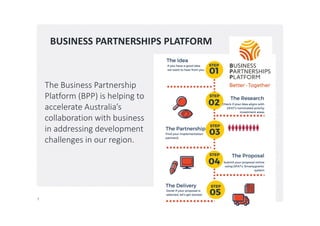
BUSINESS PARTNERSHIPS PLATFORM
7
The Business Partnership
Platform (BPP) is helping to
accelerate Australia’s
collaboration with business
in addressing development
challenges in our region.
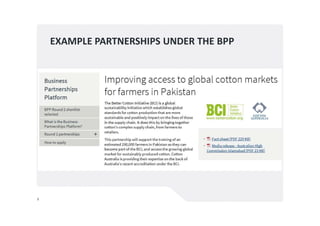
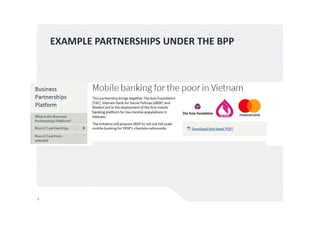
EXAMPLE PARTNERSHIPS UNDER THE BPP
8
EXAMPLE PARTNERSHIPS UNDER THE BPP
9
LESSONS LEARNT
1. It’s not just about the money
2. Open and transparent language
3. Be open to working with new partners and learn what
motivates them.
4. Create the space for collaboration
5. Embedding shared value in DFAT
10
FOR MORE INFORMATION
DFAT’s website: www.dfat.gov.au
The Share Value Initiative: www.sharedvalue.org
the UN Global Compact: www.unglobalcompact.org
Talk about private sector engagement with
DFAT staff at the Australian Embassy in your country
11
Creating Shared Value: Partnering with the Private Sector

Creating Shared Value: Partnering with the Private Sector

  • 1.
    CREATING SHARED VALUE: PARTNERING WITH THEPRIVATE SECTOR Presented by Nardia Simpson, Counsellor (Economic) Australian Embassy Manila Wednesday 4 October 2017
  • 2.
  • 3.
    DFAT’S AID ANDDEVELOPMENT POLICY AND THE GLOBAL CONTEXT 3 The Australian Government is committed to working with the private sector as an essential partner to achieve the 2030 Agenda.
  • 4.
  • 5.
    TWO CORE PRINCIPLESUNDERPIN HOW DFAT WORKS WITH BUSINESS 5 1. Shared Value Business can deliver sustainable social impact in countries while achieving robust commercial returns. 2. Problem first, partner second Partnerships are focused on development priorities and are “partner agnostic”.
  • 6.
    KEY CONSIDERATIONS FOROUR PARTNERSHIPS Complementary priorities – Engagement is focused on advancing development priorities. Building Value – Engagement will deliver greater results than would otherwise be achieved. Return on investment – Joint efforts deliver outcomes greater or proportional to resources invested. Open and transparent – Engagement will be conducted in an open and transparent manner. Responsible business – Demonstrated commitment to responsible business and have a social impact agenda. 6
  • 7.
    BUSINESS PARTNERSHIPS PLATFORM 7 TheBusiness Partnership Platform (BPP) is helping to accelerate Australia’s collaboration with business in addressing development challenges in our region.
  • 8.
  • 9.
  • 10.
    LESSONS LEARNT 1. It’snot just about the money 2. Open and transparent language 3. Be open to working with new partners and learn what motivates them. 4. Create the space for collaboration 5. Embedding shared value in DFAT 10
  • 11.
    FOR MORE INFORMATION DFAT’swebsite: www.dfat.gov.au The Share Value Initiative: www.sharedvalue.org the UN Global Compact: www.unglobalcompact.org Talk about private sector engagement with DFAT staff at the Australian Embassy in your country 11