MDG INDONESIA:
    STATUS AND THE WAY
         FORWARD
Endah Murniningtyas-National Development Planning Agency
            Widyono – University of Indonesia


    Presented at the UN-DESA UN-ESCAP MDG Workshop
                 Bangkok, 20-22 August 2008
OUTLINE
I.   MDG AND THE
     NATIONAL POLICY
II. THE STATUS
III. THE WAY FORWARD
I. MDG AND THE NATIONAL POLICY
• MDGs are not new to Indonesia. Since the development
  program existed, program towards “MDGs” target had been
  implemented.
• Example: food, family planning and health, education and
  other basic needs programs       packaged in the Five-Year
  Development Programs (REPELITA).
• Intensive efforts to balance between economic and social
  program started in the 5th and 6th Five-Year Development
  Plan (Repelita), in 1990.
• Significant progress are achieved, but the financial crisis in
  the late 90s was a downturn in the economic and social status
• In the early 2000, the government started to take shape on
  various basic policy in the national development      progress
  is experienced, with different external and internal challenge
      globalisation, democratization and decentralization.
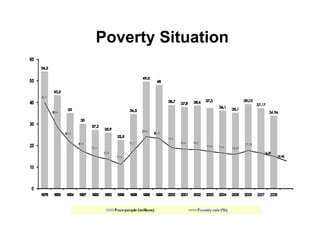
Poverty Situation
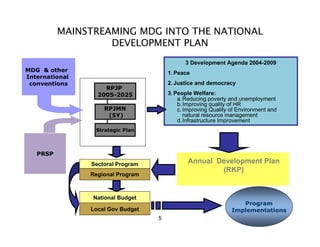
MAINSTREAMING MDG INTO THE NATIONAL
                   DEVELOPMENT PLAN
                                             3 Development Agenda 2004-2009
MDG & other                            1. Peace
International
 conventions                           2. Justice and democracy
                    RPJP
                  2005-2025            3. People Welfare:
                                           a.Reducing poverty and unemployment
                                           b.Improving quality of HR
                    RPJMN                  c. Improving Quality of Environment and
                     (5Y)                     natural resource management
                                           d.Infrastructure Improvement
                 Strategic Plan


   PRSP
                Sectoral Program              Annual Development Plan
                                                      (RKP)
                Regional Program


                National Budget
                                                                   Program
                Local Gov Budget                                Implementations
                                   5
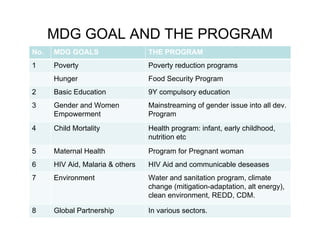
MDG GOAL AND THE PROGRAM
No.   MDG GOALS                   THE PROGRAM
1     Poverty                     Poverty reduction programs
      Hunger                      Food Security Program
2     Basic Education             9Y compulsory education
3     Gender and Women            Mainstreaming of gender issue into all dev.
      Empowerment                 Program
4     Child Mortality             Health program: infant, early childhood,
                                  nutrition etc
5     Maternal Health             Program for Pregnant woman
6     HIV Aid, Malaria & others   HIV Aid and communicable deseases
7     Environment                 Water and sanitation program, climate
                                  change (mitigation-adaptation, alt energy),
                                  clean environment, REDD, CDM.

8     Global Partnership          In various sectors.
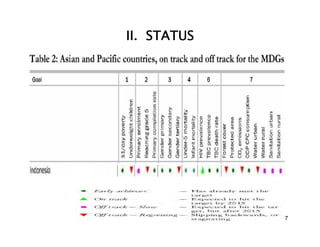
II. STATUS


             7
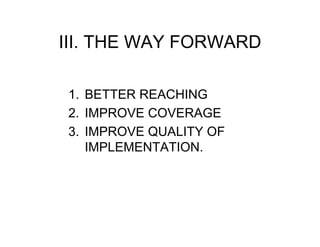
III. THE WAY FORWARD

1. BETTER REACHING
2. IMPROVE COVERAGE
3. IMPROVE QUALITY OF
   IMPLEMENTATION.
Better reaching
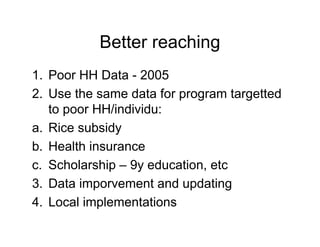
1. Poor HH Data - 2005
2. Use the same data for program targetted
   to poor HH/individu:
a. Rice subsidy
b. Health insurance
c. Scholarship – 9y education, etc
3. Data imporvement and updating
4. Local implementations
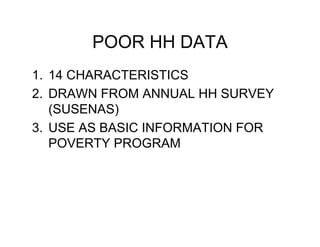
POOR HH DATA
1. 14 CHARACTERISTICS
2. DRAWN FROM ANNUAL HH SURVEY
   (SUSENAS)
3. USE AS BASIC INFORMATION FOR
   POVERTY PROGRAM
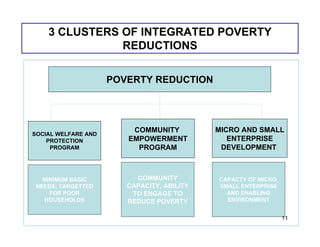
3 CLUSTERS OF INTEGRATED POVERTY
               REDUCTIONS

                     POVERTY REDUCTION


                         COMMUNITY          MICRO AND SMALL
SOCIAL WELFARE AND
    PROTECTION          EMPOWERMENT            ENTERPRISE
     PROGRAM              PROGRAM            DEVELOPMENT


   MINIMUM BASIC          COMMUNITY         CAPACTY OF MICRO,
 NEEDS: TARGETTED       CAPACITY, ABILITY   SMALL ENTERPRISE
     FOR POOR            TO ENGAGE TO         AND ENABLING
   HOUSEHOLDS           REDUCE POVERTY        ENVIRONMENT


                                                                11
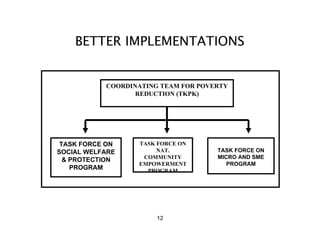
BETTER IMPLEMENTATIONS


           COORDINATING TEAM FOR POVERTY
                  REDUCTION (TKPK)


 TASK FORCE ON    TASK FORCE ON
SOCIAL WELFARE         NAT.          TASK FORCE ON
                   COMMUNITY         MICRO AND SME
  & PROTECTION
                  EMPOWERMENT           PROGRAM
    PROGRAM         PROGRAM


                       12
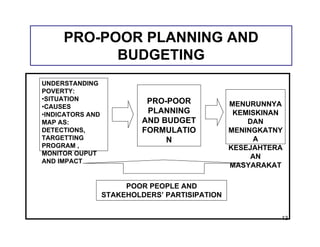
PRO-POOR PLANNING AND
           BUDGETING
UNDERSTANDING
POVERTY:
•SITUATION                  PRO-POOR
•CAUSES                                         MENURUNNYA
•INDICATORS AND
                            PLANNING             KEMISKINAN
MAP AS:                    AND BUDGET               DAN
DETECTIONS,                FORMULATIO           MENINGKATNY
TARGETTING                      N                    A
PROGRAM ,                                       KESEJAHTERA
MONITOR OUPUT
                                                     AN
AND IMPACT
                                                MASYARAKAT

                       POOR PEOPLE AND
                  STAKEHOLDERS’ PARTISIPATION


                                                          13
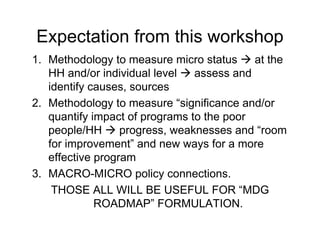
Expectation from this workshop
1. Methodology to measure micro status     at the
   HH and/or individual level   assess and
   identify causes, sources
2. Methodology to measure “significance and/or
   quantify impact of programs to the poor
   people/HH      progress, weaknesses and “room
   for improvement” and new ways for a more
   effective program
3. MACRO-MICRO policy connections.
    THOSE ALL WILL BE USEFUL FOR “MDG
             ROADMAP” FORMULATION.
TERIMA KASIH
 THANK YOU
APPENDICES
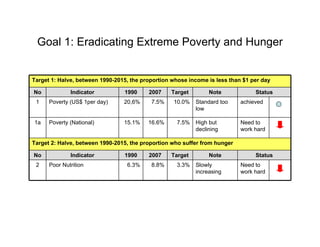
Goal 1: Eradicating Extreme Poverty and Hunger


Target 1: Halve, between 1990-2015, the proportion whose income is less than $1 per day

No            Indicator          1990     2007    Target        Note             Status
 1    Poverty (US$ 1per day)     20,6%     7.5%    10.0%   Standard too     achieved
                                                           low

1a    Poverty (National)         15.1%    16.6%     7.5%   High but         Need to
                                                           declining        work hard

Target 2: Halve, between 1990-2015, the proportion who suffer from hunger

No            Indicator          1990     2007    Target        Note             Status
 2    Poor Nutrition              6.3%     8.8%     3.3%   Slowly           Need to
                                                           increasing       work hard
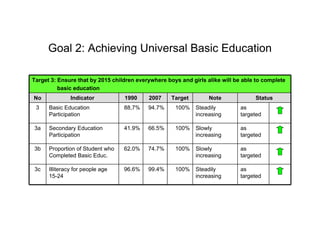
Goal 2: Achieving Universal Basic Education

Target 3: Ensure that by 2015 children everywhere boys and girls alike will be able to complete
          basic education
No             Indicator          1990     2007     Target        Note             Status
 3    Basic Education             88,7%    94.7%     100%    Steadily         as
      Participation                                          increasing       targeted

3a    Secondary Education         41.9%    66.5%     100%    Slowly           as
      Participation                                          increasing       targeted

3b    Proportion of Student who   62.0%    74.7%     100%    Slowly           as
      Completed Basic Educ.                                  increasing       targeted

3c    Illiteracy for people age   96.6%    99.4%     100%    Steadily         as
      15-24                                                  increasing       targeted
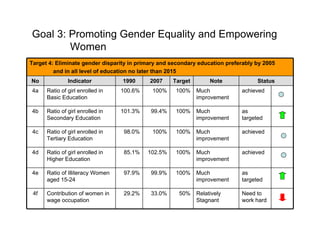
Goal 3: Promoting Gender Equality and Empowering
        Women
Target 4: Eliminate gender disparity in primary and secondary education preferably by 2005
         and in all level of education no later than 2015
No             Indicator          1990      2007    Target        Note             Status
4a    Ratio of girl enrolled in   100.6%     100%    100%    Much            achieved
      Basic Education                                        improvement

4b    Ratio of girl enrolled in   101.3%    99.4%    100%    Much            as
      Secondary Education                                    improvement     targeted

 4c   Ratio of girl enrolled in   98.0%      100%    100%    Much            achieved
      Tertiary Education                                     improvement

4d    Ratio of girl enrolled in   85.1%    102.5%    100%    Much            achieved
      Higher Education                                       improvement

4e    Ratio of Illiteracy Women   97.9%     99.9%    100%    Much            as
      aged 15-24                                             improvement     targeted

 4f   Contribution of women in    29.2%     33.0%     50%    Relatively      Need to
      wage occupation                                        Stagnant        work hard
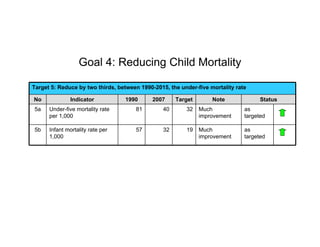
Goal 4: Reducing Child Mortality

Target 5: Reduce by two thirds, between 1990-2015, the under-five mortality rate

No             Indicator          1990      2007     Target        Note              Status
5a    Under-five mortality rate       81        40       32   Much             as
      per 1,000                                               improvement      targeted

5b    Infant mortality rate per       57        32       19   Much             as
      1,000                                                   improvement      targeted
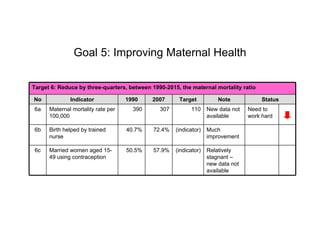
Goal 5: Improving Maternal Health

Target 6: Reduce by three-quarters, between 1990-2015, the maternal mortality ratio

No            Indicator             1990    2007      Target           Note            Status
6a    Maternal mortality rate per     390      307         110     New data not   Need to
      100,000                                                      available      work hard

6b    Birth helped by trained       40.7%    72.4%   (indicator)   Much
      nurse                                                        improvement

 6c   Married women aged 15-        50.5%    57.9%   (indicator)   Relatively
      49 using contraception                                       stagnant –
                                                                   new data not
                                                                   available
Goal 6: Combating HIV/AIDS, Malaria, and other
         Diseases
Target 7: Have halted by 2015 and begun to reserve the spread of HIV/AIDS

No             Indicator            1990      2007      Target           Note          Status
 7    HIV and AIDS prevalence                  0.1%   Combating      Increasing   Need to
                                                      the spread                  work hard
Target 8: Have halted by 2015 and begun to reserve the incidence of malaria and other major
          diseases

No             Indicator            1990      2007      Target           Note          Status
 8a   Case of Malaria per 1,000        8,5             (indicator)   Slowly
                                                                     declining

 8b   Tuberculosis prevalence per      786      262    (indicator)   declining    Need to
      100,000                                                                     work hard
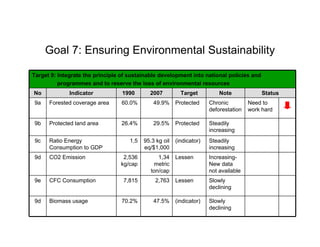
Goal 7: Ensuring Environmental Sustainability

Target 9: Integrate the principle of sustainable development into national policies and
          programmes and to reserve the loss of environmental resources
No            Indicator           1990       2007          Target          Note             Status
9a    Forested coverage area      60.0%        49.9%     Protected     Chronic         Need to
                                                                       deforestation   work hard

9b    Protected land area         26.4%        29.5%     Protected     Steadily
                                                                       increasing
 9c   Ratio Energy                   1,5   95.3 kg oil   (indicator)   Steadily
      Consumption to GDP                   eq/$1,000                   increasing
9d    CO2 Emission                2,536          1,34    Lessen        Increasing-
                                 kg/cap        metric                  New data
                                              ton/cap                  not available
9e    CFC Consumption             7,815        2,763     Lessen        Slowly
                                                                       declining

9d    Biomass usage               70.2%        47.5%     (indicator)   Slowly
                                                                       declining
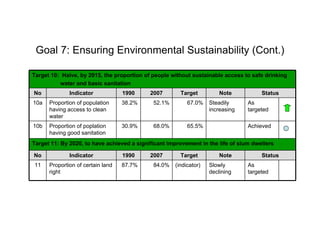
Goal 7: Ensuring Environmental Sustainability (Cont.)

Target 10: Halve, by 2015, the proportion of people without sustainable access to safe drinking
          water and basic sanitation
No            Indicator            1990     2007       Target          Note           Status
10a   Proportion of population     38.2%     52.1%        67.0%    Steadily      As
      having access to clean                                       increasing    targeted
      water
10b   Proportion of poplation      30.9%     68.0%        65.5%                  Achieved
      having good sanitation
Target 11: By 2020, to have achieved a significant improvement in the life of slum dwellers

No            Indicator            1990     2007       Target          Note           Status
11    Proportion of certain land   87.7%     84.0%   (indicator)   Slowly        As
      right                                                        declining     targeted
Goal 8: Establishing Global Partnership for Development

Target 12: Develop monetary and trading systems that are open, based on rules, predictable and
           non-discriminative
No            Indicator           1990     2007       Target           Note         Status
12a   Ratio of Export-Import to             44.4%    (indicator)
      GDP
12b   Ratio of Bank’s Credit                61.6%    (indicator)
      and Saving
Target 15: Handle Developing Countries’ Debts thru national and international effort to manage
          sustainable debt in the long run
No            Indicator           1990     2007       Target           Note         Status
13a   Ratio of foreign debt to              44.9%   (indicator)    Steadily
      GDP                                                          declining

13b   Ratio of debt to state                26.0%   (indicator)    Steadily
      budget                                                       declining
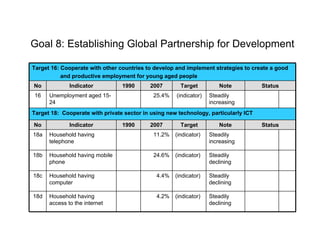
Goal 8: Establishing Global Partnership for Development

Target 16: Cooperate with other countries to develop and implement strategies to create a good
           and productive employment for young aged people
No            Indicator          1990      2007        Target          Note          Status
16    Unemployment aged 15-                  25.4%   (indicator)   Steadily
      24                                                           increasing
Target 18: Cooperate with private sector in using new technology, particularly ICT

No            Indicator          1990      2007        Target          Note          Status
18a   Household having                       11.2%   (indicator)   Steadily
      telephone                                                    increasing

18b   Household having mobile                24.6%   (indicator)   Steadily
      phone                                                        declining

18c   Household having                        4.4%   (indicator)   Steadily
      computer                                                     declining

18d   Household having                        4.2%   (indicator)   Steadily
      access to the internet                                       declining

Indonesia mdg overview_bnk

  • 1.
    MDG INDONESIA: STATUS AND THE WAY FORWARD Endah Murniningtyas-National Development Planning Agency Widyono – University of Indonesia Presented at the UN-DESA UN-ESCAP MDG Workshop Bangkok, 20-22 August 2008
  • 2.
    OUTLINE I. MDG AND THE NATIONAL POLICY II. THE STATUS III. THE WAY FORWARD
  • 3.
    I. MDG ANDTHE NATIONAL POLICY • MDGs are not new to Indonesia. Since the development program existed, program towards “MDGs” target had been implemented. • Example: food, family planning and health, education and other basic needs programs packaged in the Five-Year Development Programs (REPELITA). • Intensive efforts to balance between economic and social program started in the 5th and 6th Five-Year Development Plan (Repelita), in 1990. • Significant progress are achieved, but the financial crisis in the late 90s was a downturn in the economic and social status • In the early 2000, the government started to take shape on various basic policy in the national development progress is experienced, with different external and internal challenge globalisation, democratization and decentralization.
  • 4.
  • 5.
    MAINSTREAMING MDG INTOTHE NATIONAL DEVELOPMENT PLAN 3 Development Agenda 2004-2009 MDG & other 1. Peace International conventions 2. Justice and democracy RPJP 2005-2025 3. People Welfare: a.Reducing poverty and unemployment b.Improving quality of HR RPJMN c. Improving Quality of Environment and (5Y) natural resource management d.Infrastructure Improvement Strategic Plan PRSP Sectoral Program Annual Development Plan (RKP) Regional Program National Budget Program Local Gov Budget Implementations 5
  • 6.
    MDG GOAL ANDTHE PROGRAM No. MDG GOALS THE PROGRAM 1 Poverty Poverty reduction programs Hunger Food Security Program 2 Basic Education 9Y compulsory education 3 Gender and Women Mainstreaming of gender issue into all dev. Empowerment Program 4 Child Mortality Health program: infant, early childhood, nutrition etc 5 Maternal Health Program for Pregnant woman 6 HIV Aid, Malaria & others HIV Aid and communicable deseases 7 Environment Water and sanitation program, climate change (mitigation-adaptation, alt energy), clean environment, REDD, CDM. 8 Global Partnership In various sectors.
  • 7.
  • 8.
    III. THE WAYFORWARD 1. BETTER REACHING 2. IMPROVE COVERAGE 3. IMPROVE QUALITY OF IMPLEMENTATION.
  • 9.
    Better reaching 1. PoorHH Data - 2005 2. Use the same data for program targetted to poor HH/individu: a. Rice subsidy b. Health insurance c. Scholarship – 9y education, etc 3. Data imporvement and updating 4. Local implementations
  • 10.
    POOR HH DATA 1.14 CHARACTERISTICS 2. DRAWN FROM ANNUAL HH SURVEY (SUSENAS) 3. USE AS BASIC INFORMATION FOR POVERTY PROGRAM
  • 11.
    3 CLUSTERS OFINTEGRATED POVERTY REDUCTIONS POVERTY REDUCTION COMMUNITY MICRO AND SMALL SOCIAL WELFARE AND PROTECTION EMPOWERMENT ENTERPRISE PROGRAM PROGRAM DEVELOPMENT MINIMUM BASIC COMMUNITY CAPACTY OF MICRO, NEEDS: TARGETTED CAPACITY, ABILITY SMALL ENTERPRISE FOR POOR TO ENGAGE TO AND ENABLING HOUSEHOLDS REDUCE POVERTY ENVIRONMENT 11
  • 12.
    BETTER IMPLEMENTATIONS COORDINATING TEAM FOR POVERTY REDUCTION (TKPK) TASK FORCE ON TASK FORCE ON SOCIAL WELFARE NAT. TASK FORCE ON COMMUNITY MICRO AND SME & PROTECTION EMPOWERMENT PROGRAM PROGRAM PROGRAM 12
  • 13.
    PRO-POOR PLANNING AND BUDGETING UNDERSTANDING POVERTY: •SITUATION PRO-POOR •CAUSES MENURUNNYA •INDICATORS AND PLANNING KEMISKINAN MAP AS: AND BUDGET DAN DETECTIONS, FORMULATIO MENINGKATNY TARGETTING N A PROGRAM , KESEJAHTERA MONITOR OUPUT AN AND IMPACT MASYARAKAT POOR PEOPLE AND STAKEHOLDERS’ PARTISIPATION 13
  • 14.
    Expectation from thisworkshop 1. Methodology to measure micro status at the HH and/or individual level assess and identify causes, sources 2. Methodology to measure “significance and/or quantify impact of programs to the poor people/HH progress, weaknesses and “room for improvement” and new ways for a more effective program 3. MACRO-MICRO policy connections. THOSE ALL WILL BE USEFUL FOR “MDG ROADMAP” FORMULATION.
  • 15.
  • 16.
  • 17.
    Goal 1: EradicatingExtreme Poverty and Hunger Target 1: Halve, between 1990-2015, the proportion whose income is less than $1 per day No Indicator 1990 2007 Target Note Status 1 Poverty (US$ 1per day) 20,6% 7.5% 10.0% Standard too achieved low 1a Poverty (National) 15.1% 16.6% 7.5% High but Need to declining work hard Target 2: Halve, between 1990-2015, the proportion who suffer from hunger No Indicator 1990 2007 Target Note Status 2 Poor Nutrition 6.3% 8.8% 3.3% Slowly Need to increasing work hard
  • 18.
    Goal 2: AchievingUniversal Basic Education Target 3: Ensure that by 2015 children everywhere boys and girls alike will be able to complete basic education No Indicator 1990 2007 Target Note Status 3 Basic Education 88,7% 94.7% 100% Steadily as Participation increasing targeted 3a Secondary Education 41.9% 66.5% 100% Slowly as Participation increasing targeted 3b Proportion of Student who 62.0% 74.7% 100% Slowly as Completed Basic Educ. increasing targeted 3c Illiteracy for people age 96.6% 99.4% 100% Steadily as 15-24 increasing targeted
  • 19.
    Goal 3: PromotingGender Equality and Empowering Women Target 4: Eliminate gender disparity in primary and secondary education preferably by 2005 and in all level of education no later than 2015 No Indicator 1990 2007 Target Note Status 4a Ratio of girl enrolled in 100.6% 100% 100% Much achieved Basic Education improvement 4b Ratio of girl enrolled in 101.3% 99.4% 100% Much as Secondary Education improvement targeted 4c Ratio of girl enrolled in 98.0% 100% 100% Much achieved Tertiary Education improvement 4d Ratio of girl enrolled in 85.1% 102.5% 100% Much achieved Higher Education improvement 4e Ratio of Illiteracy Women 97.9% 99.9% 100% Much as aged 15-24 improvement targeted 4f Contribution of women in 29.2% 33.0% 50% Relatively Need to wage occupation Stagnant work hard
  • 20.
    Goal 4: ReducingChild Mortality Target 5: Reduce by two thirds, between 1990-2015, the under-five mortality rate No Indicator 1990 2007 Target Note Status 5a Under-five mortality rate 81 40 32 Much as per 1,000 improvement targeted 5b Infant mortality rate per 57 32 19 Much as 1,000 improvement targeted
  • 21.
    Goal 5: ImprovingMaternal Health Target 6: Reduce by three-quarters, between 1990-2015, the maternal mortality ratio No Indicator 1990 2007 Target Note Status 6a Maternal mortality rate per 390 307 110 New data not Need to 100,000 available work hard 6b Birth helped by trained 40.7% 72.4% (indicator) Much nurse improvement 6c Married women aged 15- 50.5% 57.9% (indicator) Relatively 49 using contraception stagnant – new data not available
  • 22.
    Goal 6: CombatingHIV/AIDS, Malaria, and other Diseases Target 7: Have halted by 2015 and begun to reserve the spread of HIV/AIDS No Indicator 1990 2007 Target Note Status 7 HIV and AIDS prevalence 0.1% Combating Increasing Need to the spread work hard Target 8: Have halted by 2015 and begun to reserve the incidence of malaria and other major diseases No Indicator 1990 2007 Target Note Status 8a Case of Malaria per 1,000 8,5 (indicator) Slowly declining 8b Tuberculosis prevalence per 786 262 (indicator) declining Need to 100,000 work hard
  • 23.
    Goal 7: EnsuringEnvironmental Sustainability Target 9: Integrate the principle of sustainable development into national policies and programmes and to reserve the loss of environmental resources No Indicator 1990 2007 Target Note Status 9a Forested coverage area 60.0% 49.9% Protected Chronic Need to deforestation work hard 9b Protected land area 26.4% 29.5% Protected Steadily increasing 9c Ratio Energy 1,5 95.3 kg oil (indicator) Steadily Consumption to GDP eq/$1,000 increasing 9d CO2 Emission 2,536 1,34 Lessen Increasing- kg/cap metric New data ton/cap not available 9e CFC Consumption 7,815 2,763 Lessen Slowly declining 9d Biomass usage 70.2% 47.5% (indicator) Slowly declining
  • 24.
    Goal 7: EnsuringEnvironmental Sustainability (Cont.) Target 10: Halve, by 2015, the proportion of people without sustainable access to safe drinking water and basic sanitation No Indicator 1990 2007 Target Note Status 10a Proportion of population 38.2% 52.1% 67.0% Steadily As having access to clean increasing targeted water 10b Proportion of poplation 30.9% 68.0% 65.5% Achieved having good sanitation Target 11: By 2020, to have achieved a significant improvement in the life of slum dwellers No Indicator 1990 2007 Target Note Status 11 Proportion of certain land 87.7% 84.0% (indicator) Slowly As right declining targeted
  • 25.
    Goal 8: EstablishingGlobal Partnership for Development Target 12: Develop monetary and trading systems that are open, based on rules, predictable and non-discriminative No Indicator 1990 2007 Target Note Status 12a Ratio of Export-Import to 44.4% (indicator) GDP 12b Ratio of Bank’s Credit 61.6% (indicator) and Saving Target 15: Handle Developing Countries’ Debts thru national and international effort to manage sustainable debt in the long run No Indicator 1990 2007 Target Note Status 13a Ratio of foreign debt to 44.9% (indicator) Steadily GDP declining 13b Ratio of debt to state 26.0% (indicator) Steadily budget declining
  • 26.
    Goal 8: EstablishingGlobal Partnership for Development Target 16: Cooperate with other countries to develop and implement strategies to create a good and productive employment for young aged people No Indicator 1990 2007 Target Note Status 16 Unemployment aged 15- 25.4% (indicator) Steadily 24 increasing Target 18: Cooperate with private sector in using new technology, particularly ICT No Indicator 1990 2007 Target Note Status 18a Household having 11.2% (indicator) Steadily telephone increasing 18b Household having mobile 24.6% (indicator) Steadily phone declining 18c Household having 4.4% (indicator) Steadily computer declining 18d Household having 4.2% (indicator) Steadily access to the internet declining