
Facilitated by
Martin S. Edwards
Associate Professor
SHU Diplomacy
martin.edwards@shu.edu
• Overview of the Goals
(Edwards)
• Break
• Breakout Sessions (3)
• Break
• Op-Ed Writing (Edwards)
• Advocacy (Neel)
Today’s Agenda:
• James Daly (Education): Goal 4
• Nalin Johri (SHMS): Goal 3
• Alyson Neel (UN Fdn): Goal 5
• Joseph O’Mahoney (Dipl): Goal 16
• Catherine Tinker (Dipl): Goals 6, 14,
and 15
Breakout Sessions:
• The UN at 70
• Recapping the MDG
Experience
• From the MDGs to the SDGs
• Some Unanswered
Questions
• Bigger Lessons
Agenda:
• Inspiring external evaluation:
• Integrated Commission on
Multilateralism
• Commission on Global Security,
Justice, and Governance
• Inspiring UN internal appraisals:
• 1325 Review
• HIPPO Panel
• Inspiring policymaking:
• Financing for Development (July)
• Post 2015 Development Agenda
Summit (September)
• Paris Climate Change Summit (Nov-
Dec)
The UN at 70:
• Unveiled the Sustainable
Development Goals
• Goals and Targets
• Means of Implementation
• Follow-Up and Review Process
• The SDGs are the follow-up to
the Millennium Development
Goals (MDGs) which have been
completed
• The SDGs are intended to guide
global policymaking until 2030
The September summit
• Several places, actually!
• OECD DAC, which created
International Development
Goals in 1996
• UN, which held a Millennium
Assembly in September 2000
• Intensive follow-ups to
produce a composite list of
goals, targets, and indicators
Where did the MDGs
come from?
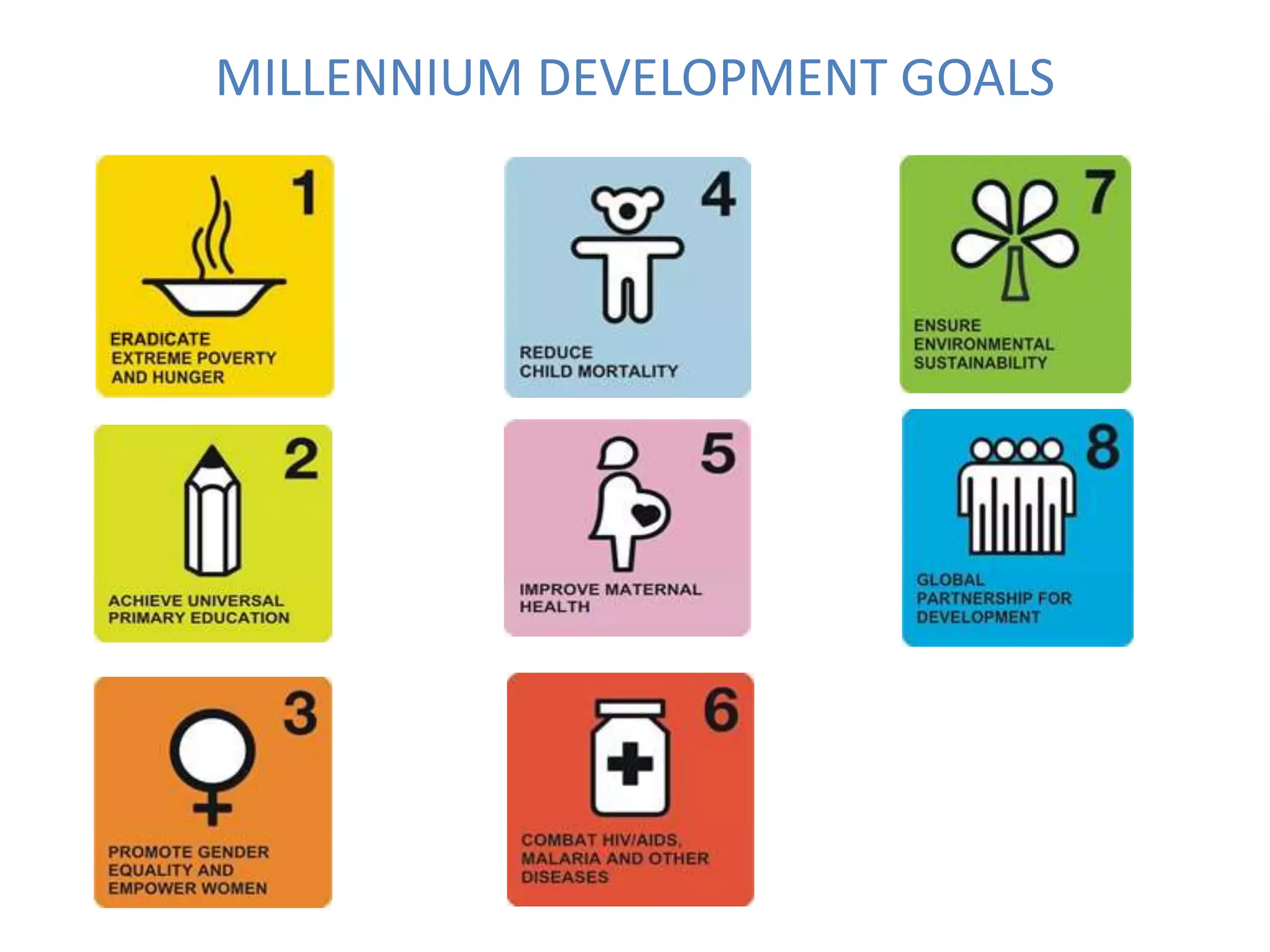
MILLENNIUM DEVELOPMENT GOALS
• The UN at 70
• Recapping the MDG
Experience
• From the MDGs to the SDGs
• Some Unanswered
Questions
• Bigger Lessons
Agenda:
• A good overview is at the link
below, but this is not without
problems:
• http://mdgs.un.org/unsd/mdg/Res
ources/Static/Products/Progress20
15/Progress_E.pdf
Recapping the MDG
Experience
• Answering the “Did the MDGs
work?” question isn’t easy:
• Counterfactual: What would
countries have done had the MDGs
not existed?
• Respecting the baseline: These
goals were ambitious!
• Implementation: The pathway from
goal to outcome is complex
• What’s the question? Are we
ascertaining if the targets were
met, or are we measuring
something else?
Recapping the MDG
Experience
• Whether targets were met varies
regionally:
• Target 1a (Halve, between 1990
and 2015, the proportion of people
whose income is less than $1 a day)
was met globally, but not in SSA
• Child mortality (Target 4a) has been
cut considerably, but progress in
Oceania has been especially
difficult
• Again, the target was a 2/3
reduction. We’re at more than
50% globally.
Here’s what we know:
• Domestic conditions matter:
• In conflict-affected countries, the
proportion of out-of-school children
has increased since 1999
• Urban-rural divides in developing
countries make progress on child
and maternal mortality difficult
• Progress on many targets hampered
by global recession
• Lack of data is also a barrier to
policymaking
Here’s what we know:
• More countries produce
better data:
• The percentage of developing
countries that had two or more data
points for at least 16 of the 22 MDG
indicators rose from 2% in 2003 to
79% in 2014.
• Domestic reforms do make a
difference:
• A forthcoming UNDP-commissioned
study of 50 countries found that 2/3
of them developed national
strategies for reaching the MDGs.
Here’s what we know:
• Need to change the process and
make it more inclusive
• Need to change the focus to the
world as a whole
• Need to change the goals
themselves to focus on improving
states too
• Need to rethink monitoring of the
goals to make sure they’re met
• Need to strengthen data
architecture so that countries
measure what counts
Lessons from the MDG
Experience
• The UN at 70
• Recapping the MDG
Experience
• From the MDGs to the SDGs
• Some Unanswered
Questions
• Bigger Lessons
Agenda:
• Key Document: Rio + 20 Summit
Declaration (2012)
• SD has three dimensions
• Economic
• Social
• Environmental
• Called for the formation of an
Open Working Group and
extensive civil society
involvement in creating the goals
From MDGs to SDGs
• Technology provided another
input to the goals
• World We Want survey: 7 ½ million
people voted worldwide on
priorities for their families
• Top two priorities: education and
health
• But note! The next two priorities
are not in MDGs:
• Better job opportunities
• Honest and responsive
government
From MDGs to SDGs
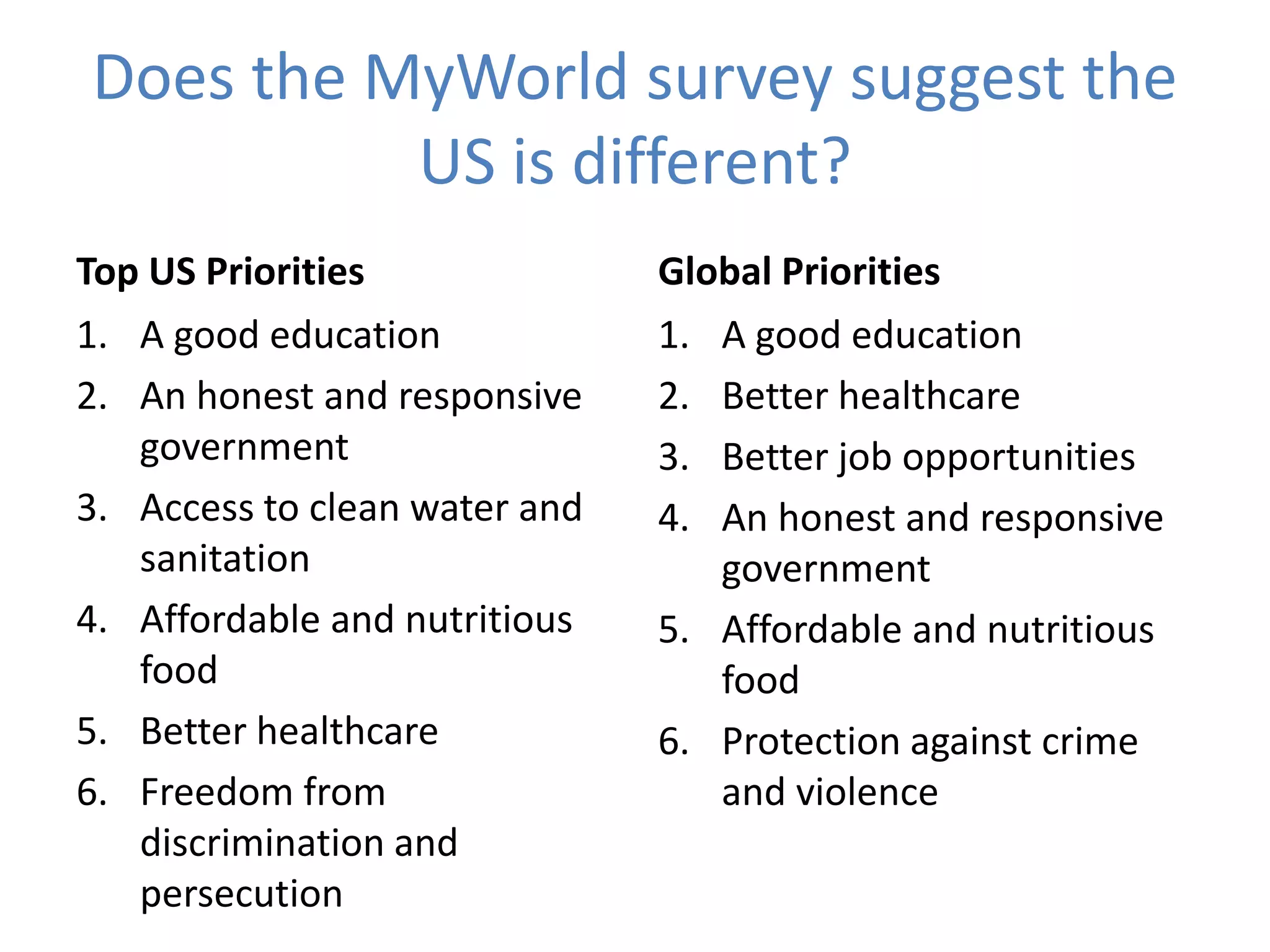
Does the MyWorld survey suggest the
US is different?
Top US Priorities
1. A good education
2. An honest and responsive
government
3. Access to clean water and
sanitation
4. Affordable and nutritious
food
5. Better healthcare
6. Freedom from
discrimination and
persecution
Global Priorities
1. A good education
2. Better healthcare
3. Better job opportunities
4. An honest and responsive
government
5. Affordable and nutritious
food
6. Protection against crime
and violence
• Open Working Group
• Originally had 30 members, then
moved to 70
• US shared a seat with Canada and
Israel
• 2 co-chairs appointed: Perm Reps
from Hungary and Kenya
• Civil Society offered advice
through 9 Major Groups and
other stakeholders
From MDGs to SDGs
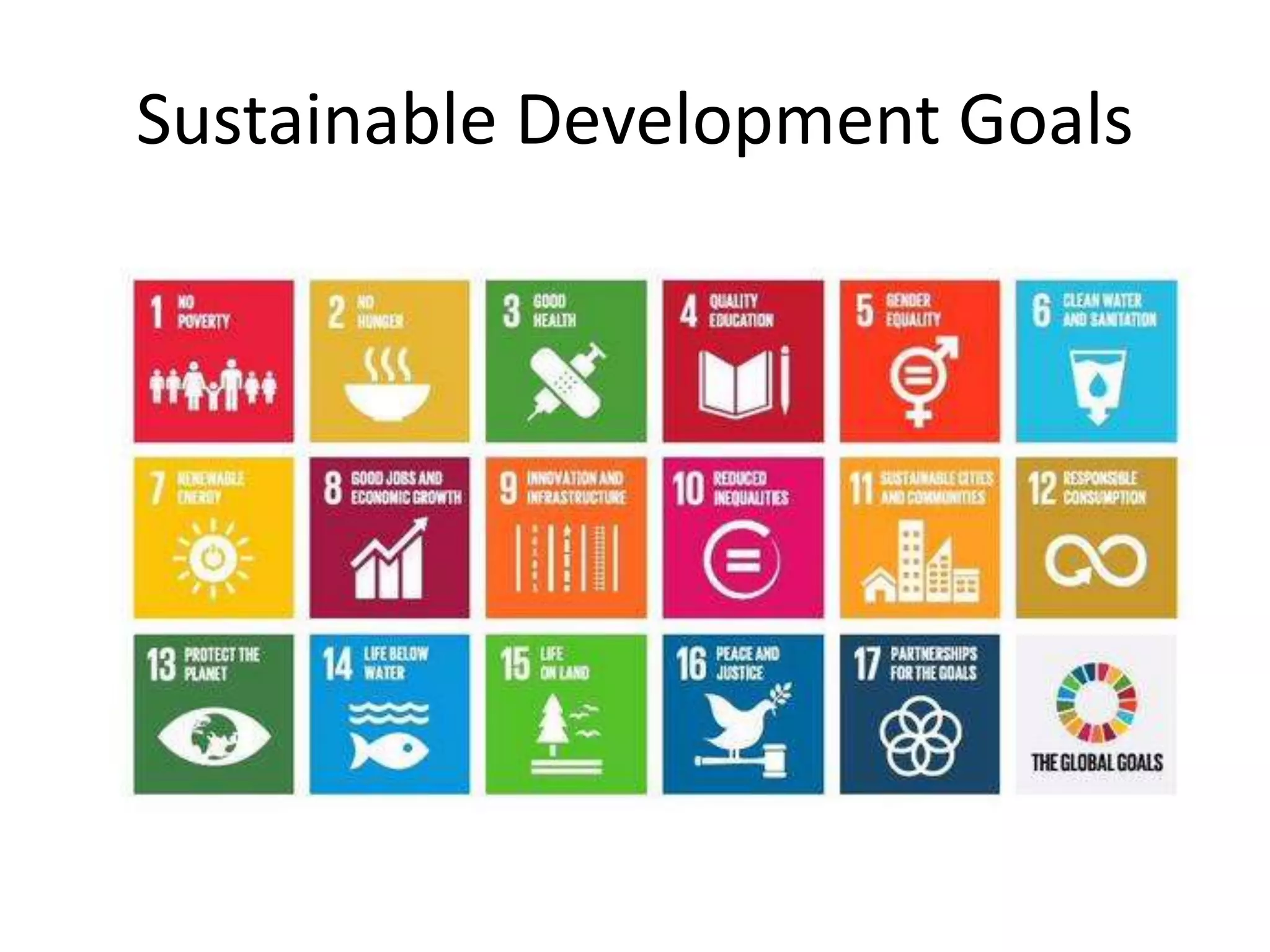
Sustainable Development Goals
• Consistent Themes:
• Poverty, Hunger, Health, Education,
Gender, Environment
• Some New Wrinkles:
• Access to Energy
• Infrastructure
• Growth and Employment
• Inequality
• Cities
• Governance
• Climate Change*
Comparing the Lists
• The goals are more ambitious for
those that ‘carried over’
• Poverty: Eliminate extreme poverty
($1.25/day)
• Hunger: End malnutrition
• Health: End preventable deaths of
newborns and children under 5
• Gender: End discrimination, VAW,
and child marriage, forced marriage
and FGM.
Comparing the Lists
• MDGs had eight goals (such as
“Improve Maternal Health”) and
18 targets (“Reduce under-five
mortality rate by 2/3 between
1990 and 2015”)
• By contrast, the SDGs have 17
goals and 169 targets
• Put another way: the SDGs are
the MDGs on steroids!
Key Difference: Scale
• The sheer number of goals and
targets has invited criticism.
• It is hard to imagine the
alternatives.
• We committed to a public
process based on an expansive
view of SD, and this was the
outcome.
• The SG’s attempt to reframe the
goals by grouping them under six
headings failed to catch on.
Too Big to Work?
• The UN at 70
• Recapping the MDG
Experience
• From the MDGs to the SDGs
• Some Unanswered
Questions
• Bigger Lessons
Agenda:
• Indicator Overload
• Follow up and review
• Footing the Bill for Post-2015
Some Unanswered
Questions
• With more goals and targets,
there are more indicators,
which places a strain on state
capacity. Indicators are to be
completed next year.
• At present, only 17% of the
300+ proposed indicators are
feasible by National
Statistical Offices
Indicator Overload
• Needs to be substantive to be
consequential
• Example that’s often referenced
is Universal Periodic Review
• Three questions
• Is the review process going to name
and shame?
• How will it avoid burdening
countries?
• How will national and regional level
reviews work?
Follow up and review
• Financing for Development (FfD)
talks held over the summer in
Addis
• States are paying their own way
through creating stronger tax
systems
• Para 51: “We encourage ODA
providers to consider setting a
target to provide at least 0.20
per cent of ODA/GNI to LDCs.”
Footing the Bill
for Post-2015
• It’s not surprising that FfD
agreement was more ambiguous
than SDGs
• States negotiate harder over $!
Financing for
Development (FfD)
• Ambiguity!
• What makes the SDGs work is
their clarity.
• FfD outcome document far
from this standard
• Agreement language doesn’t
obligate states
• Doesn’t outline benchmarks
Key difference between
SDGs and FfD
• The UN at 70
• Recapping the MDG
Experience
• From the MDGs to the SDGs
• Some Unanswered
Questions
• Bigger Lessons
Agenda:
• Post-2015 agenda is packaged
as a done deal, but it still a
work in progress.
• International cooperation is
always a difficult balancing act
of reconciling different
interests. This is as true today
as when the UN was founded.
Bigger Lessons
• Involving civil society in the
development of SDGs has been
a game-changer.
• The future of the Post-2015
agenda, though, turns on how
much civil society can help
turn pledges into action.
Bigger Lessons
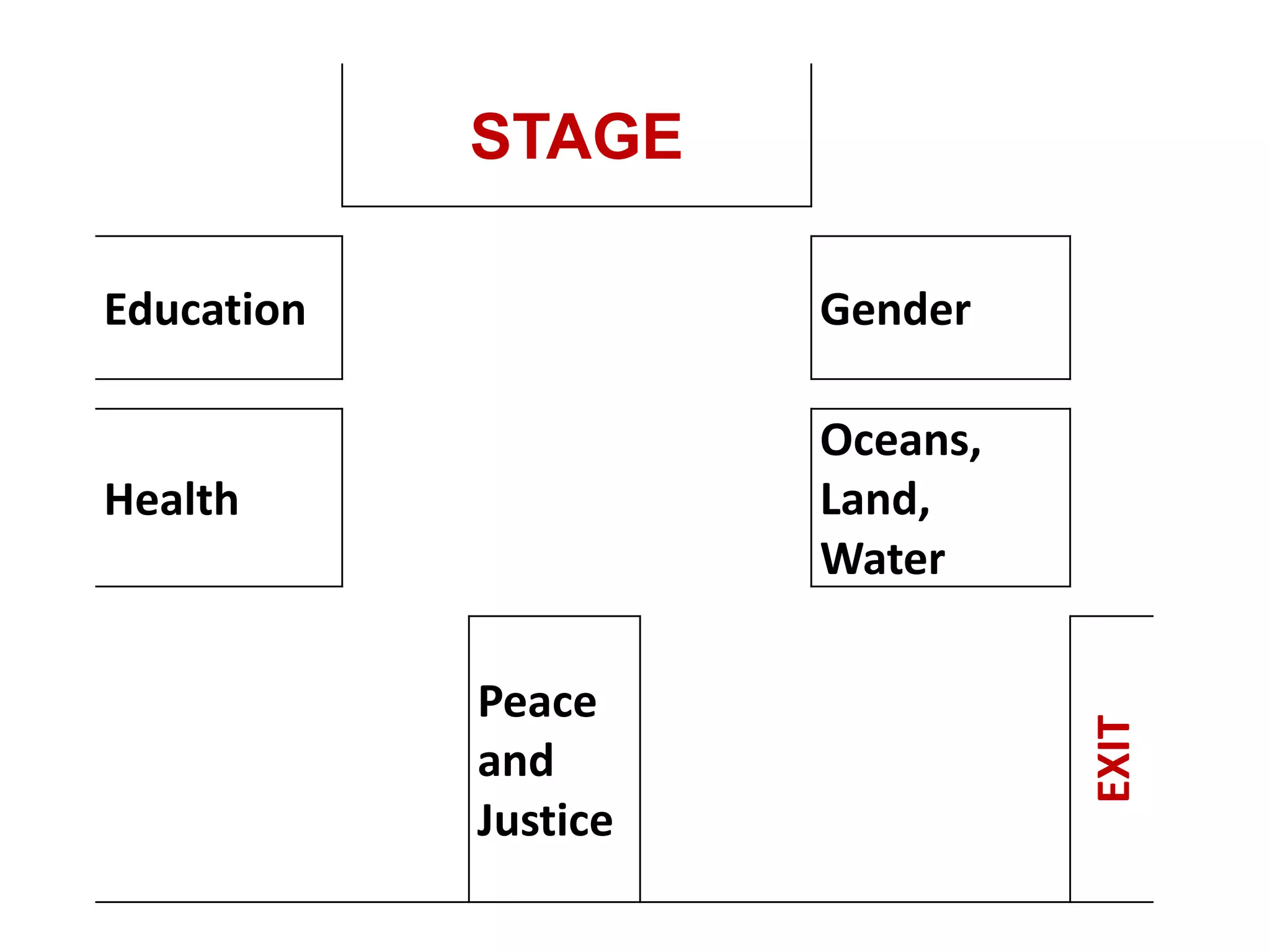
STAGE
Education Gender
Health
Oceans,
Land,
Water
Peace
and
Justice
EXIT
THANKS SO
MUCH!
For more info:
@MartinSEdwards
martin.edwards@shu.edu

Sustainable Development Goals Overview

  • 2.
    Facilitated by Martin S.Edwards Associate Professor SHU Diplomacy martin.edwards@shu.edu
  • 3.
    • Overview ofthe Goals (Edwards) • Break • Breakout Sessions (3) • Break • Op-Ed Writing (Edwards) • Advocacy (Neel) Today’s Agenda:
  • 4.
    • James Daly(Education): Goal 4 • Nalin Johri (SHMS): Goal 3 • Alyson Neel (UN Fdn): Goal 5 • Joseph O’Mahoney (Dipl): Goal 16 • Catherine Tinker (Dipl): Goals 6, 14, and 15 Breakout Sessions:
  • 5.
    • The UNat 70 • Recapping the MDG Experience • From the MDGs to the SDGs • Some Unanswered Questions • Bigger Lessons Agenda:
  • 6.
    • Inspiring externalevaluation: • Integrated Commission on Multilateralism • Commission on Global Security, Justice, and Governance • Inspiring UN internal appraisals: • 1325 Review • HIPPO Panel • Inspiring policymaking: • Financing for Development (July) • Post 2015 Development Agenda Summit (September) • Paris Climate Change Summit (Nov- Dec) The UN at 70:
  • 7.
    • Unveiled theSustainable Development Goals • Goals and Targets • Means of Implementation • Follow-Up and Review Process • The SDGs are the follow-up to the Millennium Development Goals (MDGs) which have been completed • The SDGs are intended to guide global policymaking until 2030 The September summit
  • 8.
    • Several places,actually! • OECD DAC, which created International Development Goals in 1996 • UN, which held a Millennium Assembly in September 2000 • Intensive follow-ups to produce a composite list of goals, targets, and indicators Where did the MDGs come from?
  • 9.
  • 10.
    • The UNat 70 • Recapping the MDG Experience • From the MDGs to the SDGs • Some Unanswered Questions • Bigger Lessons Agenda:
  • 11.
    • A goodoverview is at the link below, but this is not without problems: • http://mdgs.un.org/unsd/mdg/Res ources/Static/Products/Progress20 15/Progress_E.pdf Recapping the MDG Experience
  • 12.
    • Answering the“Did the MDGs work?” question isn’t easy: • Counterfactual: What would countries have done had the MDGs not existed? • Respecting the baseline: These goals were ambitious! • Implementation: The pathway from goal to outcome is complex • What’s the question? Are we ascertaining if the targets were met, or are we measuring something else? Recapping the MDG Experience
  • 13.
    • Whether targetswere met varies regionally: • Target 1a (Halve, between 1990 and 2015, the proportion of people whose income is less than $1 a day) was met globally, but not in SSA • Child mortality (Target 4a) has been cut considerably, but progress in Oceania has been especially difficult • Again, the target was a 2/3 reduction. We’re at more than 50% globally. Here’s what we know:
  • 14.
    • Domestic conditionsmatter: • In conflict-affected countries, the proportion of out-of-school children has increased since 1999 • Urban-rural divides in developing countries make progress on child and maternal mortality difficult • Progress on many targets hampered by global recession • Lack of data is also a barrier to policymaking Here’s what we know:
  • 15.
    • More countriesproduce better data: • The percentage of developing countries that had two or more data points for at least 16 of the 22 MDG indicators rose from 2% in 2003 to 79% in 2014. • Domestic reforms do make a difference: • A forthcoming UNDP-commissioned study of 50 countries found that 2/3 of them developed national strategies for reaching the MDGs. Here’s what we know:
  • 16.
    • Need tochange the process and make it more inclusive • Need to change the focus to the world as a whole • Need to change the goals themselves to focus on improving states too • Need to rethink monitoring of the goals to make sure they’re met • Need to strengthen data architecture so that countries measure what counts Lessons from the MDG Experience
  • 17.
    • The UNat 70 • Recapping the MDG Experience • From the MDGs to the SDGs • Some Unanswered Questions • Bigger Lessons Agenda:
  • 18.
    • Key Document:Rio + 20 Summit Declaration (2012) • SD has three dimensions • Economic • Social • Environmental • Called for the formation of an Open Working Group and extensive civil society involvement in creating the goals From MDGs to SDGs
  • 19.
    • Technology providedanother input to the goals • World We Want survey: 7 ½ million people voted worldwide on priorities for their families • Top two priorities: education and health • But note! The next two priorities are not in MDGs: • Better job opportunities • Honest and responsive government From MDGs to SDGs
  • 20.
    Does the MyWorldsurvey suggest the US is different? Top US Priorities 1. A good education 2. An honest and responsive government 3. Access to clean water and sanitation 4. Affordable and nutritious food 5. Better healthcare 6. Freedom from discrimination and persecution Global Priorities 1. A good education 2. Better healthcare 3. Better job opportunities 4. An honest and responsive government 5. Affordable and nutritious food 6. Protection against crime and violence
  • 21.
    • Open WorkingGroup • Originally had 30 members, then moved to 70 • US shared a seat with Canada and Israel • 2 co-chairs appointed: Perm Reps from Hungary and Kenya • Civil Society offered advice through 9 Major Groups and other stakeholders From MDGs to SDGs
  • 22.
  • 23.
    • Consistent Themes: •Poverty, Hunger, Health, Education, Gender, Environment • Some New Wrinkles: • Access to Energy • Infrastructure • Growth and Employment • Inequality • Cities • Governance • Climate Change* Comparing the Lists
  • 24.
    • The goalsare more ambitious for those that ‘carried over’ • Poverty: Eliminate extreme poverty ($1.25/day) • Hunger: End malnutrition • Health: End preventable deaths of newborns and children under 5 • Gender: End discrimination, VAW, and child marriage, forced marriage and FGM. Comparing the Lists
  • 25.
    • MDGs hadeight goals (such as “Improve Maternal Health”) and 18 targets (“Reduce under-five mortality rate by 2/3 between 1990 and 2015”) • By contrast, the SDGs have 17 goals and 169 targets • Put another way: the SDGs are the MDGs on steroids! Key Difference: Scale
  • 26.
    • The sheernumber of goals and targets has invited criticism. • It is hard to imagine the alternatives. • We committed to a public process based on an expansive view of SD, and this was the outcome. • The SG’s attempt to reframe the goals by grouping them under six headings failed to catch on. Too Big to Work?
  • 27.
    • The UNat 70 • Recapping the MDG Experience • From the MDGs to the SDGs • Some Unanswered Questions • Bigger Lessons Agenda:
  • 28.
    • Indicator Overload •Follow up and review • Footing the Bill for Post-2015 Some Unanswered Questions
  • 29.
    • With moregoals and targets, there are more indicators, which places a strain on state capacity. Indicators are to be completed next year. • At present, only 17% of the 300+ proposed indicators are feasible by National Statistical Offices Indicator Overload
  • 30.
    • Needs tobe substantive to be consequential • Example that’s often referenced is Universal Periodic Review • Three questions • Is the review process going to name and shame? • How will it avoid burdening countries? • How will national and regional level reviews work? Follow up and review
  • 31.
    • Financing forDevelopment (FfD) talks held over the summer in Addis • States are paying their own way through creating stronger tax systems • Para 51: “We encourage ODA providers to consider setting a target to provide at least 0.20 per cent of ODA/GNI to LDCs.” Footing the Bill for Post-2015
  • 32.
    • It’s notsurprising that FfD agreement was more ambiguous than SDGs • States negotiate harder over $! Financing for Development (FfD)
  • 33.
    • Ambiguity! • Whatmakes the SDGs work is their clarity. • FfD outcome document far from this standard • Agreement language doesn’t obligate states • Doesn’t outline benchmarks Key difference between SDGs and FfD
  • 34.
    • The UNat 70 • Recapping the MDG Experience • From the MDGs to the SDGs • Some Unanswered Questions • Bigger Lessons Agenda:
  • 35.
    • Post-2015 agendais packaged as a done deal, but it still a work in progress. • International cooperation is always a difficult balancing act of reconciling different interests. This is as true today as when the UN was founded. Bigger Lessons
  • 36.
    • Involving civilsociety in the development of SDGs has been a game-changer. • The future of the Post-2015 agenda, though, turns on how much civil society can help turn pledges into action. Bigger Lessons
  • 37.
  • 39.
    THANKS SO MUCH! For moreinfo: @MartinSEdwards martin.edwards@shu.edu