Corporate
Ethics
&
Governance • Adil Hussain 5B
• Aniket Kibe 8B
• Bharat Daryani 16B
• Mehak Gupta 27B
• Prince Shaji 32B
• Sarthak Chand 38B
Section B Group 4:
Moving from
Millennium Development
Goals
to
Sustainable Development
Goals
Agenda
• Bharat Daryani (16B): Overview of MDGs and SDGs
• Mehak Gupta (27B): Key differences between MDGs and SDGs with analysis
• Sarthak Chand (38B): Role of Governments in formulation of SDGs with current developments
• Aniket Kibe (8B): Cross Country analysis on the implementation of SDGs
• Prince Shaji (32B): Role of SDGs in the Corporate Governance
• Adil Hussain (5B): Corporate case studies
Task Allocation
Millennium Development Goals
Introduction
•Series of 8 time bound targets started in September 2000 by world
leaders at United Nations Headquarters
•Aim to partner nations with an aim to reduce extreme poverty
•Deadline set to 2015 to measure the progress and implementation
Achievements
•Population of people living in extreme poverty declined by more
than half since 1990
•Proportion of undernourished people in developing regions reduced
by half
•The under-half mortality rate down by 50% and maternal mortality
by 45%
•Gains in fight against HIV/AIDS, malaria and tuberculosis
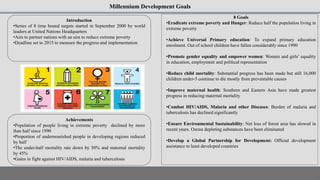
8 Goals
•Eradicate extreme poverty and Hunger: Reduce half the population living in
extreme poverty
•Achieve Universal Primary education: To expand primary education
enrolment. Out of school children have fallen considerably since 1990
•Promote gender equality and empower women: Women and girls’ equality
in education, employment and political representation
•Reduce child mortality: Substantial progress has been made but still 16,000
children under-5 continue to die mostly from preventable causes
•Improve maternal health: Southern and Eastern Asia have made greatest
progress in reducing maternal mortality
•Combat HIV/AIDS, Malaria and other Diseases: Burden of malaria and
tuberculosis has declined significantly
•Ensure Environmental Sustainability: Net loss of forest area has slowed in
recent years. Ozone depleting substances have been eliminated
•Develop a Global Partnership for Development: Official development
assistance to least developed countries
Sustainable Development Goals (1/2)
Introduction
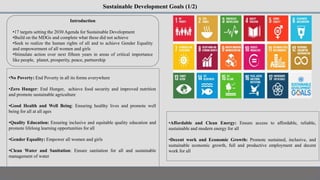
•17 targets setting the 2030 Agenda for Sustainable Development
•Build on the MDGs and complete what these did not achieve
•Seek to realize the human rights of all and to achieve Gender Equality
and empowerment of all women and girls
•Stimulate action over next fifteen years in areas of critical importance
like people, planet, prosperity, peace, partnership
•No Poverty: End Poverty in all its forms everywhere
•Zero Hunger: End Hunger, achieve food security and improved nutrition
and promote sustainable agriculture
•Good Health and Well Being: Ensuring healthy lives and promote well
being for all at all ages
•Quality Education: Ensuring inclusive and equitable quality education and
promote lifelong learning opportunities for all
•Gender Equality: Empower all women and girls
•Clean Water and Sanitation: Ensure sanitation for all and sustainable
management of water
•Affordable and Clean Energy: Ensure access to affordable, reliable,
sustainable and modern energy for all
•Decent work and Economic Growth: Promote sustained, inclusive, and
sustainable economic growth, full and productive employment and decent
work for all
Sustainable Development Goals (2/2)
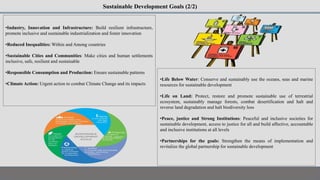
•Industry, Innovation and Infrastructure: Build resilient infrastructure,
promote inclusive and sustainable industrialization and foster innovation
•Reduced Inequalities: Within and Among countries
•Sustainable Cities and Communities: Make cities and human settlements
inclusive, safe, resilient and sustainable
•Responsible Consumption and Production: Ensure sustainable patterns
•Climate Action: Urgent action to combat Climate Change and its impacts
•Life Below Water: Conserve and sustainably use the oceans, seas and marine
resources for sustainable development
•Life on Land: Protect, restore and promote sustainable use of terrestrial
ecosystem, sustainably manage forests, combat desertification and halt and
reverse land degradation and halt biodiversity loss
•Peace, justice and Strong Institutions: Peaceful and inclusive societies for
sustainable development, access to justice for all and build affective, accountable
and inclusive institutions at all levels
•Partnerships for the goals: Strengthen the means of implementation and
revitalize the global partnership for sustainable development
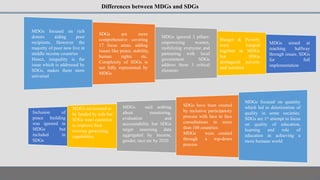
Differences between MDGs and SDGs
MDGs aimed at
reaching halfway
through issues. SDGs
for full
implementation
Hunger & Poverty
were lumped
together in MDGs
but SDGs
distinguish poverty
and nutrition
MDGs ignored 3 pillars:
empowering women,
mobilizing everyone and
partnering with local
government. SDGs
address these 3 critical
elements
SDGs are more
comprehensive covering
17 focus areas. adding
issues like peace, stability,
human rights etc.
Complexity of SDGs is
not fully represented by
MDGs
MDGs focused on rich
donors aiding poor
recipients. However the
majority of poor now live in
middle income countries
Hence, inequality is the
issue which is addressed by
SDGs, makes them more
universal
Inclusion of
peace building
was ignored in
MDGs but
included in
SDGs
MDGs envisioned to
be funded by aids but
SDGs want countries
to improve their
revenue generating
capabilities
MDGs focused on quantity
which led to deterioration of
quality in some societies.
SDGs are 1st attempt to focus
on quality of education,
learning and role of
education in achieving a
more humane world
MDGs said nothing
about monitoring,
evaluation and
accountability but SDGs
target assessing data
aggregated by income,
gender, race etc by 2020
SDGs have been created
by inclusive participatory
process with face to face
consultations in more
than 100 countries
MDGs were created
through a top-down
process
While the MDGs provided a focal point for
governments – a framework around which they
could develop policies and over programs
designed to end poverty and improve the lives of
poor people – they were too narrow.
ROLE OF GOVERNMENTS (1/2)
The 8 MDGs failed to consider the root causes of
poverty and overlooked gender inequality &
holistic nature of development. No mention of
human rights or address to economic
development.
Why do we need another
set of goals?
A more collaborative effort:
Unlike the MDGs, which were drawn up by a
group of men in the basement of UN
headquarters (or so the legend goes), the UN
has conducted the largest consultation
programme in its history to gauge opinion on what
the SDGs should include.
Alongside the open working group discussions,
the UN conducted a series of “global
conversations”. These included 11 thematic and
83 national consultations, and door-to-door
surveys. The UN also launched an online survey
for rhe same.
The open working group, with representatives
from 70 countries was formed. Member state
negotiations followed, and the final wording of the
goals and targets, and the preamble and
declaration that comes with them, were agreed in
August 2015.
ROLE OF GOVERNMENTS (2/2)
Are governments happy about the
proposed 17 goals?
• The majority seem to be, but a handful of
member states, including the UK and Japan,
aren’t so keen.
• Some countries feel that an agenda
consisting of 17 goals is too unwieldy to
implement or sell to the public, and would
prefer a narrower brief.
• Some believe the underlying reason is to get
rid of some of the more uncomfortable goals,
such as those relating to the environment.
• Britain’s prime minister, David Cameron, has
publicly said he wants 12 goals at the most,
preferably 10.
• It’s not clear, though, which goals the UK
government would like taken out if they had
the choice.
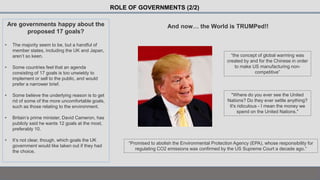
And now… the World is TRUMPed!!
“Promised to abolish the Environmental Protection Agency (EPA), whose responsibility for
regulating CO2 emissions was confirmed by the US Supreme Court a decade ago.”
“the concept of global warming was
created by and for the Chinese in order
to make US manufacturing non-
competitive”
"Where do you ever see the United
Nations? Do they ever settle anything?
It's ridiculous - I mean the money we
spend on the United Nations."
CASE OF EUROPEAN UNION
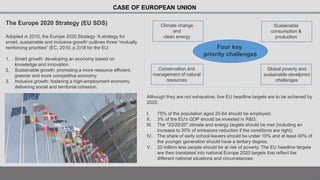
The Europe 2020 Strategy (EU SDS)
Adopted in 2010, the Europe 2020 Strategy ‘A strategy for
smart, sustainable and inclusive growth’ outlines three “mutually
reinforcing priorities” (EC, 2010, p.3)18 for the EU:
1. Smart growth: developing an economy based on
knowledge and innovation
2. Sustainable growth: promoting a more resource efficient,
greener and more competitive economy
3. Inclusive growth: fostering a high-employment economy
delivering social and territorial cohesion.
Although they are not exhaustive, five EU headline targets are to be achieved by
2020:
I. 75% of the population aged 20-64 should be employed;
II. 3% of the EU's GDP should be invested in R&D;
III. The "20/20/20" climate and energy targets should be met (including an
increase to 30% of emissions reduction if the conditions are right);
IV. The share of early school leavers should be under 10% and at least 40% of
the younger generation should have a tertiary degree;
V. 20 million less people should be at risk of poverty. The EU headline targets
are then translated into national Europe 2020 targets that reflect the
different national situations and circumstances.
Four key
priority challenges
Climate change
and
clean energy
Sustainable
consumption &
production
Conservation and
management of natural
resources
Global poverty and
sustainable develpmnt
challenges
CASE OF INDIA
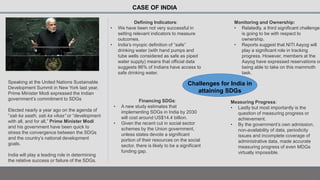
Speaking at the United Nations Sustainable
Development Summit in New York last year,
Prime Minister Modi expressed the Indian
government’s commitment to SDGs
Elected nearly a year ago on the agenda of
“sab ka saath, sab ka vikas” or “development
with all, and for all,” Prime Minister Modi
and his government have been quick to
stress the convergence between the SDGs
and the country’s national development
goals.
India will play a leading role in determining
the relative success or failure of the SDGs.
Challenges for India in
attaining SDGs
Defining Indicators:
• We have been not very successful in
setting relevant indicators to measure
outcomes.
• India’s myopic definition of “safe”
drinking water (with hand pumps and
tube wells considered as safe as piped
water supply) means that official data
suggests 86% of Indians have access to
safe drinking water.
Financing SDGs:
• A new study estimates that
implementing SDGs in India by 2030
will cost around US$14.4 billion.
• Given the recent cut in social sector
schemes by the Union government,
unless states devote a significant
portion of their resources on the social
sector, there is likely to be a significant
funding gap.
Monitoring and Ownership:
• Relatedly, a third significant challenge
is going to be with respect to
ownership.
• Reports suggest that NITI Aayog will
play a significant role in tracking
progress. However, members at the
Aayog have expressed reservations on
being able to take on this mammoth
task.
Measuring Progress:
• Lastly but most importantly is the
question of measuring progress or
achievement.
• By the government’s own admission,
non-availability of data, periodicity
issues and incomplete coverage of
administrative data, made accurate
measuring progress of even MDGs
virtually impossible.
The Sustainable Development Goals (SDGs) define global sustainable development priorities and aspirations for 2030 and seek to
mobilize global efforts around a common set of goals and targets.
The SDGs call for worldwide action among governments, business and civil society to end poverty and
create a life of dignity and opportunity for all, within the boundaries of the planet
Why do the SDGs matter for business?
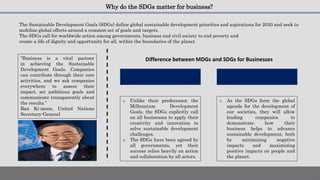
Difference between MDGs and SDGs for Businesses
o Unlike their predecessor, the
Millennium Development
Goals, the SDGs explicitly call
on all businesses to apply their
creativity and innovation to
solve sustainable development
challenges.
o The SDGs have been agreed by
all governments, yet their
success relies heavily on action
and collaboration by all actors.
o As the SDGs form the global
agenda for the development of
our societies, they will allow
leading companies to
demonstrate how their
business helps to advance
sustainable development, both
by minimizing negative
impacts and maximizing
positive impacts on people and
the planet.
“Business is a vital partner
in achieving the Sustainable
Development Goals. Companies
can contribute through their core
activities, and we ask companies
everywhere to assess their
impact, set ambitious goals and
communicate transparently about
the results.”
Ban Ki-moon, United Nations
Secretary-General
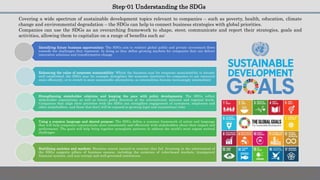
Step-01 Understanding the SDGs
Covering a wide spectrum of sustainable development topics relevant to companies – such as poverty, health, education, climate
change and environmental degradation – the SDGs can help to connect business strategies with global priorities.
Companies can use the SDGs as an overarching framework to shape, steer, communicate and report their strategies, goals and
activities, allowing them to capitalize on a range of benefits such as:
Identifying future business opportunities: The SDGs aim to redirect global public and private investment flows
towards the challenges they represent. In doing so they define growing markets for companies that can deliver
innovative solutions and transformative change
Enhancing the value of corporate sustainability: Whilst the business case for corporate sustainability is already
well established, the SDGs may for example strengthen the economic incentives for companies to use resources
more efficiently, or to switch to more sustainable alternatives, as externalities become increasingly internalized
Strengthening stakeholder relations and keeping the pace with policy developments: The SDGs reflect
stakeholder expectations as well as future policy direction at the international, national and regional levels.
Companies that align their priorities with the SDGs can strengthen engagement of customers, employees and
other stakeholders, and those that don’t will be exposed to growing legal and reputational risks
Using a common language and shared purpose: The SDGs define a common framework of action and language
that will help companies communicate more consistently and effectively with stakeholders about their impact and
performance. The goals will help bring together synergistic partners to address the world’s most urgent societal
challenges
Stabilizing societies and markets: Business cannot succeed in societies that fail. Investing in the achievement of
the SDGs supports pillars of business success, including the existence of rules-based markets, transparent
financial systems, and non-corrupt and well-governed institutions
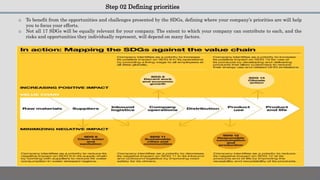
Step 02 Defining priorities
o To benefit from the opportunities and challenges presented by the SDGs, defining where your company’s priorities are will help
you to focus your efforts.
o Not all 17 SDGs will be equally relevant for your company. The extent to which your company can contribute to each, and the
risks and opportunities they individually represent, will depend on many factors.
Step 03 Setting goals
Goal setting builds directly on the outcomes from the impact assessment and prioritization covered in step 02, and is essential to
driving good performance
• Setting specific, measurable and time-bound sustainability goals
helps foster shared priorities and drive performance across the
organization, and is becoming increasingly widespread.
• By aligning with the SDGs, companies can set more meaningful
goals and communicate more effectively about its commitment to
sustainable development.
Define scope of goals and select KPIs
• It is recommended that the scope of your company’s sustainability
goals is guided by the strategic priorities identified in step 02
• This will ensure that your company’s goals will include
opportunities to make positive contributions to the SDGs as well as
to reduce current and potential negative impacts.
• Similarly, this will ensure the goals not only cover your company’s
own operations but also create opportunities to make improvements
across the entire value chain
Define baseline and select goal type
• It is important to define the baseline for each goal
- A particular point in time: For example, there
might be a goal to increase the number of women
on the Board of Directors by 40% at the end of
2020 relative to the baseline defined at the end of
2013
- A particular period of time: For example, your
company could set a goal to decrease average
water usage in the three-year period from 2018–
2020 by 50% compared to the average water
usage across 2006–2008, thereby eliminating the
impacts that short-term variability may have
- Absolute goals, which take only the KPI into
account: for example, reduce the number of health
and safety related incidents by 30% by 2020 from
2015; – Relative (also called intensity) goals,
which compare the KPI to a unit of output: for
example, reduce Scope 1 greenhouse gas
emissions per unit of company sales by 25% by
2018 from 2014
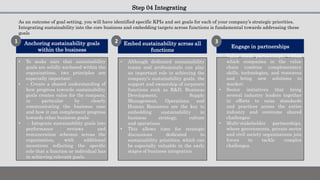
Step 04 Integrating
As an outcome of goal setting, you will have identified specific KPIs and set goals for each of your company’s strategic priorities.
Integrating sustainability into the core business and embedding targets across functions is fundamental towards addressing these
goals
Anchoring sustainability goals
within the business
• To make sure that sustainability
goals are solidly anchored within the
organizations, two principles are
especially important:
• – Create a shared understanding of
how progress towards sustainability
goals creates value for the company,
in particular by clearly
communicating the business case
and how it can complement progress
towards other business goals;
• – Integrate sustainability goals into
performance reviews and
remuneration schemes across the
organization, with additional
incentives reflecting the specific
role that a function or individual has
in achieving relevant goals.
Embed sustainability across all
functions
• Although dedicated sustainability
teams and professionals can play
an important role in achieving the
company’s sustainability goals, the
support and ownership of corporate
functions such as R&D, Business
Development, Supply
Management, Operations and
Human Resources are the key to
embedding sustainability in
business strategy, culture
and operations
• This allows time for strategic
discussions dedicated to
sustainability priorities, which can
be especially valuable in the early
stages of business integration
Engage in partnerships
• Value chain partnerships, within
which companies in the value
chain combine complementary
skills, technologies, and resources
and bring new solutions to
market;
• Sector initiatives that bring
several industry leaders together
in efforts to raise standards
and practices across the entire
industry and overcome shared
challenges;
• Multi-stakeholder partnerships,
where governments, private sector
and civil society organizations join
forces to tackle complex
challenges.
1 2 3
Corporate Initiatives (I/II)
• The Sahara Group is a Nigerian conglomerate with longstanding
experience in the oil and gas sector, and more recently in the wider
energy and infrastructure sector.
• It is made up of 20 operating companies and currently maintains
offices and operations on four continents.
• With the publishing of its first sustainability report in 2014, the Sahara Group reaffirms its commitment to accountability and
sustainability and is working to more closely align its numerous CSR initiatives with the SDGs.
• It sees these initiatives and its wider work towards attaining the SDGs as a “business safety net and trampoline for our core
business and the society at large”.
Sahara Group: Introduction
Light Up Nigeria Challenge
• The Sahara Group, in conjunction with ENACTUS Nigeria, hosts a yearly event to encourage innovation in alternative and
renewable energy resources
• The competition brings together students from tertiary education institutions from around the country who present projects
showcasing alternative energy sources and innovations to help ensure sustainable electricity supply in Nigeria. The 2015
competition, which attracted entries from 28 different schools, involved developing simple models to reduce energy production
costs and encourage the use of alternative energy sources in communities, small businesses and schools. The winning group
then had the opportunity to present their ideas in front of a global audience in South Africa
• This competition provides a national and international platform for young people to present their ideas and empowers them to
make real change in their communities
Corporate Initiatives (II/II)
• Azim Premji Foundation is a not-for profit organisation that has
been working for more than a decade now towards making deep,
large scale and institutionalised impact on the quality and equity of
education in India, along with related development areas.
• The Foundation today works in 8 states which together have more
than 3,50,000 schools
Key aspects of its work are as follows:
Azim Premji Foundation
 Partnering with Government: Azim Premji Foundation works in collaboration with State Governments and engages with
teachers, teacher educators, head teachers, block and cluster level education officials, senior government functionaries and
policy makers at the state and national level.
 State and District Institutes: The Foundation has State Institutes in the capitals of select Indian states and several District
Institutes within these states, each having dedicated teams. The work of the State and District Institute is institutional in
nature, recognising that long term and consistent engagement is necessary for educational change. At many of the District
Institutes, schools have been established for the specific purpose of demonstration. These schools provide quality free
education to the local community, at costs and constraints similar to that of rural government schools.
 Research: In many of the states, the Foundation is engaged in large scale educational research work that will create new
knowledge and also support evidence based policy making.
 Scale and Reach: Over the next few years, the Foundation plans to have about 50 District Institutes, 30 schools and over 4000
employees.
1
• The MDGs were targets mainly for poor countries, to which rich countries were to add their solidarity and assistance through
finances and technology. The SDGs are more inclusive and holistic in nature because of the growing urgency of sustainable
development for the entire world.
2
• SDGs are more collaborative and inclusive than MDGs. Reason being that United Nations has spent considerable amount of
resources and effort in order to bring most of the stakeholders on the table while the formulation of the SDGs
3
• From an Organization Perspective, it is not possible to implement all SDG’s. Hence organizations have to identify feasible goals for
them to implement and sustain on a long term
4
• Relationship between corporates and SDGs is mutually beneficial. The SDGs have vast potential for improving the global business
climate. By encouraging a “solid enabling environment”, they also provide the basis for corporate growth.
5
• While sustainable development goals (SDGs) are universal in character, they need to be adapted to national contexts, according to
specific sets of constraints and opportunities. Hence most member nations have come up with the priority list according to the
conditions specific to their own
6
• Governments worldwide have already agreed to these goals. Now it is time for business to take action. The SDG Compass provides
guidance for companies on how they can align their strategies as well as measure and manage their contribution to the realization
of the SDGs.
Key Learning
Sustainable_Development_Goals.pptx

Sustainable_Development_Goals.pptx

  • 1.
    Corporate Ethics & Governance • AdilHussain 5B • Aniket Kibe 8B • Bharat Daryani 16B • Mehak Gupta 27B • Prince Shaji 32B • Sarthak Chand 38B Section B Group 4: Moving from Millennium Development Goals to Sustainable Development Goals
  • 2.
    Agenda • Bharat Daryani(16B): Overview of MDGs and SDGs • Mehak Gupta (27B): Key differences between MDGs and SDGs with analysis • Sarthak Chand (38B): Role of Governments in formulation of SDGs with current developments • Aniket Kibe (8B): Cross Country analysis on the implementation of SDGs • Prince Shaji (32B): Role of SDGs in the Corporate Governance • Adil Hussain (5B): Corporate case studies Task Allocation
  • 3.
    Millennium Development Goals Introduction •Seriesof 8 time bound targets started in September 2000 by world leaders at United Nations Headquarters •Aim to partner nations with an aim to reduce extreme poverty •Deadline set to 2015 to measure the progress and implementation Achievements •Population of people living in extreme poverty declined by more than half since 1990 •Proportion of undernourished people in developing regions reduced by half •The under-half mortality rate down by 50% and maternal mortality by 45% •Gains in fight against HIV/AIDS, malaria and tuberculosis 8 Goals •Eradicate extreme poverty and Hunger: Reduce half the population living in extreme poverty •Achieve Universal Primary education: To expand primary education enrolment. Out of school children have fallen considerably since 1990 •Promote gender equality and empower women: Women and girls’ equality in education, employment and political representation •Reduce child mortality: Substantial progress has been made but still 16,000 children under-5 continue to die mostly from preventable causes •Improve maternal health: Southern and Eastern Asia have made greatest progress in reducing maternal mortality •Combat HIV/AIDS, Malaria and other Diseases: Burden of malaria and tuberculosis has declined significantly •Ensure Environmental Sustainability: Net loss of forest area has slowed in recent years. Ozone depleting substances have been eliminated •Develop a Global Partnership for Development: Official development assistance to least developed countries
  • 4.
    Sustainable Development Goals(1/2) Introduction •17 targets setting the 2030 Agenda for Sustainable Development •Build on the MDGs and complete what these did not achieve •Seek to realize the human rights of all and to achieve Gender Equality and empowerment of all women and girls •Stimulate action over next fifteen years in areas of critical importance like people, planet, prosperity, peace, partnership •No Poverty: End Poverty in all its forms everywhere •Zero Hunger: End Hunger, achieve food security and improved nutrition and promote sustainable agriculture •Good Health and Well Being: Ensuring healthy lives and promote well being for all at all ages •Quality Education: Ensuring inclusive and equitable quality education and promote lifelong learning opportunities for all •Gender Equality: Empower all women and girls •Clean Water and Sanitation: Ensure sanitation for all and sustainable management of water •Affordable and Clean Energy: Ensure access to affordable, reliable, sustainable and modern energy for all •Decent work and Economic Growth: Promote sustained, inclusive, and sustainable economic growth, full and productive employment and decent work for all
  • 5.
    Sustainable Development Goals(2/2) •Industry, Innovation and Infrastructure: Build resilient infrastructure, promote inclusive and sustainable industrialization and foster innovation •Reduced Inequalities: Within and Among countries •Sustainable Cities and Communities: Make cities and human settlements inclusive, safe, resilient and sustainable •Responsible Consumption and Production: Ensure sustainable patterns •Climate Action: Urgent action to combat Climate Change and its impacts •Life Below Water: Conserve and sustainably use the oceans, seas and marine resources for sustainable development •Life on Land: Protect, restore and promote sustainable use of terrestrial ecosystem, sustainably manage forests, combat desertification and halt and reverse land degradation and halt biodiversity loss •Peace, justice and Strong Institutions: Peaceful and inclusive societies for sustainable development, access to justice for all and build affective, accountable and inclusive institutions at all levels •Partnerships for the goals: Strengthen the means of implementation and revitalize the global partnership for sustainable development
  • 6.
    Differences between MDGsand SDGs MDGs aimed at reaching halfway through issues. SDGs for full implementation Hunger & Poverty were lumped together in MDGs but SDGs distinguish poverty and nutrition MDGs ignored 3 pillars: empowering women, mobilizing everyone and partnering with local government. SDGs address these 3 critical elements SDGs are more comprehensive covering 17 focus areas. adding issues like peace, stability, human rights etc. Complexity of SDGs is not fully represented by MDGs MDGs focused on rich donors aiding poor recipients. However the majority of poor now live in middle income countries Hence, inequality is the issue which is addressed by SDGs, makes them more universal Inclusion of peace building was ignored in MDGs but included in SDGs MDGs envisioned to be funded by aids but SDGs want countries to improve their revenue generating capabilities MDGs focused on quantity which led to deterioration of quality in some societies. SDGs are 1st attempt to focus on quality of education, learning and role of education in achieving a more humane world MDGs said nothing about monitoring, evaluation and accountability but SDGs target assessing data aggregated by income, gender, race etc by 2020 SDGs have been created by inclusive participatory process with face to face consultations in more than 100 countries MDGs were created through a top-down process
  • 7.
    While the MDGsprovided a focal point for governments – a framework around which they could develop policies and over programs designed to end poverty and improve the lives of poor people – they were too narrow. ROLE OF GOVERNMENTS (1/2) The 8 MDGs failed to consider the root causes of poverty and overlooked gender inequality & holistic nature of development. No mention of human rights or address to economic development. Why do we need another set of goals? A more collaborative effort: Unlike the MDGs, which were drawn up by a group of men in the basement of UN headquarters (or so the legend goes), the UN has conducted the largest consultation programme in its history to gauge opinion on what the SDGs should include. Alongside the open working group discussions, the UN conducted a series of “global conversations”. These included 11 thematic and 83 national consultations, and door-to-door surveys. The UN also launched an online survey for rhe same. The open working group, with representatives from 70 countries was formed. Member state negotiations followed, and the final wording of the goals and targets, and the preamble and declaration that comes with them, were agreed in August 2015.
  • 8.
    ROLE OF GOVERNMENTS(2/2) Are governments happy about the proposed 17 goals? • The majority seem to be, but a handful of member states, including the UK and Japan, aren’t so keen. • Some countries feel that an agenda consisting of 17 goals is too unwieldy to implement or sell to the public, and would prefer a narrower brief. • Some believe the underlying reason is to get rid of some of the more uncomfortable goals, such as those relating to the environment. • Britain’s prime minister, David Cameron, has publicly said he wants 12 goals at the most, preferably 10. • It’s not clear, though, which goals the UK government would like taken out if they had the choice. And now… the World is TRUMPed!! “Promised to abolish the Environmental Protection Agency (EPA), whose responsibility for regulating CO2 emissions was confirmed by the US Supreme Court a decade ago.” “the concept of global warming was created by and for the Chinese in order to make US manufacturing non- competitive” "Where do you ever see the United Nations? Do they ever settle anything? It's ridiculous - I mean the money we spend on the United Nations."
  • 9.
    CASE OF EUROPEANUNION The Europe 2020 Strategy (EU SDS) Adopted in 2010, the Europe 2020 Strategy ‘A strategy for smart, sustainable and inclusive growth’ outlines three “mutually reinforcing priorities” (EC, 2010, p.3)18 for the EU: 1. Smart growth: developing an economy based on knowledge and innovation 2. Sustainable growth: promoting a more resource efficient, greener and more competitive economy 3. Inclusive growth: fostering a high-employment economy delivering social and territorial cohesion. Although they are not exhaustive, five EU headline targets are to be achieved by 2020: I. 75% of the population aged 20-64 should be employed; II. 3% of the EU's GDP should be invested in R&D; III. The "20/20/20" climate and energy targets should be met (including an increase to 30% of emissions reduction if the conditions are right); IV. The share of early school leavers should be under 10% and at least 40% of the younger generation should have a tertiary degree; V. 20 million less people should be at risk of poverty. The EU headline targets are then translated into national Europe 2020 targets that reflect the different national situations and circumstances. Four key priority challenges Climate change and clean energy Sustainable consumption & production Conservation and management of natural resources Global poverty and sustainable develpmnt challenges
  • 10.
    CASE OF INDIA Speakingat the United Nations Sustainable Development Summit in New York last year, Prime Minister Modi expressed the Indian government’s commitment to SDGs Elected nearly a year ago on the agenda of “sab ka saath, sab ka vikas” or “development with all, and for all,” Prime Minister Modi and his government have been quick to stress the convergence between the SDGs and the country’s national development goals. India will play a leading role in determining the relative success or failure of the SDGs. Challenges for India in attaining SDGs Defining Indicators: • We have been not very successful in setting relevant indicators to measure outcomes. • India’s myopic definition of “safe” drinking water (with hand pumps and tube wells considered as safe as piped water supply) means that official data suggests 86% of Indians have access to safe drinking water. Financing SDGs: • A new study estimates that implementing SDGs in India by 2030 will cost around US$14.4 billion. • Given the recent cut in social sector schemes by the Union government, unless states devote a significant portion of their resources on the social sector, there is likely to be a significant funding gap. Monitoring and Ownership: • Relatedly, a third significant challenge is going to be with respect to ownership. • Reports suggest that NITI Aayog will play a significant role in tracking progress. However, members at the Aayog have expressed reservations on being able to take on this mammoth task. Measuring Progress: • Lastly but most importantly is the question of measuring progress or achievement. • By the government’s own admission, non-availability of data, periodicity issues and incomplete coverage of administrative data, made accurate measuring progress of even MDGs virtually impossible.
  • 11.
    The Sustainable DevelopmentGoals (SDGs) define global sustainable development priorities and aspirations for 2030 and seek to mobilize global efforts around a common set of goals and targets. The SDGs call for worldwide action among governments, business and civil society to end poverty and create a life of dignity and opportunity for all, within the boundaries of the planet Why do the SDGs matter for business? Difference between MDGs and SDGs for Businesses o Unlike their predecessor, the Millennium Development Goals, the SDGs explicitly call on all businesses to apply their creativity and innovation to solve sustainable development challenges. o The SDGs have been agreed by all governments, yet their success relies heavily on action and collaboration by all actors. o As the SDGs form the global agenda for the development of our societies, they will allow leading companies to demonstrate how their business helps to advance sustainable development, both by minimizing negative impacts and maximizing positive impacts on people and the planet. “Business is a vital partner in achieving the Sustainable Development Goals. Companies can contribute through their core activities, and we ask companies everywhere to assess their impact, set ambitious goals and communicate transparently about the results.” Ban Ki-moon, United Nations Secretary-General
  • 12.
    Step-01 Understanding theSDGs Covering a wide spectrum of sustainable development topics relevant to companies – such as poverty, health, education, climate change and environmental degradation – the SDGs can help to connect business strategies with global priorities. Companies can use the SDGs as an overarching framework to shape, steer, communicate and report their strategies, goals and activities, allowing them to capitalize on a range of benefits such as: Identifying future business opportunities: The SDGs aim to redirect global public and private investment flows towards the challenges they represent. In doing so they define growing markets for companies that can deliver innovative solutions and transformative change Enhancing the value of corporate sustainability: Whilst the business case for corporate sustainability is already well established, the SDGs may for example strengthen the economic incentives for companies to use resources more efficiently, or to switch to more sustainable alternatives, as externalities become increasingly internalized Strengthening stakeholder relations and keeping the pace with policy developments: The SDGs reflect stakeholder expectations as well as future policy direction at the international, national and regional levels. Companies that align their priorities with the SDGs can strengthen engagement of customers, employees and other stakeholders, and those that don’t will be exposed to growing legal and reputational risks Using a common language and shared purpose: The SDGs define a common framework of action and language that will help companies communicate more consistently and effectively with stakeholders about their impact and performance. The goals will help bring together synergistic partners to address the world’s most urgent societal challenges Stabilizing societies and markets: Business cannot succeed in societies that fail. Investing in the achievement of the SDGs supports pillars of business success, including the existence of rules-based markets, transparent financial systems, and non-corrupt and well-governed institutions
  • 13.
    Step 02 Definingpriorities o To benefit from the opportunities and challenges presented by the SDGs, defining where your company’s priorities are will help you to focus your efforts. o Not all 17 SDGs will be equally relevant for your company. The extent to which your company can contribute to each, and the risks and opportunities they individually represent, will depend on many factors.
  • 14.
    Step 03 Settinggoals Goal setting builds directly on the outcomes from the impact assessment and prioritization covered in step 02, and is essential to driving good performance • Setting specific, measurable and time-bound sustainability goals helps foster shared priorities and drive performance across the organization, and is becoming increasingly widespread. • By aligning with the SDGs, companies can set more meaningful goals and communicate more effectively about its commitment to sustainable development. Define scope of goals and select KPIs • It is recommended that the scope of your company’s sustainability goals is guided by the strategic priorities identified in step 02 • This will ensure that your company’s goals will include opportunities to make positive contributions to the SDGs as well as to reduce current and potential negative impacts. • Similarly, this will ensure the goals not only cover your company’s own operations but also create opportunities to make improvements across the entire value chain Define baseline and select goal type • It is important to define the baseline for each goal - A particular point in time: For example, there might be a goal to increase the number of women on the Board of Directors by 40% at the end of 2020 relative to the baseline defined at the end of 2013 - A particular period of time: For example, your company could set a goal to decrease average water usage in the three-year period from 2018– 2020 by 50% compared to the average water usage across 2006–2008, thereby eliminating the impacts that short-term variability may have - Absolute goals, which take only the KPI into account: for example, reduce the number of health and safety related incidents by 30% by 2020 from 2015; – Relative (also called intensity) goals, which compare the KPI to a unit of output: for example, reduce Scope 1 greenhouse gas emissions per unit of company sales by 25% by 2018 from 2014
  • 15.
    Step 04 Integrating Asan outcome of goal setting, you will have identified specific KPIs and set goals for each of your company’s strategic priorities. Integrating sustainability into the core business and embedding targets across functions is fundamental towards addressing these goals Anchoring sustainability goals within the business • To make sure that sustainability goals are solidly anchored within the organizations, two principles are especially important: • – Create a shared understanding of how progress towards sustainability goals creates value for the company, in particular by clearly communicating the business case and how it can complement progress towards other business goals; • – Integrate sustainability goals into performance reviews and remuneration schemes across the organization, with additional incentives reflecting the specific role that a function or individual has in achieving relevant goals. Embed sustainability across all functions • Although dedicated sustainability teams and professionals can play an important role in achieving the company’s sustainability goals, the support and ownership of corporate functions such as R&D, Business Development, Supply Management, Operations and Human Resources are the key to embedding sustainability in business strategy, culture and operations • This allows time for strategic discussions dedicated to sustainability priorities, which can be especially valuable in the early stages of business integration Engage in partnerships • Value chain partnerships, within which companies in the value chain combine complementary skills, technologies, and resources and bring new solutions to market; • Sector initiatives that bring several industry leaders together in efforts to raise standards and practices across the entire industry and overcome shared challenges; • Multi-stakeholder partnerships, where governments, private sector and civil society organizations join forces to tackle complex challenges. 1 2 3
  • 16.
    Corporate Initiatives (I/II) •The Sahara Group is a Nigerian conglomerate with longstanding experience in the oil and gas sector, and more recently in the wider energy and infrastructure sector. • It is made up of 20 operating companies and currently maintains offices and operations on four continents. • With the publishing of its first sustainability report in 2014, the Sahara Group reaffirms its commitment to accountability and sustainability and is working to more closely align its numerous CSR initiatives with the SDGs. • It sees these initiatives and its wider work towards attaining the SDGs as a “business safety net and trampoline for our core business and the society at large”. Sahara Group: Introduction Light Up Nigeria Challenge • The Sahara Group, in conjunction with ENACTUS Nigeria, hosts a yearly event to encourage innovation in alternative and renewable energy resources • The competition brings together students from tertiary education institutions from around the country who present projects showcasing alternative energy sources and innovations to help ensure sustainable electricity supply in Nigeria. The 2015 competition, which attracted entries from 28 different schools, involved developing simple models to reduce energy production costs and encourage the use of alternative energy sources in communities, small businesses and schools. The winning group then had the opportunity to present their ideas in front of a global audience in South Africa • This competition provides a national and international platform for young people to present their ideas and empowers them to make real change in their communities
  • 17.
    Corporate Initiatives (II/II) •Azim Premji Foundation is a not-for profit organisation that has been working for more than a decade now towards making deep, large scale and institutionalised impact on the quality and equity of education in India, along with related development areas. • The Foundation today works in 8 states which together have more than 3,50,000 schools Key aspects of its work are as follows: Azim Premji Foundation  Partnering with Government: Azim Premji Foundation works in collaboration with State Governments and engages with teachers, teacher educators, head teachers, block and cluster level education officials, senior government functionaries and policy makers at the state and national level.  State and District Institutes: The Foundation has State Institutes in the capitals of select Indian states and several District Institutes within these states, each having dedicated teams. The work of the State and District Institute is institutional in nature, recognising that long term and consistent engagement is necessary for educational change. At many of the District Institutes, schools have been established for the specific purpose of demonstration. These schools provide quality free education to the local community, at costs and constraints similar to that of rural government schools.  Research: In many of the states, the Foundation is engaged in large scale educational research work that will create new knowledge and also support evidence based policy making.  Scale and Reach: Over the next few years, the Foundation plans to have about 50 District Institutes, 30 schools and over 4000 employees.
  • 18.
    1 • The MDGswere targets mainly for poor countries, to which rich countries were to add their solidarity and assistance through finances and technology. The SDGs are more inclusive and holistic in nature because of the growing urgency of sustainable development for the entire world. 2 • SDGs are more collaborative and inclusive than MDGs. Reason being that United Nations has spent considerable amount of resources and effort in order to bring most of the stakeholders on the table while the formulation of the SDGs 3 • From an Organization Perspective, it is not possible to implement all SDG’s. Hence organizations have to identify feasible goals for them to implement and sustain on a long term 4 • Relationship between corporates and SDGs is mutually beneficial. The SDGs have vast potential for improving the global business climate. By encouraging a “solid enabling environment”, they also provide the basis for corporate growth. 5 • While sustainable development goals (SDGs) are universal in character, they need to be adapted to national contexts, according to specific sets of constraints and opportunities. Hence most member nations have come up with the priority list according to the conditions specific to their own 6 • Governments worldwide have already agreed to these goals. Now it is time for business to take action. The SDG Compass provides guidance for companies on how they can align their strategies as well as measure and manage their contribution to the realization of the SDGs. Key Learning