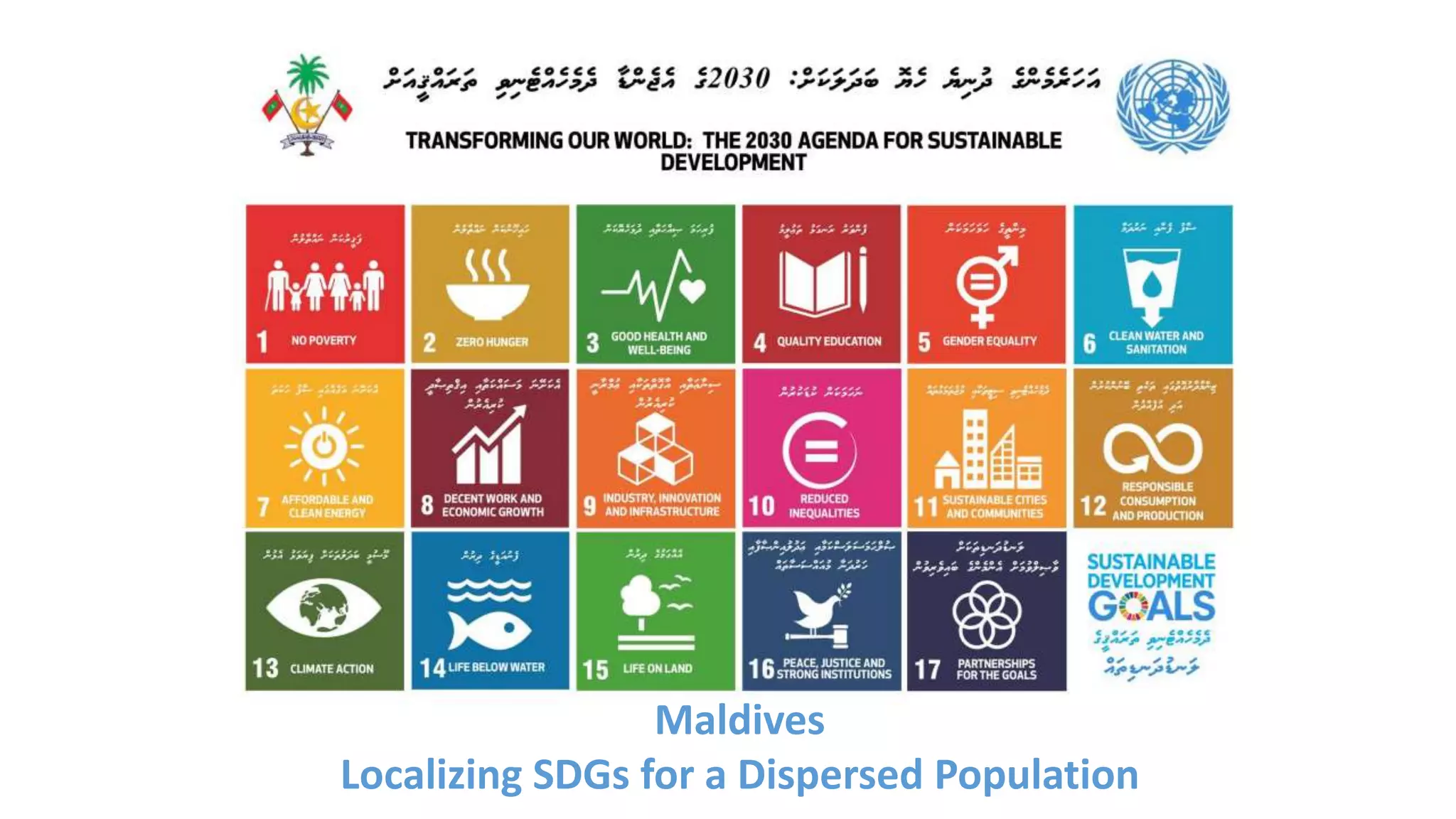
Maldives
Localizing SDGs for a Dispersed Population
Maldives
• Approximately 1,190 island
• 26 ring-like atolls
• Spreads across 90,000 square
kilometres
• The total population is approximately
400,000, including over 59,000
migrant workers
• Average ground-level elevation of 1.5
meters
• 116 of 188 administrative islands have
populations of below 1000
• 3 Islands with population above
10,000
Regional Inequalities
Regional inequalities
• Factors contributing to falling into
poverty:
• Proportion of household members not
working due to bad health
• Number of young household members
• Living in the northern regions
Regional inequalities – access to health
services
Regional inequalities – education and
employment opportunities
The Main Challenge for Localization
Maldives has no Long Term Plan Development, a Medium Term Development Plan
nor a Strategic Action Plan for the country
The country is dependent on Political Party Manifestos
Two Key Partnerships for localization
1. Local Councils or Municipalities
2. Civil Society
Subnational Level Planning
The constitution of Maldives states that the administrative divisions of the
Maldives shall be administered decentrally
The decentralization act of the stipulates that every local is expected to develop a
five year development plan, based on the National Development Plan
New Local Planning Methodology
• In 2016, a new planning methodology for local councils was
developed
• The planning process identifies the role of island councils in planning
and managing mitigation, resilience and adaptation.
• It proposed a participatory and inclusive approach and the
importance of involving all the relevant stakeholders, as well as
women’s role in Island development and enabling their participation
in the planning process.
New Local Planning Methodology
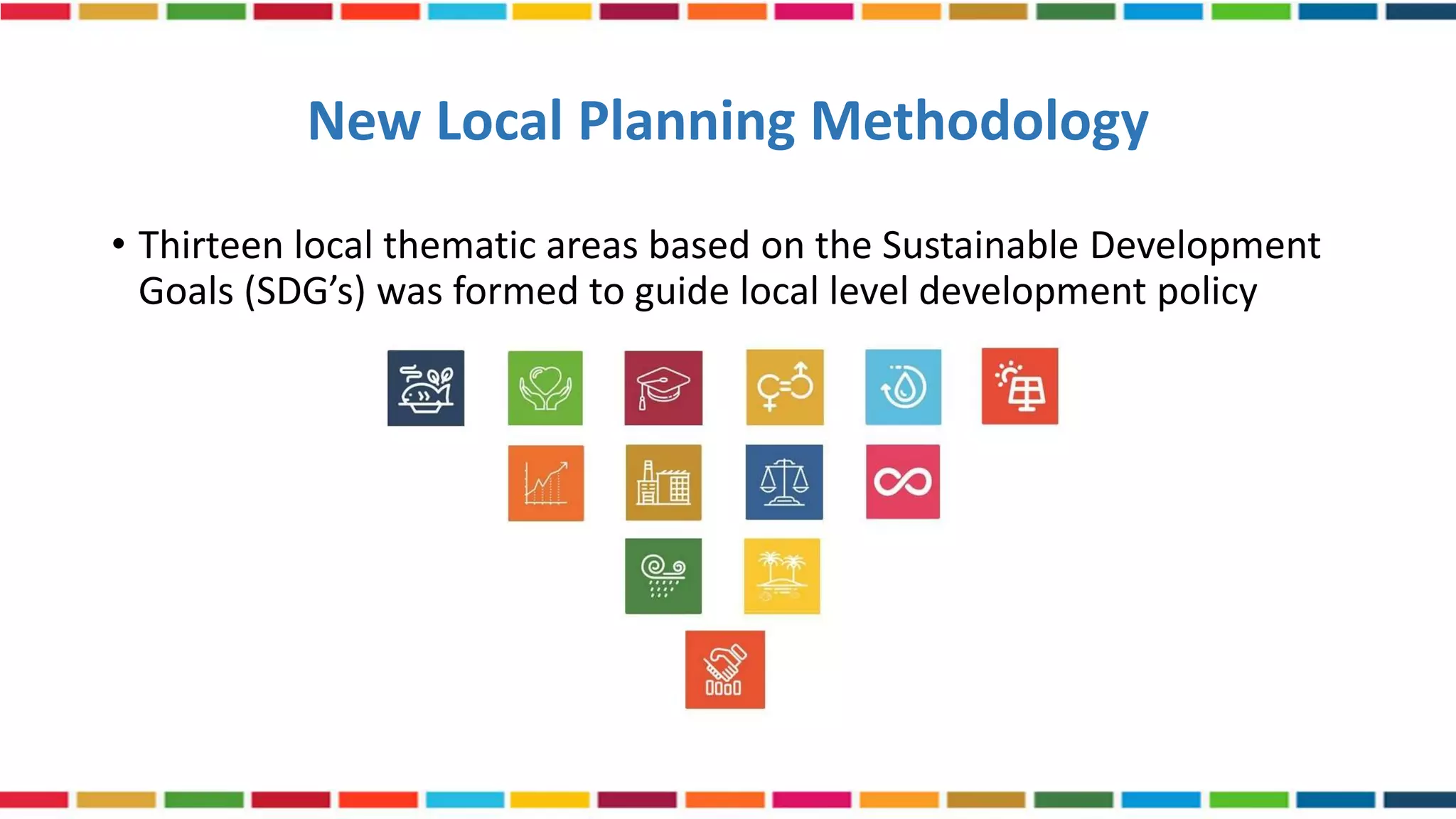
• Thirteen local thematic areas based on the Sustainable Development
Goals (SDG’s) was formed to guide local level development policy
Local Planning Methodology
1. Self Sufficiency and Food Security
2. Good Health and Wellbeing
3. Quality Education and Vocational Skills
4. Gender Equality
5. Clean water, sanitation and people centered habitat
6. Electricity and Clean Energy
7. Increasing Jobs and achieving Economic Growth
8. Industry and Infrastructure
9. Peace and Equality
10. Resource mapping and responsible production
11. Disaster Risk Reduction
12. Land and Marine Resources
13. Partnership for Results
Engaging the Grassroots
1. There are over 1000 registered
Civil Society Organizations across
the country
2. Nearly 300 are active
3. Every Single Island has an
organization based in the island
The Government of Maldives has
taken the initiative to develop a
platform to engage Civil Society
Organization in the Implementation
of the SDGs
Engaging the Grassroots
Through this engagement;
• Island specific initiatives based on goals
are being identified
• Island specific challenges related to goals
are being identified
• Community input from individual islands
are being provided for the national
prioritization process
In the future it is envisioned that this
engagement and partnership will allow
for the development of island specific
set of indicators to help identify, and
bring attention to, the issues that are
most pressing in the local context
Data Revolution
• The Geographical Setting makes data collection costly
• Maldives has one of the highest teledensity rate in the world standing
at 249%
• The whole country has 3G coverage
• Government with development partners are exploring ways to use ICT
to reduce cost and improve accuracy of data collection from remote
islands

Localizing SDGs for a Dispersed Population

  • 1.
    Maldives Localizing SDGs fora Dispersed Population
  • 2.
    Maldives • Approximately 1,190island • 26 ring-like atolls • Spreads across 90,000 square kilometres • The total population is approximately 400,000, including over 59,000 migrant workers • Average ground-level elevation of 1.5 meters • 116 of 188 administrative islands have populations of below 1000 • 3 Islands with population above 10,000
  • 3.
  • 4.
    Regional inequalities • Factorscontributing to falling into poverty: • Proportion of household members not working due to bad health • Number of young household members • Living in the northern regions
  • 5.
    Regional inequalities –access to health services
  • 6.
    Regional inequalities –education and employment opportunities
  • 7.
    The Main Challengefor Localization Maldives has no Long Term Plan Development, a Medium Term Development Plan nor a Strategic Action Plan for the country The country is dependent on Political Party Manifestos
  • 8.
    Two Key Partnershipsfor localization 1. Local Councils or Municipalities 2. Civil Society
  • 9.
    Subnational Level Planning Theconstitution of Maldives states that the administrative divisions of the Maldives shall be administered decentrally The decentralization act of the stipulates that every local is expected to develop a five year development plan, based on the National Development Plan
  • 10.
    New Local PlanningMethodology • In 2016, a new planning methodology for local councils was developed • The planning process identifies the role of island councils in planning and managing mitigation, resilience and adaptation. • It proposed a participatory and inclusive approach and the importance of involving all the relevant stakeholders, as well as women’s role in Island development and enabling their participation in the planning process.
  • 11.
    New Local PlanningMethodology • Thirteen local thematic areas based on the Sustainable Development Goals (SDG’s) was formed to guide local level development policy
  • 12.
    Local Planning Methodology 1.Self Sufficiency and Food Security 2. Good Health and Wellbeing 3. Quality Education and Vocational Skills 4. Gender Equality 5. Clean water, sanitation and people centered habitat 6. Electricity and Clean Energy 7. Increasing Jobs and achieving Economic Growth 8. Industry and Infrastructure 9. Peace and Equality 10. Resource mapping and responsible production 11. Disaster Risk Reduction 12. Land and Marine Resources 13. Partnership for Results
  • 13.
    Engaging the Grassroots 1.There are over 1000 registered Civil Society Organizations across the country 2. Nearly 300 are active 3. Every Single Island has an organization based in the island The Government of Maldives has taken the initiative to develop a platform to engage Civil Society Organization in the Implementation of the SDGs
  • 14.
    Engaging the Grassroots Throughthis engagement; • Island specific initiatives based on goals are being identified • Island specific challenges related to goals are being identified • Community input from individual islands are being provided for the national prioritization process In the future it is envisioned that this engagement and partnership will allow for the development of island specific set of indicators to help identify, and bring attention to, the issues that are most pressing in the local context
  • 15.
    Data Revolution • TheGeographical Setting makes data collection costly • Maldives has one of the highest teledensity rate in the world standing at 249% • The whole country has 3G coverage • Government with development partners are exploring ways to use ICT to reduce cost and improve accuracy of data collection from remote islands

Editor's Notes

  • #6 Kulhudhuffushi hospital caters to Haa alif, Haa dhal and shaviyani atoll, if seen as one atoll it could be the largest atoll in temrs of length in the whole world. For a hospital this level, it doesn’t provide services that are necessary. Sometimes gynecologists and other specialists are not around.
  • #7 For instance, a person living in Malé is likely to complete three years more of schooling than someone living in the atolls, and the average income of a person living in Malé is nearly twice as high as that of a person living in the atolls.