


IWRM
Integrated Water Resources Management
(IWRM) is defined as a process which promotes
the coordinated development and management
of water, land and related resources in order to
maximize economic and social welfare in an
equitable manner without compromising the
sustainability of vital ecosystems.
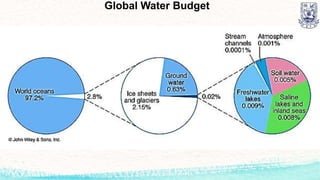
Global Water Budget
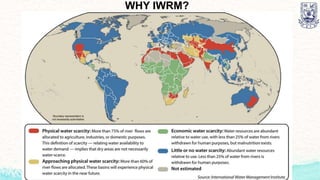
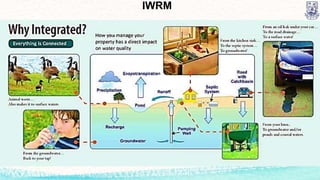
WHY IWRM?
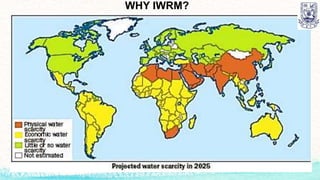
WHY IWRM?
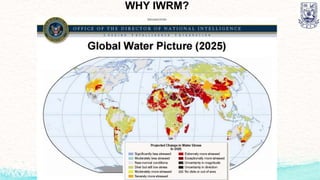
WHY IWRM?
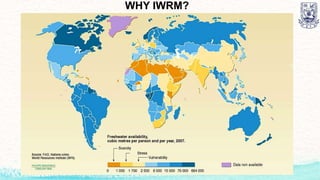
WHY IWRM?
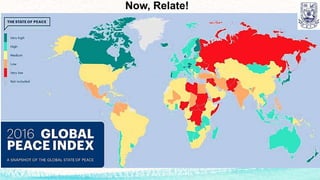
Now, Relate!
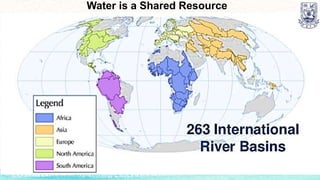
Water is a Shared Resource
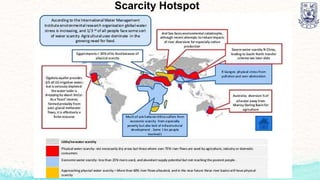
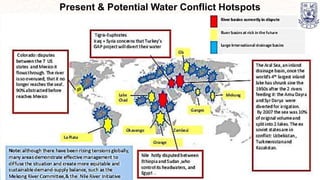
Scarcity Hotspot
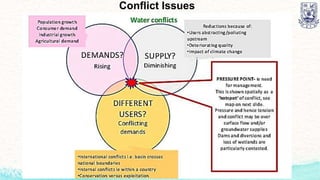
Conflict Issues
Present & Potential Water Conflict Hotspots
IWRM
IWRM Principles
The IWRM principles adopted at the International Conference on Water
and the Environment in Dublin, Ireland, in 1992, are known as the Dublin
Principles:
 Fresh water is a finite and vulnerable resource, essential to sustain life,
development and the environment
 Water development and management should be based on a participatory
approach, involving users, planners and policy-makers at all levels
 Women play a central part in the provision, management and safeguarding of
water
 Water has an economic value in all its competing uses and should be
recognized as an economic good
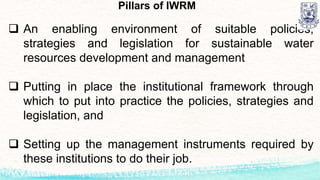
Pillars of IWRM
 An enabling environment of suitable policies,
strategies and legislation for sustainable water
resources development and management
 Putting in place the institutional framework through
which to put into practice the policies, strategies and
legislation, and
 Setting up the management instruments required by
these institutions to do their job.
IWRM
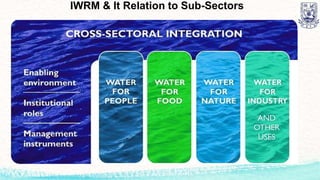
IWRM & It Relation to Sub-Sectors
Add a Slide Title - 1
Add a Slide Title
- 4
Add a Slide Title
- 5

Integrated Water Resource Management

  • 2.
    IWRM Integrated Water ResourcesManagement (IWRM) is defined as a process which promotes the coordinated development and management of water, land and related resources in order to maximize economic and social welfare in an equitable manner without compromising the sustainability of vital ecosystems.
  • 3.
  • 4.
  • 5.
  • 6.
  • 7.
  • 8.
  • 9.
    Water is aShared Resource
  • 10.
  • 11.
  • 12.
    Present & PotentialWater Conflict Hotspots
  • 13.
  • 14.
    IWRM Principles The IWRMprinciples adopted at the International Conference on Water and the Environment in Dublin, Ireland, in 1992, are known as the Dublin Principles:  Fresh water is a finite and vulnerable resource, essential to sustain life, development and the environment  Water development and management should be based on a participatory approach, involving users, planners and policy-makers at all levels  Women play a central part in the provision, management and safeguarding of water  Water has an economic value in all its competing uses and should be recognized as an economic good
  • 15.
    Pillars of IWRM An enabling environment of suitable policies, strategies and legislation for sustainable water resources development and management  Putting in place the institutional framework through which to put into practice the policies, strategies and legislation, and  Setting up the management instruments required by these institutions to do their job.
  • 16.
  • 17.
    IWRM & ItRelation to Sub-Sectors
  • 19.
    Add a SlideTitle - 1
  • 20.
    Add a SlideTitle - 4
  • 21.
    Add a SlideTitle - 5

Editor's Notes

  • #13 As water supply decreases, tensions will increase as different players try to access common water supplies Many conflicts are transboundary in nature, either between states or countries
  • #15 Summation of Principle: Integrated water resources management is based on the equitable and efficient management and sustainable use of water and recognises that water is an integral part of the ecosystem, a natural resource, and a social and economic good, whose quantity and quality determine the nature of its utilisation.
  • #16 Summation of Principle: Integrated water resources management is based on the equitable and efficient management and sustainable use of water and recognises that water is an integral part of the ecosystem, a natural resource, and a social and economic good, whose quantity and quality determine the nature of its utilisation.
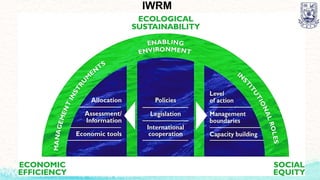
  • #17 This emphasizes the importance of an integrated approach as well as clearly articulating the link between water resources management and the “3Es” of sustainable development: economic efficiency in water use, social equity, and environmental and ecological sustainability.