Kewal Prasad Bhandari
October 3, 2017
Manila, Philippines
Budget and Program Division
Ministry of Finance
Nepal
A Nepali Experiences
Climate Change Financing Framework
(CCFF)
Evolution of Governance of Climate Finance in Nepal
2010
2011
2012
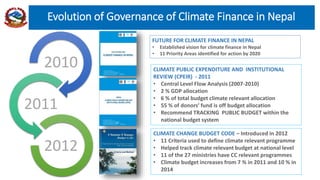
FUTURE FOR CLIMATE FINANCE IN NEPAL
• Established vision for climate finance in Nepal
• 11 Priority Areas identified for action by 2020
CLIMATE PUBLIC EXPENDITURE AND INSTITUTIONAL
REVIEW (CPEIR) - 2011
• Central Level Flow Analysis (2007-2010)
• 2 % GDP allocation
• 6 % of total budget climate relevant allocation
• 55 % of donors’ fund is off budget allocation
• Recommend TRACKING PUBLIC BUDGET within the
national budget system
CLIMATE CHANGE BUDGET CODE – Introduced in 2012
• 11 Criteria used to define climate relevant programme
• Helped track climate relevant budget at national level
• 11 of the 27 ministries have CC relevant programmes
• Climate budget increases from 7 % in 2011 and 10 % in
2014
Evolution of Governance of Climate Finance in Nepal
2014
2016
2017
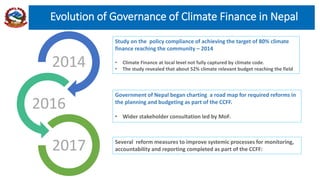
Study on the policy compliance of achieving the target of 80% climate
finance reaching the community – 2014
• Climate Finance at local level not fully captured by climate code.
• The study revealed that about 52% climate relevant budget reaching the field
Government of Nepal began charting a road map for required reforms in
the planning and budgeting as part of the CCFF.
• Wider stakeholder consultation led by MoF.
Several reform measures to improve systemic processes for monitoring,
accountability and reporting completed as part of the CCFF:
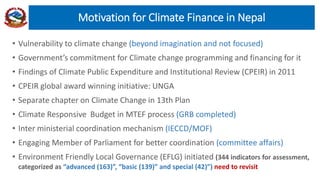
• Vulnerability to climate change (beyond imagination and not focused)
• Government’s commitment for Climate change programming and financing for it
• Findings of Climate Public Expenditure and Institutional Review (CPEIR) in 2011
• CPEIR global award winning initiative: UNGA
• Separate chapter on Climate Change in 13th Plan
• Climate Responsive Budget in MTEF process (GRB completed)
• Inter ministerial coordination mechanism (IECCD/MOF)
• Engaging Member of Parliament for better coordination (committee affairs)
• Environment Friendly Local Governance (EFLG) initiated (344 indicators for assessment,
categorized as “advanced (163)”, “basic (139)” and special (42)”) need to revisit
Motivation for Climate Finance in Nepal
• By establishing tools for insuring funds can be targeted better to reach the
most local vulnerable population groups. (priority under CC policy)
• By improving climate finance readiness through strengthening existing
finance management structures to manage external funds through country
systems (all sectors) ; and
• By improving effectiveness by existing climate finance through reforms to
planning and budgeting guidelines and other tools for more informed
decision making. (more focus on Sub National transfer)
Addressing Policy Challenges for Climate Finance
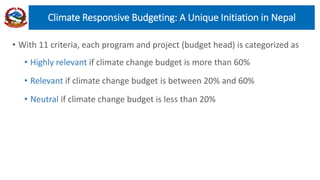
• With 11 criteria, each program and project (budget head) is categorized as
• Highly relevant if climate change budget is more than 60%
• Relevant if climate change budget is between 20% and 60%
• Neutral if climate change budget is less than 20%
Climate Responsive Budgeting: A Unique Initiation in Nepal
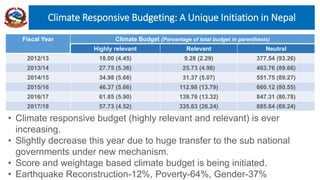
Fiscal Year Climate Budget (Percentage of total budget in parenthesis)
Highly relevant Relevant Neutral
2012/13 18.00 (4.45) 9.28 (2.29) 377.54 (93.26)
2013/14 27.75 (5.36) 25.73 (4.98) 463.76 (89.66)
2014/15 34.98 (5.66) 31.37 (5.07) 551.75 (89.27)
2015/16 46.37 (5.66) 112.98 (13.79) 660.12 (80.55)
2016/17 61.85 (5.90) 139.76 (13.32) 847.31 (80.78)
2017/18 57.73 (4.52) 335.63 (26.24) 885.64 (69.24)
• Climate responsive budget (highly relevant and relevant) is ever
increasing.
• Slightly decrease this year due to huge transfer to the sub national
governments under new mechanism.
• Score and weightage based climate budget is being initiated.
• Earthquake Reconstruction-12%, Poverty-64%, Gender-37%
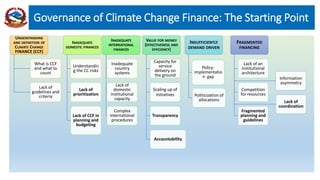
Governance of Climate Change Finance: The Starting Point
UNDERSTANDING
AND DEFINITION OF
CLIMATE CHANGE
FINANCE (CCF)
What is CCF
and what to
count
Lack of
guidelines and
criteria
INADEQUATE
DOMESTIC FINANCES
Understandin
g the CC risks
Lack of
prioritization
Lack of CCF in
planning and
budgeting
INADEQUATE
INTERNATIONAL
FINANCES
Inadequate
country
systems
Lack of
domestic
institutional
capacity
Complex
international
procedures
VALUE FOR MONEY
(EFFECTIVENESS AND
EFFICIENCY)
Capacity for
service
delivery on
the ground
Scaling up of
initiatives
Transparency
Accountability
INSUFFICIENTLY
DEMAND DRIVEN
Policy-
implementatio
n gap
Politicization of
allocations
FRAGMENTED
FINANCING
Lack of an
institutional
architecture
Competition
for resources
Fragmented
planning and
guidelines
Lack of
coordination
Information
asymmetry
Climate
Change
Financing
Framework
Expenditure
Reporting and
Analyzing
Medium Term
Expenditure
Framework
(MTEF)
Reform
Roadmap
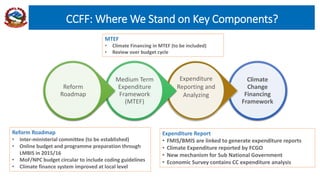
CCFF: Where We Stand on Key Components?
Reform Roadmap
• Inter-ministerial committee (to be established)
• Online budget and programme preparation through
LMBIS in 2015/16
• MoF/NPC budget circular to include coding guidelines
• Climate finance system improved at local level
MTEF
• Climate Financing in MTEF (to be included)
• Review over budget cycle
Expenditure Report
• FMIS/BMIS are linked to generate expenditure reports
• Climate Expenditure reported by FCGO
• New mechanism for Sub National Government
• Economic Survey contains CC expenditure analysis
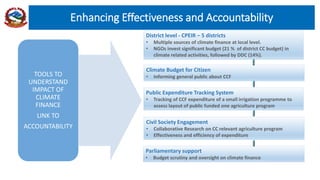
Enhancing Effectiveness and Accountability
District level - CPEIR – 5 districts
• Multiple sources of climate finance at local level.
• NGOs invest significant budget (21 % of district CC budget) in
climate related activities, followed by DDC (14%).
Public Expenditure Tracking System
• Tracking of CCF expenditure of a small irrigation programme to
assess layout of public funded one agriculture program
Parliamentary support
• Budget scrutiny and oversight on climate finance
Civil Society Engagement
• Collaborative Research on CC relevant agriculture program
• Effectiveness and efficiency of expenditure
Climate Budget for Citizen
• Informing general public about CCFTOOLS TO
UNDERSTAND
IMPACT OF
CLIMATE
FINANCE
LINK TO
ACCOUNTABILITY
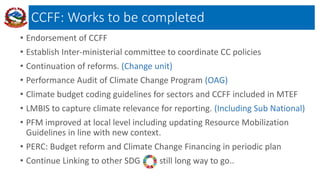
CCFF: Works to be completed
• Endorsement of CCFF
• Establish Inter-ministerial committee to coordinate CC policies
• Continuation of reforms. (Change unit)
• Performance Audit of Climate Change Program (OAG)
• Climate budget coding guidelines for sectors and CCFF included in MTEF
• LMBIS to capture climate relevance for reporting. (Including Sub National)
• PFM improved at local level including updating Resource Mobilization
Guidelines in line with new context.
• PERC: Budget reform and Climate Change Financing in periodic plan
• Continue Linking to other SDG still long way to go..
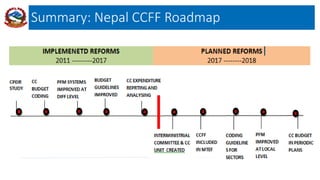
Summary: Nepal CCFF Roadmap
kbhandari@mof.gov.np
Budget and Program Division
Ministry of Finance
Nepal
THANK YOU

Developing a Climate Responsive Budget: Lessons from Nepal

  • 1.
    Kewal Prasad Bhandari October3, 2017 Manila, Philippines Budget and Program Division Ministry of Finance Nepal A Nepali Experiences Climate Change Financing Framework (CCFF)
  • 2.
    Evolution of Governanceof Climate Finance in Nepal 2010 2011 2012 FUTURE FOR CLIMATE FINANCE IN NEPAL • Established vision for climate finance in Nepal • 11 Priority Areas identified for action by 2020 CLIMATE PUBLIC EXPENDITURE AND INSTITUTIONAL REVIEW (CPEIR) - 2011 • Central Level Flow Analysis (2007-2010) • 2 % GDP allocation • 6 % of total budget climate relevant allocation • 55 % of donors’ fund is off budget allocation • Recommend TRACKING PUBLIC BUDGET within the national budget system CLIMATE CHANGE BUDGET CODE – Introduced in 2012 • 11 Criteria used to define climate relevant programme • Helped track climate relevant budget at national level • 11 of the 27 ministries have CC relevant programmes • Climate budget increases from 7 % in 2011 and 10 % in 2014
  • 3.
    Evolution of Governanceof Climate Finance in Nepal 2014 2016 2017 Study on the policy compliance of achieving the target of 80% climate finance reaching the community – 2014 • Climate Finance at local level not fully captured by climate code. • The study revealed that about 52% climate relevant budget reaching the field Government of Nepal began charting a road map for required reforms in the planning and budgeting as part of the CCFF. • Wider stakeholder consultation led by MoF. Several reform measures to improve systemic processes for monitoring, accountability and reporting completed as part of the CCFF:
  • 4.
    • Vulnerability toclimate change (beyond imagination and not focused) • Government’s commitment for Climate change programming and financing for it • Findings of Climate Public Expenditure and Institutional Review (CPEIR) in 2011 • CPEIR global award winning initiative: UNGA • Separate chapter on Climate Change in 13th Plan • Climate Responsive Budget in MTEF process (GRB completed) • Inter ministerial coordination mechanism (IECCD/MOF) • Engaging Member of Parliament for better coordination (committee affairs) • Environment Friendly Local Governance (EFLG) initiated (344 indicators for assessment, categorized as “advanced (163)”, “basic (139)” and special (42)”) need to revisit Motivation for Climate Finance in Nepal
  • 5.
    • By establishingtools for insuring funds can be targeted better to reach the most local vulnerable population groups. (priority under CC policy) • By improving climate finance readiness through strengthening existing finance management structures to manage external funds through country systems (all sectors) ; and • By improving effectiveness by existing climate finance through reforms to planning and budgeting guidelines and other tools for more informed decision making. (more focus on Sub National transfer) Addressing Policy Challenges for Climate Finance
  • 6.
    • With 11criteria, each program and project (budget head) is categorized as • Highly relevant if climate change budget is more than 60% • Relevant if climate change budget is between 20% and 60% • Neutral if climate change budget is less than 20% Climate Responsive Budgeting: A Unique Initiation in Nepal
  • 7.
    Climate Responsive Budgeting:A Unique Initiation in Nepal Fiscal Year Climate Budget (Percentage of total budget in parenthesis) Highly relevant Relevant Neutral 2012/13 18.00 (4.45) 9.28 (2.29) 377.54 (93.26) 2013/14 27.75 (5.36) 25.73 (4.98) 463.76 (89.66) 2014/15 34.98 (5.66) 31.37 (5.07) 551.75 (89.27) 2015/16 46.37 (5.66) 112.98 (13.79) 660.12 (80.55) 2016/17 61.85 (5.90) 139.76 (13.32) 847.31 (80.78) 2017/18 57.73 (4.52) 335.63 (26.24) 885.64 (69.24) • Climate responsive budget (highly relevant and relevant) is ever increasing. • Slightly decrease this year due to huge transfer to the sub national governments under new mechanism. • Score and weightage based climate budget is being initiated. • Earthquake Reconstruction-12%, Poverty-64%, Gender-37%
  • 8.
    Governance of ClimateChange Finance: The Starting Point UNDERSTANDING AND DEFINITION OF CLIMATE CHANGE FINANCE (CCF) What is CCF and what to count Lack of guidelines and criteria INADEQUATE DOMESTIC FINANCES Understandin g the CC risks Lack of prioritization Lack of CCF in planning and budgeting INADEQUATE INTERNATIONAL FINANCES Inadequate country systems Lack of domestic institutional capacity Complex international procedures VALUE FOR MONEY (EFFECTIVENESS AND EFFICIENCY) Capacity for service delivery on the ground Scaling up of initiatives Transparency Accountability INSUFFICIENTLY DEMAND DRIVEN Policy- implementatio n gap Politicization of allocations FRAGMENTED FINANCING Lack of an institutional architecture Competition for resources Fragmented planning and guidelines Lack of coordination Information asymmetry
  • 9.
    Climate Change Financing Framework Expenditure Reporting and Analyzing Medium Term Expenditure Framework (MTEF) Reform Roadmap CCFF:Where We Stand on Key Components? Reform Roadmap • Inter-ministerial committee (to be established) • Online budget and programme preparation through LMBIS in 2015/16 • MoF/NPC budget circular to include coding guidelines • Climate finance system improved at local level MTEF • Climate Financing in MTEF (to be included) • Review over budget cycle Expenditure Report • FMIS/BMIS are linked to generate expenditure reports • Climate Expenditure reported by FCGO • New mechanism for Sub National Government • Economic Survey contains CC expenditure analysis
  • 10.
    Enhancing Effectiveness andAccountability District level - CPEIR – 5 districts • Multiple sources of climate finance at local level. • NGOs invest significant budget (21 % of district CC budget) in climate related activities, followed by DDC (14%). Public Expenditure Tracking System • Tracking of CCF expenditure of a small irrigation programme to assess layout of public funded one agriculture program Parliamentary support • Budget scrutiny and oversight on climate finance Civil Society Engagement • Collaborative Research on CC relevant agriculture program • Effectiveness and efficiency of expenditure Climate Budget for Citizen • Informing general public about CCFTOOLS TO UNDERSTAND IMPACT OF CLIMATE FINANCE LINK TO ACCOUNTABILITY
  • 11.
    CCFF: Works tobe completed • Endorsement of CCFF • Establish Inter-ministerial committee to coordinate CC policies • Continuation of reforms. (Change unit) • Performance Audit of Climate Change Program (OAG) • Climate budget coding guidelines for sectors and CCFF included in MTEF • LMBIS to capture climate relevance for reporting. (Including Sub National) • PFM improved at local level including updating Resource Mobilization Guidelines in line with new context. • PERC: Budget reform and Climate Change Financing in periodic plan • Continue Linking to other SDG still long way to go..
  • 12.
  • 13.
    kbhandari@mof.gov.np Budget and ProgramDivision Ministry of Finance Nepal THANK YOU

Editor's Notes

  • #3 Climate Finance study was carried out for a future vision of climate finance in 2010. It recommended to conduct climate public expenditure and institutional review (CPEIR). CPEIR recommended to develop criteria to define climate change programme and devise method to track climate budget, which was developed in 2012 and introduced in the budget since 2013/14. Climate code helped track climate budget, which increased from 7 % in 2011 to 10 % in 2014. Nepal has prepared National Adaptation Progarmme of Action (2010); Climate Change Policy (2011), National Framework for Local Adaptation Plan of Action (2011); This shows how Nepal is able to prioritize and define climate finance domestically and make internal system responsive to climate action.
  • #5 The establishment of such a framework would facilitate the prioritization of climate change responses in Nepal, as well as the financing of such priorities.
  • #6 The establishment of such a framework would facilitate the prioritization of climate change responses in Nepal, as well as the financing of such priorities.
  • #7 The establishment of such a framework would facilitate the prioritization of climate change responses in Nepal, as well as the financing of such priorities.
  • #8 The establishment of such a framework would facilitate the prioritization of climate change responses in Nepal, as well as the financing of such priorities.
  • #9 Climate Finance challenges in Nepal. With the various gap identified to mainstream climate finance in public finance management system, Nepal is currently working to strengthen reform process in orange shaded areas. As Nepal becomes experienced in the current reform process it will attempt to address all issue systematically. Overarching these specific challenge on climate change finance, is the lack of an implementation framework of the National Climate Change Policy, as well as a National Adaptation Plan (under preparation). Nepal is able to dissect the climate finance challenges which major instrument has not elaborated such as NAPA, Climate Change policy and other relevant sectoral policy.