NAP EXPO 2016
BONN, GERMANY
11-15 JULY, 2016
SHEIKH MOHAMMED TAUHIDUL ISLAM
SENIOR ASSISTANT SECRETARY
MINISTRY OF ENVIRONMENT AND FORESTS, BANGLADESH
National Adaptation Program of Action (NAPA) 2005
NAPA Update 2009
Bangladesh Climate Change Strategy and Action Plan
(BCCSAP) 2009
INDC/NDC
A Roadmap for Developing NAP
•Bangladesh prepared NAPA in Nov. 2005; (second
country to submit the NAPA to UNFCCC).
•Six sectors was taken into consideration;
–Forestry, Biodiversity, Land-use
–Agriculture, Fisheries and Livestock
–Water, Coastal Areas, Natural Disaster and Health
–Livelihood, gender, Local Governance and Food Security
–Industry and Infrastructure
–Institutional and Policy Issues.
National Adaptation Programme of Action
• Bangladesh prepared NAPA in Nov. 2005; (second
country to submit the NAPA to UNFCCC).
• Six sectors was taken into consideration;
– Forestry, Biodiversity, Land-use
– Agriculture, Fisheries and Livestock
– Water, Coastal Areas, Natural Disaster and Health
– Livelihood, gender, Local Governance and Food Security
– Industry and Infrastructure
– Institutional and Policy Issues.
NAPA (Cont..)
 Fifteen priority projects were identified in the NAPA
document to address immediate and urgent needs to
address CC (approx. total investment of US$ 70+ million)
 Two projects based on the NAPA Priority - Community
based Coastal Aforestation (Phase I and Phase II) has been
implemented with the support of LDC Fund (total US$ 10
mill) (Bangladesh Forest Department/UNDP)
 Third Project has recently been approved by GEF (Fisheries
sector/5.2 million +) (Department of Fisheries/FAO)
 Fourth project is on ecosystem based adaptation in wetland
and barind region of Bangladesh (US$ 5.2 million)
(DoE/UNEP)
NAPA update, 2009
 Bangladesh updated NAPA in 2009
 Time frame for adaptation actions: the updated NAPA
included 9 short and 9 medium term projects
 Updated NAPA included the following in the short term;
 Assessment of Financial Needs to combat climate change
 Revision of National and Sectoral Policies to mainstream
adaptation to climate change
 Updated NAPA included the following issues in the medium term
 Monitoring of climate change impacts on ecosystems and
biodiversity
 Aforestation including coastal green belt
 Restoration of the Sundarbans Mangrove Ecosystem
Bangladesh Climate Change
Strategy and Action Plan (BCCSAP)
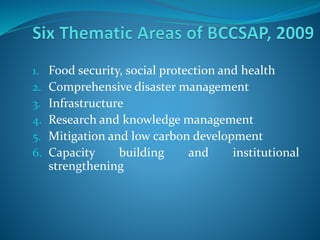
1. Food security, social protection and health
2. Comprehensive disaster management
3. Infrastructure
4. Research and knowledge management
5. Mitigation and low carbon development
6. Capacity building and institutional
strengthening
Under Six thematic Areas there are total of 44
programme areas to address overall climate change
activities of the country. Specific projects or
activities may be undertaken on any of these
programme areas.
Financial Requirement to
implement BCCSAP
 During first 2 years US$ 500 million will be
required to implement immediate Actions
 Total Cost of the Programmes commencing in the
first 5 years is US$ 5 billion
BANGLADESH INDC/NDC
Bangladesh Intended Nationally Determined
Contributions (INDCs)
 Bangladesh has submitted INDCs on 25 September 2015
 Bangladesh has proposed an unconditional contribution to
reduce GHG emissions by 5% from Business as Usual
(BAU) levels by 2030 in the power, transport and industry
sectors, based on existing resources;
 Bangladesh has proposed for a conditional 15% reduction
in GHG emissions from BAU levels by 2030 in the power,
transport, and industry sectors, subject to appropriate
international support in the form of finance, investment,
technology development and transfer, and capacity
building.
 Bangladesh considered 2012 as the Base Year.
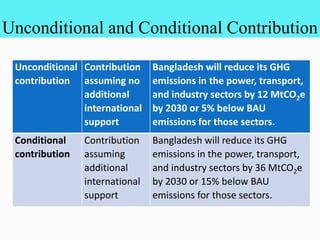
Unconditional and Conditional Contribution
Unconditional
contribution
Contribution
assuming no
additional
international
support
Bangladesh will reduce its GHG
emissions in the power, transport,
and industry sectors by 12 MtCO2e
by 2030 or 5% below BAU
emissions for those sectors.
Conditional
contribution
Contribution
assuming
additional
international
support
Bangladesh will reduce its GHG
emissions in the power, transport,
and industry sectors by 36 MtCO2e
by 2030 or 15% below BAU
emissions for those sectors.
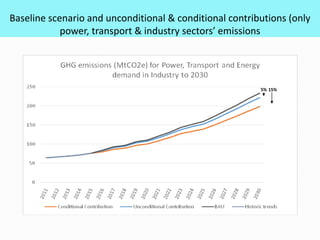
Baseline scenario and unconditional & conditional contributions (only
power, transport & industry sectors’ emissions
15%5%
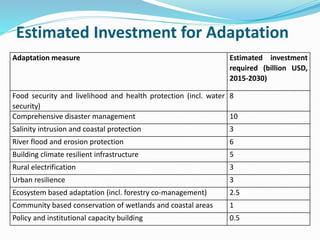
Estimated Investment for Adaptation
Adaptation measure Estimated investment
required (billion USD,
2015-2030)
Food security and livelihood and health protection (incl. water
security)
8
Comprehensive disaster management 10
Salinity intrusion and coastal protection 3
River flood and erosion protection 6
Building climate resilient infrastructure 5
Rural electrification 3
Urban resilience 3
Ecosystem based adaptation (incl. forestry co-management) 2.5
Community based conservation of wetlands and coastal areas 1
Policy and institutional capacity building 0.5
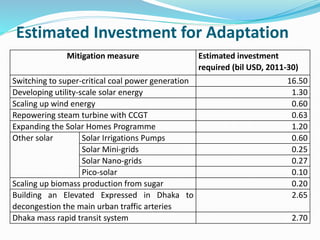
Estimated Investment for Adaptation
Mitigation measure Estimated investment
required (bil USD, 2011-30)
Switching to super-critical coal power generation 16.50
Developing utility-scale solar energy 1.30
Scaling up wind energy 0.60
Repowering steam turbine with CCGT 0.63
Expanding the Solar Homes Programme 1.20
Other solar Solar Irrigations Pumps 0.60
Solar Mini-grids 0.25
Solar Nano-grids 0.27
Pico-solar 0.10
Scaling up biomass production from sugar 0.20
Building an Elevated Expressed in Dhaka to
decongestion the main urban traffic arteries
2.65
Dhaka mass rapid transit system 2.70
A Road Map for developing NAP for
Bangladesh
 A Roadmap for Developing a National Adaptation
Plan for Bangladesh was prepared in 2015
 Bangladesh NAP Roadmap has considered the UNEP
LDC Guidelines (PROVIA Guideline not considered).
Proposed the four steps similar to that of LDC
Guidelines:
 1. Lay the Groundwork and Address Gaps
 2. Preparatory Elements
 3. Implementation Strategies
 4. Reporting, Monitoring and Review
Methodological Guidelines to prepare NAP
 Climate change: signals from the past, scenarios
for the future
 Understanding Bangladesh’s specific
vulnerabilities to climate change
 Water Resources Sector
 Agriculture sector (including sub sectors)
 Communication Sector
 Physical Infrastructure
 Food & health security
 Disaster Risk Reduction
 Livelihoods
 Urban Habitation
Contd..
 Understanding adaptation needs in
vulnerable sectors
 Water Resources Sector
 Agriculture sector (including sub sectors)
 Communication Sector
 Physical Infrastructure
 Food & health security
 Disaster Management
 Residual Impacts beyond Adaptation
 by sector: Planning for addressing Loss & Damage
Contd..
 Integration of NAP with National
Development Paradigm
 Scoping of NAP: How Nationally Appropriate
Adaptations are Perceived in key documents
 Recent adaptation strides, investments, gaps and
limitations in approach & actions (Scope of retrofitting
adaptation in ongoing/rolled out ADP projects)
 Adaptation Needs for Different Time-slices and Various
Scenarios
 Integration of NAP with ADP investments across sectors
 Integration of adaptation actions at different
(governance) tiers: central level, household/community
level, inter-sectoral perspective
Contd..
 Institutional mapping for implementation of
NAP
 Institutional Mechanism for Implementation of NAP
 An approach for Monitoring and Evaluation
 Inter-agency coordination
 Capacity of implementing bodies in different tiers
 Technological Needs towards implementing NAP
elements
 Mechanism of Updating of NAP and Incorporation of
Feedback
Contd..
 Financing adaptation
 Estimating Costs of Adaptation by Key Sector
 Prioritization of Specific Adaptations and Scheduling of
Finance for Adaptation
 Location-specificity of Financing Adaptation
 Sources of Finance
 Financing Strategy
Institutional Arrangement for NAP
preparation
 The formulation of a Inter-Ministerial Steering
Committee (IMSC)
 Technical Advisory Committee (TAC) to guide the
process
 A Core NAP Formulation Team needs to be
established to drive the NAP development under
the guidance of both the IMSC and the TAC
On-going activities which is going to
support NAP preparation
 Country Wide Vulnerability Assessment
 GIZ is providing support to MoEF/DoE for countrywide
vulnerability assessment (district wise and hotspot
based – coastal vul., drought vul., flood vul. Etc.)
 Bangladesh Disaster-related Statistics 2015 –
Climate Change and Natural Disaster Perspective
Challenges/Gaps
 The following studies as a pre-requisite to the
formulation of the NAP;
 A modeling based climate change scenario exercise for
present time (i.e., 2015), and future time-frames (2030,
2050 and 2100)
 Projections of population, economic growth,
employment situation in three scenarios (optimistic,
pessimistic and business-as usual) for three time-frames
as above
 A composite scenario document based on the above
findings (climate, population, economy, … all inclusive)
 A complete analysis of water related vulnerability under
three scenarios and each of these in three time-frames as
above
 Similar vulnerability analysis of other key sectors
Challenges
 The NAP formulation process must be as inclusive
as possible, in order to address concerns of all
stakeholders representing all vulnerable sectors,
regions and groups
 An effective Coordination Mechanism to prepare
and implement NAP
 Successful integration of the following Ministries is
crucial
 Ministry of Environment and Forests
 Ministry of Planning
 Ministry of Finance
 Other Sectoral Ministries’ (Water, Agriculture, Health. )
Best practices/Experience
 Bangladesh has the experience of preparation and
implementation of various adaptation projects;
 NAPA
 BCCSAP, 2009
 A Roadmap for Developing a NAP for Bangladesh
 On going Vulnerability assessment
 Bangladesh Climate Change Trust Fund
 Experience of financial support to Implement 276
projects
 Fundamental State Policy of Bangladesh Constitution
NAP process and Bangladesh

NAP process and Bangladesh

  • 1.
    NAP EXPO 2016 BONN,GERMANY 11-15 JULY, 2016 SHEIKH MOHAMMED TAUHIDUL ISLAM SENIOR ASSISTANT SECRETARY MINISTRY OF ENVIRONMENT AND FORESTS, BANGLADESH
  • 2.
    National Adaptation Programof Action (NAPA) 2005 NAPA Update 2009 Bangladesh Climate Change Strategy and Action Plan (BCCSAP) 2009 INDC/NDC A Roadmap for Developing NAP
  • 3.
    •Bangladesh prepared NAPAin Nov. 2005; (second country to submit the NAPA to UNFCCC). •Six sectors was taken into consideration; –Forestry, Biodiversity, Land-use –Agriculture, Fisheries and Livestock –Water, Coastal Areas, Natural Disaster and Health –Livelihood, gender, Local Governance and Food Security –Industry and Infrastructure –Institutional and Policy Issues.
  • 4.
    National Adaptation Programmeof Action • Bangladesh prepared NAPA in Nov. 2005; (second country to submit the NAPA to UNFCCC). • Six sectors was taken into consideration; – Forestry, Biodiversity, Land-use – Agriculture, Fisheries and Livestock – Water, Coastal Areas, Natural Disaster and Health – Livelihood, gender, Local Governance and Food Security – Industry and Infrastructure – Institutional and Policy Issues.
  • 5.
    NAPA (Cont..)  Fifteenpriority projects were identified in the NAPA document to address immediate and urgent needs to address CC (approx. total investment of US$ 70+ million)  Two projects based on the NAPA Priority - Community based Coastal Aforestation (Phase I and Phase II) has been implemented with the support of LDC Fund (total US$ 10 mill) (Bangladesh Forest Department/UNDP)  Third Project has recently been approved by GEF (Fisheries sector/5.2 million +) (Department of Fisheries/FAO)  Fourth project is on ecosystem based adaptation in wetland and barind region of Bangladesh (US$ 5.2 million) (DoE/UNEP)
  • 6.
    NAPA update, 2009 Bangladesh updated NAPA in 2009  Time frame for adaptation actions: the updated NAPA included 9 short and 9 medium term projects  Updated NAPA included the following in the short term;  Assessment of Financial Needs to combat climate change  Revision of National and Sectoral Policies to mainstream adaptation to climate change  Updated NAPA included the following issues in the medium term  Monitoring of climate change impacts on ecosystems and biodiversity  Aforestation including coastal green belt  Restoration of the Sundarbans Mangrove Ecosystem
  • 7.
    Bangladesh Climate Change Strategyand Action Plan (BCCSAP)
  • 8.
    1. Food security,social protection and health 2. Comprehensive disaster management 3. Infrastructure 4. Research and knowledge management 5. Mitigation and low carbon development 6. Capacity building and institutional strengthening
  • 9.
    Under Six thematicAreas there are total of 44 programme areas to address overall climate change activities of the country. Specific projects or activities may be undertaken on any of these programme areas.
  • 10.
    Financial Requirement to implementBCCSAP  During first 2 years US$ 500 million will be required to implement immediate Actions  Total Cost of the Programmes commencing in the first 5 years is US$ 5 billion
  • 11.
  • 12.
    Bangladesh Intended NationallyDetermined Contributions (INDCs)  Bangladesh has submitted INDCs on 25 September 2015  Bangladesh has proposed an unconditional contribution to reduce GHG emissions by 5% from Business as Usual (BAU) levels by 2030 in the power, transport and industry sectors, based on existing resources;  Bangladesh has proposed for a conditional 15% reduction in GHG emissions from BAU levels by 2030 in the power, transport, and industry sectors, subject to appropriate international support in the form of finance, investment, technology development and transfer, and capacity building.  Bangladesh considered 2012 as the Base Year.
  • 13.
    Unconditional and ConditionalContribution Unconditional contribution Contribution assuming no additional international support Bangladesh will reduce its GHG emissions in the power, transport, and industry sectors by 12 MtCO2e by 2030 or 5% below BAU emissions for those sectors. Conditional contribution Contribution assuming additional international support Bangladesh will reduce its GHG emissions in the power, transport, and industry sectors by 36 MtCO2e by 2030 or 15% below BAU emissions for those sectors.
  • 14.
    Baseline scenario andunconditional & conditional contributions (only power, transport & industry sectors’ emissions 15%5%
  • 15.
    Estimated Investment forAdaptation Adaptation measure Estimated investment required (billion USD, 2015-2030) Food security and livelihood and health protection (incl. water security) 8 Comprehensive disaster management 10 Salinity intrusion and coastal protection 3 River flood and erosion protection 6 Building climate resilient infrastructure 5 Rural electrification 3 Urban resilience 3 Ecosystem based adaptation (incl. forestry co-management) 2.5 Community based conservation of wetlands and coastal areas 1 Policy and institutional capacity building 0.5
  • 16.
    Estimated Investment forAdaptation Mitigation measure Estimated investment required (bil USD, 2011-30) Switching to super-critical coal power generation 16.50 Developing utility-scale solar energy 1.30 Scaling up wind energy 0.60 Repowering steam turbine with CCGT 0.63 Expanding the Solar Homes Programme 1.20 Other solar Solar Irrigations Pumps 0.60 Solar Mini-grids 0.25 Solar Nano-grids 0.27 Pico-solar 0.10 Scaling up biomass production from sugar 0.20 Building an Elevated Expressed in Dhaka to decongestion the main urban traffic arteries 2.65 Dhaka mass rapid transit system 2.70
  • 18.
    A Road Mapfor developing NAP for Bangladesh  A Roadmap for Developing a National Adaptation Plan for Bangladesh was prepared in 2015  Bangladesh NAP Roadmap has considered the UNEP LDC Guidelines (PROVIA Guideline not considered). Proposed the four steps similar to that of LDC Guidelines:  1. Lay the Groundwork and Address Gaps  2. Preparatory Elements  3. Implementation Strategies  4. Reporting, Monitoring and Review
  • 19.
    Methodological Guidelines toprepare NAP  Climate change: signals from the past, scenarios for the future  Understanding Bangladesh’s specific vulnerabilities to climate change  Water Resources Sector  Agriculture sector (including sub sectors)  Communication Sector  Physical Infrastructure  Food & health security  Disaster Risk Reduction  Livelihoods  Urban Habitation
  • 20.
    Contd..  Understanding adaptationneeds in vulnerable sectors  Water Resources Sector  Agriculture sector (including sub sectors)  Communication Sector  Physical Infrastructure  Food & health security  Disaster Management  Residual Impacts beyond Adaptation  by sector: Planning for addressing Loss & Damage
  • 21.
    Contd..  Integration ofNAP with National Development Paradigm  Scoping of NAP: How Nationally Appropriate Adaptations are Perceived in key documents  Recent adaptation strides, investments, gaps and limitations in approach & actions (Scope of retrofitting adaptation in ongoing/rolled out ADP projects)  Adaptation Needs for Different Time-slices and Various Scenarios  Integration of NAP with ADP investments across sectors  Integration of adaptation actions at different (governance) tiers: central level, household/community level, inter-sectoral perspective
  • 22.
    Contd..  Institutional mappingfor implementation of NAP  Institutional Mechanism for Implementation of NAP  An approach for Monitoring and Evaluation  Inter-agency coordination  Capacity of implementing bodies in different tiers  Technological Needs towards implementing NAP elements  Mechanism of Updating of NAP and Incorporation of Feedback
  • 23.
    Contd..  Financing adaptation Estimating Costs of Adaptation by Key Sector  Prioritization of Specific Adaptations and Scheduling of Finance for Adaptation  Location-specificity of Financing Adaptation  Sources of Finance  Financing Strategy
  • 24.
    Institutional Arrangement forNAP preparation  The formulation of a Inter-Ministerial Steering Committee (IMSC)  Technical Advisory Committee (TAC) to guide the process  A Core NAP Formulation Team needs to be established to drive the NAP development under the guidance of both the IMSC and the TAC
  • 25.
    On-going activities whichis going to support NAP preparation  Country Wide Vulnerability Assessment  GIZ is providing support to MoEF/DoE for countrywide vulnerability assessment (district wise and hotspot based – coastal vul., drought vul., flood vul. Etc.)  Bangladesh Disaster-related Statistics 2015 – Climate Change and Natural Disaster Perspective
  • 26.
    Challenges/Gaps  The followingstudies as a pre-requisite to the formulation of the NAP;  A modeling based climate change scenario exercise for present time (i.e., 2015), and future time-frames (2030, 2050 and 2100)  Projections of population, economic growth, employment situation in three scenarios (optimistic, pessimistic and business-as usual) for three time-frames as above  A composite scenario document based on the above findings (climate, population, economy, … all inclusive)  A complete analysis of water related vulnerability under three scenarios and each of these in three time-frames as above  Similar vulnerability analysis of other key sectors
  • 27.
    Challenges  The NAPformulation process must be as inclusive as possible, in order to address concerns of all stakeholders representing all vulnerable sectors, regions and groups  An effective Coordination Mechanism to prepare and implement NAP  Successful integration of the following Ministries is crucial  Ministry of Environment and Forests  Ministry of Planning  Ministry of Finance  Other Sectoral Ministries’ (Water, Agriculture, Health. )
  • 28.
    Best practices/Experience  Bangladeshhas the experience of preparation and implementation of various adaptation projects;  NAPA  BCCSAP, 2009  A Roadmap for Developing a NAP for Bangladesh  On going Vulnerability assessment  Bangladesh Climate Change Trust Fund  Experience of financial support to Implement 276 projects  Fundamental State Policy of Bangladesh Constitution