Sustainable development
Presented By: Baghershahi, P.
Amirkabir University of Technology – Tehran PolyTechnic
Spring 2018
1
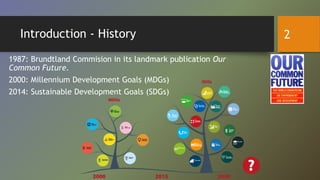
Introduction - History
1987: Brundtland Commision in its landmark publication Our
Common Future.
2000: Millennium Development Goals (MDGs)
2014: Sustainable Development Goals (SDGs)
2
Introduction - Definition
Significant steps to have a
clear outline of SD:
1. Definition of the main goals
2. Data Measurement or
estimation
3. Evaluation
4. Generation of new and reliable
data
5. Reporting
Three major aspects of key
criticisms
1. Concept of sustainable
development.
2. Difficulty of measuring activities
3. The oxymoron concept
3
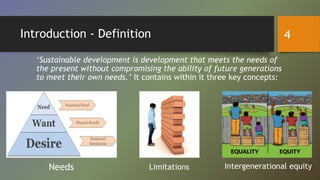
Introduction - Definition
‘Sustainable development is development that meets the needs of
the present without compromising the ability of future generations
to meet their own needs.’ It contains within it three key concepts:
Needs Limitations Intergenerational equity
4
Introduction - The Solutions Network’s
Leadership Council
• 60 leaders from academia, the research community, business and civil
society
• Action-oriented
• Spur authorities to challenges
• Map out pathways
5
Introduction – councils & communities
They can be classified along
two dimensions
• The actors of the documents
• The evolution of the documents
6
Introduction – councils & communities
OECD Guidelines
(The Organization for
Economic Co-operation
and Development)
CERES Principles
(The Coalition for
Environmentally Responsible
Economies)
ICC Business Charter
(The International Chamber of Commerce)
7
Introduction – councils & communities
CAUX Principles
Global Sullivan Principles (GSP)
UN Global Compact Principles
8
Challenges & Solutions
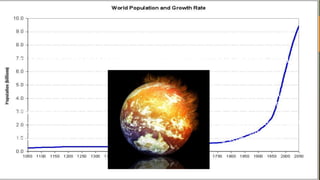
Population growthOld ageInequalities of earnings in many countriesPrimary resources overuse in high-income and middle-income countriesEnvironmental problems
• Major environmental accidents
• Water pollution
• Maritime pollution
• Land use and siting impact
• Radiation and radioactivity
• Solid waste disposal
• Hazardous air pollutants
• Ambient air quality
• Acid rain
• Stratospheric ozone depletion
• Global climate change
(greenhouse effect).
9
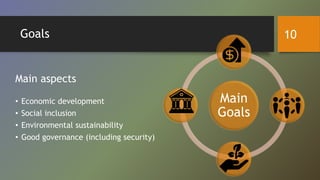
Main
Goals
Goals
Main aspects
• Economic development
• Social inclusion
• Environmental sustainability
• Good governance (including security)
10
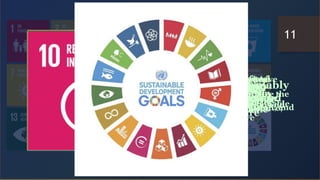
Take urgent action to
combat climate change
and its impacts
Conserve and sustainably
use the oceans, seas and
marine resources
Protect, restore and promote
sustainable use of terrestrial
ecosystems sustainably manage
forests, combat desertification, and
halt and reverse
Promote peaceful and inclusive
societies for sustainable
development, provide access to
justice for all and build effective,
accountable and inclusive
Strengthen the means of
implementation and revitalize the
global partnership for sustainable
development
Reduce inequality within
and among countries
Make cities and human
settlements inclusive, safe,
resilient and sustainable
Ensure sustainable
consumption and
production patterns
Build resilient infrastructure,
promote inclusive and
sustainable industrialization and
foster innovation
End poverty in all its
forms everywhere
End hunger, achieve food
security and improved
nutrition and promote
sustainable agriculture
Ensure healthy lives and
promote well-being for
all at all ages
Ensure inclusive and
equitable quality education
and promote lifelong learning
opportunities for all
Achieve gender equality and
empower all women and girls
Ensure availability and
sustainable management of
water and sanitation for all
Ensure access to affordable,
reliable, sustainable and
modern energy for all
Promote sustained, inclusive
and sustainable economic
growth, full and productive
employment and decent work
for all
11
Actors
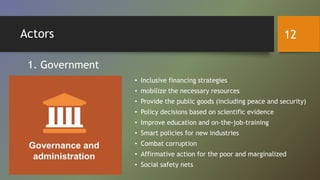
• Inclusive financing strategies
• mobilize the necessary resources
• Provide the public goods (including peace and security)
• Policy decisions based on scientific evidence
• Improve education and on-the-job-training
• Smart policies for new industries
• Combat corruption
• Affirmative action for the poor and marginalized
• Social safety nets
1. Government
12
Actors
o Adopt transparent goals for sustainable
development
o Work responsibly and constructively with
governments
o Align private incentives with public objectives
o be accountable for “polluter pays” principle
4. Private sector
13
Actors
• Stretch goals
• Data systems
• Contributions to research
• Implications for practice
• Limitations of our work
• Cybernetic controls
3. Technology
14
Actors
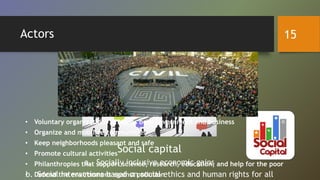
Social capital
a. Socially inclusive economic gains
b. Social interactions based on social ethics and human rights for all
4. Civil society
• Voluntary organizations to assess both government and business
• Organize and mobilize communities
• Keep neighborhoods pleasant and safe
• Promote cultural activities
• Philanthropies that support science, research, education, and help for the poor
• Defend the environment against pollution
15
Pathways for environmental problems
1. Renewable energy technologies
2. Energy conservation (efficient energy utilization)
3. Cogeneration and district heating
4. Energy storage technologies
5. Alternative energy dimensions for transport
6. Coal cleaning technologies
7. Optimum monitoring and evaluation of energy
indicators
8. Policy integration
9. Energy source switching from fossil fuels to
environmentally benign energy forms
10.Recycling
11.Process change and sectoral shiftment
12.Acceleration of forestation
13.Carbon or fuel taxes
14.Materials substitution
15.Promoting public transport
16.Changing life styles
17.Increasing public awareness
18.Education and training.
16
Pathways for energy management
1. The importance of decoupling
• Decouple rising energy use from carbon dioxide emissions
(Energy efficiency measures and low-carbon energy systems)
• Decouple rising food yields from unsustainable utilization of
water, chemicals, fertilizers, and land (Precision farming,
improved crop varieties, efficient water management, and
no-till farm practices)
• Decouple urbanization from rising urban energy use and
ensure effective land use (Green buildings, smart grids, and
improved transportation systems)
2. The need to change behavior and articulate
the business case for sustainable development
3. Quantifying the challenges of sustainable
development
4. Economic growth
5. Energy Use and Carbon Emissions
6. Sustainable food supply
7. Financing strategy
• First, polluters should pay to clean up after
themselves
• Second, ecosystem services need to be priced
• Third, rich countries should help poor countries to
cover the incremental costs of investment
8. Analyzing opportunities for renewable energy and
working in consultation with industry to identify
R&D and market strategies to meet technological
goals
9. Conducting R&D in cooperation with industry to
develop and commercialize technologies
10.Encouraging the application of renewable energy
technologies to potential users, including utilities
11.Providing technical support and advice to industry
associations and government programs that are
encouraging the increased use of renewable
energy.
12.Improving the collection and conversion
efficiencies
13.Lowering the initial and maintenance costs
14.Increasing the reliability and applicability
15.Understanding the phenomena of renewable
energy systems
16.Technology assessment
17.Technology transfer
17
Resources
1. What Happened to the ‘Development’ in Sustainable Development? Business
Guidelines Two Decades after Brundtland
2. Towards Integration at Last? The Sustainable Development Goals as a Network of
Targets (David Le Blanc)
3. A Framework for Sustainable Development
4. Renewable energy and sustainable development: a crucial review
5. Managing sustainable development with management control systems: A literature
review
6. https://www.unicef.org
7. https://en.unesco.org
8. https://sustainabledevelopment.un.org
9. http://www.undp.org
18

Sustainable development

  • 1.
    Sustainable development Presented By:Baghershahi, P. Amirkabir University of Technology – Tehran PolyTechnic Spring 2018 1
  • 2.
    Introduction - History 1987:Brundtland Commision in its landmark publication Our Common Future. 2000: Millennium Development Goals (MDGs) 2014: Sustainable Development Goals (SDGs) 2
  • 3.
    Introduction - Definition Significantsteps to have a clear outline of SD: 1. Definition of the main goals 2. Data Measurement or estimation 3. Evaluation 4. Generation of new and reliable data 5. Reporting Three major aspects of key criticisms 1. Concept of sustainable development. 2. Difficulty of measuring activities 3. The oxymoron concept 3
  • 4.
    Introduction - Definition ‘Sustainabledevelopment is development that meets the needs of the present without compromising the ability of future generations to meet their own needs.’ It contains within it three key concepts: Needs Limitations Intergenerational equity 4
  • 5.
    Introduction - TheSolutions Network’s Leadership Council • 60 leaders from academia, the research community, business and civil society • Action-oriented • Spur authorities to challenges • Map out pathways 5
  • 6.
    Introduction – councils& communities They can be classified along two dimensions • The actors of the documents • The evolution of the documents 6
  • 7.
    Introduction – councils& communities OECD Guidelines (The Organization for Economic Co-operation and Development) CERES Principles (The Coalition for Environmentally Responsible Economies) ICC Business Charter (The International Chamber of Commerce) 7
  • 8.
    Introduction – councils& communities CAUX Principles Global Sullivan Principles (GSP) UN Global Compact Principles 8
  • 9.
    Challenges & Solutions PopulationgrowthOld ageInequalities of earnings in many countriesPrimary resources overuse in high-income and middle-income countriesEnvironmental problems • Major environmental accidents • Water pollution • Maritime pollution • Land use and siting impact • Radiation and radioactivity • Solid waste disposal • Hazardous air pollutants • Ambient air quality • Acid rain • Stratospheric ozone depletion • Global climate change (greenhouse effect). 9
  • 10.
    Main Goals Goals Main aspects • Economicdevelopment • Social inclusion • Environmental sustainability • Good governance (including security) 10
  • 11.
    Take urgent actionto combat climate change and its impacts Conserve and sustainably use the oceans, seas and marine resources Protect, restore and promote sustainable use of terrestrial ecosystems sustainably manage forests, combat desertification, and halt and reverse Promote peaceful and inclusive societies for sustainable development, provide access to justice for all and build effective, accountable and inclusive Strengthen the means of implementation and revitalize the global partnership for sustainable development Reduce inequality within and among countries Make cities and human settlements inclusive, safe, resilient and sustainable Ensure sustainable consumption and production patterns Build resilient infrastructure, promote inclusive and sustainable industrialization and foster innovation End poverty in all its forms everywhere End hunger, achieve food security and improved nutrition and promote sustainable agriculture Ensure healthy lives and promote well-being for all at all ages Ensure inclusive and equitable quality education and promote lifelong learning opportunities for all Achieve gender equality and empower all women and girls Ensure availability and sustainable management of water and sanitation for all Ensure access to affordable, reliable, sustainable and modern energy for all Promote sustained, inclusive and sustainable economic growth, full and productive employment and decent work for all 11
  • 12.
    Actors • Inclusive financingstrategies • mobilize the necessary resources • Provide the public goods (including peace and security) • Policy decisions based on scientific evidence • Improve education and on-the-job-training • Smart policies for new industries • Combat corruption • Affirmative action for the poor and marginalized • Social safety nets 1. Government 12
  • 13.
    Actors o Adopt transparentgoals for sustainable development o Work responsibly and constructively with governments o Align private incentives with public objectives o be accountable for “polluter pays” principle 4. Private sector 13
  • 14.
    Actors • Stretch goals •Data systems • Contributions to research • Implications for practice • Limitations of our work • Cybernetic controls 3. Technology 14
  • 15.
    Actors Social capital a. Sociallyinclusive economic gains b. Social interactions based on social ethics and human rights for all 4. Civil society • Voluntary organizations to assess both government and business • Organize and mobilize communities • Keep neighborhoods pleasant and safe • Promote cultural activities • Philanthropies that support science, research, education, and help for the poor • Defend the environment against pollution 15
  • 16.
    Pathways for environmentalproblems 1. Renewable energy technologies 2. Energy conservation (efficient energy utilization) 3. Cogeneration and district heating 4. Energy storage technologies 5. Alternative energy dimensions for transport 6. Coal cleaning technologies 7. Optimum monitoring and evaluation of energy indicators 8. Policy integration 9. Energy source switching from fossil fuels to environmentally benign energy forms 10.Recycling 11.Process change and sectoral shiftment 12.Acceleration of forestation 13.Carbon or fuel taxes 14.Materials substitution 15.Promoting public transport 16.Changing life styles 17.Increasing public awareness 18.Education and training. 16
  • 17.
    Pathways for energymanagement 1. The importance of decoupling • Decouple rising energy use from carbon dioxide emissions (Energy efficiency measures and low-carbon energy systems) • Decouple rising food yields from unsustainable utilization of water, chemicals, fertilizers, and land (Precision farming, improved crop varieties, efficient water management, and no-till farm practices) • Decouple urbanization from rising urban energy use and ensure effective land use (Green buildings, smart grids, and improved transportation systems) 2. The need to change behavior and articulate the business case for sustainable development 3. Quantifying the challenges of sustainable development 4. Economic growth 5. Energy Use and Carbon Emissions 6. Sustainable food supply 7. Financing strategy • First, polluters should pay to clean up after themselves • Second, ecosystem services need to be priced • Third, rich countries should help poor countries to cover the incremental costs of investment 8. Analyzing opportunities for renewable energy and working in consultation with industry to identify R&D and market strategies to meet technological goals 9. Conducting R&D in cooperation with industry to develop and commercialize technologies 10.Encouraging the application of renewable energy technologies to potential users, including utilities 11.Providing technical support and advice to industry associations and government programs that are encouraging the increased use of renewable energy. 12.Improving the collection and conversion efficiencies 13.Lowering the initial and maintenance costs 14.Increasing the reliability and applicability 15.Understanding the phenomena of renewable energy systems 16.Technology assessment 17.Technology transfer 17
  • 18.
    Resources 1. What Happenedto the ‘Development’ in Sustainable Development? Business Guidelines Two Decades after Brundtland 2. Towards Integration at Last? The Sustainable Development Goals as a Network of Targets (David Le Blanc) 3. A Framework for Sustainable Development 4. Renewable energy and sustainable development: a crucial review 5. Managing sustainable development with management control systems: A literature review 6. https://www.unicef.org 7. https://en.unesco.org 8. https://sustainabledevelopment.un.org 9. http://www.undp.org 18