DEMOGRAPHY 
SUJATA MOHAPATRA
DEMOGRAPHY 
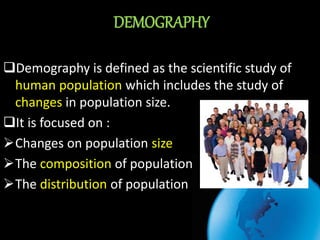
Demography is defined as the scientific study of 
human population which includes the study of 
changes in population size. 
It is focused on : 
Changes on population size 
The composition of population 
The distribution of population
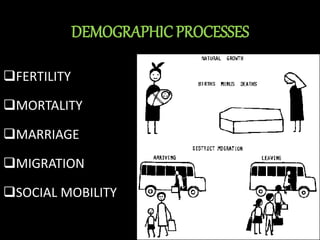
DEMOGRAPHIC PROCESSES 
FERTILITY 
MORTALITY 
MARRIAGE 
MIGRATION 
SOCIAL MOBILITY
DEMOGRAPHIC CYCLE 
1) High Stationary Stage/ First stage 
2) Early Expansion Stage/ Second Stage 
3) Late Expansion Stage/ Third Stage 
4) Low Stationary Stage/ Fourth Stage 
5) Declining Stage/ Fifth Stage
1) High Stationary Stage/ First 
stage 
High Birth rate 
High death rate 
They Nullify each other’s effect 
No change in size of population
Early Expansion Stage/ Second 
Stage 
Birth rate remains the same 
Death rate decrease 
Some increase in population
Late Expansion Stage/ Third 
Stage 
Birth rate increases 
Death rate decreases 
Tremendous increase in population
Low Stationary Stage/ Fourth 
Stage 
Low Birth rate 
Low death rate 
They Nullify each other’s effect 
No change in size of population
Declining Stage/ Fifth Stage 
Birth rate lower than death rate. 
Negative growth in population
Factors influencing population size 
 Age at marriage 
 Duration of married life 
 Family planning 
 Environmental sanitation 
 Education & Economic status 
 Health care facility 
 Nutrition 
 Caste & religion 
 Living standard 
 Occupational health & safety 
 Effective pharmaceutical
DEMOGRAPHIC MEASURMENT 
The study & measurement of population using 
measurement tools. 
Two aspects of demographic measurement: 
1. Population Static 
2. Population dynamic
Demographic measurment tools 
• Birth rate 
• Death rate 
• Growth rate 
• Dependency ratio 
• Sex ratio 
• Density 
• Marietal status 
• Socioeconomic status 
• Population distribution 
• Population size 
• Life expactancy
Demographic Treands in World 
• The world population crossed 1 billion nearly by the year 
1800AD. 
• 80% of population is in the developing of countries of 
Asia, Latin America, Africa. 
• Among Asian countries China has GR 0.53% & India has 
GR 1.64%. 
• World’s most populous country is China(21.08%), 
India(16.87%), USA(4.63%), Indonesia(3.49%), Brazil 
(2.8%)Pakistan(2.58%), Russia(2.42%).
AGE & SEX COMPOSITION : 
 0-14Yrs :- Male > Female (1.3%) 
 60+: - Female> Male (0.6%)
SEX RATIO:- 
 Sex ratio of India is generally adverse to 
woman. 
 Highest in Kerala(1,084) & lowest in 
Hariyana(877)
DEPENDENCY RATIO: 
 The proportion of persons above 65 yrs of 
age & children below 15 years old age are 
considered to be dependent on economically 
productive age group(15-64year). 
 In 2005 - 59% 
 2009- 55% 
 2010- 54% 
 2011- 54% 
 2012- 53%
DENSITY OF POPULATION:
LITERACY RATE
LIFE EXPECTANCY
SOURCES OF DEMOGRAPHIC DATA 
Census 
Registration of Vital Statistics 
Sample Registration System 
Hospital / Medical Records 
Popoulation Survey
CHN CONSIDERATIONS 
• Documentation 
• Analysis of Vital events 
• Prediction for Health hazard 
• Collection & interpretation of data to identify the 
areas health services needed most. 
• Planning & Implementation as per the information.
SUMMERIZATION
DEMOGRAPHY

DEMOGRAPHY

  • 1.
  • 2.
    DEMOGRAPHY Demography isdefined as the scientific study of human population which includes the study of changes in population size. It is focused on : Changes on population size The composition of population The distribution of population
  • 3.
    DEMOGRAPHIC PROCESSES FERTILITY MORTALITY MARRIAGE MIGRATION SOCIAL MOBILITY
  • 4.
    DEMOGRAPHIC CYCLE 1)High Stationary Stage/ First stage 2) Early Expansion Stage/ Second Stage 3) Late Expansion Stage/ Third Stage 4) Low Stationary Stage/ Fourth Stage 5) Declining Stage/ Fifth Stage
  • 5.
    1) High StationaryStage/ First stage High Birth rate High death rate They Nullify each other’s effect No change in size of population
  • 6.
    Early Expansion Stage/Second Stage Birth rate remains the same Death rate decrease Some increase in population
  • 7.
    Late Expansion Stage/Third Stage Birth rate increases Death rate decreases Tremendous increase in population
  • 8.
    Low Stationary Stage/Fourth Stage Low Birth rate Low death rate They Nullify each other’s effect No change in size of population
  • 9.
    Declining Stage/ FifthStage Birth rate lower than death rate. Negative growth in population
  • 10.
    Factors influencing populationsize  Age at marriage  Duration of married life  Family planning  Environmental sanitation  Education & Economic status  Health care facility  Nutrition  Caste & religion  Living standard  Occupational health & safety  Effective pharmaceutical
  • 11.
    DEMOGRAPHIC MEASURMENT Thestudy & measurement of population using measurement tools. Two aspects of demographic measurement: 1. Population Static 2. Population dynamic
  • 12.
    Demographic measurment tools • Birth rate • Death rate • Growth rate • Dependency ratio • Sex ratio • Density • Marietal status • Socioeconomic status • Population distribution • Population size • Life expactancy
  • 13.
    Demographic Treands inWorld • The world population crossed 1 billion nearly by the year 1800AD. • 80% of population is in the developing of countries of Asia, Latin America, Africa. • Among Asian countries China has GR 0.53% & India has GR 1.64%. • World’s most populous country is China(21.08%), India(16.87%), USA(4.63%), Indonesia(3.49%), Brazil (2.8%)Pakistan(2.58%), Russia(2.42%).
  • 17.
    AGE & SEXCOMPOSITION :  0-14Yrs :- Male > Female (1.3%)  60+: - Female> Male (0.6%)
  • 20.
    SEX RATIO:- Sex ratio of India is generally adverse to woman.  Highest in Kerala(1,084) & lowest in Hariyana(877)
  • 22.
    DEPENDENCY RATIO: The proportion of persons above 65 yrs of age & children below 15 years old age are considered to be dependent on economically productive age group(15-64year).  In 2005 - 59%  2009- 55%  2010- 54%  2011- 54%  2012- 53%
  • 23.
  • 24.
  • 25.
  • 26.
    SOURCES OF DEMOGRAPHICDATA Census Registration of Vital Statistics Sample Registration System Hospital / Medical Records Popoulation Survey
  • 27.
    CHN CONSIDERATIONS •Documentation • Analysis of Vital events • Prediction for Health hazard • Collection & interpretation of data to identify the areas health services needed most. • Planning & Implementation as per the information.
  • 28.