Downloaded 613 times


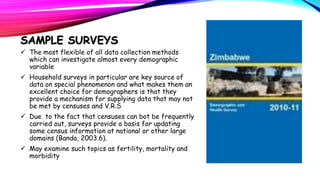


This document discusses the main sources of demographic data, including population censuses, administrative records, vital registration systems, sample surveys, and universal population registers. Population censuses conducted every 10 years are the primary source of demographic data worldwide. They provide information on population size, composition, and fertility and mortality rates. Administrative records like health statistics are also widely used but depend on complete recording. Vital registration systems specifically track births, deaths, marriages and provide key fertility and mortality data, though many developing countries' systems remain limited. Sample surveys offer flexibility to investigate various demographic variables and update census data. Universal population registers maintained in some developed countries continuously collect lifetime statistics.


