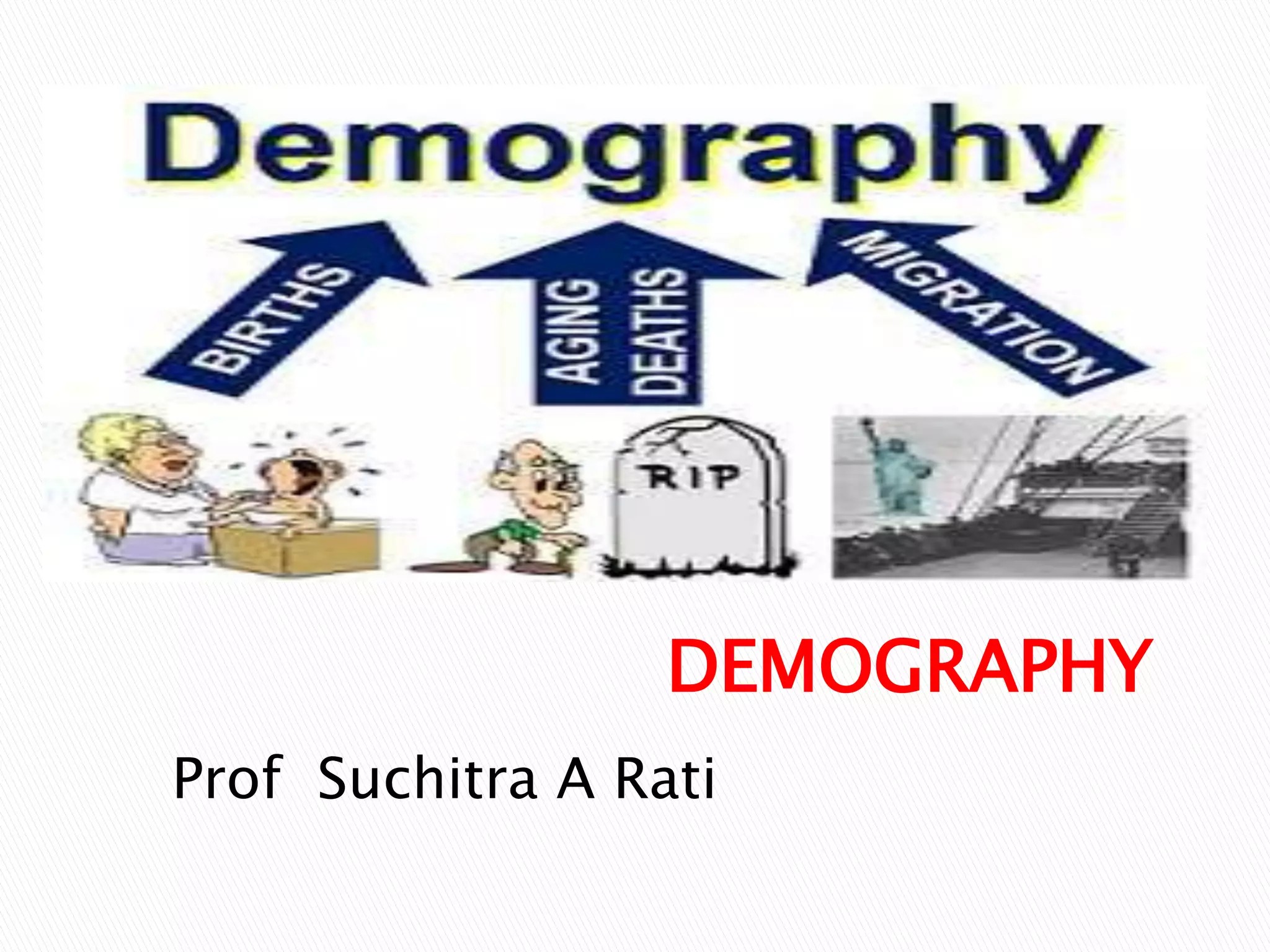
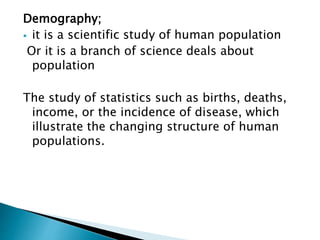
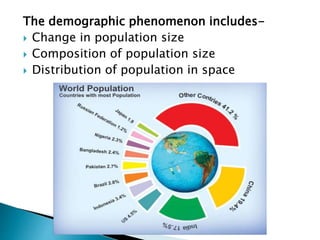
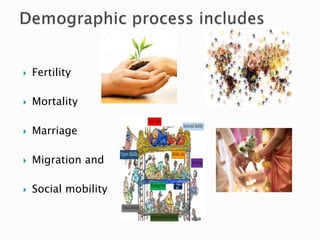
This document summarizes key concepts and trends in demography and population studies. It discusses that nearly 3/4 of the world's population lives in developing countries. India crossed 1 billion people in 2000 and grows by 16 million people per year. Demography is the scientific study of human populations, examining statistics like births, deaths, and disease rates. Key demographic factors include population size, composition, distribution, fertility, mortality, marriage, and migration patterns. Most world population growth occurs in developing nations, with 1/3 of the global population under age 15. The world population is projected to reach 10 billion by 2050.

![Demographic cycle
This explains the nature of a population like
composition, distribution and frequency of
population in particular area.
It includes 5 stages through which a nation
passes
1-First Stage [High Stationary]-characterized
by a high rate of birth and death rate. Where
the population will be constant[1920 India]
2-Second Stage [Early Expanding]-
characterized by death rate begins to decline,
while birth rate remains unchanged
[improved health condition]ex Africa](https://image.slidesharecdn.com/3rdgnm-demography-200426054334/85/3rd-gnm-demography-6-320.jpg)
![ 3-Third Stage [Late Expanding] death
rates declined further and birth rate
tends to fall population continuous to
grow-ex developing country-China
4-Fourth stage [low stationary]-
characterized by declined birth rate
and death rate with result of this the
population becomes stationary, ex
Denmark, Sweden etc
5-Fifth stage [declining]-population
starts declining because birth rate is
lower than the birth rate ex Germany](https://image.slidesharecdn.com/3rdgnm-demography-200426054334/85/3rd-gnm-demography-7-320.jpg)
![Demographic trends
World population Is growing176/min,
10564/hr and 253542/day and
92543000/year
955 of population growth is in
developing country
1/3rd of the population is under age of
15 and entering to reproductive age
group
Reaches to 10 billion population by
2050
1169million population of India[2007]](https://image.slidesharecdn.com/3rdgnm-demography-200426054334/85/3rd-gnm-demography-8-320.jpg)
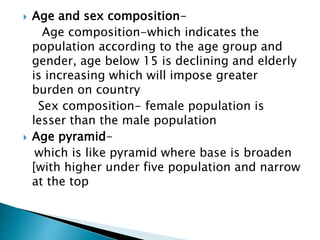
![ Sex ratio-
the number of females per
1000 population, presently male
population is higher than the
female population [1000; 892
Dependency ratio-
age above 65 and below 15 yr
considered dependency rate
[total dependency is 55%]
Density of the population-
number of the people living per
square kilometer [363/sq km]-
2004]](https://image.slidesharecdn.com/3rdgnm-demography-200426054334/85/3rd-gnm-demography-10-320.jpg)
![ Family size-
[total number of people in the family] in
demography ‘the total number of children
women has borne at a point of a time-
3/family [2007-2.8]
Urbanization-
it is an recent phenomena-migration of
population from rural[village] to urban[city]
285 million in 2001
5161 no urban at the year 2001
]](https://image.slidesharecdn.com/3rdgnm-demography-200426054334/85/3rd-gnm-demography-11-320.jpg)
![ Literacy and education-
a person is deemed to as literate if he or she
can read and write with understanding in any
language[who can merely read but cont write
is not considered as literate]
In India
Male; female-76; 54
-Keral -91% and Bihar etc45%
[Govt has made free, compulsory education
up to 14 yr]](https://image.slidesharecdn.com/3rdgnm-demography-200426054334/85/3rd-gnm-demography-12-320.jpg)



![2nd yr bsc[n] cet ppt-methods of teaching -nsg education](https://cdn.slidesharecdn.com/ss_thumbnails/2ndyrbscncet-ppt-methodsofteaching-nsgeducation-200426055039-thumbnail.jpg?width=640&height=640&fit=bounds)


![ONFH[AVN HIP] -TRIPLE REGIME -A NOVAL SURGICAL CONCEPT .pptx](https://cdn.slidesharecdn.com/ss_thumbnails/onfhavnhip2026koaconcalicutdrgokuldevdrmashraf-260210064517-213ec005-thumbnail.jpg?width=640&height=640&fit=bounds)


