Prof Nagamani.T
 Demography is the statistical study of human
population. It encompasses the study of the
size, structure and distribution of these
populations, and spatial and/or temporal
changes in them in response to birth,
migration, aging and death.
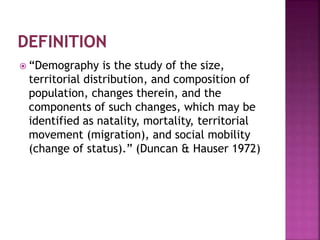
 “Demography is the study of the size,
territorial distribution, and composition of
population, changes therein, and the
components of such changes, which may be
identified as natality, mortality, territorial
movement (migration), and social mobility
(change of status).” (Duncan & Hauser 1972)
Collection of demographic data can be broadly
categorized into two methods:
 Direct demographic data Collection
 Indirect demographic data Collection
Direct demographic data collection is the
process of collecting data straight from
statistics registries which are responsible for
tracking all birth and death records and also
records pertaining to marital status and
migration. Perhaps the most common and
popular methods of direct collection of
demographic data is the census.
The indirect method of demographic data
collection may involve only certain people or
informants in trying to get data for the entire
population.
 For instance, one of the indirect demographic
data methods is the sister method.
 In this method, a researchers only asks all the
women on the number of their sisters who have
died or have had children who have died at what
age they died.
 From the collected data, the researchers will
draw their analysis and conclusions based on
indirect estimates on birth and death rates and
then apply some mathematical formula
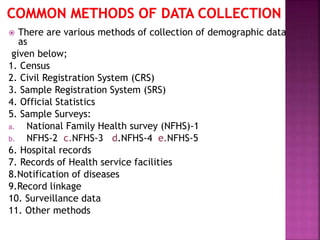
 There are various methods of collection of demographic data
as
given below;
1. Census
2. Civil Registration System (CRS)
3. Sample Registration System (SRS)
4. Official Statistics
5. Sample Surveys:
a. National Family Health survey (NFHS)-1
b. NFHS-2 c.NFHS-3 d.NFHS-4 e.NFHS-5
6. Hospital records
7. Records of Health service facilities
8.Notification of diseases
9.Record linkage
10. Surveillance data
11. Other methods
 "The total process of collecting, compiling,
evaluating, analysing, and publishing or
otherwise disseminating demographic, economic
and social data pertaining to all persons in a
country or in a welldelineated part of a country
at a specified time.” (United Nations 2008)
 It provides a portrait as of a given time of a
population constantly changing under the
influence of the events of births, deaths and
marriage as well as migration that occur in it.
 A census is designed to produce population
statistics.
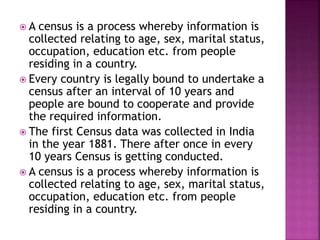
 A census is a process whereby information is
collected relating to age, sex, marital status,
occupation, education etc. from people
residing in a country.
 Every country is legally bound to undertake a
census after an interval of 10 years and
people are bound to cooperate and provide
the required information.
 The first Census data was collected in India
in the year 1881. There after once in every
10 years Census is getting conducted.
 A census is a process whereby information is
collected relating to age, sex, marital status,
occupation, education etc. from people
residing in a country.
 A census is usually conducted after an interval
of 10 years.
 The census covers the entire country or a part
of it.
 The census operations are completed within
specified dates.
 It is organized and conducted by the
Government through the Census Commission of
the country.
 A household or family is treated as a unit.
However in large census operations, migrant
individuals and homeless persons are also
enumerated at night at their places of rest or
sleep.
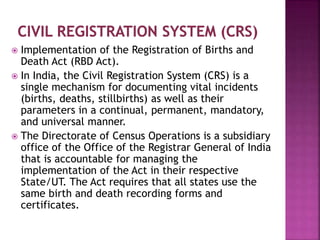
 Implementation of the Registration of Births and
Death Act (RBD Act).
 In India, the Civil Registration System (CRS) is a
single mechanism for documenting vital incidents
(births, deaths, stillbirths) as well as their
parameters in a continual, permanent, mandatory,
and universal manner.
 The Directorate of Census Operations is a subsidiary
office of the Office of the Registrar General of India
that is accountable for managing the
implementation of the Act in their respective
State/UT. The Act requires that all states use the
same birth and death recording forms and
certificates.
 This births and deaths should be reported
within 14 and 7 days of their occurrence
respectively.
 For births, the following information is
recorded;
 Place of birth
 Order of birth
 Sex of the child
 Age of mother
 Literacy, occupation and religion of parents
 Type of medical attention at birth
 In case of deaths, the following information is
recorded;
 Place of death
 Sex of the deceased
 Age of the deceased
 Marital status of the deceased
 Religion of the deceased
 Occupation of the deceased
 Cause of death
 Whether it is medically certified
 Type of medical attention received
 The Sample Registration System (SRS) is a large-
scale demographic survey for providing reliable
annual estimates of Infant mortality rate, birth
rate, death rate and other fertility & mortality
indicators at the national and sub national levels,
it became fully operational during 1969-70.
 Information about the changes happening in
various types of demographic data every year is
being obtained through Sample Registration
System itself. Main objective of SRS is to provide
reliable estimates of birth rate, death rate and
infant mortality rate at the natural division level
for the rural areas and at the state level for the
urban areas.
 The field investigation under Sample Registration
System consists of continuous enumeration of
birth and death events in a sample of
villages/segmented villages and urban blocks by
a resident part-time enumerator and an
independent six monthly retrospective survey by
a full-time supervisor.
 The data obtained through these two sources are
matched. The un-matched and partially matched
events are re-verified in the field to get an
unduplicated count of births and deaths. In that
way it is a self-evaluating technique based on a
dual record system.
 official statistics are sets of numerical
data collected by the government and
associated government agencies. They are
often gathered on a large scale and are a
major source of secondary quantitative
data.
 Data from official statistics is used to
identify trends and patterns and to make
decisions concerning the whole population or
a particular subsection.
 For eg.,
• No.of acceptors of different family planning
methods.
• No.of children immunized with BCG, DPT,
Measles and polio
• No. of pregnant woman given T.Tinjection
and IFA tablets.
 The Demographic Sample Survey is another
method of data collection for population
studies. In a sample survey, information is
collected only from a sample of the
population, which is representative of the
whole and from which conclusions are drawn
by the use of scientific methods.
 The National Family Health Survey (NFHS) is
a large-scale, multi-round survey conducted
in a representative sample of households
throughout India.
 The First National Family Health
Survey (NFHS -1) was conducted in 1992-93.
The survey collected extensive information
on population, health, and nutrition, with an
emphasis on women and young children.
Eighteen Population Research Centres (PRCs),
located in universities and institutes of
national repute, assisted IIPS in all stages of
conducting NFHS-1.
 The Second National Family Health Survey
(NFHS-2) was conducted in 1998-99 in all 26
states of India with added features on the
quality of health and family planning
services, domestic violence, reproductive
health, anemia, the nutrition of women, and
the status of women.
 The Third National Family Health
Survey (NFHS -3) was carried out in 2005-
2006. Eighteen Research Organizations
including five Population Research Centres
carried out the survey in 29 states of India.
The funding for NFHS-3 is provided by USAID,
DFID, the Bill and Melinda Gates Foundation,
UNICEF, UNFPA, and MOHFW, GOI, ICF (USA),
is providing technical assistance for NFHS-3,
and the National AIDS Control Organization
(NACO) and the National AIDS Research
Institute (NARI) are providing technical
assistance for the HIV component.
 In 2014-2015, India will implement the fourth
National Family Health Survey (NFHS-4).
 NFHS-4 will be conducted under the stewardship
of the Ministry of Health and Family Welfare,
coordinated by the International Institute for
Population Sciences, Mumbai, and implemented
by a group of survey organizations and
Population Research Centres, following a
rigorous selection procedure.
 In addition to the 29 states, NFHS-4 will also
include all six union territories for the first time
and will also provide estimates of most
indicators at the district level for all 640
districts in the country as per the 2011 census.
 2019-21, 5th NHFS was conducted.
 Information that you help collect during the
registration process on patient demographic
data such as: age, gender, race and
ethnicity; becomes a part of the patient’s
medical record. This information helps the
care team communicate effectively with
patients, as well as understand a patient’s
culture, which may affect their health. By
knowing more about the patients that we
serve, our hospital will be better able to
deliver services.
 Health service records maintained in health
centres, hospital out patient deoartments,
sub centres and other clinic facilities i.e,
poly clinics, MCH centres provide information
about birth weight, height, other
anthropometric measures, immunization etc.
 Records maintained in the hospital and
health centres are permanent records for
followup.
 Disease notification involves the official and
timely reporting of the occurrence of specific
diseases and conditions to designated public
health authorities by clinicians and other health
personnel for action using designated reporting
tools.
 Disease notification is an important source of data
collection for an effective and efficient disease
surveillance system.
 It is crucial to note that disease outbreak do not
give notice before its occurrence neither do they
respect the borders of nations. When they
eventually occur, they are likely to spread like
wildfire and often resulting in high morbidity and
case fatality rate with consequent economic
impact.
 Disease notification is a practice of reporting
the occurrence of a specific disease or health-
related condition to the appropriate and
designated authority.
2. A notifiable disease is any disease that is
required by law to be reported to government
authorities.
3. Effective notification allows the authorities
to monitor the disease, and provides early
warning of possible outbreaks
4. A notifiable disease is one for which regular
and timely information regarding individual
cases is considered necessary for the
prevention and control of the disease.
5. Reasons for Declaring a Disease as Notifiable may
be:
a. It is of interest to national or international
regulations or control programs
b. Its national/ State/ District incidence
c. Its severity (potential for rapid mortality)
d. Its communicability/ Its potential to cause
outbreaks
e. Significant risk of international spread
f. The socio-economic costs of its cases
g. Its preventability
h. Evidence that its pattern is changing
i. In other words, diseases which are considered to
be serious menaces to public health are included in
the list of notifiable diseases
6. Hence the list of notifiable diseases vary from
a. Country to country and (notifiable diseases in
India)
b. Within the same country
i. Between the States and
ii. Between urban and rural areas
 Disease surveillance is the continuous scrutiny of
occurrence of diseases and health-related events
to enable prompt intervention for the control of
diseases.
 It involves the ongoing systematic collection,
collation, analysis and interpretation of data on
disease occurrence and public health related
events and dissemination of the information
obtained from such data for prompt public
health action.
 An effective and efficient disease surveillance
and notification system allows early detection of
disease outbreaks that will prompt intervention
for the reduction of morbidity and mortality that
may result from the epidemics of these
infectious diseases
 Record linkage is an important tool in
creating data required for examining the
health of the public and of the health care
system itself. It can be used to improve data
holdings, data collection, quality
assessment, and the dissemination of
information.
 Other methods of collection of demographic
data include;
 Media reports
 World Health Reports
 Weekly epidemiological reports
 Annual statistical reports
 Annual reports published by the Directorate
General Heath Services(DGHS)
 Health information of India published by
CBHI
Thank You