WAP- Wireless Application 
Protocol 
by 
Team 11 Presenters: 
Suma Pramod Connie Barbosa 
Niti Pandey Patrick Cunning 
Olga Pavlenko 
04/11/2002
Overview 
 WAP Introduction 
 WAP architecture requirements 
 Architecture overview 
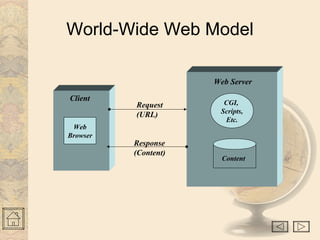
 World-wide web model 
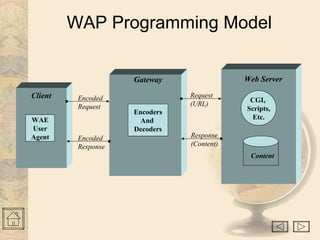
 WAP model 
 Components of WAP architecture 
 Sample Configuration of WAP technology 
 Usage, Advantages & Disadvantages of WAP 
 Summary
WAP- Wireless Application 
Protocol 
• An open, global specification that empowers 
mobile users with wireless devices to easily 
access and interact with internet information 
and services instantly. 
• The wireless industry came up with the idea 
of WAP. The point of this standard was to 
show internet contents on wireless clients, 
like mobile phones.
• WAP stands for Wireless Application 
Protocol 
o WAP is an application communication 
protocol 
o WAP is used to access services and 
information 
o WAP is inherited from Internet standards 
o WAP is for handheld devices such as mobile 
phones 
o WAP is a protocol designed for micro 
browsers 
o WAP enables the creating of web 
applications for mobile devices. 
o WAP uses the mark-up language WML (not 
HTML) WML is defined as an XML 1.0 
application
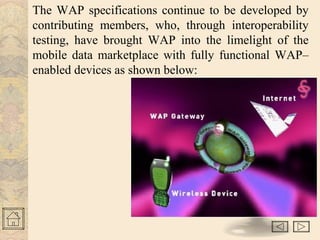
The WAP specifications continue to be developed by 
contributing members, who, through interoperability 
testing, have brought WAP into the limelight of the 
mobile data marketplace with fully functional WAP– 
enabled devices as shown below:
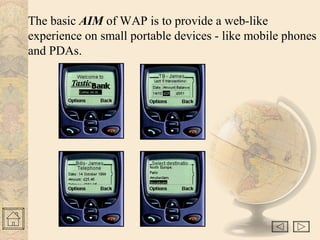
The basic AIM of WAP is to provide a web-like 
experience on small portable devices - like mobile phones 
and PDAs.
Purpose of WAP 
To enable easy, fast delivery of relevant information 
and services to mobile users. 
Type of devices that use WAP 
Handheld digital wireless devices such as mobile 
phones, pagers, two-way radios, smart phones and 
communicators -- from low-end to high-end. 
WAP works with most Wireless networks such as: 
CDPD, CDMA, GSM, PDC, PHS, TDMA, FLEX, 
ReFLEX, iDEN, TETRA, DECT, DataTAC, Mobitex.
Operating systems that are compatible with WAP 
•WAP is a communications protocol and an application 
environment. 
•WAP is independent of OS that means WAP can be 
implemented on any OS. 
•It can be built on any operating system including Palm 
OS, EPOC 32, Windows CE, FLEXOS, OS/9, Java OS, 
etc. It provides service interoperability even between 
different device families.
WAP Architecture 
Requirements 
• Leverage existing standards whenever 
possible 
• Define a layered, scaleable and extensible 
architecture 
• Support as many wireless networks as 
possible 
• Optimize for narrow-band bearers with high 
latency
WAP Architecture 
Requirements (Contd.) 
• Optimize for efficient use of device 
resources 
• Provide support for secure applications and 
communication
Architecture Overview 
• WWW programming model is optimized and 
extended to match characteristics of the 
wireless environment 
• Utilizes proxy technology to connect 
between the wireless domain and WWW
World-Wide Web Model 
Web Server 
CGI, 
Scripts, 
Etc. 
Content 
Client 
Web 
Browser 
Request 
(URL) 
Response 
(Content)
WAP Programming Model 
Web Server 
CGI, 
Scripts, 
Etc. 
Content 
Client 
WAE 
User 
Agent 
Request 
(URL) 
Response 
(Content) 
Gateway 
Encoders 
And 
Decoders 
Encoded 
Request 
Encoded 
Response
• WAP D e v i c e 
- Is used to access WAP applications and 
content. It might be a PDA, handheld 
computer. 
• WAP Client 
- Entity that receives content from Internet via a 
WAP Gateway. This is usually the WAP 
Browser. 
• WAP Content/Origin/Application Server 
- Element in the network where the information 
or web/WAP applications resides.
• WAP Proxy 
- Acts both as a client and as a server in the 
network.Typically has 
– Protocol gateway : translates requests from the 
WAP protocol stack to WWW protocol stack 
– Content encoders and decoders : translate WAP 
content into compact encoded formats to reduce 
the size of data over the network 
It allows content and applications to be 
hosted on standard WWW servers and 
developed using proven WWW technologies 
such as CGI scripting
• WAP Gateway 
- Intermediary element used to connect two different 
types of network. It receives request directly from 
the clients as if it actually were the origin server that 
clients want to receive the information form. The 
clients are usually unaware that they are speaking to 
the Gateway. 
• WAP Browser 
– Software running on the WAP device that 
interprets the WAP content arriving from the 
internet and decides how to display it on WAP 
device.
WML 
• WML – Wireless Markup Language formerly 
called HDML (Handheld Devices Markup 
Language) 
• Is a tag language that allows the text portions of 
Web Pages to be presented on cellular phones and 
Personal Digital Assistants (PDAs) via wireless 
access. 
• WML is used for delivering data to WAP devices, 
and is HTML- like in its appearance. 
• An alternative to WML is I-Mode’s cHTML 
language.
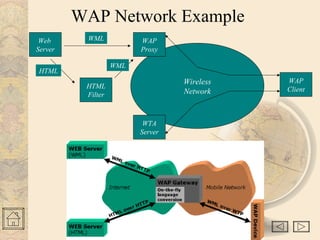
WAP Network Example 
Web 
Server 
Wireless 
Network 
WAP 
Proxy 
HTML 
Filter 
WTA 
Server 
WAP 
Client 
WML 
WML 
HTML
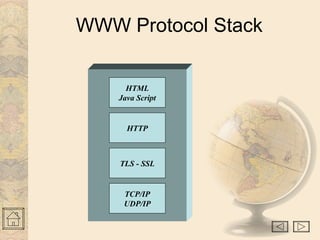
WWW Protocol Stack 
HTML 
Java Script 
HTTP 
TLS - SSL 
TCP/IP 
UDP/IP
Components of WAP 
Architecture 
Other Services 
And Applications 
Application Layer (WAE) 
Session Layer (WSP) 
Transaction Layer (WTP) 
Security Layer (WTLS) 
Transport Layer (WDP) 
Bearers : 
GSM CDMA PHS IS-136 CDPD PDC-P FLEX Etc…
Wireless Application Environment 
(WAE) 
• General-purpose application environment 
based on a combination of WWW and 
mobile telephony technologies. 
• It defines the user interface on the phone. It 
contains WML and WTA (Wireless 
Telephony Application). 
• Primary objective – interoperable 
environment.
Wireless Application Environment 
(Contd.) 
• WAE includes a micro-browser (Client software 
designed to overcome challenges of mobile handheld 
devices that enables wireless access to services such 
as Internet information in combination with a 
suitable network) server environment which provides 
– WML 
– WML script 
– WTA 
– Content formats
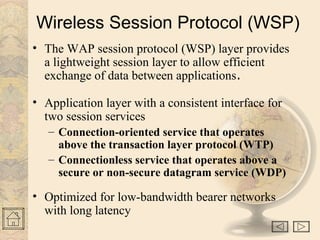
Wireless Session Protocol (WSP) 
• The WAP session protocol (WSP) layer provides 
a lightweight session layer to allow efficient 
exchange of data between applications. 
• Application layer with a consistent interface for 
two session services 
– Connection-oriented service that operates 
above the transaction layer protocol (WTP) 
– Connectionless service that operates above a 
secure or non-secure datagram service (WDP) 
• Optimized for low-bandwidth bearer networks 
with long latency
Wireless Transaction Protocol 
(WTP) 
» Runs on top of a datagram service 
• The WAP transaction protocol (WTP) layer 
provides transaction support, adding reliability to 
the datagram service provided by WDP. 
• Light weight transaction-oriented protocol 
• Three classes of transaction services 
– Unreliable one-way requests 
– Reliable one-way requests 
– Reliable two-way request-reply transactions
Wireless Transport Layer 
Security (WTLS) 
Based on industry-standard Transport Layer 
Security (TLS) protocol 
• Optimized for use over narrow-band 
communication channels 
• Features: 
– Data integrity 
– Privacy 
– Authentication 
– Denial-of-service protection
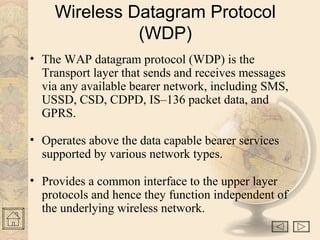
Wireless Datagram Protocol 
(WDP) 
• The WAP datagram protocol (WDP) is the 
Transport layer that sends and receives messages 
via any available bearer network, including SMS, 
USSD, CSD, CDPD, IS–136 packet data, and 
GPRS. 
• Operates above the data capable bearer services 
supported by various network types. 
• Provides a common interface to the upper layer 
protocols and hence they function independent of 
the underlying wireless network.
Bearers 
• Differing levels of quality of service with 
respect to throughput, error rate, and delays 
• WAP protocols are designed to compensate 
for or tolerate these varying levels of 
service 
• WDP specification lists the bearers that are 
supported and techniques used to allow 
WAP protocols to run over each bearer
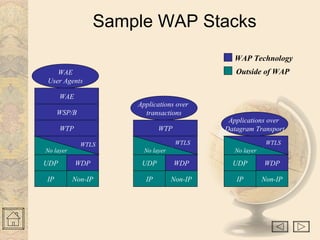
Sample WAP Stacks 
WAE 
User Agents 
WAE 
WSP/B 
WTP 
No layer 
WTLS 
UDP WDP 
IP Non-IP 
Applications over 
transactions 
WTP 
No layer 
WTLS 
UDP WDP 
IP Non-IP 
WAP Technology 
Outside of WAP 
Applications over 
Datagram Transport 
No layer 
WTLS 
UDP WDP 
IP Non-IP
Mobile-Originated Example of WAP 
Architecture 
The request from the mobile device is sent as a URL 
through the operator's network to the WAP gateway, 
which is the interface between the operator's network 
and the Internet as shown in the figure below.
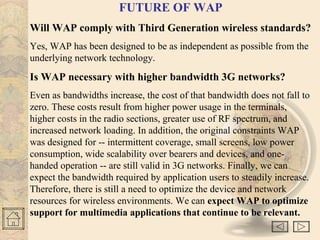
FUTURE OF WAP 
Will WAP comply with Third Generation wireless standards? 
Yes, WAP has been designed to be as independent as possible from the 
underlying network technology. 
Is WAP necessary with higher bandwidth 3G networks? 
Even as bandwidths increase, the cost of that bandwidth does not fall to 
zero. These costs result from higher power usage in the terminals, 
higher costs in the radio sections, greater use of RF spectrum, and 
increased network loading. In addition, the original constraints WAP 
was designed for -- intermittent coverage, small screens, low power 
consumption, wide scalability over bearers and devices, and one-handed 
operation -- are still valid in 3G networks. Finally, we can 
expect the bandwidth required by application users to steadily increase. 
Therefore, there is still a need to optimize the device and network 
resources for wireless environments. We can expect WAP to optimize 
support for multimedia applications that continue to be relevant.
If WAP is very successful in mass-markets on 2.5G networks, 3G 
networks may be needed purely for capacity relief. 
The reasons to migrate to WAP technology 
Network operators are behind WAP 
With minimal risk and investment, WAP enables operators to 
decrease churn, cut costs, and increase revenues by improving 
existing, value-added services and offering exciting new 
informational services. 
Why are equipment manufacturers interested in WAP? 
Being a global open specification suite, WAP has generated the 
critical mass for manufacturers. This has opened up new product 
and marketing opportunities in the wireless industry and provides 
new revenue to participating companies.
WAP in the Competitive Environment 
Competition for WAP protocols could come from a number of 
sources: 
• subscriber identity module (SIM) toolkit—The use of 
SIMs or smart cards in wireless devices is already widespread and 
used in some of the service sectors. 
• Windows CE—This is a multitasking, multithreaded operating 
system from Microsoft designed for including or embedding 
mobile and other space-constrained devices. 
• JavaPhone™—Sun Microsystems is developing 
PersonalJava™ and a JavaPhone™ API, which is embedded in a 
Java™ virtual machine on the handset. NEPs will be able to build 
cellular phones that can download extra features and functions 
over the Internet; thus, customers will no longer be required to 
buy a new phone to take advantage of improved features.
USAGE 
- Corporate Applications: Sales force automation 
where sales people use their WAP enabled handsets to 
get instant, direct access to the latest pricing, latest 
news, competitive information any time, anywhere. 
- Online Services: 
Banking: Users can get their current balance, 
transfer funds between accounts and receive fax of a 
mini-statement. 
Electronic Commerce: Subscribers can use their 
handset just like their PC to purchase products and 
services over the Web.
- Tele services 
Prepaid Services: With a WAP-enabled phone, 
prepaid subscribers can see their current balance with 
the press of a button. By pressing another button, 
they can also recharge their account by entering a 
credit card or voucher number into the handset. 
- Personal Productivity 
Email: Using WAP users can keep track of their 
email right from their handset. 
- Others include: 
- Interactive Chat 
- Auctions 
- Games
The ADVANTAGES that WAP can offer over these 
other methods are the following: 
•open standard, vendor independent 
•network-standard independent 
•transport mechanism–optimized for wireless data 
bearers 
•application downloaded from the server, enabling 
fast service creation and introduction, as opposed to 
embedded software
DISADVANTAGES of WAP 
• Small screens: For web phones, there's an incredibly small 
viewing area; palmtops are barely better. 
• Speed of access: All devices have slow access. 
• Limited or fragmented availability: Wireless web access is 
sporadic in many areas and entirely unavailable in other 
areas. 
• Price: Many technology limitations are being addressed by 
higher-end devices and services. But the entry price for a 
good wireless web palmtop with decent display, keyboard, 
and speed is easily $700 to $900, not including monthly 
access. 
• Lack of user habit: It takes some patience and overcoming 
the learning curve to get the hang of it -- connecting, putting 
in an address, typing. Users just aren't used to the idea and 
protocol yet. 
•
Summary 
• WAP provides a markup language and a transport protocol that 
open the possibilities of the wireless environment and give 
players from all levels of the industry the opportunity to access an 
untapped market that is still in its infancy. 
• The bearer-independent nature of WAP has proved to be a long-awaited 
breath of fresh air for an industry riddled with multiple 
proprietary standards that have suffocated the advent of a new 
wave of mobile-Internet communications. WAP is an enabling 
technology that, through gateway infrastructure deployed in 
mobile operator's network, will bridge the gap between the mobile 
world and the Internet, bringing sophisticated solutions to mobile 
users, independent of the bearer and network. 
• Backed by 75 percent of the companies behind the world's 
mobile telephone market and the huge development potential of 
WAP, the future for WAP looks bright.
References 
Websites: 
Books: 
• Beginning WAP – Wrox Publications 
• Dynamic WAP Application Development- 
Manning Publications, Inc

WAP- Wireless Application Protocol

  • 1.
    WAP- Wireless Application Protocol by Team 11 Presenters: Suma Pramod Connie Barbosa Niti Pandey Patrick Cunning Olga Pavlenko 04/11/2002
  • 2.
    Overview  WAPIntroduction  WAP architecture requirements  Architecture overview  World-wide web model  WAP model  Components of WAP architecture  Sample Configuration of WAP technology  Usage, Advantages & Disadvantages of WAP  Summary
  • 3.
    WAP- Wireless Application Protocol • An open, global specification that empowers mobile users with wireless devices to easily access and interact with internet information and services instantly. • The wireless industry came up with the idea of WAP. The point of this standard was to show internet contents on wireless clients, like mobile phones.
  • 4.
    • WAP standsfor Wireless Application Protocol o WAP is an application communication protocol o WAP is used to access services and information o WAP is inherited from Internet standards o WAP is for handheld devices such as mobile phones o WAP is a protocol designed for micro browsers o WAP enables the creating of web applications for mobile devices. o WAP uses the mark-up language WML (not HTML) WML is defined as an XML 1.0 application
  • 5.
    The WAP specificationscontinue to be developed by contributing members, who, through interoperability testing, have brought WAP into the limelight of the mobile data marketplace with fully functional WAP– enabled devices as shown below:
  • 6.
    The basic AIMof WAP is to provide a web-like experience on small portable devices - like mobile phones and PDAs.
  • 7.
    Purpose of WAP To enable easy, fast delivery of relevant information and services to mobile users. Type of devices that use WAP Handheld digital wireless devices such as mobile phones, pagers, two-way radios, smart phones and communicators -- from low-end to high-end. WAP works with most Wireless networks such as: CDPD, CDMA, GSM, PDC, PHS, TDMA, FLEX, ReFLEX, iDEN, TETRA, DECT, DataTAC, Mobitex.
  • 8.
    Operating systems thatare compatible with WAP •WAP is a communications protocol and an application environment. •WAP is independent of OS that means WAP can be implemented on any OS. •It can be built on any operating system including Palm OS, EPOC 32, Windows CE, FLEXOS, OS/9, Java OS, etc. It provides service interoperability even between different device families.
  • 9.
    WAP Architecture Requirements • Leverage existing standards whenever possible • Define a layered, scaleable and extensible architecture • Support as many wireless networks as possible • Optimize for narrow-band bearers with high latency
  • 10.
    WAP Architecture Requirements(Contd.) • Optimize for efficient use of device resources • Provide support for secure applications and communication
  • 11.
    Architecture Overview •WWW programming model is optimized and extended to match characteristics of the wireless environment • Utilizes proxy technology to connect between the wireless domain and WWW
  • 12.
    World-Wide Web Model Web Server CGI, Scripts, Etc. Content Client Web Browser Request (URL) Response (Content)
  • 13.
    WAP Programming Model Web Server CGI, Scripts, Etc. Content Client WAE User Agent Request (URL) Response (Content) Gateway Encoders And Decoders Encoded Request Encoded Response
  • 14.
    • WAP De v i c e - Is used to access WAP applications and content. It might be a PDA, handheld computer. • WAP Client - Entity that receives content from Internet via a WAP Gateway. This is usually the WAP Browser. • WAP Content/Origin/Application Server - Element in the network where the information or web/WAP applications resides.
  • 15.
    • WAP Proxy - Acts both as a client and as a server in the network.Typically has – Protocol gateway : translates requests from the WAP protocol stack to WWW protocol stack – Content encoders and decoders : translate WAP content into compact encoded formats to reduce the size of data over the network It allows content and applications to be hosted on standard WWW servers and developed using proven WWW technologies such as CGI scripting
  • 16.
    • WAP Gateway - Intermediary element used to connect two different types of network. It receives request directly from the clients as if it actually were the origin server that clients want to receive the information form. The clients are usually unaware that they are speaking to the Gateway. • WAP Browser – Software running on the WAP device that interprets the WAP content arriving from the internet and decides how to display it on WAP device.
  • 17.
    WML • WML– Wireless Markup Language formerly called HDML (Handheld Devices Markup Language) • Is a tag language that allows the text portions of Web Pages to be presented on cellular phones and Personal Digital Assistants (PDAs) via wireless access. • WML is used for delivering data to WAP devices, and is HTML- like in its appearance. • An alternative to WML is I-Mode’s cHTML language.
  • 18.
    WAP Network Example Web Server Wireless Network WAP Proxy HTML Filter WTA Server WAP Client WML WML HTML
  • 19.
    WWW Protocol Stack HTML Java Script HTTP TLS - SSL TCP/IP UDP/IP
  • 20.
    Components of WAP Architecture Other Services And Applications Application Layer (WAE) Session Layer (WSP) Transaction Layer (WTP) Security Layer (WTLS) Transport Layer (WDP) Bearers : GSM CDMA PHS IS-136 CDPD PDC-P FLEX Etc…
  • 21.
    Wireless Application Environment (WAE) • General-purpose application environment based on a combination of WWW and mobile telephony technologies. • It defines the user interface on the phone. It contains WML and WTA (Wireless Telephony Application). • Primary objective – interoperable environment.
  • 22.
    Wireless Application Environment (Contd.) • WAE includes a micro-browser (Client software designed to overcome challenges of mobile handheld devices that enables wireless access to services such as Internet information in combination with a suitable network) server environment which provides – WML – WML script – WTA – Content formats
  • 23.
    Wireless Session Protocol(WSP) • The WAP session protocol (WSP) layer provides a lightweight session layer to allow efficient exchange of data between applications. • Application layer with a consistent interface for two session services – Connection-oriented service that operates above the transaction layer protocol (WTP) – Connectionless service that operates above a secure or non-secure datagram service (WDP) • Optimized for low-bandwidth bearer networks with long latency
  • 24.
    Wireless Transaction Protocol (WTP) » Runs on top of a datagram service • The WAP transaction protocol (WTP) layer provides transaction support, adding reliability to the datagram service provided by WDP. • Light weight transaction-oriented protocol • Three classes of transaction services – Unreliable one-way requests – Reliable one-way requests – Reliable two-way request-reply transactions
  • 25.
    Wireless Transport Layer Security (WTLS) Based on industry-standard Transport Layer Security (TLS) protocol • Optimized for use over narrow-band communication channels • Features: – Data integrity – Privacy – Authentication – Denial-of-service protection
  • 26.
    Wireless Datagram Protocol (WDP) • The WAP datagram protocol (WDP) is the Transport layer that sends and receives messages via any available bearer network, including SMS, USSD, CSD, CDPD, IS–136 packet data, and GPRS. • Operates above the data capable bearer services supported by various network types. • Provides a common interface to the upper layer protocols and hence they function independent of the underlying wireless network.
  • 27.
    Bearers • Differinglevels of quality of service with respect to throughput, error rate, and delays • WAP protocols are designed to compensate for or tolerate these varying levels of service • WDP specification lists the bearers that are supported and techniques used to allow WAP protocols to run over each bearer
  • 28.
    Sample WAP Stacks WAE User Agents WAE WSP/B WTP No layer WTLS UDP WDP IP Non-IP Applications over transactions WTP No layer WTLS UDP WDP IP Non-IP WAP Technology Outside of WAP Applications over Datagram Transport No layer WTLS UDP WDP IP Non-IP
  • 29.
    Mobile-Originated Example ofWAP Architecture The request from the mobile device is sent as a URL through the operator's network to the WAP gateway, which is the interface between the operator's network and the Internet as shown in the figure below.
  • 30.
    FUTURE OF WAP Will WAP comply with Third Generation wireless standards? Yes, WAP has been designed to be as independent as possible from the underlying network technology. Is WAP necessary with higher bandwidth 3G networks? Even as bandwidths increase, the cost of that bandwidth does not fall to zero. These costs result from higher power usage in the terminals, higher costs in the radio sections, greater use of RF spectrum, and increased network loading. In addition, the original constraints WAP was designed for -- intermittent coverage, small screens, low power consumption, wide scalability over bearers and devices, and one-handed operation -- are still valid in 3G networks. Finally, we can expect the bandwidth required by application users to steadily increase. Therefore, there is still a need to optimize the device and network resources for wireless environments. We can expect WAP to optimize support for multimedia applications that continue to be relevant.
  • 31.
    If WAP isvery successful in mass-markets on 2.5G networks, 3G networks may be needed purely for capacity relief. The reasons to migrate to WAP technology Network operators are behind WAP With minimal risk and investment, WAP enables operators to decrease churn, cut costs, and increase revenues by improving existing, value-added services and offering exciting new informational services. Why are equipment manufacturers interested in WAP? Being a global open specification suite, WAP has generated the critical mass for manufacturers. This has opened up new product and marketing opportunities in the wireless industry and provides new revenue to participating companies.
  • 32.
    WAP in theCompetitive Environment Competition for WAP protocols could come from a number of sources: • subscriber identity module (SIM) toolkit—The use of SIMs or smart cards in wireless devices is already widespread and used in some of the service sectors. • Windows CE—This is a multitasking, multithreaded operating system from Microsoft designed for including or embedding mobile and other space-constrained devices. • JavaPhone™—Sun Microsystems is developing PersonalJava™ and a JavaPhone™ API, which is embedded in a Java™ virtual machine on the handset. NEPs will be able to build cellular phones that can download extra features and functions over the Internet; thus, customers will no longer be required to buy a new phone to take advantage of improved features.
  • 33.
    USAGE - CorporateApplications: Sales force automation where sales people use their WAP enabled handsets to get instant, direct access to the latest pricing, latest news, competitive information any time, anywhere. - Online Services: Banking: Users can get their current balance, transfer funds between accounts and receive fax of a mini-statement. Electronic Commerce: Subscribers can use their handset just like their PC to purchase products and services over the Web.
  • 34.
    - Tele services Prepaid Services: With a WAP-enabled phone, prepaid subscribers can see their current balance with the press of a button. By pressing another button, they can also recharge their account by entering a credit card or voucher number into the handset. - Personal Productivity Email: Using WAP users can keep track of their email right from their handset. - Others include: - Interactive Chat - Auctions - Games
  • 35.
    The ADVANTAGES thatWAP can offer over these other methods are the following: •open standard, vendor independent •network-standard independent •transport mechanism–optimized for wireless data bearers •application downloaded from the server, enabling fast service creation and introduction, as opposed to embedded software
  • 36.
    DISADVANTAGES of WAP • Small screens: For web phones, there's an incredibly small viewing area; palmtops are barely better. • Speed of access: All devices have slow access. • Limited or fragmented availability: Wireless web access is sporadic in many areas and entirely unavailable in other areas. • Price: Many technology limitations are being addressed by higher-end devices and services. But the entry price for a good wireless web palmtop with decent display, keyboard, and speed is easily $700 to $900, not including monthly access. • Lack of user habit: It takes some patience and overcoming the learning curve to get the hang of it -- connecting, putting in an address, typing. Users just aren't used to the idea and protocol yet. •
  • 37.
    Summary • WAPprovides a markup language and a transport protocol that open the possibilities of the wireless environment and give players from all levels of the industry the opportunity to access an untapped market that is still in its infancy. • The bearer-independent nature of WAP has proved to be a long-awaited breath of fresh air for an industry riddled with multiple proprietary standards that have suffocated the advent of a new wave of mobile-Internet communications. WAP is an enabling technology that, through gateway infrastructure deployed in mobile operator's network, will bridge the gap between the mobile world and the Internet, bringing sophisticated solutions to mobile users, independent of the bearer and network. • Backed by 75 percent of the companies behind the world's mobile telephone market and the huge development potential of WAP, the future for WAP looks bright.
  • 38.
    References Websites: Books: • Beginning WAP – Wrox Publications • Dynamic WAP Application Development- Manning Publications, Inc