ITA1008 M-Commerce
Module -5
Ref. Book Name : Wap -The Wireless Application Protocol
Author: Sandeep Singhal et al.,
Publisher: Pearson Education India; 1 edition (2002)
TCP/IP on mobile Network
TCP – Transmission Control Protocol
IP – Internet Protocol
• Controls how data packets are formed
• Addresses each packet with the source and destination address
• A data packet conforming to the IP spec is called an IP datagram
•Breaks information into small chucks called data packets
•Manages the transfer of the packets from computer to computer
•Reassembles data packets into a message at the destination
TCP/IP on mobile Network
• connection-oriented: setup required between client and server
processes
• reliable transport between sending and receiving process
• flow control: sender won’t overwhelm receiver
• congestion control: throttle sender when network overloaded
• does not provide: timing, minimum throughput guarantees, security
• Routers
• Connect one network to another
• Identify each device on a network as unique using IP protocol
• Serve as the “Traffic Cop” directing packets to their destination
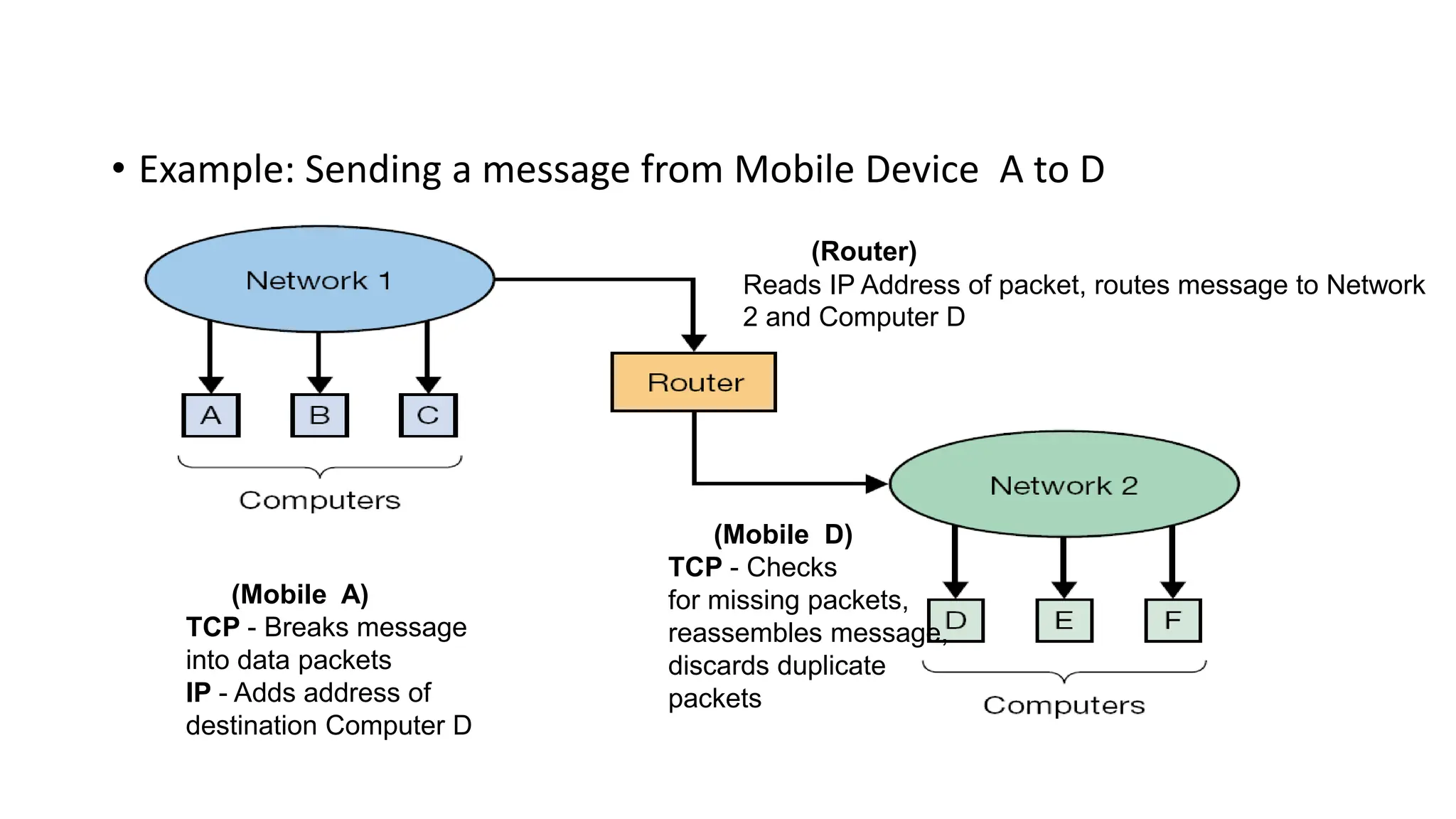
• Example: Sending a message from Mobile Device A to D
(Mobile A)
TCP - Breaks message
into data packets
IP - Adds address of
destination Computer D
(Mobile D)
TCP - Checks
for missing packets,
reassembles message,
discards duplicate
packets
(Router)
Reads IP Address of packet, routes message to Network
2 and Computer D
Over view of WAP architecture
• WAP- Wireless Application Protocol
• An open, global specification that empowers mobile users with
wireless devices to easily access and interact with internet information
and services instantly.
• The wireless industry came up with the idea of WAP. The point of this
standard was to show internet contents on wireless clients, like mobile
phones.
Over view of WAP architecture
• WAP stands for Wireless Application Protocol
o WAP is an application communication protocol
o WAP is used to access services and information
o WAP is inherited from Internet standards
o WAP is for handheld devices such as mobile phones
o WAP is a protocol designed for micro browsers
o WAP enables the creating of web applications for mobile devices.
o WAP uses the mark-up language WML (not HTML) WML is defined
as an XML 1.0 application
Purpose of WAP
To enable easy, fast delivery of relevant information and services to mobile users.
Type of devices that use WAP
Handheld digital wireless devices such as mobile phones, ipad, two-way radios,
smart phones and communicators -- from low-end to high-end.
WAP works with most Wireless networks such as:
CDPD, CDMA, GSM, PDC, PHS, TDMA, FLEX, ReFLEX, iDEN, TETRA,
DECT, DataTAC, Mobitex.
Architecture Overview
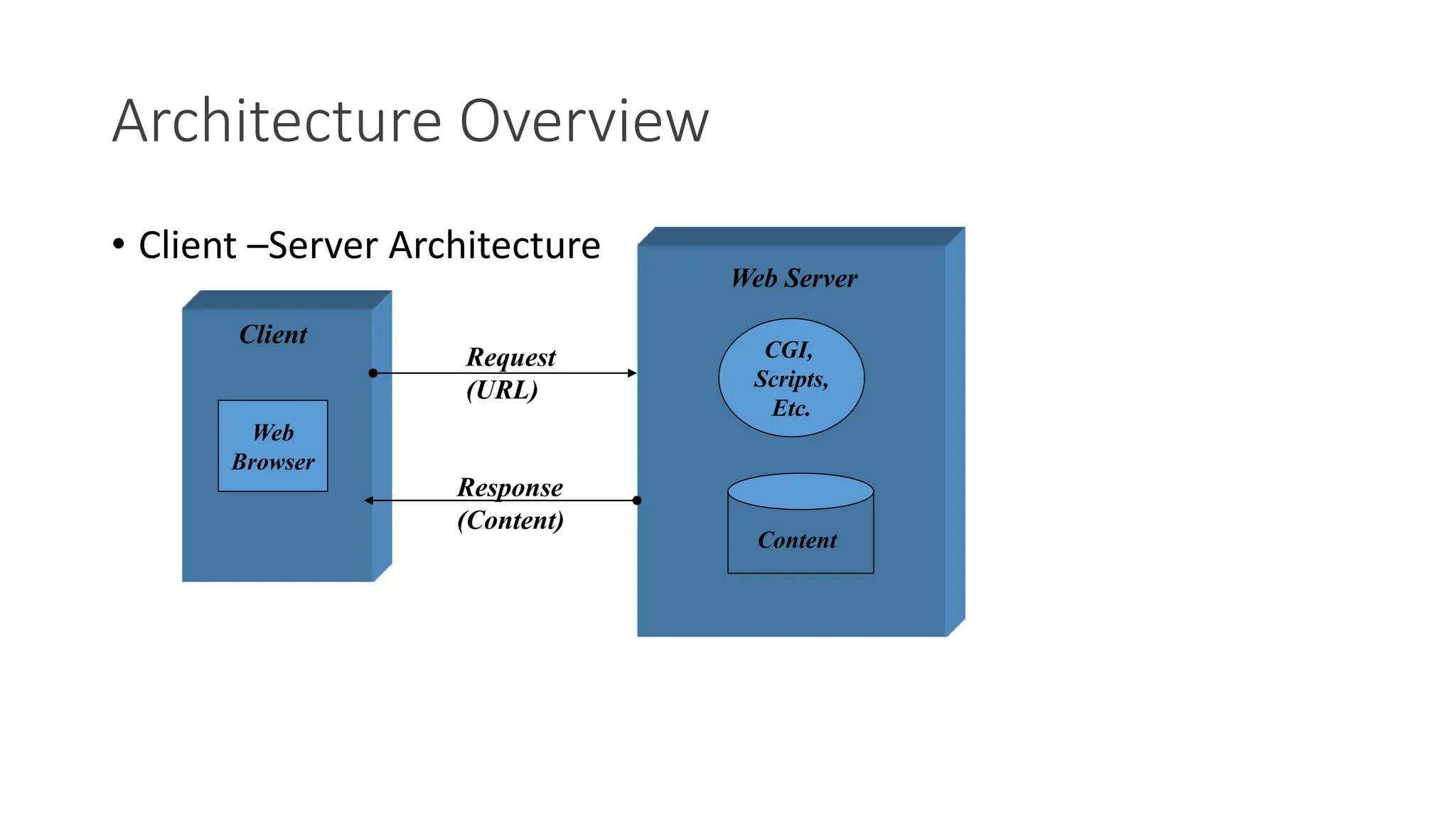
• Client –Server Architecture
CGI,
Scripts,
Etc.
Content
Web Server
Client
Web
Browser
Request
(URL)
Response
(Content)
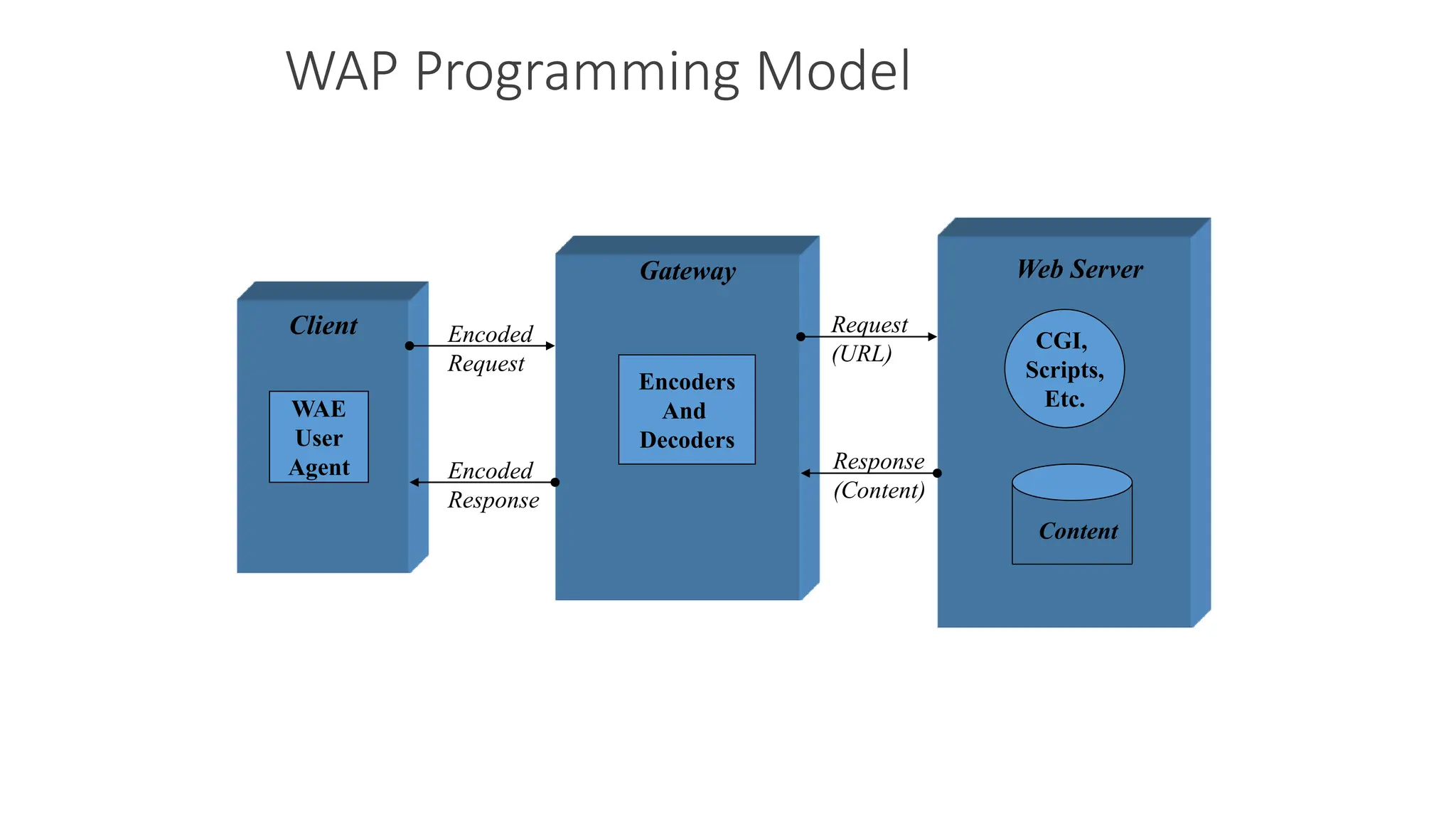
WAP Programming Model
CGI,
Scripts,
Etc.
Content
Web Server
Client
WAE
User
Agent
Request
(URL)
Response
(Content)
Gateway
Encoders
And
Decoders
Encoded
Request
Encoded
Response
WAP
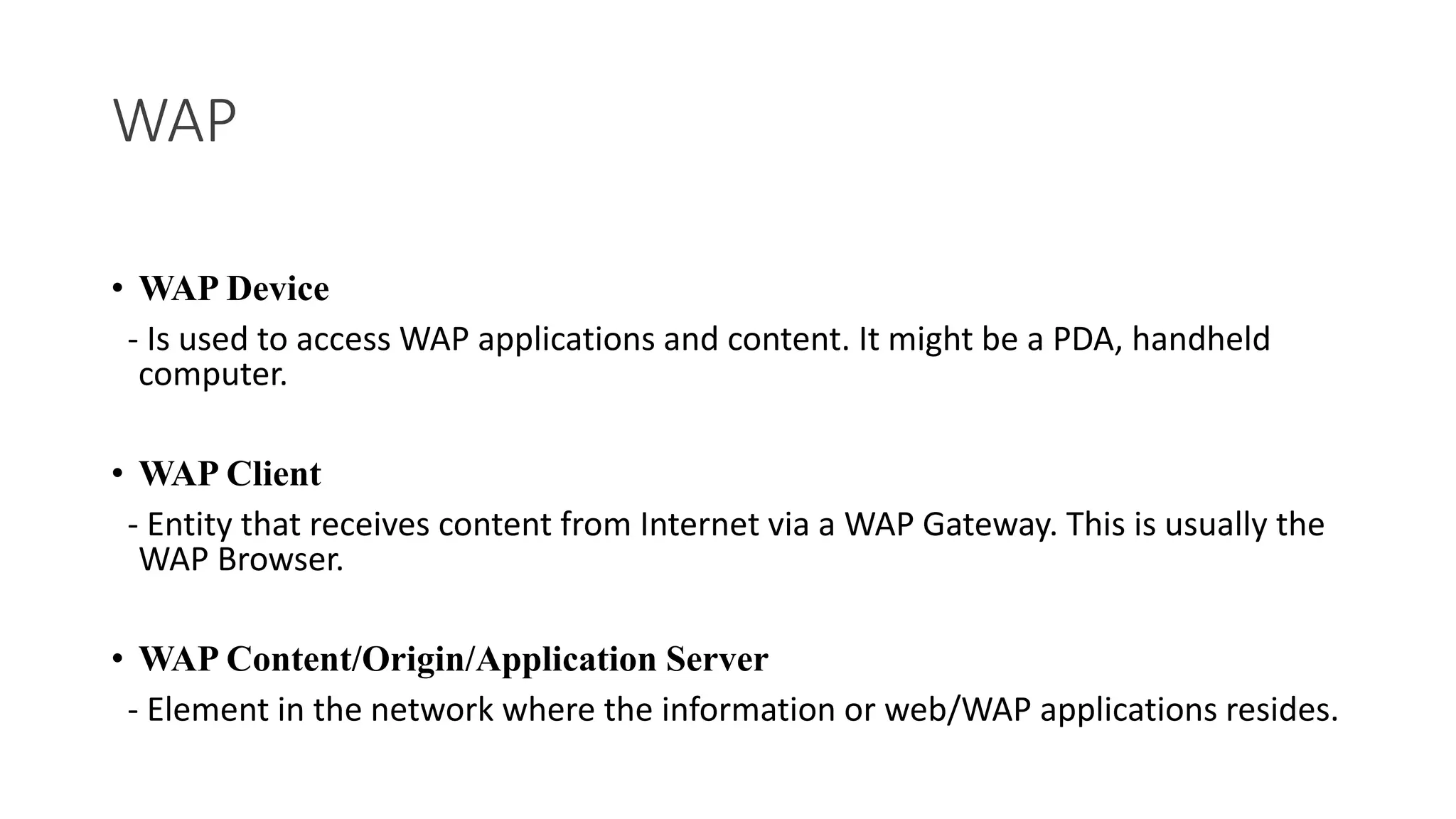
• WAP Device
- Is used to access WAP applications and content. It might be a PDA, handheld
computer.
• WAP Client
- Entity that receives content from Internet via a WAP Gateway. This is usually the
WAP Browser.
• WAP Content/Origin/Application Server
- Element in the network where the information or web/WAP applications resides.
WAP Proxy
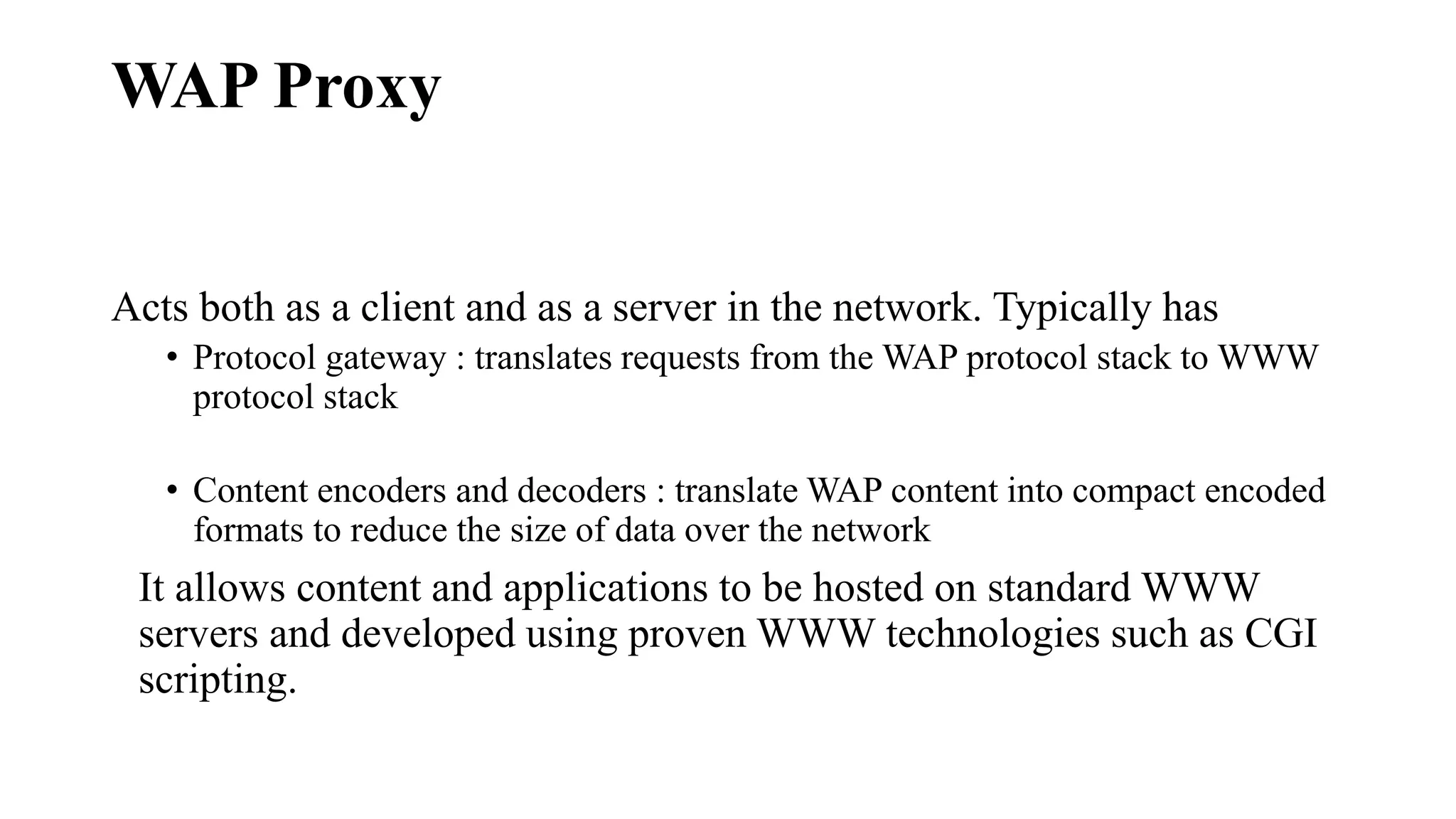
Acts both as a client and as a server in the network. Typically has
• Protocol gateway : translates requests from the WAP protocol stack to WWW
protocol stack
• Content encoders and decoders : translate WAP content into compact encoded
formats to reduce the size of data over the network
It allows content and applications to be hosted on standard WWW
servers and developed using proven WWW technologies such as CGI
scripting.
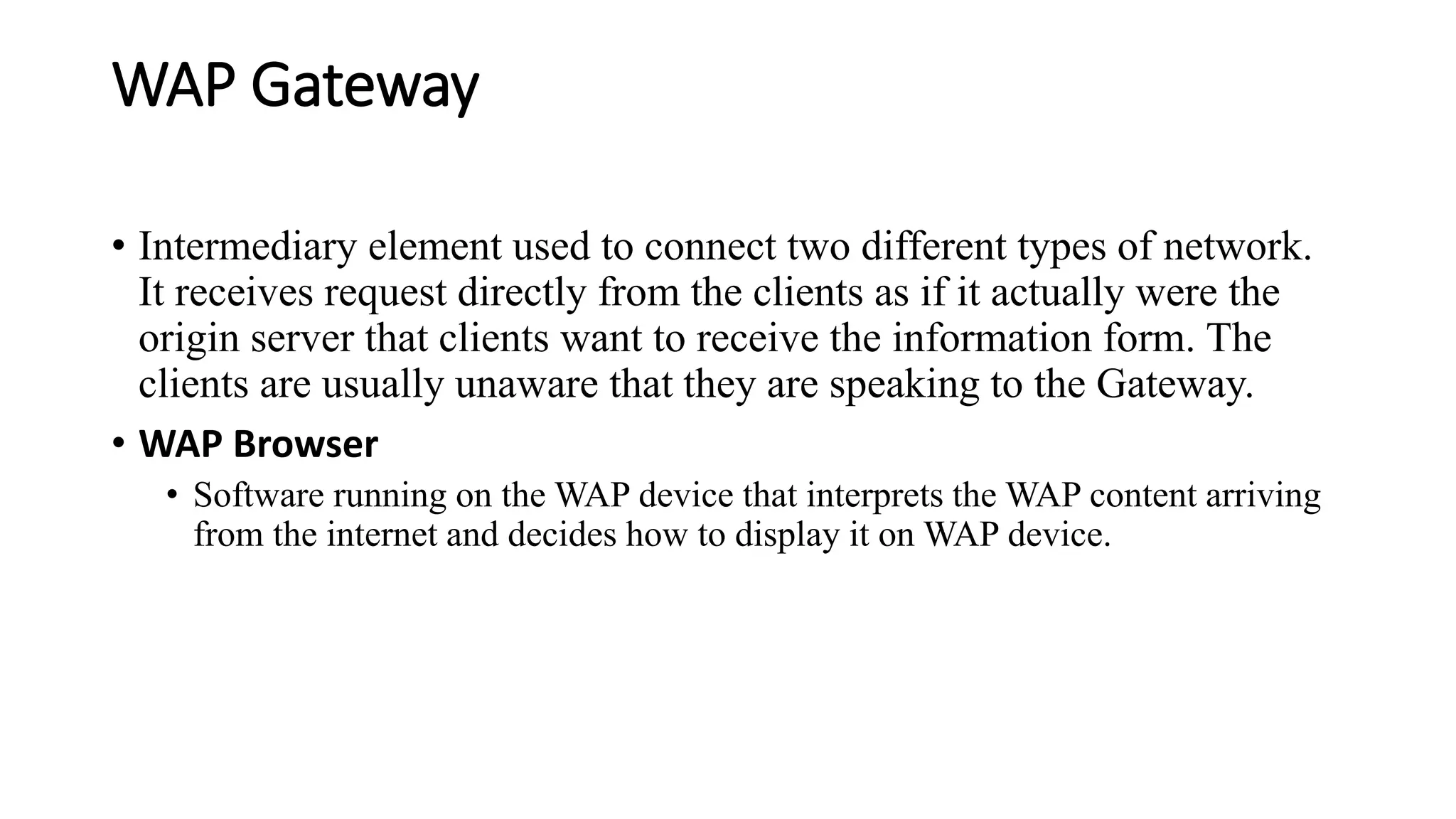
WAP Gateway
• Intermediary element used to connect two different types of network.
It receives request directly from the clients as if it actually were the
origin server that clients want to receive the information form. The
clients are usually unaware that they are speaking to the Gateway.
• WAP Browser
• Software running on the WAP device that interprets the WAP content arriving
from the internet and decides how to display it on WAP device.
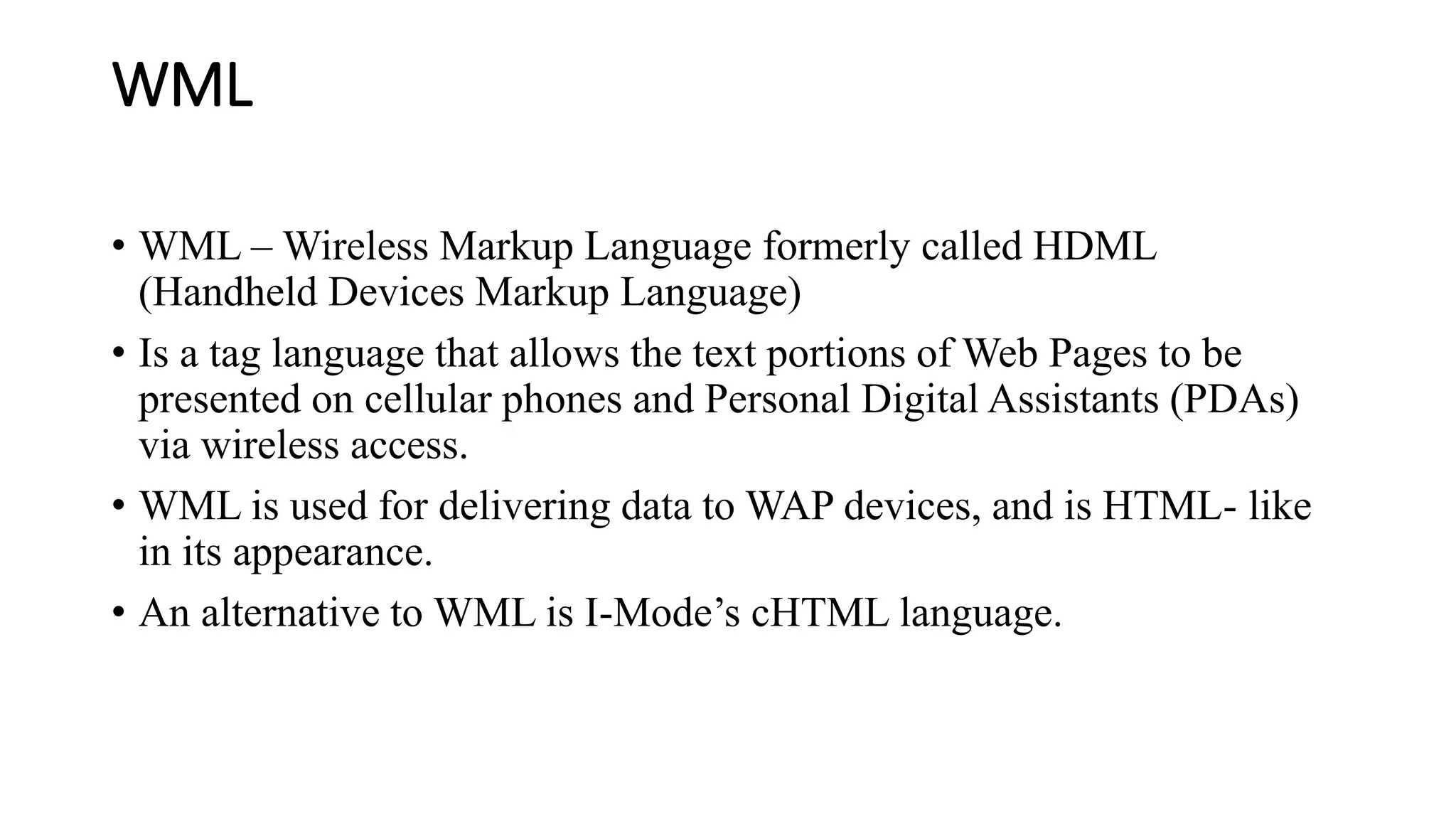
WML
• WML – Wireless Markup Language formerly called HDML
(Handheld Devices Markup Language)
• Is a tag language that allows the text portions of Web Pages to be
presented on cellular phones and Personal Digital Assistants (PDAs)
via wireless access.
• WML is used for delivering data to WAP devices, and is HTML- like
in its appearance.
• An alternative to WML is I-Mode’s cHTML language.
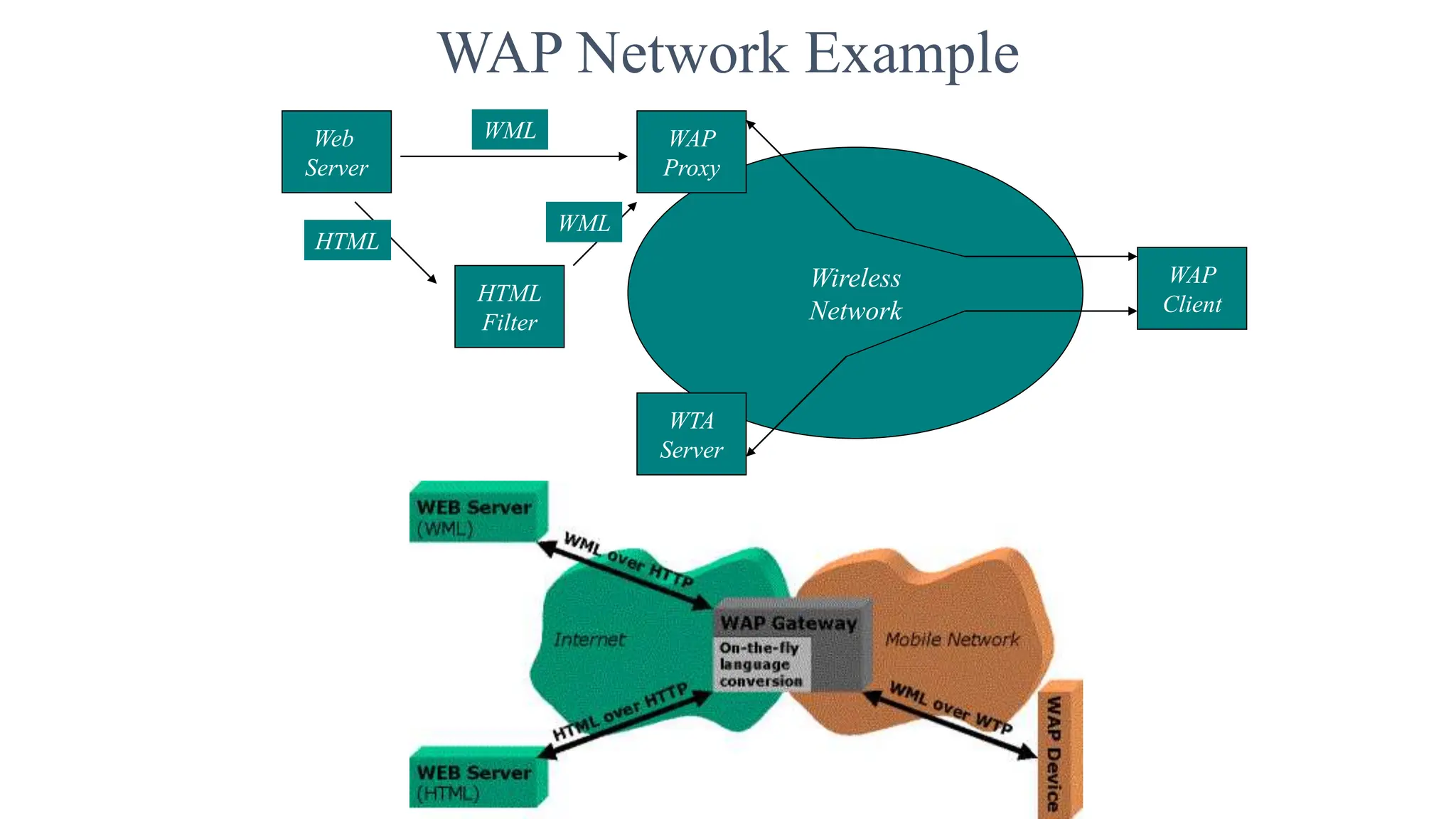
WAP Network Example
Web
Server
Wireless
Network
WAP
Proxy
HTML
Filter
WTA
Server
WAP
Client
WML
WML
HTML
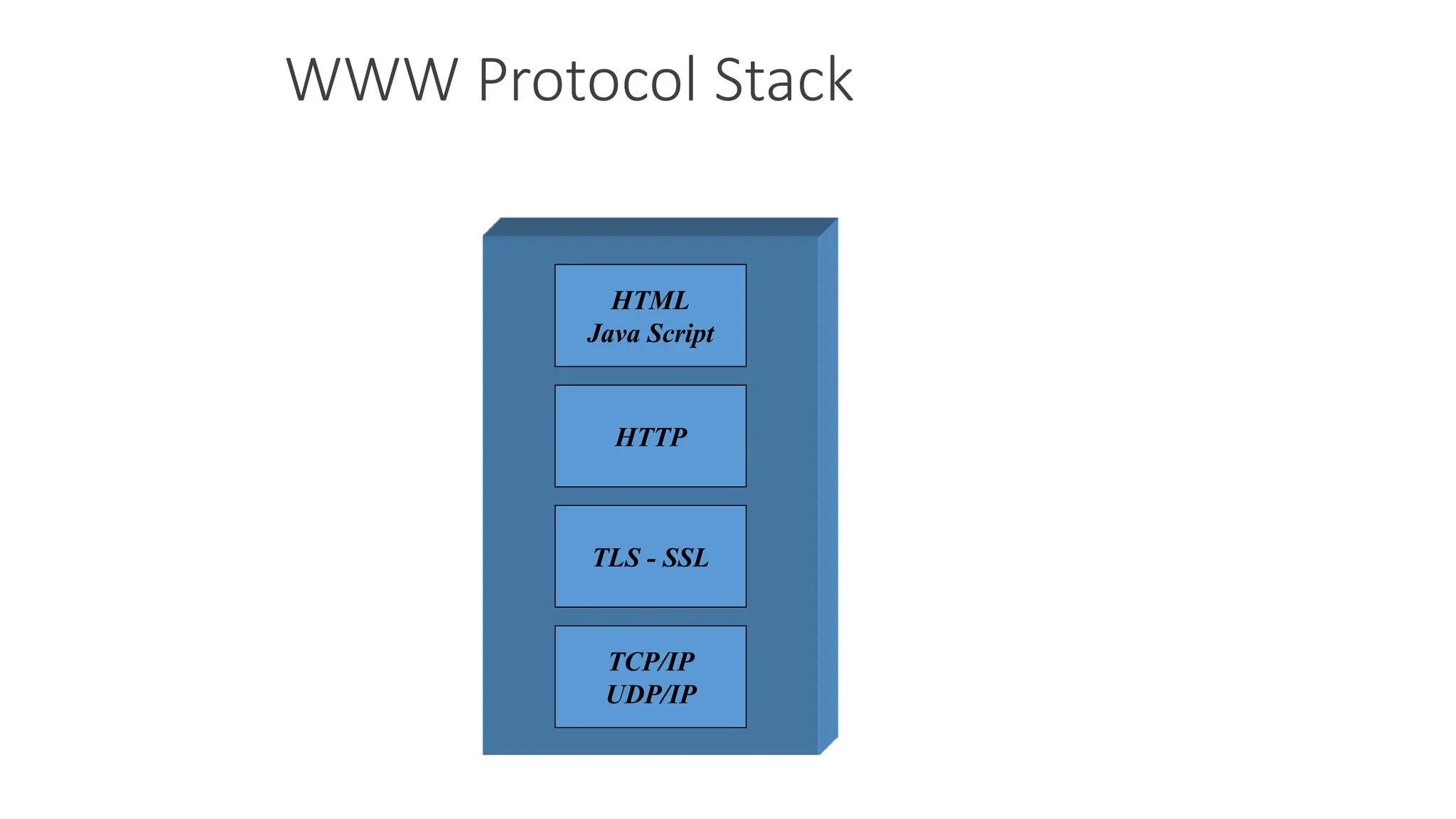
WWW Protocol Stack
TCP/IP
UDP/IP
TLS - SSL
HTTP
HTML
Java Script
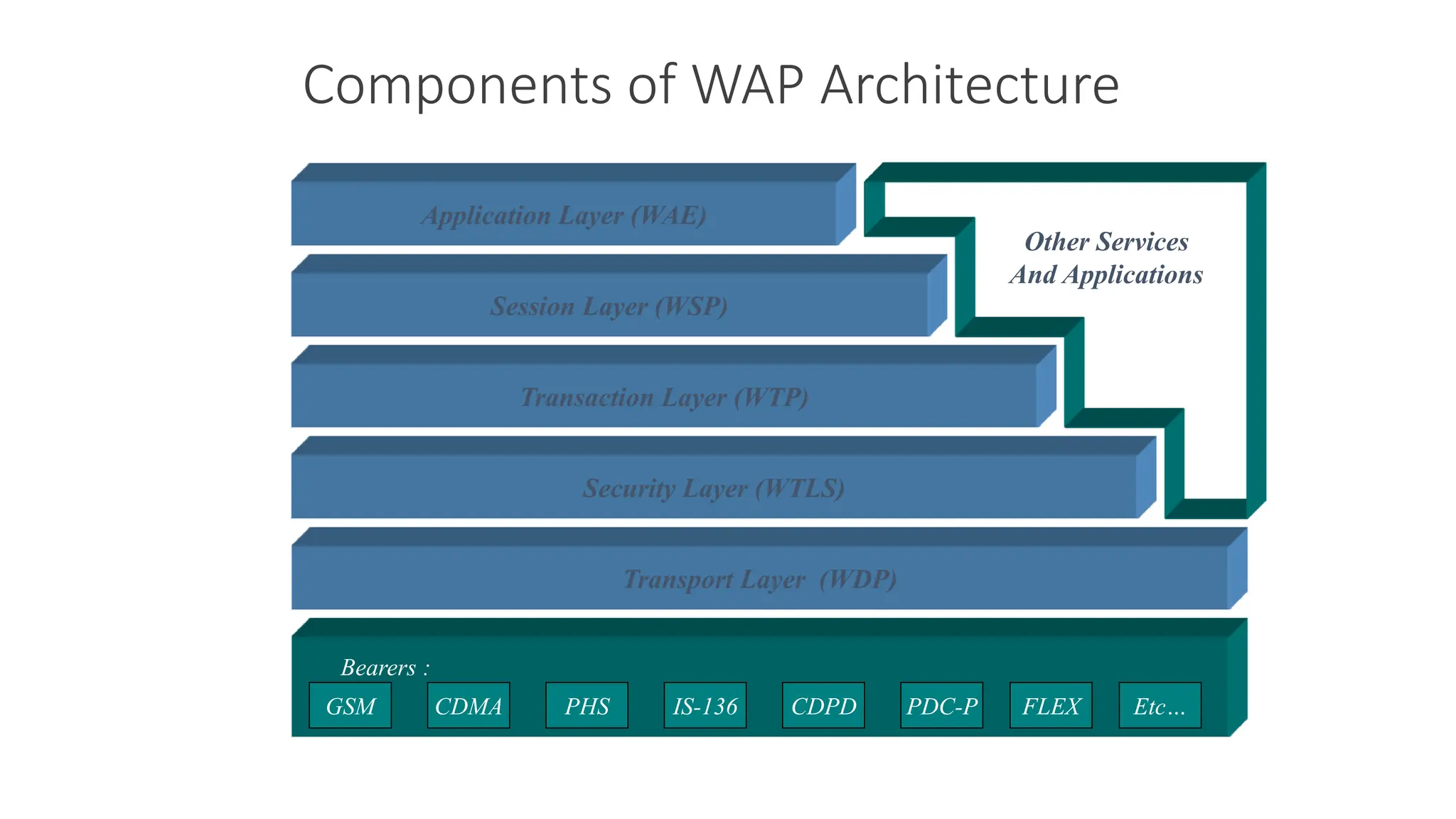
Components of WAP Architecture
Other Services
And Applications
Transport Layer (WDP)
Security Layer (WTLS)
Transaction Layer (WTP)
Session Layer (WSP)
Application Layer (WAE)
GSM CDMA PHS IS-136 CDPD PDC-P FLEX Etc…
Bearers :
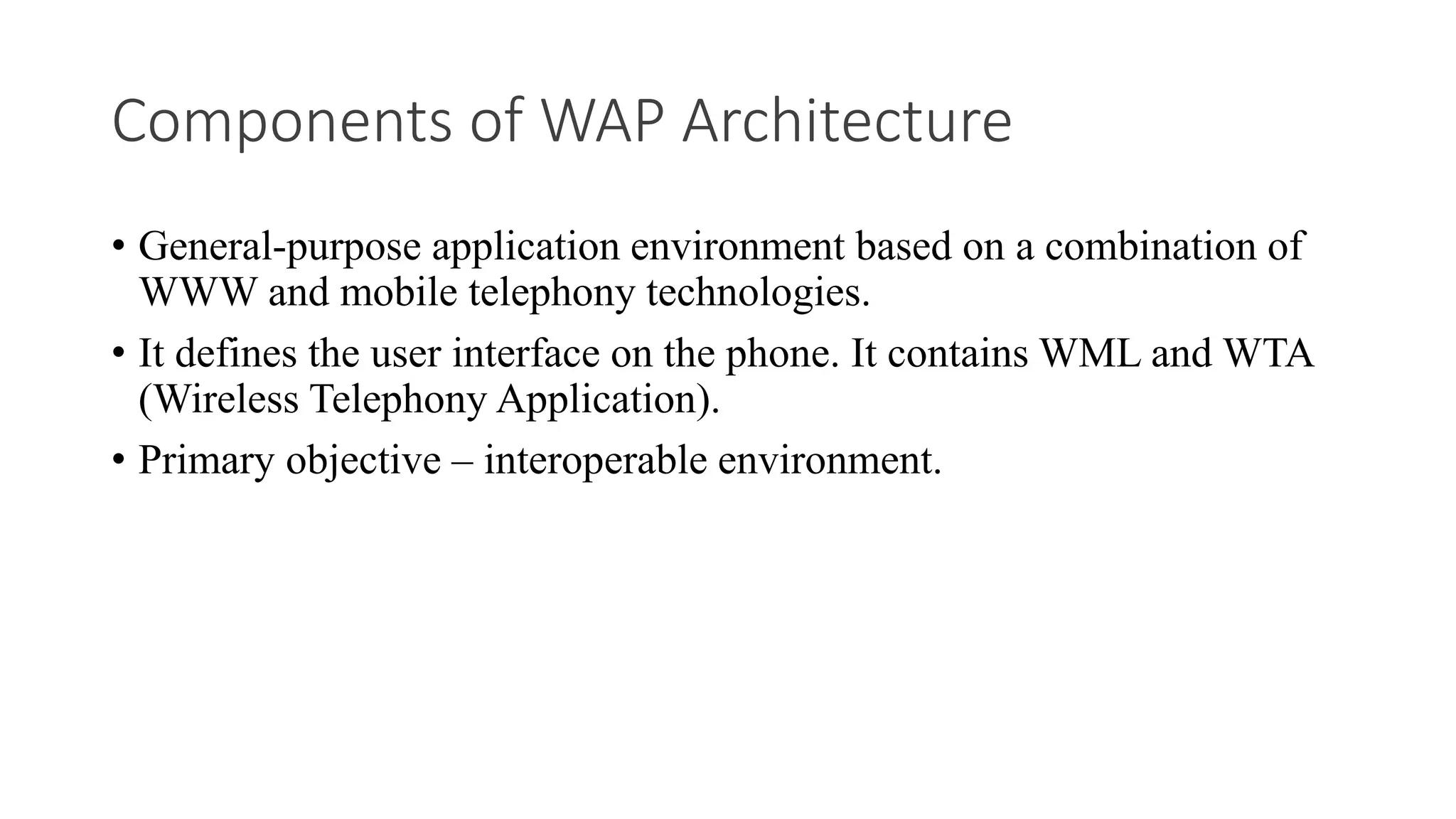
Components of WAP Architecture
• General-purpose application environment based on a combination of
WWW and mobile telephony technologies.
• It defines the user interface on the phone. It contains WML and WTA
(Wireless Telephony Application).
• Primary objective – interoperable environment.
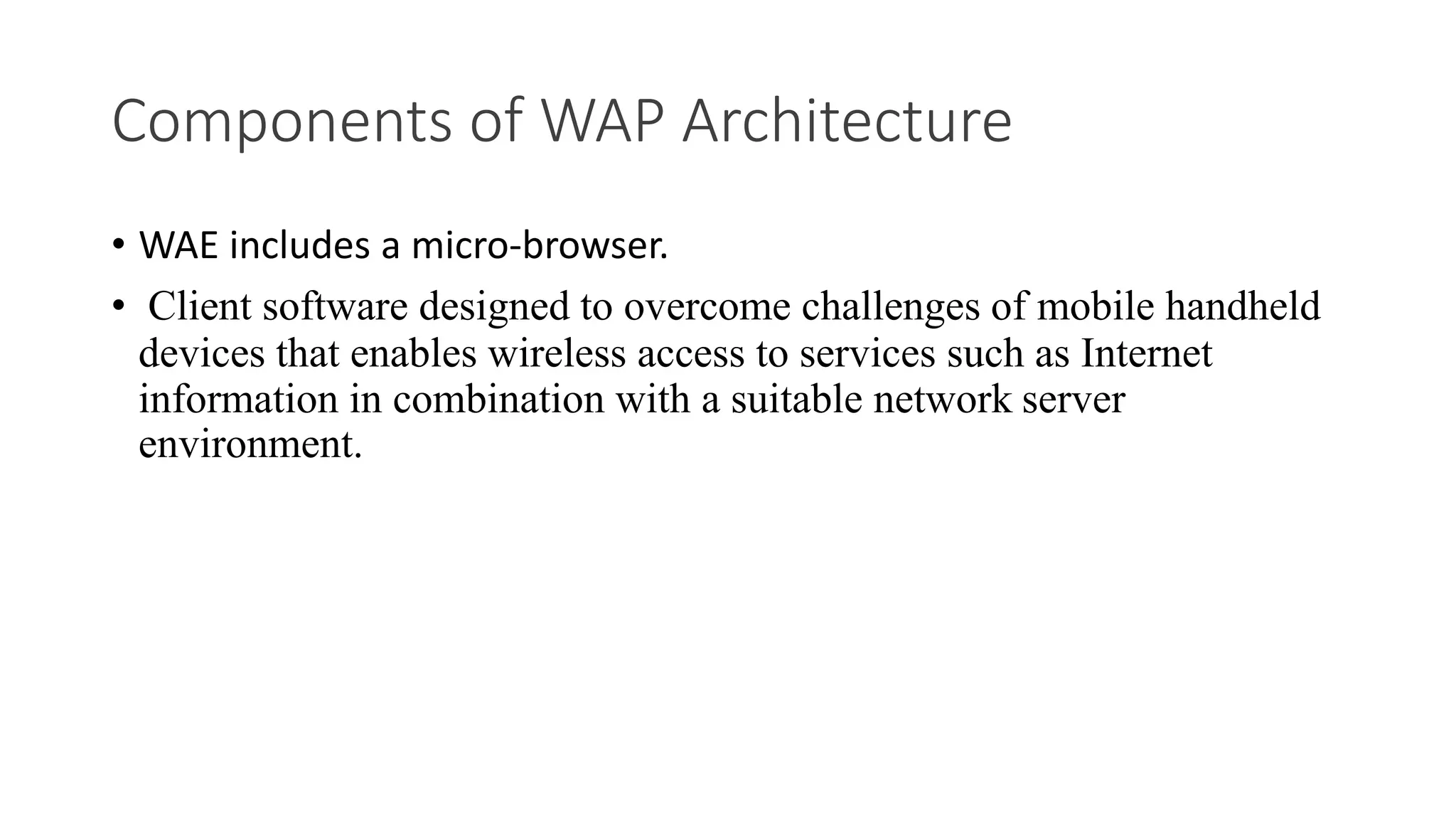
Components of WAP Architecture
• WAE includes a micro-browser.
• Client software designed to overcome challenges of mobile handheld
devices that enables wireless access to services such as Internet
information in combination with a suitable network server
environment.

FALLSEM2023-24_ITA1008_TH_VL2023240102332_2023-09-21_Reference-Material-I.pptx

  • 1.
    ITA1008 M-Commerce Module -5 Ref.Book Name : Wap -The Wireless Application Protocol Author: Sandeep Singhal et al., Publisher: Pearson Education India; 1 edition (2002)
  • 2.
    TCP/IP on mobileNetwork TCP – Transmission Control Protocol IP – Internet Protocol • Controls how data packets are formed • Addresses each packet with the source and destination address • A data packet conforming to the IP spec is called an IP datagram •Breaks information into small chucks called data packets •Manages the transfer of the packets from computer to computer •Reassembles data packets into a message at the destination
  • 3.
    TCP/IP on mobileNetwork • connection-oriented: setup required between client and server processes • reliable transport between sending and receiving process • flow control: sender won’t overwhelm receiver • congestion control: throttle sender when network overloaded • does not provide: timing, minimum throughput guarantees, security
  • 4.
    • Routers • Connectone network to another • Identify each device on a network as unique using IP protocol • Serve as the “Traffic Cop” directing packets to their destination
  • 5.
    • Example: Sendinga message from Mobile Device A to D (Mobile A) TCP - Breaks message into data packets IP - Adds address of destination Computer D (Mobile D) TCP - Checks for missing packets, reassembles message, discards duplicate packets (Router) Reads IP Address of packet, routes message to Network 2 and Computer D
  • 6.
    Over view ofWAP architecture • WAP- Wireless Application Protocol • An open, global specification that empowers mobile users with wireless devices to easily access and interact with internet information and services instantly. • The wireless industry came up with the idea of WAP. The point of this standard was to show internet contents on wireless clients, like mobile phones.
  • 7.
    Over view ofWAP architecture • WAP stands for Wireless Application Protocol o WAP is an application communication protocol o WAP is used to access services and information o WAP is inherited from Internet standards o WAP is for handheld devices such as mobile phones o WAP is a protocol designed for micro browsers o WAP enables the creating of web applications for mobile devices. o WAP uses the mark-up language WML (not HTML) WML is defined as an XML 1.0 application
  • 8.
    Purpose of WAP Toenable easy, fast delivery of relevant information and services to mobile users. Type of devices that use WAP Handheld digital wireless devices such as mobile phones, ipad, two-way radios, smart phones and communicators -- from low-end to high-end. WAP works with most Wireless networks such as: CDPD, CDMA, GSM, PDC, PHS, TDMA, FLEX, ReFLEX, iDEN, TETRA, DECT, DataTAC, Mobitex.
  • 9.
    Architecture Overview • Client–Server Architecture CGI, Scripts, Etc. Content Web Server Client Web Browser Request (URL) Response (Content)
  • 10.
    WAP Programming Model CGI, Scripts, Etc. Content WebServer Client WAE User Agent Request (URL) Response (Content) Gateway Encoders And Decoders Encoded Request Encoded Response
  • 11.
    WAP • WAP Device -Is used to access WAP applications and content. It might be a PDA, handheld computer. • WAP Client - Entity that receives content from Internet via a WAP Gateway. This is usually the WAP Browser. • WAP Content/Origin/Application Server - Element in the network where the information or web/WAP applications resides.
  • 12.
    WAP Proxy Acts bothas a client and as a server in the network. Typically has • Protocol gateway : translates requests from the WAP protocol stack to WWW protocol stack • Content encoders and decoders : translate WAP content into compact encoded formats to reduce the size of data over the network It allows content and applications to be hosted on standard WWW servers and developed using proven WWW technologies such as CGI scripting.
  • 13.
    WAP Gateway • Intermediaryelement used to connect two different types of network. It receives request directly from the clients as if it actually were the origin server that clients want to receive the information form. The clients are usually unaware that they are speaking to the Gateway. • WAP Browser • Software running on the WAP device that interprets the WAP content arriving from the internet and decides how to display it on WAP device.
  • 14.
    WML • WML –Wireless Markup Language formerly called HDML (Handheld Devices Markup Language) • Is a tag language that allows the text portions of Web Pages to be presented on cellular phones and Personal Digital Assistants (PDAs) via wireless access. • WML is used for delivering data to WAP devices, and is HTML- like in its appearance. • An alternative to WML is I-Mode’s cHTML language.
  • 15.
  • 16.
    WWW Protocol Stack TCP/IP UDP/IP TLS- SSL HTTP HTML Java Script
  • 17.
    Components of WAPArchitecture Other Services And Applications Transport Layer (WDP) Security Layer (WTLS) Transaction Layer (WTP) Session Layer (WSP) Application Layer (WAE) GSM CDMA PHS IS-136 CDPD PDC-P FLEX Etc… Bearers :
  • 18.
    Components of WAPArchitecture • General-purpose application environment based on a combination of WWW and mobile telephony technologies. • It defines the user interface on the phone. It contains WML and WTA (Wireless Telephony Application). • Primary objective – interoperable environment.
  • 19.
    Components of WAPArchitecture • WAE includes a micro-browser. • Client software designed to overcome challenges of mobile handheld devices that enables wireless access to services such as Internet information in combination with a suitable network server environment.