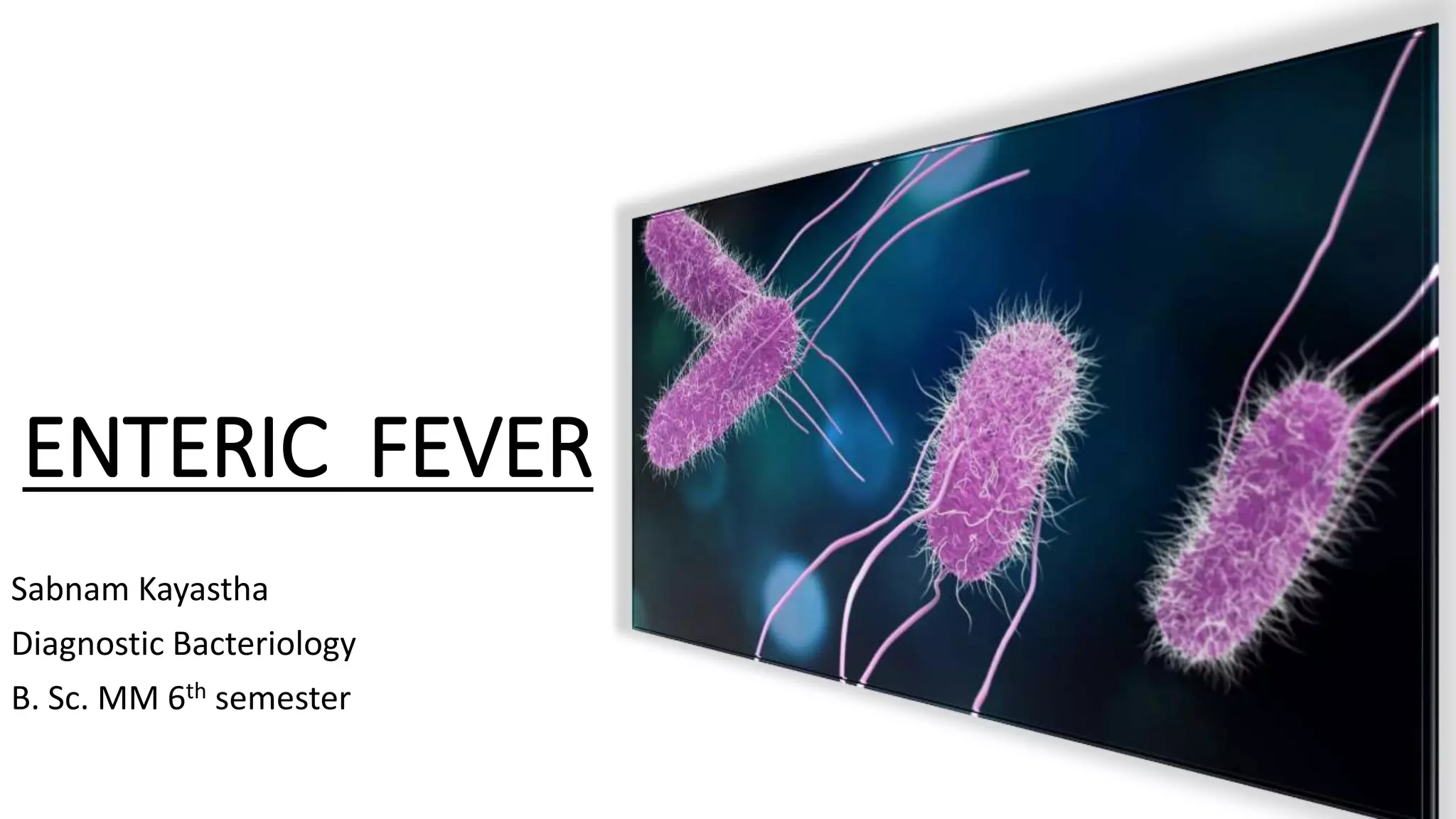
ENTERIC FEVER
Sabnam Kayastha
Diagnostic Bacteriology
B. Sc. MM 6th semester
INTRODUCTION
• Enteric fever is caused by Salmonella typhi and Salmonella paratyphi
subtypes, also known as typhoid fever.
• Enteric fever is an acute illness characterized by fever, headache and
abdominal discomfort.
• Non typhoidal Salmonella causes food poisoning, gastroenteritis.
• Humans are the only source of this infection and the spread is from
person to person via contaminated food and water.
ETIOLOGY
• Salmonella typhi and Salmonella paratyphi A, B and C are the
causative agent of enteric fever.
• They are member of enterobacteriaceae family, Gram negative bacilli,
non sporing, non capsulated and generally motile.
VIRULANCE FACTORS
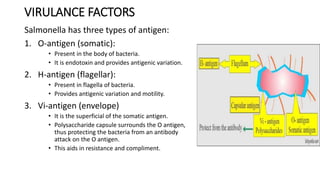
Salmonella has three types of antigen:
1. O-antigen (somatic):
• Present in the body of bacteria.
• It is endotoxin and provides antigenic variation.
2. H-antigen (flagellar):
• Present in flagella of bacteria.
• Provides antigenic variation and motility.
3. Vi-antigen (envelope)
• It is the superficial of the somatic antigen.
• Polysaccharide capsule surrounds the O antigen,
thus protecting the bacteria from an antibody
attack on the O antigen.
• This aids in resistance and compliment.
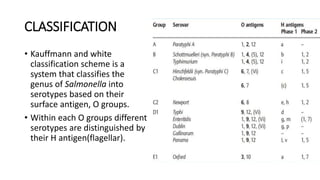
CLASSIFICATION
• Kauffmann and white
classification scheme is a
system that classifies the
genus of Salmonella into
serotypes based on their
surface antigen, O groups.
• Within each O groups different
serotypes are distinguished by
their H antigen(flagellar).
MODE OF INFECTION
• Contaminated food and meat
• Contaminated water supply
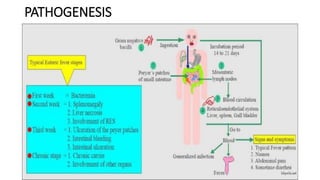
PATHOGENESIS
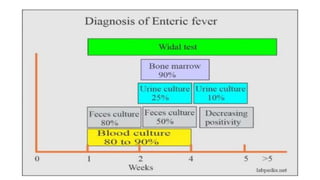
LAB DIAGNOSIS
1. Specimen collection
• Blood: first 10days and during 3rd weeks. 5-10ml venomous blood is collected
aseptically, inoculated in 50-100ml broth and incubated at 37’c for 24hrs.
• Feces: during 2nd and 3rd week.
• Urine: 3rd week. (not as useful as blood culture)
• Bone marrow: in case of chronic salmonellosis.
CULTURAL CHARACTERISTICS
• Grows in ordinary media.
• Aerobic and facultative anaerobe.
• Optimum tempeture is 37’c.
• On Blood Agar colonies are circular, low convex, smooth, greyish white,
translucent and non hemolytic.
• On MacConkey agar colonies are non-lactose fermenter i.e. pale yellow colonies
measuring about 1-3mm in diameter.
• Salmonella Shigella agar, colonies are color less with black center due to
production of H2S.
Continue..
• On Deoxycholate agar colonies are colorless, non-lactose fermenter and smaller
colonies than in MA.
• Wilson and Blair bismuth sulphate medium colonies are black with metallic
sheen due to production of H2S.
• Xylose Lysine Dextrose agar, the colonies are red due to fermentation of xylose
with black center due to production of H2S.
• Selenite F broth and Tetrathionate broth is the enrichment medium for
Salmonella typhi. The fecal specimen inoculated in selenite F broth are incubated
for 6-12hrs before subculture.
• Incase of negative subculture, the process is repeated for 10days and reported as
negative.
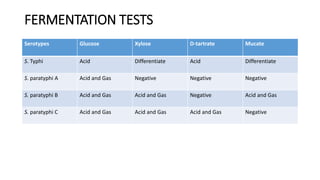
FERMENTATION TESTS
Serotypes Glucose Xylose D-tartrate Mucate
S. Typhi Acid Differentiate Acid Differentiate
S. paratyphi A Acid and Gas Negative Negative Negative
S. paratyphi B Acid and Gas Acid and Gas Negative Acid and Gas
S. paratyphi C Acid and Gas Acid and Gas Acid and Gas Negative
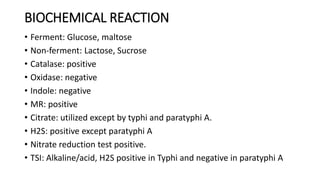
BIOCHEMICAL REACTION
• Ferment: Glucose, maltose
• Non-ferment: Lactose, Sucrose
• Catalase: positive
• Oxidase: negative
• Indole: negative
• MR: positive
• Citrate: utilized except by typhi and paratyphi A.
• H2S: positive except paratyphi A
• Nitrate reduction test positive.
• TSI: Alkaline/acid, H2S positive in Typhi and negative in paratyphi A
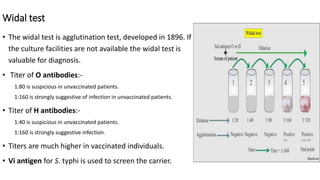
Widal test
• The widal test is agglutination test, developed in 1896. If
the culture facilities are not available the widal test is
valuable for diagnosis.
• Titer of O antibodies:-
1:80 is suspicious in unvaccinated patients.
1:160 is strongly suggestive of infection in unvaccinated patients.
• Titer of H antibodies:-
1:40 is suspicious in unvaccinated patients.
1:160 is strongly suggestive infection.
• Titers are much higher in vaccinated individuals.
• Vi antigen for S. typhi is used to screen the carrier.
Drawbacks of the Widal test:
• Antibodies are absent in the early illness, may appear after 7 days.
• Antibodies may not develop due to antibiotic therapy.
• Antibody response is variable and does not correlate with the severity of the disease.
• In some patients, there is no adequate level of O-antibody titer.
Other culture method include:
• Castaneda’s method
• It is a biphasic medium used to minimize contamination.
• Clot culture
• Clot cultures are better for the isolation of bacteria.
• In this method the blood is allowed to clot and after 30 minutes, centrifuged it and remove
the clot and put in a streptokinase broth.
• The serum from the clot has lot of antibodies which the clot doesn’t have and hence useful in
investigation.
Treatment
• The drug of choice is Ciprofloxacin.
• Chloramphenicol is also effective, but this may have serious side
effects.
• Co-trimoxazole is also used and has less serious side effects than
Chloramphenicol.
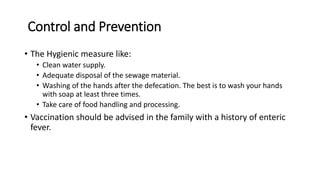
Control and Prevention
• The Hygienic measure like:
• Clean water supply.
• Adequate disposal of the sewage material.
• Washing of the hands after the defecation. The best is to wash your hands
with soap at least three times.
• Take care of food handling and processing.
• Vaccination should be advised in the family with a history of enteric
fever.
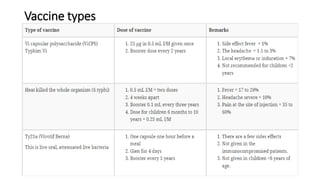
Vaccine types
THANK YOU
ANY QUERIES?

ENTERIC FEVER.pptx

  • 1.
    ENTERIC FEVER Sabnam Kayastha DiagnosticBacteriology B. Sc. MM 6th semester
  • 2.
    INTRODUCTION • Enteric feveris caused by Salmonella typhi and Salmonella paratyphi subtypes, also known as typhoid fever. • Enteric fever is an acute illness characterized by fever, headache and abdominal discomfort. • Non typhoidal Salmonella causes food poisoning, gastroenteritis. • Humans are the only source of this infection and the spread is from person to person via contaminated food and water.
  • 3.
    ETIOLOGY • Salmonella typhiand Salmonella paratyphi A, B and C are the causative agent of enteric fever. • They are member of enterobacteriaceae family, Gram negative bacilli, non sporing, non capsulated and generally motile.
  • 4.
    VIRULANCE FACTORS Salmonella hasthree types of antigen: 1. O-antigen (somatic): • Present in the body of bacteria. • It is endotoxin and provides antigenic variation. 2. H-antigen (flagellar): • Present in flagella of bacteria. • Provides antigenic variation and motility. 3. Vi-antigen (envelope) • It is the superficial of the somatic antigen. • Polysaccharide capsule surrounds the O antigen, thus protecting the bacteria from an antibody attack on the O antigen. • This aids in resistance and compliment.
  • 5.
    CLASSIFICATION • Kauffmann andwhite classification scheme is a system that classifies the genus of Salmonella into serotypes based on their surface antigen, O groups. • Within each O groups different serotypes are distinguished by their H antigen(flagellar).
  • 6.
    MODE OF INFECTION •Contaminated food and meat • Contaminated water supply
  • 7.
  • 8.
    LAB DIAGNOSIS 1. Specimencollection • Blood: first 10days and during 3rd weeks. 5-10ml venomous blood is collected aseptically, inoculated in 50-100ml broth and incubated at 37’c for 24hrs. • Feces: during 2nd and 3rd week. • Urine: 3rd week. (not as useful as blood culture) • Bone marrow: in case of chronic salmonellosis.
  • 10.
    CULTURAL CHARACTERISTICS • Growsin ordinary media. • Aerobic and facultative anaerobe. • Optimum tempeture is 37’c. • On Blood Agar colonies are circular, low convex, smooth, greyish white, translucent and non hemolytic. • On MacConkey agar colonies are non-lactose fermenter i.e. pale yellow colonies measuring about 1-3mm in diameter. • Salmonella Shigella agar, colonies are color less with black center due to production of H2S.
  • 11.
    Continue.. • On Deoxycholateagar colonies are colorless, non-lactose fermenter and smaller colonies than in MA. • Wilson and Blair bismuth sulphate medium colonies are black with metallic sheen due to production of H2S. • Xylose Lysine Dextrose agar, the colonies are red due to fermentation of xylose with black center due to production of H2S. • Selenite F broth and Tetrathionate broth is the enrichment medium for Salmonella typhi. The fecal specimen inoculated in selenite F broth are incubated for 6-12hrs before subculture. • Incase of negative subculture, the process is repeated for 10days and reported as negative.
  • 12.
    FERMENTATION TESTS Serotypes GlucoseXylose D-tartrate Mucate S. Typhi Acid Differentiate Acid Differentiate S. paratyphi A Acid and Gas Negative Negative Negative S. paratyphi B Acid and Gas Acid and Gas Negative Acid and Gas S. paratyphi C Acid and Gas Acid and Gas Acid and Gas Negative
  • 13.
    BIOCHEMICAL REACTION • Ferment:Glucose, maltose • Non-ferment: Lactose, Sucrose • Catalase: positive • Oxidase: negative • Indole: negative • MR: positive • Citrate: utilized except by typhi and paratyphi A. • H2S: positive except paratyphi A • Nitrate reduction test positive. • TSI: Alkaline/acid, H2S positive in Typhi and negative in paratyphi A
  • 14.
    Widal test • Thewidal test is agglutination test, developed in 1896. If the culture facilities are not available the widal test is valuable for diagnosis. • Titer of O antibodies:- 1:80 is suspicious in unvaccinated patients. 1:160 is strongly suggestive of infection in unvaccinated patients. • Titer of H antibodies:- 1:40 is suspicious in unvaccinated patients. 1:160 is strongly suggestive infection. • Titers are much higher in vaccinated individuals. • Vi antigen for S. typhi is used to screen the carrier.
  • 15.
    Drawbacks of theWidal test: • Antibodies are absent in the early illness, may appear after 7 days. • Antibodies may not develop due to antibiotic therapy. • Antibody response is variable and does not correlate with the severity of the disease. • In some patients, there is no adequate level of O-antibody titer. Other culture method include: • Castaneda’s method • It is a biphasic medium used to minimize contamination. • Clot culture • Clot cultures are better for the isolation of bacteria. • In this method the blood is allowed to clot and after 30 minutes, centrifuged it and remove the clot and put in a streptokinase broth. • The serum from the clot has lot of antibodies which the clot doesn’t have and hence useful in investigation.
  • 16.
    Treatment • The drugof choice is Ciprofloxacin. • Chloramphenicol is also effective, but this may have serious side effects. • Co-trimoxazole is also used and has less serious side effects than Chloramphenicol.
  • 17.
    Control and Prevention •The Hygienic measure like: • Clean water supply. • Adequate disposal of the sewage material. • Washing of the hands after the defecation. The best is to wash your hands with soap at least three times. • Take care of food handling and processing. • Vaccination should be advised in the family with a history of enteric fever.
  • 18.
  • 19.