Dr Adhya Dubey
JR-2
Dept Of Community Medicine
Pt. B D Sharma PGIMS, Rohtak
INTRODUCTION
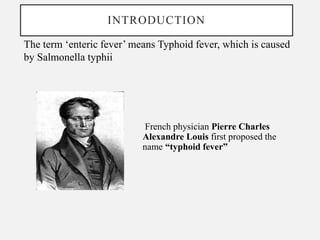
French physician Pierre Charles
Alexandre Louis first proposed the
name “typhoid fever”
The term ‘enteric fever’ means Typhoid fever, which is caused
by Salmonella typhii
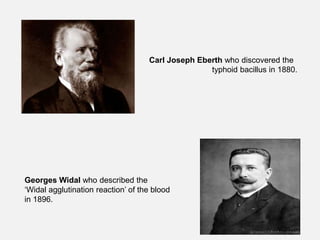
Carl Joseph Eberth who discovered the
typhoid bacillus in 1880.
Georges Widal who described the
‘Widal agglutination reaction’ of the blood
in 1896.
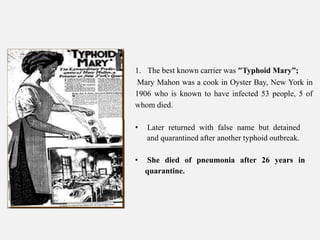
1. The best known carrier was "Typhoid Mary”;
Mary Mahon was a cook in Oyster Bay, New York in
1906 who is known to have infected 53 people, 5 of
whom died.
• Later returned with false name but detained
and quarantined after another typhoid outbreak.
• She died of pneumonia after 26 years in
quarantine.
DEFINITION
Typhoid fever, or enteric fever, is a potentially fatal
multisystemic infection produced primarily by Salmonella
enterica serotype typhi and to a lesser extent Salmonella
enterica serotypes paratyphi A, B, and C.
Acute generalised infection of the reticuloendothelial system,
intestinal lymphoid tissue and the gall bladder.
EPIDEMIOLOGY
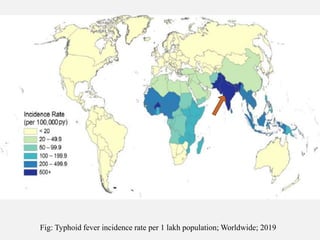
• An estimated 11–21 million cases of typhoid fever and 5 million cases of paratyphoid fever
occur worldwide each year, causing an estimated 135,000–230,000 deaths.
• Improved living conditions and introduction of antibiotics has resulted in a drastic reduction
of typhoid fever morbidity and mortality in industrialised countries.
• The disease continues to be a public health problem in many developing areas of the WHO
African, Eastern Mediterranean, South-East Asia and Western Pacific Regions.
• Typhoid risk is higher in populations that lack access to safe water and adequate sanitation,
and children are at highest risk
Fig: Typhoid fever incidence rate per 1 lakh population; Worldwide; 2019
ETIOLOGY
1. Caused by the bacterium Salmonella Typhi and paratyphi A, B and C.
2. Ingestion of contaminated food or water.
3. Contact with an acute case of typhoid fever or chronic asymptomatic carrier.
4. Salmonella enteriditis and Salmonella typhimurium are other salmonella bacteria,
cause food poisoning and diarrhoea.
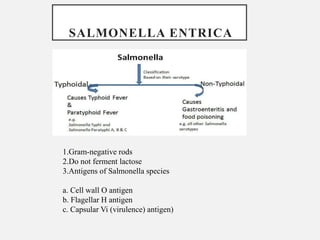
SALMONELLA ENTRICA
1.Gram-negative rods
2.Do not ferment lactose
3.Antigens of Salmonella species
a. Cell wall O antigen
b. Flagellar H antigen
c. Capsular Vi (virulence) antigen)
SYMPTOMS
There are four stages of typhoid fever, and each step might last for one week.
The typhoid incubation period usually takes 7–14 days after ingestion of S. typhi.
The stages are as follows:
1.First stage
2.Second stage
3.Third stage
4.Fourth stage
• First stage: The patient exhibits some early typhoid symptoms during this stage
(first week), such as abdominal pain (right upper), difficult-to-pass stools, dry
cough, delirium, stupor, malaise and dull headache. Each day, the temperature
rises and then falls by the following morning. Over time, the temperature
gradually increases.
• Second stage: In this stage (second week), there will be a progression of first-
stage symptoms, such as
 Body temperature rises to 102 to 104 degrees Fahrenheit
 Abdominal swelling
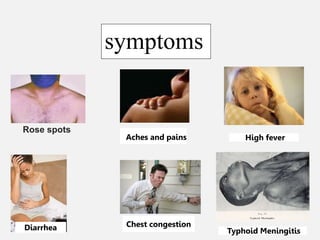
 The appearance of rose spots on the chest, back and abdomen might resolve in 2-
5 days (~30% of the patients experience this).
Rose spots
High fever
Diarrhea Typhoid Meningitis
Aches and pains
Chest congestion
symptoms
Third stage: This is the serious stage, where the patient may experience the
following
•Decreases in weight
•Conjunctivitis
•Tachypnea
•Increase in toxaemia
•Anorexia
•Crackling sound from the base of the lungs
•Severe abdominal distension
•Liquid diarrhoea (foul, green-yellow)
•Increase delirium's intensity
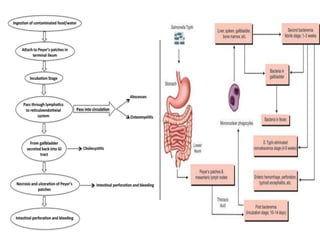
•Bowel perforation and peritonitis can develop as a result of necrosis in Peyer's
patches.
•Death may occur due to severe toxaemia, myocarditis or intestinal bleeding.
Fourth stage: Extremely high fever is the defining feature of this typhoid
stage.
•Over a few days, the fever, mental state, and abdominal discomfort gradually
improved.
•Patients who are not treated could develop intestinal and neurological issues.
•Loss of weight and extreme weakness (may last for months)
•Some patients with an asymptomatic carrier condition can continue
transmitting the bacterium.
RDT for antibody- Detection of antibody against Salmonella in single serum specimens
Sensitivity: 69%–78%, specificity: 77%–90%
Turnaround time 2–4 hours
No RDT for enteric fever is accurate enough to replace reference tests.
Confirmatory test: Culture-Isolation of enteric fever Salmonella from blood and bone marrow
Sensitivity: 40%–87% in blood and 80% in marrow, specificity: 100%
Isolation allows drug sensitivity testing
Turnaround time 3–6 days.
Widal test† ≥4-fold rise in titer*
Sensitivity depends on local prevalence, specificity: 100%
Affordable
≥4 fold increase may not occur in partially treated patients, ≥4-fold rise can be missed if antibody
level peaks before first specimen is collected.
DIAGNOSIS
WIDAL TEST
" A test involving agglutination of typhoid bacilli when they are mixed with serum
containing typhoid antibodies from an individual having typhoid fever; used to
detect the presence of Salmonella typhi and S. paratyphi”
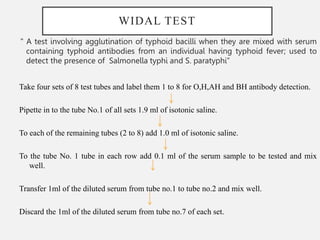
Take four sets of 8 test tubes and label them 1 to 8 for O,H,AH and BH antibody detection.
Pipette in to the tube No.1 of all sets 1.9 ml of isotonic saline.
To each of the remaining tubes (2 to 8) add 1.0 ml of isotonic saline.
To the tube No. 1 tube in each row add 0.1 ml of the serum sample to be tested and mix
well.
Transfer 1ml of the diluted serum from tube no.1 to tube no.2 and mix well.
Discard the 1ml of the diluted serum from tube no.7 of each set.
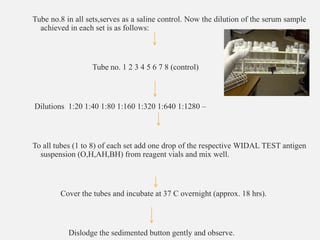
Tube no.8 in all sets,serves as a saline control. Now the dilution of the serum sample
achieved in each set is as follows:
Tube no. 1 2 3 4 5 6 7 8 (control)
Dilutions 1:20 1:40 1:80 1:160 1:320 1:640 1:1280 –
To all tubes (1 to 8) of each set add one drop of the respective WIDAL TEST antigen
suspension (O,H,AH,BH) from reagent vials and mix well.
Cover the tubes and incubate at 37 C overnight (approx. 18 hrs).
Dislodge the sedimented button gently and observe.
RESULT FOR THE WIDAL TEST
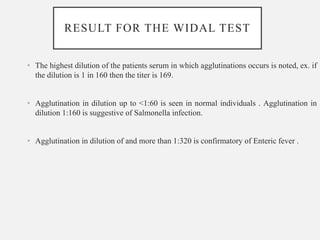
• The highest dilution of the patients serum in which agglutinations occurs is noted, ex. if
the dilution is 1 in 160 then the titer is 169.
• Agglutination in dilution up to <1:60 is seen in normal individuals . Agglutination in
dilution 1:160 is suggestive of Salmonella infection.
• Agglutination in dilution of and more than 1:320 is confirmatory of Enteric fever .
Prevention
And
Treatment
Early antibiotic treatment is essential to decrease mortality.
Can be started empirically if clinical suspicion is strong.
• Tepid sponging to bring down temperature.
• Tab Paracetamol 10mg/kg TDS for 4 days.
• Presumptive treatment for malaria after collecting blood slide viz
Tab Chloroquine (Base) 10mg/kg stat
• First line antibiotic- Oral Ciprofloxacin / Ofloxacin- 7.5mg/kg BD for 5-7 days (drug of
choice even in MDR Typhoid)
• Second line antibiotics (Widespread resistance reported in India)
 Oral Amoxicillin 25mg/kg TDS for 10-14 days.
 Oral Trimethoprim/ Sulphamethoxazole 4/20 mg/kg BD for -14 days.
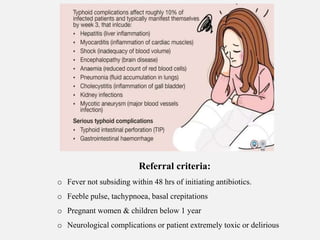
Referral criteria:
o Fever not subsiding within 48 hrs of initiating antibiotics.
o Feeble pulse, tachypnoea, basal crepitations
o Pregnant women & children below 1 year
o Neurological complications or patient extremely toxic or delirious
Surgical Care
Usually indicated in cases of intestinal perforation.
Most surgeons prefer simple closure of the perforation with drainage of the peritoneum.
Small-bowel resection is indicated for patients with multiple perforations.
If antibiotic treatment fails to eradicate the hepatobiliary carriage, the gallbladder should be
resected.
Cholecystectomy is not always successful in eradicating the carrier state because of persisting
hepatic infection.
Diet
Fluids and electrolytes should be monitored and replaced diligently.
Oral nutrition with a soft digestible diet is preferable in the absence of abdominal distension or
ileus.
Activity
No specific limitations on activity are indicated.
Rest is helpful, but mobility should be maintained if tolerable.
The patient should be encouraged to stay home from work until recovery
1. Treatment of patients and carriers
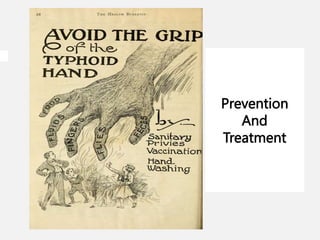
2. Education on handwashing, particularly food handlers, patients and childcare givers
3. Sanitary disposal of feces and control of flies.
4. Provision of safe and adequate water
5. Safe handling of food.
6. Exclusion of typhoid carriers and patients from handling of food and patients
7. Immunization for people at special risk (e.g. Travelers to endemic areas)8. Regular check-up
of food handlers in food and drinking establishments
PREVENTION AND CONTROL
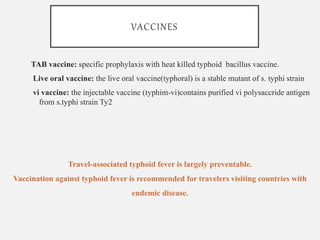
VACCINES
TAB vaccine: specific prophylaxis with heat killed typhoid bacillus vaccine.
Live oral vaccine: the live oral vaccine(typhoral) is a stable mutant of s. typhi strain
vi vaccine: the injectable vaccine (typhim-vi)contains purified vi polysaccride antigen
from s.typhi strain Ty2
Travel-associated typhoid fever is largely preventable.
Vaccination against typhoid fever is recommended for travelers visiting countries with
endemic disease.
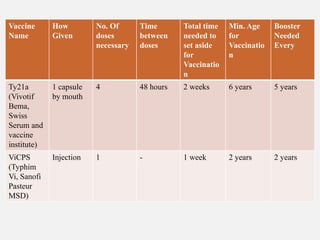
Vaccine
Name
How
Given
No. Of
doses
necessary
Time
between
doses
Total time
needed to
set aside
for
Vaccinatio
n
Min. Age
for
Vaccinatio
n
Booster
Needed
Every
Ty21a
(Vivotif
Bema,
Swiss
Serum and
vaccine
institute)
1 capsule
by mouth
4 48 hours 2 weeks 6 years 5 years
ViCPS
(Typhim
Vi, Sanofi
Pasteur
MSD)
Injection 1 - 1 week 2 years 2 years
CommunitymedicineSalmonellatyphi/paratyphi.pptx

CommunitymedicineSalmonellatyphi/paratyphi.pptx

  • 1.
    Dr Adhya Dubey JR-2 DeptOf Community Medicine Pt. B D Sharma PGIMS, Rohtak
  • 2.
    INTRODUCTION French physician PierreCharles Alexandre Louis first proposed the name “typhoid fever” The term ‘enteric fever’ means Typhoid fever, which is caused by Salmonella typhii
  • 3.
    Carl Joseph Eberthwho discovered the typhoid bacillus in 1880. Georges Widal who described the ‘Widal agglutination reaction’ of the blood in 1896.
  • 4.
    1. The bestknown carrier was "Typhoid Mary”; Mary Mahon was a cook in Oyster Bay, New York in 1906 who is known to have infected 53 people, 5 of whom died. • Later returned with false name but detained and quarantined after another typhoid outbreak. • She died of pneumonia after 26 years in quarantine.
  • 5.
    DEFINITION Typhoid fever, orenteric fever, is a potentially fatal multisystemic infection produced primarily by Salmonella enterica serotype typhi and to a lesser extent Salmonella enterica serotypes paratyphi A, B, and C. Acute generalised infection of the reticuloendothelial system, intestinal lymphoid tissue and the gall bladder.
  • 6.
    EPIDEMIOLOGY • An estimated11–21 million cases of typhoid fever and 5 million cases of paratyphoid fever occur worldwide each year, causing an estimated 135,000–230,000 deaths. • Improved living conditions and introduction of antibiotics has resulted in a drastic reduction of typhoid fever morbidity and mortality in industrialised countries. • The disease continues to be a public health problem in many developing areas of the WHO African, Eastern Mediterranean, South-East Asia and Western Pacific Regions. • Typhoid risk is higher in populations that lack access to safe water and adequate sanitation, and children are at highest risk
  • 7.
    Fig: Typhoid feverincidence rate per 1 lakh population; Worldwide; 2019
  • 8.
    ETIOLOGY 1. Caused bythe bacterium Salmonella Typhi and paratyphi A, B and C. 2. Ingestion of contaminated food or water. 3. Contact with an acute case of typhoid fever or chronic asymptomatic carrier. 4. Salmonella enteriditis and Salmonella typhimurium are other salmonella bacteria, cause food poisoning and diarrhoea.
  • 9.
    SALMONELLA ENTRICA 1.Gram-negative rods 2.Donot ferment lactose 3.Antigens of Salmonella species a. Cell wall O antigen b. Flagellar H antigen c. Capsular Vi (virulence) antigen)
  • 11.
    SYMPTOMS There are fourstages of typhoid fever, and each step might last for one week. The typhoid incubation period usually takes 7–14 days after ingestion of S. typhi. The stages are as follows: 1.First stage 2.Second stage 3.Third stage 4.Fourth stage
  • 12.
    • First stage:The patient exhibits some early typhoid symptoms during this stage (first week), such as abdominal pain (right upper), difficult-to-pass stools, dry cough, delirium, stupor, malaise and dull headache. Each day, the temperature rises and then falls by the following morning. Over time, the temperature gradually increases. • Second stage: In this stage (second week), there will be a progression of first- stage symptoms, such as  Body temperature rises to 102 to 104 degrees Fahrenheit  Abdominal swelling  The appearance of rose spots on the chest, back and abdomen might resolve in 2- 5 days (~30% of the patients experience this).
  • 13.
    Rose spots High fever DiarrheaTyphoid Meningitis Aches and pains Chest congestion symptoms
  • 14.
    Third stage: Thisis the serious stage, where the patient may experience the following •Decreases in weight •Conjunctivitis •Tachypnea •Increase in toxaemia •Anorexia •Crackling sound from the base of the lungs •Severe abdominal distension •Liquid diarrhoea (foul, green-yellow) •Increase delirium's intensity •Bowel perforation and peritonitis can develop as a result of necrosis in Peyer's patches. •Death may occur due to severe toxaemia, myocarditis or intestinal bleeding.
  • 15.
    Fourth stage: Extremelyhigh fever is the defining feature of this typhoid stage. •Over a few days, the fever, mental state, and abdominal discomfort gradually improved. •Patients who are not treated could develop intestinal and neurological issues. •Loss of weight and extreme weakness (may last for months) •Some patients with an asymptomatic carrier condition can continue transmitting the bacterium.
  • 16.
    RDT for antibody-Detection of antibody against Salmonella in single serum specimens Sensitivity: 69%–78%, specificity: 77%–90% Turnaround time 2–4 hours No RDT for enteric fever is accurate enough to replace reference tests. Confirmatory test: Culture-Isolation of enteric fever Salmonella from blood and bone marrow Sensitivity: 40%–87% in blood and 80% in marrow, specificity: 100% Isolation allows drug sensitivity testing Turnaround time 3–6 days. Widal test† ≥4-fold rise in titer* Sensitivity depends on local prevalence, specificity: 100% Affordable ≥4 fold increase may not occur in partially treated patients, ≥4-fold rise can be missed if antibody level peaks before first specimen is collected. DIAGNOSIS
  • 17.
    WIDAL TEST " Atest involving agglutination of typhoid bacilli when they are mixed with serum containing typhoid antibodies from an individual having typhoid fever; used to detect the presence of Salmonella typhi and S. paratyphi” Take four sets of 8 test tubes and label them 1 to 8 for O,H,AH and BH antibody detection. Pipette in to the tube No.1 of all sets 1.9 ml of isotonic saline. To each of the remaining tubes (2 to 8) add 1.0 ml of isotonic saline. To the tube No. 1 tube in each row add 0.1 ml of the serum sample to be tested and mix well. Transfer 1ml of the diluted serum from tube no.1 to tube no.2 and mix well. Discard the 1ml of the diluted serum from tube no.7 of each set.
  • 18.
    Tube no.8 inall sets,serves as a saline control. Now the dilution of the serum sample achieved in each set is as follows: Tube no. 1 2 3 4 5 6 7 8 (control) Dilutions 1:20 1:40 1:80 1:160 1:320 1:640 1:1280 – To all tubes (1 to 8) of each set add one drop of the respective WIDAL TEST antigen suspension (O,H,AH,BH) from reagent vials and mix well. Cover the tubes and incubate at 37 C overnight (approx. 18 hrs). Dislodge the sedimented button gently and observe.
  • 19.
    RESULT FOR THEWIDAL TEST • The highest dilution of the patients serum in which agglutinations occurs is noted, ex. if the dilution is 1 in 160 then the titer is 169. • Agglutination in dilution up to <1:60 is seen in normal individuals . Agglutination in dilution 1:160 is suggestive of Salmonella infection. • Agglutination in dilution of and more than 1:320 is confirmatory of Enteric fever .
  • 20.
  • 21.
    Early antibiotic treatmentis essential to decrease mortality. Can be started empirically if clinical suspicion is strong. • Tepid sponging to bring down temperature. • Tab Paracetamol 10mg/kg TDS for 4 days. • Presumptive treatment for malaria after collecting blood slide viz Tab Chloroquine (Base) 10mg/kg stat • First line antibiotic- Oral Ciprofloxacin / Ofloxacin- 7.5mg/kg BD for 5-7 days (drug of choice even in MDR Typhoid) • Second line antibiotics (Widespread resistance reported in India)  Oral Amoxicillin 25mg/kg TDS for 10-14 days.  Oral Trimethoprim/ Sulphamethoxazole 4/20 mg/kg BD for -14 days.
  • 22.
    Referral criteria: o Fevernot subsiding within 48 hrs of initiating antibiotics. o Feeble pulse, tachypnoea, basal crepitations o Pregnant women & children below 1 year o Neurological complications or patient extremely toxic or delirious
  • 23.
    Surgical Care Usually indicatedin cases of intestinal perforation. Most surgeons prefer simple closure of the perforation with drainage of the peritoneum. Small-bowel resection is indicated for patients with multiple perforations. If antibiotic treatment fails to eradicate the hepatobiliary carriage, the gallbladder should be resected. Cholecystectomy is not always successful in eradicating the carrier state because of persisting hepatic infection. Diet Fluids and electrolytes should be monitored and replaced diligently. Oral nutrition with a soft digestible diet is preferable in the absence of abdominal distension or ileus. Activity No specific limitations on activity are indicated. Rest is helpful, but mobility should be maintained if tolerable. The patient should be encouraged to stay home from work until recovery
  • 24.
    1. Treatment ofpatients and carriers 2. Education on handwashing, particularly food handlers, patients and childcare givers 3. Sanitary disposal of feces and control of flies. 4. Provision of safe and adequate water 5. Safe handling of food. 6. Exclusion of typhoid carriers and patients from handling of food and patients 7. Immunization for people at special risk (e.g. Travelers to endemic areas)8. Regular check-up of food handlers in food and drinking establishments PREVENTION AND CONTROL
  • 25.
    VACCINES TAB vaccine: specificprophylaxis with heat killed typhoid bacillus vaccine. Live oral vaccine: the live oral vaccine(typhoral) is a stable mutant of s. typhi strain vi vaccine: the injectable vaccine (typhim-vi)contains purified vi polysaccride antigen from s.typhi strain Ty2 Travel-associated typhoid fever is largely preventable. Vaccination against typhoid fever is recommended for travelers visiting countries with endemic disease.
  • 26.
    Vaccine Name How Given No. Of doses necessary Time between doses Total time neededto set aside for Vaccinatio n Min. Age for Vaccinatio n Booster Needed Every Ty21a (Vivotif Bema, Swiss Serum and vaccine institute) 1 capsule by mouth 4 48 hours 2 weeks 6 years 5 years ViCPS (Typhim Vi, Sanofi Pasteur MSD) Injection 1 - 1 week 2 years 2 years