Topic: Sampling of Soil
Submitted by: Hassan Noorani
Roll No. 64
University College Of Agriculture, University
Of Sargodha
Soil Sampling
It commonly refers to the analysis of a soil sample to
determine nutrient content, composition, and other
characteristics such as the acidity or pH level
Sampling Procedure
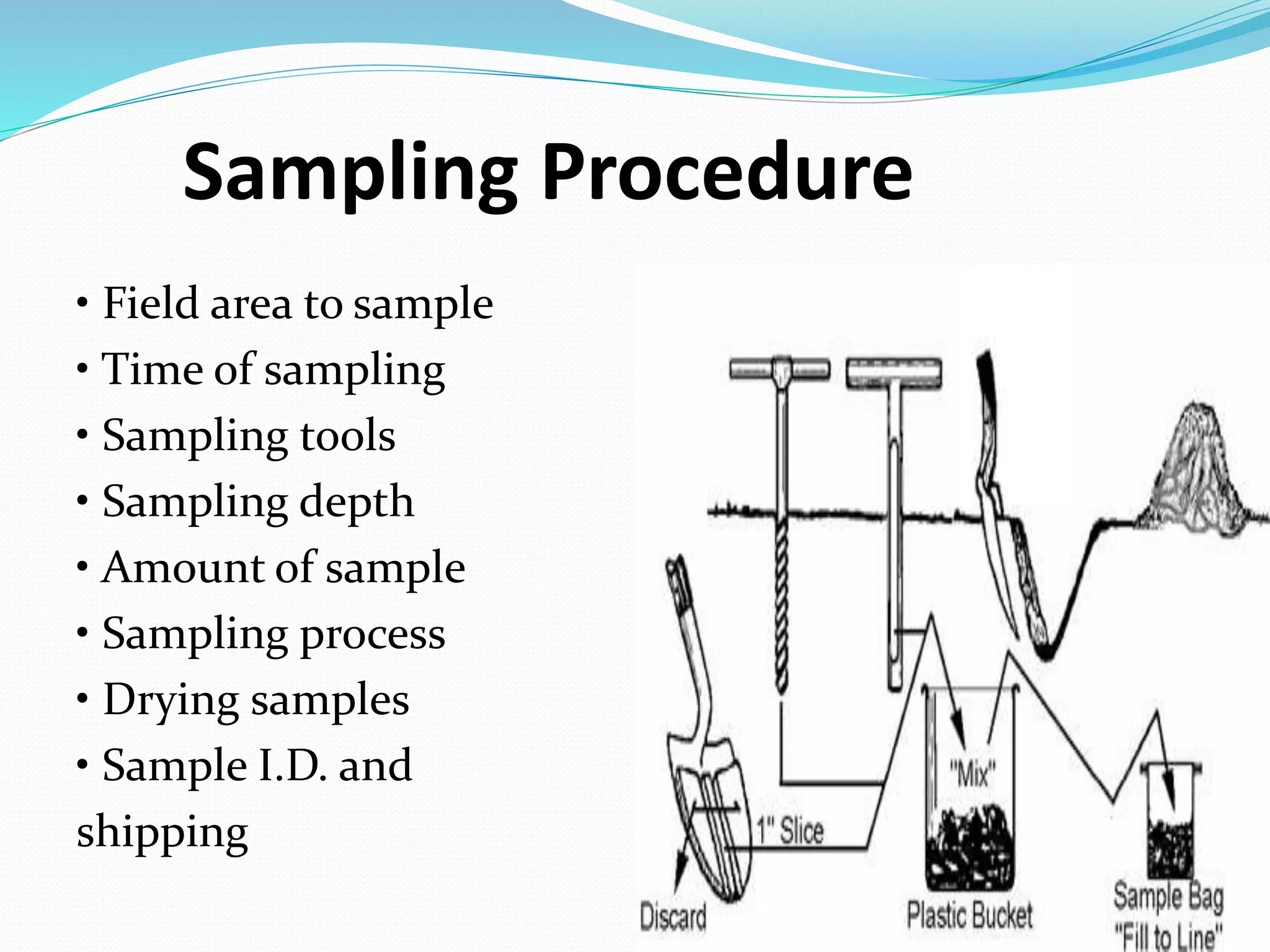
• Field area to sample
• Time of sampling
• Sampling tools
• Sampling depth
• Amount of sample
• Sampling process
• Drying samples
• Sample I.D. and
shipping
Types of Soil Sampling
1-disturbed sampling
is one in which the structure of the soil has been changed
sufficiently that tests of structural properties of the soil
will not be representative of in-situ conditions, and only
properties of the soil grains can be accurately
determined
2-undisturbed sampling
is one where the condition of the soil in the sample is close
enough to the conditions of the soil in-situ to allow tests of
structural properties of the soil to be used to approximate the
properties of the soil in-situ
3-Random Sampling
Uniform fields can be randomly sampled throughout the
entire field. To see long-term trends in soil nutrient data,
these points should be geo referenced with a global
positioning system (GPS) receiver and sampled in these same
locations in subsequent years.
4-Grid Sampling
Two main types of grid sampling
1-Grid-cell soil sampling randomly collects either one or
multiple subsamples throughout the cell for a composite
sample
2-Grid-point soil sampling collects one or multiple subsamples
around a geo referenced point within a grid or at a grid
intersection.
5-Zone Sampling
Zone sampling is a soil sampling technique that assumes that
each field contains different soils with unique soil properties
and crop characteristics, and therefore should be separated
into unique zones of management
6-Topographic/Geographic Unit Sampling
Fields vary in natural features such as elevation, hilltops,
slopes or depressions. Topographic/geographic unit sampling
assumes these features differ in soil characteristics and
therefore uses these features to establish unique zones.
2 basic types
1- area-based sampling
2-point-based sampling
Sampling for different Fields
1-For vegetable fields
15-30cm & 30-45cm depth is sufficient for sampling
2-For field crops
sufficient sampling depth is 45-60cm & 60-90cm
3-For orchards and gardens
sufficient sampling depth is 45-60cm,60-90cm,90-120cm
120-150cm
Soil samplers
1- Shovel
2- Trial Pits
3- Hand/Machine Driven Auger
4- Continuous Flight Auger
5- Split-spoon / SPT Sampler
6- Modified California Sampler
7- Shelby Tube Sampler
8- Piston samplers
9- Pitcher Barrel sample
soil sampling

soil sampling

  • 1.
    Topic: Sampling ofSoil Submitted by: Hassan Noorani Roll No. 64 University College Of Agriculture, University Of Sargodha
  • 2.
    Soil Sampling It commonlyrefers to the analysis of a soil sample to determine nutrient content, composition, and other characteristics such as the acidity or pH level
  • 3.
    Sampling Procedure • Fieldarea to sample • Time of sampling • Sampling tools • Sampling depth • Amount of sample • Sampling process • Drying samples • Sample I.D. and shipping
  • 4.
    Types of SoilSampling 1-disturbed sampling is one in which the structure of the soil has been changed sufficiently that tests of structural properties of the soil will not be representative of in-situ conditions, and only properties of the soil grains can be accurately determined
  • 5.
    2-undisturbed sampling is onewhere the condition of the soil in the sample is close enough to the conditions of the soil in-situ to allow tests of structural properties of the soil to be used to approximate the properties of the soil in-situ 3-Random Sampling Uniform fields can be randomly sampled throughout the entire field. To see long-term trends in soil nutrient data, these points should be geo referenced with a global positioning system (GPS) receiver and sampled in these same locations in subsequent years.
  • 6.
    4-Grid Sampling Two maintypes of grid sampling 1-Grid-cell soil sampling randomly collects either one or multiple subsamples throughout the cell for a composite sample 2-Grid-point soil sampling collects one or multiple subsamples around a geo referenced point within a grid or at a grid intersection.
  • 7.
    5-Zone Sampling Zone samplingis a soil sampling technique that assumes that each field contains different soils with unique soil properties and crop characteristics, and therefore should be separated into unique zones of management 6-Topographic/Geographic Unit Sampling Fields vary in natural features such as elevation, hilltops, slopes or depressions. Topographic/geographic unit sampling assumes these features differ in soil characteristics and therefore uses these features to establish unique zones. 2 basic types 1- area-based sampling 2-point-based sampling
  • 8.
    Sampling for differentFields 1-For vegetable fields 15-30cm & 30-45cm depth is sufficient for sampling 2-For field crops sufficient sampling depth is 45-60cm & 60-90cm 3-For orchards and gardens sufficient sampling depth is 45-60cm,60-90cm,90-120cm 120-150cm
  • 9.
    Soil samplers 1- Shovel 2-Trial Pits 3- Hand/Machine Driven Auger 4- Continuous Flight Auger 5- Split-spoon / SPT Sampler 6- Modified California Sampler 7- Shelby Tube Sampler 8- Piston samplers 9- Pitcher Barrel sample