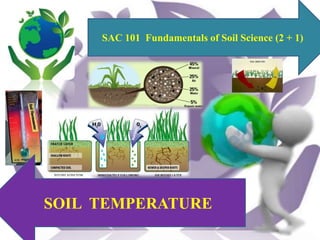
SAC 101 Fundamentals of Soil Science (2 + 1)
SOIL TEMPERATURE
SOIL TEMPERATURE
 Soil temperature is an important plant growth factor like air,
water and nutrients.
 Soil temperature affects plant growth directly and indirectly.
 Specific crops are adapted to specific soil temperatures.
Eg: Apple grows well when the soil temperature is about 18°C,
maize 25°C, potato 16 to 21°C, and so on.
Sources of soil heat
 Solar radiation
 Microbial decomposition of organic matter
 Respiration by soil organisms
 Internal source of heat
SOLAR CONSTANT
The rate of solar radiation reaching the earth’s atmosphere is
called as solar constant and has a value of 2 cal /sq.cm/ min.
Major part of this energy is absorbed in the atmosphere,
absorbed by plants and also scattered. Only a small part of it
reaches soil
The average annual soil temperature is about 1°C higher than
mean annual air temperature. Soil temperature is influenced by
climatic conditions.
1) Environmental factors
2) Soil factors
a) Thermal (Heat) capacity of soil
b) Heat of vaporization
c) Thermal conductivity and diffusivity
d) Biological activity
e) Radiation from soil
f) Soil colour
g) Soil structure, texture and moisture
h) Soluble salts
Thermal (Heat) capacity of soil:
 The amount of energy required to raise the temperature by
1°C is called heat capacity.
 When it is expressed per unit mass (Calories per gram),
then it is called as specific heat.
 The specific heat of water is 1.00 cal /g where the specific
heat of a dry soil is 0.2 cal /g.
Heat of vaporization: The evaporation of water from soil
requires a large amount of energy, 540 kilocalories/ kg soil.
Thermal conductivity and diffusivity: This refers to the
movement of heat in soils.
The ratio between the incoming (incident energy) and outgoing
(reflected energy) radiation is called albedo. (Albedo =
Reflected Radiation/incident Radiation)
Soil temperature requirements of plants:
The soil temperature requirements of plants vary with the species.
The temperature at which a plant thrives and
produces best growth is called optimum range
(temperature).
The entire range of temperature under which a
plant can grow including the optimum range is called growth
range.
The maximum and minimum temperatures
beyond which the plant will die are called survival limits.
Low temperatures reduce the nutrient availability, microbial
activities and root growth and branching.
The ability to absorb nutrients and water by plants reduces at
low temperatures.
Soil Temperature Management
Use of organic and synthetic mulches:
Mulches keep soil cooler in hot
summer and warm in cool winter.
Soil water management: High
moisture content in humid temperate
region lowers soil temperature.
Tillage management: Tilling soil to
break the natural structure reduces
the heat conductance and heat loss. A
highly compact soil looses heat faster
than loose friable soil.
Methods Of Measuring Soil Temperature
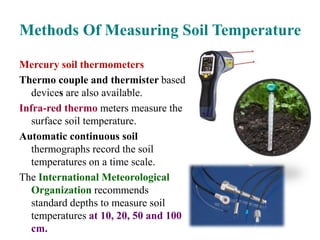
Mercury soil thermometers
Thermo couple and thermister based
devices are also available.
Infra-red thermo meters measure the
surface soil temperature.
Automatic continuous soil
thermographs record the soil
temperatures on a time scale.
The International Meteorological
Organization recommends
standard depths to measure soil
temperatures at 10, 20, 50 and 100
cm.
29-Nov-18 Sethupathi Siva, M.Sc., (Ag.) in SS & AC 11

Soil temperature

  • 1.
    SAC 101 Fundamentalsof Soil Science (2 + 1) SOIL TEMPERATURE
  • 2.
    SOIL TEMPERATURE  Soiltemperature is an important plant growth factor like air, water and nutrients.  Soil temperature affects plant growth directly and indirectly.  Specific crops are adapted to specific soil temperatures. Eg: Apple grows well when the soil temperature is about 18°C, maize 25°C, potato 16 to 21°C, and so on.
  • 3.
    Sources of soilheat  Solar radiation  Microbial decomposition of organic matter  Respiration by soil organisms  Internal source of heat SOLAR CONSTANT The rate of solar radiation reaching the earth’s atmosphere is called as solar constant and has a value of 2 cal /sq.cm/ min. Major part of this energy is absorbed in the atmosphere, absorbed by plants and also scattered. Only a small part of it reaches soil
  • 4.
    The average annualsoil temperature is about 1°C higher than mean annual air temperature. Soil temperature is influenced by climatic conditions. 1) Environmental factors 2) Soil factors a) Thermal (Heat) capacity of soil b) Heat of vaporization c) Thermal conductivity and diffusivity d) Biological activity e) Radiation from soil f) Soil colour g) Soil structure, texture and moisture h) Soluble salts
  • 5.
    Thermal (Heat) capacityof soil:  The amount of energy required to raise the temperature by 1°C is called heat capacity.  When it is expressed per unit mass (Calories per gram), then it is called as specific heat.  The specific heat of water is 1.00 cal /g where the specific heat of a dry soil is 0.2 cal /g. Heat of vaporization: The evaporation of water from soil requires a large amount of energy, 540 kilocalories/ kg soil. Thermal conductivity and diffusivity: This refers to the movement of heat in soils. The ratio between the incoming (incident energy) and outgoing (reflected energy) radiation is called albedo. (Albedo = Reflected Radiation/incident Radiation)
  • 6.
    Soil temperature requirementsof plants: The soil temperature requirements of plants vary with the species. The temperature at which a plant thrives and produces best growth is called optimum range (temperature). The entire range of temperature under which a plant can grow including the optimum range is called growth range. The maximum and minimum temperatures beyond which the plant will die are called survival limits.
  • 8.
    Low temperatures reducethe nutrient availability, microbial activities and root growth and branching. The ability to absorb nutrients and water by plants reduces at low temperatures.
  • 9.
    Soil Temperature Management Useof organic and synthetic mulches: Mulches keep soil cooler in hot summer and warm in cool winter. Soil water management: High moisture content in humid temperate region lowers soil temperature. Tillage management: Tilling soil to break the natural structure reduces the heat conductance and heat loss. A highly compact soil looses heat faster than loose friable soil.
  • 10.
    Methods Of MeasuringSoil Temperature Mercury soil thermometers Thermo couple and thermister based devices are also available. Infra-red thermo meters measure the surface soil temperature. Automatic continuous soil thermographs record the soil temperatures on a time scale. The International Meteorological Organization recommends standard depths to measure soil temperatures at 10, 20, 50 and 100 cm.
  • 11.
    29-Nov-18 Sethupathi Siva,M.Sc., (Ag.) in SS & AC 11