Agarfa Agricultural college
Department of plant science
Unit of Competence: Sample Soil and Analayze
Results
LO1. Prepare for soil sampling
LO2. Determine soil characteristics by
performing soil sampling
LO3. Interpret results of soil analysis
By: Dabi K.
March, 2021
LO. 1. Preparing for soil sampling
• Soil testing is the best way to find out how much lime and
fertilizer to apply based on the crop and existing field
conditions.
• Soil is the main source of nutrients for crops. It provides
support for plant growth in various ways. Knowledge
about soil health and its maintenance is critical to
sustaining crop productivity.
• The health of soils can be assessed by the quality and
stand of the crops grown on them. However, this is a
general assessment made by the farmers. A scientifically
assessment is through detailed physical, chemical and
biological analysis of the soils.
• Sampling involves the selection from the total population
of a subset of individuals upon which measurements will
be made; the measurements made on this sample will then
be used to estimate the properties of the total population.
1.1. Select tools and equipment
• Shovel / Spade
• Soil auger or sampling probe
• Bucket (pail) :- To collect individual samples and mix
them to make a composite or average sample.
• Paper sack (soil bag)
• Sieve, mortar and pestle
• Ruler, pencil and note pad for labeling each container and
recording information.
• Drier
The soil probe is the best tool for collecting soil samples
but it have some limitations
• It cannot be used when the soil is too wet because the
soil compresses;
• It cannot be used when the soil is too dry because it is
difficult to penetrate the soil.
• do not work well in soils that contain gravel.
1.3. Carryout pre-operational and safety checks
• Check all the tools and equipments before use, are all
functional and sufficient in number? Are all clean of
any soil contaminants? During sampling any
contaminant soil remaining on the sampling tools can
affect the test of the new sample.
1.4. Identify areas of homogeneous soil types
Considerations in determining the sampling area
• The sample should be truly representing the field/area it
belongs to.
• A field can be treated as a single sampling unit if it is
uniform. Generally an area not exceeding 0.5 ha is taken
as one sampling unit.
• Variations in slope, color, texture, crop growth, and
management practices are the important factors that
should be taken in to account for sampling. Separate
samples are required from areas differing in these
characteristics.
• An area of about 3-3 meters along all the sides of
the field should be left in large fields.
• Larger area may be divided in to appropriate
number of smaller homogeneous units for better
representations of the field.
• Recently fertilized plots, bunds, channels, marshy
tracts, wells, areas near trees or other non-
representative locations must be carefully avoided
during sampling.
LO 2. Determining soil characteristics
2.1. Determining depth of Sampling and excavating hole
The depth of the sampling is important because the
mobility of the nutrients varies with the nutrient
content in the different soil zones.
The recommended depth for sampling is the following:
• 0-15 cm To measure pH, P, K, Cl, S, Ca, Mg, Zn, NH4 + -
N, Fe, Mn, Cu, soluble salts
• 15-60 cm To measure soluble salts, NO3-N, S, Cl (in
addition to 0-15 cm depth)
• 60-120 cm To measure NO3-N (in addition to 0-15 cm
and 15-60 cm depth)
Plant root penetration is the guide in deciding the depth of
sampling.
 For cereals, vegetables and other seasonal crops :- from
0-15cm.
 For plantation crops or fruit trees, composite sample
from 0-30, 30-60, and 60-90cm depths should be made
from 4-5 pits dug in about 0.5 ha field.
Collecting samples
Factors that influence the quality of the sample
o Taking the sample at right time and in the right way
o The tools used
o The area sampled
o The depth and the correct mix of the sample
o The information provided and packing
Time of sampling
Take a soil sample a few months before starting any
plantations.
If the soil test report recommends lime, you will have
enough time to apply it and have it adjust the soil pH
before you plant.
• Avoid taking samples when the soil is very wet, dry or
frozen.
Method of soil sampling
There are two different methods for sampling. The first
sampling method is performed at a fixed depth while the
second sampling technique is taken from each horizon.
The most common sample collection designs or
Sampling pattern are the following:
1. Grid / systematic/sampling:- the sampling points
follow a simple pattern and are separated by a fixed
distance.
2. Random sampling
3. Stratified / cluster/ sampling:- the total area is broken
into a number of strata or subpopulations and a random
sample is taken from each stratum.
This method is used:
 To make statements about each stratum or
subpopulation separately.
 To increase the precision of estimates over the entire
areas.
4. Exploratory/ Investigation/ Direct sampling:- may
be used for qualitative assessment of soils where an
impact or damage is visible or anticipated.
Eg. Small waste site, the area affected is known but
the type of contaminants may be unknown.
Composite sampling
• Compositing or combining sampling units in to a
single sample is an effective method for accurate
estimation of population
Preparing samples
Appropriate sample preparation and handling for lab.
analysis
• Drying: Most soil samples for testing are “field
moist” and should be air-dried before transported
to the laboratory. must be dried at 40 ° C
temperature. Higher temperature may cause losses in
nutrients, especially in nitrogen.
• Grinding: Most laboratories grind samples to pass a
2 mm sieve to ensure homogeneity. Samples must be
free of organic residues (both plant and animal),
gravels and other.
• Storage: Soil samples prepared under appropriate
instructions can be stored in a cool and dry place (in
paper bags or in a plastic containers).
Labeling the sample
Records that need to be taken during sampling
 Sampling date
 Sampler :- Name, address, phone number, email
 Sample depth
 Sample location:- farm/home/orchard
 Last season/ year crop
 Field ID
 Geographic location
 Irrigation system: drip/sprinkler/ flood
 Depth to ground water
Determining physical characteristic/properties/ of the soil
Physical properties of soils are those characteristics,
processes or reactions of a soil that are caused by
physical forces and that can be described by, or
expressed in, physical terms or equations. Determines
the success or failure of crops.
It includes; -
- Soil texture - soil moisture
- Soil structure - soil porosity
- Soil color - soil consistency
- Soil bulk/particle density - temperature
- Horizons
Soil texture
- Is the proportion of the soil separates that make
up the mineral component of soil.
o Sand soils: contain more than 70% sand
o Silt soils: contain more than 80% silt
o Clay soils: contain more than 40% clay
Loam soils: contains an intermediate mixture of
sand, silt and clay.
What is the importance of soil texture ?
It determines the soil ability to Hold nutrient,
Store water that provide for plant root growth and
development.
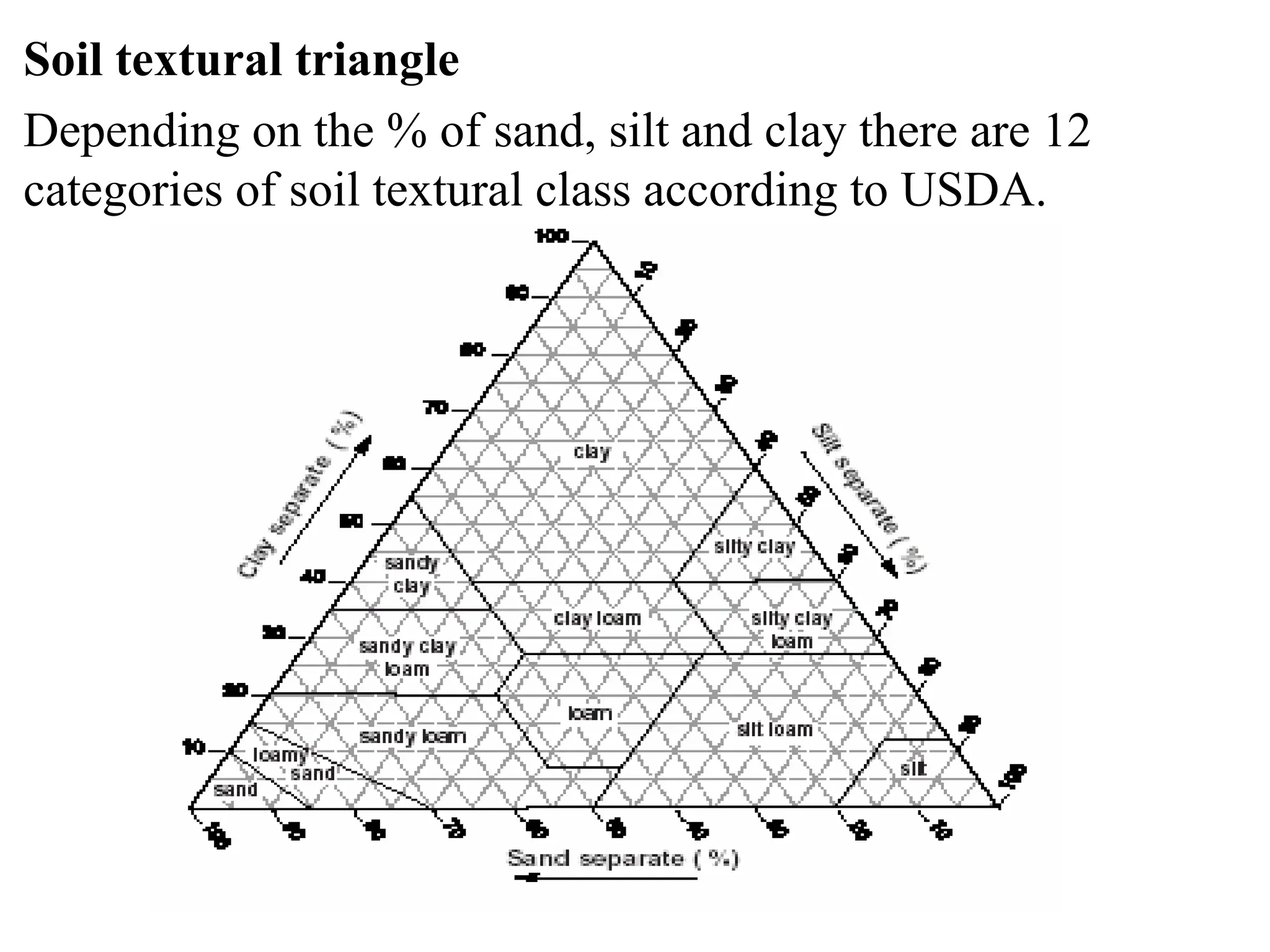
Soil textural triangle
Depending on the % of sand, silt and clay there are 12
categories of soil textural class according to USDA.
How to determine soil particle size/texture???
1. Rapid feel method texture determination
a small soil sample is taken and water is added to the
sample. Place the soil in your palm and knead it to break up
aggregates
a. Rub the soil between your fingers. If sand is present, it
feels “grainy. Compress some moist soil by clenching it in
your hand. If the soil holds together, toss it from hand to
hand. The more durable it is, the more clay is present.
b. Moisten the soil thoroughly and compress it between
thumb and forefinger. Determine degree of stickiness by
noting how strongly the soil adheres to the thumb and
forefinger when pressure is released, and how much it
stretches. Stickiness increases with clay content.
c. Roll some moist soil between the palms of your hand to
form the longest and thinnest worm possible. The longer,
thinner and more durable worm contains more clay.
Work a small amount of wet soil between your thumb and
fingers. Generally, we can say that :
• Sand feels gritty
• Silt feels smooth and silky and
• Clay feels sticky.
2. Mechanical sieving ( see operation sheet )
Soil particles and particle diameters
Sand: 0.05 – 2mm
Silt : 0.002 – 0.05 mm
Clay: less than 0.002
3. Hydrometer method
• The hydrometer method is a fairly accurate method for
determining the particle size distribution of a soil sample.
•Hydrometer is used to measure the density of the soil
suspension
•Stokes law = the larger particle settle first
•Sand particle settle at 40 second, silt at 2 hours and clay at
24hours
 Place the hydrometer and thermometer in soil suspension
at 40 second to measure the density of silt plus clay
suspension and temperature respectively.
•Place the hydrometer and thermometer in soil suspension
after 2 hours to measure the density of clay suspension and
temperature respectively
Correcting Hydrometer Reading
For temperature above 20 °c :
Corrected hydrometer reading = measured
hydrometer reading (g/l) + {(measured temp. – 20
°c) * 0.36}
For temperature below 20 °c :
Corrected hydrometer reading = measured
hydrometer reading (g/l) - {(20 °c - measured temp.)
* 0.36}
Determining Percent of Sand, Silt and Clay
% clay = corrected 2 hrs hydrometer reading *100
Oven dry weight of soil
% silt plus clay = corrected 40 ‘’ reading * 100
Oven dry weight of soil
% sand = 100 - % silt plus clay
Example: given:
• weight of dry sample 48 gram
• 40 second hydrometer reading and temperature is 11
g/l and 26 °c respectively.
• 2hr hydrometer reading and temperature is 9 g/l and
19 °c respectively.
Calculate
a. Corrected 40 second hydrometer reading
b. Corrected 2 hours hydrometer reading
c. % clay
d. % silt
e. %Sand
f. Textural class name
Exercise:
Air dry weight of sample soil is 50g and the weight of
oven dried sample is 46g. The first hydrometer reading
and temperature is 13g/l and 24 °c respectively. The
second hydrometer reading and temperature is 4g/l and
23 °c respectively.
Calculate
a. Corrected 40 second hydrometer reading
b. Corrected 2 hours hydrometer reading
c. % clay
d. % silt
e. %Sand
f. Textural class name
soil structure
- The arrangement of soil particles into aggregates or group.
 differentiate peds and clods
Ped:- soil aggregates that occur naturally in soil.
Clods:- clumps of soil caused by tillage
What causes structure?
i. Biological factors/organic matter
• Bacterial exudates
• Root activity and exudates
• Macrofauna activity and waste
ii. Clay (type and amount)
iii. Calcium and sodium effects
iv. Climate (wet/dry, freeze/thaw)
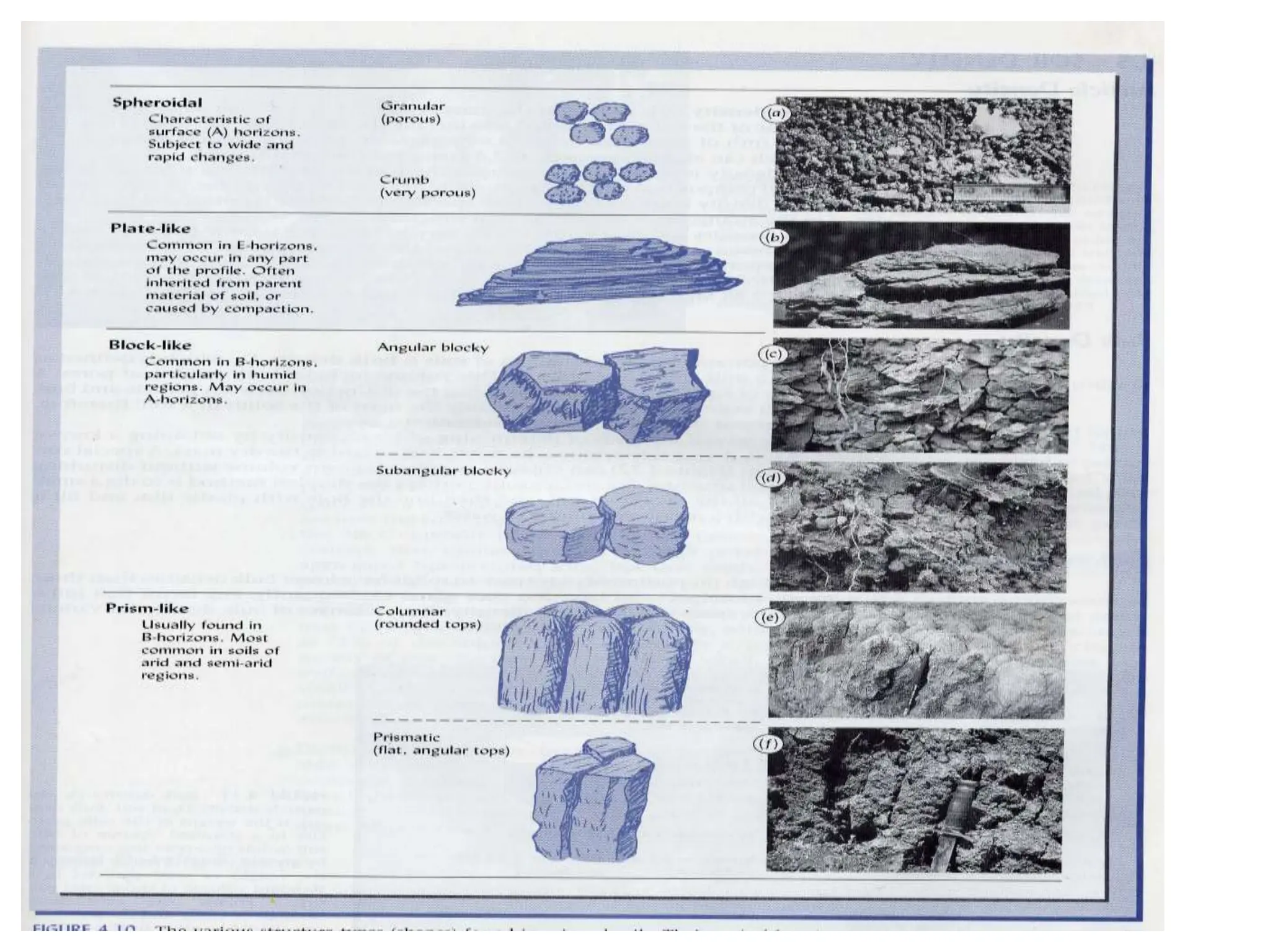
types soil structure
Based on the shape and arrangement aggregates soil
structure is classified into four principal types.
i. Platy-the aggregates are arranged in relatively thin
horizontal plates. It is often formed from parent
materials and can also result due to compaction by
heavy tractor on clayey soils.
ii.Prismatic-vertically oriented aggregates,
occurring commonly in subsurface horizons (B-
horizons) of arid and semiarid regions. The prisms
having rounded tops are called columnar structure,
and the prisms having angular tops and relatively flat
horizontally are called prismatic structures.
iii.Blocky-the aggregates look like blocks having
irregularly six-faced and more or less equal in three
dimensions. Block like structures in which the cubes
of the blocks have sharp edges and distinct
rectangular faces are called angular blocky and the
ones in which some rounding of the cubes occur are
called subangular blocky. The block like structure
types are common in B-horizons, particularly in
humid regions, and may also occur in A-horizons.
iv.Spheroidal- these are characteristic of surface (A)
horizons high in organic matter, grasslands and
subject to wide and rapid changes. When the peds are
relatively nonporous they are called granules and the
porous granules are termed crumbs.
particle and bulk densities
a) particle density of the soil
- is the mass of a unit volume of soil solids.
Particle density = mass of soil solid
volume of soil solids
b. bulk density
- is the oven dry weight of a given volume of soil
divided by the volume. It is expressed in grams per
cubic centimeter. It is an indicator of the amount of
pore space available with in individual soil horizons
as well as compaction.
Bulk density = mass of oven dry soil
total volume of soil
factors that affect bulk density
a. Types of minerals that make up the soil particles.
Some minerals are heavier than others.
b. Soil texture. Clay are lighter than silts and sand
c. Organic matter content. OM has low bulk density
than mineral particles.
d. Soil compaction. Compacted soils have higher bulk
densities than non-compacted soils.
How bulk density in form cropping
High bulk density- compacted soils that restrict root
growth.
Need improvement with practices: - cover cropping
and incorporating crop residues.
Calculation of bulk density
 W1 = weight of empty core sampler
 W2= weight of empty core sampler plus field moist
soil
 W3= weight of empty core sampler plus oven dry soil
 h = the length (height) of the sampler
 r = the internal diameter of the core sampler: then
Volume of the core sampler = πr2h
Weight of oven dry soil = W3 – W1
Weight of moisture = W2 - W3
% moisture content = W2 – W3 *100
W3-W1
Bulk density = W3 – W1
πr2h
Pore space ( voids)
a) What are they and why are they important?
Pores are the “holes” or voids in the soils. They are
important because air and water move through and are
stored in pores. Without air, roots cannot live nor can most
microbes that are essential to the proper functioning of a
healthy soil.
b) Types of pores: Three types of pores are generally
recognized
i. Interstitial pores: Spaces between mineral grains and peds
ii. Tubular pores: Pores made by root or animal activity that
are or were at one time continuous
iii. Vesicular pores: Bubble-shaped pores
c) Sizes of pores—two basic size classes of pores are
recognized, though there is not a
particular size limit between them
i. Macropores: allow free movement of air and water
ii. Micropores: air movement is greatly impeded;
water movement is restricted to capillary flow.
Calculation of porosity (f)
• % pore space + % solid space = 100
• %ps = 100 - % ss (when divided by %)
• porosity = 1- solid space
 F= 1- bulk density
particle density
 %f = 1- bulk density x 100
particle density
Factors influencing total pore space
• Texture
• Compaction
• Organic matter
• Handling of a soil/soil structure
Exercise:
Let Sabaf take soil sample by using the core sampler
that have 16gram, 10 cm and 5cm of weight , height
and internal diameter respectively .
The weight of sampled soil with the weight of core
sampler is 140 gram its weight is reduced to 110 gram
after it was stayed in oven dry for 24 hours in 105 °c .
Then : calculate
a. % of moisture content
b. Particle density
c. Bulk density
d. Porosity and % of porosity
Soil color
Soil color varies with parent material, how long the soil
has been formed and the environment it self.
Describing soil color
- By munsell color book
There are three elements on munsell color book
1. Hue :- the particular color. R, Y, G or mixture of pure
color.
2. Value :- the degree of brightness or darkness of hue
3. Chroma :- intensity or lightness (the relative purity
of the hue)
Eg. 5 YR 5/6 ( hue, value, Chroma) = yellow red
Chemical Properties of soil
1. Cation Exchange Capacity (CEC)
2. Soil pH
3. Electrical conductivity (EC)
4. Organic matter
5. Soil Salinity
Cation Exchange Capacity (CEC)
• Cation exchange is the ability of soil clays and organic
matter to adsorb and exchange cations with those in
soil solution (water in soil pore space).
• Silicate clays and organic matter typically possess net
negative charge because of cation substitutions in the
crystalline structures of clay and the loss of hydrogen
cations from functional groups of organic matter.
• Positively-charged cations are attracted to these
negatively-charged particles, just as opposite poles of
magnets attract one another.
• The quantity of cation exchange is measured per unit
of soil weight and is termed CEC.
Cation exchange capacity is an important phenomenon
for two reasons:
I. Exchangeable cations such as calcium, magnesium,
and potassium are readily available for plant uptake and
II. Cations adsorbed to exchange sites are more
resistant to leaching, or downward movement in soils
with water.
• The energy of retention of cations on negatively
charged exchange sites varies with the particular
cation. The order of retention is: aluminum > calcium
> magnesium > potassium > sodium > hydrogen.
• The cations of calcium, magnesium, potassium, and
sodium produce an alkaline reaction in water and are
termed bases or basic cations.
• Aluminum and hydrogen ions produce acidity in water
and are called acidic cations.
• The percentage of the cation exchange capacity
occupied by basic cations is called percent base
saturation. The greater the percent base saturation,
the higher the soil pH. A higher base saturation means
agreater nutrient reserve than a low base saturation for
the same CEC.
Soil pH
pH (the negative log of the hydrogen ion activity in
solution).
soil pH decreases as hydrogen ion, or acidity, increases in
soil solution. Soil pH increases as acidity decreases.
A soil pH of 7 is considered neutral. Soil pH values
greater than 7 signify alkaline conditions, whereas those
with values less than 7 indicate acidic conditions.
The influence of soil pH on plant growth
i. affects the quantity, activity, and types of
microorganisms in soils.
ii. affects other nutrient transformations and the
solubility, or plant availability, of many plant essential
nutrients.
Examples:
• P : most available in slightly acid to slightly alkaline
soils
• all essential micronutrients, except molybdenum,
become more available with decreasing pH.
• Al, Mn and Fe can become sufficiently soluble at
pH < 5.5 to become toxic to plants.
• Bacteria which are important mediators of
nutrient transformation mechanisms in soils most
active in slightly acid to alkaline conditions
According to the range of the pH test there are
seven different categories:
Categories pH value
• Extremely acidic <4.0
• Strongly acidic 4.5 – 5.5
• Acidic 5.5 - 6.5
• Slightly acidic to neutral 6.5 – 7.2
• Alkaline 7.3 – 7.8
• Strongly alkaline 7.8 – 8.5
• Extremely alkaline >8.5
Factors that affect soil pH
i. parent material : quartz-rich sandstone is acidic;
limestone is alkaline
ii. Vegetation : conifers, produce organic acids;
iii. Climate : In humid areas, soils tend to become
more acidic over time because rainfall washes
away basic cations and replaces them with
hydrogen
iv. Fertilizer: Addition of certain fertilizers to soil can
also produce hydrogen ions. Liming the soil adds
calcium, which replaces exchangeable and
solution H+ and raises soil pH.
Electrical conductivity (EC)
• EC is the ability of a material to transmit an electrical
charge. Its magnitude varies according to the material.
• The relationship between EC and soil properties is
strong. Soil texture is significantly expressed by EC.
Clay textured soil with high water holding capacity is
highly conductive. Sandy soils with poor water
holding capacity are poor conductors.
• High CEC is also indicated by higher EC. It can help
to determine the exchangeable calcium or magnesium
level in the soil. In case of high organic matter
content, the EC value is higher
Soil Salinity
Salinity is a high concentration of soluble salts in
soils. If the EC of soil is higher than 4ds/m it is
defined as saline.
there are three categories of salt affected soils based
on the following criteria:
The salinity of the saturation extract as measured
by the electrical conductivity (EC) at 25 C,
 The Exchangeable Sodium
pH
Summary of Salt Affected Soil Classification
ECse = Electrical conductivity of the saturated extract, ESP
= exchangeable sodium percentage.
Classification ECse
(mmhos/cm
)
Soil pH ESP Soil
Physical
Condition
Saline > 4.0 < 8.5 < 15 Normal
Saline-sodic > 4.0 < 8.5 > 15 Normal
Sodic < 4.0 > 8.5 >15 Poor
LO 3. Interpreting results of soil analysis
• The main purpose of interpreting soil test results
is calibration and economic evaluation of the
relationship between soil test values and crop
responses to nutrients.
• The most commonly used categories refer to
available soil nutrient levels: very low, low,
medium, good, high and very high.
3.1. Comparing the collected soil sample with acceptable
soil parameters
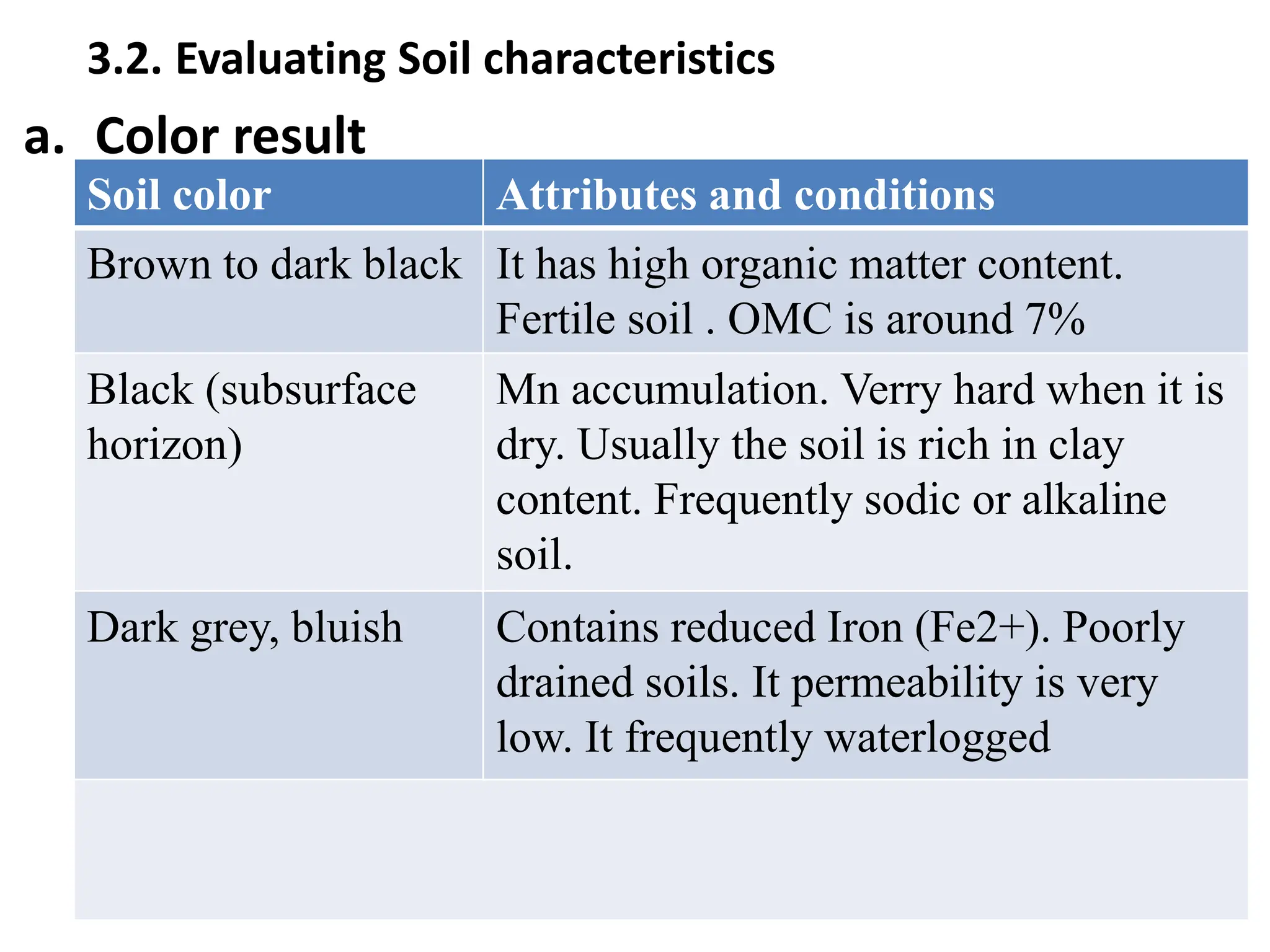
3.2. Evaluating Soil characteristics
a. Color result
Soil color Attributes and conditions
Brown to dark black It has high organic matter content.
Fertile soil . OMC is around 7%
Black (subsurface
horizon)
Mn accumulation. Verry hard when it is
dry. Usually the soil is rich in clay
content. Frequently sodic or alkaline
soil.
Dark grey, bluish Contains reduced Iron (Fe2+). Poorly
drained soils. It permeability is very
low. It frequently waterlogged
White to grey Accumulation of salts.
Dark red Fe and Al accumulation
Yellow to reddish Rich in oxidized Iron (Fe3+).
They are well aerated
b. Soil pH
c. Electrical Conductivity
Conductivity(mmho/cm) Interpretation
4 or above
Severe accumulation of salts. May
restrict growth of many vegetables and
ornamentals.
2 to 4
Moderate accumulation of salts. Will not
restrict plant growth, but may require
more frequent irrigation.
less than 2
Low salt accumulation. Will not affect
plants.

Sample soil and analyze results pptx

  • 1.
    Agarfa Agricultural college Departmentof plant science Unit of Competence: Sample Soil and Analayze Results LO1. Prepare for soil sampling LO2. Determine soil characteristics by performing soil sampling LO3. Interpret results of soil analysis By: Dabi K. March, 2021
  • 2.
    LO. 1. Preparingfor soil sampling • Soil testing is the best way to find out how much lime and fertilizer to apply based on the crop and existing field conditions. • Soil is the main source of nutrients for crops. It provides support for plant growth in various ways. Knowledge about soil health and its maintenance is critical to sustaining crop productivity. • The health of soils can be assessed by the quality and stand of the crops grown on them. However, this is a general assessment made by the farmers. A scientifically assessment is through detailed physical, chemical and biological analysis of the soils.
  • 3.
    • Sampling involvesthe selection from the total population of a subset of individuals upon which measurements will be made; the measurements made on this sample will then be used to estimate the properties of the total population. 1.1. Select tools and equipment • Shovel / Spade • Soil auger or sampling probe • Bucket (pail) :- To collect individual samples and mix them to make a composite or average sample. • Paper sack (soil bag) • Sieve, mortar and pestle • Ruler, pencil and note pad for labeling each container and recording information. • Drier
  • 4.
    The soil probeis the best tool for collecting soil samples but it have some limitations • It cannot be used when the soil is too wet because the soil compresses; • It cannot be used when the soil is too dry because it is difficult to penetrate the soil. • do not work well in soils that contain gravel. 1.3. Carryout pre-operational and safety checks • Check all the tools and equipments before use, are all functional and sufficient in number? Are all clean of any soil contaminants? During sampling any contaminant soil remaining on the sampling tools can affect the test of the new sample.
  • 5.
    1.4. Identify areasof homogeneous soil types Considerations in determining the sampling area • The sample should be truly representing the field/area it belongs to. • A field can be treated as a single sampling unit if it is uniform. Generally an area not exceeding 0.5 ha is taken as one sampling unit. • Variations in slope, color, texture, crop growth, and management practices are the important factors that should be taken in to account for sampling. Separate samples are required from areas differing in these characteristics.
  • 6.
    • An areaof about 3-3 meters along all the sides of the field should be left in large fields. • Larger area may be divided in to appropriate number of smaller homogeneous units for better representations of the field. • Recently fertilized plots, bunds, channels, marshy tracts, wells, areas near trees or other non- representative locations must be carefully avoided during sampling.
  • 7.
    LO 2. Determiningsoil characteristics 2.1. Determining depth of Sampling and excavating hole The depth of the sampling is important because the mobility of the nutrients varies with the nutrient content in the different soil zones. The recommended depth for sampling is the following: • 0-15 cm To measure pH, P, K, Cl, S, Ca, Mg, Zn, NH4 + - N, Fe, Mn, Cu, soluble salts • 15-60 cm To measure soluble salts, NO3-N, S, Cl (in addition to 0-15 cm depth) • 60-120 cm To measure NO3-N (in addition to 0-15 cm and 15-60 cm depth)
  • 8.
    Plant root penetrationis the guide in deciding the depth of sampling.  For cereals, vegetables and other seasonal crops :- from 0-15cm.  For plantation crops or fruit trees, composite sample from 0-30, 30-60, and 60-90cm depths should be made from 4-5 pits dug in about 0.5 ha field. Collecting samples Factors that influence the quality of the sample o Taking the sample at right time and in the right way o The tools used o The area sampled o The depth and the correct mix of the sample o The information provided and packing
  • 9.
    Time of sampling Takea soil sample a few months before starting any plantations. If the soil test report recommends lime, you will have enough time to apply it and have it adjust the soil pH before you plant. • Avoid taking samples when the soil is very wet, dry or frozen. Method of soil sampling There are two different methods for sampling. The first sampling method is performed at a fixed depth while the second sampling technique is taken from each horizon.
  • 10.
    The most commonsample collection designs or Sampling pattern are the following: 1. Grid / systematic/sampling:- the sampling points follow a simple pattern and are separated by a fixed distance. 2. Random sampling 3. Stratified / cluster/ sampling:- the total area is broken into a number of strata or subpopulations and a random sample is taken from each stratum. This method is used:  To make statements about each stratum or subpopulation separately.  To increase the precision of estimates over the entire areas.
  • 11.
    4. Exploratory/ Investigation/Direct sampling:- may be used for qualitative assessment of soils where an impact or damage is visible or anticipated. Eg. Small waste site, the area affected is known but the type of contaminants may be unknown. Composite sampling • Compositing or combining sampling units in to a single sample is an effective method for accurate estimation of population
  • 12.
    Preparing samples Appropriate samplepreparation and handling for lab. analysis • Drying: Most soil samples for testing are “field moist” and should be air-dried before transported to the laboratory. must be dried at 40 ° C temperature. Higher temperature may cause losses in nutrients, especially in nitrogen. • Grinding: Most laboratories grind samples to pass a 2 mm sieve to ensure homogeneity. Samples must be free of organic residues (both plant and animal), gravels and other. • Storage: Soil samples prepared under appropriate instructions can be stored in a cool and dry place (in paper bags or in a plastic containers).
  • 13.
    Labeling the sample Recordsthat need to be taken during sampling  Sampling date  Sampler :- Name, address, phone number, email  Sample depth  Sample location:- farm/home/orchard  Last season/ year crop  Field ID  Geographic location  Irrigation system: drip/sprinkler/ flood  Depth to ground water
  • 14.
    Determining physical characteristic/properties/of the soil Physical properties of soils are those characteristics, processes or reactions of a soil that are caused by physical forces and that can be described by, or expressed in, physical terms or equations. Determines the success or failure of crops. It includes; - - Soil texture - soil moisture - Soil structure - soil porosity - Soil color - soil consistency - Soil bulk/particle density - temperature - Horizons
  • 15.
    Soil texture - Isthe proportion of the soil separates that make up the mineral component of soil. o Sand soils: contain more than 70% sand o Silt soils: contain more than 80% silt o Clay soils: contain more than 40% clay Loam soils: contains an intermediate mixture of sand, silt and clay. What is the importance of soil texture ? It determines the soil ability to Hold nutrient, Store water that provide for plant root growth and development.
  • 16.
    Soil textural triangle Dependingon the % of sand, silt and clay there are 12 categories of soil textural class according to USDA.
  • 17.
    How to determinesoil particle size/texture??? 1. Rapid feel method texture determination a small soil sample is taken and water is added to the sample. Place the soil in your palm and knead it to break up aggregates a. Rub the soil between your fingers. If sand is present, it feels “grainy. Compress some moist soil by clenching it in your hand. If the soil holds together, toss it from hand to hand. The more durable it is, the more clay is present. b. Moisten the soil thoroughly and compress it between thumb and forefinger. Determine degree of stickiness by noting how strongly the soil adheres to the thumb and forefinger when pressure is released, and how much it stretches. Stickiness increases with clay content.
  • 18.
    c. Roll somemoist soil between the palms of your hand to form the longest and thinnest worm possible. The longer, thinner and more durable worm contains more clay. Work a small amount of wet soil between your thumb and fingers. Generally, we can say that : • Sand feels gritty • Silt feels smooth and silky and • Clay feels sticky. 2. Mechanical sieving ( see operation sheet ) Soil particles and particle diameters Sand: 0.05 – 2mm Silt : 0.002 – 0.05 mm Clay: less than 0.002
  • 19.
    3. Hydrometer method •The hydrometer method is a fairly accurate method for determining the particle size distribution of a soil sample. •Hydrometer is used to measure the density of the soil suspension •Stokes law = the larger particle settle first •Sand particle settle at 40 second, silt at 2 hours and clay at 24hours  Place the hydrometer and thermometer in soil suspension at 40 second to measure the density of silt plus clay suspension and temperature respectively. •Place the hydrometer and thermometer in soil suspension after 2 hours to measure the density of clay suspension and temperature respectively
  • 20.
    Correcting Hydrometer Reading Fortemperature above 20 °c : Corrected hydrometer reading = measured hydrometer reading (g/l) + {(measured temp. – 20 °c) * 0.36} For temperature below 20 °c : Corrected hydrometer reading = measured hydrometer reading (g/l) - {(20 °c - measured temp.) * 0.36}
  • 21.
    Determining Percent ofSand, Silt and Clay % clay = corrected 2 hrs hydrometer reading *100 Oven dry weight of soil % silt plus clay = corrected 40 ‘’ reading * 100 Oven dry weight of soil % sand = 100 - % silt plus clay
  • 22.
    Example: given: • weightof dry sample 48 gram • 40 second hydrometer reading and temperature is 11 g/l and 26 °c respectively. • 2hr hydrometer reading and temperature is 9 g/l and 19 °c respectively. Calculate a. Corrected 40 second hydrometer reading b. Corrected 2 hours hydrometer reading c. % clay d. % silt e. %Sand f. Textural class name
  • 23.
    Exercise: Air dry weightof sample soil is 50g and the weight of oven dried sample is 46g. The first hydrometer reading and temperature is 13g/l and 24 °c respectively. The second hydrometer reading and temperature is 4g/l and 23 °c respectively. Calculate a. Corrected 40 second hydrometer reading b. Corrected 2 hours hydrometer reading c. % clay d. % silt e. %Sand f. Textural class name
  • 24.
    soil structure - Thearrangement of soil particles into aggregates or group.  differentiate peds and clods Ped:- soil aggregates that occur naturally in soil. Clods:- clumps of soil caused by tillage What causes structure? i. Biological factors/organic matter • Bacterial exudates • Root activity and exudates • Macrofauna activity and waste ii. Clay (type and amount) iii. Calcium and sodium effects iv. Climate (wet/dry, freeze/thaw)
  • 25.
    types soil structure Basedon the shape and arrangement aggregates soil structure is classified into four principal types. i. Platy-the aggregates are arranged in relatively thin horizontal plates. It is often formed from parent materials and can also result due to compaction by heavy tractor on clayey soils. ii.Prismatic-vertically oriented aggregates, occurring commonly in subsurface horizons (B- horizons) of arid and semiarid regions. The prisms having rounded tops are called columnar structure, and the prisms having angular tops and relatively flat horizontally are called prismatic structures.
  • 26.
    iii.Blocky-the aggregates looklike blocks having irregularly six-faced and more or less equal in three dimensions. Block like structures in which the cubes of the blocks have sharp edges and distinct rectangular faces are called angular blocky and the ones in which some rounding of the cubes occur are called subangular blocky. The block like structure types are common in B-horizons, particularly in humid regions, and may also occur in A-horizons. iv.Spheroidal- these are characteristic of surface (A) horizons high in organic matter, grasslands and subject to wide and rapid changes. When the peds are relatively nonporous they are called granules and the porous granules are termed crumbs.
  • 28.
    particle and bulkdensities a) particle density of the soil - is the mass of a unit volume of soil solids. Particle density = mass of soil solid volume of soil solids b. bulk density - is the oven dry weight of a given volume of soil divided by the volume. It is expressed in grams per cubic centimeter. It is an indicator of the amount of pore space available with in individual soil horizons as well as compaction.
  • 29.
    Bulk density =mass of oven dry soil total volume of soil factors that affect bulk density a. Types of minerals that make up the soil particles. Some minerals are heavier than others. b. Soil texture. Clay are lighter than silts and sand c. Organic matter content. OM has low bulk density than mineral particles. d. Soil compaction. Compacted soils have higher bulk densities than non-compacted soils. How bulk density in form cropping High bulk density- compacted soils that restrict root growth. Need improvement with practices: - cover cropping and incorporating crop residues.
  • 30.
    Calculation of bulkdensity  W1 = weight of empty core sampler  W2= weight of empty core sampler plus field moist soil  W3= weight of empty core sampler plus oven dry soil  h = the length (height) of the sampler  r = the internal diameter of the core sampler: then Volume of the core sampler = πr2h Weight of oven dry soil = W3 – W1 Weight of moisture = W2 - W3
  • 31.
    % moisture content= W2 – W3 *100 W3-W1 Bulk density = W3 – W1 πr2h Pore space ( voids) a) What are they and why are they important? Pores are the “holes” or voids in the soils. They are important because air and water move through and are stored in pores. Without air, roots cannot live nor can most microbes that are essential to the proper functioning of a healthy soil.
  • 32.
    b) Types ofpores: Three types of pores are generally recognized i. Interstitial pores: Spaces between mineral grains and peds ii. Tubular pores: Pores made by root or animal activity that are or were at one time continuous iii. Vesicular pores: Bubble-shaped pores c) Sizes of pores—two basic size classes of pores are recognized, though there is not a particular size limit between them i. Macropores: allow free movement of air and water ii. Micropores: air movement is greatly impeded; water movement is restricted to capillary flow.
  • 33.
    Calculation of porosity(f) • % pore space + % solid space = 100 • %ps = 100 - % ss (when divided by %) • porosity = 1- solid space  F= 1- bulk density particle density  %f = 1- bulk density x 100 particle density Factors influencing total pore space • Texture • Compaction • Organic matter • Handling of a soil/soil structure
  • 34.
    Exercise: Let Sabaf takesoil sample by using the core sampler that have 16gram, 10 cm and 5cm of weight , height and internal diameter respectively . The weight of sampled soil with the weight of core sampler is 140 gram its weight is reduced to 110 gram after it was stayed in oven dry for 24 hours in 105 °c . Then : calculate a. % of moisture content b. Particle density c. Bulk density d. Porosity and % of porosity
  • 35.
    Soil color Soil colorvaries with parent material, how long the soil has been formed and the environment it self. Describing soil color - By munsell color book There are three elements on munsell color book 1. Hue :- the particular color. R, Y, G or mixture of pure color. 2. Value :- the degree of brightness or darkness of hue 3. Chroma :- intensity or lightness (the relative purity of the hue) Eg. 5 YR 5/6 ( hue, value, Chroma) = yellow red
  • 36.
    Chemical Properties ofsoil 1. Cation Exchange Capacity (CEC) 2. Soil pH 3. Electrical conductivity (EC) 4. Organic matter 5. Soil Salinity Cation Exchange Capacity (CEC) • Cation exchange is the ability of soil clays and organic matter to adsorb and exchange cations with those in soil solution (water in soil pore space). • Silicate clays and organic matter typically possess net negative charge because of cation substitutions in the crystalline structures of clay and the loss of hydrogen cations from functional groups of organic matter.
  • 37.
    • Positively-charged cationsare attracted to these negatively-charged particles, just as opposite poles of magnets attract one another. • The quantity of cation exchange is measured per unit of soil weight and is termed CEC. Cation exchange capacity is an important phenomenon for two reasons: I. Exchangeable cations such as calcium, magnesium, and potassium are readily available for plant uptake and II. Cations adsorbed to exchange sites are more resistant to leaching, or downward movement in soils with water.
  • 38.
    • The energyof retention of cations on negatively charged exchange sites varies with the particular cation. The order of retention is: aluminum > calcium > magnesium > potassium > sodium > hydrogen. • The cations of calcium, magnesium, potassium, and sodium produce an alkaline reaction in water and are termed bases or basic cations. • Aluminum and hydrogen ions produce acidity in water and are called acidic cations. • The percentage of the cation exchange capacity occupied by basic cations is called percent base saturation. The greater the percent base saturation, the higher the soil pH. A higher base saturation means agreater nutrient reserve than a low base saturation for the same CEC.
  • 39.
    Soil pH pH (thenegative log of the hydrogen ion activity in solution). soil pH decreases as hydrogen ion, or acidity, increases in soil solution. Soil pH increases as acidity decreases. A soil pH of 7 is considered neutral. Soil pH values greater than 7 signify alkaline conditions, whereas those with values less than 7 indicate acidic conditions. The influence of soil pH on plant growth i. affects the quantity, activity, and types of microorganisms in soils. ii. affects other nutrient transformations and the solubility, or plant availability, of many plant essential nutrients.
  • 40.
    Examples: • P :most available in slightly acid to slightly alkaline soils • all essential micronutrients, except molybdenum, become more available with decreasing pH. • Al, Mn and Fe can become sufficiently soluble at pH < 5.5 to become toxic to plants. • Bacteria which are important mediators of nutrient transformation mechanisms in soils most active in slightly acid to alkaline conditions
  • 41.
    According to therange of the pH test there are seven different categories: Categories pH value • Extremely acidic <4.0 • Strongly acidic 4.5 – 5.5 • Acidic 5.5 - 6.5 • Slightly acidic to neutral 6.5 – 7.2 • Alkaline 7.3 – 7.8 • Strongly alkaline 7.8 – 8.5 • Extremely alkaline >8.5
  • 42.
    Factors that affectsoil pH i. parent material : quartz-rich sandstone is acidic; limestone is alkaline ii. Vegetation : conifers, produce organic acids; iii. Climate : In humid areas, soils tend to become more acidic over time because rainfall washes away basic cations and replaces them with hydrogen iv. Fertilizer: Addition of certain fertilizers to soil can also produce hydrogen ions. Liming the soil adds calcium, which replaces exchangeable and solution H+ and raises soil pH.
  • 43.
    Electrical conductivity (EC) •EC is the ability of a material to transmit an electrical charge. Its magnitude varies according to the material. • The relationship between EC and soil properties is strong. Soil texture is significantly expressed by EC. Clay textured soil with high water holding capacity is highly conductive. Sandy soils with poor water holding capacity are poor conductors. • High CEC is also indicated by higher EC. It can help to determine the exchangeable calcium or magnesium level in the soil. In case of high organic matter content, the EC value is higher
  • 44.
    Soil Salinity Salinity isa high concentration of soluble salts in soils. If the EC of soil is higher than 4ds/m it is defined as saline. there are three categories of salt affected soils based on the following criteria: The salinity of the saturation extract as measured by the electrical conductivity (EC) at 25 C,  The Exchangeable Sodium pH
  • 45.
    Summary of SaltAffected Soil Classification ECse = Electrical conductivity of the saturated extract, ESP = exchangeable sodium percentage. Classification ECse (mmhos/cm ) Soil pH ESP Soil Physical Condition Saline > 4.0 < 8.5 < 15 Normal Saline-sodic > 4.0 < 8.5 > 15 Normal Sodic < 4.0 > 8.5 >15 Poor
  • 46.
    LO 3. Interpretingresults of soil analysis • The main purpose of interpreting soil test results is calibration and economic evaluation of the relationship between soil test values and crop responses to nutrients. • The most commonly used categories refer to available soil nutrient levels: very low, low, medium, good, high and very high. 3.1. Comparing the collected soil sample with acceptable soil parameters
  • 47.
    3.2. Evaluating Soilcharacteristics a. Color result Soil color Attributes and conditions Brown to dark black It has high organic matter content. Fertile soil . OMC is around 7% Black (subsurface horizon) Mn accumulation. Verry hard when it is dry. Usually the soil is rich in clay content. Frequently sodic or alkaline soil. Dark grey, bluish Contains reduced Iron (Fe2+). Poorly drained soils. It permeability is very low. It frequently waterlogged
  • 48.
    White to greyAccumulation of salts. Dark red Fe and Al accumulation Yellow to reddish Rich in oxidized Iron (Fe3+). They are well aerated
  • 49.
  • 50.
    c. Electrical Conductivity Conductivity(mmho/cm)Interpretation 4 or above Severe accumulation of salts. May restrict growth of many vegetables and ornamentals. 2 to 4 Moderate accumulation of salts. Will not restrict plant growth, but may require more frequent irrigation. less than 2 Low salt accumulation. Will not affect plants.