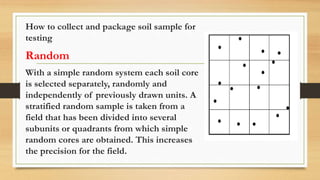
Soil sampling is important to measure nutrient levels in fields and determine optimal fertilization plans. There are several sampling strategies including random sampling, grid sampling, soil series, and topographic unit sampling. Random sampling selects cores randomly while grid sampling divides the area into sections. Soil series sampling composites multiple single samples to profile nutrient levels in different areas. Topographic unit sampling accounts for natural variations in slopes, elevations, and depressions. Samples should be collected 3-6 months before planting and do not need to be taken every year. Proper sampling involves mapping areas, collecting 5-10 spot samples per area, compositing samples, and sending about 1/2 kilo to a testing lab.