Department of Biochemistry, KMC, Duwakot
Wednesday,
January 20, 2016
Rajesh Chaudhary
1
For BDS II
Purpose of Renal Function Test
To assess functional capacity of kidneys.
For early detection of possible renal impairment.
To assess severity and progression of renal impairment.
To monitor the response of treatment of renal diseases.
Wednesday,
January 20, 2016
Rajesh Chaudhary
2
Wednesday,
January 20, 2016
Rajesh Chaudhary
3
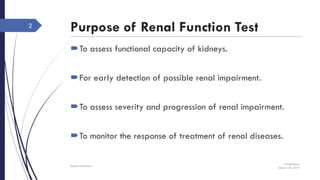
A stepwise increase in three nitrogenous
components (uric acid, urea, creatinine) of
blood is believed to reflect a deteriorating
kidney function.
-- MN Chatterjea, Textbook of Medical Biochemistry
Indications of RFT
 Family history of chronic kidney disease
 Diabetes mellitus.
 Hypertension
 Nephrolithiasis
 Drugs toxicity
Wednesday,
January 20, 2016
Rajesh Chaudhary
4
Kidney functions
Biological functions of kidney:
Excretion
Homeostatic regulation
And, Endocrine
Wednesday,
January 20, 2016
Rajesh Chaudhary
5
Types of Kidney
examination
Physical examination
Biochemical examination
Renal Function Tests / Biochemical examination
Can be classified broadly
into two categories:
1. Test that measures
glomerular function
2. Test that measures
tubular function
Wednesday,
January 20, 2016
Rajesh Chaudhary
6
Tests that are part of
kidney function test:
Urine examination
Serum urea
Serum Creatinine
BUN
Calcium, phosphorous, protein,
albumin
Renal Function Tests
Glomerular
Filtration Tests
Clearance test
Creatinine clearance
Urea clearance
Inulin clearance
Wednesday,
January 20, 2016
Rajesh Chaudhary
7
Dilution and
concentration test
Serum electrolyte
level
Routine Tests for Renal Functions
 Estimation of serum urea, creatinine.
 Determination of BUN.
 Estimation of serum electrolyte (Na, K).
 Estimation of serum total proteins/albumin.
 Urine analysis.
Wednesday,
January 20, 2016
Rajesh Chaudhary
8
Classification of Renal Function Test
Tests based on glomerulus filtration
Urea clearance, endogenous creatinine clearance test, inulin
clearance
Test to measure renal plasma flow
Tests based on tubular function
Certain miscellaneous tests
Wednesday,
January 20, 2016
Rajesh Chaudhary
9
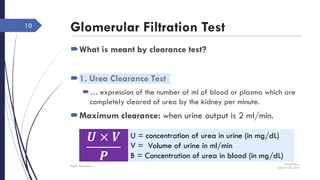
Glomerular Filtration Test
What is meant by clearance test?
1. Urea Clearance Test
… expression of the number of ml of blood or plasma which are
completely cleared of urea by the kidney per minute.
Maximum clearance: when urine output is 2 ml/min.
Wednesday,
January 20, 2016
Rajesh Chaudhary
10
𝑼 × 𝑽
𝑷
U = concentration of urea in urine (in mg/dL)
V = Volume of urine in ml/min
B = Concentration of urea in blood (in mg/dL)
“
”
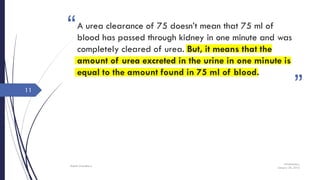
A urea clearance of 75 doesn’t mean that 75 ml of
blood has passed through kidney in one minute and was
completely cleared of urea. But, it means that the
amount of urea excreted in the urine in one minute is
equal to the amount found in 75 ml of blood.
Wednesday,
January 20, 2016
Rajesh Chaudhary
11
Interpretation of results
 Urea clearance of 70% indicates of normal functioning.
 In Acute Renal Failure: Urea clearance is usually less than ½.
 In Chronic Nephritis: Urea clearance falls progressively and
reaches to ½ or less of the normal before the blood urea concn.
Begins to rise.
 In Terminal Uraemia: Urea clearance falls to about 5% of the
normal value.
 In Nephrotic Syndrome: Urea clearance is usually normal until the
onset of renal insufficiency sets in and produces same change as
chronic nephritis.
Wednesday,
January 20, 2016
Rajesh Chaudhary
12
Interpretation of Urea clearance test results
(… in short)
1. If Urea clearance is >70%, renal function is normal.
2. If Urea clearance is between 40-70%, renal function is
mildly impaired.
3. If Urea clearance is <20%, renal function is severely
impaired.
Wednesday,
January 20, 2016
Rajesh Chaudhary
13
Endogenous Creatinine Clearance Test
(Procedure for Creatinine Clearance Test)
Collection of 24 hrs urine specimen.
Blood specimen is collected for serum creatinine estimation at
the mid point of 24 hrs urine collection.
The concentration of creatinine in both serum and urine is
measured.
Total urine volume is measured carefully.
Creatinine clearance is calculated.
Wednesday,
January 20, 2016
Rajesh Chaudhary
14
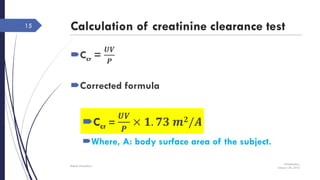
Calculation of creatinine clearance test
Ccr =
𝑼𝑽
𝑷
Corrected formula
Ccr =
𝑼𝑽
𝑷
× 𝟏. 𝟕𝟑 𝒎 𝟐/𝑨
Where, A: body surface area of the subject.
Wednesday,
January 20, 2016
Rajesh Chaudhary
15
Advantages of Creatinine Clearance Test
Endogenous metabolic product synthesized at a constant rate
for a given individual.
Unaffected by non-renal factors (e.g. protein diet, GI
hemorrhage)
Cleared essentially by glomerular filtration, not reabsorbed
and only slightly secreted (<5%) by PCT.
Its clearance value is closer to GFR.
Wednesday,
January 20, 2016
Rajesh Chaudhary
16
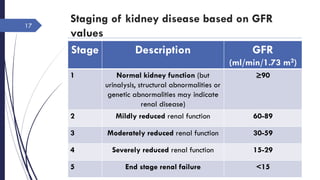
Staging of kidney disease based on GFR
values
Wednesday,
January 20, 2016
Rajesh Chaudhary
17
Stage Description GFR
(ml/min/1.73 m2)
1 Normal kidney function (but
urinalysis, structural abnormalities or
genetic abnormalities may indicate
renal disease)
≥90
2 Mildly reduced renal function 60-89
3 Moderately reduced renal function 30-59
4 Severely reduced renal function 15-29
5 End stage renal failure <15
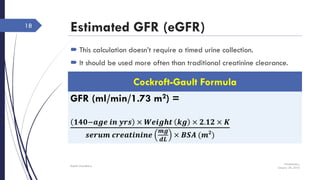
Estimated GFR (eGFR)
 This calculation doesn’t require a timed urine collection.
 It should be used more often than traditional creatinine clearance.
Wednesday,
January 20, 2016
Rajesh Chaudhary
18
GFR (ml/min/1.73 m2) =
𝟏𝟒𝟎−𝒂𝒈𝒆 𝒊𝒏 𝒚𝒓𝒔 × 𝑾𝒆𝒊𝒈𝒉𝒕 𝒌𝒈 × 𝟐.𝟏𝟐 × 𝑲
𝒔𝒆𝒓𝒖𝒎 𝒄𝒓𝒆𝒂𝒕𝒊𝒏𝒊𝒏𝒆
𝒎𝒈
𝒅𝑳
× 𝑩𝑺𝑨 (𝒎 𝟐
)
Cockroft-Gault Formula
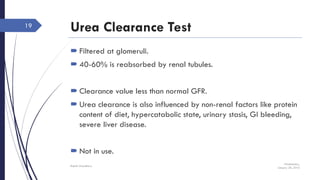
Urea Clearance Test
 Filtered at glomeruli.
 40-60% is reabsorbed by renal tubules.
 Clearance value less than normal GFR.
 Urea clearance is also influenced by non-renal factors like protein
content of diet, hypercatabolic state, urinary stasis, GI bleeding,
severe liver disease.
 Not in use.
Wednesday,
January 20, 2016
Rajesh Chaudhary
19
Inulin Clearance Test
Neither reabsorbed nor secreted by renal tubules.
Inulin clearance value is equal to GFR.
Administered intravenously to measure GFR.
Not in practice.
Wednesday,
January 20, 2016
Rajesh Chaudhary
20
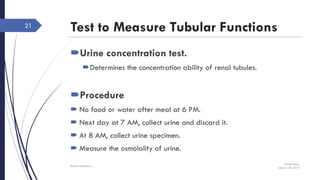
Test to Measure Tubular Functions
Urine concentration test.
Determines the concentration ability of renal tubules.
Procedure
 No food or water after meal at 6 PM.
 Next day at 7 AM, collect urine and discard it.
 At 8 AM, collect urine specimen.
 Measure the osmolality of urine.
Wednesday,
January 20, 2016
Rajesh Chaudhary
21
Interpretation
Urine osmolality >850 mOsm/kg water (renal
concentration ability normal).
Lower osmolality of urine indicates
Chronic renal failure
Acute tubular necrosis
Nephrogenic diabetes insipidus etc.
Wednesday,
January 20, 2016
Rajesh Chaudhary
22
Measurement of Urine & Plasma
Osmolality Ratio
Ratio between urine osmolality and plasma osmolality is
1:1 – 3:1 (Normal condition).
Low ratio indicates renal tubular dysfunction.
In Diabetes insipidus, the ratio of 0.2:1 – 0.7:1.
Wednesday,
January 20, 2016
Rajesh Chaudhary
23
PSP Excretion Test
This test measures tubular activity as well as renal blood
flow.
Excretion of less than 23% of the dye during this period
regardless of the amount excreted in 2 hours indicates
impaired renal function.
It is also used to determine the function of both kidneys
separately.
Wednesday,
January 20, 2016
Rajesh Chaudhary
24
Wednesday,
January 20, 2016
Rajesh Chaudhary
25
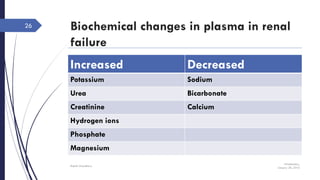
Biochemical changes in plasma in renal
failure
Wednesday,
January 20, 2016
Rajesh Chaudhary
26
Increased Decreased
Potassium Sodium
Urea Bicarbonate
Creatinine Calcium
Hydrogen ions
Phosphate
Magnesium
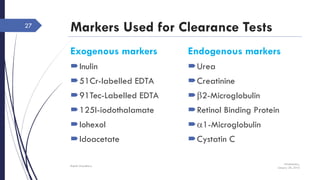
Markers Used for Clearance Tests
Exogenous markers
Inulin
51Cr-labelled EDTA
91Tec-Labelled EDTA
125I-iodothalamate
Iohexol
Idoacetate
Wednesday,
January 20, 2016
Rajesh Chaudhary
27
Endogenous markers
Urea
Creatinine
b2-Microglobulin
Retinol Binding Protein
a1-Microglobulin
Cystatin C
References
Wednesday,
January 20, 2016
Rajesh Chaudhary
28

Renal function test

  • 1.
    Department of Biochemistry,KMC, Duwakot Wednesday, January 20, 2016 Rajesh Chaudhary 1 For BDS II
  • 2.
    Purpose of RenalFunction Test To assess functional capacity of kidneys. For early detection of possible renal impairment. To assess severity and progression of renal impairment. To monitor the response of treatment of renal diseases. Wednesday, January 20, 2016 Rajesh Chaudhary 2
  • 3.
    Wednesday, January 20, 2016 RajeshChaudhary 3 A stepwise increase in three nitrogenous components (uric acid, urea, creatinine) of blood is believed to reflect a deteriorating kidney function. -- MN Chatterjea, Textbook of Medical Biochemistry
  • 4.
    Indications of RFT Family history of chronic kidney disease  Diabetes mellitus.  Hypertension  Nephrolithiasis  Drugs toxicity Wednesday, January 20, 2016 Rajesh Chaudhary 4
  • 5.
    Kidney functions Biological functionsof kidney: Excretion Homeostatic regulation And, Endocrine Wednesday, January 20, 2016 Rajesh Chaudhary 5 Types of Kidney examination Physical examination Biochemical examination
  • 6.
    Renal Function Tests/ Biochemical examination Can be classified broadly into two categories: 1. Test that measures glomerular function 2. Test that measures tubular function Wednesday, January 20, 2016 Rajesh Chaudhary 6 Tests that are part of kidney function test: Urine examination Serum urea Serum Creatinine BUN Calcium, phosphorous, protein, albumin
  • 7.
    Renal Function Tests Glomerular FiltrationTests Clearance test Creatinine clearance Urea clearance Inulin clearance Wednesday, January 20, 2016 Rajesh Chaudhary 7 Dilution and concentration test Serum electrolyte level
  • 8.
    Routine Tests forRenal Functions  Estimation of serum urea, creatinine.  Determination of BUN.  Estimation of serum electrolyte (Na, K).  Estimation of serum total proteins/albumin.  Urine analysis. Wednesday, January 20, 2016 Rajesh Chaudhary 8
  • 9.
    Classification of RenalFunction Test Tests based on glomerulus filtration Urea clearance, endogenous creatinine clearance test, inulin clearance Test to measure renal plasma flow Tests based on tubular function Certain miscellaneous tests Wednesday, January 20, 2016 Rajesh Chaudhary 9
  • 10.
    Glomerular Filtration Test Whatis meant by clearance test? 1. Urea Clearance Test … expression of the number of ml of blood or plasma which are completely cleared of urea by the kidney per minute. Maximum clearance: when urine output is 2 ml/min. Wednesday, January 20, 2016 Rajesh Chaudhary 10 𝑼 × 𝑽 𝑷 U = concentration of urea in urine (in mg/dL) V = Volume of urine in ml/min B = Concentration of urea in blood (in mg/dL)
  • 11.
    “ ” A urea clearanceof 75 doesn’t mean that 75 ml of blood has passed through kidney in one minute and was completely cleared of urea. But, it means that the amount of urea excreted in the urine in one minute is equal to the amount found in 75 ml of blood. Wednesday, January 20, 2016 Rajesh Chaudhary 11
  • 12.
    Interpretation of results Urea clearance of 70% indicates of normal functioning.  In Acute Renal Failure: Urea clearance is usually less than ½.  In Chronic Nephritis: Urea clearance falls progressively and reaches to ½ or less of the normal before the blood urea concn. Begins to rise.  In Terminal Uraemia: Urea clearance falls to about 5% of the normal value.  In Nephrotic Syndrome: Urea clearance is usually normal until the onset of renal insufficiency sets in and produces same change as chronic nephritis. Wednesday, January 20, 2016 Rajesh Chaudhary 12
  • 13.
    Interpretation of Ureaclearance test results (… in short) 1. If Urea clearance is >70%, renal function is normal. 2. If Urea clearance is between 40-70%, renal function is mildly impaired. 3. If Urea clearance is <20%, renal function is severely impaired. Wednesday, January 20, 2016 Rajesh Chaudhary 13
  • 14.
    Endogenous Creatinine ClearanceTest (Procedure for Creatinine Clearance Test) Collection of 24 hrs urine specimen. Blood specimen is collected for serum creatinine estimation at the mid point of 24 hrs urine collection. The concentration of creatinine in both serum and urine is measured. Total urine volume is measured carefully. Creatinine clearance is calculated. Wednesday, January 20, 2016 Rajesh Chaudhary 14
  • 15.
    Calculation of creatinineclearance test Ccr = 𝑼𝑽 𝑷 Corrected formula Ccr = 𝑼𝑽 𝑷 × 𝟏. 𝟕𝟑 𝒎 𝟐/𝑨 Where, A: body surface area of the subject. Wednesday, January 20, 2016 Rajesh Chaudhary 15
  • 16.
    Advantages of CreatinineClearance Test Endogenous metabolic product synthesized at a constant rate for a given individual. Unaffected by non-renal factors (e.g. protein diet, GI hemorrhage) Cleared essentially by glomerular filtration, not reabsorbed and only slightly secreted (<5%) by PCT. Its clearance value is closer to GFR. Wednesday, January 20, 2016 Rajesh Chaudhary 16
  • 17.
    Staging of kidneydisease based on GFR values Wednesday, January 20, 2016 Rajesh Chaudhary 17 Stage Description GFR (ml/min/1.73 m2) 1 Normal kidney function (but urinalysis, structural abnormalities or genetic abnormalities may indicate renal disease) ≥90 2 Mildly reduced renal function 60-89 3 Moderately reduced renal function 30-59 4 Severely reduced renal function 15-29 5 End stage renal failure <15
  • 18.
    Estimated GFR (eGFR) This calculation doesn’t require a timed urine collection.  It should be used more often than traditional creatinine clearance. Wednesday, January 20, 2016 Rajesh Chaudhary 18 GFR (ml/min/1.73 m2) = 𝟏𝟒𝟎−𝒂𝒈𝒆 𝒊𝒏 𝒚𝒓𝒔 × 𝑾𝒆𝒊𝒈𝒉𝒕 𝒌𝒈 × 𝟐.𝟏𝟐 × 𝑲 𝒔𝒆𝒓𝒖𝒎 𝒄𝒓𝒆𝒂𝒕𝒊𝒏𝒊𝒏𝒆 𝒎𝒈 𝒅𝑳 × 𝑩𝑺𝑨 (𝒎 𝟐 ) Cockroft-Gault Formula
  • 19.
    Urea Clearance Test Filtered at glomeruli.  40-60% is reabsorbed by renal tubules.  Clearance value less than normal GFR.  Urea clearance is also influenced by non-renal factors like protein content of diet, hypercatabolic state, urinary stasis, GI bleeding, severe liver disease.  Not in use. Wednesday, January 20, 2016 Rajesh Chaudhary 19
  • 20.
    Inulin Clearance Test Neitherreabsorbed nor secreted by renal tubules. Inulin clearance value is equal to GFR. Administered intravenously to measure GFR. Not in practice. Wednesday, January 20, 2016 Rajesh Chaudhary 20
  • 21.
    Test to MeasureTubular Functions Urine concentration test. Determines the concentration ability of renal tubules. Procedure  No food or water after meal at 6 PM.  Next day at 7 AM, collect urine and discard it.  At 8 AM, collect urine specimen.  Measure the osmolality of urine. Wednesday, January 20, 2016 Rajesh Chaudhary 21
  • 22.
    Interpretation Urine osmolality >850mOsm/kg water (renal concentration ability normal). Lower osmolality of urine indicates Chronic renal failure Acute tubular necrosis Nephrogenic diabetes insipidus etc. Wednesday, January 20, 2016 Rajesh Chaudhary 22
  • 23.
    Measurement of Urine& Plasma Osmolality Ratio Ratio between urine osmolality and plasma osmolality is 1:1 – 3:1 (Normal condition). Low ratio indicates renal tubular dysfunction. In Diabetes insipidus, the ratio of 0.2:1 – 0.7:1. Wednesday, January 20, 2016 Rajesh Chaudhary 23
  • 24.
    PSP Excretion Test Thistest measures tubular activity as well as renal blood flow. Excretion of less than 23% of the dye during this period regardless of the amount excreted in 2 hours indicates impaired renal function. It is also used to determine the function of both kidneys separately. Wednesday, January 20, 2016 Rajesh Chaudhary 24
  • 25.
  • 26.
    Biochemical changes inplasma in renal failure Wednesday, January 20, 2016 Rajesh Chaudhary 26 Increased Decreased Potassium Sodium Urea Bicarbonate Creatinine Calcium Hydrogen ions Phosphate Magnesium
  • 27.
    Markers Used forClearance Tests Exogenous markers Inulin 51Cr-labelled EDTA 91Tec-Labelled EDTA 125I-iodothalamate Iohexol Idoacetate Wednesday, January 20, 2016 Rajesh Chaudhary 27 Endogenous markers Urea Creatinine b2-Microglobulin Retinol Binding Protein a1-Microglobulin Cystatin C
  • 28.