RENAL FUNCTION TESTS
By-
Dr. Amita Yadav
MBBS, MD (Pathology)
Functions of kidney---
• Maintenance of extracellular fluid volume
• and composition.
• Excretion of metabolic waste products.
• Regulation of blood pressure.
• Synthesis of erythropoietin.
• Production of vitamin D3
Factors affecting renal function---
•Pre renal conditions- decrease in renal blood flow as in
dehydration,congestive cardiac failure and shock.
•Diffuse renal disease.
•Post renal conditions- obstruction to urinary outflow.
Indications for renal function tests---
 Early identification of impairment of renal function in
patients with risk of chronic renal disease.
 Diagnosis of renal disease.
 Follow the course of renal disease and assess
response to treatment.
 Plan renal replacement therapy (dialysis or renal
transplantation) in advanced renal disease.
 Adjust drug doses according to renal function.
Conditions with increased risk of chronic
renal disease---
Diabetes Mellitus
Hypertension
Autoimmune diseases like SLE
Older age
Family history of renal disease
Systemic infection
Urinary tract infection
Lower urinary tract obstruction
Classification of renal function tests---
Routine urine analysis- 1. Physical examination
2.Chemical examination
3. Microscopic examination
Tests to evaluate glomerular function
Tests to evaluate tubular function
Tests to evaluate glomerular function---
 Clearance tests to measure GFR-
Inuline clearance
I125-iothalamate clearance
Cr51 EDTA clearance
Cystatin C Clearance
Creatinine clearance
Urea clearance
Glomerular Filtration Rate (GFR )-
 Best test for assessment of excretory renal function.
 Rate in ml/min at which a substance is cleared from
circulation by glomeruli.
 Normal GFR in young adults is 120-130 ml/min/1.73m2
 Creatine claerance is most commonly used as a
measure of GFR.
 GFR varies according to age,sex and body weight of
an individual,it also depends upon renal blood flow and
pressure.
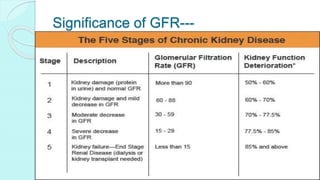
Significance of GFR---
Blood Biochemistry---
 Serum creatinine
 Blood urea nitrogen (BUN)
 BUN/Serum creatinine ratio
Tests to evaluate tubular function---
 Tests to assess proximal tubular function-
Glycosuria,phosphaturia,uricosuria
Aminoaciduria
Tubular proteinuria
Fractional sodium excretion
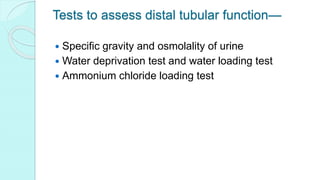
Tests to assess distal tubular function—
 Specific gravity and osmolality of urine
 Water deprivation test and water loading test
 Ammonium chloride loading test
Clearance tests-
Clearance of a substance refers to the volume of
plasma,which is completely cleared of that
substance per minute.
 CLEARANCE = U V / P
U- concentration of a substance in urine in mg/dl
V- Volume of urine excreted in ml/ min
P- concentration of a substance in plasma in mg/dl
Properties of agents used for measurement
of GFR-
 Physiologically inert
 Preferably endogenous
 Freely filtered by glomeruli
 Neither reabsorbed nor secreted by renal tubules
 Should not bind to plasma
 Should not be metabolised by kidneys
 Should be excreted only by kidneys
Agents used for measurement of GFR-
 Exogenous- Inulin,
Cr51- EDTA ,
I125-iothalamate
 Endogenous- Creatinine,
Urea,
Cystatin C
Inulin clearance---
 Inert fructose polymer
 Ideal agent for measuring GFR-Freely filtered by
glomeruli,neither reabsorbed nor secreted by
tubules.
 Bolus dose- 25 ml of 10% solution iv
 Constant iv infusion 500 ml of 1.5% solution at the
rate of 4 ml/min
 Gold standard but rarely used because it is time
consuming,expensive,constant iv infusion
needed,difficulty in laboratory analysis.
 Inulin clearance in a healthy young adult has mean
value of
127 ml/min/1.73 m2 – Men
118 ml/min/1.73 m2 - Women
Clearance of radiolabelled agents---
( I125-iothalamate,Cr51-EDTA, Tc99-DTPA)
 Expensive
 Risk of exposure to radioactive substances.
Clearance of Cystatin C---
 Cysteine protease inhibitor
 Completely reabsorbed by proximal tubule, so its
appearance signifies proximal tubular damage.
 Measured by immunoassay
 More sensitive and specific marker than creatinine
because its level is not affected by sex,diet or
muscle mass.
Creatinine Clearance---
 Most commonly used test for measuring GFR.
 Produced constantly by creatine in muscles.
 Completely filtered by glomeruli , is not reabsorbed
by tubules. However a small amount is secreted by
tubules.
 A 24 hour urine sample is preferred to overcome
problem of diurnal variation of creatinine excretion.
 A blood sample for estimation of plasma creatinine
is obtained at midpoint of urine collection.
Creatinine clearance= U V / P
• Formula overestimates GFR by 10% because of
secretion of creatinine by renal tubules.
• Level of creatinine is affected by-
Secretion of small amount in renal tubules.
Collection urine is incomplete.
Intake of meat.
Muscle mass.
Certain drugs- Cimetidine,probenecid, trimethoprim
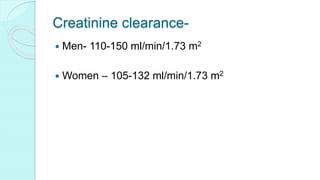
Creatinine clearance-
 Men- 110-150 ml/min/1.73 m2
 Women – 105-132 ml/min/1.73 m2
Prediction Equations---
( Estimation of creatinine clearance from
serum creatinine )
Cockcroft and Gault Formula-
Creatinine clearance in ml/min =
(140-age in years) x (Body weight in kg )
( 72 x Serum creatinine in mg / dl )
In females value obtained is multiplied by 0.85.
SCHWARTZ FORMULA-
CrCl(ml/min/1.73m2) = k x ht in cm/S.Cr(mg/dl)
k = 0.45 ,infants < 1 year of age
k = 0.55 ,children and adolescent
females.
k = 0.7, adolescent males.
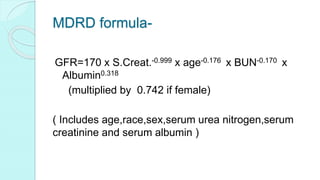
MDRD formula-
GFR=170 x S.Creat.-0.999 x age-0.176 x BUN-0.170 x
Albumin0.318
(multiplied by 0.742 if female)
( Includes age,race,sex,serum urea nitrogen,serum
creatinine and serum albumin )
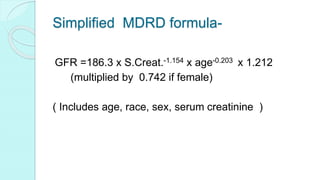
Simplified MDRD formula-
GFR =186.3 x S.Creat.-1.154 x age-0.203 x 1.212
(multiplied by 0.742 if female)
( Includes age, race, sex, serum creatinine )
Urea clearance---
 Urea is filtered by glomeruli but about 40% is
reabsorbed by the tubules.
 Underestimates GFR.
Blood biochemistry---
 Blood Urea Nitrogen (BUN)
 Serum Creatinine
 BUN / Serum creatinine ratio
Blood Urea Nitrogen---
 Proteins Amino acids
Synthesis of tissue Ammonia
Proteins and Energy Urea Cycle
Other Urea
Compounds
Excretion in urine
Concentration of blood urea is usually expressed as
BUN.
Real concentration of urea is BUN x 60/28
Azotemia- Increase in blood level of urea.
Uremia- Clinical syndrome resulting from increase in
blood level of urea.
Causes of increase in BUN-
 Pre renal azotemia- shock,congestive heart
failure,salt and water depletion.
 Renal azotemia- impairment of renal function.
 Post renal azotemia- obstruction of urinary tract.
 Increase in rate of production-
High protein diet,
Increase in protein catabolism(trauma,burn,fever)
Gastrointestinal haemorrhage or tissue hematoma.
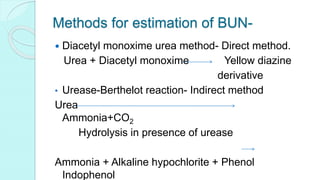
Methods for estimation of BUN-
 Diacetyl monoxime urea method- Direct method.
Urea + Diacetyl monoxime Yellow diazine
derivative
• Urease-Berthelot reaction- Indirect method
Urea
Ammonia+CO2
Hydrolysis in presence of urease
Ammonia + Alkaline hypochlorite + Phenol
Indophenol
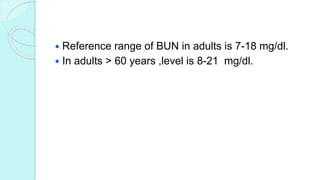
 Reference range of BUN in adults is 7-18 mg/dl.
 In adults > 60 years ,level is 8-21 mg/dl.
Serum creatinine-
 More sensitive and specific marker of renal
function as compared to BUN because-
Level is not affected by diet,protein catabolism or
other exogenous factors.
 Not a sensitive marker for early renal impairment
because significant increase in serum creatinine
does not occur until about 50% of kidney function is
lost.
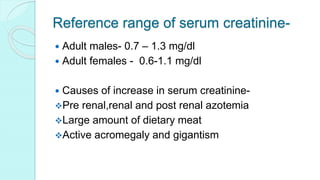
Reference range of serum creatinine-
 Adult males- 0.7 – 1.3 mg/dl
 Adult females - 0.6-1.1 mg/dl
 Causes of increase in serum creatinine-
Pre renal,renal and post renal azotemia
Large amount of dietary meat
Active acromegaly and gigantism
Causes of decreased serum creatinine-
 Pregnancy
 Increasing age
 Methods of estimation of Serum creatinine-
Jaffe’s reaction
Enzymatic methods
Jaffe’s reaction ( Alkaline picrate
reaction )-
 Creatinine reacts with picrate in alkaline solution to
produce a yellow red colour.
 Non creatinine chromogens-
o Glucose,
o Fructose,
o Protein,
o Ascorbic acid,
o Acetoacetate,
o Acetone,
o Cephalosporin
Cause false elevation of serum creatinine level.
BUN/Serum Creatinine ratio-
 Normal ratio is 12:1 to 20:1
 Used to discriminate pre renal and post renal
azotemia from renal azotemia.
Microalbuminuria -
 Albuminuria in the range of 30-300 mg/ 24 hours.
 Earliest evidence of glomerular damage.
Macroalbuminuria –
• Albuminuria >300 mg/24 hours.
• Indicates significant glomerular damage.
Tests to evaluate proximal tubular
function-
 Glycosuria
 Generalized aminoaciduria
 Tubular proteinuria( normally low molecular weight
proteins are completely reabsorbed by proximal
renal tubule ).
 Urinary concentration of sodium ( Increases in acute
tubular necrosis).
 Fractional excretion of sodium ( FENa)
FENa =
Urine sodium x Plasma creatinine x 100
Plasma sodium x Urine creatinine
Values above 3% are strongly suggestive of acute
tubular necrosis.
(Refers to percentage of filtered sodium that has been
absorbed and percentage that has been excreted.)
Tests to assess distal tubular function-
 Urine specific gravity
 Urine osmolality
 Water deprivation test
 Water loading antidiuretic hormone suppression test
 Ammonium chloride loading test
Urine specific gravity --
 Normal specific gravity is 1.003 to 1.030
- It depends on amount of solutes in solution.
- It reflects the relative degree of concentration
or dilution of a urine specimen.
- It helps in evaluating the concentrating and
diluting abilities of the kidneys
- Urea( 20 %) ,Na Cl (25%), Sulphate ,
Phosphate – major contributors
 Increase in specific gravity-
Diabetes mellitus
Nephrotic syndrome
Fever
Congestive heart failure
 Decrease in specific gravity-
Diabetes insipidus
Compulsive water drinking
• Isosthenuria -Specific gravity is fixed (1.010 )
Measurement of specific gravity-
1. Urinometer method-
Based on principle of buoyancy
2. Refractometer method-
Measures refractive index of dissolved
solids
3. Reagent strip method-
indirect method .
3 main ingredients : polyelectrolyte ,
indicator and a buffer.
Urinometer-
 Urinometer is a hydrometer that is calibrated to
measure the specific gravity of urine at a specific
temperature, usually at 200C.
 Based on principle of buoyancy so the urinometer
will float higher in urine than in water, because urine
is denser.
 Thus higher the specific gravity of a specimen, the
higher the urinometer will float.
 Specific gravity is affected by presence of dense
molecules, protein and glucose.
Temperature correction-
 For every 30C below 200C, subtract 0.001 from the
reading and for every 30C above 200C, add 0.001.
 Subtract 0.003 from specific gravity after
temperature correction for each 1 g/dl of protein and
0.004 for each 1g/dl of glucose.
Urine Osmolality---
 Most sensitive method for determination of ability of
concentration by renal tubule.
 Measures number of dissolved particles in a
solution.
 Expressed as milliosmol/kg of water.
 Measured by osmometer.
 Urine/Plasma osmolality ratio is helpful in
distinguishing pre renal azotemia from acute tubular
nacrosis. ( Higher in pre renal azotemia ).
Water Deprivation Test-
 Water intake is restricted for specified period of time
followed by measurement of specific gravity or
osmolality.
 Normally urine osmolality should rise.
 If it fails to rise ,then desmopressin is administered
to differentiate between central diabetes insipidus
and nephrogenic diabetes insipidus.
 If urine osmolality is >800 mOsm/kg of water or
specific gravity is more than or equal to 1.025
following dehydration,concentrating ability of renal
tubules is normal.
Water loading Antidiuretic Hormone
suppression test--
 This test assesses capacity of kidney to make urine
dilute after water loading.
 After overnight fast ,patient empties the bladder and
drinks 20ml/kg of water in 15-30 minutes.
 Urine is collected at hourly intervals for next 4 hours
for measurement of urine volume,specific gravity
and osmolality.
 Plasma level of ADH and serum osmolality should
be measured at hourly intervals.
 Normally >90% of water should be excreted in 4
hours.
 Specific gravity should fall to 1.003 and osmolality
should fall to <100 mOsm/kg.
 In renal function impairment urine volume is
reduced(<80% of fluid intake is excreted ).
 Specific gravity and osmolality fail to decrease.
Ammonium Chloride Loading Test—
(Acid Load Test)
 Gold standard for the diagnosis of distal or type 1
Renal tubular acidosis.
 Urine pH and plasma bicarbonate are measured
after overnight fasting.
 If pH is < 5.4 ,acidifying ability of renal tubules is
normal.
 If pH is > 5.4 and plasma bicarbonate is low
Diagnosis of RTA is confirmed.
 If neither of above results is obtained patient is
given ammonium chloride orally ( 0.1 gm/kg )over
one hour after overnight fast and urine samples are
collected for next 6-8 hours
 Ammonium chloride makes blood acidic.
 If pH is <5.4 in any one of the samples,acidifying
ability of renal tubules is normal.
Renal Biopsy--
 Refers to obtaining a small piece of kidney tissue for
microscopic examination.
 Helpful for-
Establishing the diagnosis.
Assess severity and activity of disease.
Assess prognosis.
To plan treatment and monitor response to therapy.
Indications for Renal Biopsy --
 Nephrotic syndrome in adults
 Nephrotic syndrome not responding to corticosteroids in
children.
 Acute nephritic syndrome.
 Unexplained renal insufficiency
 Asymptomatic hematuria
 Isolated non nephrotic range proteinuria with renal
impairment.
 Impaired function of renal graft
 Involvement of kidney in systemic diseases like SLE
and amyloidosis.
Contraindications--
 Uncontrolled severe hypertension
 Haemorrhagic diathesis
 Solitary kidney
 Renal neoplasm
 Large and multiple renal cysts
 Small shrunken kidney
 Acute urinary tract infection like pyelonephritis.
 Urinary tract obstruction.
Complications--
 Haemorrhage
 Arteriovenous fistula
 Infection
 Perforation of viscus
 Death (rare )
After taking biopsy sections are stained
by-
 Hematoxyline and eosine – For general architecture
of kidney and cellularity.
 Periodic acid Schiff – To highlight basement
membrane and connective tissue matrix.
 Congo red – For amyloid.
renal Function Test

renal Function Test

  • 1.
    RENAL FUNCTION TESTS By- Dr.Amita Yadav MBBS, MD (Pathology)
  • 2.
    Functions of kidney--- •Maintenance of extracellular fluid volume • and composition. • Excretion of metabolic waste products. • Regulation of blood pressure. • Synthesis of erythropoietin. • Production of vitamin D3
  • 3.
    Factors affecting renalfunction--- •Pre renal conditions- decrease in renal blood flow as in dehydration,congestive cardiac failure and shock. •Diffuse renal disease. •Post renal conditions- obstruction to urinary outflow.
  • 4.
    Indications for renalfunction tests---  Early identification of impairment of renal function in patients with risk of chronic renal disease.  Diagnosis of renal disease.  Follow the course of renal disease and assess response to treatment.  Plan renal replacement therapy (dialysis or renal transplantation) in advanced renal disease.  Adjust drug doses according to renal function.
  • 5.
    Conditions with increasedrisk of chronic renal disease--- Diabetes Mellitus Hypertension Autoimmune diseases like SLE Older age Family history of renal disease Systemic infection Urinary tract infection Lower urinary tract obstruction
  • 6.
    Classification of renalfunction tests--- Routine urine analysis- 1. Physical examination 2.Chemical examination 3. Microscopic examination Tests to evaluate glomerular function Tests to evaluate tubular function
  • 7.
    Tests to evaluateglomerular function---  Clearance tests to measure GFR- Inuline clearance I125-iothalamate clearance Cr51 EDTA clearance Cystatin C Clearance Creatinine clearance Urea clearance
  • 8.
    Glomerular Filtration Rate(GFR )-  Best test for assessment of excretory renal function.  Rate in ml/min at which a substance is cleared from circulation by glomeruli.  Normal GFR in young adults is 120-130 ml/min/1.73m2  Creatine claerance is most commonly used as a measure of GFR.  GFR varies according to age,sex and body weight of an individual,it also depends upon renal blood flow and pressure.
  • 9.
  • 10.
    Blood Biochemistry---  Serumcreatinine  Blood urea nitrogen (BUN)  BUN/Serum creatinine ratio
  • 11.
    Tests to evaluatetubular function---  Tests to assess proximal tubular function- Glycosuria,phosphaturia,uricosuria Aminoaciduria Tubular proteinuria Fractional sodium excretion
  • 12.
    Tests to assessdistal tubular function—  Specific gravity and osmolality of urine  Water deprivation test and water loading test  Ammonium chloride loading test
  • 13.
    Clearance tests- Clearance ofa substance refers to the volume of plasma,which is completely cleared of that substance per minute.  CLEARANCE = U V / P U- concentration of a substance in urine in mg/dl V- Volume of urine excreted in ml/ min P- concentration of a substance in plasma in mg/dl
  • 14.
    Properties of agentsused for measurement of GFR-  Physiologically inert  Preferably endogenous  Freely filtered by glomeruli  Neither reabsorbed nor secreted by renal tubules  Should not bind to plasma  Should not be metabolised by kidneys  Should be excreted only by kidneys
  • 15.
    Agents used formeasurement of GFR-  Exogenous- Inulin, Cr51- EDTA , I125-iothalamate  Endogenous- Creatinine, Urea, Cystatin C
  • 16.
    Inulin clearance---  Inertfructose polymer  Ideal agent for measuring GFR-Freely filtered by glomeruli,neither reabsorbed nor secreted by tubules.  Bolus dose- 25 ml of 10% solution iv  Constant iv infusion 500 ml of 1.5% solution at the rate of 4 ml/min  Gold standard but rarely used because it is time consuming,expensive,constant iv infusion needed,difficulty in laboratory analysis.
  • 17.
     Inulin clearancein a healthy young adult has mean value of 127 ml/min/1.73 m2 – Men 118 ml/min/1.73 m2 - Women
  • 18.
    Clearance of radiolabelledagents--- ( I125-iothalamate,Cr51-EDTA, Tc99-DTPA)  Expensive  Risk of exposure to radioactive substances.
  • 19.
    Clearance of CystatinC---  Cysteine protease inhibitor  Completely reabsorbed by proximal tubule, so its appearance signifies proximal tubular damage.  Measured by immunoassay  More sensitive and specific marker than creatinine because its level is not affected by sex,diet or muscle mass.
  • 20.
    Creatinine Clearance---  Mostcommonly used test for measuring GFR.  Produced constantly by creatine in muscles.  Completely filtered by glomeruli , is not reabsorbed by tubules. However a small amount is secreted by tubules.  A 24 hour urine sample is preferred to overcome problem of diurnal variation of creatinine excretion.  A blood sample for estimation of plasma creatinine is obtained at midpoint of urine collection.
  • 21.
    Creatinine clearance= UV / P • Formula overestimates GFR by 10% because of secretion of creatinine by renal tubules. • Level of creatinine is affected by- Secretion of small amount in renal tubules. Collection urine is incomplete. Intake of meat. Muscle mass. Certain drugs- Cimetidine,probenecid, trimethoprim
  • 22.
    Creatinine clearance-  Men-110-150 ml/min/1.73 m2  Women – 105-132 ml/min/1.73 m2
  • 23.
    Prediction Equations--- ( Estimationof creatinine clearance from serum creatinine ) Cockcroft and Gault Formula- Creatinine clearance in ml/min = (140-age in years) x (Body weight in kg ) ( 72 x Serum creatinine in mg / dl ) In females value obtained is multiplied by 0.85.
  • 24.
    SCHWARTZ FORMULA- CrCl(ml/min/1.73m2) =k x ht in cm/S.Cr(mg/dl) k = 0.45 ,infants < 1 year of age k = 0.55 ,children and adolescent females. k = 0.7, adolescent males.
  • 25.
    MDRD formula- GFR=170 xS.Creat.-0.999 x age-0.176 x BUN-0.170 x Albumin0.318 (multiplied by 0.742 if female) ( Includes age,race,sex,serum urea nitrogen,serum creatinine and serum albumin )
  • 26.
    Simplified MDRD formula- GFR=186.3 x S.Creat.-1.154 x age-0.203 x 1.212 (multiplied by 0.742 if female) ( Includes age, race, sex, serum creatinine )
  • 27.
    Urea clearance---  Ureais filtered by glomeruli but about 40% is reabsorbed by the tubules.  Underestimates GFR.
  • 28.
    Blood biochemistry---  BloodUrea Nitrogen (BUN)  Serum Creatinine  BUN / Serum creatinine ratio
  • 29.
    Blood Urea Nitrogen--- Proteins Amino acids Synthesis of tissue Ammonia Proteins and Energy Urea Cycle Other Urea Compounds Excretion in urine Concentration of blood urea is usually expressed as BUN.
  • 30.
    Real concentration ofurea is BUN x 60/28 Azotemia- Increase in blood level of urea. Uremia- Clinical syndrome resulting from increase in blood level of urea.
  • 31.
    Causes of increasein BUN-  Pre renal azotemia- shock,congestive heart failure,salt and water depletion.  Renal azotemia- impairment of renal function.  Post renal azotemia- obstruction of urinary tract.  Increase in rate of production- High protein diet, Increase in protein catabolism(trauma,burn,fever) Gastrointestinal haemorrhage or tissue hematoma.
  • 32.
    Methods for estimationof BUN-  Diacetyl monoxime urea method- Direct method. Urea + Diacetyl monoxime Yellow diazine derivative • Urease-Berthelot reaction- Indirect method Urea Ammonia+CO2 Hydrolysis in presence of urease Ammonia + Alkaline hypochlorite + Phenol Indophenol
  • 33.
     Reference rangeof BUN in adults is 7-18 mg/dl.  In adults > 60 years ,level is 8-21 mg/dl.
  • 34.
    Serum creatinine-  Moresensitive and specific marker of renal function as compared to BUN because- Level is not affected by diet,protein catabolism or other exogenous factors.  Not a sensitive marker for early renal impairment because significant increase in serum creatinine does not occur until about 50% of kidney function is lost.
  • 35.
    Reference range ofserum creatinine-  Adult males- 0.7 – 1.3 mg/dl  Adult females - 0.6-1.1 mg/dl  Causes of increase in serum creatinine- Pre renal,renal and post renal azotemia Large amount of dietary meat Active acromegaly and gigantism
  • 36.
    Causes of decreasedserum creatinine-  Pregnancy  Increasing age  Methods of estimation of Serum creatinine- Jaffe’s reaction Enzymatic methods
  • 37.
    Jaffe’s reaction (Alkaline picrate reaction )-  Creatinine reacts with picrate in alkaline solution to produce a yellow red colour.  Non creatinine chromogens- o Glucose, o Fructose, o Protein, o Ascorbic acid, o Acetoacetate, o Acetone, o Cephalosporin Cause false elevation of serum creatinine level.
  • 38.
    BUN/Serum Creatinine ratio- Normal ratio is 12:1 to 20:1  Used to discriminate pre renal and post renal azotemia from renal azotemia.
  • 39.
    Microalbuminuria -  Albuminuriain the range of 30-300 mg/ 24 hours.  Earliest evidence of glomerular damage. Macroalbuminuria – • Albuminuria >300 mg/24 hours. • Indicates significant glomerular damage.
  • 40.
    Tests to evaluateproximal tubular function-  Glycosuria  Generalized aminoaciduria  Tubular proteinuria( normally low molecular weight proteins are completely reabsorbed by proximal renal tubule ).  Urinary concentration of sodium ( Increases in acute tubular necrosis).  Fractional excretion of sodium ( FENa)
  • 41.
    FENa = Urine sodiumx Plasma creatinine x 100 Plasma sodium x Urine creatinine Values above 3% are strongly suggestive of acute tubular necrosis. (Refers to percentage of filtered sodium that has been absorbed and percentage that has been excreted.)
  • 42.
    Tests to assessdistal tubular function-  Urine specific gravity  Urine osmolality  Water deprivation test  Water loading antidiuretic hormone suppression test  Ammonium chloride loading test
  • 43.
    Urine specific gravity--  Normal specific gravity is 1.003 to 1.030 - It depends on amount of solutes in solution. - It reflects the relative degree of concentration or dilution of a urine specimen. - It helps in evaluating the concentrating and diluting abilities of the kidneys - Urea( 20 %) ,Na Cl (25%), Sulphate , Phosphate – major contributors
  • 44.
     Increase inspecific gravity- Diabetes mellitus Nephrotic syndrome Fever Congestive heart failure  Decrease in specific gravity- Diabetes insipidus Compulsive water drinking • Isosthenuria -Specific gravity is fixed (1.010 )
  • 45.
    Measurement of specificgravity- 1. Urinometer method- Based on principle of buoyancy 2. Refractometer method- Measures refractive index of dissolved solids 3. Reagent strip method- indirect method . 3 main ingredients : polyelectrolyte , indicator and a buffer.
  • 46.
  • 47.
     Urinometer isa hydrometer that is calibrated to measure the specific gravity of urine at a specific temperature, usually at 200C.  Based on principle of buoyancy so the urinometer will float higher in urine than in water, because urine is denser.  Thus higher the specific gravity of a specimen, the higher the urinometer will float.
  • 48.
     Specific gravityis affected by presence of dense molecules, protein and glucose. Temperature correction-  For every 30C below 200C, subtract 0.001 from the reading and for every 30C above 200C, add 0.001.  Subtract 0.003 from specific gravity after temperature correction for each 1 g/dl of protein and 0.004 for each 1g/dl of glucose.
  • 49.
    Urine Osmolality---  Mostsensitive method for determination of ability of concentration by renal tubule.  Measures number of dissolved particles in a solution.  Expressed as milliosmol/kg of water.  Measured by osmometer.  Urine/Plasma osmolality ratio is helpful in distinguishing pre renal azotemia from acute tubular nacrosis. ( Higher in pre renal azotemia ).
  • 50.
    Water Deprivation Test- Water intake is restricted for specified period of time followed by measurement of specific gravity or osmolality.  Normally urine osmolality should rise.  If it fails to rise ,then desmopressin is administered to differentiate between central diabetes insipidus and nephrogenic diabetes insipidus.
  • 51.
     If urineosmolality is >800 mOsm/kg of water or specific gravity is more than or equal to 1.025 following dehydration,concentrating ability of renal tubules is normal.
  • 52.
    Water loading AntidiureticHormone suppression test--  This test assesses capacity of kidney to make urine dilute after water loading.  After overnight fast ,patient empties the bladder and drinks 20ml/kg of water in 15-30 minutes.  Urine is collected at hourly intervals for next 4 hours for measurement of urine volume,specific gravity and osmolality.  Plasma level of ADH and serum osmolality should be measured at hourly intervals.
  • 53.
     Normally >90%of water should be excreted in 4 hours.  Specific gravity should fall to 1.003 and osmolality should fall to <100 mOsm/kg.  In renal function impairment urine volume is reduced(<80% of fluid intake is excreted ).  Specific gravity and osmolality fail to decrease.
  • 54.
    Ammonium Chloride LoadingTest— (Acid Load Test)  Gold standard for the diagnosis of distal or type 1 Renal tubular acidosis.  Urine pH and plasma bicarbonate are measured after overnight fasting.  If pH is < 5.4 ,acidifying ability of renal tubules is normal.  If pH is > 5.4 and plasma bicarbonate is low Diagnosis of RTA is confirmed.
  • 55.
     If neitherof above results is obtained patient is given ammonium chloride orally ( 0.1 gm/kg )over one hour after overnight fast and urine samples are collected for next 6-8 hours  Ammonium chloride makes blood acidic.  If pH is <5.4 in any one of the samples,acidifying ability of renal tubules is normal.
  • 56.
    Renal Biopsy--  Refersto obtaining a small piece of kidney tissue for microscopic examination.  Helpful for- Establishing the diagnosis. Assess severity and activity of disease. Assess prognosis. To plan treatment and monitor response to therapy.
  • 57.
    Indications for RenalBiopsy --  Nephrotic syndrome in adults  Nephrotic syndrome not responding to corticosteroids in children.  Acute nephritic syndrome.  Unexplained renal insufficiency  Asymptomatic hematuria  Isolated non nephrotic range proteinuria with renal impairment.  Impaired function of renal graft  Involvement of kidney in systemic diseases like SLE and amyloidosis.
  • 58.
    Contraindications--  Uncontrolled severehypertension  Haemorrhagic diathesis  Solitary kidney  Renal neoplasm  Large and multiple renal cysts  Small shrunken kidney  Acute urinary tract infection like pyelonephritis.  Urinary tract obstruction.
  • 59.
    Complications--  Haemorrhage  Arteriovenousfistula  Infection  Perforation of viscus  Death (rare )
  • 60.
    After taking biopsysections are stained by-  Hematoxyline and eosine – For general architecture of kidney and cellularity.  Periodic acid Schiff – To highlight basement membrane and connective tissue matrix.  Congo red – For amyloid.