UTMUNIVERSITI TEKNOLOGI MALAYSIA
 
Fault Detection and Classification on Single Circuit
Transmission Line using Discrete Wavelet Transform and
Backpropagation Neural Network based on Clarke’s
Transformation
Makmur SAINI
Abdullah Asuhaimi Bin MOHD ZIN
Mohd Wazir Bin MUSTAFA
Ahmad Rizal SULTAN
Rahimuddin
Abstract
This paper proposes a new technique of using discrete wavelet transform (DWT) and back-
propagation neural network (BPNN) based on Clarke’s transformation for fault
classification and detection on a single circuit transmission line. Simulation and training process
for the neural network are done by using PSCAD / EMTDC and MATLAB. Daubechies4
mother wavelet (DB4) is used to decompose the high frequency components of these signals.
The wavelet transform coefficients (WTC) and wavelet energy coefficients (WEC) for
classification fault and detect patterns used as input for neural network training
backpropagation (BPNN). This information is then fed into a neural network to classify
the fault condition. A DWT with quasi optimal performance forpreprocessing stage are
presented. This study also includes a comparison of the results of training BPPN and DWT with
and without Clarke’s transformation, where the results show that using Clarke transformation in
training will give in a smaller mean square error (MSE) and mean absolute error (MAE). The
simulation also shows that the new algorithm is more reliable and accurate.
Introduction
This paper proposes a method of using discrete wavelet
transform (DWT) and back-propagation neural network (BPNN)
based on Clarke’s transformation to determine the fault
detection and classification on single circuit transmission line.
This study presents a different approach called alpha-beta
transformation based on the Clarke’s transformation, which is
also a transformation of a three-phase system into a two-phase
system [1, 2], where the result of the Clarke’s transformation is
transformed into discrete wavelets transform.In recent years,
several methods of fault classification have been proposed.
Some of them are based on artificial neural network [3,4],
wavelet transform [5,6] and also combination of these
techniques [7-8 ].
Introduction
This paper proposes a novel method for fault
classification in transmission lines using discrete
wavelet transform (DWT) and back-propagation neural
network (BPNN). The key idea of the method is to use
wavelet coefficient detail and the wavelet energy
coefficient of the currents as the input patterns to
create a simple multi-layer perception network (MLP).
This paper presents the development of a new decision
algorithm for use in the protective relay for fault
detection and classification. To validate this technique,
the fault conditions had been simulated using EMTDC /
PSCAD [9]
Discrete Wavelet Transform (DWT)
In general, wavelet transform is the decomposition of a signal by
a function which has been dilated and translated, known as the
mother wavelet. In other words, the signal is represented as the
sum of a collection of dilated-version and translated-version
mother wavelet function. The set of functions are as defined in
the following equations [10, 11]:
where S is the dilation parameter ( S є real) and is the translation
parameter (є real ).
Back-Propagation Neural Network (BPNN)
Back-propagation neural network (BPPN) is a trained network to
obtain a balance between the ability of the network to recognize
the patterns used for training, as well as the network's ability to
provide the correct response to the input pattern similar to the
style employed during training. Back-propagation training
includes the following 3 steps:
Step I: Feed Forward
During the forward propagation, the value of the input () and the output of each unit of
the hidden layer () will be propagated to the hidden layer is defined using activation
function, and so on to generate the output value of the network (). Next, the output
value of the network () will be compared with the target to be achieved (). Difference of
is the error that occurs. If this error is smaller than the tolerance limit, the iteration is
stopped. However, if the error is greater than the tolerance limit, the weight of each line
in the network will be modified to reduce the errors
Back-Propagation Neural Network (BPNN)
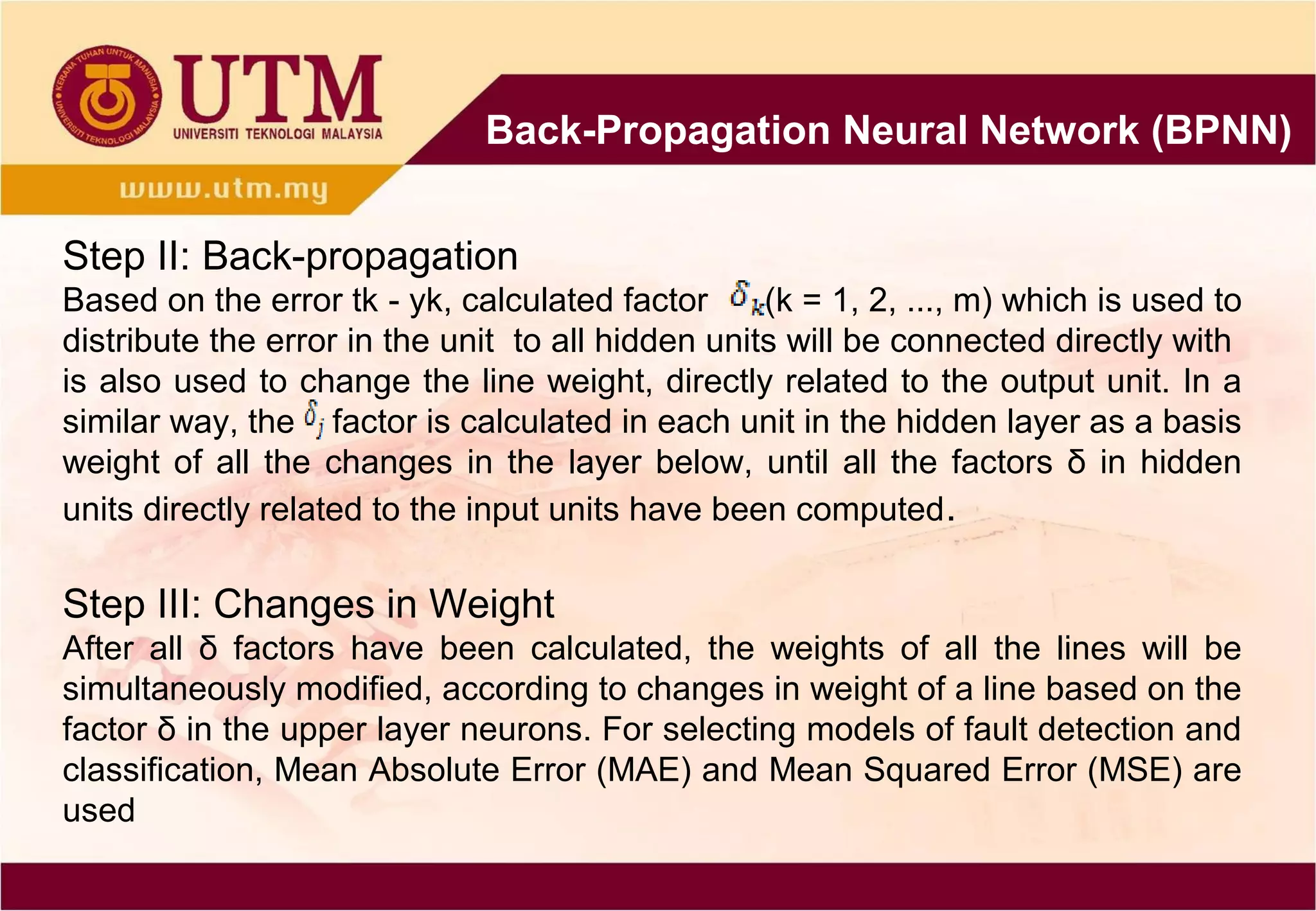
Step II: Back-propagation
Based on the error tk - yk, calculated factor (k = 1, 2, ..., m) which is used to
distribute the error in the unit to all hidden units will be connected directly with
is also used to change the line weight, directly related to the output unit. In a
similar way, the factor is calculated in each unit in the hidden layer as a basis
weight of all the changes in the layer below, until all the factors δ in hidden
units directly related to the input units have been computed.
Step III: Changes in Weight
After all δ factors have been calculated, the weights of all the lines will be
simultaneously modified, according to changes in weight of a line based on the
factor δ in the upper layer neurons. For selecting models of fault detection and
classification, Mean Absolute Error (MAE) and Mean Squared Error (MSE) are
used
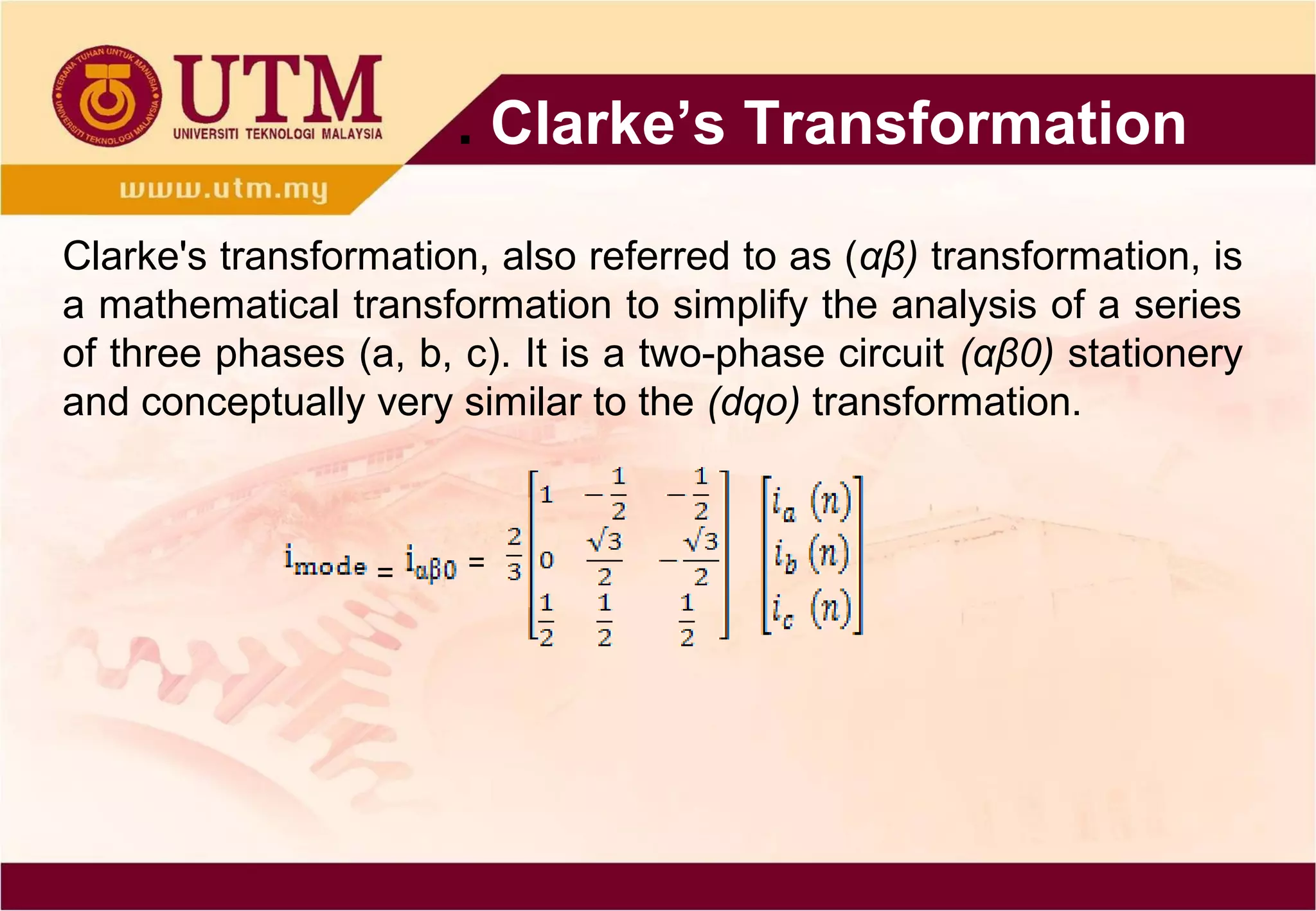
. Clarke’s Transformation
Clarke's transformation, also referred to as (αβ) transformation, is
a mathematical transformation to simplify the analysis of a series
of three phases (a, b, c). It is a two-phase circuit (αβ0) stationery
and conceptually very similar to the (dqo) transformation.
= =
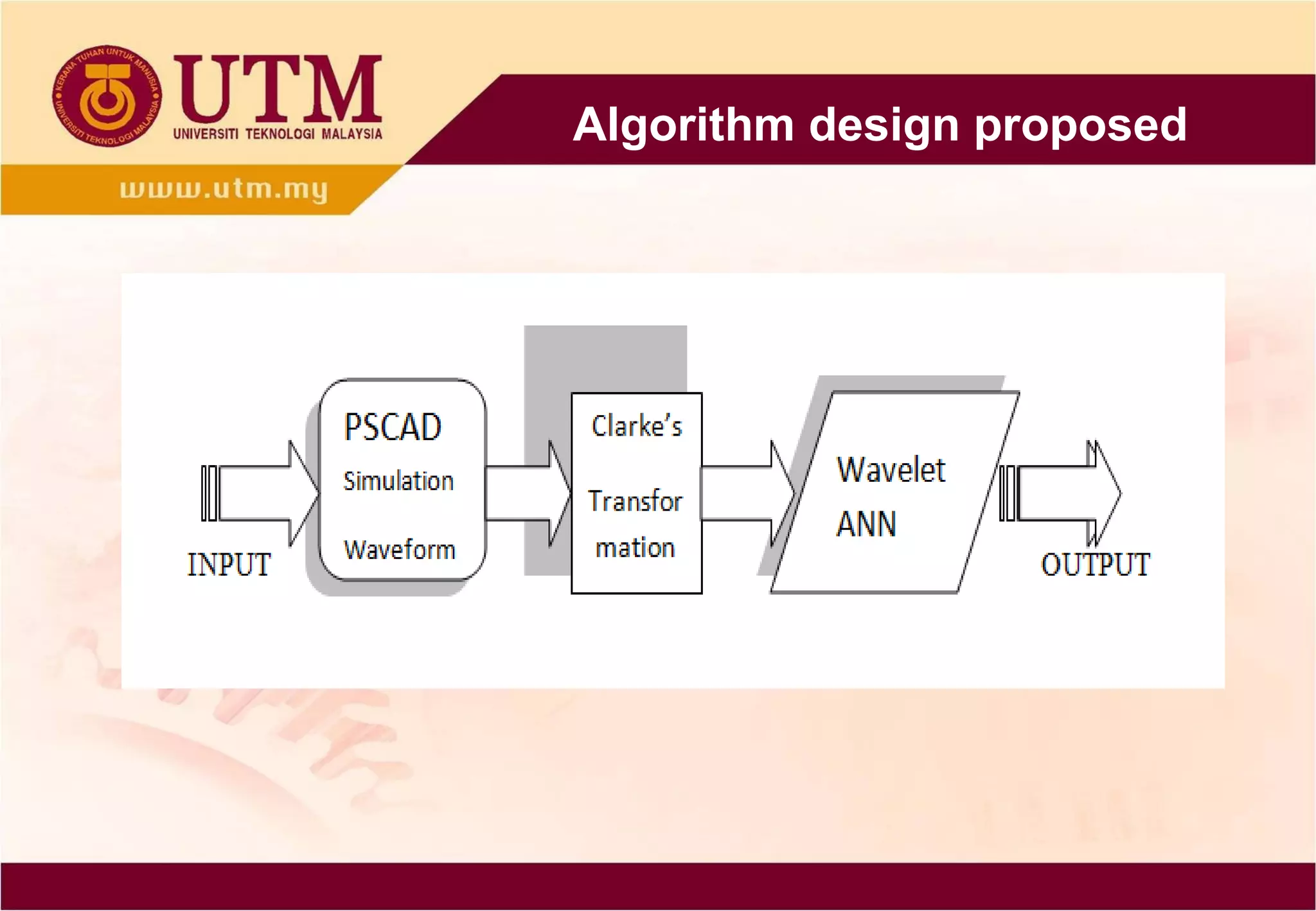
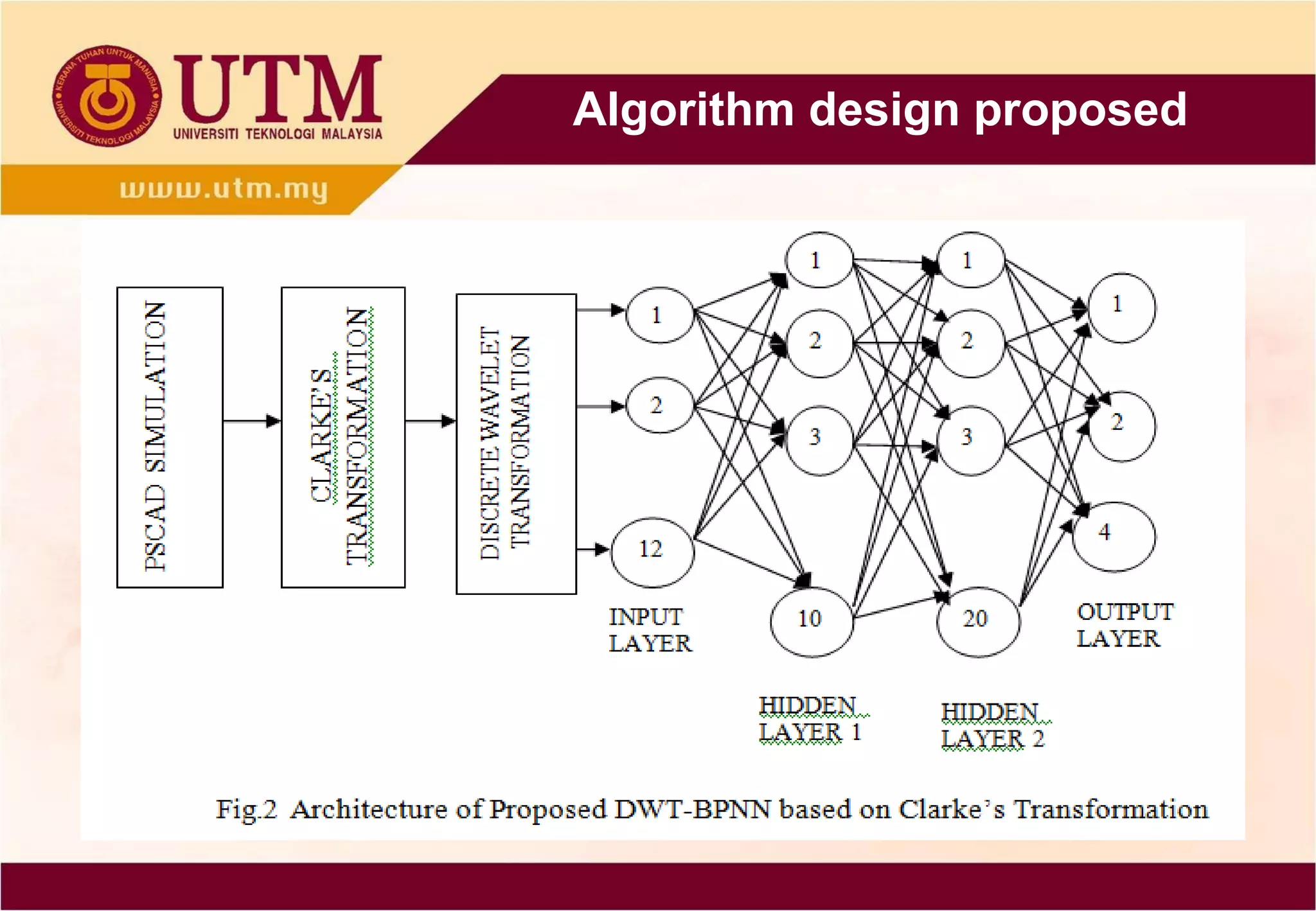
Algorithm design proposed
Simulation Result and Discussion
.
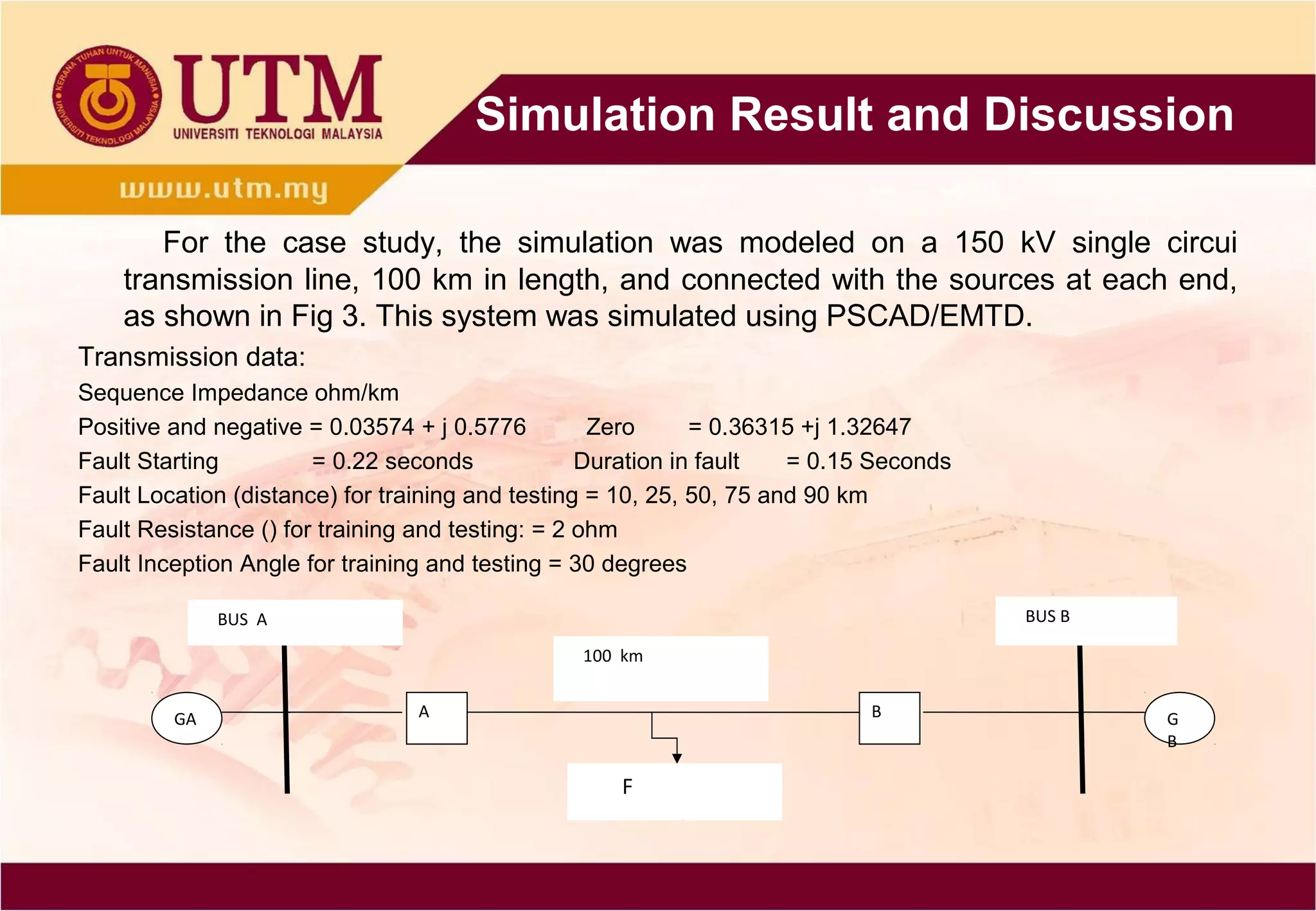
For the case study, the simulation was modeled on a 150 kV single circui
transmission line, 100 km in length, and connected with the sources at each end,
as shown in Fig 3. This system was simulated using PSCAD/EMTD.
Transmission data:
Sequence Impedance ohm/km
Positive and negative = 0.03574 + j 0.5776 Zero = 0.36315 +j 1.32647
Fault Starting = 0.22 seconds Duration in fault = 0.15 Seconds
Fault Location (distance) for training and testing = 10, 25, 50, 75 and 90 km
Fault Resistance () for training and testing: = 2 ohm
Fault Inception Angle for training and testing = 30 degrees
GA G
B
A B
100 km100 km
BUS A BUS B
F
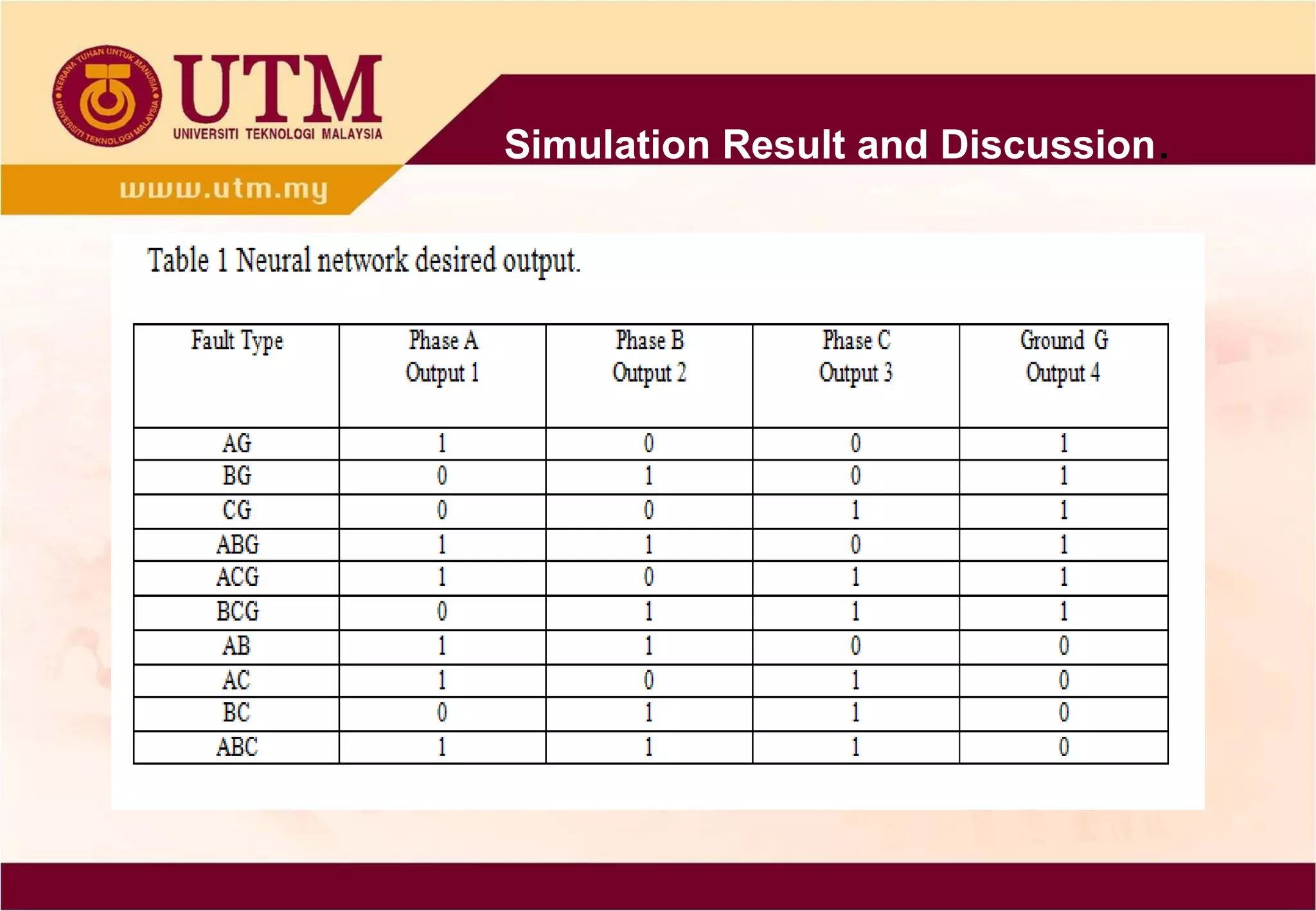
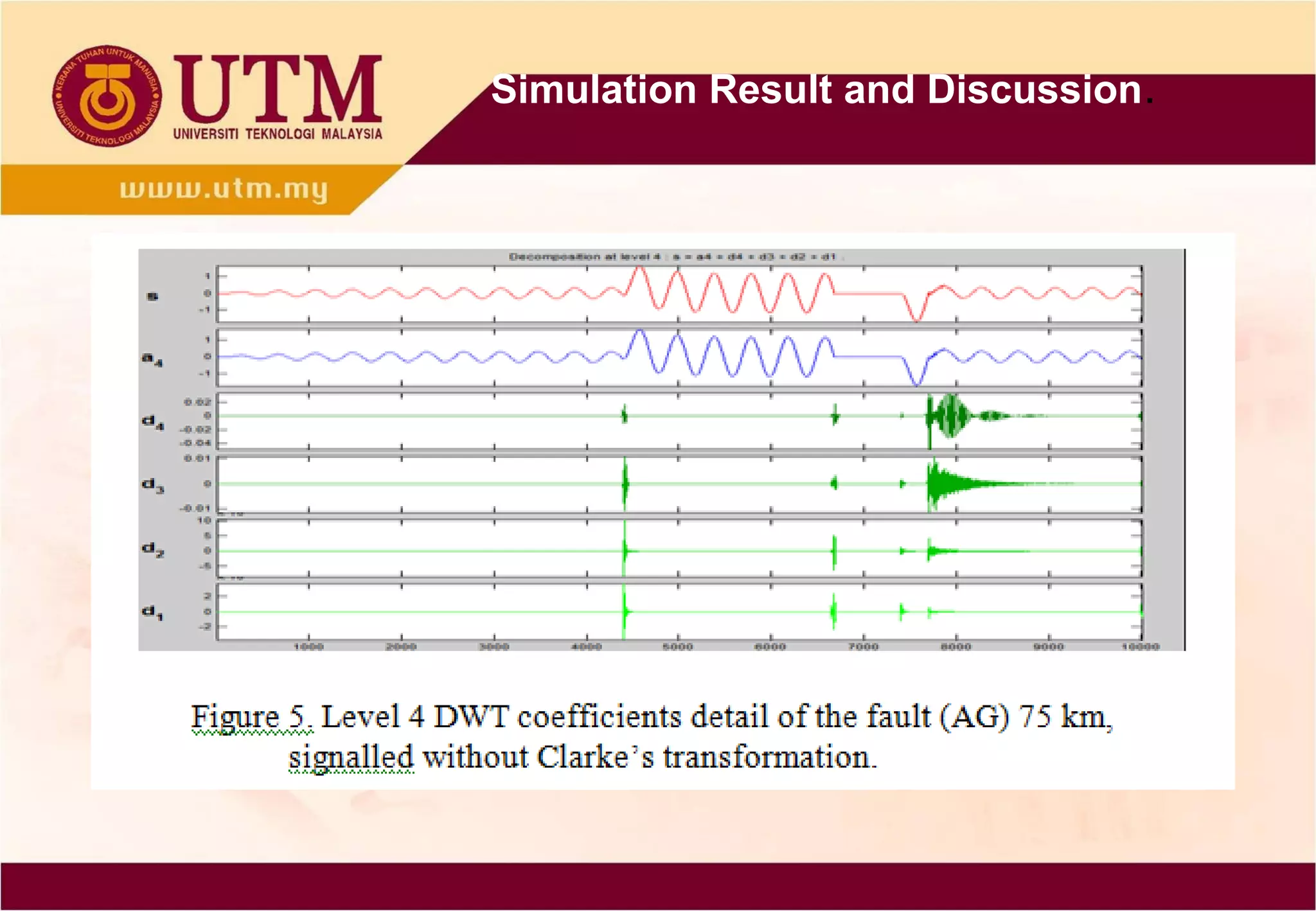
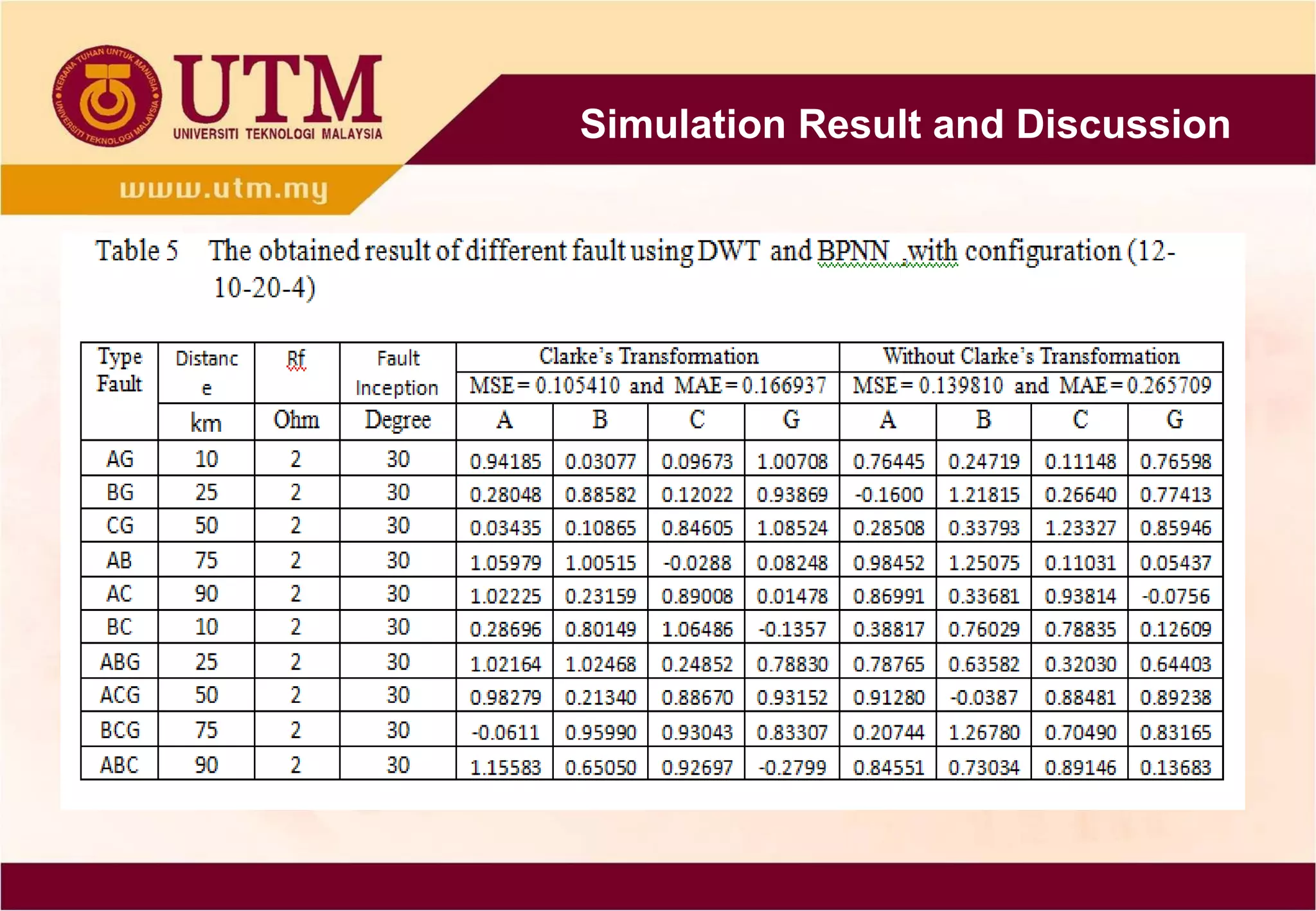
Simulation Result and Discussion.
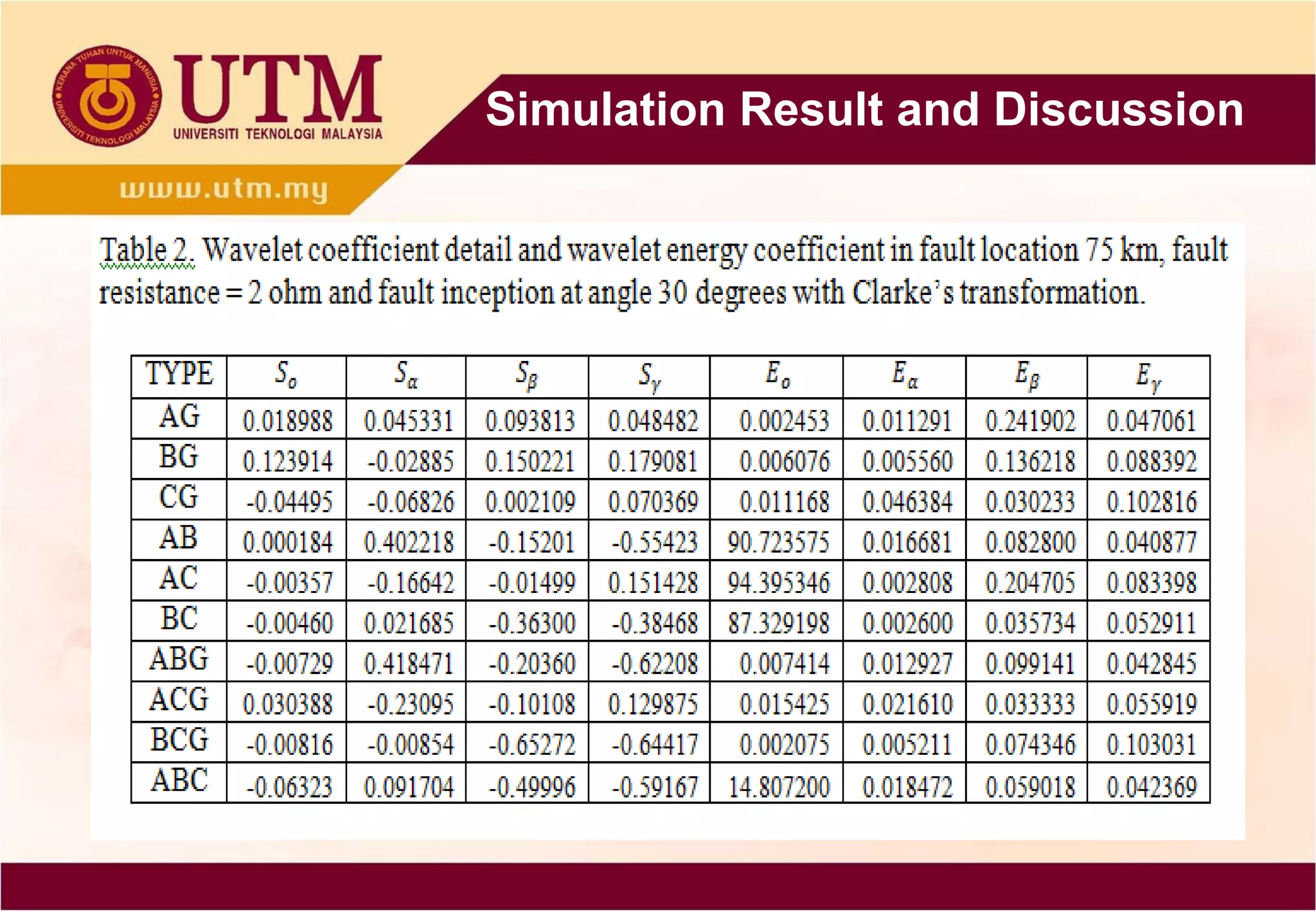
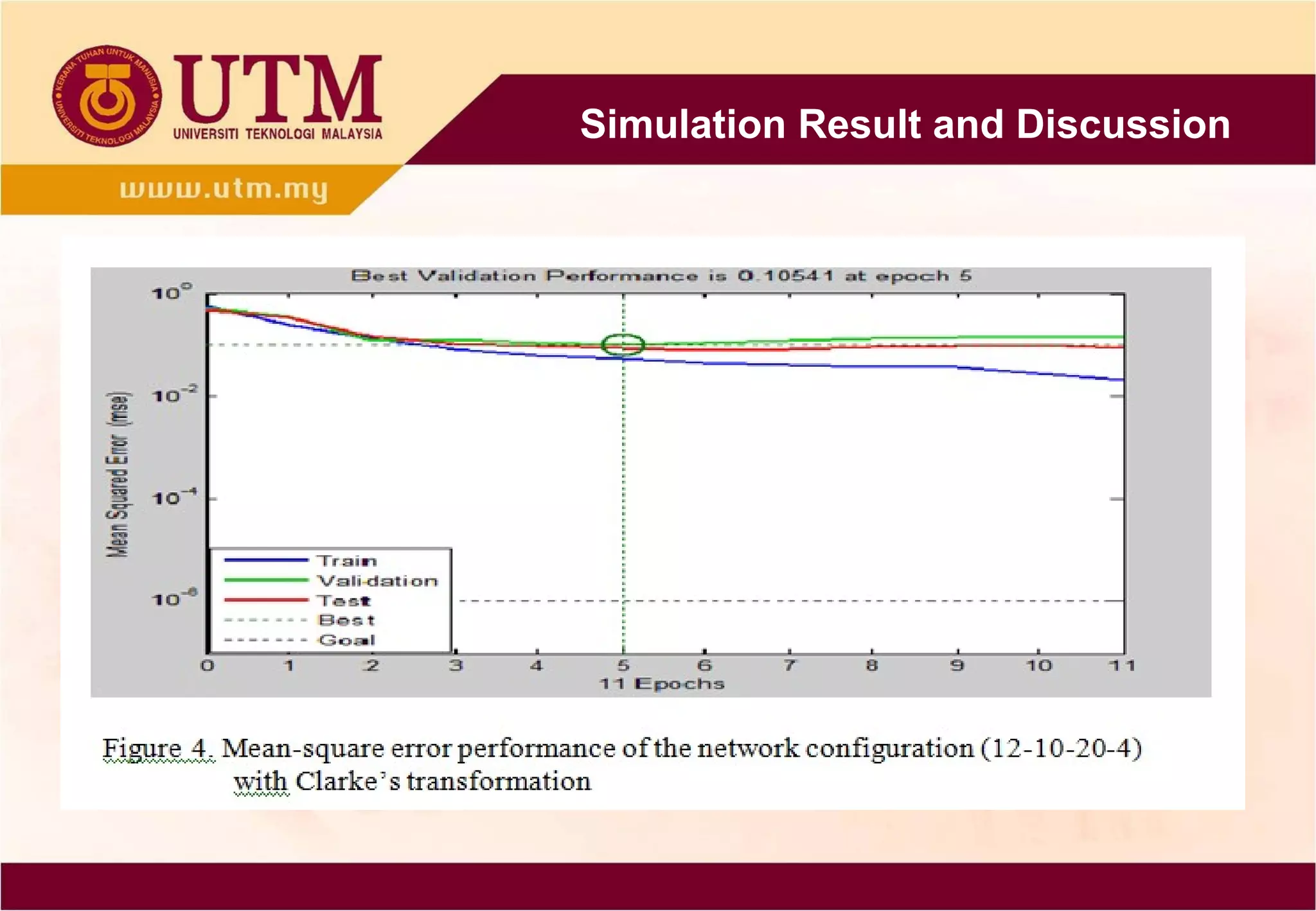
Simulation Result and Discussion


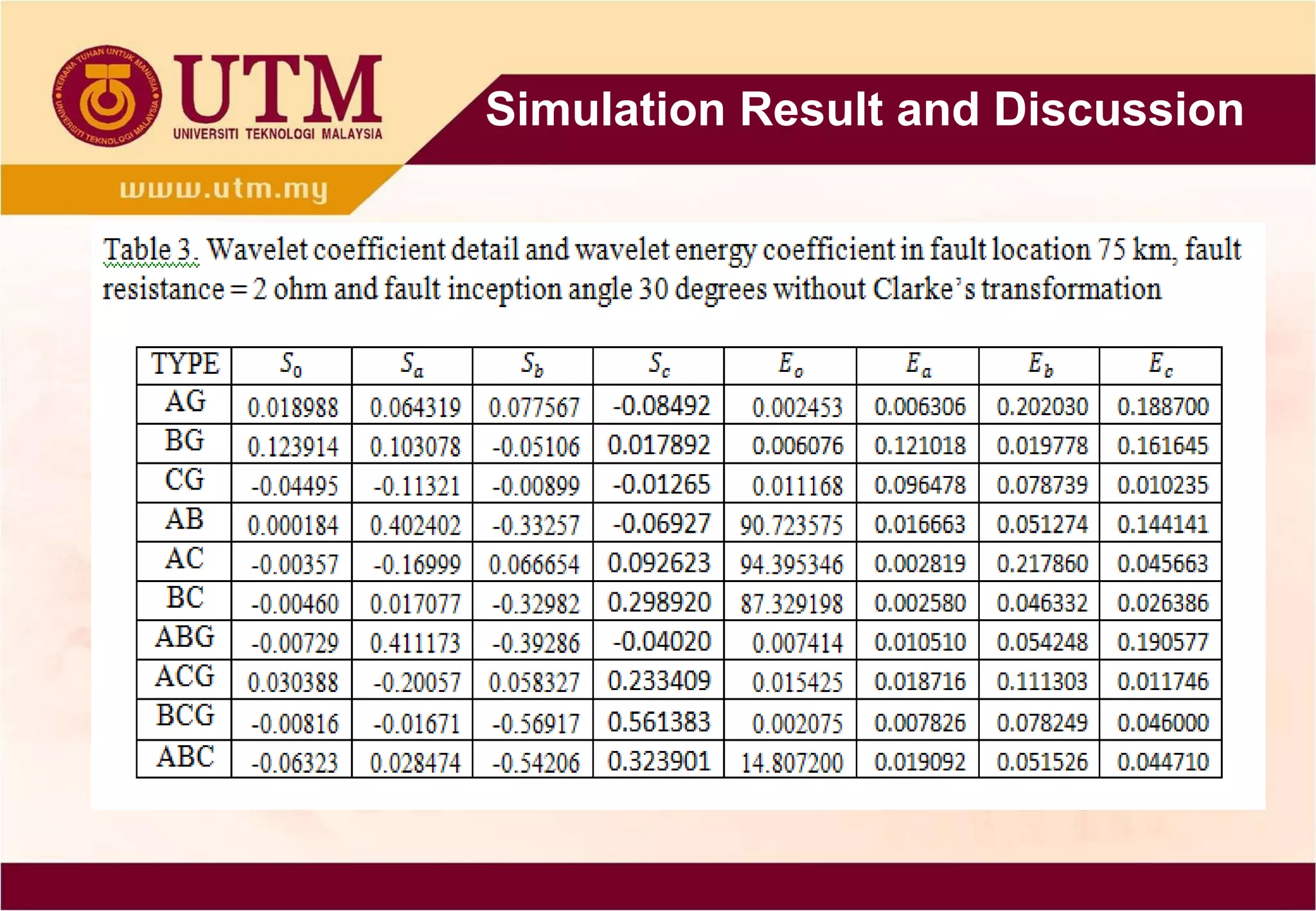
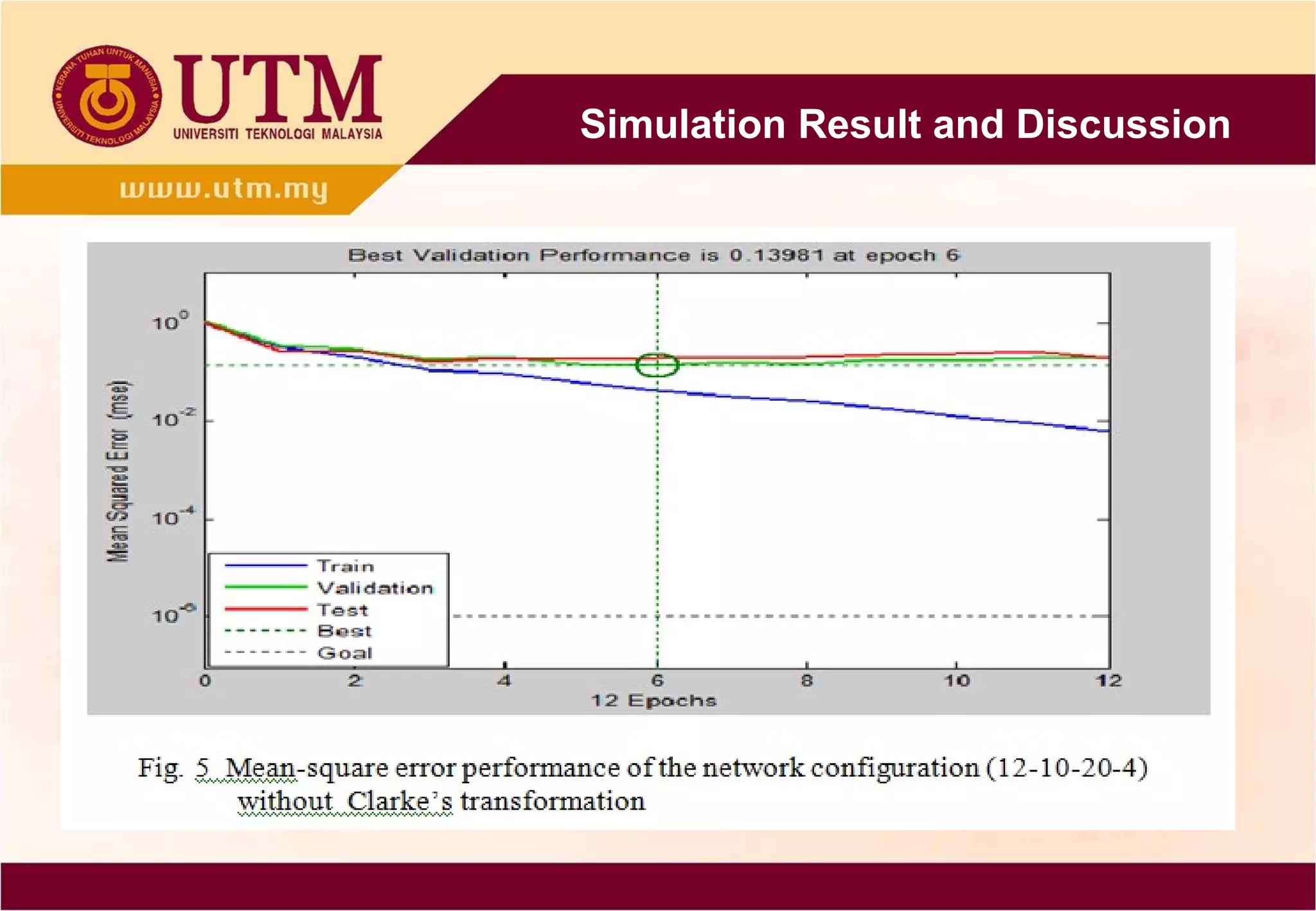
                               Simulation Result and Discussion


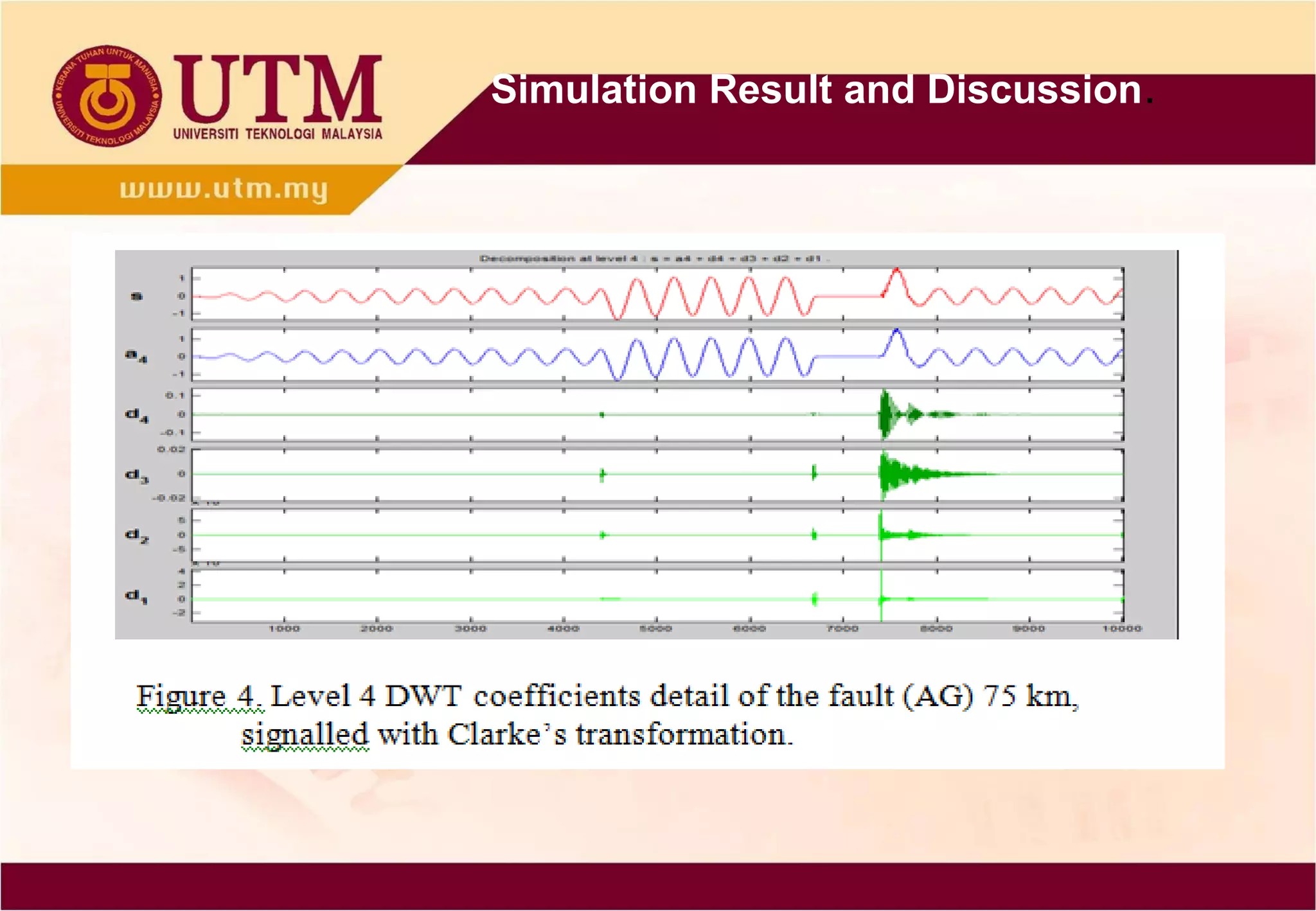
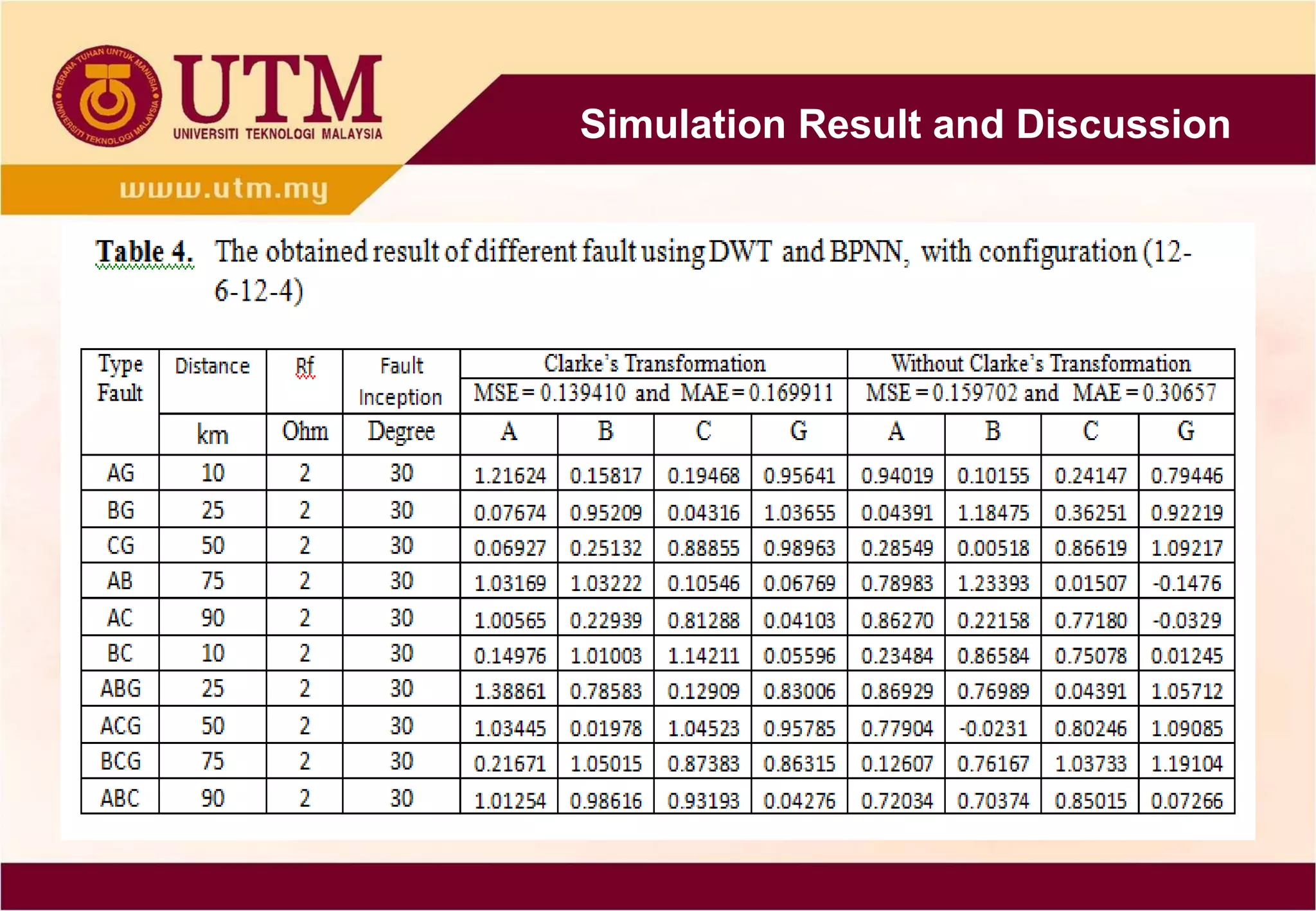
                               Simulation Result and Discussion


Conclusion
This  paper    developed  the  technique  which  is  the    linking        discrete 
wavelet transform (DWT) and back-propagation neural network (BPNN) 
based on the Clarke transformation for fault classification and detect on 
single circuit transmission lines. This study also includes comparison on 
the  results  of  training  BPPN  and  DWT  with  and  without  Clarke’s 
transformation,  where  the  results  show  that  using  the  Clarke’s 
transformation in training will produce smaller MSE and MAE, compared 
with  without  transformation  Clarke’s,  among  the  three  structures,  the 
Architecture  result  was  the  best,  which  was  12  –  10  –  20  -  12.  This 
technique applies Daubechies4 (db4) as a mother wavelet using in this 
paper, the performance shows   that  the  proposed  technique  gives   
good  accuracy  of  transient classification
22
Acknowledgment
The  authors  would  like  to  express  their 
gratitude  to  Universiti  Teknologi  Malaysia, 
The State Polytechnic of Ujung Pandang, PT. 
PLN  (Persero)  of  South  Sulawesi  and  the 
Government of South Sulawesi, Indonesia for 
providing the financial and technical support 
for this research
23
Reference
24

FAULT DETECTION AND CLASSIFICATION ON SINGLE CIRCUIT TRANSMISSION LINE USING DISCRETE WAVELET TRANSFORM AND BACK PROPAGATION NEURAL NETWORK BASED ON CLARKE’S TRANSFORMATION

  • 1.
    UTMUNIVERSITI TEKNOLOGI MALAYSIA   FaultDetection and Classification on Single Circuit Transmission Line using Discrete Wavelet Transform and Backpropagation Neural Network based on Clarke’s Transformation Makmur SAINI Abdullah Asuhaimi Bin MOHD ZIN Mohd Wazir Bin MUSTAFA Ahmad Rizal SULTAN Rahimuddin
  • 2.
    Abstract This paper proposesa new technique of using discrete wavelet transform (DWT) and back- propagation neural network (BPNN) based on Clarke’s transformation for fault classification and detection on a single circuit transmission line. Simulation and training process for the neural network are done by using PSCAD / EMTDC and MATLAB. Daubechies4 mother wavelet (DB4) is used to decompose the high frequency components of these signals. The wavelet transform coefficients (WTC) and wavelet energy coefficients (WEC) for classification fault and detect patterns used as input for neural network training backpropagation (BPNN). This information is then fed into a neural network to classify the fault condition. A DWT with quasi optimal performance forpreprocessing stage are presented. This study also includes a comparison of the results of training BPPN and DWT with and without Clarke’s transformation, where the results show that using Clarke transformation in training will give in a smaller mean square error (MSE) and mean absolute error (MAE). The simulation also shows that the new algorithm is more reliable and accurate.
  • 3.
    Introduction This paper proposesa method of using discrete wavelet transform (DWT) and back-propagation neural network (BPNN) based on Clarke’s transformation to determine the fault detection and classification on single circuit transmission line. This study presents a different approach called alpha-beta transformation based on the Clarke’s transformation, which is also a transformation of a three-phase system into a two-phase system [1, 2], where the result of the Clarke’s transformation is transformed into discrete wavelets transform.In recent years, several methods of fault classification have been proposed. Some of them are based on artificial neural network [3,4], wavelet transform [5,6] and also combination of these techniques [7-8 ].
  • 4.
    Introduction This paper proposesa novel method for fault classification in transmission lines using discrete wavelet transform (DWT) and back-propagation neural network (BPNN). The key idea of the method is to use wavelet coefficient detail and the wavelet energy coefficient of the currents as the input patterns to create a simple multi-layer perception network (MLP). This paper presents the development of a new decision algorithm for use in the protective relay for fault detection and classification. To validate this technique, the fault conditions had been simulated using EMTDC / PSCAD [9]
  • 5.
    Discrete Wavelet Transform(DWT) In general, wavelet transform is the decomposition of a signal by a function which has been dilated and translated, known as the mother wavelet. In other words, the signal is represented as the sum of a collection of dilated-version and translated-version mother wavelet function. The set of functions are as defined in the following equations [10, 11]: where S is the dilation parameter ( S є real) and is the translation parameter (є real ).
  • 6.
    Back-Propagation Neural Network(BPNN) Back-propagation neural network (BPPN) is a trained network to obtain a balance between the ability of the network to recognize the patterns used for training, as well as the network's ability to provide the correct response to the input pattern similar to the style employed during training. Back-propagation training includes the following 3 steps: Step I: Feed Forward During the forward propagation, the value of the input () and the output of each unit of the hidden layer () will be propagated to the hidden layer is defined using activation function, and so on to generate the output value of the network (). Next, the output value of the network () will be compared with the target to be achieved (). Difference of is the error that occurs. If this error is smaller than the tolerance limit, the iteration is stopped. However, if the error is greater than the tolerance limit, the weight of each line in the network will be modified to reduce the errors
  • 7.
    Back-Propagation Neural Network(BPNN) Step II: Back-propagation Based on the error tk - yk, calculated factor (k = 1, 2, ..., m) which is used to distribute the error in the unit to all hidden units will be connected directly with is also used to change the line weight, directly related to the output unit. In a similar way, the factor is calculated in each unit in the hidden layer as a basis weight of all the changes in the layer below, until all the factors δ in hidden units directly related to the input units have been computed. Step III: Changes in Weight After all δ factors have been calculated, the weights of all the lines will be simultaneously modified, according to changes in weight of a line based on the factor δ in the upper layer neurons. For selecting models of fault detection and classification, Mean Absolute Error (MAE) and Mean Squared Error (MSE) are used
  • 8.
    . Clarke’s Transformation Clarke'stransformation, also referred to as (αβ) transformation, is a mathematical transformation to simplify the analysis of a series of three phases (a, b, c). It is a two-phase circuit (αβ0) stationery and conceptually very similar to the (dqo) transformation. = =
  • 9.
  • 10.
  • 11.
    Simulation Result andDiscussion . For the case study, the simulation was modeled on a 150 kV single circui transmission line, 100 km in length, and connected with the sources at each end, as shown in Fig 3. This system was simulated using PSCAD/EMTD. Transmission data: Sequence Impedance ohm/km Positive and negative = 0.03574 + j 0.5776 Zero = 0.36315 +j 1.32647 Fault Starting = 0.22 seconds Duration in fault = 0.15 Seconds Fault Location (distance) for training and testing = 10, 25, 50, 75 and 90 km Fault Resistance () for training and testing: = 2 ohm Fault Inception Angle for training and testing = 30 degrees GA G B A B 100 km100 km BUS A BUS B F
  • 12.
  • 13.
  • 14.
  • 15.
  • 16.
  • 17.
  • 18.
  • 19.
  • 20.
  • 21.
                                           Conclusion This  paper   developed  the  technique  which  is  the    linking        discrete  wavelet transform (DWT) and back-propagation neural network (BPNN)  based on the Clarke transformation for fault classification and detect on  single circuit transmission lines. This study also includes comparison on  the  results  of  training  BPPN  and  DWT  with  and  without  Clarke’s  transformation,  where  the  results  show  that  using  the  Clarke’s  transformation in training will produce smaller MSE and MAE, compared  with  without  transformation  Clarke’s,  among  the  three  structures,  the  Architecture  result  was  the  best,  which  was  12  –  10  –  20  -  12.  This  technique applies Daubechies4 (db4) as a mother wavelet using in this  paper, the performance shows   that  the  proposed  technique  gives    good  accuracy  of  transient classification
  • 22.
    22 Acknowledgment The  authors  would like  to  express  their  gratitude  to  Universiti  Teknologi  Malaysia,  The State Polytechnic of Ujung Pandang, PT.  PLN  (Persero)  of  South  Sulawesi  and  the  Government of South Sulawesi, Indonesia for  providing the financial and technical support  for this research
  • 23.
  • 24.