AIR FLOW DETECTOR
Presented To :
Engineer Muhammad Ramiz
Presented By:
Muhammad Arslan Hafeez
Zain Asghar
Abu-Bakar Rasheed
Muhammad Umair Ikram
Hammad Ahmad
Introduction
 Explicit airflow detection is essential in many applications.
 High power density electronics are liable and self-destruct when cooling fan failures go
unnoticed.
 Heating and air-conditioning systems often incorporate multipoint monitoring of
ventilation-duct flow.
 Clean room air handling systems with undetected dirty blocked air-filters can ruin
process yield.
 Laboratory fume hoods can contain volatile solvents or toxic reagents making adequate
air turn-over critical to safety.
 In these and similar scenarios , the consequences' of undetected airflow interruption can
range from the merely expensive to the frankly dangerous.
 Therefore it becomes necessary to use some reliable means of airflow detection.
 This is a design for detecting airflow.
 This circuit can give visual for the measurement it can be also used to check whether
there is a airflow in a given space.
Components
 Comparator IC (LM339)
 Voltage regulator IC (7805)
 40W Incandescent Bulb Filament
 LED
 9 V DC Battery
 Resistors:
 R1 100 OHM
 R2 470 OHM
 R3 1K OHM
 R4 10K OHM
 R5 20K OHM
Incandescent Bulb Filament
 The filament L1 can be made by removing the glass of a 40W
incandescent bulb.
 Caution,We do not touch the filaments of incandescent lamps
by hand.
 The circuit can be powered from a 12 V DC power supply.
 In case the filament is not available, we can use different
resistances to denote the change in resistance across the
filament.
 The glass will have to be removed from L1 without breaking
the filament.
Filament as a Bulb
 The glass will have to be removed from L1
without breaking the filament.
 We wrap the glass in masking tape.
 We slowly crank down until the glass breaks,
then remove the bulb and carefully peel back
the tape.
 If the filament has broken, we need another
lamp.
IC 7805
 IC 7805 7805 is a voltage regulator integrated circuit.
 It is a member of 78xx series of fixed linear voltage regulator ICs.
 The voltage source in a circuit may have fluctuations and would not give
the fixed voltage output.
 The voltage regulator IC maintains the output voltage at a constant value.
 The xx in 78xx indicates the fixed output voltage it is designed to provide.
 7805 provides +5V regulated power supply. Capacitors of suitable values
can be connected at input and output pins depending upon the
respective voltage levels.
Pin Diagram of IC 7805
IC LM339
 IC LM339 is a comparator IC with four inbuilt comparators.
 A comparator is a simple circuit that moves signals between the analog and
digital worlds.
 It compares two input voltage levels and gives digital output to indicate the
larger one.
 The two input pins are termed as inverting (V-) and non-inverting (V+).
 The output pin goes high when voltage at V+ is greater than that at V-, and
vice versa.
 In common applications, one of the pins is provided with a reference voltage
and the other one receives analog input from a sensor or any external device.
 If inverting pin (V-) is set as reference, then V+ must exceed this reference to
result in high output. For inverted logic, the reference is set at V+ pin.
Pin Diagram of IC LM339
LED &
RESISTORS We vary the resistances, the brightness of LED
varies.
 When the resistance is high, i.e there is no air
flow, the LED doesn’t glow.
 When resistance is low i.e when air flow is there
the LED glows.
 As we don’t get low resistance in the laboratory,
we use a short circuit with a wire to denote low
resistance.
Principle
 Principle of hot wire anemometer is
used in this circuit.
 Resistance of filament changes during
the flow of air and that is compared
with the reference voltage to detect
the air flow.
Working
 When there is no air flow the resistance of the filament will be high.
 When there is air flow the resistance drops , because the moving air
will remove some of the heat generated in the filament.
 We know that heat generated is directly proportional to resistance.
 So, with the flow of air, resistance across the filament varies.
 This variations in the resistance will produce variation of voltage
across the filament (OHM’S LAW).
 These variations will be picked up by the opamp (LM339) and the
brightness of the LED at its output will be varied proportionally to the
airflow.
Applications
Industrial Application
 Industrial gas flow measurement.
 Detection of air leakage in
pressurized air systems.
 Air intake of combustion engines.
Application in Medical Science
 Spirometers.
 A spirometer is an apparatus for
measuring the volume of air inspired
and expired by the lungs.
 A spirometer measures ventilation,
the movement of air into and out of
the lungs.
Future Scope
Wind energy
farms.
Vacuum detector.
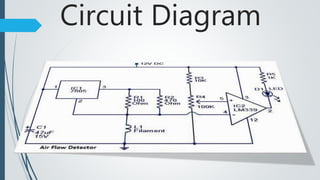
Circuit Diagram
Schematic Capture
PCB Layout
Air Flow Detector Video
Conclusion
 The circuit can give a visual indication of the rate of air flow.
 It can be also used to check whether there is air flow in a
given space.
 The filament of an incandescent bulb is the sensing part of
the circuit.
 When there is no air flow the resistance of the filament will
be high.
 Thus the air flow is been detected and as an output the LED
indicates.
Air Flow Detector

Air Flow Detector

  • 2.
    AIR FLOW DETECTOR PresentedTo : Engineer Muhammad Ramiz Presented By: Muhammad Arslan Hafeez Zain Asghar Abu-Bakar Rasheed Muhammad Umair Ikram Hammad Ahmad
  • 3.
    Introduction  Explicit airflowdetection is essential in many applications.  High power density electronics are liable and self-destruct when cooling fan failures go unnoticed.  Heating and air-conditioning systems often incorporate multipoint monitoring of ventilation-duct flow.  Clean room air handling systems with undetected dirty blocked air-filters can ruin process yield.  Laboratory fume hoods can contain volatile solvents or toxic reagents making adequate air turn-over critical to safety.  In these and similar scenarios , the consequences' of undetected airflow interruption can range from the merely expensive to the frankly dangerous.  Therefore it becomes necessary to use some reliable means of airflow detection.  This is a design for detecting airflow.  This circuit can give visual for the measurement it can be also used to check whether there is a airflow in a given space.
  • 4.
    Components  Comparator IC(LM339)  Voltage regulator IC (7805)  40W Incandescent Bulb Filament  LED  9 V DC Battery  Resistors:  R1 100 OHM  R2 470 OHM  R3 1K OHM  R4 10K OHM  R5 20K OHM
  • 5.
    Incandescent Bulb Filament The filament L1 can be made by removing the glass of a 40W incandescent bulb.  Caution,We do not touch the filaments of incandescent lamps by hand.  The circuit can be powered from a 12 V DC power supply.  In case the filament is not available, we can use different resistances to denote the change in resistance across the filament.  The glass will have to be removed from L1 without breaking the filament.
  • 6.
    Filament as aBulb  The glass will have to be removed from L1 without breaking the filament.  We wrap the glass in masking tape.  We slowly crank down until the glass breaks, then remove the bulb and carefully peel back the tape.  If the filament has broken, we need another lamp.
  • 7.
    IC 7805  IC7805 7805 is a voltage regulator integrated circuit.  It is a member of 78xx series of fixed linear voltage regulator ICs.  The voltage source in a circuit may have fluctuations and would not give the fixed voltage output.  The voltage regulator IC maintains the output voltage at a constant value.  The xx in 78xx indicates the fixed output voltage it is designed to provide.  7805 provides +5V regulated power supply. Capacitors of suitable values can be connected at input and output pins depending upon the respective voltage levels.
  • 8.
  • 9.
    IC LM339  ICLM339 is a comparator IC with four inbuilt comparators.  A comparator is a simple circuit that moves signals between the analog and digital worlds.  It compares two input voltage levels and gives digital output to indicate the larger one.  The two input pins are termed as inverting (V-) and non-inverting (V+).  The output pin goes high when voltage at V+ is greater than that at V-, and vice versa.  In common applications, one of the pins is provided with a reference voltage and the other one receives analog input from a sensor or any external device.  If inverting pin (V-) is set as reference, then V+ must exceed this reference to result in high output. For inverted logic, the reference is set at V+ pin.
  • 10.
  • 11.
    LED & RESISTORS Wevary the resistances, the brightness of LED varies.  When the resistance is high, i.e there is no air flow, the LED doesn’t glow.  When resistance is low i.e when air flow is there the LED glows.  As we don’t get low resistance in the laboratory, we use a short circuit with a wire to denote low resistance.
  • 12.
    Principle  Principle ofhot wire anemometer is used in this circuit.  Resistance of filament changes during the flow of air and that is compared with the reference voltage to detect the air flow.
  • 13.
    Working  When thereis no air flow the resistance of the filament will be high.  When there is air flow the resistance drops , because the moving air will remove some of the heat generated in the filament.  We know that heat generated is directly proportional to resistance.  So, with the flow of air, resistance across the filament varies.  This variations in the resistance will produce variation of voltage across the filament (OHM’S LAW).  These variations will be picked up by the opamp (LM339) and the brightness of the LED at its output will be varied proportionally to the airflow.
  • 14.
  • 15.
    Industrial Application  Industrialgas flow measurement.  Detection of air leakage in pressurized air systems.  Air intake of combustion engines.
  • 16.
    Application in MedicalScience  Spirometers.  A spirometer is an apparatus for measuring the volume of air inspired and expired by the lungs.  A spirometer measures ventilation, the movement of air into and out of the lungs.
  • 17.
  • 18.
  • 19.
  • 20.
  • 21.
  • 22.
    Conclusion  The circuitcan give a visual indication of the rate of air flow.  It can be also used to check whether there is air flow in a given space.  The filament of an incandescent bulb is the sensing part of the circuit.  When there is no air flow the resistance of the filament will be high.  Thus the air flow is been detected and as an output the LED indicates.