BASIC PROCESSES OF
POWDER METALLURGY 1
The basic operation of powder
metallurgy techniques
• The four basic operations of the powder metallurgy are:
1.Manufacture of powder
2.Mixing or blending powder particles
3.Compacting
4.Sintering
2
Summarized steps of power
metallurgy
• Obtaining metal powder of required fineness and purity
• Subjecting these particles to a sufficiently high pressure in a
die using a press to achieve cohesion among them
• Sintering these compacted mass at a temperature high
enough to diffuse particles & cause inter-granular grain
growth to form a single solid.
• Taking out solid component & applying the secondary
operations such as finishing, sizing & finally inspecting the
component.
3
Manufacture of Powder
Metallurgy
• The size of powder particles normally ranges
from 1-100 µm, preferably 10-20 µm.
• The processes:
1.Mechanical Process
2.Atomization
3.Electrolytic Deposition
4.Reduction
5.Hydride & Carbonyl Process
6.Condensation of Metal Powder
4
Methods For Manufacturing of
Metal Powder
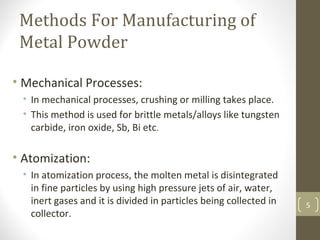
• Mechanical Processes:
• In mechanical processes, crushing or milling takes place.
• This method is used for brittle metals/alloys like tungsten
carbide, iron oxide, Sb, Bi etc.
• Atomization:
• In atomization process, the molten metal is disintegrated
in fine particles by using high pressure jets of air, water,
inert gases and it is divided in particles being collected in
collector.
5
Methods For Manufacturing
of Metal Powder
Ball MillingBall Milling AtomizationAtomization
6
Methods For Manufacturing
of Metal Powder
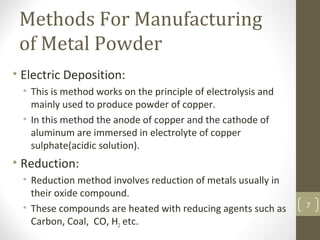
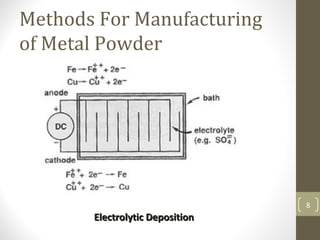
• Electric Deposition:
• This is method works on the principle of electrolysis and
mainly used to produce powder of copper.
• In this method the anode of copper and the cathode of
aluminum are immersed in electrolyte of copper
sulphate(acidic solution).
• Reduction:
• Reduction method involves reduction of metals usually in
their oxide compound.
• These compounds are heated with reducing agents such as
Carbon, Coal, CO, H2 etc.
7
Methods For Manufacturing
of Metal Powder
Electrolytic DepositionElectrolytic Deposition
8
Methods For Manufacturing
of Metal Powder
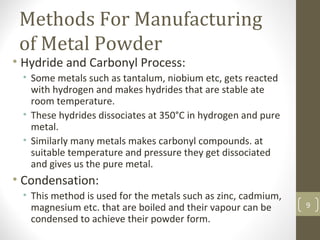
• Hydride and Carbonyl Process:
• Some metals such as tantalum, niobium etc, gets reacted
with hydrogen and makes hydrides that are stable ate
room temperature.
• These hydrides dissociates at 350°C in hydrogen and pure
metal.
• Similarly many metals makes carbonyl compounds. at
suitable temperature and pressure they get dissociated
and gives us the pure metal.
• Condensation:
• This method is used for the metals such as zinc, cadmium,
magnesium etc. that are boiled and their vapour can be
condensed to achieve their powder form.
9
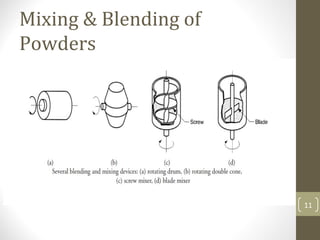
Mixing & Blending of
Powders
• Mixing:
• The powder is mixed well to produce uniform distribution
of powder, particularly when the size of powders is
different.
• In wet mixing the better mixing of powders, water or
solvent is used for reduction of dust, reduction of chances
of exploration and hazardous side effects and to prevent it
from getting oxidized.
• Blending:
• Blending is the operation to add lubricant and volatizing
agents and then thoroughly mixing of the powder.
• The lubricants used are basically the metallic separators
such as zinc separate, graphite, oil, glycerin, paraffin etc.
10
Mixing & Blending of
Powders
11
Powder Compaction
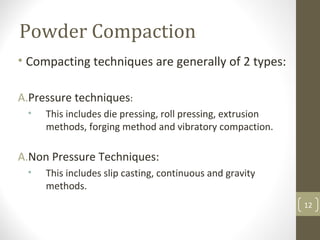
• Compacting techniques are generally of 2 types:
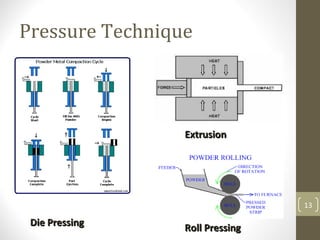
A.Pressure techniques:
• This includes die pressing, roll pressing, extrusion
methods, forging method and vibratory compaction.
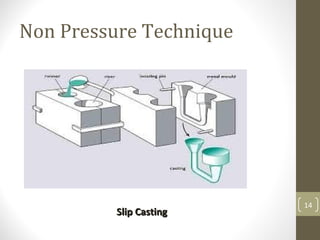
A.Non Pressure Techniques:
• This includes slip casting, continuous and gravity
methods.
12
Pressure Technique
13
ExtrusionExtrusion
Roll PressingRoll PressingDie PressingDie Pressing
Non Pressure Technique
Slip CastingSlip Casting
14
Sintering
• After compacting of the metal powder, the mass
obtained is called “Green Compact” or “Briquette”.
• To achieve the final finished product, Sintering must be
done. Sintering is applied to obtain the all possible final
strength and hardness that is needed.
• The sintering process is consist of heating the Green
compact in a furnace to a temperature below it’s melting
point. The heating takes place in reducing atmosphere.
• Sintering is essentially a process of bending particles by
atomic diffusion.
15
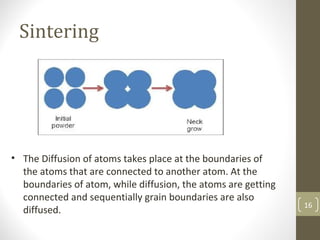
Sintering
• The Diffusion of atoms takes place at the boundaries of
the atoms that are connected to another atom. At the
boundaries of atom, while diffusion, the atoms are getting
connected and sequentially grain boundaries are also
diffused.
16
Sintering
• There are basically 2 types of sintering:
1.Solid Phase Sintering:
• In this process the sintering takes place across the cold
welded surfaces that are adjacent to each-other.
1.Liquid Phase Sintering:
• In this process, the melt of one metal is penetrated
through another metal, thus alloying results in a
continuous bonds between those two metals. 17

Basic Processes of Powder Metallurgy

  • 1.
  • 2.
    The basic operationof powder metallurgy techniques • The four basic operations of the powder metallurgy are: 1.Manufacture of powder 2.Mixing or blending powder particles 3.Compacting 4.Sintering 2
  • 3.
    Summarized steps ofpower metallurgy • Obtaining metal powder of required fineness and purity • Subjecting these particles to a sufficiently high pressure in a die using a press to achieve cohesion among them • Sintering these compacted mass at a temperature high enough to diffuse particles & cause inter-granular grain growth to form a single solid. • Taking out solid component & applying the secondary operations such as finishing, sizing & finally inspecting the component. 3
  • 4.
    Manufacture of Powder Metallurgy •The size of powder particles normally ranges from 1-100 µm, preferably 10-20 µm. • The processes: 1.Mechanical Process 2.Atomization 3.Electrolytic Deposition 4.Reduction 5.Hydride & Carbonyl Process 6.Condensation of Metal Powder 4
  • 5.
    Methods For Manufacturingof Metal Powder • Mechanical Processes: • In mechanical processes, crushing or milling takes place. • This method is used for brittle metals/alloys like tungsten carbide, iron oxide, Sb, Bi etc. • Atomization: • In atomization process, the molten metal is disintegrated in fine particles by using high pressure jets of air, water, inert gases and it is divided in particles being collected in collector. 5
  • 6.
    Methods For Manufacturing ofMetal Powder Ball MillingBall Milling AtomizationAtomization 6
  • 7.
    Methods For Manufacturing ofMetal Powder • Electric Deposition: • This is method works on the principle of electrolysis and mainly used to produce powder of copper. • In this method the anode of copper and the cathode of aluminum are immersed in electrolyte of copper sulphate(acidic solution). • Reduction: • Reduction method involves reduction of metals usually in their oxide compound. • These compounds are heated with reducing agents such as Carbon, Coal, CO, H2 etc. 7
  • 8.
    Methods For Manufacturing ofMetal Powder Electrolytic DepositionElectrolytic Deposition 8
  • 9.
    Methods For Manufacturing ofMetal Powder • Hydride and Carbonyl Process: • Some metals such as tantalum, niobium etc, gets reacted with hydrogen and makes hydrides that are stable ate room temperature. • These hydrides dissociates at 350°C in hydrogen and pure metal. • Similarly many metals makes carbonyl compounds. at suitable temperature and pressure they get dissociated and gives us the pure metal. • Condensation: • This method is used for the metals such as zinc, cadmium, magnesium etc. that are boiled and their vapour can be condensed to achieve their powder form. 9
  • 10.
    Mixing & Blendingof Powders • Mixing: • The powder is mixed well to produce uniform distribution of powder, particularly when the size of powders is different. • In wet mixing the better mixing of powders, water or solvent is used for reduction of dust, reduction of chances of exploration and hazardous side effects and to prevent it from getting oxidized. • Blending: • Blending is the operation to add lubricant and volatizing agents and then thoroughly mixing of the powder. • The lubricants used are basically the metallic separators such as zinc separate, graphite, oil, glycerin, paraffin etc. 10
  • 11.
    Mixing & Blendingof Powders 11
  • 12.
    Powder Compaction • Compactingtechniques are generally of 2 types: A.Pressure techniques: • This includes die pressing, roll pressing, extrusion methods, forging method and vibratory compaction. A.Non Pressure Techniques: • This includes slip casting, continuous and gravity methods. 12
  • 13.
  • 14.
    Non Pressure Technique SlipCastingSlip Casting 14
  • 15.
    Sintering • After compactingof the metal powder, the mass obtained is called “Green Compact” or “Briquette”. • To achieve the final finished product, Sintering must be done. Sintering is applied to obtain the all possible final strength and hardness that is needed. • The sintering process is consist of heating the Green compact in a furnace to a temperature below it’s melting point. The heating takes place in reducing atmosphere. • Sintering is essentially a process of bending particles by atomic diffusion. 15
  • 16.
    Sintering • The Diffusionof atoms takes place at the boundaries of the atoms that are connected to another atom. At the boundaries of atom, while diffusion, the atoms are getting connected and sequentially grain boundaries are also diffused. 16
  • 17.
    Sintering • There arebasically 2 types of sintering: 1.Solid Phase Sintering: • In this process the sintering takes place across the cold welded surfaces that are adjacent to each-other. 1.Liquid Phase Sintering: • In this process, the melt of one metal is penetrated through another metal, thus alloying results in a continuous bonds between those two metals. 17