Powder Metallurgy
Essentially, Powder Metallurgy (PM) is an art &
science of producing metal or metallic powders, and
using them to make finished or semi-finished products.
Particulate technology is probably the oldest forming
technique known to man.
There are archeological evidences to prove that the
ancient man knew something about it.
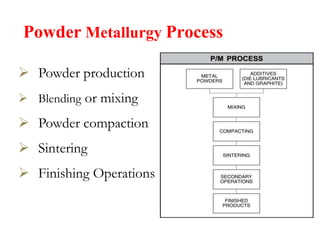
Powder Metallurgy Process
 Powder production
 Blending or mixing
 Powder compaction
 Sintering
 Finishing Operations
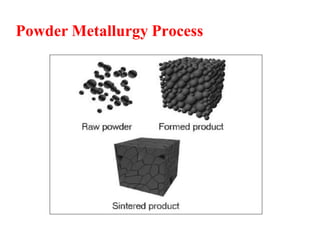
Powder Metallurgy Process
Methods of powder production
Mechanical methods:-
 Milling
Machining
Shotting
Graining
Physical methods:-
 Electrolytic deposition
Atomization
Water Atomization
Gas Atomization
Vacuum Atomization
Centrifugal Atomization
Rotating disk Atomization
Ultrasonic Atomisation
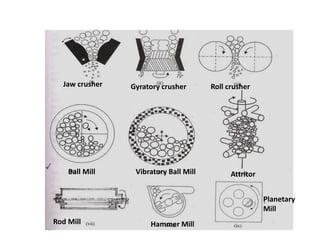
Jaw crusher Gyratory crusher Roll crusher
Ball Mill Vibratory Ball Mill Attritor
Rod Mill Hammer Mill
Planetary
Mill
Electrolytic deposition:-
This method is mainly used for producing copper, iron
powders.
This method is also used for producing zinc, tin, nickel,
cadmium, antimony, silver, lead, beryllium
powders.
Reaction:
at anode: Cu -> Cu+ + e- at cathode: Cu+ + e- ->Cu
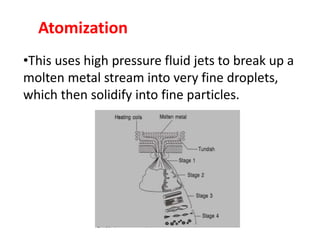
Atomization
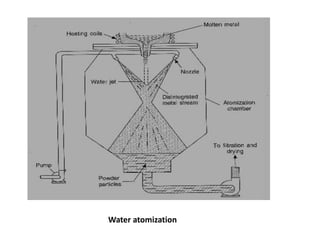
•This uses high pressure fluid jets to break up a
molten metal stream into very fine droplets,
which then solidify into fine particles.
1. Water atomization: High pressure water jets are used to
bring about the disintegration of molten metal stream.
Types of atomization:-
2.Gas atomization: Here instead of water, high velocity argon,
nitrogen and helium gas jets are used. The molten metal is
disintegrated and collected as atomized powder in a water bath
3.Vacuum atomization: In this method, when a molten metal
supersaturated with a gas under pressure is suddenly exposed into
vacuum, the gas coming from metal solution expands, causing
atomization of the metal stream.
Water atomization
Powder treatment & Handling
Cleaning of powder
Grinding
Powder classification and screening
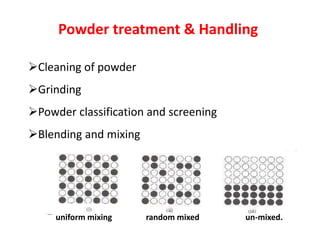
Blending and mixing
uniform mixing random mixed un-mixed.
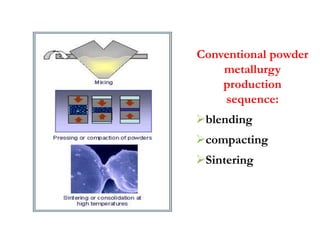
Conventional powder
metallurgy
production
sequence:
blending
compacting
Sintering
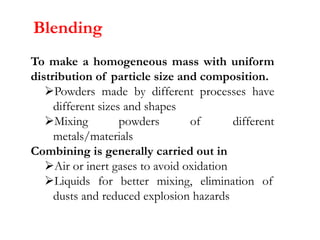
Blending
To make a homogeneous mass with uniform
distribution of particle size and composition.
Powders made by different processes have
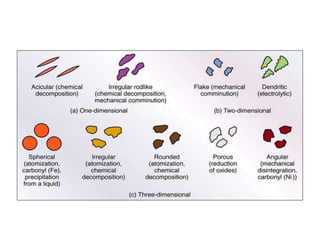
different sizes and shapes
Mixing powders of different
metals/materials
Combining is generally carried out in
Air or inert gases to avoid oxidation
Liquids for better mixing, elimination of
dusts and reduced explosion hazards
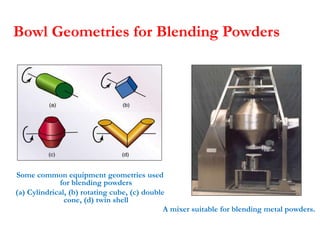
Bowl Geometries for Blending Powders
Some common equipment geometries used
for blending powders
(a) Cylindrical, (b) rotating cube, (c) double
cone, (d) twin shell
A mixer suitable for blending metal powders.
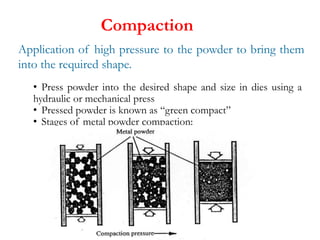
Compaction
Application of high pressure to the powder to bring them
into the required shape.
• Press powder into the desired shape and size in dies using a
hydraulic or mechanical press
• Pressed powder is known as “green compact”
• Stages of metal powder compaction:
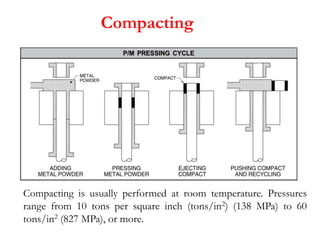
Compacting
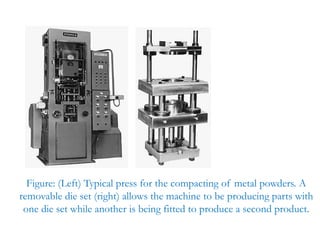
Compacting is usually performed at room temperature. Pressures
range from 10 tons per square inch (tons/in2) (138 MPa) to 60
tons/in2 (827 MPa), or more.
Figure: (Left) Typical press for the compacting of metal powders. A
removable die set (right) allows the machine to be producing parts with
one die set while another is being fitted to produce a second product.
Sintering
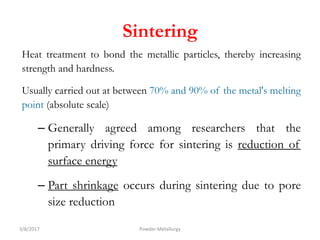
Heat treatment to bond the metallic particles, thereby increasing
strength and hardness.
Usually carried out at between 70% and 90% of the metal's melting
point (absolute scale)
– Generally agreed among researchers that the
primary driving force for sintering is reduction of
surface energy
– Part shrinkage occurs during sintering due to pore
size reduction
3/8/2017 Powder Metallurgy
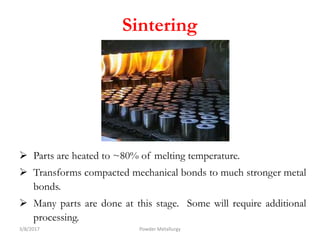
 Parts are heated to ~80% of melting temperature.
 Transforms compacted mechanical bonds to much stronger metal
bonds.
 Many parts are done at this stage. Some will require additional
processing.
3/8/2017 Powder Metallurgy
Sintering
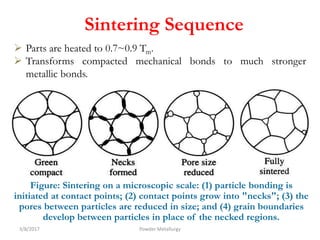
Figure: Sintering on a microscopic scale: (1) particle bonding is
initiated at contact points; (2) contact points grow into "necks"; (3) the
pores between particles are reduced in size; and (4) grain boundaries
develop between particles in place of the necked regions.
3/8/2017 Powder Metallurgy
Sintering Sequence
 Parts are heated to 0.7~0.9 Tm.
 Transforms compacted mechanical bonds to much stronger
metallic bonds.
Third stage:
Sintered product is cooled in a controlled atmosphere.
–Prevents oxidation and thermal shock
Gases commonly used for sintering:
H2, N2, inert gases or vacuum
3/8/2017 Powder Metallurgy
Sintering
Advantages of P/M
 Virtually unlimited choice of alloys, composites, and
associated properties
 Refractory materials are popular by this process
 Can be very economical at large run sizes (100,000
parts)
 Long term reliability through close control of
dimensions and physical properties
 Wide latitude of shape and design
 Very good material utilization
3/8/2017 Powder Metallurgy
Limitations and Disadvantages
 High tooling and equipment costs.
 Metallic powders are expensive.
 Problems in storing and handling metal powders.
Degradation over time, fire hazards with certain
metals
 Limitations on part geometry because metal powders do not
readily flow laterally in the die during pressing.
 Variations in density throughout part may be a problem,
especially for complex geometries.
3/8/2017 Powder Metallurgy
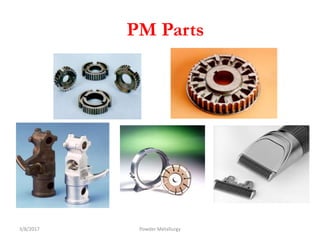
PM Parts
3/8/2017 Powder Metallurgy
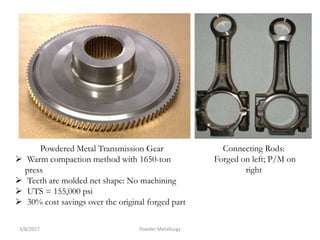
Connecting Rods:
Forged on left; P/M on
right
Powdered Metal Transmission Gear
 Warm compaction method with 1650-ton
press
 Teeth are molded net shape: No machining
 UTS = 155,000 psi
 30% cost savings over the original forged part
3/8/2017 Powder Metallurgy
Modern application of powder metallurgy
Used in both conventional aerospace application and
space vehicle system
Ex-
•Sintered bronze bearing (in explorer 3)
•Sinter magnets(navigational satellites)
•Beryllium(used for vehicle skins)
References:-
•Modern development in powder metallurgy by C G Goetzel.
•Paper submitted by R L ORBAN on new research directions in
powder metallurgy.
•Manufacturing technology (Vol-1) by P N Rao.
Thank You

Powder metallurgy

  • 1.
    Powder Metallurgy Essentially, PowderMetallurgy (PM) is an art & science of producing metal or metallic powders, and using them to make finished or semi-finished products. Particulate technology is probably the oldest forming technique known to man. There are archeological evidences to prove that the ancient man knew something about it.
  • 2.
    Powder Metallurgy Process Powder production  Blending or mixing  Powder compaction  Sintering  Finishing Operations
  • 3.
  • 4.
    Methods of powderproduction Mechanical methods:-  Milling Machining Shotting Graining Physical methods:-  Electrolytic deposition Atomization Water Atomization Gas Atomization Vacuum Atomization Centrifugal Atomization Rotating disk Atomization Ultrasonic Atomisation
  • 5.
    Jaw crusher Gyratorycrusher Roll crusher Ball Mill Vibratory Ball Mill Attritor Rod Mill Hammer Mill Planetary Mill
  • 6.
    Electrolytic deposition:- This methodis mainly used for producing copper, iron powders. This method is also used for producing zinc, tin, nickel, cadmium, antimony, silver, lead, beryllium powders. Reaction: at anode: Cu -> Cu+ + e- at cathode: Cu+ + e- ->Cu
  • 7.
    Atomization •This uses highpressure fluid jets to break up a molten metal stream into very fine droplets, which then solidify into fine particles.
  • 8.
    1. Water atomization:High pressure water jets are used to bring about the disintegration of molten metal stream. Types of atomization:- 2.Gas atomization: Here instead of water, high velocity argon, nitrogen and helium gas jets are used. The molten metal is disintegrated and collected as atomized powder in a water bath 3.Vacuum atomization: In this method, when a molten metal supersaturated with a gas under pressure is suddenly exposed into vacuum, the gas coming from metal solution expands, causing atomization of the metal stream.
  • 9.
  • 11.
    Powder treatment &Handling Cleaning of powder Grinding Powder classification and screening Blending and mixing uniform mixing random mixed un-mixed.
  • 12.
  • 13.
    Blending To make ahomogeneous mass with uniform distribution of particle size and composition. Powders made by different processes have different sizes and shapes Mixing powders of different metals/materials Combining is generally carried out in Air or inert gases to avoid oxidation Liquids for better mixing, elimination of dusts and reduced explosion hazards
  • 14.
    Bowl Geometries forBlending Powders Some common equipment geometries used for blending powders (a) Cylindrical, (b) rotating cube, (c) double cone, (d) twin shell A mixer suitable for blending metal powders.
  • 15.
    Compaction Application of highpressure to the powder to bring them into the required shape. • Press powder into the desired shape and size in dies using a hydraulic or mechanical press • Pressed powder is known as “green compact” • Stages of metal powder compaction:
  • 16.
    Compacting Compacting is usuallyperformed at room temperature. Pressures range from 10 tons per square inch (tons/in2) (138 MPa) to 60 tons/in2 (827 MPa), or more.
  • 17.
    Figure: (Left) Typicalpress for the compacting of metal powders. A removable die set (right) allows the machine to be producing parts with one die set while another is being fitted to produce a second product.
  • 18.
    Sintering Heat treatment tobond the metallic particles, thereby increasing strength and hardness. Usually carried out at between 70% and 90% of the metal's melting point (absolute scale) – Generally agreed among researchers that the primary driving force for sintering is reduction of surface energy – Part shrinkage occurs during sintering due to pore size reduction 3/8/2017 Powder Metallurgy
  • 19.
     Parts areheated to ~80% of melting temperature.  Transforms compacted mechanical bonds to much stronger metal bonds.  Many parts are done at this stage. Some will require additional processing. 3/8/2017 Powder Metallurgy Sintering
  • 20.
    Figure: Sintering ona microscopic scale: (1) particle bonding is initiated at contact points; (2) contact points grow into "necks"; (3) the pores between particles are reduced in size; and (4) grain boundaries develop between particles in place of the necked regions. 3/8/2017 Powder Metallurgy Sintering Sequence  Parts are heated to 0.7~0.9 Tm.  Transforms compacted mechanical bonds to much stronger metallic bonds.
  • 21.
    Third stage: Sintered productis cooled in a controlled atmosphere. –Prevents oxidation and thermal shock Gases commonly used for sintering: H2, N2, inert gases or vacuum 3/8/2017 Powder Metallurgy Sintering
  • 22.
    Advantages of P/M Virtually unlimited choice of alloys, composites, and associated properties  Refractory materials are popular by this process  Can be very economical at large run sizes (100,000 parts)  Long term reliability through close control of dimensions and physical properties  Wide latitude of shape and design  Very good material utilization 3/8/2017 Powder Metallurgy
  • 23.
    Limitations and Disadvantages High tooling and equipment costs.  Metallic powders are expensive.  Problems in storing and handling metal powders. Degradation over time, fire hazards with certain metals  Limitations on part geometry because metal powders do not readily flow laterally in the die during pressing.  Variations in density throughout part may be a problem, especially for complex geometries. 3/8/2017 Powder Metallurgy
  • 24.
  • 25.
    Connecting Rods: Forged onleft; P/M on right Powdered Metal Transmission Gear  Warm compaction method with 1650-ton press  Teeth are molded net shape: No machining  UTS = 155,000 psi  30% cost savings over the original forged part 3/8/2017 Powder Metallurgy
  • 26.
    Modern application ofpowder metallurgy Used in both conventional aerospace application and space vehicle system Ex- •Sintered bronze bearing (in explorer 3) •Sinter magnets(navigational satellites) •Beryllium(used for vehicle skins)
  • 27.
    References:- •Modern development inpowder metallurgy by C G Goetzel. •Paper submitted by R L ORBAN on new research directions in powder metallurgy. •Manufacturing technology (Vol-1) by P N Rao.
  • 28.