Powder Metallurgy
Presentation by: Nima Namvar
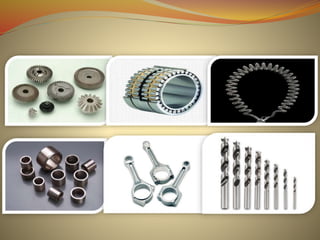
•What is powder metallurgy?
•What are the applications of powder
metallurgy?
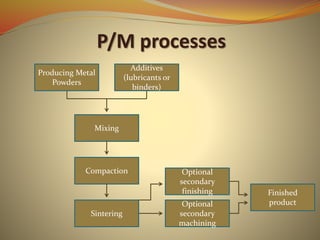
P/M processes
Producing Metal
Powders
Additives
(lubricants or
binders)
Mixing
Compaction
Sintering
Optional
secondary
machining
Optional
secondary
finishing Finished
product
P/M processes
Producing metal powders
• Metal powders are produced by mechanical or chemical
methods.
• The most common method is atomization.
• Other methods: milling, mechanical alloying, electrolysis
and chemical methods including reduction of oxides.
P/M processes
Producing metal powders
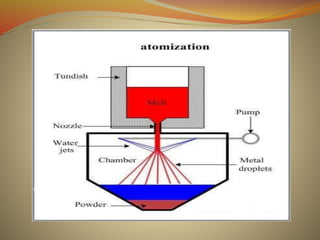
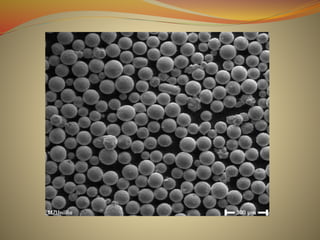
 Atomization :
Atomization is perhaps the most versatile method
that produces metal powders over a wide range of
production rates.
Atomization is based on breaking up of liquid into
fine droplets.
Processes of P/M
Producing metal powders
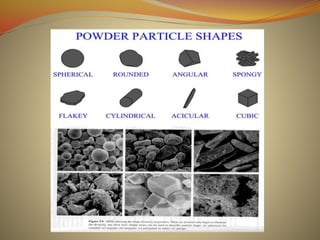
• After atomization the powder is screened to ensure a
correct and uniform particle size distribution and
then thermally processed.
• Powders can be ‘elemental’ or ‘pre-alloyed’.
P/M processes
Adding additives & Mixing
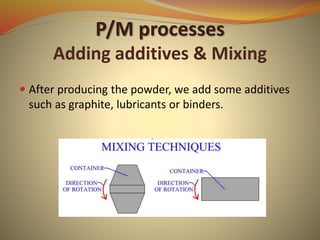
 After producing the powder, we add some additives
such as graphite, lubricants or binders.
P/M processes
Adding additives & Mixing
 Porosity:
After mixing , some spaces will be created between
particles of powder which are open to outside or not
In order these are called open/closed porosities.
P/M processes
compaction
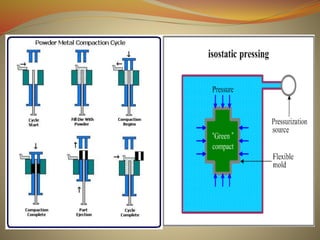
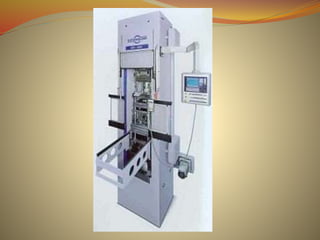
 There are several methods that range from high-pressure
die compaction to pressureless methods such as slip
casting.
 Die compaction at high pressure is the dominant
approach.
 Two other common methods are CIP & HIP.
 The resulting component termed a ‘green’ compact.
P/M processes
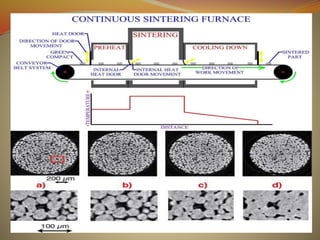
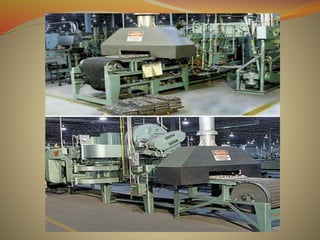
sintering
 During sintering some bonds are created between
the particles of metal powders
 The temperature is below the melting point of the
major constituent.
 The atmosphere is protective.
P/M processes
secondary mechanical operations
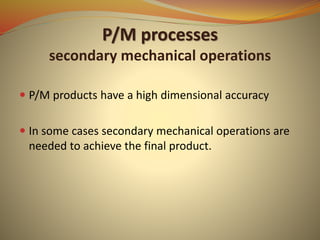
 P/M products have a high dimensional accuracy
 In some cases secondary mechanical operations are
needed to achieve the final product.
P/M advantages & disadvantages
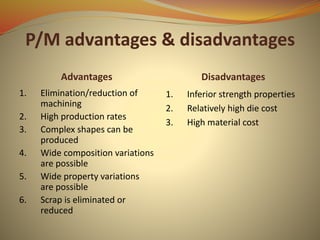
Advantages Disadvantages
1. Elimination/reduction of
machining
2. High production rates
3. Complex shapes can be
produced
4. Wide composition variations
are possible
5. Wide property variations
are possible
6. Scrap is eliminated or
reduced
1. Inferior strength properties
2. Relatively high die cost
3. High material cost
Sources
 ASM Handbook Volume 07 - Powder Metal Technologies and Applications
 thelibraryofmanufacturing.com/powder_processes.html
 www.gkn.com/sintermetals/technologyandinnovation/Pages/from-
powder-to-part-1-material-manufacture.aspx
 www.tpipm.com/powder-metal-process/

Powder metallurgy

  • 1.
  • 2.
    •What is powdermetallurgy? •What are the applications of powder metallurgy?
  • 4.
    P/M processes Producing Metal Powders Additives (lubricantsor binders) Mixing Compaction Sintering Optional secondary machining Optional secondary finishing Finished product
  • 5.
    P/M processes Producing metalpowders • Metal powders are produced by mechanical or chemical methods. • The most common method is atomization. • Other methods: milling, mechanical alloying, electrolysis and chemical methods including reduction of oxides.
  • 6.
    P/M processes Producing metalpowders  Atomization : Atomization is perhaps the most versatile method that produces metal powders over a wide range of production rates. Atomization is based on breaking up of liquid into fine droplets.
  • 9.
    Processes of P/M Producingmetal powders • After atomization the powder is screened to ensure a correct and uniform particle size distribution and then thermally processed. • Powders can be ‘elemental’ or ‘pre-alloyed’.
  • 10.
    P/M processes Adding additives& Mixing  After producing the powder, we add some additives such as graphite, lubricants or binders.
  • 11.
    P/M processes Adding additives& Mixing  Porosity: After mixing , some spaces will be created between particles of powder which are open to outside or not In order these are called open/closed porosities.
  • 13.
    P/M processes compaction  Thereare several methods that range from high-pressure die compaction to pressureless methods such as slip casting.  Die compaction at high pressure is the dominant approach.  Two other common methods are CIP & HIP.  The resulting component termed a ‘green’ compact.
  • 16.
    P/M processes sintering  Duringsintering some bonds are created between the particles of metal powders  The temperature is below the melting point of the major constituent.  The atmosphere is protective.
  • 19.
    P/M processes secondary mechanicaloperations  P/M products have a high dimensional accuracy  In some cases secondary mechanical operations are needed to achieve the final product.
  • 20.
    P/M advantages &disadvantages Advantages Disadvantages 1. Elimination/reduction of machining 2. High production rates 3. Complex shapes can be produced 4. Wide composition variations are possible 5. Wide property variations are possible 6. Scrap is eliminated or reduced 1. Inferior strength properties 2. Relatively high die cost 3. High material cost
  • 21.
    Sources  ASM HandbookVolume 07 - Powder Metal Technologies and Applications  thelibraryofmanufacturing.com/powder_processes.html  www.gkn.com/sintermetals/technologyandinnovation/Pages/from- powder-to-part-1-material-manufacture.aspx  www.tpipm.com/powder-metal-process/