Department of Mechanical Department SSET 2014
Page1
Module III
POWDER METALLURGY
Powder metallurgy (PM) is a metal working process for forming precision metal components
from metal powders. The metal powder is first pressed into product shape at room
temperature. This is followed by heating (sintering) that causes the powder particles to fuse
together without melting. Strength and other properties are imparted to the components by
sintering operations.
The most commonly used metals in P/M are iron, copper, aluminum, tin, nickel, titanium and
refractory metals.
The parts produced by PM have adequate physical and mechanical properties while
completely meeting the functional performance characteristics. The cost of producing a
component of given shape and the required dimensional tolerances by PM is generally lower
than the cost of casting or making it as a wrought product, because of extremely low scrap
and the fewer processing steps. The cost advantage is the main reason for selecting PM as a
process of production for high – volume component which needs to be produced exactly to,
or close to, final dimensions. The rate of production of parts is quite high, a few hundreds to
several thousands per hour. Parts can be produced which are impregnated with oil or plastic,
or infiltrated with lower melting point metal. They can be electroplated, heat treated, and
machined if necessary.
Industrial applications of PM parts are several. These include self – lubricating bearings,
porous metal filters and a wide range of engineered shapes, such as gears, cams, brackets,
sprockets, etc.
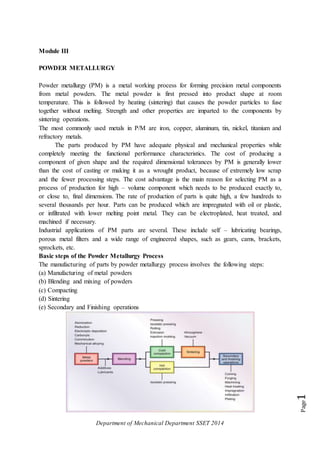
Basic steps of the Powder Metallurgy Process
The manufacturing of parts by powder metallurgy process involves the following steps:
(a) Manufacturing of metal powders
(b) Blending and mixing of powders
(c) Compacting
(d) Sintering
(e) Secondary and Finishing operations
Department of Mechanical Department SSET 2014
Page2
Preparation of metal powders
Powders of almost all metals can be produced. Powder production processes are constantly
being improved to meet the quality, cost and performance requirements of all types of
applications. Which powder production process is used depends on the required production
rate, the desired powder properties and the properties desired in the final part. There are
various methods available for the production of powders, depending upon the type and nature
of metal. Some of the important processes are:
 Atomization
 Reduction methods (Chemical )
 Electrolytic Deposition
 Carbonyls (Thermal decomposition)
 Crushing and Milling ( also called comminution)
 Shotting
Chemical and electrolytic methods are used to produce high purity powders. Mechanical
milling is widely used for the production of hard metals and oxides.
Atomization
In this process molten metal is broken up into small droplets and rapidly frozen before the
drops come into contact with each other or with a solid surface. The principal method is to
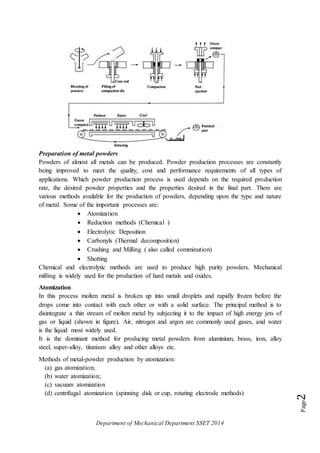
disintegrate a thin stream of molten metal by subjecting it to the impact of high energy jets of
gas or liquid (shown in figure). Air, nitrogen and argon are commonly used gases, and water
is the liquid most widely used.
It is the dominant method for producing metal powders from aluminium, brass, iron, alloy
steel, super-alloy, titanium alloy and other alloys etc.
Methods of metal-powder production by atomization:
(a) gas atomization;
(b) water atomization;
(c) vacuum atomization
(d) centrifugal atomization (spinning disk or cup, rotating electrode methods)
Department of Mechanical Department SSET 2014
Page3
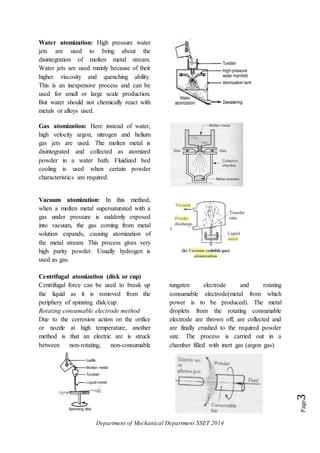
Water atomization: High pressure water
jets are used to bring about the
disintegration of molten metal stream.
Water jets are used mainly because of their
higher viscosity and quenching ability.
This is an inexpensive process and can be
used for small or large scale production.
But water should not chemically react with
metals or alloys used.
Gas atomization: Here instead of water,
high velocity argon, nitrogen and helium
gas jets are used. The molten metal is
disintegrated and collected as atomized
powder in a water bath. Fluidized bed
cooling is used when certain powder
characteristics are required.
Vacuum atomization: In this method,
when a molten metal supersaturated with a
gas under pressure is suddenly exposed
into vacuum, the gas coming from metal
solution expands, causing atomization of
the metal stream. This process gives very
high purity powder. Usually hydrogen is
used as gas.
Centrifugal atomization (disk or cup)
Centrifugal force can be used to break up
the liquid as it is removed from the
periphery of spinning disk/cup.
Rotating consumable electrode method
Due to the corrosion action on the orifice
or nozzle at high temperature, another
method is that an electric arc is struck
between non-rotating, non-consumable
tungsten electrode and rotating
consumable electrode(metal from which
power is to be produced). The metal
droplets from the rotating consumable
electrode are thrown off, are collected and
are finally crushed to the required powder
size. The process is carried out in a
chamber filled with inert gas (argon gas).
Department of Mechanical Department SSET 2014
Page4
As the metal stream exits through the nozzle, it is struck by a high velocity stream of the
atomizing medium (water, air, or an inert gas). The molten metal stream is disintegrated into
fine droplets which solidify during their fall through the atomizing tank. Particles are
collected at the bottom of the tank.
Process controlling parameters determining size and shape of particles
1. Metal flow rate
2. Pressure of the stream of air or gas.
3. Temperature of the stream.
Atomization process steps
 The molten alloy is prepared in a furnace and then it is transferred to the tundish.
 The melt is poured from the tundish through the nozzle into the chamber.
 The water (air, gas) jets break the melt stream into fine droplets.
 The droplets solidify when they fall in the chamber.
 The powder is collected at the bottom of the chamber, removed and dried
Reduction method (Chemical methods)
Pure metal is obtained by reducing its oxide with a suitable reducing gas at an elevated
temperature below the melting point. Selected ore is crushed, mixed with reducing gas or
solid (carbon monoxide, hydrogen etc) and passed through a continuous furnace where
reaction takes place leaving a cake of sponge iron which is then further treated by crushing,
separation of non-metallic material, and sieving to produce powder. Since no refining
operation is involved, the purity of the powder is dependent on that of the raw materials.
Fe3O4 + 4CO + (heat) → 3Fe + 4CO2
2CuO2 + 4H2 (heat) → 2Cu + 4H2O
This process is cheap and a large amount of powder is made by this method. This is a
convenient and extremely flexible method for controlling the properties of size, shape and
porosity. It is used in the manufacture of Fe, Cu, Ni, Mo and Co.
The resulting particles are of irregular shape and are quite porous and spongy. Readily
compressible and have good green strength. Furnace temperature, amount of gas and its
purity are the controlling factors.
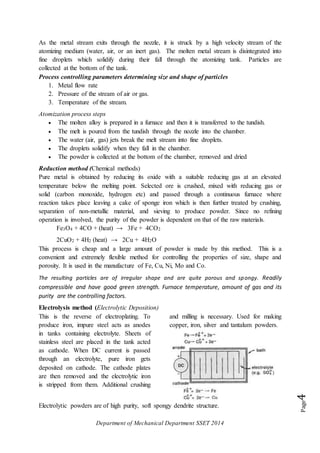
Electrolysis method (Electrolytic Deposition)
This is the reverse of electroplating. To
produce iron, impure steel acts as anodes
in tanks containing electrolyte. Sheets of
stainless steel are placed in the tank acted
as cathode. When DC current is passed
through an electrolyte, pure iron gets
deposited on cathode. The cathode plates
are then removed and the electrolytic iron
is stripped from them. Additional crushing
and milling is necessary. Used for making
copper, iron, silver and tantalum powders.
Electrolytic powders are of high purity, soft spongy dendrite structure.
Department of Mechanical Department SSET 2014
Page5
Processes parameters of electrolyte method of powder preparation
(a) Electrolyte composition and strength
(b) Current density
(c) Temperature of electrolyte
Advantages of electrolysis
(a) High degree of purity
(b) Uniformity in characteristics
(c) Excellent compacting and sintering property (high quality product)
(d) Economical
Disadvantages
(a) Time consuming
(b) Unsuitable for alloy powder
(c) Low production rate
Carbonyls method (decomposition method)
The metal carbonyl process is used as a way of refining or making pure metal from ores.
Metal reacts with carbon monoxide to form metal carbonyl gas, which can be decomposed
back to pure metal at moderate temperatures with the recovery of carbon monoxide.
Carbonyls can be obtained by passing carbon monoxide over spongy metal (iron or nickel) at
specific temperature and pressure. Then decompose the metal compound by raising the
temperature and lowering the pressure gives the purest metal.
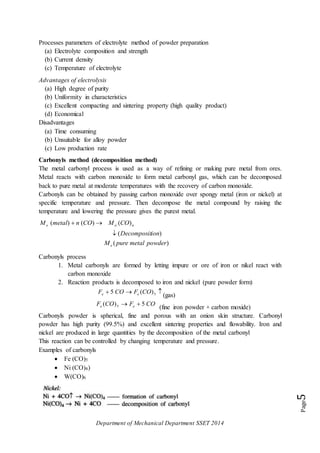
)(
)(
)()()(
powdermetalpureM
ionDecomposit
COMCOnmetalM
e
nee

 
Carbonyls process
1. Metal carbonyls are formed by letting impure or ore of iron or nikel react with
carbon monoxide
2. Reaction products is decomposed to iron and nickel (pure powder form)
 5)(5 COFCOF ee
(gas)
COFCOF ee 5)( 5 
(fine iron powder + carbon moxide)
Carbonyls powder is spherical, fine and porous with an onion skin structure. Carbonyl
powder has high purity (99.5%) and excellent sintering properties and flowability. Iron and
nickel are produced in large quantities by the decomposition of the metal carbonyl
This reaction can be controlled by changing temperature and pressure.
Examples of carbonyls
 Fe (CO)5
 Ni (CO)4)
 W(CO)6
Department of Mechanical Department SSET 2014
Page6
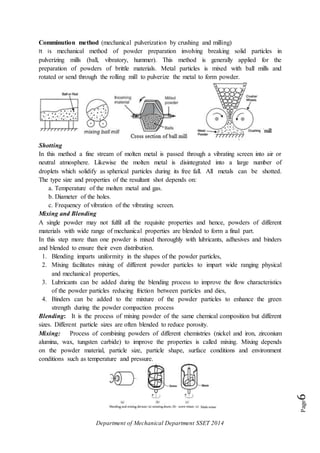
Comminution method (mechanical pulverization by crushing and milling)
It is mechanical method of powder preparation involving breaking solid particles in
pulverizing mills (ball, vibratory, hummer). This method is generally applied for the
preparation of powders of brittle materials. Metal particles is mixed with ball mills and
rotated or send through the rolling mill to pulverize the metal to form powder.
Shotting
In this method a fine stream of molten metal is passed through a vibrating screen into air or
neutral atmosphere. Likewise the molten metal is disintegrated into a large number of
droplets which solidify as spherical particles during its free fall. All metals can be shotted.
The type size and properties of the resultant shot depends on:
a. Temperature of the molten metal and gas.
b. Diameter of the holes.
c. Frequency of vibration of the vibrating screen.
Mixing and Blending
A single powder may not fulfil all the requisite properties and hence, powders of different
materials with wide range of mechanical properties are blended to form a final part.
In this step more than one powder is mixed thoroughly with lubricants, adhesives and binders
and blended to ensure their even distribution.
1. Blending imparts uniformity in the shapes of the powder particles,
2. Mixing facilitates mixing of different powder particles to impart wide ranging physical
and mechanical properties,
3. Lubricants can be added during the blending process to improve the flow characteristics
of the powder particles reducing friction between particles and dies,
4. Binders can be added to the mixture of the powder particles to enhance the green
strength during the powder compaction process
Blending: It is the process of mixing powder of the same chemical composition but different
sizes. Different particle sizes are often blended to reduce porosity.
Mixing: Process of combining powders of different chemistries (nickel and iron, zirconium
alumina, wax, tungsten carbide) to improve the properties is called mixing. Mixing depends
on the powder material, particle size, particle shape, surface conditions and environment
conditions such as temperature and pressure.
Department of Mechanical Department SSET 2014
Page7
Metal powder characteristics or Properties of fine powder
Characteristics/properties of metal powder
1. Size and shape of powder
2. Powder distribution (homogenious)
3. Purity of powder
4. Composition of powder
5. Porous nature of powder
6. Surface area or aspect ratio
7. Flow rate
8. Density
All these properties of powder influences the following
1. Green strength
2. Compressibility
3. Mechanical property etc
Flow rate: It is the ability of powder to flow readily to fill the mould cavity. It is a very
important property, since the minimum time of filling improves the production rates and
economy. Very fine particles will flow just like a liquid. When such powder is pressed in a
die, it will flow into complex die cavities. Flow rate or flow ability depends on the:
 Shape of the powder particle
 Size of the powder particle
 Size distribution of the powder particle
Green strength: Green strength is used to describe the strength of the pressed powder after
compacting, but before sintering. The green strength increases with the increase of
compaction pressure and apparent density.
1. It helps to retain the sharp edges from damage during ejection and handling time
2. To handle the part for quality measurements,
3. To handle for sintering operations.
Apparent Density: Density of loose powder after filling the volume. It depends upon the
particle shape, size and size distribution. The apparent density of irregularly shaped particles
will be lower than that of spherical particles and fine particles. And Green density is the
density of powder after the compacting process.
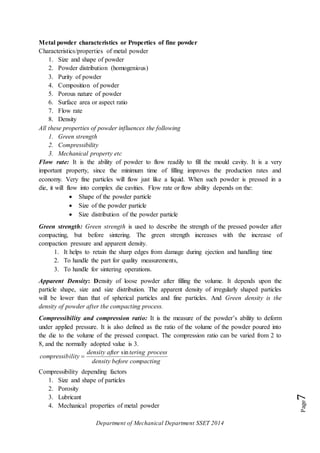
Compressibility and compression ratio: It is the measure of the powder’s ability to deform
under applied pressure. It is also defined as the ratio of the volume of the powder poured into
the die to the volume of the pressed compact. The compression ratio can be varied from 2 to
8, and the normally adopted value is 3.
compactingbeforedensity
processteringafterdensity
ilitycompressib
sin

Compressibility depending factors
1. Size and shape of particles
2. Porosity
3. Lubricant
4. Mechanical properties of metal powder
Department of Mechanical Department SSET 2014
Page8
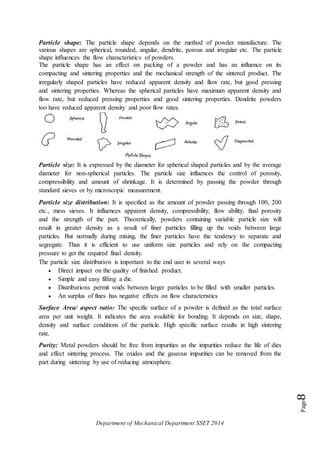
Particle shape: The particle shape depends on the method of powder manufacture. The
various shapes are spherical, rounded, angular, dendrite, porous and irregular etc. The particle
shape influences the flow characteristics of powders.
The particle shape has an effect on packing of a powder and has an influence on its
compacting and sintering properties and the mechanical strength of the sintered product. The
irregularly shaped particles have reduced apparent density and flow rate, but good pressing
and sintering properties. Whereas the spherical particles have maximum apparent density and
flow rate, but reduced pressing properties and good sintering properties. Dendrite powders
too have reduced apparent density and poor flow rates.
Particle size: It is expressed by the diameter for spherical shaped particles and by the average
diameter for non-spherical particles. The particle size influences the control of porosity,
compressibility and amount of shrinkage. It is determined by passing the powder through
standard sieves or by microscopic measurement.
Particle size distribution: It is specified as the amount of powder passing through 100, 200
etc., mess sieves. It influences apparent density, compressibility, flow ability, final porosity
and the strength of the part. Theoretically, powders containing variable particle size will
result in greater density as a result of finer particles filling up the voids between large
particles. But normally during mixing, the finer particles have the tendency to separate and
segregate. Thus it is efficient to use uniform size particles and rely on the compacting
pressure to get the required final density.
The particle size distribution is important to the end user in several ways
 Direct impact on the quality of finished product.
 Simple and easy filling a die.
 Distributions permit voids between larger particles to be filled with smaller particles.
 An surplus of fines has negative effects on flow characteristics
Surface Area/ aspect ratio: The specific surface of a powder is defined as the total surface
area per unit weight. It indicates the area available for bonding. It depends on size, shape,
density and surface conditions of the particle. High specific surface results in high sintering
rate.
Purity: Metal powders should be free from impurities as the impurities reduce the life of dies
and effect sintering process. The oxides and the gaseous impurities can be removed from the
part during sintering by use of reducing atmosphere.
Department of Mechanical Department SSET 2014
Page9
Compacting
Blended powders are pressed in dies under high pressure to form them into the required
shape. The work part after compaction is called a green compact or simply a green, the word
green meaning not yet fully processed. The compaction is done to bring the finely divided
particles of powder into close proximity while imparting the desired part configuration. The
following methods are adopted for compacting:
1. Die Pressing
2. Centrifugal compacting
3. Injection moulding
4. Extrusion
5. Rolling
6. Gravity sintering
7. Slip casting
8. Isostatic moulding
9. Explosive moulding
Die Pressing: The metal powders are placed in a die cavity and compressed to form a
component shaped to the contour of the die. The pressure used for producing green compact
of the component vary from 80 Mpa to 1400 Mpa, depending upon the material and the
characteristics of the powder used. Mechanical presses are used for compacting objects at low
pressure. Hydraulic presses are for compacting objects at high pressure.
The basic components are:
 Hydraulic mechanism to apply
pressure
 A die of adequate strength having a
cavity of the desired shape and
dimension.
 Feeding devices for fill the die
cavity.
 Upper and lower punches to apply
pressure, and to assist in the
ejection of the green compact.
 Control system to maintain the
magnitude of pressure and rate of
pressure application, speed of
punches etc.
Single Action Die Compaction: Used to manufacture flat, thin parts such as washers, discs,
thin rings etc. The lower punch is stationery during the application of pressure by the motion
of the upper punch acting from the direction only on the powder placed in the cavity. After
compression the punch is raised in order to eject the part from the die cavity.
Advantages are:
 Tools used are very simple
 Mechanical or hydraulic press may be employed.
Disadvantage: it is not suitable for manufacture of long parts because of non-uniform
density distribution.
Department of Mechanical Department SSET 2014
Page10
Double Action Die Compaction: The powder is compacted simultaneously from opposite
directions by both the top and bottom punches. Equal or different amounts of pressure may be
employed from each direction. The die table remains stationery and the upward movement of
the lower punch, ejects the part out.
This technique can be used for the manufacture of thin walled bushing and cylindrical
bearings.
Centrifugal Compacting: The powder is swirled in a mould and packed uniformly with
pressures up to 3 MPa. The uniform density is obtained as a result of centrifugal force. ,
acting on each particle of powder. This method is employed for heavy metals such as
tungsten carbide and for materials that are relatively incompressible by conventional die
compaction. The main drawback of this process is relatively slower process because it takes
larger time for the fluid to be absorbed by the method.
Department of Mechanical Department SSET 2014
Page11
Extrusion: This method is employed to produce the components with high density. Both cold
and hot extrusion processes are for compacting specific materials. In cold extrusion, the metal
powder is mixed with binder and this mixture is compressed into billet. The billet is charged
into a container and then forced through the die by means of ram. The cross-section of
product depends on the opening of the die. The cross-section of products depends on the
opening of the die. Cold extrusion process is used for cemented carbide drills and cutters.
In the hot extrusion, the powder is compacted into billet and is heated to extruding
temperature in non-oxidising atmosphere. Extrusion is used for manufacturing furnace tubes,
thermocouple components and heat exchanger tubes.
Injection molding is the method of compaction of ceramic powder fed and injected into a
mold cavity by means of a screw rotating in cylinder. The method is similar to the plastic
injection molding.
Rolling: This method is used for making continuous strips and rods having controlled
porosity with uniform mechanical properties. In this method, the metal powder is fed between
two rolls which compress and interlock the powder particles to form a sheet of sufficient
strength as shown. It is then rerolled and heat treated if necessary. The metals that can be
rolled are Cu, Brass, Bronze, Ni and Stainless steel.
Slip casting technique In this method, the powder is converted into slurry with water and
poured into the mould made of plaster of paris. The liquid in the slurry is gradually absorbed
by the mould leaving the solid compact within the mould. The mould may be vibrated to
increase the density of the compact.
Department of Mechanical Department SSET 2014
Page12
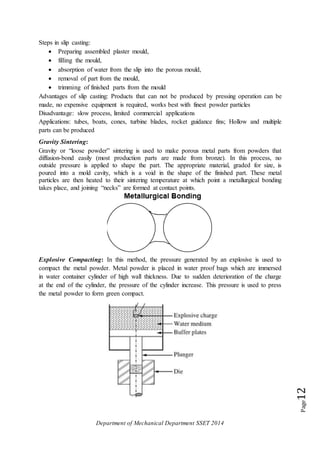
Steps in slip casting:
 Preparing assembled plaster mould,
 filling the mould,
 absorption of water from the slip into the porous mould,
 removal of part from the mould,
 trimming of finished parts from the mould
Advantages of slip casting: Products that can not be produced by pressing operation can be
made, no expensive equipment is required, works best with finest powder particles
Disadvantage: slow process, limited commercial applications
Applications: tubes, boats, cones, turbine blades, rocket guidance fins; Hollow and multiple
parts can be produced
Gravity Sintering:
Gravity or “loose powder” sintering is used to make porous metal parts from powders that
diffusion-bond easily (most production parts are made from bronze). In this process, no
outside pressure is applied to shape the part. The appropriate material, graded for size, is
poured into a mold cavity, which is a void in the shape of the finished part. These metal
particles are then heated to their sintering temperature at which point a metallurgical bonding
takes place, and joining “necks” are formed at contact points.
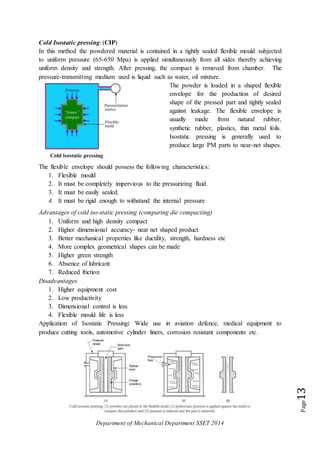
Explosive Compacting: In this method, the pressure generated by an explosive is used to
compact the metal powder. Metal powder is placed in water proof bags which are immersed
in water container cylinder of high wall thickness. Due to sudden deterioration of the charge
at the end of the cylinder, the pressure of the cylinder increase. This pressure is used to press
the metal powder to form green compact.
Department of Mechanical Department SSET 2014
Page13
Cold Isostatic pressing: (CIP)
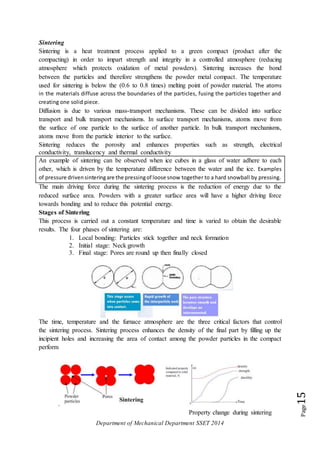
In this method the powdered material is contained in a tightly sealed flexible mould subjected
to uniform pressure (65-650 Mpa) is applied simultaneously from all sides thereby achieving
uniform density and strength. After pressing, the compact is removed from chamber. The
pressure-transmitting medium used is liquid such as water, oil mixture.
The powder is loaded in a shaped flexible
envelope for the production of desired
shape of the pressed part and tightly sealed
against leakage. The flexible envelope is
usually made from natural rubber,
synthetic rubber, plastics, thin metal foils.
Isostatic pressing is generally used to
produce large PM parts to near-net shapes.
The flexible envelope should possess the following characteristics:
1. Flexible mould
2. It must be completely impervious to the pressurizing fluid.
3. It must be easily sealed.
4. It must be rigid enough to withstand the internal pressure
Advantages of cold iso-static pressing (comparing die compacting)
1. Uniform and high density compact
2. Higher dimensional accuracy- near net shaped product
3. Better mechanical properties like ductility, strength, hardness etc
4. More complex geometrical shapes can be made
5. Higher green strength
6. Absence of lubricant
7. Reduced friction
Disadvantages
1. Higher equipment cost
2. Low productivity
3. Dimensional control is less
4. Flexible mould life is less
Application of Isostatic Pressing: Wide use in aviation defence, medical equipment to
produce cutting tools, automotive cylinder liners, corrosion resistant components etc.
Department of Mechanical Department SSET 2014
Page14
Hot isostatic pressing (HIP)
Hot iso-static pressing is a compacting process where high temperature and pressure is
applied simultaneously (3-dimensions) to produce a dense component. The pressure is
uniform in all directions (isostatic). At high temperatures, the hermetic container deforms
plastically and the powder is compacted within it under pressure. No further sintering process
is needed here as the combination of heat and pressure during the process is done. Metal or
glass is used for making the hermetic container. The pressurizing medium is a gas (inert
argon/helium) with a pressure 100 to 200 MPa and temperatures to 2200°C.
Hot isostatic pressing (CIP) is combining the compaction and sintering processes in PM
production process. So it eliminates separate sintering.
Advantages
1. Little or no porosity
2. Better surface finish
3. Neat net shape product
4. Improvements in mechanical and physical properties, fatigue, surface finish,
reliability
5. Fast delivery
6. More uniform strength
7. Less pressure requirement
Disadvantages
1. Very expensive
2. Protective environment is needed
Department of Mechanical Department SSET 2014
Page15
Sintering
Sintering is a heat treatment process applied to a green compact (product after the
compacting) in order to impart strength and integrity in a controlled atmosphere (reducing
atmosphere which protects oxidation of metal powders). Sintering increases the bond
between the particles and therefore strengthens the powder metal compact. The temperature
used for sintering is below the (0.6 to 0.8 times) melting point of powder material. The atoms
in the materials diffuse across the boundaries of the particles, fusing the particles together and
creating one solid piece.
Diffusion is due to various mass-transport mechanisms. These can be divided into surface
transport and bulk transport mechanisms. In surface transport mechanisms, atoms move from
the surface of one particle to the surface of another particle. In bulk transport mechanisms,
atoms move from the particle interior to the surface.
Sintering reduces the porosity and enhances properties such as strength, electrical
conductivity, translucency and thermal conductivity
An example of sintering can be observed when ice cubes in a glass of water adhere to each
other, which is driven by the temperature difference between the water and the ice. Examples
of pressure drivensinteringare the pressingof loose snow together to a hard snowball by pressing.
The main driving force during the sintering process is the reduction of energy due to the
reduced surface area. Powders with a greater surface area will have a higher driving force
towards bonding and to reduce this potential energy.
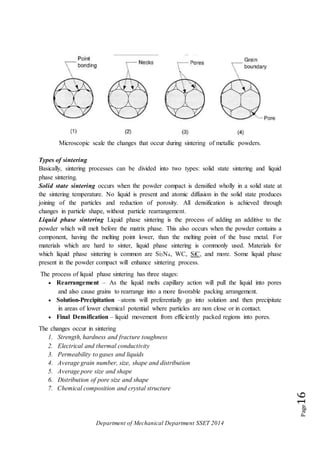
Stages of Sintering
This process is carried out a constant temperature and time is varied to obtain the desirable
results. The four phases of sintering are:
1. Local bonding: Particles stick together and neck formation
2. Initial stage: Neck growth
3. Final stage: Pores are round up then finally closed
The time, temperature and the furnace atmosphere are the three critical factors that control
the sintering process. Sintering process enhances the density of the final part by filling up the
incipient holes and increasing the area of contact among the powder particles in the compact
perform
.
Property change during sintering
Department of Mechanical Department SSET 2014
Page16
Microscopic scale the changes that occur during sintering of metallic powders.
Types of sintering
Basically, sintering processes can be divided into two types: solid state sintering and liquid
phase sintering.
Solid state sintering occurs when the powder compact is densified wholly in a solid state at
the sintering temperature. No liquid is present and atomic diffusion in the solid state produces
joining of the particles and reduction of porosity. All densification is achieved through
changes in particle shape, without particle rearrangement.
Liquid phase sintering Liquid phase sintering is the process of adding an additive to the
powder which will melt before the matrix phase. This also occurs when the powder contains a
component, having the melting point lower, than the melting point of the base metal. For
materials which are hard to sinter, liquid phase sintering is commonly used. Materials for
which liquid phase sintering is common are Si3N4, WC, SiC, and more. Some liquid phase
present in the powder compact will enhance sintering process.
The process of liquid phase sintering has three stages:
 Rearrangement – As the liquid melts capillary action will pull the liquid into pores
and also cause grains to rearrange into a more favorable packing arrangement.
 Solution-Precipitation –atoms will preferentially go into solution and then precipitate
in areas of lower chemical potential where particles are non close or in contact.
 Final Densification – liquid movement from efficiently packed regions into pores.
The changes occur in sintering
1. Strength, hardness and fracture toughness
2. Electrical and thermal conductivity
3. Permeability to gases and liquids
4. Average grain number, size, shape and distribution
5. Average pore size and shape
6. Distribution of pore size and shape
7. Chemical composition and crystal structure
Department of Mechanical Department SSET 2014
Page17
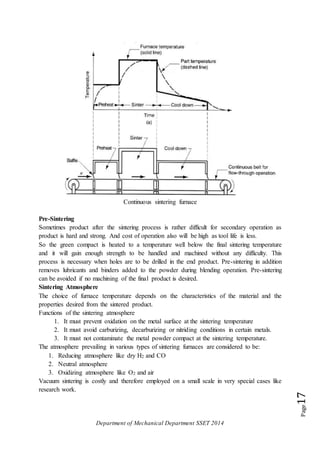
Continuous sintering furnace
Pre-Sintering
Sometimes product after the sintering process is rather difficult for secondary operation as
product is hard and strong. And cost of operation also will be high as tool life is less.
So the green compact is heated to a temperature well below the final sintering temperature
and it will gain enough strength to be handled and machined without any difficulty. This
process is necessary when holes are to be drilled in the end product. Pre-sintering in addition
removes lubricants and binders added to the powder during blending operation. Pre-sintering
can be avoided if no machining of the final product is desired.
Sintering Atmosphere
The choice of furnace temperature depends on the characteristics of the material and the
properties desired from the sintered product.
Functions of the sintering atmosphere
1. It must prevent oxidation on the metal surface at the sintering temperature
2. It must avoid carburizing, decarburizing or nitriding conditions in certain metals.
3. It must not contaminate the metal powder compact at the sintering temperature.
The atmosphere prevailing in various types of sintering furnaces are considered to be:
1. Reducing atmosphere like dry H2 and CO
2. Neutral atmosphere
3. Oxidizing atmosphere like O2 and air
Vacuum sintering is costly and therefore employed on a small scale in very special cases like
research work.
Department of Mechanical Department SSET 2014
Page18
Secondary and finishing operations
Sometimes additional operations are carried out on sintered PM parts in order to further
improve their properties or to impart special characteristics.
1. Coining and sizing. These are high pressure compacting operations. Their main function
is to impart (a) greater dimensional accuracy to the sintered part, and (b) greater strength
and better surface finish by further densification.
2. Forging. The sintered PM parts may be hot or cold forged to obtain exact shape, good
surface finish, good dimensional tolerances, and a uniform and fine grain size. Forged PM
parts are being increasingly used for such applications as highly stressed automotive, jet –
engine and turbine components.
3. Impregnation. The inherent porosity of PM parts is utilized by impregnating them with a
fluid like oil or grease. A typical application of this operation is for sintered bearings and
bushings that are internally lubricated with upto 30% oil by volume by simply immersing
them in heated oil. Such components have a continuous supply of lubricant by capillary
action, during their use. Universal joint is typical grease – impregnated PM part.
4. Infiltration. The pores of sintered part are filled with some low melting point metal with
the result that part's hardness and tensile strength are improved. A slug of metal to be
impregnated is kept in close contact with the sintered component and together they are
heated to the melting point of the slug. The molten metal infiltrates the pores by capillary
action. When the process is complete, the component has greater density, hardness, and
strength. Copper is often used for the infiltration of iron – base PM components. Lead has
also been used for infiltration of components like bushes for which lower frictional
characteristics are needed.
5. Heat Treatment. Sintered PM components may be heat treated for obtaining greater
hardness or strength in them.
6. Machining. The sintered component may be machined by turning, milling, drilling,
threading, grinding, etc. to obtain various geometric features.
7. Joining. PM parts can be welded by several conventional methods. Electric resistance
welding is better suited than oxy- acetylene welding and arc welding because of oxidation
of the interior porosity. Argon arc welding is suitable for stainless steel PM parts
Finishing process: Almost all the commonly used finishing method is applicable to PM
parts. Some of such methods are plating, burnishing, coating, and colouring.
1. Plating. For improved appearance and resistance to wear and corrosion, the sintered
compacts may be plated by electroplating or other plating processes. To avoid
penetration and entrapment of plating solution in the pores of the part, an
impregnation or infiltration treatment is often necessary before plating. Copper, zinc,
nickel, chromium, and cadmium plating can be applied.
2. Burnishing. To work harden the surface or to improve the surface finish and
dimensional accuracy, burnishing may be done on PM parts.
3. Coating. PM sintered parts are more susceptible to environmental degradation than cast
and machined parts. This is because of inter – connected porosity in PM parts.
Coatings fill in the pores and seal the entire reactive surface.
4. Colouring. Ferrous PM parts can be applied colour for protection against corrosion.
Department of Mechanical Department SSET 2014
Page19
Advantages of powder metallurgy
The main advantages of P/M process over the conventional material processing methods such
as casting, forging and rolling are the following
1. PM parts can be mass produced to net shape or near net shape, eliminating or
reducing the need for subsequent machining which saves time and cost. It also
reduces wastes by material about 97% of the starting powders are converted to
product
2. Special alloys can be synthesized. Wide variety of materials(metals and non metals)
and composition can be made possible to impart required properties like magnetic,
and mechanical properties
3. PM parts can be made with a specified level of porosity, to produce porous metal
parts. Examples: filters, oil impregnated bearings and gears
4. Parts can be produced from high melting point refractory metals with respectively less
difficulty and at less cost.
5. Difficult to machine materials like carbide and tungsten can be made by this method
6. Wide property control is possible with the product with variation in composition and
further heat treatment
7. Certain metals that are difficult to fabricate by other methods can be shaped by
powder metallurgy. Example: Tungsten filaments for incandescent lamp bulbs are
made by PM
8. Certain alloy combinations made by PM cannot be produced in other ways
9. Close dimensional control is possible when comparing with other process
10. PM production methods can be automated for economical production for large
production volume.
11. More eco-friendly process
Limitations and Disadvantages with PM Processing
1. High tooling and equipment costs
2. Metallic powders are expensive
3. Problems in storing and handling metal powders
a. Examples: degradation over time, fire hazards with certain metals
4. Limitations on part geometry because metal powders do not readily flow laterally in
the die during pressing
5. Variations in density throughout part may be a problem, especially for complex
geometries
6. Some powders (such as aluminum, magnesium, titanium and zirconium) in a finally
divided state present fire hazard and risk of explosion.
7. Low melting point metal powders (such as of zinc, tin, cadmium) give thermal
difficulties during sintering operation, as most oxides of these metals cannot be
reduced at temperatures below the melting point.
8. Powder metallurgy is not economical for small scale production.
9. Articles produced by powder metallurgy process possess poorductility
Department of Mechanical Department SSET 2014
Page20
Application of powder metallurgy
There is a great variety of machine components that are produced from metal powders, many
of these are put to use without any machining operation carried out on them. Following are
some of the prominent PM Products.
Self-Lubricating Bearing and Filters:
Porous bronze bearings are made
by mixing copper and tin powder in
correct proportions, cold pressed to the
desired shape and then sintered. These
bearings soak up considerable quantity of
oil. Hence during service, these bearings
produce a constant supply of lubricant to
the surface due to capillary action. These
are used where lubricating is not possible.
Porous filters can be manufactured and are
used to remove, undesirable materials from
liquids and gases.
Cutting Tools and Dies: Cemented carbide cutting tool inserts find extensive applications in
machine shops. These are produced by PM from tungsten carbide powder mixed with cobalt
binder.
Machinery Parts: Several machinery parts including gears, bushes and bearings, sprockets,
rotors are made from metal powders mixed with sufficient graphite to give to product the
desired carbon content.
Friction Materials: These are made by powder metallurgy. Clutch liners and Brake bands are
the example of friction materials.
Gears and Pump Rotors: Gears and pump rotor for automobile oil pumps are manufactured
by powder metallurgy. Iron powder is mixed with graphite, compacted under a pressure of 40
kg/ cm and sintered in an electric furnace with an atmosphere and hydrocarbon gas. These are
impregnated with oil.
Refractory Materials: Metals with high melting points are termed as refractory metals. These
basically include four metals tungsten, molybdenum, tantalum and niobium. Refractory
metals as well as their alloys are manufactured by powder metallurgy.
Magnets: Small magnets produced from different compositions of powders of iron,
aluminum, nickel and cobalt has shown excellent performance, far superior to that cast.
Electrical Parts: Several combinations such as copper – tungsten, cobalt – tungsten, silver –
tungsten, copper-nickel, and silver – molybdenum have been used for production of these
parts. These parts are required to have excellent electrical conductively, be wear resistant, and
somewhat refractory.
Department of Mechanical Department SSET 2014
Page21
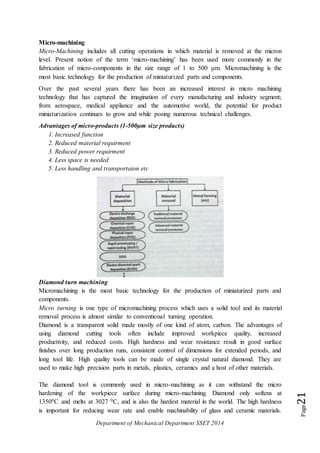
Micro-machining
Micro-Machining includes all cutting operations in which material is removed at the micron
level. Present notion of the term ‘micro-machining’ has been used more commonly in the
fabrication of micro-components in the size range of 1 to 500 μm. Micromachining is the
most basic technology for the production of miniaturized parts and components.
Over the past several years there has been an increased interest in micro machining
technology that has captured the imagination of every manufacturing and industry segment;
from aerospace, medical appliance and the automotive world, the potential for product
miniaturization continues to grow and while posing numerous technical challenges.
Advantages of micro-products (1-500µm size products)
1. Increased function
2. Reduced material requirment
3. Reduced power requirment
4. Less space is needed
5. Less handling and transportaion etc
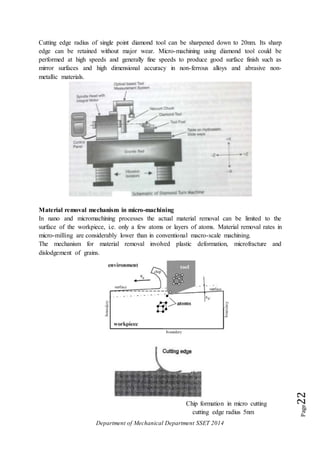
Diamond turn machining
Micromachining is the most basic technology for the production of miniaturized parts and
components.
Micro turning is one type of micromachining process which uses a solid tool and its material
removal process is almost similar to conventional turning operation.
Diamond is a transparent solid made mostly of one kind of atom, carbon. The advantages of
using diamond cutting tools often include improved workpiece quality, increased
productivity, and reduced costs. High hardness and wear resistance result in good surface
finishes over long production runs, consistent control of dimensions for extended periods, and
long tool life. High quality tools can be made of single crystal natural diamond. They are
used to make high precision parts in metals, plastics, ceramics and a host of other materials.
The diamond tool is commonly used in micro-machining as it can withstand the micro
hardening of the workpiece surface during micro-machining. Diamond only softens at
13500C and melts at 3027 0C, and is also the hardest material in the world. The high hardness
is important for reducing wear rate and enable machinability of glass and ceramic materials.
Department of Mechanical Department SSET 2014
Page22
Cutting edge radius of single point diamond tool can be sharpened down to 20nm. Its sharp
edge can be retained without major wear. Micro-machining using diamond tool could be
performed at high speeds and generally fine speeds to produce good surface finish such as
mirror surfaces and high dimensional accuracy in non-ferrous alloys and abrasive non-
metallic materials.
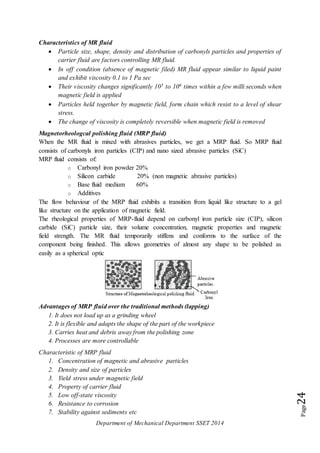
Material removal mechanism in micro-machining
In nano and micromachining processes the actual material removal can be limited to the
surface of the workpiece, i.e. only a few atoms or layers of atoms. Material removal rates in
micro-milling are considerably lower than in conventional macro-scale machining.
The mechanism for material removal involved plastic deformation, microfracture and
dislodgement of grains.
Chip formation in micro cutting
cutting edge radius 5nm
Department of Mechanical Department SSET 2014
Page23
Magnetorheological nano-finishing process
Commonly used traditional finishing processes are grinding, lapping and honing. All these
processes use multipoint cutting edges in the form of abrasives, which may or may not be
bonded, to perform cutting action. These processes have been in use from the earliest times
because of their capability to produce smooth surface at close tolerances. Earlier there has
been a limit on the fine size of abrasives (a few μm) but today, new advances in materials
syntheses have enabled production of ultra fine abrasives in the nanometer range. The
ultimate precision obtainable through finishing is when chip size approaches atomic size (0.3
nm). To finish surfaces in nanometer range, it is required to remove material in the form of
atoms or molecules individually or in the groups.
To name a few, these magnetic field assisted finishing processes include Magnetic Abrasive
Finishing (MAF), Magnetic Float Polishing (MFP), Magnetorheological Finishing (MRF),
and Magnetorheological Abrasive Flow Finishing (MRAFF).
Magnetorheological fluid (MR fluid)
A magnetorheological (MR) fluid is a suspension of magnetically soft ferromagnetic particles
in a carrier liquid. Typically, the particles are of the order of a few microns in diameter and
their volume concentration is 30% to 40%. When exposed to a magnetic field, the viscosity
and yield stress of the suspension increase several orders of magnitude. Under magnetic field,
the particles line up, thickening the fluid and fluid to behave more like a solid. The term
"magnetorheological" comes from this effect. The particles are tiny, measuring between 3 to
10 microns of carbonyl iron dispersed in a non-magnetic carrier medium like silicone oil,
mineral oil or water.
Magnetic particles (µm /nm) size suspended within the carrier oil are distributed randomly
Under magnetic field, microscopic particles align themselves along the lines of magnetic flux
Department of Mechanical Department SSET 2014
Page24
Characteristics of MR fluid
 Particle size, shape, density and distribution of carbonyls particles and properties of
carrier fluid are factors controlling MR fluid.
 In off condition (absence of magnetic filed) MR fluid appear similar to liquid paint
and exhibit viscosity 0.1 to 1 Pa sec
 Their viscosity changes significantly 105 to 106 times within a few milli seconds when
magnetic field is applied
 Particles held together by magnetic field, form chain which resist to a level of shear
stress.
 The change of viscosity is completely reversible when magnetic field is removed
Magnetorheologcal polishing fluid (MRP fluid)
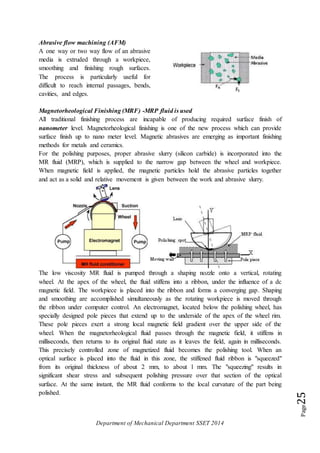
When the MR fluid is mixed with abrasives particles, we get a MRP fluid. So MRP fluid
consists of carbonyls iron particles (CIP) and nano sized abrasive particles (SiC)
MRP fluid consists of:
o Carbonyl iron powder 20%
o Silicon carbide 20% (non magnetic abrasive particles)
o Base fluid medium 60%
o Additives
The flow behaviour of the MRP fluid exhibits a transition from liquid like structure to a gel
like structure on the application of magnetic field.
The rheological properties of MRP-fluid depend on carbonyl iron particle size (CIP), silicon
carbide (SiC) particle size, their volume concentration, magnetic properties and magnetic
field strength. The MR fluid temporarily stiffens and conforms to the surface of the
component being finished. This allows geometries of almost any shape to be polished as
easily as a spherical optic
Advantages of MRP fluid over the traditional methods (lapping)
1. It does not load up as a grinding wheel
2. It is flexible and adapts the shape of the part of the workpiece
3. Carries heat and debris away from the polishing zone
4. Processes are more controllable
Characteristic of MRP fluid
1. Concentration of magnetic and abrasive particles
2. Density and size of particles
3. Yield stress under magnetic field
4. Property of carrier fluid
5. Low off-state viscosity
6. Resistance to corrosion
7. Stability against sediments etc
Department of Mechanical Department SSET 2014
Page25
Abrasive flow machining (AFM)
A one way or two way flow of an abrasive
media is extruded through a workpiece,
smoothing and finishing rough surfaces.
The process is particularly useful for
difficult to reach internal passages, bends,
cavities, and edges.
Magnetorheological Finishing (MRF) -MRP fluid is used
All traditional finishing process are incapable of producing required surface finish of
nanometer level. Magnetorheological finishing is one of the new process which can provide
surface finish up to nano meter level. Magnetic abrasives are emerging as important finishing
methods for metals and ceramics.
For the polishing purposes, proper abrasive slurry (silicon carbide) is incorporated into the
MR fluid (MRP), which is supplied to the narrow gap between the wheel and workpiece.
When magnetic field is applied, the magnetic particles hold the abrasive particles together
and act as a solid and relative movement is given between the work and abrasive slurry.
The low viscosity MR fluid is pumped through a shaping nozzle onto a vertical, rotating
wheel. At the apex of the wheel, the fluid stiffens into a ribbon, under the influence of a dc
magnetic field. The workpiece is placed into the ribbon and forms a converging gap. Shaping
and smoothing are accomplished simultaneously as the rotating workpiece is moved through
the ribbon under computer control. An electromagnet, located below the polishing wheel, has
specially designed pole pieces that extend up to the underside of the apex of the wheel rim.
These pole pieces exert a strong local magnetic field gradient over the upper side of the
wheel. When the magnetorheological fluid passes through the magnetic field, it stiffens in
milliseconds, then returns to its original fluid state as it leaves the field, again in milliseconds.
This precisely controlled zone of magnetized fluid becomes the polishing tool. When an
optical surface is placed into the fluid in this zone, the stiffened fluid ribbon is "squeezed"
from its original thickness of about 2 mm, to about l mm. The "squeezing" results in
significant shear stress and subsequent polishing pressure over that section of the optical
surface. At the same instant, the MR fluid conforms to the local curvature of the part being
polished.
Department of Mechanical Department SSET 2014
Page26
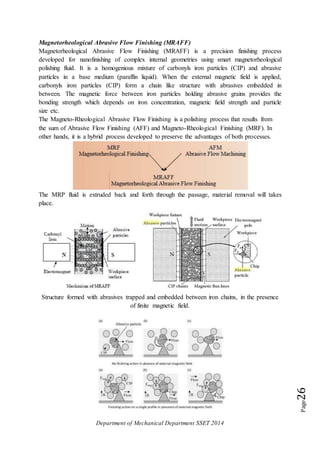
Magnetorheological Abrasive Flow Finishing (MRAFF)
Magnetorheological Abrasive Flow Finishing (MRAFF) is a precision finishing process
developed for nanofinishing of complex internal geometries using smart magnetorheological
polishing fluid. It is a homogenious mixture of carbonyls iron particles (CIP) and abrasive
particles in a base medium (paraffin liquid). When the external magnetic field is applied,
carbonyls iron particles (CIP) form a chain like structure with abrasives embedded in
between. The magnetic force between iron particles holding abrasive grains provides the
bonding strength which depends on iron concentration, magnetic field strength and particle
size etc.
The Magneto-Rheological Abrasive Flow Finishing is a polishing process that results from
the sum of Abrasive Flow Finishing (AFF) and Magneto-Rheological Finishing (MRF). In
other hands, it is a hybrid process developed to preserve the advantages of both processes.
The MRP fluid is extruded back and forth through the passage, material removal will takes
place.
Structure formed with abrasives trapped and embedded between iron chains, in the presence
of finite magnetic field.
Department of Mechanical Department SSET 2014
Page27
Module III (Questions)
1. Explain the procedure of manufacturing parts by powder metallurgy.
2. Explain the manufacturing of powder metallurgy components with suitable flowchart.
3. Describe, the steps involved in the production of powder metallurgy parts.****
4. Discuss secondary operations in Powder Metallurgy.
**************************************
5. What are the advantages of powder metallurgy offers?****
6. What are advantages and limitations of powder metallurgy?***
7. Discuss/Explain the applications of Powder Metallurgy. ****
8. What are the main industrial uses of powder metallurgy?
9. Explain the process capabilities of powder metallurgy
10. Explain why powder metallurgy has become highly competitive with casting, forging
and machining processes. **
11. What are the design considerations for the powder metallurgy parts?***
12. Describe the design considerations making powder metallurgy parts. How different
are these compared to casting and forging of metals.
*******************************************
13. Describe briefly the methods by which powders suitable for powder metallurgy can he
produced.******
14. Explain how metal powders are produced by atomization. ***
15. Explain the various methods of powder production. Give the characteristics required
for metal powders
16. Explain three methods of powder production with neat sketches and discuss their
influences on the properties of the final product.
17. Explain the characteristics of metal powders required?****
18. What are the desirable properties of metal powder?
19. What are the important physical characteristics of powder-metals
20. Explain the effects of using fine powders and coarse powders respectively in making
P/M parts
***************************************
21. What are some of the objectives of powder mixing or blending**
22. Briefly explain blending of powders in powder metallurgy
23. List and discuss the material properties affecting blending in Powder metallurgy
process.
*************************
24. Explain the various compaction techniques used in Powder metallurgy. ****
25. What are some of the objectives of the compacting operation?
26. Why might double-action pressing be more attractive than compaction with a single
moving punch?
27. In what ways might the final density of a P/M product be reported?
28. What are some of the other methods that can produce high-density PIM products?
29. Why is there a density variation in compacting powders?
30. With suitable sketches explain double compaction of parts out of powders.
31. Discuss cold and hot isostatic pressing process.
Department of Mechanical Department SSET 2014
Page28
32. What is meant by Isostatic pressing?
33. What is isostatic compaction? For what product shapes might it be preferred?
34. What are the disadvantages of hot pressing? How can you overcome them
35. Describe the relative advantages and limitations of cold and hot isostatic pressing.**
36. Describe, with suitable sketches, hot isostatic pressing of metal powders.***
37. What are some of the attractive properties of HlP products?
38. What are some of the major limitations-of HIP process and how does the sinter
process eliminate or minimize them?
******************************************************
39. Differentiate between infiltration and "impregnation” with reference to powder
metallurgy
40. What is the purpose of repressing, coining or sizing operations?
41. Why can the original compaction tooling not be used to shape the product during
repressing?
42. What are pre alloyed and pre-coated powders? How are these powders manufactured?
43. What are impregnations and infiltration processes in powder metallurgy?
*******************************************
44. Why it is necessary to use lubricants in the press compaction of powders? State and
explain the advantages of porous and self-lubricating bearings over the standard
sleeve bearings.
45. What are self lubricating bearings?**
46. Why is pore size important in the manufacture of self lubricating bearing? How may
pore size be controlled?
*********************************************
47. Define the following terms in relation to metal powders :
a. Surface area,
b. Compressibility,
c. Apparent density and particle size distribution.
48. Write notes on
a. Hot pressing,
b. Impact compacting
c. Powder rolling.**
***************************************************
49. Explain pre-sintering and sintering in detail.***
50. Differentiate between pre-sintering and sintering.
51. What is meant by sintering of powder compacts?
52. Give an account of sintering atmospheres**
53. What are the effects of sintering on the powder compact produced by pressing
54. Explain the mechanism of sintering of single and multi-phase materials.
55. Outline the advantages of pre-sintering and coining on the metal compacts.
56. Give an account of sintering furnaces used in powder metallurgy industries.
57. Should green compacts be brought up to the sintering temperature slowly or rapidly?
Explain the advantages and limitations of each.
Department of Mechanical Department SSET 2014
Page29
Extra notes
PM comparing with casting and forging process
a. Net shape manufacturing
b. Controlled porosity product
c. Higher melting point material product can be made
d. Brittle and hard material
e. High production rate with automation
f. Higher finish and dimensional accuracy
g. Less scrap
h. More ecofriedly
i. Higher mechanical and other properties
Powder production
Metal powder production techniques are used to manufacture a wide spectrum of metal
powders designed to meet the requirements of a large variety of applications. Powders of
almost all metals can be produced. Various powder production processes allow precise
control of the chemical and physical characteristics of powders and permit the development
of specific attributes for the desired applications. Powder production processes are constantly
being improved to meet the quality, cost and performance requirements of all types of
applications. Metal powders are produced by mechanical or chemical methods. The most
commonly used methods include water and gas atomization, milling, mechanical alloying,
electrolysis, and chemical reduction of oxides.
Which powder production process is used depends on the required production rate, the
desired powder properties and the properties desired in the final part. Chemical and
electrolyic methods are used to produce high purity powders. Atomization is the most
versatile method for producing metal powders. It is the dominant method for producing metal
and pre-alloyed powders from aluminum, brass, iron, low- alloy steel, stainless steel, tool
steel, superalloy, titanium alloy and other alloys. For the production of ultra fine or nano-
powders, a growing market, gas phase reactions, spray drying or precipitation methods are
used.
In the case of iron, sponge powder is produced from magnetite iron ore that is directly
reduced at elevated temperatures to obtain sponge form. The material is then disintegrated
into powder and annealed to obtain the desired properties.Sponge iron has a very high surface
area and exhibits high green strength.It is used for low and medium density ferrous P/M
parts.
Advantages of PM
1. Eliminates or minimizes machining
2. Eliminates or minimizes scrap losses
3. Maintains close dimensional tolerances
4. Permits a wide variety of alloy systems
5. Produces good surface finishes
6. Provides materials which may be heat-treated for increased strength or increased wear
resistance
Department of Mechanical Department SSET 2014
Page30
7. Provides controlled porosity for self-lubrication or filtration
8. Facilitates manufacture of complex or unique shapes which would be impractical or
impossible with other metalworking processes
9. Parts can be made to net or near net shape
10. Suited to moderate -to high volume components production requirements
11. Rapid solidification allows extension of solubility limits, production of novel phases,
and more refined microstructures than conventional metallurgical techniques
12. Permits the production of metal-matrix composites
13. Permits the production of nanostructured materials
Carbonyls process steps
1. Impure metal or metal ore is heated in a furnace with carbon monoxide to form metal
carbonyls (gaseous state) under pressure.
2. The metal carbonyl gas is condensed to a liquid at room temperature
3. Then heated at atmospheric pressure to vaporize liquid carbonyls
4. Decomposition of vapour carbonyls gives pure metal powder (at temperature at 200 to
3500C).
Heat treating:
The main purpose is to improve wear resistance rather than strength. The process of heating
and cooling sintered parts is to improve
1. Wear Resistance
2. Grain Structure
3. Strength
The following heat treatment processes are used to the parts made by powder metallurgy:
1. Stress relieving
2. Carburising
3. Nitriding
4. Induction Hardening
Carburizing
Steel parts may be carburized using solid, liquid or gas medium at conventional temperature
in a controlled atmosphere of high carbon potential. Arrangements for enriching the furnace
with carbon is done to, provide nascent carbon for the carburization of powder metallurgy
parts. After heat treatment they are quenched and tempered to obtain high surface hardness.
Gas carburizing is most widely used because gases penetrate much faster through the pores in
the sintered parts. Thus deeper carbon penetration.
Carbonitriding
This process is similar to carburizing, in which heating of the sintered part takes place in a
mixture of endothermic gas with propane and ammonia. Since carried out at low
temperatures, care should be taken to prevent formation of carbide networks, which are
dissolved at higher temperatures. Used to produce high hardness and hardenability of the
case. Better movement of gas particles through the pores. Treatment time is less. It may be oil
quenched to ensure high hardness of the surface.
Department of Mechanical Department SSET 2014
Page31
Nitriding
This method is used to increase the fatigue strength of the sintered parts. It also provides
good wear resistance, increased hardness and low co-efficient of friction. When ammonia
comes into contact with the heated work piece it disassociates into nitrogen and hydrogen.
The nitrogen then diffuses from the surface into the core of the material.
Through Hardening
This treatment consists of heating the sintered components to 815ºC to 870ºC under
controlled atmospheric condition for 15 to 30 minutes, followed by quenching in oil.
However a more severe quenching medium is required here because of the lower thermal
conductivity of porous materials. The combination of high strength and flexibility of
properties has made the through hardening popular.
Induction Hardening
The part is heated to 50ºF to 100 ºF higher than through hardening in an induction coil for a
very short time and then quenched in oil. Since heating cycle is short, little grain growth
occurs and controlled atmosphere condition is not essential particularly for very dense
parts.This is process is done where a hard, wear-resistant surface is required but the interior
part must be left unhardened for close dimensional tolerances or subsequent machinery.
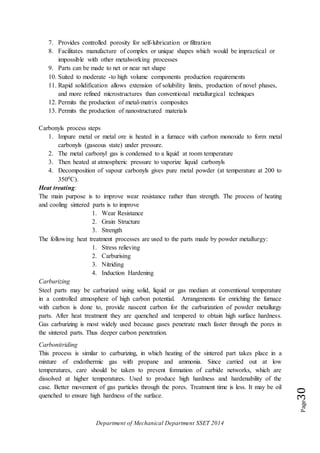
Particle size and shape
Ductile regime machining process
Every material however hard and brittle shows some degree of ductility at nano/ micron level. If
the material removal is carried out nano level (ductile regime)plastic deformation of hard and
brittle material will takes place. The process of machining brittle materials where the material is
removedbyplasticflow,thus leaving a crack free surface is known as ductile-regime machining.
Ductile machiningof brittle materials can produce surfaces of very high quality comparable with
processes such as polishing, lapping etc.
Brittle materialssuchassilicon,germanium, glassandceramicsare widelyusedinsemiconductor,
optical,micro-electronicsandvariousotherfields.The conventional machining processes such as
single point turning and milling are not conducive to brittle materials as they produce
discontinuous chips owing to brittle failure at the shear plane before any tangible plastic flow
occurs.
Department of Mechanical Department SSET 2014
Page32
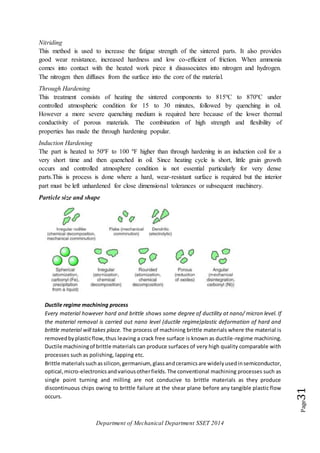
Magnetic abrasive finishing process (MAF)
Ferromagnetic particles mixed with fine abrasive power (silicon carbide/aluminium oxide
etc) subjected to magnetic field. The magnetic field act as a binder and it is similar to a wire
brush.
The magnetic abrasive grains are combined to each other magnetically between magnetic poles
along a line of magnetic force, forming a flexible magnetic abrasive brush. MAF uses this
magnetic abrasive brush for surface and edge finishing. The magnetic field retains the powder in
the gap, and acts as a binder causing the powder to be pressed against the surface to be finished
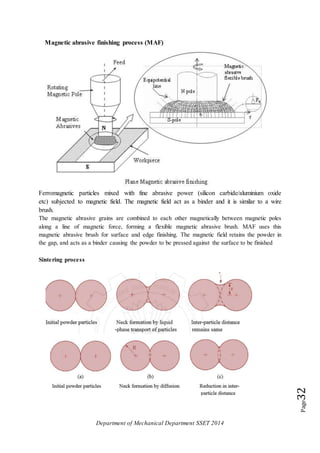
Sintering process

powder metallurgy and micromachining notes

  • 1.
    Department of MechanicalDepartment SSET 2014 Page1 Module III POWDER METALLURGY Powder metallurgy (PM) is a metal working process for forming precision metal components from metal powders. The metal powder is first pressed into product shape at room temperature. This is followed by heating (sintering) that causes the powder particles to fuse together without melting. Strength and other properties are imparted to the components by sintering operations. The most commonly used metals in P/M are iron, copper, aluminum, tin, nickel, titanium and refractory metals. The parts produced by PM have adequate physical and mechanical properties while completely meeting the functional performance characteristics. The cost of producing a component of given shape and the required dimensional tolerances by PM is generally lower than the cost of casting or making it as a wrought product, because of extremely low scrap and the fewer processing steps. The cost advantage is the main reason for selecting PM as a process of production for high – volume component which needs to be produced exactly to, or close to, final dimensions. The rate of production of parts is quite high, a few hundreds to several thousands per hour. Parts can be produced which are impregnated with oil or plastic, or infiltrated with lower melting point metal. They can be electroplated, heat treated, and machined if necessary. Industrial applications of PM parts are several. These include self – lubricating bearings, porous metal filters and a wide range of engineered shapes, such as gears, cams, brackets, sprockets, etc. Basic steps of the Powder Metallurgy Process The manufacturing of parts by powder metallurgy process involves the following steps: (a) Manufacturing of metal powders (b) Blending and mixing of powders (c) Compacting (d) Sintering (e) Secondary and Finishing operations
  • 2.
    Department of MechanicalDepartment SSET 2014 Page2 Preparation of metal powders Powders of almost all metals can be produced. Powder production processes are constantly being improved to meet the quality, cost and performance requirements of all types of applications. Which powder production process is used depends on the required production rate, the desired powder properties and the properties desired in the final part. There are various methods available for the production of powders, depending upon the type and nature of metal. Some of the important processes are:  Atomization  Reduction methods (Chemical )  Electrolytic Deposition  Carbonyls (Thermal decomposition)  Crushing and Milling ( also called comminution)  Shotting Chemical and electrolytic methods are used to produce high purity powders. Mechanical milling is widely used for the production of hard metals and oxides. Atomization In this process molten metal is broken up into small droplets and rapidly frozen before the drops come into contact with each other or with a solid surface. The principal method is to disintegrate a thin stream of molten metal by subjecting it to the impact of high energy jets of gas or liquid (shown in figure). Air, nitrogen and argon are commonly used gases, and water is the liquid most widely used. It is the dominant method for producing metal powders from aluminium, brass, iron, alloy steel, super-alloy, titanium alloy and other alloys etc. Methods of metal-powder production by atomization: (a) gas atomization; (b) water atomization; (c) vacuum atomization (d) centrifugal atomization (spinning disk or cup, rotating electrode methods)
  • 3.
    Department of MechanicalDepartment SSET 2014 Page3 Water atomization: High pressure water jets are used to bring about the disintegration of molten metal stream. Water jets are used mainly because of their higher viscosity and quenching ability. This is an inexpensive process and can be used for small or large scale production. But water should not chemically react with metals or alloys used. Gas atomization: Here instead of water, high velocity argon, nitrogen and helium gas jets are used. The molten metal is disintegrated and collected as atomized powder in a water bath. Fluidized bed cooling is used when certain powder characteristics are required. Vacuum atomization: In this method, when a molten metal supersaturated with a gas under pressure is suddenly exposed into vacuum, the gas coming from metal solution expands, causing atomization of the metal stream. This process gives very high purity powder. Usually hydrogen is used as gas. Centrifugal atomization (disk or cup) Centrifugal force can be used to break up the liquid as it is removed from the periphery of spinning disk/cup. Rotating consumable electrode method Due to the corrosion action on the orifice or nozzle at high temperature, another method is that an electric arc is struck between non-rotating, non-consumable tungsten electrode and rotating consumable electrode(metal from which power is to be produced). The metal droplets from the rotating consumable electrode are thrown off, are collected and are finally crushed to the required powder size. The process is carried out in a chamber filled with inert gas (argon gas).
  • 4.
    Department of MechanicalDepartment SSET 2014 Page4 As the metal stream exits through the nozzle, it is struck by a high velocity stream of the atomizing medium (water, air, or an inert gas). The molten metal stream is disintegrated into fine droplets which solidify during their fall through the atomizing tank. Particles are collected at the bottom of the tank. Process controlling parameters determining size and shape of particles 1. Metal flow rate 2. Pressure of the stream of air or gas. 3. Temperature of the stream. Atomization process steps  The molten alloy is prepared in a furnace and then it is transferred to the tundish.  The melt is poured from the tundish through the nozzle into the chamber.  The water (air, gas) jets break the melt stream into fine droplets.  The droplets solidify when they fall in the chamber.  The powder is collected at the bottom of the chamber, removed and dried Reduction method (Chemical methods) Pure metal is obtained by reducing its oxide with a suitable reducing gas at an elevated temperature below the melting point. Selected ore is crushed, mixed with reducing gas or solid (carbon monoxide, hydrogen etc) and passed through a continuous furnace where reaction takes place leaving a cake of sponge iron which is then further treated by crushing, separation of non-metallic material, and sieving to produce powder. Since no refining operation is involved, the purity of the powder is dependent on that of the raw materials. Fe3O4 + 4CO + (heat) → 3Fe + 4CO2 2CuO2 + 4H2 (heat) → 2Cu + 4H2O This process is cheap and a large amount of powder is made by this method. This is a convenient and extremely flexible method for controlling the properties of size, shape and porosity. It is used in the manufacture of Fe, Cu, Ni, Mo and Co. The resulting particles are of irregular shape and are quite porous and spongy. Readily compressible and have good green strength. Furnace temperature, amount of gas and its purity are the controlling factors. Electrolysis method (Electrolytic Deposition) This is the reverse of electroplating. To produce iron, impure steel acts as anodes in tanks containing electrolyte. Sheets of stainless steel are placed in the tank acted as cathode. When DC current is passed through an electrolyte, pure iron gets deposited on cathode. The cathode plates are then removed and the electrolytic iron is stripped from them. Additional crushing and milling is necessary. Used for making copper, iron, silver and tantalum powders. Electrolytic powders are of high purity, soft spongy dendrite structure.
  • 5.
    Department of MechanicalDepartment SSET 2014 Page5 Processes parameters of electrolyte method of powder preparation (a) Electrolyte composition and strength (b) Current density (c) Temperature of electrolyte Advantages of electrolysis (a) High degree of purity (b) Uniformity in characteristics (c) Excellent compacting and sintering property (high quality product) (d) Economical Disadvantages (a) Time consuming (b) Unsuitable for alloy powder (c) Low production rate Carbonyls method (decomposition method) The metal carbonyl process is used as a way of refining or making pure metal from ores. Metal reacts with carbon monoxide to form metal carbonyl gas, which can be decomposed back to pure metal at moderate temperatures with the recovery of carbon monoxide. Carbonyls can be obtained by passing carbon monoxide over spongy metal (iron or nickel) at specific temperature and pressure. Then decompose the metal compound by raising the temperature and lowering the pressure gives the purest metal. )( )( )()()( powdermetalpureM ionDecomposit COMCOnmetalM e nee    Carbonyls process 1. Metal carbonyls are formed by letting impure or ore of iron or nikel react with carbon monoxide 2. Reaction products is decomposed to iron and nickel (pure powder form)  5)(5 COFCOF ee (gas) COFCOF ee 5)( 5  (fine iron powder + carbon moxide) Carbonyls powder is spherical, fine and porous with an onion skin structure. Carbonyl powder has high purity (99.5%) and excellent sintering properties and flowability. Iron and nickel are produced in large quantities by the decomposition of the metal carbonyl This reaction can be controlled by changing temperature and pressure. Examples of carbonyls  Fe (CO)5  Ni (CO)4)  W(CO)6
  • 6.
    Department of MechanicalDepartment SSET 2014 Page6 Comminution method (mechanical pulverization by crushing and milling) It is mechanical method of powder preparation involving breaking solid particles in pulverizing mills (ball, vibratory, hummer). This method is generally applied for the preparation of powders of brittle materials. Metal particles is mixed with ball mills and rotated or send through the rolling mill to pulverize the metal to form powder. Shotting In this method a fine stream of molten metal is passed through a vibrating screen into air or neutral atmosphere. Likewise the molten metal is disintegrated into a large number of droplets which solidify as spherical particles during its free fall. All metals can be shotted. The type size and properties of the resultant shot depends on: a. Temperature of the molten metal and gas. b. Diameter of the holes. c. Frequency of vibration of the vibrating screen. Mixing and Blending A single powder may not fulfil all the requisite properties and hence, powders of different materials with wide range of mechanical properties are blended to form a final part. In this step more than one powder is mixed thoroughly with lubricants, adhesives and binders and blended to ensure their even distribution. 1. Blending imparts uniformity in the shapes of the powder particles, 2. Mixing facilitates mixing of different powder particles to impart wide ranging physical and mechanical properties, 3. Lubricants can be added during the blending process to improve the flow characteristics of the powder particles reducing friction between particles and dies, 4. Binders can be added to the mixture of the powder particles to enhance the green strength during the powder compaction process Blending: It is the process of mixing powder of the same chemical composition but different sizes. Different particle sizes are often blended to reduce porosity. Mixing: Process of combining powders of different chemistries (nickel and iron, zirconium alumina, wax, tungsten carbide) to improve the properties is called mixing. Mixing depends on the powder material, particle size, particle shape, surface conditions and environment conditions such as temperature and pressure.
  • 7.
    Department of MechanicalDepartment SSET 2014 Page7 Metal powder characteristics or Properties of fine powder Characteristics/properties of metal powder 1. Size and shape of powder 2. Powder distribution (homogenious) 3. Purity of powder 4. Composition of powder 5. Porous nature of powder 6. Surface area or aspect ratio 7. Flow rate 8. Density All these properties of powder influences the following 1. Green strength 2. Compressibility 3. Mechanical property etc Flow rate: It is the ability of powder to flow readily to fill the mould cavity. It is a very important property, since the minimum time of filling improves the production rates and economy. Very fine particles will flow just like a liquid. When such powder is pressed in a die, it will flow into complex die cavities. Flow rate or flow ability depends on the:  Shape of the powder particle  Size of the powder particle  Size distribution of the powder particle Green strength: Green strength is used to describe the strength of the pressed powder after compacting, but before sintering. The green strength increases with the increase of compaction pressure and apparent density. 1. It helps to retain the sharp edges from damage during ejection and handling time 2. To handle the part for quality measurements, 3. To handle for sintering operations. Apparent Density: Density of loose powder after filling the volume. It depends upon the particle shape, size and size distribution. The apparent density of irregularly shaped particles will be lower than that of spherical particles and fine particles. And Green density is the density of powder after the compacting process. Compressibility and compression ratio: It is the measure of the powder’s ability to deform under applied pressure. It is also defined as the ratio of the volume of the powder poured into the die to the volume of the pressed compact. The compression ratio can be varied from 2 to 8, and the normally adopted value is 3. compactingbeforedensity processteringafterdensity ilitycompressib sin  Compressibility depending factors 1. Size and shape of particles 2. Porosity 3. Lubricant 4. Mechanical properties of metal powder
  • 8.
    Department of MechanicalDepartment SSET 2014 Page8 Particle shape: The particle shape depends on the method of powder manufacture. The various shapes are spherical, rounded, angular, dendrite, porous and irregular etc. The particle shape influences the flow characteristics of powders. The particle shape has an effect on packing of a powder and has an influence on its compacting and sintering properties and the mechanical strength of the sintered product. The irregularly shaped particles have reduced apparent density and flow rate, but good pressing and sintering properties. Whereas the spherical particles have maximum apparent density and flow rate, but reduced pressing properties and good sintering properties. Dendrite powders too have reduced apparent density and poor flow rates. Particle size: It is expressed by the diameter for spherical shaped particles and by the average diameter for non-spherical particles. The particle size influences the control of porosity, compressibility and amount of shrinkage. It is determined by passing the powder through standard sieves or by microscopic measurement. Particle size distribution: It is specified as the amount of powder passing through 100, 200 etc., mess sieves. It influences apparent density, compressibility, flow ability, final porosity and the strength of the part. Theoretically, powders containing variable particle size will result in greater density as a result of finer particles filling up the voids between large particles. But normally during mixing, the finer particles have the tendency to separate and segregate. Thus it is efficient to use uniform size particles and rely on the compacting pressure to get the required final density. The particle size distribution is important to the end user in several ways  Direct impact on the quality of finished product.  Simple and easy filling a die.  Distributions permit voids between larger particles to be filled with smaller particles.  An surplus of fines has negative effects on flow characteristics Surface Area/ aspect ratio: The specific surface of a powder is defined as the total surface area per unit weight. It indicates the area available for bonding. It depends on size, shape, density and surface conditions of the particle. High specific surface results in high sintering rate. Purity: Metal powders should be free from impurities as the impurities reduce the life of dies and effect sintering process. The oxides and the gaseous impurities can be removed from the part during sintering by use of reducing atmosphere.
  • 9.
    Department of MechanicalDepartment SSET 2014 Page9 Compacting Blended powders are pressed in dies under high pressure to form them into the required shape. The work part after compaction is called a green compact or simply a green, the word green meaning not yet fully processed. The compaction is done to bring the finely divided particles of powder into close proximity while imparting the desired part configuration. The following methods are adopted for compacting: 1. Die Pressing 2. Centrifugal compacting 3. Injection moulding 4. Extrusion 5. Rolling 6. Gravity sintering 7. Slip casting 8. Isostatic moulding 9. Explosive moulding Die Pressing: The metal powders are placed in a die cavity and compressed to form a component shaped to the contour of the die. The pressure used for producing green compact of the component vary from 80 Mpa to 1400 Mpa, depending upon the material and the characteristics of the powder used. Mechanical presses are used for compacting objects at low pressure. Hydraulic presses are for compacting objects at high pressure. The basic components are:  Hydraulic mechanism to apply pressure  A die of adequate strength having a cavity of the desired shape and dimension.  Feeding devices for fill the die cavity.  Upper and lower punches to apply pressure, and to assist in the ejection of the green compact.  Control system to maintain the magnitude of pressure and rate of pressure application, speed of punches etc. Single Action Die Compaction: Used to manufacture flat, thin parts such as washers, discs, thin rings etc. The lower punch is stationery during the application of pressure by the motion of the upper punch acting from the direction only on the powder placed in the cavity. After compression the punch is raised in order to eject the part from the die cavity. Advantages are:  Tools used are very simple  Mechanical or hydraulic press may be employed. Disadvantage: it is not suitable for manufacture of long parts because of non-uniform density distribution.
  • 10.
    Department of MechanicalDepartment SSET 2014 Page10 Double Action Die Compaction: The powder is compacted simultaneously from opposite directions by both the top and bottom punches. Equal or different amounts of pressure may be employed from each direction. The die table remains stationery and the upward movement of the lower punch, ejects the part out. This technique can be used for the manufacture of thin walled bushing and cylindrical bearings. Centrifugal Compacting: The powder is swirled in a mould and packed uniformly with pressures up to 3 MPa. The uniform density is obtained as a result of centrifugal force. , acting on each particle of powder. This method is employed for heavy metals such as tungsten carbide and for materials that are relatively incompressible by conventional die compaction. The main drawback of this process is relatively slower process because it takes larger time for the fluid to be absorbed by the method.
  • 11.
    Department of MechanicalDepartment SSET 2014 Page11 Extrusion: This method is employed to produce the components with high density. Both cold and hot extrusion processes are for compacting specific materials. In cold extrusion, the metal powder is mixed with binder and this mixture is compressed into billet. The billet is charged into a container and then forced through the die by means of ram. The cross-section of product depends on the opening of the die. The cross-section of products depends on the opening of the die. Cold extrusion process is used for cemented carbide drills and cutters. In the hot extrusion, the powder is compacted into billet and is heated to extruding temperature in non-oxidising atmosphere. Extrusion is used for manufacturing furnace tubes, thermocouple components and heat exchanger tubes. Injection molding is the method of compaction of ceramic powder fed and injected into a mold cavity by means of a screw rotating in cylinder. The method is similar to the plastic injection molding. Rolling: This method is used for making continuous strips and rods having controlled porosity with uniform mechanical properties. In this method, the metal powder is fed between two rolls which compress and interlock the powder particles to form a sheet of sufficient strength as shown. It is then rerolled and heat treated if necessary. The metals that can be rolled are Cu, Brass, Bronze, Ni and Stainless steel. Slip casting technique In this method, the powder is converted into slurry with water and poured into the mould made of plaster of paris. The liquid in the slurry is gradually absorbed by the mould leaving the solid compact within the mould. The mould may be vibrated to increase the density of the compact.
  • 12.
    Department of MechanicalDepartment SSET 2014 Page12 Steps in slip casting:  Preparing assembled plaster mould,  filling the mould,  absorption of water from the slip into the porous mould,  removal of part from the mould,  trimming of finished parts from the mould Advantages of slip casting: Products that can not be produced by pressing operation can be made, no expensive equipment is required, works best with finest powder particles Disadvantage: slow process, limited commercial applications Applications: tubes, boats, cones, turbine blades, rocket guidance fins; Hollow and multiple parts can be produced Gravity Sintering: Gravity or “loose powder” sintering is used to make porous metal parts from powders that diffusion-bond easily (most production parts are made from bronze). In this process, no outside pressure is applied to shape the part. The appropriate material, graded for size, is poured into a mold cavity, which is a void in the shape of the finished part. These metal particles are then heated to their sintering temperature at which point a metallurgical bonding takes place, and joining “necks” are formed at contact points. Explosive Compacting: In this method, the pressure generated by an explosive is used to compact the metal powder. Metal powder is placed in water proof bags which are immersed in water container cylinder of high wall thickness. Due to sudden deterioration of the charge at the end of the cylinder, the pressure of the cylinder increase. This pressure is used to press the metal powder to form green compact.
  • 13.
    Department of MechanicalDepartment SSET 2014 Page13 Cold Isostatic pressing: (CIP) In this method the powdered material is contained in a tightly sealed flexible mould subjected to uniform pressure (65-650 Mpa) is applied simultaneously from all sides thereby achieving uniform density and strength. After pressing, the compact is removed from chamber. The pressure-transmitting medium used is liquid such as water, oil mixture. The powder is loaded in a shaped flexible envelope for the production of desired shape of the pressed part and tightly sealed against leakage. The flexible envelope is usually made from natural rubber, synthetic rubber, plastics, thin metal foils. Isostatic pressing is generally used to produce large PM parts to near-net shapes. The flexible envelope should possess the following characteristics: 1. Flexible mould 2. It must be completely impervious to the pressurizing fluid. 3. It must be easily sealed. 4. It must be rigid enough to withstand the internal pressure Advantages of cold iso-static pressing (comparing die compacting) 1. Uniform and high density compact 2. Higher dimensional accuracy- near net shaped product 3. Better mechanical properties like ductility, strength, hardness etc 4. More complex geometrical shapes can be made 5. Higher green strength 6. Absence of lubricant 7. Reduced friction Disadvantages 1. Higher equipment cost 2. Low productivity 3. Dimensional control is less 4. Flexible mould life is less Application of Isostatic Pressing: Wide use in aviation defence, medical equipment to produce cutting tools, automotive cylinder liners, corrosion resistant components etc.
  • 14.
    Department of MechanicalDepartment SSET 2014 Page14 Hot isostatic pressing (HIP) Hot iso-static pressing is a compacting process where high temperature and pressure is applied simultaneously (3-dimensions) to produce a dense component. The pressure is uniform in all directions (isostatic). At high temperatures, the hermetic container deforms plastically and the powder is compacted within it under pressure. No further sintering process is needed here as the combination of heat and pressure during the process is done. Metal or glass is used for making the hermetic container. The pressurizing medium is a gas (inert argon/helium) with a pressure 100 to 200 MPa and temperatures to 2200°C. Hot isostatic pressing (CIP) is combining the compaction and sintering processes in PM production process. So it eliminates separate sintering. Advantages 1. Little or no porosity 2. Better surface finish 3. Neat net shape product 4. Improvements in mechanical and physical properties, fatigue, surface finish, reliability 5. Fast delivery 6. More uniform strength 7. Less pressure requirement Disadvantages 1. Very expensive 2. Protective environment is needed
  • 15.
    Department of MechanicalDepartment SSET 2014 Page15 Sintering Sintering is a heat treatment process applied to a green compact (product after the compacting) in order to impart strength and integrity in a controlled atmosphere (reducing atmosphere which protects oxidation of metal powders). Sintering increases the bond between the particles and therefore strengthens the powder metal compact. The temperature used for sintering is below the (0.6 to 0.8 times) melting point of powder material. The atoms in the materials diffuse across the boundaries of the particles, fusing the particles together and creating one solid piece. Diffusion is due to various mass-transport mechanisms. These can be divided into surface transport and bulk transport mechanisms. In surface transport mechanisms, atoms move from the surface of one particle to the surface of another particle. In bulk transport mechanisms, atoms move from the particle interior to the surface. Sintering reduces the porosity and enhances properties such as strength, electrical conductivity, translucency and thermal conductivity An example of sintering can be observed when ice cubes in a glass of water adhere to each other, which is driven by the temperature difference between the water and the ice. Examples of pressure drivensinteringare the pressingof loose snow together to a hard snowball by pressing. The main driving force during the sintering process is the reduction of energy due to the reduced surface area. Powders with a greater surface area will have a higher driving force towards bonding and to reduce this potential energy. Stages of Sintering This process is carried out a constant temperature and time is varied to obtain the desirable results. The four phases of sintering are: 1. Local bonding: Particles stick together and neck formation 2. Initial stage: Neck growth 3. Final stage: Pores are round up then finally closed The time, temperature and the furnace atmosphere are the three critical factors that control the sintering process. Sintering process enhances the density of the final part by filling up the incipient holes and increasing the area of contact among the powder particles in the compact perform . Property change during sintering
  • 16.
    Department of MechanicalDepartment SSET 2014 Page16 Microscopic scale the changes that occur during sintering of metallic powders. Types of sintering Basically, sintering processes can be divided into two types: solid state sintering and liquid phase sintering. Solid state sintering occurs when the powder compact is densified wholly in a solid state at the sintering temperature. No liquid is present and atomic diffusion in the solid state produces joining of the particles and reduction of porosity. All densification is achieved through changes in particle shape, without particle rearrangement. Liquid phase sintering Liquid phase sintering is the process of adding an additive to the powder which will melt before the matrix phase. This also occurs when the powder contains a component, having the melting point lower, than the melting point of the base metal. For materials which are hard to sinter, liquid phase sintering is commonly used. Materials for which liquid phase sintering is common are Si3N4, WC, SiC, and more. Some liquid phase present in the powder compact will enhance sintering process. The process of liquid phase sintering has three stages:  Rearrangement – As the liquid melts capillary action will pull the liquid into pores and also cause grains to rearrange into a more favorable packing arrangement.  Solution-Precipitation –atoms will preferentially go into solution and then precipitate in areas of lower chemical potential where particles are non close or in contact.  Final Densification – liquid movement from efficiently packed regions into pores. The changes occur in sintering 1. Strength, hardness and fracture toughness 2. Electrical and thermal conductivity 3. Permeability to gases and liquids 4. Average grain number, size, shape and distribution 5. Average pore size and shape 6. Distribution of pore size and shape 7. Chemical composition and crystal structure
  • 17.
    Department of MechanicalDepartment SSET 2014 Page17 Continuous sintering furnace Pre-Sintering Sometimes product after the sintering process is rather difficult for secondary operation as product is hard and strong. And cost of operation also will be high as tool life is less. So the green compact is heated to a temperature well below the final sintering temperature and it will gain enough strength to be handled and machined without any difficulty. This process is necessary when holes are to be drilled in the end product. Pre-sintering in addition removes lubricants and binders added to the powder during blending operation. Pre-sintering can be avoided if no machining of the final product is desired. Sintering Atmosphere The choice of furnace temperature depends on the characteristics of the material and the properties desired from the sintered product. Functions of the sintering atmosphere 1. It must prevent oxidation on the metal surface at the sintering temperature 2. It must avoid carburizing, decarburizing or nitriding conditions in certain metals. 3. It must not contaminate the metal powder compact at the sintering temperature. The atmosphere prevailing in various types of sintering furnaces are considered to be: 1. Reducing atmosphere like dry H2 and CO 2. Neutral atmosphere 3. Oxidizing atmosphere like O2 and air Vacuum sintering is costly and therefore employed on a small scale in very special cases like research work.
  • 18.
    Department of MechanicalDepartment SSET 2014 Page18 Secondary and finishing operations Sometimes additional operations are carried out on sintered PM parts in order to further improve their properties or to impart special characteristics. 1. Coining and sizing. These are high pressure compacting operations. Their main function is to impart (a) greater dimensional accuracy to the sintered part, and (b) greater strength and better surface finish by further densification. 2. Forging. The sintered PM parts may be hot or cold forged to obtain exact shape, good surface finish, good dimensional tolerances, and a uniform and fine grain size. Forged PM parts are being increasingly used for such applications as highly stressed automotive, jet – engine and turbine components. 3. Impregnation. The inherent porosity of PM parts is utilized by impregnating them with a fluid like oil or grease. A typical application of this operation is for sintered bearings and bushings that are internally lubricated with upto 30% oil by volume by simply immersing them in heated oil. Such components have a continuous supply of lubricant by capillary action, during their use. Universal joint is typical grease – impregnated PM part. 4. Infiltration. The pores of sintered part are filled with some low melting point metal with the result that part's hardness and tensile strength are improved. A slug of metal to be impregnated is kept in close contact with the sintered component and together they are heated to the melting point of the slug. The molten metal infiltrates the pores by capillary action. When the process is complete, the component has greater density, hardness, and strength. Copper is often used for the infiltration of iron – base PM components. Lead has also been used for infiltration of components like bushes for which lower frictional characteristics are needed. 5. Heat Treatment. Sintered PM components may be heat treated for obtaining greater hardness or strength in them. 6. Machining. The sintered component may be machined by turning, milling, drilling, threading, grinding, etc. to obtain various geometric features. 7. Joining. PM parts can be welded by several conventional methods. Electric resistance welding is better suited than oxy- acetylene welding and arc welding because of oxidation of the interior porosity. Argon arc welding is suitable for stainless steel PM parts Finishing process: Almost all the commonly used finishing method is applicable to PM parts. Some of such methods are plating, burnishing, coating, and colouring. 1. Plating. For improved appearance and resistance to wear and corrosion, the sintered compacts may be plated by electroplating or other plating processes. To avoid penetration and entrapment of plating solution in the pores of the part, an impregnation or infiltration treatment is often necessary before plating. Copper, zinc, nickel, chromium, and cadmium plating can be applied. 2. Burnishing. To work harden the surface or to improve the surface finish and dimensional accuracy, burnishing may be done on PM parts. 3. Coating. PM sintered parts are more susceptible to environmental degradation than cast and machined parts. This is because of inter – connected porosity in PM parts. Coatings fill in the pores and seal the entire reactive surface. 4. Colouring. Ferrous PM parts can be applied colour for protection against corrosion.
  • 19.
    Department of MechanicalDepartment SSET 2014 Page19 Advantages of powder metallurgy The main advantages of P/M process over the conventional material processing methods such as casting, forging and rolling are the following 1. PM parts can be mass produced to net shape or near net shape, eliminating or reducing the need for subsequent machining which saves time and cost. It also reduces wastes by material about 97% of the starting powders are converted to product 2. Special alloys can be synthesized. Wide variety of materials(metals and non metals) and composition can be made possible to impart required properties like magnetic, and mechanical properties 3. PM parts can be made with a specified level of porosity, to produce porous metal parts. Examples: filters, oil impregnated bearings and gears 4. Parts can be produced from high melting point refractory metals with respectively less difficulty and at less cost. 5. Difficult to machine materials like carbide and tungsten can be made by this method 6. Wide property control is possible with the product with variation in composition and further heat treatment 7. Certain metals that are difficult to fabricate by other methods can be shaped by powder metallurgy. Example: Tungsten filaments for incandescent lamp bulbs are made by PM 8. Certain alloy combinations made by PM cannot be produced in other ways 9. Close dimensional control is possible when comparing with other process 10. PM production methods can be automated for economical production for large production volume. 11. More eco-friendly process Limitations and Disadvantages with PM Processing 1. High tooling and equipment costs 2. Metallic powders are expensive 3. Problems in storing and handling metal powders a. Examples: degradation over time, fire hazards with certain metals 4. Limitations on part geometry because metal powders do not readily flow laterally in the die during pressing 5. Variations in density throughout part may be a problem, especially for complex geometries 6. Some powders (such as aluminum, magnesium, titanium and zirconium) in a finally divided state present fire hazard and risk of explosion. 7. Low melting point metal powders (such as of zinc, tin, cadmium) give thermal difficulties during sintering operation, as most oxides of these metals cannot be reduced at temperatures below the melting point. 8. Powder metallurgy is not economical for small scale production. 9. Articles produced by powder metallurgy process possess poorductility
  • 20.
    Department of MechanicalDepartment SSET 2014 Page20 Application of powder metallurgy There is a great variety of machine components that are produced from metal powders, many of these are put to use without any machining operation carried out on them. Following are some of the prominent PM Products. Self-Lubricating Bearing and Filters: Porous bronze bearings are made by mixing copper and tin powder in correct proportions, cold pressed to the desired shape and then sintered. These bearings soak up considerable quantity of oil. Hence during service, these bearings produce a constant supply of lubricant to the surface due to capillary action. These are used where lubricating is not possible. Porous filters can be manufactured and are used to remove, undesirable materials from liquids and gases. Cutting Tools and Dies: Cemented carbide cutting tool inserts find extensive applications in machine shops. These are produced by PM from tungsten carbide powder mixed with cobalt binder. Machinery Parts: Several machinery parts including gears, bushes and bearings, sprockets, rotors are made from metal powders mixed with sufficient graphite to give to product the desired carbon content. Friction Materials: These are made by powder metallurgy. Clutch liners and Brake bands are the example of friction materials. Gears and Pump Rotors: Gears and pump rotor for automobile oil pumps are manufactured by powder metallurgy. Iron powder is mixed with graphite, compacted under a pressure of 40 kg/ cm and sintered in an electric furnace with an atmosphere and hydrocarbon gas. These are impregnated with oil. Refractory Materials: Metals with high melting points are termed as refractory metals. These basically include four metals tungsten, molybdenum, tantalum and niobium. Refractory metals as well as their alloys are manufactured by powder metallurgy. Magnets: Small magnets produced from different compositions of powders of iron, aluminum, nickel and cobalt has shown excellent performance, far superior to that cast. Electrical Parts: Several combinations such as copper – tungsten, cobalt – tungsten, silver – tungsten, copper-nickel, and silver – molybdenum have been used for production of these parts. These parts are required to have excellent electrical conductively, be wear resistant, and somewhat refractory.
  • 21.
    Department of MechanicalDepartment SSET 2014 Page21 Micro-machining Micro-Machining includes all cutting operations in which material is removed at the micron level. Present notion of the term ‘micro-machining’ has been used more commonly in the fabrication of micro-components in the size range of 1 to 500 μm. Micromachining is the most basic technology for the production of miniaturized parts and components. Over the past several years there has been an increased interest in micro machining technology that has captured the imagination of every manufacturing and industry segment; from aerospace, medical appliance and the automotive world, the potential for product miniaturization continues to grow and while posing numerous technical challenges. Advantages of micro-products (1-500µm size products) 1. Increased function 2. Reduced material requirment 3. Reduced power requirment 4. Less space is needed 5. Less handling and transportaion etc Diamond turn machining Micromachining is the most basic technology for the production of miniaturized parts and components. Micro turning is one type of micromachining process which uses a solid tool and its material removal process is almost similar to conventional turning operation. Diamond is a transparent solid made mostly of one kind of atom, carbon. The advantages of using diamond cutting tools often include improved workpiece quality, increased productivity, and reduced costs. High hardness and wear resistance result in good surface finishes over long production runs, consistent control of dimensions for extended periods, and long tool life. High quality tools can be made of single crystal natural diamond. They are used to make high precision parts in metals, plastics, ceramics and a host of other materials. The diamond tool is commonly used in micro-machining as it can withstand the micro hardening of the workpiece surface during micro-machining. Diamond only softens at 13500C and melts at 3027 0C, and is also the hardest material in the world. The high hardness is important for reducing wear rate and enable machinability of glass and ceramic materials.
  • 22.
    Department of MechanicalDepartment SSET 2014 Page22 Cutting edge radius of single point diamond tool can be sharpened down to 20nm. Its sharp edge can be retained without major wear. Micro-machining using diamond tool could be performed at high speeds and generally fine speeds to produce good surface finish such as mirror surfaces and high dimensional accuracy in non-ferrous alloys and abrasive non- metallic materials. Material removal mechanism in micro-machining In nano and micromachining processes the actual material removal can be limited to the surface of the workpiece, i.e. only a few atoms or layers of atoms. Material removal rates in micro-milling are considerably lower than in conventional macro-scale machining. The mechanism for material removal involved plastic deformation, microfracture and dislodgement of grains. Chip formation in micro cutting cutting edge radius 5nm
  • 23.
    Department of MechanicalDepartment SSET 2014 Page23 Magnetorheological nano-finishing process Commonly used traditional finishing processes are grinding, lapping and honing. All these processes use multipoint cutting edges in the form of abrasives, which may or may not be bonded, to perform cutting action. These processes have been in use from the earliest times because of their capability to produce smooth surface at close tolerances. Earlier there has been a limit on the fine size of abrasives (a few μm) but today, new advances in materials syntheses have enabled production of ultra fine abrasives in the nanometer range. The ultimate precision obtainable through finishing is when chip size approaches atomic size (0.3 nm). To finish surfaces in nanometer range, it is required to remove material in the form of atoms or molecules individually or in the groups. To name a few, these magnetic field assisted finishing processes include Magnetic Abrasive Finishing (MAF), Magnetic Float Polishing (MFP), Magnetorheological Finishing (MRF), and Magnetorheological Abrasive Flow Finishing (MRAFF). Magnetorheological fluid (MR fluid) A magnetorheological (MR) fluid is a suspension of magnetically soft ferromagnetic particles in a carrier liquid. Typically, the particles are of the order of a few microns in diameter and their volume concentration is 30% to 40%. When exposed to a magnetic field, the viscosity and yield stress of the suspension increase several orders of magnitude. Under magnetic field, the particles line up, thickening the fluid and fluid to behave more like a solid. The term "magnetorheological" comes from this effect. The particles are tiny, measuring between 3 to 10 microns of carbonyl iron dispersed in a non-magnetic carrier medium like silicone oil, mineral oil or water. Magnetic particles (µm /nm) size suspended within the carrier oil are distributed randomly Under magnetic field, microscopic particles align themselves along the lines of magnetic flux
  • 24.
    Department of MechanicalDepartment SSET 2014 Page24 Characteristics of MR fluid  Particle size, shape, density and distribution of carbonyls particles and properties of carrier fluid are factors controlling MR fluid.  In off condition (absence of magnetic filed) MR fluid appear similar to liquid paint and exhibit viscosity 0.1 to 1 Pa sec  Their viscosity changes significantly 105 to 106 times within a few milli seconds when magnetic field is applied  Particles held together by magnetic field, form chain which resist to a level of shear stress.  The change of viscosity is completely reversible when magnetic field is removed Magnetorheologcal polishing fluid (MRP fluid) When the MR fluid is mixed with abrasives particles, we get a MRP fluid. So MRP fluid consists of carbonyls iron particles (CIP) and nano sized abrasive particles (SiC) MRP fluid consists of: o Carbonyl iron powder 20% o Silicon carbide 20% (non magnetic abrasive particles) o Base fluid medium 60% o Additives The flow behaviour of the MRP fluid exhibits a transition from liquid like structure to a gel like structure on the application of magnetic field. The rheological properties of MRP-fluid depend on carbonyl iron particle size (CIP), silicon carbide (SiC) particle size, their volume concentration, magnetic properties and magnetic field strength. The MR fluid temporarily stiffens and conforms to the surface of the component being finished. This allows geometries of almost any shape to be polished as easily as a spherical optic Advantages of MRP fluid over the traditional methods (lapping) 1. It does not load up as a grinding wheel 2. It is flexible and adapts the shape of the part of the workpiece 3. Carries heat and debris away from the polishing zone 4. Processes are more controllable Characteristic of MRP fluid 1. Concentration of magnetic and abrasive particles 2. Density and size of particles 3. Yield stress under magnetic field 4. Property of carrier fluid 5. Low off-state viscosity 6. Resistance to corrosion 7. Stability against sediments etc
  • 25.
    Department of MechanicalDepartment SSET 2014 Page25 Abrasive flow machining (AFM) A one way or two way flow of an abrasive media is extruded through a workpiece, smoothing and finishing rough surfaces. The process is particularly useful for difficult to reach internal passages, bends, cavities, and edges. Magnetorheological Finishing (MRF) -MRP fluid is used All traditional finishing process are incapable of producing required surface finish of nanometer level. Magnetorheological finishing is one of the new process which can provide surface finish up to nano meter level. Magnetic abrasives are emerging as important finishing methods for metals and ceramics. For the polishing purposes, proper abrasive slurry (silicon carbide) is incorporated into the MR fluid (MRP), which is supplied to the narrow gap between the wheel and workpiece. When magnetic field is applied, the magnetic particles hold the abrasive particles together and act as a solid and relative movement is given between the work and abrasive slurry. The low viscosity MR fluid is pumped through a shaping nozzle onto a vertical, rotating wheel. At the apex of the wheel, the fluid stiffens into a ribbon, under the influence of a dc magnetic field. The workpiece is placed into the ribbon and forms a converging gap. Shaping and smoothing are accomplished simultaneously as the rotating workpiece is moved through the ribbon under computer control. An electromagnet, located below the polishing wheel, has specially designed pole pieces that extend up to the underside of the apex of the wheel rim. These pole pieces exert a strong local magnetic field gradient over the upper side of the wheel. When the magnetorheological fluid passes through the magnetic field, it stiffens in milliseconds, then returns to its original fluid state as it leaves the field, again in milliseconds. This precisely controlled zone of magnetized fluid becomes the polishing tool. When an optical surface is placed into the fluid in this zone, the stiffened fluid ribbon is "squeezed" from its original thickness of about 2 mm, to about l mm. The "squeezing" results in significant shear stress and subsequent polishing pressure over that section of the optical surface. At the same instant, the MR fluid conforms to the local curvature of the part being polished.
  • 26.
    Department of MechanicalDepartment SSET 2014 Page26 Magnetorheological Abrasive Flow Finishing (MRAFF) Magnetorheological Abrasive Flow Finishing (MRAFF) is a precision finishing process developed for nanofinishing of complex internal geometries using smart magnetorheological polishing fluid. It is a homogenious mixture of carbonyls iron particles (CIP) and abrasive particles in a base medium (paraffin liquid). When the external magnetic field is applied, carbonyls iron particles (CIP) form a chain like structure with abrasives embedded in between. The magnetic force between iron particles holding abrasive grains provides the bonding strength which depends on iron concentration, magnetic field strength and particle size etc. The Magneto-Rheological Abrasive Flow Finishing is a polishing process that results from the sum of Abrasive Flow Finishing (AFF) and Magneto-Rheological Finishing (MRF). In other hands, it is a hybrid process developed to preserve the advantages of both processes. The MRP fluid is extruded back and forth through the passage, material removal will takes place. Structure formed with abrasives trapped and embedded between iron chains, in the presence of finite magnetic field.
  • 27.
    Department of MechanicalDepartment SSET 2014 Page27 Module III (Questions) 1. Explain the procedure of manufacturing parts by powder metallurgy. 2. Explain the manufacturing of powder metallurgy components with suitable flowchart. 3. Describe, the steps involved in the production of powder metallurgy parts.**** 4. Discuss secondary operations in Powder Metallurgy. ************************************** 5. What are the advantages of powder metallurgy offers?**** 6. What are advantages and limitations of powder metallurgy?*** 7. Discuss/Explain the applications of Powder Metallurgy. **** 8. What are the main industrial uses of powder metallurgy? 9. Explain the process capabilities of powder metallurgy 10. Explain why powder metallurgy has become highly competitive with casting, forging and machining processes. ** 11. What are the design considerations for the powder metallurgy parts?*** 12. Describe the design considerations making powder metallurgy parts. How different are these compared to casting and forging of metals. ******************************************* 13. Describe briefly the methods by which powders suitable for powder metallurgy can he produced.****** 14. Explain how metal powders are produced by atomization. *** 15. Explain the various methods of powder production. Give the characteristics required for metal powders 16. Explain three methods of powder production with neat sketches and discuss their influences on the properties of the final product. 17. Explain the characteristics of metal powders required?**** 18. What are the desirable properties of metal powder? 19. What are the important physical characteristics of powder-metals 20. Explain the effects of using fine powders and coarse powders respectively in making P/M parts *************************************** 21. What are some of the objectives of powder mixing or blending** 22. Briefly explain blending of powders in powder metallurgy 23. List and discuss the material properties affecting blending in Powder metallurgy process. ************************* 24. Explain the various compaction techniques used in Powder metallurgy. **** 25. What are some of the objectives of the compacting operation? 26. Why might double-action pressing be more attractive than compaction with a single moving punch? 27. In what ways might the final density of a P/M product be reported? 28. What are some of the other methods that can produce high-density PIM products? 29. Why is there a density variation in compacting powders? 30. With suitable sketches explain double compaction of parts out of powders. 31. Discuss cold and hot isostatic pressing process.
  • 28.
    Department of MechanicalDepartment SSET 2014 Page28 32. What is meant by Isostatic pressing? 33. What is isostatic compaction? For what product shapes might it be preferred? 34. What are the disadvantages of hot pressing? How can you overcome them 35. Describe the relative advantages and limitations of cold and hot isostatic pressing.** 36. Describe, with suitable sketches, hot isostatic pressing of metal powders.*** 37. What are some of the attractive properties of HlP products? 38. What are some of the major limitations-of HIP process and how does the sinter process eliminate or minimize them? ****************************************************** 39. Differentiate between infiltration and "impregnation” with reference to powder metallurgy 40. What is the purpose of repressing, coining or sizing operations? 41. Why can the original compaction tooling not be used to shape the product during repressing? 42. What are pre alloyed and pre-coated powders? How are these powders manufactured? 43. What are impregnations and infiltration processes in powder metallurgy? ******************************************* 44. Why it is necessary to use lubricants in the press compaction of powders? State and explain the advantages of porous and self-lubricating bearings over the standard sleeve bearings. 45. What are self lubricating bearings?** 46. Why is pore size important in the manufacture of self lubricating bearing? How may pore size be controlled? ********************************************* 47. Define the following terms in relation to metal powders : a. Surface area, b. Compressibility, c. Apparent density and particle size distribution. 48. Write notes on a. Hot pressing, b. Impact compacting c. Powder rolling.** *************************************************** 49. Explain pre-sintering and sintering in detail.*** 50. Differentiate between pre-sintering and sintering. 51. What is meant by sintering of powder compacts? 52. Give an account of sintering atmospheres** 53. What are the effects of sintering on the powder compact produced by pressing 54. Explain the mechanism of sintering of single and multi-phase materials. 55. Outline the advantages of pre-sintering and coining on the metal compacts. 56. Give an account of sintering furnaces used in powder metallurgy industries. 57. Should green compacts be brought up to the sintering temperature slowly or rapidly? Explain the advantages and limitations of each.
  • 29.
    Department of MechanicalDepartment SSET 2014 Page29 Extra notes PM comparing with casting and forging process a. Net shape manufacturing b. Controlled porosity product c. Higher melting point material product can be made d. Brittle and hard material e. High production rate with automation f. Higher finish and dimensional accuracy g. Less scrap h. More ecofriedly i. Higher mechanical and other properties Powder production Metal powder production techniques are used to manufacture a wide spectrum of metal powders designed to meet the requirements of a large variety of applications. Powders of almost all metals can be produced. Various powder production processes allow precise control of the chemical and physical characteristics of powders and permit the development of specific attributes for the desired applications. Powder production processes are constantly being improved to meet the quality, cost and performance requirements of all types of applications. Metal powders are produced by mechanical or chemical methods. The most commonly used methods include water and gas atomization, milling, mechanical alloying, electrolysis, and chemical reduction of oxides. Which powder production process is used depends on the required production rate, the desired powder properties and the properties desired in the final part. Chemical and electrolyic methods are used to produce high purity powders. Atomization is the most versatile method for producing metal powders. It is the dominant method for producing metal and pre-alloyed powders from aluminum, brass, iron, low- alloy steel, stainless steel, tool steel, superalloy, titanium alloy and other alloys. For the production of ultra fine or nano- powders, a growing market, gas phase reactions, spray drying or precipitation methods are used. In the case of iron, sponge powder is produced from magnetite iron ore that is directly reduced at elevated temperatures to obtain sponge form. The material is then disintegrated into powder and annealed to obtain the desired properties.Sponge iron has a very high surface area and exhibits high green strength.It is used for low and medium density ferrous P/M parts. Advantages of PM 1. Eliminates or minimizes machining 2. Eliminates or minimizes scrap losses 3. Maintains close dimensional tolerances 4. Permits a wide variety of alloy systems 5. Produces good surface finishes 6. Provides materials which may be heat-treated for increased strength or increased wear resistance
  • 30.
    Department of MechanicalDepartment SSET 2014 Page30 7. Provides controlled porosity for self-lubrication or filtration 8. Facilitates manufacture of complex or unique shapes which would be impractical or impossible with other metalworking processes 9. Parts can be made to net or near net shape 10. Suited to moderate -to high volume components production requirements 11. Rapid solidification allows extension of solubility limits, production of novel phases, and more refined microstructures than conventional metallurgical techniques 12. Permits the production of metal-matrix composites 13. Permits the production of nanostructured materials Carbonyls process steps 1. Impure metal or metal ore is heated in a furnace with carbon monoxide to form metal carbonyls (gaseous state) under pressure. 2. The metal carbonyl gas is condensed to a liquid at room temperature 3. Then heated at atmospheric pressure to vaporize liquid carbonyls 4. Decomposition of vapour carbonyls gives pure metal powder (at temperature at 200 to 3500C). Heat treating: The main purpose is to improve wear resistance rather than strength. The process of heating and cooling sintered parts is to improve 1. Wear Resistance 2. Grain Structure 3. Strength The following heat treatment processes are used to the parts made by powder metallurgy: 1. Stress relieving 2. Carburising 3. Nitriding 4. Induction Hardening Carburizing Steel parts may be carburized using solid, liquid or gas medium at conventional temperature in a controlled atmosphere of high carbon potential. Arrangements for enriching the furnace with carbon is done to, provide nascent carbon for the carburization of powder metallurgy parts. After heat treatment they are quenched and tempered to obtain high surface hardness. Gas carburizing is most widely used because gases penetrate much faster through the pores in the sintered parts. Thus deeper carbon penetration. Carbonitriding This process is similar to carburizing, in which heating of the sintered part takes place in a mixture of endothermic gas with propane and ammonia. Since carried out at low temperatures, care should be taken to prevent formation of carbide networks, which are dissolved at higher temperatures. Used to produce high hardness and hardenability of the case. Better movement of gas particles through the pores. Treatment time is less. It may be oil quenched to ensure high hardness of the surface.
  • 31.
    Department of MechanicalDepartment SSET 2014 Page31 Nitriding This method is used to increase the fatigue strength of the sintered parts. It also provides good wear resistance, increased hardness and low co-efficient of friction. When ammonia comes into contact with the heated work piece it disassociates into nitrogen and hydrogen. The nitrogen then diffuses from the surface into the core of the material. Through Hardening This treatment consists of heating the sintered components to 815ºC to 870ºC under controlled atmospheric condition for 15 to 30 minutes, followed by quenching in oil. However a more severe quenching medium is required here because of the lower thermal conductivity of porous materials. The combination of high strength and flexibility of properties has made the through hardening popular. Induction Hardening The part is heated to 50ºF to 100 ºF higher than through hardening in an induction coil for a very short time and then quenched in oil. Since heating cycle is short, little grain growth occurs and controlled atmosphere condition is not essential particularly for very dense parts.This is process is done where a hard, wear-resistant surface is required but the interior part must be left unhardened for close dimensional tolerances or subsequent machinery. Particle size and shape Ductile regime machining process Every material however hard and brittle shows some degree of ductility at nano/ micron level. If the material removal is carried out nano level (ductile regime)plastic deformation of hard and brittle material will takes place. The process of machining brittle materials where the material is removedbyplasticflow,thus leaving a crack free surface is known as ductile-regime machining. Ductile machiningof brittle materials can produce surfaces of very high quality comparable with processes such as polishing, lapping etc. Brittle materialssuchassilicon,germanium, glassandceramicsare widelyusedinsemiconductor, optical,micro-electronicsandvariousotherfields.The conventional machining processes such as single point turning and milling are not conducive to brittle materials as they produce discontinuous chips owing to brittle failure at the shear plane before any tangible plastic flow occurs.
  • 32.
    Department of MechanicalDepartment SSET 2014 Page32 Magnetic abrasive finishing process (MAF) Ferromagnetic particles mixed with fine abrasive power (silicon carbide/aluminium oxide etc) subjected to magnetic field. The magnetic field act as a binder and it is similar to a wire brush. The magnetic abrasive grains are combined to each other magnetically between magnetic poles along a line of magnetic force, forming a flexible magnetic abrasive brush. MAF uses this magnetic abrasive brush for surface and edge finishing. The magnetic field retains the powder in the gap, and acts as a binder causing the powder to be pressed against the surface to be finished Sintering process