Learning Intention and Success
Criteria
 Learning Intention: Students will understand that
what a Permutation matrix is and how it can be used
to rearrange the rows or columns of a matrix
 Success Criteria: You will be able to create and use
Permutation matrices to rearrange the rows and
columns of a matrix
Definition of a Permutation Matrix
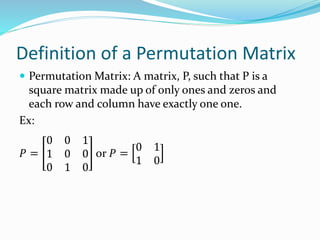
 Permutation Matrix: A matrix, P, such that P is a
square matrix made up of only ones and zeros and
each row and column have exactly one one.
Ex:
𝑃 =
0 0 1
1 0 0
0 1 0
or 𝑃 =
0 1
1 0
Definition of a Permutation Matrix
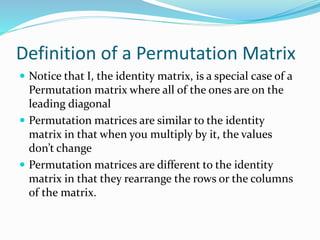
 Notice that I, the identity matrix, is a special case of a
Permutation matrix where all of the ones are on the
leading diagonal
 Permutation matrices are similar to the identity
matrix in that when you multiply by it, the values
don’t change
 Permutation matrices are different to the identity
matrix in that they rearrange the rows or the columns
of the matrix.
How to use Permutation Matrices
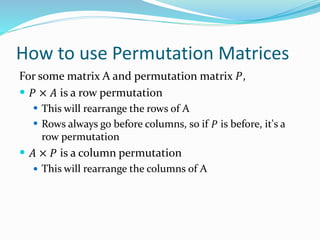
For some matrix A and permutation matrix 𝑃,
 𝑃 × 𝐴 is a row permutation
 This will rearrange the rows of A
 Rows always go before columns, so if 𝑃 is before, it's a
row permutation
 𝐴 × 𝑃 is a column permutation
 This will rearrange the columns of A
How to use Permutation Matrices
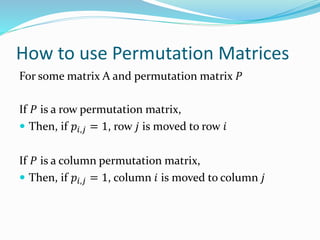
For some matrix A and permutation matrix 𝑃
If 𝑃 is a row permutation matrix,
 Then, if 𝑝𝑖,𝑗 = 1, row 𝑗 is moved to row 𝑖
If 𝑃 is a column permutation matrix,
 Then, if 𝑝𝑖,𝑗 = 1, column 𝑖 is moved to column 𝑗
Using a Permutation Matrix
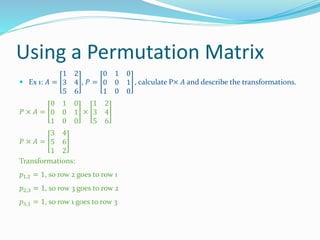
 Ex 1: 𝐴 =
1 2
3 4
5 6
, 𝑃 =
0 1 0
0 0 1
1 0 0
, calculate P× 𝐴 and describe the transformations.
𝑃 × 𝐴 =
0 1 0
0 0 1
1 0 0
×
1 2
3 4
5 6
𝑃 × 𝐴 =
3 4
5 6
1 2
Transformations:
𝑝1,2 = 1, so row 2 goes to row 1
𝑝2,3 = 1, so row 3 goes to row 2
𝑝3,1 = 1, so row 1 goes to row 3
Using a Permutation Matrix
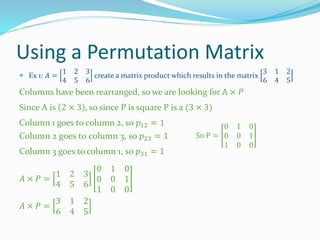
 Ex 1: 𝐴 =
1 2 3
4 5 6
create a matrix product which results in the matrix
3 1 2
6 4 5
Columns have been rearranged, so we are looking for A × 𝑃
Since A is 2 × 3 , so since P is square P is a (3 × 3)
Column 1 goes to column 2, so 𝑝12 = 1
Column 2 goes to column 3, so 𝑝23 = 1
Column 3 goes to column 1, so 𝑝31 = 1
𝐴 × 𝑃 =
1 2 3
4 5 6
0 1 0
0 0 1
1 0 0
𝐴 × 𝑃 =
3 1 2
6 4 5
So P =
0 1 0
0 0 1
1 0 0

Lesson 4a - permutation matrices

  • 2.
    Learning Intention andSuccess Criteria  Learning Intention: Students will understand that what a Permutation matrix is and how it can be used to rearrange the rows or columns of a matrix  Success Criteria: You will be able to create and use Permutation matrices to rearrange the rows and columns of a matrix
  • 3.
    Definition of aPermutation Matrix  Permutation Matrix: A matrix, P, such that P is a square matrix made up of only ones and zeros and each row and column have exactly one one. Ex: 𝑃 = 0 0 1 1 0 0 0 1 0 or 𝑃 = 0 1 1 0
  • 4.
    Definition of aPermutation Matrix  Notice that I, the identity matrix, is a special case of a Permutation matrix where all of the ones are on the leading diagonal  Permutation matrices are similar to the identity matrix in that when you multiply by it, the values don’t change  Permutation matrices are different to the identity matrix in that they rearrange the rows or the columns of the matrix.
  • 5.
    How to usePermutation Matrices For some matrix A and permutation matrix 𝑃,  𝑃 × 𝐴 is a row permutation  This will rearrange the rows of A  Rows always go before columns, so if 𝑃 is before, it's a row permutation  𝐴 × 𝑃 is a column permutation  This will rearrange the columns of A
  • 6.
    How to usePermutation Matrices For some matrix A and permutation matrix 𝑃 If 𝑃 is a row permutation matrix,  Then, if 𝑝𝑖,𝑗 = 1, row 𝑗 is moved to row 𝑖 If 𝑃 is a column permutation matrix,  Then, if 𝑝𝑖,𝑗 = 1, column 𝑖 is moved to column 𝑗
  • 7.
    Using a PermutationMatrix  Ex 1: 𝐴 = 1 2 3 4 5 6 , 𝑃 = 0 1 0 0 0 1 1 0 0 , calculate P× 𝐴 and describe the transformations. 𝑃 × 𝐴 = 0 1 0 0 0 1 1 0 0 × 1 2 3 4 5 6 𝑃 × 𝐴 = 3 4 5 6 1 2 Transformations: 𝑝1,2 = 1, so row 2 goes to row 1 𝑝2,3 = 1, so row 3 goes to row 2 𝑝3,1 = 1, so row 1 goes to row 3
  • 8.
    Using a PermutationMatrix  Ex 1: 𝐴 = 1 2 3 4 5 6 create a matrix product which results in the matrix 3 1 2 6 4 5 Columns have been rearranged, so we are looking for A × 𝑃 Since A is 2 × 3 , so since P is square P is a (3 × 3) Column 1 goes to column 2, so 𝑝12 = 1 Column 2 goes to column 3, so 𝑝23 = 1 Column 3 goes to column 1, so 𝑝31 = 1 𝐴 × 𝑃 = 1 2 3 4 5 6 0 1 0 0 0 1 1 0 0 𝐴 × 𝑃 = 3 1 2 6 4 5 So P = 0 1 0 0 0 1 1 0 0