Republic of the Philippines
PANGASINAN STATE UNIVERSITY
Lingayen Campus

Cyclic Groups
OBJECTIVES:
 Recall the meaning of cyclic groups
 Determine the important characteristics of

cyclic groups
 Draw a subgroup lattice of a group precisely
 Find all elements and generators of a cyclic
group
 Identify the relationships among the various
subgroups of a group
Cyclic Groups
The notion of a “group,” viewed only 30 years ago as the
epitome of sophistication, is today one of the
mathematical concepts most widely used in physics,
chemistry, biochemistry, and mathematics itself.

ALEXEY SOSINSKY , 1991
A Cyclic Group is a group which can be generated by one
of its elements.
That is, for some a in G,
G={an | n is an element of Z}
Or, in addition notation,
G={na |n is an element of Z}
This element a
(which need not be unique) is called a generator of G.
Alternatively, we may write G=<a>.
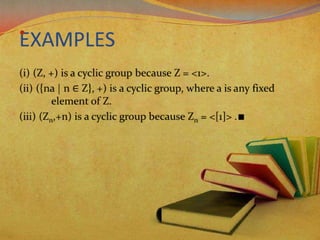
EXAMPLES
 The set of integers Z under ordinary addition is cyclic.

Both 1 and −1 are generators. (Recall that, when the
operation is addition, 1n is interpreted as
1 + 1 + ∙ ∙ ∙+ 1
n terms
when n is positive and as
(-1) + (-1) + ∙ ∙ ∙+ (-1)
|n| terms

when n is negative.)
 The set Zn = {0, 1, . . . , n−1} for n ≥ 1 is a cyclic group under

addition modulo n. Again, 1 and −1 =n−1 are generators.
Unlike Z, which has only two generators, Zn may have many
generators
(depending on which n we are given).
 Z8 = <1> = <3> = <5> = <7>.
To verify, for instance, that Z8 = <3>, we note that <3> = {3, 3
+ 3, 3 + 3 + 3, . . .} is the set {3, 6, 1, 4, 7, 2, 5, 0} = Z8 . Thus,
3 is a generator of Z8 . On the other hand, 2 is not a
generator, since <2>={0, 2, 4, 6} ≠ Z 8.
 U(10) = {1, 3, 7, 9} = {30 , 31 , 33 , 32 } = <3>. Also, {1, 3, 7,

9} = {70 , 73 , 71 , 72 } = <7>. So both 3 and 7 are
generators for U(10).
 Quite often in mathematics, a “nonexample” is as helpful in

understanding a concept as an example. With regard to
cyclic groups, U(8) serves this purpose; that is, U(8) is not
a cyclic group. Note that U(8) = {1, 3, 5, 7}. But
<1> = {1}
<3> = {3, 1}
<5> = {5, 1}
<7> = {7, 1}
so U(8) ≠ <a> for any a in U(8).
With these examples under
our belts, we are now ready to
tackle cyclic groups in an
abstract way and state their
key properties.
Properties of Cyclic Groups
Theorem 4.1 Criterion for ai = aj
Let G be a group, and let a belong to G. If a has
infinite order, then aia j if and only if i=j. If a has
finite order, say, n, then <a>= {e, a, a2, . . . , an–1}
and aia j if and only if n divides i – j.
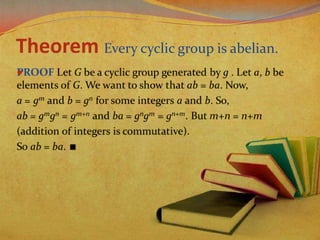
Theorem Every cyclic group is abelian.


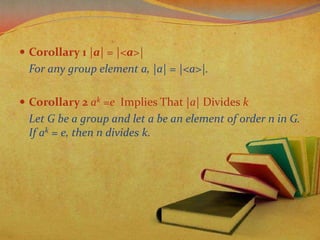
 Corollary 1 |a| = |<a>|

For any group element a, |a| = |<a>|.
 Corollary 2 ak =e Implies That |a| Divides k

Let G be a group and let a be an element of order n in G.
If ak = e, then n divides k.
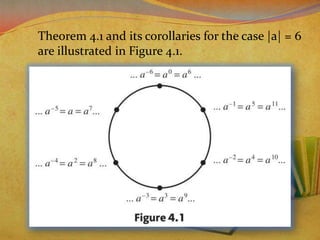
Theorem 4.1 and its corollaries for the case |a| = 6
are illustrated in Figure 4.1.
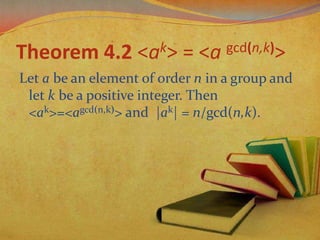
Theorem 4.2

k>
<a

= <a

gcd(n,k)>

Let a be an element of order n in a group and
let k be a positive integer. Then
<ak>=<agcd(n,k)> and |ak| = n/gcd(n,k).
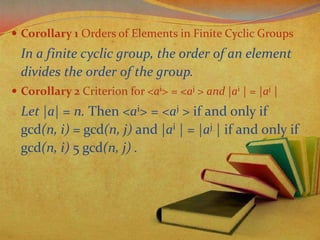
 Corollary 1 Orders of Elements in Finite Cyclic Groups

In a finite cyclic group, the order of an element
divides the order of the group.
 Corollary 2 Criterion for <ai> = <aj > and |ai | = |aj |

Let |a| = n. Then <ai> = <aj > if and only if
gcd(n, i) = gcd(n, j) and |ai | = |aj | if and only if
gcd(n, i) 5 gcd(n, j) .
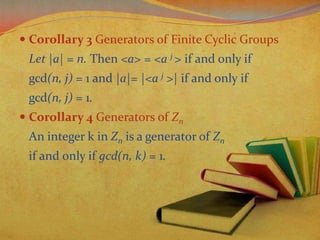
 Corollary 3 Generators of Finite Cyclic Groups

Let |a| = n. Then <a> = <a j > if and only if
gcd(n, j) = 1 and |a|= |<a j >| if and only if
gcd(n, j) = 1.
 Corollary 4 Generators of Zn

An integer k in Zn is a generator of Zn
if and only if gcd(n, k) = 1.
Classification of Subgroups
of Cyclic Groups
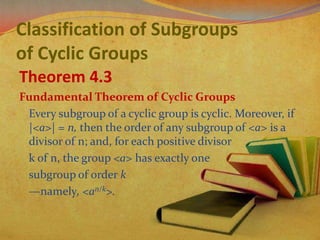
Theorem 4.3
Fundamental Theorem of Cyclic Groups
Every subgroup of a cyclic group is cyclic. Moreover, if
|<a>| = n, then the order of any subgroup of <a> is a
divisor of n; and, for each positive divisor
k of n, the group <a> has exactly one
subgroup of order k
—namely, <an/k>.
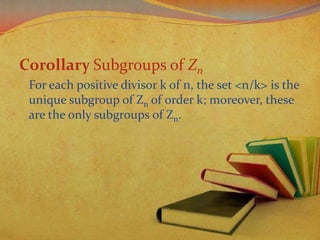
Corollary Subgroups of Zn
For each positive divisor k of n, the set <n/k> is the
unique subgroup of Zn of order k; moreover, these
are the only subgroups of Zn.
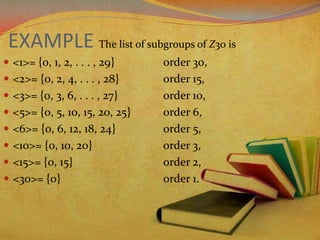
EXAMPLE The list of subgroups of Z30 is
 <1>= {0, 1, 2, . . . , 29}
 <2>= {0, 2, 4, . . . , 28}
 <3>= {0, 3, 6, . . . , 27}
 <5>= {0, 5, 10, 15, 20, 25}
 <6>= {0, 6, 12, 18, 24}
 <10>= {0, 10, 20}
 <15>= {0, 15}
 <30>= {0}

order 30,
order 15,
order 10,
order 6,
order 5,
order 3,
order 2,
order 1.
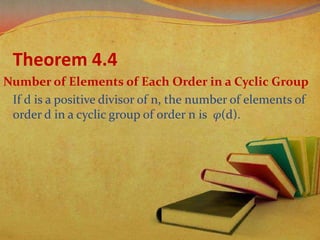
Theorem 4.4
Number of Elements of Each Order in a Cyclic Group
If d is a positive divisor of n, the number of elements of
order d in a cyclic group of order n is φ(d).
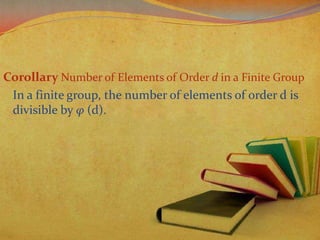
Corollary Number of Elements of Order d in a Finite Group
In a finite group, the number of elements of order d is
divisible by φ (d).
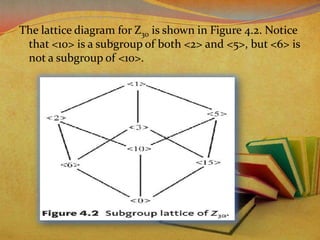
The lattice diagram for Z30 is shown in Figure 4.2. Notice
that <10> is a subgroup of both <2> and <5>, but <6> is
not a subgroup of <10>.
PREPATRED BY:
TONY A. CERVERA JR.
III-BSMATH-PURE

Chapter 4 Cyclic Groups

  • 1.
    Republic of thePhilippines PANGASINAN STATE UNIVERSITY Lingayen Campus Cyclic Groups
  • 2.
    OBJECTIVES:  Recall themeaning of cyclic groups  Determine the important characteristics of cyclic groups  Draw a subgroup lattice of a group precisely  Find all elements and generators of a cyclic group  Identify the relationships among the various subgroups of a group
  • 3.
    Cyclic Groups The notionof a “group,” viewed only 30 years ago as the epitome of sophistication, is today one of the mathematical concepts most widely used in physics, chemistry, biochemistry, and mathematics itself. ALEXEY SOSINSKY , 1991
  • 4.
    A Cyclic Groupis a group which can be generated by one of its elements. That is, for some a in G, G={an | n is an element of Z} Or, in addition notation, G={na |n is an element of Z} This element a (which need not be unique) is called a generator of G. Alternatively, we may write G=<a>.
  • 5.
    EXAMPLES  The setof integers Z under ordinary addition is cyclic. Both 1 and −1 are generators. (Recall that, when the operation is addition, 1n is interpreted as 1 + 1 + ∙ ∙ ∙+ 1 n terms when n is positive and as (-1) + (-1) + ∙ ∙ ∙+ (-1) |n| terms when n is negative.)
  • 6.
     The setZn = {0, 1, . . . , n−1} for n ≥ 1 is a cyclic group under addition modulo n. Again, 1 and −1 =n−1 are generators. Unlike Z, which has only two generators, Zn may have many generators (depending on which n we are given).  Z8 = <1> = <3> = <5> = <7>. To verify, for instance, that Z8 = <3>, we note that <3> = {3, 3 + 3, 3 + 3 + 3, . . .} is the set {3, 6, 1, 4, 7, 2, 5, 0} = Z8 . Thus, 3 is a generator of Z8 . On the other hand, 2 is not a generator, since <2>={0, 2, 4, 6} ≠ Z 8.
  • 7.
     U(10) ={1, 3, 7, 9} = {30 , 31 , 33 , 32 } = <3>. Also, {1, 3, 7, 9} = {70 , 73 , 71 , 72 } = <7>. So both 3 and 7 are generators for U(10).  Quite often in mathematics, a “nonexample” is as helpful in understanding a concept as an example. With regard to cyclic groups, U(8) serves this purpose; that is, U(8) is not a cyclic group. Note that U(8) = {1, 3, 5, 7}. But <1> = {1} <3> = {3, 1} <5> = {5, 1} <7> = {7, 1} so U(8) ≠ <a> for any a in U(8).
  • 8.
    With these examplesunder our belts, we are now ready to tackle cyclic groups in an abstract way and state their key properties.
  • 9.
    Properties of CyclicGroups Theorem 4.1 Criterion for ai = aj Let G be a group, and let a belong to G. If a has infinite order, then aia j if and only if i=j. If a has finite order, say, n, then <a>= {e, a, a2, . . . , an–1} and aia j if and only if n divides i – j.
  • 10.
    Theorem Every cyclicgroup is abelian. 
  • 11.
  • 12.
     Corollary 1|a| = |<a>| For any group element a, |a| = |<a>|.  Corollary 2 ak =e Implies That |a| Divides k Let G be a group and let a be an element of order n in G. If ak = e, then n divides k.
  • 13.
    Theorem 4.1 andits corollaries for the case |a| = 6 are illustrated in Figure 4.1.
  • 14.
    Theorem 4.2 k> <a = <a gcd(n,k)> Leta be an element of order n in a group and let k be a positive integer. Then <ak>=<agcd(n,k)> and |ak| = n/gcd(n,k).
  • 15.
     Corollary 1Orders of Elements in Finite Cyclic Groups In a finite cyclic group, the order of an element divides the order of the group.  Corollary 2 Criterion for <ai> = <aj > and |ai | = |aj | Let |a| = n. Then <ai> = <aj > if and only if gcd(n, i) = gcd(n, j) and |ai | = |aj | if and only if gcd(n, i) 5 gcd(n, j) .
  • 16.
     Corollary 3Generators of Finite Cyclic Groups Let |a| = n. Then <a> = <a j > if and only if gcd(n, j) = 1 and |a|= |<a j >| if and only if gcd(n, j) = 1.  Corollary 4 Generators of Zn An integer k in Zn is a generator of Zn if and only if gcd(n, k) = 1.
  • 17.
    Classification of Subgroups ofCyclic Groups Theorem 4.3 Fundamental Theorem of Cyclic Groups Every subgroup of a cyclic group is cyclic. Moreover, if |<a>| = n, then the order of any subgroup of <a> is a divisor of n; and, for each positive divisor k of n, the group <a> has exactly one subgroup of order k —namely, <an/k>.
  • 18.
    Corollary Subgroups ofZn For each positive divisor k of n, the set <n/k> is the unique subgroup of Zn of order k; moreover, these are the only subgroups of Zn.
  • 19.
    EXAMPLE The listof subgroups of Z30 is  <1>= {0, 1, 2, . . . , 29}  <2>= {0, 2, 4, . . . , 28}  <3>= {0, 3, 6, . . . , 27}  <5>= {0, 5, 10, 15, 20, 25}  <6>= {0, 6, 12, 18, 24}  <10>= {0, 10, 20}  <15>= {0, 15}  <30>= {0} order 30, order 15, order 10, order 6, order 5, order 3, order 2, order 1.
  • 20.
    Theorem 4.4 Number ofElements of Each Order in a Cyclic Group If d is a positive divisor of n, the number of elements of order d in a cyclic group of order n is φ(d).
  • 21.
    Corollary Number ofElements of Order d in a Finite Group In a finite group, the number of elements of order d is divisible by φ (d).
  • 22.
    The lattice diagramfor Z30 is shown in Figure 4.2. Notice that <10> is a subgroup of both <2> and <5>, but <6> is not a subgroup of <10>.
  • 23.
    PREPATRED BY: TONY A.CERVERA JR. III-BSMATH-PURE