Numerical Method
Prepared by: Engr. Mark
Module 1: Mathematical Foundation
› Lesson 1: Physical Meaning of Derivatives and Integrals
› Lesson 2: Power Series Expansion
› Lesson 3: Complex Analysis
› Lesson 4: Vector Analysis
› Lesson 5: Matrix Analysis
› Lesson 6: Transpose, Determinant, and rank of Matrix
Lesson 5 & 6:
Matrix Analysis & Transpose,
Determinant, and rank of Matrix
Matrices - Introduction
Matrix algebra has at least two advantages:
•Reduces complicated systems of equations to simple
expressions
•Adaptable to systematic method of mathematical treatment
and well suited to computers
Definition:
A matrix is a set or group of numbers arranged in a square or
rectangular array enclosed by two brackets
 
1
1  





 0
3
2
4






d
c
b
a
Matrices - Introduction
Properties:
•A specified number of rows and a specified number of
columns
•Two numbers (rows x columns) describe the dimensions
or size of the matrix.
Examples:
3x3 matrix
2x4 matrix
1x2 matrix 










3
3
3
5
1
4
4
2
1





 
2
3
3
3
0
1
0
1
 
1
1 
Matrices - Introduction
TYPES OF MATRICES
3. Rectangular matrix
Contains more than one element and number of rows is not
equal to the number of columns













6
7
7
7
7
3
1
1






0
3
3
0
2
0
0
1
1
1
n
m 
Matrices - Introduction
TYPES OF MATRICES
4. Square matrix
The number of rows is equal to the number of columns
(a square matrix A has an order of m)






0
3
1
1










1
6
6
0
9
9
1
1
1
m x m
The principal or main diagonal of a square matrix is composed of all
elements aij for which i=j
Matrices - Introduction
TYPES OF MATRICES
5. Diagonal matrix
A square matrix where all the elements are zero except those on
the main diagonal










1
0
0
0
2
0
0
0
1












9
0
0
0
0
5
0
0
0
0
3
0
0
0
0
3
i.e. aij =0 for all i = j
aij = 0 for some or all i = j
Matrices - Introduction
TYPES OF MATRICES
6. Unit or Identity matrix - I
A diagonal matrix with ones on the main diagonal












1
0
0
0
0
1
0
0
0
0
1
0
0
0
0
1






1
0
0
1
i.e. aij =0 for all i = j
aij = 1 for some or all i = j






ij
ij
a
a
0
0
Matrices - Introduction
TYPES OF MATRICES
7. Null (zero) matrix - 0
All elements in the matrix are zero










0
0
0










0
0
0
0
0
0
0
0
0
0

ij
a For all i,j
Matrices - Introduction
TYPES OF MATRICES
8. Triangular matrix
A square matrix whose elements above or below the main
diagonal are all zero










3
2
5
0
1
2
0
0
1










3
2
5
0
1
2
0
0
1










3
0
0
6
1
0
9
8
1
Matrices - Introduction
TYPES OF MATRICES
8a. Upper triangular matrix
A square matrix whose elements below the main
diagonal are all zero
i.e. aij = 0 for all i > j










3
0
0
8
1
0
7
8
1












3
0
0
0
8
7
0
0
4
7
1
0
4
4
7
1










ij
ij
ij
ij
ij
ij
a
a
a
a
a
a
0
0
0
Matrices - Introduction
TYPES OF MATRICES
A square matrix whose elements above the main diagonal are all
zero
8b. Lower triangular matrix
i.e. aij = 0 for all i < j










3
2
5
0
1
2
0
0
1










ij
ij
ij
ij
ij
ij
a
a
a
a
a
a
0
0
0
Matrices – Introduction
TYPES OF MATRICES
9. Scalar matrix
A diagonal matrix whose main diagonal elements are
equal to the same scalar
A scalar is defined as a single number or constant










1
0
0
0
1
0
0
0
1












6
0
0
0
0
6
0
0
0
0
6
0
0
0
0
6
i.e. aij = 0 for all i = j
aij = a for all i = j










ij
ij
ij
a
a
a
0
0
0
0
0
0
Matrices
Matrix Operations
Matrices - Operations
EQUALITY OF MATRICES
Two matrices are said to be equal only when all
corresponding elements are equal
Therefore, their size or dimensions are equal as well










3
2
5
0
1
2
0
0
1










3
2
5
0
1
2
0
0
1
A = B = A = B
Matrices - Operations
Some properties of equality:
•If A = B, then B = A for all A and B
•If A = B, and B = C, then A = C for all A, B and C










3
2
5
0
1
2
0
0
1
A = B =










33
32
31
23
22
21
13
12
11
b
b
b
b
b
b
b
b
b
If A = B, then ij
ij b
a 
Matrices - Operations
ADDITION AND SUBTRACTION OF MATRICES
The sum or difference of two matrices, A and B of the same
size yields a matrix C of the same size
ij
ij
ij b
a
c 

Matrices of different sizes cannot be added or subtracted
Matrices - Operations
Commutative Law:
A + B = B + A
Associative Law:
A + (B + C) = (A + B) + C = A + B + C


























9
7
2
5
8
8
3
2
4
6
5
1
6
5
2
1
3
7
A
2x3
B
2x3
C
2x3
Matrices - Operations
A + 0 = 0 + A = A
A + (-A) = 0 (where –A is the matrix composed of –aij as elements)





















1
2
2
2
2
5
8
0
1
0
2
1
7
2
3
2
4
6
Matrices - Operations
SCALAR MULTIPLICATION OF MATRICES
Matrices can be multiplied by a scalar (constant or single
element)
Let k be a scalar quantity; then
kA = Ak
Ex. If k=4 and















1
4
3
2
1
2
1
3
A
Matrices - Operations














































4
16
12
8
4
8
4
12
4
1
4
3
2
1
2
1
3
1
4
3
2
1
2
1
3
4
Properties:
• k (A + B) = kA + kB
• (k + g)A = kA + gA
• k(AB) = (kA)B = A(k)B
• k(gA) = (kg)A
Matrices - Operations
MULTIPLICATION OF MATRICES
The product of two matrices is another matrix
Two matrices A and B must be conformable for multiplication to
be possible
i.e. the number of columns of A must equal the number of rows
of B
Example.
A x B = C
(1x3) (3x1) (1x1)
Matrices - Operations
B x A = Not possible!
(2x1) (4x2)
A x B = Not possible!
(6x2) (6x3)
Example
A x B = C
(2x3) (3x2) (2x2)
Matrices - Operations























22
21
12
11
32
31
22
21
12
11
23
22
21
13
12
11
c
c
c
c
b
b
b
b
b
b
a
a
a
a
a
a
22
32
23
22
22
12
21
21
31
23
21
22
11
21
12
32
13
22
12
12
11
11
31
13
21
12
11
11
)
(
)
(
)
(
)
(
)
(
)
(
)
(
)
(
)
(
)
(
)
(
)
(
c
b
a
b
a
b
a
c
b
a
b
a
b
a
c
b
a
b
a
b
a
c
b
a
b
a
b
a
























Successive multiplication of row i of A with column j of
B – row by column multiplication
Matrices - Operations











































)
3
7
(
)
2
2
(
)
8
4
(
)
5
7
(
)
6
2
(
)
4
4
(
)
3
3
(
)
2
2
(
)
8
1
(
)
5
3
(
)
6
2
(
)
4
1
(
3
5
2
6
8
4
7
2
4
3
2
1







57
63
21
31
Remember also:
IA = A






1
0
0
1






57
63
21
31







57
63
21
31
Matrices - Operations
Assuming that matrices A, B and C are conformable for
the operations indicated, the following are true:
1. AI = IA = A
2. A(BC) = (AB)C = ABC - (associative law)
3. A(B+C) = AB + AC - (first distributive law)
4. (A+B)C = AC + BC - (second distributive law)
Caution!
1. AB not generally equal to BA, BA may not be conformable
2. If AB = 0, neither A nor B necessarily = 0
3. If AB = AC, B not necessarily = C
Matrices - Operations
AB not generally equal to BA, BA may not be conformable






















































0
10
6
23
0
5
2
1
2
0
4
3
20
15
8
3
2
0
4
3
0
5
2
1
2
0
4
3
0
5
2
1
ST
TS
S
T
Matrices - Operations
If AB = 0, neither A nor B necessarily = 0





















0
0
0
0
3
2
3
2
0
0
1
1
Matrices - Operations
TRANSPOSE OF A MATRIX
If :








1
3
5
7
4
2
3
2 A
A
2x3












1
7
3
4
5
2
3
2
T
T
A
A
Then transpose of A, denoted AT
is:
T
ji
ij a
a  For all i and j
Matrices - Operations
To transpose:
Interchange rows and columns
The dimensions of AT
are the reverse of the dimensions of A








1
3
5
7
4
2
3
2 A
A












1
7
3
4
5
2
2
3
T
T
A
A
2 x 3
3 x 2
Matrices - Operations
Properties of transposed matrices:
1. (A+B)T
= AT
+ BT
2. (AB)T
= BT
AT
3. (kA)T
= kAT
4. (AT
)T
= A
Matrices - Operations
1. (A+B)T
= AT
+ BT


























9
7
2
5
8
8
3
2
4
6
5
1
6
5
2
1
3
7












9
5
7
8
2
8






































9
5
7
8
2
8
3
6
2
5
4
1
6
1
5
3
2
7
Matrices - Operations
(AB)T
= BT
AT
 
   
8
2
3
0
2
1
0
1
2
1
1
8
2
8
2
2
1
1
3
2
0
0
1
1



































Matrices - Operations
SYMMETRIC MATRICES
A Square matrix is symmetric if it is equal to its
transpose:
A = AT














d
b
b
a
A
d
b
b
a
A
T
Matrices - Operations
When the original matrix is square, transposition does not
affect the elements of the main diagonal














d
b
c
a
A
d
c
b
a
A
T
The identity matrix, I, a diagonal matrix D, and a scalar matrix, K,
are equal to their transpose since the diagonal is unaffected.
Matrices - Operations
INVERSE OF A MATRIX
Consider a scalar k. The inverse is the reciprocal or division of 1
by the scalar.
Example:
k=7 the inverse of k or k-1
= 1/k = 1/7
Division of matrices is not defined since there may be AB = AC
while B = C
Instead matrix inversion is used.
The inverse of a square matrix, A, if it exists, is the unique matrix
A-1
where:
AA-1
= A-1
A = I
Matrices - Operations
Example:


















3
2
1
1
1
2
1
3
1
2
2
A
A
A










































1
0
0
1
3
2
1
1
1
2
1
3
1
0
0
1
1
2
1
3
3
2
1
1
Because:
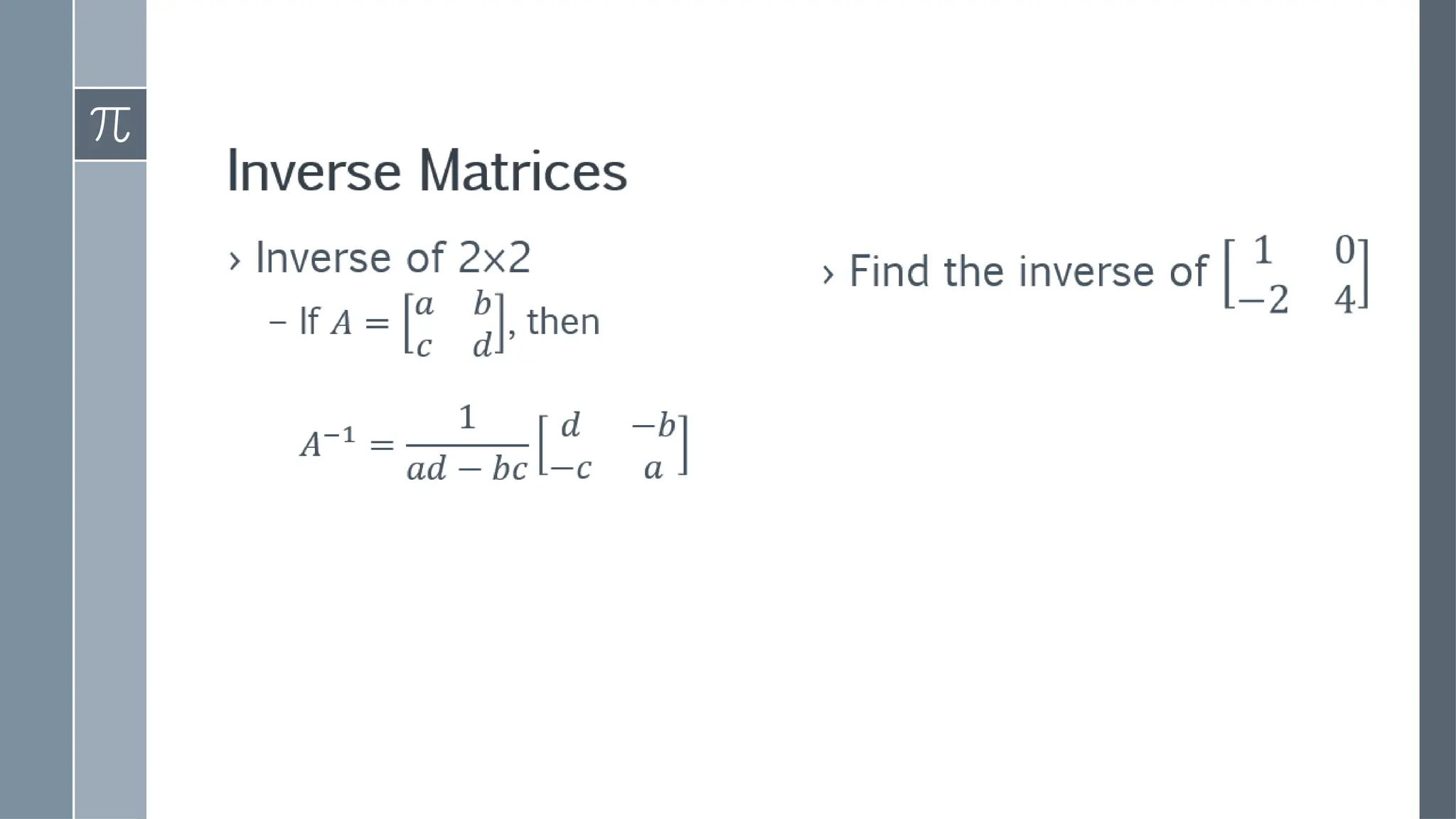
Inverse Matrices
How to solve the inverse of an matrix.
1. Gauss-Jordan Elimination Method
2. Cofactor-Adjugate Method
Inverse Matrices
How to solve the inverse of an matrix.
1. Gauss-Jordan Elimination Method
• Swap rows
• Add or subtract two or more rows
• Multiply a row by any scalar value
Introduction to Determinants
Definition
The determinant of a 2  2 matrix A is denoted |A| and is given
by
Observe that the determinant of a 2  2 matrix is given by the
different of the products of the two diagonals of the matrix.
The notation det(A) is also used for the determinant of A.
21
12
22
11
22
21
12
11
a
a
a
a
a
a
a
a


Example 1








1
3
4
2
A
14
12
2
))
3
(
4
(
)
1
2
(
1
3
4
2
)
det( 









A
Determinant of a Matrix
Let be an square matrix.
1. If n = 1, that is then we define .
2. If n > 1, we define that
= co-factor of
Where:
= minor of
Note: You can choose any
row, but only one
CH0
3_49
Definition
Let A be a square matrix.
The minor of the element aij is denoted Mij and is the determinant
of the matrix that remains after deleting row i and column j of A.
The cofactor of aij is denoted Cij and is given by
Cij = (–1)i+j
Mij
Note that Cij = Mij or -Mij .
CH0
3_50
10
)
4
3
(
)
2
1
(
2
4
3
1
1
2
0
2
1
4
3
0
1
:
of
Minor 32
32 









M
a
3
))
2
(
2
(
)
1
1
(
1
2
2
1
1
2
0
2
1
4
3
0
1
:
of
Minor 11
11 












M
a
Example 2
Solution
Determine the minors and cofactors of the elements a11 and a32 of
the following matrix A.











1
2
0
2
1
4
3
0
1
A
3
)
3
(
)
1
(
)
1
(
:
of
Cofactor 2
11
1
1
11
11 



 
M
C
a
10
)
10
(
)
1
(
)
1
(
:
of
Cofactor 5
32
2
3
32
32 




 
M
C
a
Example 1.
Find the determinant of:
𝐴=[5]
det ( 𝐴)=5
Example 2.
Find the determinant of:
𝐴=
[2 3
4 5]
det ( 𝐴)=− 2
Example 3.
Find the determinant of:
𝐴=
[
2 3 4
5 6 7
8 9 1 ]
det ( 𝐴)=27
Example 4.
Find the determinant of:
det ( 𝐴)=− 87
Cofactor ( Adjugate Method)
Where:
The adjugate, adj(A), is the matrix of cofactors
Cofactor ( Adjugate Method)
Example 5.
Find the inverse of:
4
5
4
3
−
1
15
2
5
1
3
2
15
−
1
5
−
2
3
−
1
15
[
1 2 3
0 − 1 − 2
− 3 4 − 4]

5. Matrix Analysis12424214124124124.pptx

Editor's Notes

  • #46 Augment with identity 3×1st add to 3rd 10×2nd add to 3rd -2×3rd add to 15×2nd 3rd add to 5×1st 2×2nd add to 3×1st 1/15×1st, -1/15×2nd, -1/15×3rd