Multiplying Matrices
             Warm Up
             Lesson Presentation
             Lesson Quiz
Warm Up
State the dimensions of each matrix.
1. [3 1 4 6] 1   4
2.
          3 2


Calculate.
3. 3(–4) + (–2)(5) + 4(7) 6
4. (–3)3 + 2(5) + (–1)(12) –11
Objectives
Understand the properties of matrices
with respect to multiplication.
Multiply two matrices.
Vocabulary
matrix product
square matrix
main diagonal
multiplicative identity matrix
In previous lesson, you multiplied matrices by a
number called a scalar. You can also multiply matrices
together. The product of two or more matrices is the
matrix product. The following rules apply when
multiplying matrices.

   • Matrices A and B can be multiplied only if the
   number of columns in A equals the number of
   rows in B.

   • The product of an m    n and an n   p matrix
   is an m p matrix.
An m n matrix A can be identified by using the
notation Am n.
Helpful Hint
The CAR key:
Columns (of A)
As
Rows (of B)
or matrix product AB
won’t even start
Example 1A: Identifying Matrix Products

Tell whether the product is defined. If so, give
its dimensions.
A3       4   and B4     2;   AB
     A             B         AB
3        4     4       2=    3    2 matrix

The inner dimensions are equal (4 = 4), so the matrix
product is defined. The dimensions of the product are
the outer numbers, 3 2.
Example 1B: Identifying Matrix Products

Tell whether the product is defined. If so, give
its dimensions.
C1   4   and D3      4;   CD
     C           D
1        4   3   4

The inner dimensions are not equal (4 ≠ 3), so the
matrix product is not defined.
Check It Out! Example 1a

Tell whether the product is defined. If so, give
its dimensions.
P2   5           Q5    3      R4   3    S4   5


QP
Q            P
5    3   2       5
The inner dimensions are not equal (3 ≠ 2), so the
matrix product is not defined.
Check It Out! Example 1b

Tell whether the product is defined. If so, give
its dimensions.
P2   5           Q5    3      R4   3    S4   5


SR
S            R
4    5   4       3
The inner dimensions are not equal (5 ≠ 4), so the
matrix product is not defined.
Check It Out! Example 1c

Tell whether the product is defined. If so, give
its dimensions.
P2   5           Q5   3    R4   3    S4   5


SQ
S            Q
4    5   5   3
The inner dimensions are equal (5 = 5), so the matrix
product is defined. The dimensions of the product are
the outer numbers, 4 3.
Just as you look across the columns of A and down
the rows of B to see if a product AB exists, you do
the same to find the entries in a matrix product.
Example 2A: Finding the Matrix Product

Find the product, if possible.
WX


Check the dimensions. W is 3   2 , X is 2   3.
WX is defined and is 3 3.
Example 2A Continued


Multiply row 1 of W and column 1 of X as shown.
Place the result in wx11.

                                 3(4) + –2(5)
Example 2A Continued


Multiply row 1 of W and column 2 of X as shown.
Place the result in wx12.

                                 3(7) + –2(1)
Example 2A Continued


Multiply row 1 of W and column 3 of X as shown.
Place the result in wx13.

                                   3(–2) + –2(–1)
Example 2A Continued


Multiply row 2 of W and column 1 of X as shown.
Place the result in wx21.


                                  1(4) + 0(5)
Example 2A Continued


Multiply row 2 of W and column 2 of X as shown.
Place the result in wx22.


                                  1(7) + 0(1)
Example 2A Continued


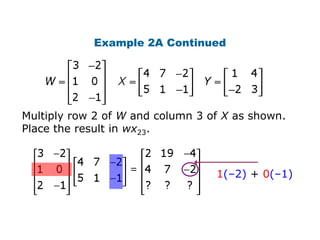
Multiply row 2 of W and column 3 of X as shown.
Place the result in wx23.


                                  1(–2) + 0(–1)
Example 2A Continued


Multiply row 3 of W and column 1 of X as shown.
Place the result in wx31.


                                 2(4) + –1(5)
Example 2A Continued


Multiply row 3 of W and column 2 of X as shown.
Place the result in wx32.


                                  2(7) + –1(1)
Example 2A Continued


Multiply row 3 of W and column 3 of X as shown.
Place the result in wx33.


                                  2(–2) + –1(–1)
Example 2B: Finding the Matrix Product

Find each product, if possible.
XW


Check the dimensions. X is 2 3, and W is 3   2 so
the product is defined and is 2 2.
Example 2C: Finding the Matrix Product

Find each product, if possible.
XY


Check the dimensions. X is 2 3, and Y is 2 2.
The product is not defined. The matrices cannot be
multiplied in this order.
Check It Out! Example 2a

 Find the product, if possible.
 BC


Check the dimensions. B is 3 2, and C is 2   2 so
the product is defined and is 3 2.
Check It Out! Example 2b
Find the product, if possible.
CA


Check the dimensions. C is 2 2, and A is 2   3 so
the product is defined and is 2 3.
Businesses can use matrix multiplication to find
total revenues, costs, and profits.
Example 3: Inventory Application

Two stores held sales on their videos and DVDs,
with prices as shown. Use the sales data to
determine how much money each store brought
in from the sale on Saturday.


Use a product matrix to find the sales of each store
for each day.
Example 3 Continued


  Fri     Sat      Sun
                         Video World
                         Star Movies

On Saturday, Video World made $851.05 and
Star Movies made $832.50.
Check It Out! Example 3

Change Store 2’s inventory to 6 complete and 9
super complete. Update the product matrix, and
find the profit for Store 2.

          Skateboard Kit Inventory
                                Super
                   Complete
                               Complete
     Store 1          14          10
     Store 2           6           9
Check It Out! Example 3

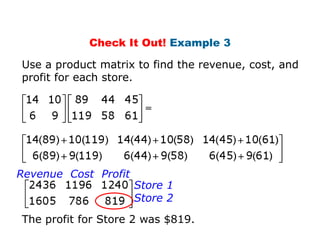
Use a product matrix to find the revenue, cost, and
profit for each store.


Revenue Cost Profit
                      Store 1
                      Store 2
The profit for Store 2 was $819.
A square matrix is any matrix that has the same
number of rows as columns; it is an n × n matrix. The
main diagonal of a square matrix is the diagonal
from the upper left corner to the lower right corner.


The multiplicative identity matrix is any square
matrix, named with the letter I, that has all of the
entries along the main diagonal equal to 1 and all of
the other entries equal to 0.
Because square matrices can be multiplied by
themselves any number of times, you can find powers
of square matrices.
Example 4A: Finding Powers of Matrices


Evaluate, if possible.
P3
Example 4A Continued


Check Use a calculator.
Example 4B: Finding Powers of Matrices


Evaluate, if possible.
Q2
Check It Out! Example 4a


Evaluate if possible.
C2


The matrices cannot be multiplied.
Check It Out! Example 4b


Evaluate if possible.
A3
Check It Out! Example 4c


Evaluate if possible.
B3
Check It Out! Example 4d


Evaluate if possible.
I4
Lesson Quiz


Evaluate if possible.
1. AB

2. BA

3. A2

4. BD

5. C3
Lesson Quiz
Evaluate if possible.
1. AB


2. BA

3. A2   not possible
4. BD   not possible

5. C3

Matrix product

  • 1.
    Multiplying Matrices Warm Up Lesson Presentation Lesson Quiz
  • 2.
    Warm Up State thedimensions of each matrix. 1. [3 1 4 6] 1 4 2. 3 2 Calculate. 3. 3(–4) + (–2)(5) + 4(7) 6 4. (–3)3 + 2(5) + (–1)(12) –11
  • 3.
    Objectives Understand the propertiesof matrices with respect to multiplication. Multiply two matrices.
  • 4.
    Vocabulary matrix product square matrix maindiagonal multiplicative identity matrix
  • 5.
    In previous lesson,you multiplied matrices by a number called a scalar. You can also multiply matrices together. The product of two or more matrices is the matrix product. The following rules apply when multiplying matrices. • Matrices A and B can be multiplied only if the number of columns in A equals the number of rows in B. • The product of an m n and an n p matrix is an m p matrix.
  • 6.
    An m nmatrix A can be identified by using the notation Am n.
  • 7.
    Helpful Hint The CARkey: Columns (of A) As Rows (of B) or matrix product AB won’t even start
  • 8.
    Example 1A: IdentifyingMatrix Products Tell whether the product is defined. If so, give its dimensions. A3 4 and B4 2; AB A B AB 3 4 4 2= 3 2 matrix The inner dimensions are equal (4 = 4), so the matrix product is defined. The dimensions of the product are the outer numbers, 3 2.
  • 9.
    Example 1B: IdentifyingMatrix Products Tell whether the product is defined. If so, give its dimensions. C1 4 and D3 4; CD C D 1 4 3 4 The inner dimensions are not equal (4 ≠ 3), so the matrix product is not defined.
  • 10.
    Check It Out!Example 1a Tell whether the product is defined. If so, give its dimensions. P2 5 Q5 3 R4 3 S4 5 QP Q P 5 3 2 5 The inner dimensions are not equal (3 ≠ 2), so the matrix product is not defined.
  • 11.
    Check It Out!Example 1b Tell whether the product is defined. If so, give its dimensions. P2 5 Q5 3 R4 3 S4 5 SR S R 4 5 4 3 The inner dimensions are not equal (5 ≠ 4), so the matrix product is not defined.
  • 12.
    Check It Out!Example 1c Tell whether the product is defined. If so, give its dimensions. P2 5 Q5 3 R4 3 S4 5 SQ S Q 4 5 5 3 The inner dimensions are equal (5 = 5), so the matrix product is defined. The dimensions of the product are the outer numbers, 4 3.
  • 13.
    Just as youlook across the columns of A and down the rows of B to see if a product AB exists, you do the same to find the entries in a matrix product.
  • 15.
    Example 2A: Findingthe Matrix Product Find the product, if possible. WX Check the dimensions. W is 3 2 , X is 2 3. WX is defined and is 3 3.
  • 16.
    Example 2A Continued Multiplyrow 1 of W and column 1 of X as shown. Place the result in wx11. 3(4) + –2(5)
  • 17.
    Example 2A Continued Multiplyrow 1 of W and column 2 of X as shown. Place the result in wx12. 3(7) + –2(1)
  • 18.
    Example 2A Continued Multiplyrow 1 of W and column 3 of X as shown. Place the result in wx13. 3(–2) + –2(–1)
  • 19.
    Example 2A Continued Multiplyrow 2 of W and column 1 of X as shown. Place the result in wx21. 1(4) + 0(5)
  • 20.
    Example 2A Continued Multiplyrow 2 of W and column 2 of X as shown. Place the result in wx22. 1(7) + 0(1)
  • 21.
    Example 2A Continued Multiplyrow 2 of W and column 3 of X as shown. Place the result in wx23. 1(–2) + 0(–1)
  • 22.
    Example 2A Continued Multiplyrow 3 of W and column 1 of X as shown. Place the result in wx31. 2(4) + –1(5)
  • 23.
    Example 2A Continued Multiplyrow 3 of W and column 2 of X as shown. Place the result in wx32. 2(7) + –1(1)
  • 24.
    Example 2A Continued Multiplyrow 3 of W and column 3 of X as shown. Place the result in wx33. 2(–2) + –1(–1)
  • 25.
    Example 2B: Findingthe Matrix Product Find each product, if possible. XW Check the dimensions. X is 2 3, and W is 3 2 so the product is defined and is 2 2.
  • 26.
    Example 2C: Findingthe Matrix Product Find each product, if possible. XY Check the dimensions. X is 2 3, and Y is 2 2. The product is not defined. The matrices cannot be multiplied in this order.
  • 27.
    Check It Out!Example 2a Find the product, if possible. BC Check the dimensions. B is 3 2, and C is 2 2 so the product is defined and is 3 2.
  • 28.
    Check It Out!Example 2b Find the product, if possible. CA Check the dimensions. C is 2 2, and A is 2 3 so the product is defined and is 2 3.
  • 29.
    Businesses can usematrix multiplication to find total revenues, costs, and profits.
  • 30.
    Example 3: InventoryApplication Two stores held sales on their videos and DVDs, with prices as shown. Use the sales data to determine how much money each store brought in from the sale on Saturday. Use a product matrix to find the sales of each store for each day.
  • 31.
    Example 3 Continued Fri Sat Sun Video World Star Movies On Saturday, Video World made $851.05 and Star Movies made $832.50.
  • 32.
    Check It Out!Example 3 Change Store 2’s inventory to 6 complete and 9 super complete. Update the product matrix, and find the profit for Store 2. Skateboard Kit Inventory Super Complete Complete Store 1 14 10 Store 2 6 9
  • 33.
    Check It Out!Example 3 Use a product matrix to find the revenue, cost, and profit for each store. Revenue Cost Profit Store 1 Store 2 The profit for Store 2 was $819.
  • 34.
    A square matrixis any matrix that has the same number of rows as columns; it is an n × n matrix. The main diagonal of a square matrix is the diagonal from the upper left corner to the lower right corner. The multiplicative identity matrix is any square matrix, named with the letter I, that has all of the entries along the main diagonal equal to 1 and all of the other entries equal to 0.
  • 35.
    Because square matricescan be multiplied by themselves any number of times, you can find powers of square matrices.
  • 36.
    Example 4A: FindingPowers of Matrices Evaluate, if possible. P3
  • 37.
  • 38.
    Example 4A Continued CheckUse a calculator.
  • 39.
    Example 4B: FindingPowers of Matrices Evaluate, if possible. Q2
  • 40.
    Check It Out!Example 4a Evaluate if possible. C2 The matrices cannot be multiplied.
  • 41.
    Check It Out!Example 4b Evaluate if possible. A3
  • 42.
    Check It Out!Example 4c Evaluate if possible. B3
  • 43.
    Check It Out!Example 4d Evaluate if possible. I4
  • 44.
    Lesson Quiz Evaluate ifpossible. 1. AB 2. BA 3. A2 4. BD 5. C3
  • 45.
    Lesson Quiz Evaluate ifpossible. 1. AB 2. BA 3. A2 not possible 4. BD not possible 5. C3