Learning Intention and Success
Criteria
 Learning Intention: Students will understand that
we can convert a system of linear equations to a matrix
equation.
 Success Criteria: You can solve a worded problem
representing linear equations using matrix equations.
Prior Knowledge
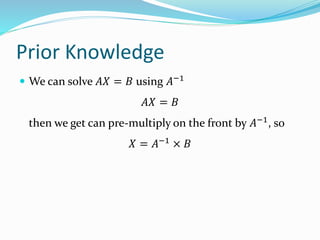
 We can solve 𝐴𝑋 = 𝐵 using 𝐴−1
𝐴𝑋 = 𝐵
then we get can pre-multiply on the front by 𝐴−1
, so
𝑋 = 𝐴−1
× 𝐵
Converting Linear Equations to
Matrices
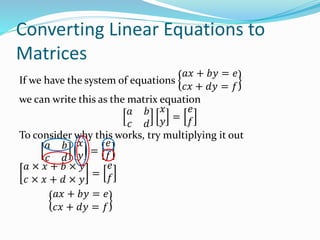
If we have the system of equations
𝑎𝑥 + 𝑏𝑦 = 𝑒
𝑐𝑥 + 𝑑𝑦 = 𝑓
we can write this as the matrix equation
𝑎 𝑏
𝑐 𝑑
𝑥
𝑦 =
𝑒
𝑓
To consider why this works, try multiplying it out
𝑎 𝑏
𝑐 𝑑
𝑥
𝑦 =
𝑒
𝑓
𝑎 × 𝑥 + 𝑏 × 𝑦
𝑐 × 𝑥 + 𝑑 × 𝑦
=
𝑒
𝑓
𝑎𝑥 + 𝑏𝑦 = 𝑒
𝑐𝑥 + 𝑑𝑦 = 𝑓
Converting Linear Equations to
Matrices
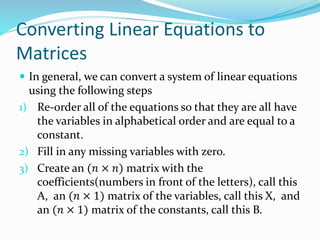
 In general, we can convert a system of linear equations
using the following steps
1) Re-order all of the equations so that they are all have
the variables in alphabetical order and are equal to a
constant.
2) Fill in any missing variables with zero.
3) Create an (𝑛 × 𝑛) matrix with the
coefficients(numbers in front of the letters), call this
A, an (𝑛 × 1) matrix of the variables, call this X, and
an (𝑛 × 1) matrix of the constants, call this B.
Example 1
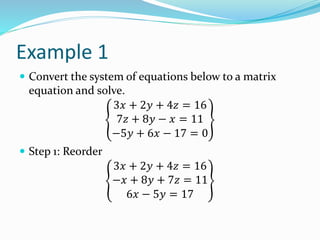
 Convert the system of equations below to a matrix
equation and solve.
3𝑥 + 2𝑦 + 4𝑧 = 16
7𝑧 + 8𝑦 − 𝑥 = 11
−5𝑦 + 6𝑥 − 17 = 0
 Step 1: Reorder
3𝑥 + 2𝑦 + 4𝑧 = 16
−𝑥 + 8𝑦 + 7𝑧 = 11
6𝑥 − 5𝑦 = 17
Example 1
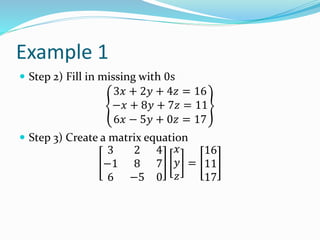
 Step 2) Fill in missing with 0s
3𝑥 + 2𝑦 + 4𝑧 = 16
−𝑥 + 8𝑦 + 7𝑧 = 11
6𝑥 − 5𝑦 + 0𝑧 = 17
 Step 3) Create a matrix equation
3 2 4
−1 8 7
6 −5 0
𝑥
𝑦
𝑧
=
16
11
17
Example 1
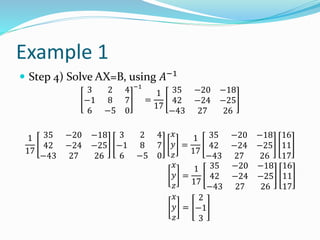
 Step 4) Solve AX=B, using 𝐴−1
3 2 4
−1 8 7
6 −5 0
−1
=
1
17
35 −20 −18
42 −24 −25
−43 27 26
1
17
35 −20 −18
42 −24 −25
−43 27 26
3 2 4
−1 8 7
6 −5 0
𝑥
𝑦
𝑧
=
1
17
35 −20 −18
42 −24 −25
−43 27 26
16
11
17
𝑥
𝑦
𝑧
=
1
17
35 −20 −18
42 −24 −25
−43 27 26
16
11
17
𝑥
𝑦
𝑧
=
2
−1
3
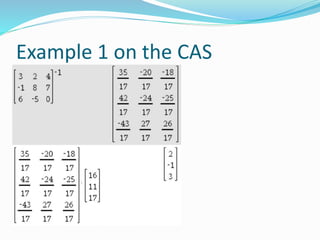
Example 1 on the CAS
Example 2
A cinema has a child price of $8, an adult price of $14.50
and a senior price of $11.25. At one movie they made a
profit of $836.25. There was a total of 70 people at the
movie. There was double the number of children as
there was seniors. Set up a system of matrix equations
and use it to solve the problem of how many of each type
of ticket they sold.
Example 2 solution
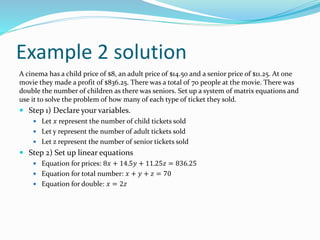
A cinema has a child price of $8, an adult price of $14.50 and a senior price of $11.25. At one
movie they made a profit of $836.25. There was a total of 70 people at the movie. There was
double the number of children as there was seniors. Set up a system of matrix equations and
use it to solve the problem of how many of each type of ticket they sold.
 Step 1) Declare your variables.
 Let 𝑥 represent the number of child tickets sold
 Let y represent the number of adult tickets sold
 Let z represent the number of senior tickets sold
 Step 2) Set up linear equations
 Equation for prices: 8𝑥 + 14.5𝑦 + 11.25𝑧 = 836.25
 Equation for total number: 𝑥 + 𝑦 + 𝑧 = 70
 Equation for double: 𝑥 = 2𝑧
Example 2 solution
A cinema has a child price of $8, an adult price of $14.50 and a senior price of $11.25. At one
movie they made a profit of $836.25. There was a total of 70 people at the movie. There was
double the number of children as there was seniors. Set up a system of matrix equations and
use it to solve the problem of how many of each type of ticket they sold.
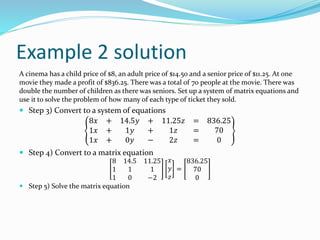
 Step 3) Convert to a system of equations
8𝑥 + 14.5𝑦 + 11.25𝑧 = 836.25
1𝑥 + 1𝑦 + 1𝑧 = 70
1𝑥 + 0𝑦 − 2𝑧 = 0
 Step 4) Convert to a matrix equation
8 14.5 11.25
1 1 1
1 0 −2
𝑥
𝑦
𝑧
=
836.25
70
0
 Step 5) Solve the matrix equation
Example 2 solution
A cinema has a child price of $8, an adult price of $14.50 and a senior price of $11.25. At one
movie they made a profit of $836.25. There was a total of 70 people at the movie. There was
double the number of children as there was seniors. Set up a system of matrix equations and
use it to solve the problem of how many of each type of ticket they sold.
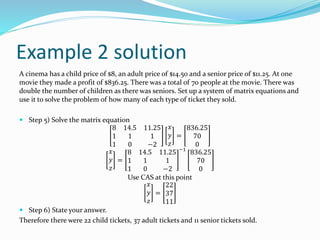
 Step 5) Solve the matrix equation
8 14.5 11.25
1 1 1
1 0 −2
𝑥
𝑦
𝑧
=
836.25
70
0
𝑥
𝑦
𝑧
=
8 14.5 11.25
1 1 1
1 0 −2
−1
836.25
70
0
Use CAS at this point
𝑥
𝑦
𝑧
=
22
37
11
 Step 6) State your answer.
Therefore there were 22 child tickets, 37 adult tickets and 11 senior tickets sold.

Lesson 6 simultaneous

  • 2.
    Learning Intention andSuccess Criteria  Learning Intention: Students will understand that we can convert a system of linear equations to a matrix equation.  Success Criteria: You can solve a worded problem representing linear equations using matrix equations.
  • 3.
    Prior Knowledge  Wecan solve 𝐴𝑋 = 𝐵 using 𝐴−1 𝐴𝑋 = 𝐵 then we get can pre-multiply on the front by 𝐴−1 , so 𝑋 = 𝐴−1 × 𝐵
  • 4.
    Converting Linear Equationsto Matrices If we have the system of equations 𝑎𝑥 + 𝑏𝑦 = 𝑒 𝑐𝑥 + 𝑑𝑦 = 𝑓 we can write this as the matrix equation 𝑎 𝑏 𝑐 𝑑 𝑥 𝑦 = 𝑒 𝑓 To consider why this works, try multiplying it out 𝑎 𝑏 𝑐 𝑑 𝑥 𝑦 = 𝑒 𝑓 𝑎 × 𝑥 + 𝑏 × 𝑦 𝑐 × 𝑥 + 𝑑 × 𝑦 = 𝑒 𝑓 𝑎𝑥 + 𝑏𝑦 = 𝑒 𝑐𝑥 + 𝑑𝑦 = 𝑓
  • 5.
    Converting Linear Equationsto Matrices  In general, we can convert a system of linear equations using the following steps 1) Re-order all of the equations so that they are all have the variables in alphabetical order and are equal to a constant. 2) Fill in any missing variables with zero. 3) Create an (𝑛 × 𝑛) matrix with the coefficients(numbers in front of the letters), call this A, an (𝑛 × 1) matrix of the variables, call this X, and an (𝑛 × 1) matrix of the constants, call this B.
  • 6.
    Example 1  Convertthe system of equations below to a matrix equation and solve. 3𝑥 + 2𝑦 + 4𝑧 = 16 7𝑧 + 8𝑦 − 𝑥 = 11 −5𝑦 + 6𝑥 − 17 = 0  Step 1: Reorder 3𝑥 + 2𝑦 + 4𝑧 = 16 −𝑥 + 8𝑦 + 7𝑧 = 11 6𝑥 − 5𝑦 = 17
  • 7.
    Example 1  Step2) Fill in missing with 0s 3𝑥 + 2𝑦 + 4𝑧 = 16 −𝑥 + 8𝑦 + 7𝑧 = 11 6𝑥 − 5𝑦 + 0𝑧 = 17  Step 3) Create a matrix equation 3 2 4 −1 8 7 6 −5 0 𝑥 𝑦 𝑧 = 16 11 17
  • 8.
    Example 1  Step4) Solve AX=B, using 𝐴−1 3 2 4 −1 8 7 6 −5 0 −1 = 1 17 35 −20 −18 42 −24 −25 −43 27 26 1 17 35 −20 −18 42 −24 −25 −43 27 26 3 2 4 −1 8 7 6 −5 0 𝑥 𝑦 𝑧 = 1 17 35 −20 −18 42 −24 −25 −43 27 26 16 11 17 𝑥 𝑦 𝑧 = 1 17 35 −20 −18 42 −24 −25 −43 27 26 16 11 17 𝑥 𝑦 𝑧 = 2 −1 3
  • 9.
    Example 1 onthe CAS
  • 10.
    Example 2 A cinemahas a child price of $8, an adult price of $14.50 and a senior price of $11.25. At one movie they made a profit of $836.25. There was a total of 70 people at the movie. There was double the number of children as there was seniors. Set up a system of matrix equations and use it to solve the problem of how many of each type of ticket they sold.
  • 11.
    Example 2 solution Acinema has a child price of $8, an adult price of $14.50 and a senior price of $11.25. At one movie they made a profit of $836.25. There was a total of 70 people at the movie. There was double the number of children as there was seniors. Set up a system of matrix equations and use it to solve the problem of how many of each type of ticket they sold.  Step 1) Declare your variables.  Let 𝑥 represent the number of child tickets sold  Let y represent the number of adult tickets sold  Let z represent the number of senior tickets sold  Step 2) Set up linear equations  Equation for prices: 8𝑥 + 14.5𝑦 + 11.25𝑧 = 836.25  Equation for total number: 𝑥 + 𝑦 + 𝑧 = 70  Equation for double: 𝑥 = 2𝑧
  • 12.
    Example 2 solution Acinema has a child price of $8, an adult price of $14.50 and a senior price of $11.25. At one movie they made a profit of $836.25. There was a total of 70 people at the movie. There was double the number of children as there was seniors. Set up a system of matrix equations and use it to solve the problem of how many of each type of ticket they sold.  Step 3) Convert to a system of equations 8𝑥 + 14.5𝑦 + 11.25𝑧 = 836.25 1𝑥 + 1𝑦 + 1𝑧 = 70 1𝑥 + 0𝑦 − 2𝑧 = 0  Step 4) Convert to a matrix equation 8 14.5 11.25 1 1 1 1 0 −2 𝑥 𝑦 𝑧 = 836.25 70 0  Step 5) Solve the matrix equation
  • 13.
    Example 2 solution Acinema has a child price of $8, an adult price of $14.50 and a senior price of $11.25. At one movie they made a profit of $836.25. There was a total of 70 people at the movie. There was double the number of children as there was seniors. Set up a system of matrix equations and use it to solve the problem of how many of each type of ticket they sold.  Step 5) Solve the matrix equation 8 14.5 11.25 1 1 1 1 0 −2 𝑥 𝑦 𝑧 = 836.25 70 0 𝑥 𝑦 𝑧 = 8 14.5 11.25 1 1 1 1 0 −2 −1 836.25 70 0 Use CAS at this point 𝑥 𝑦 𝑧 = 22 37 11  Step 6) State your answer. Therefore there were 22 child tickets, 37 adult tickets and 11 senior tickets sold.