D. J. Jayamanne
NSBM 1
Numbers & Indices
Outline:
NSBM 2
• Real Numbers
• Rational Numbers
• Irrational Numbers
• Integers
• Natural Numbers
• Prime Numbers
Surds
Indices / Powers – Rules of Indices
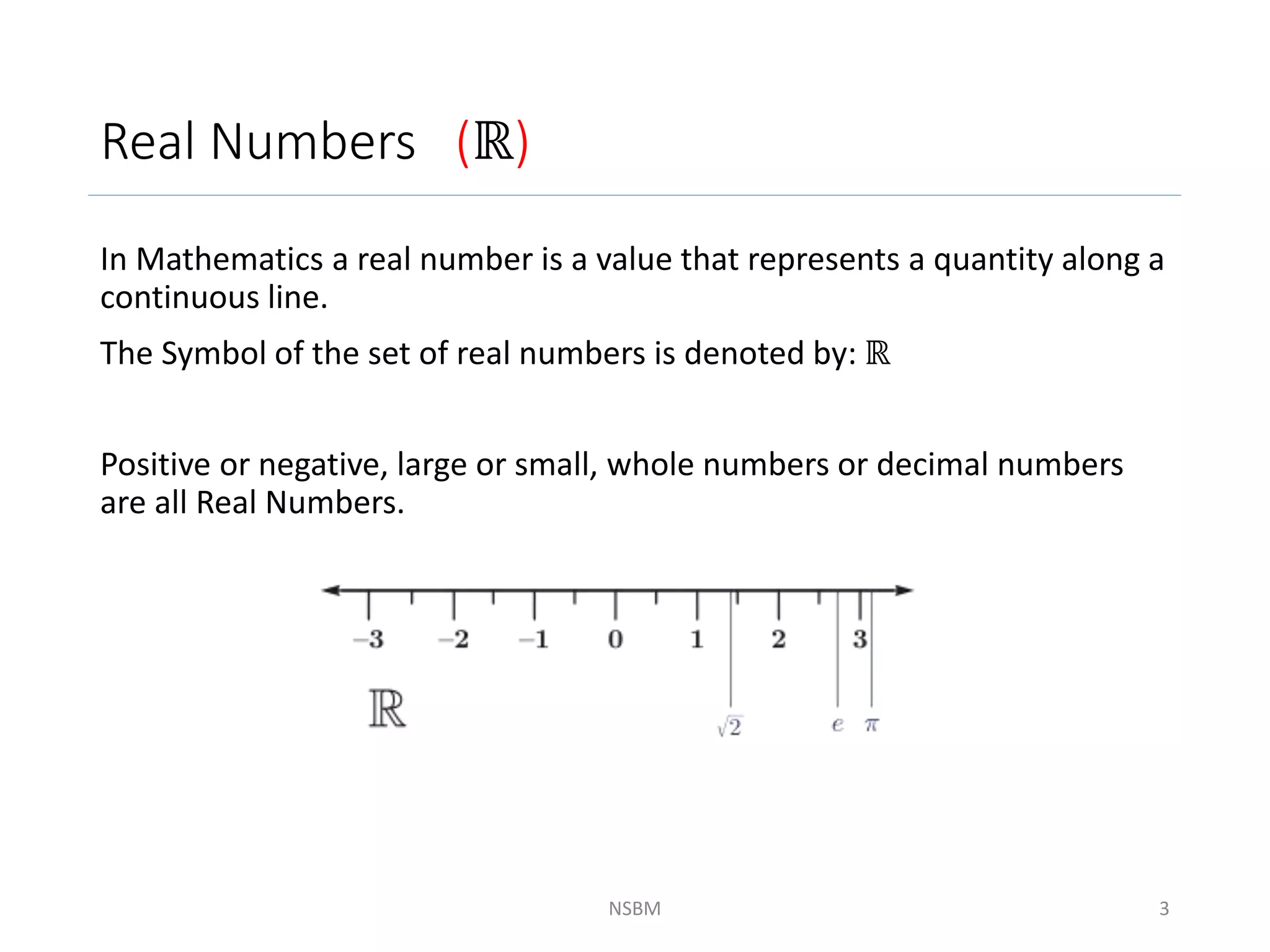
Real Numbers (ℝ)
In Mathematics a real number is a value that represents a quantity along a
continuous line.
The Symbol of the set of real numbers is denoted by: ℝ
Positive or negative, large or small, whole numbers or decimal numbers
are all Real Numbers.
NSBM 3
Real Numbers
Real numbers can be represented geometrically by points on an infinitely
long straight line called the Real Number line.
Each point on this line represents a unique real number and each real
number can be represented by a unique point on this line.
There are two kinds of real numbers:
1. Rational Numbers
2. Irrational Numbers
NSBM 4
Rational Numbers
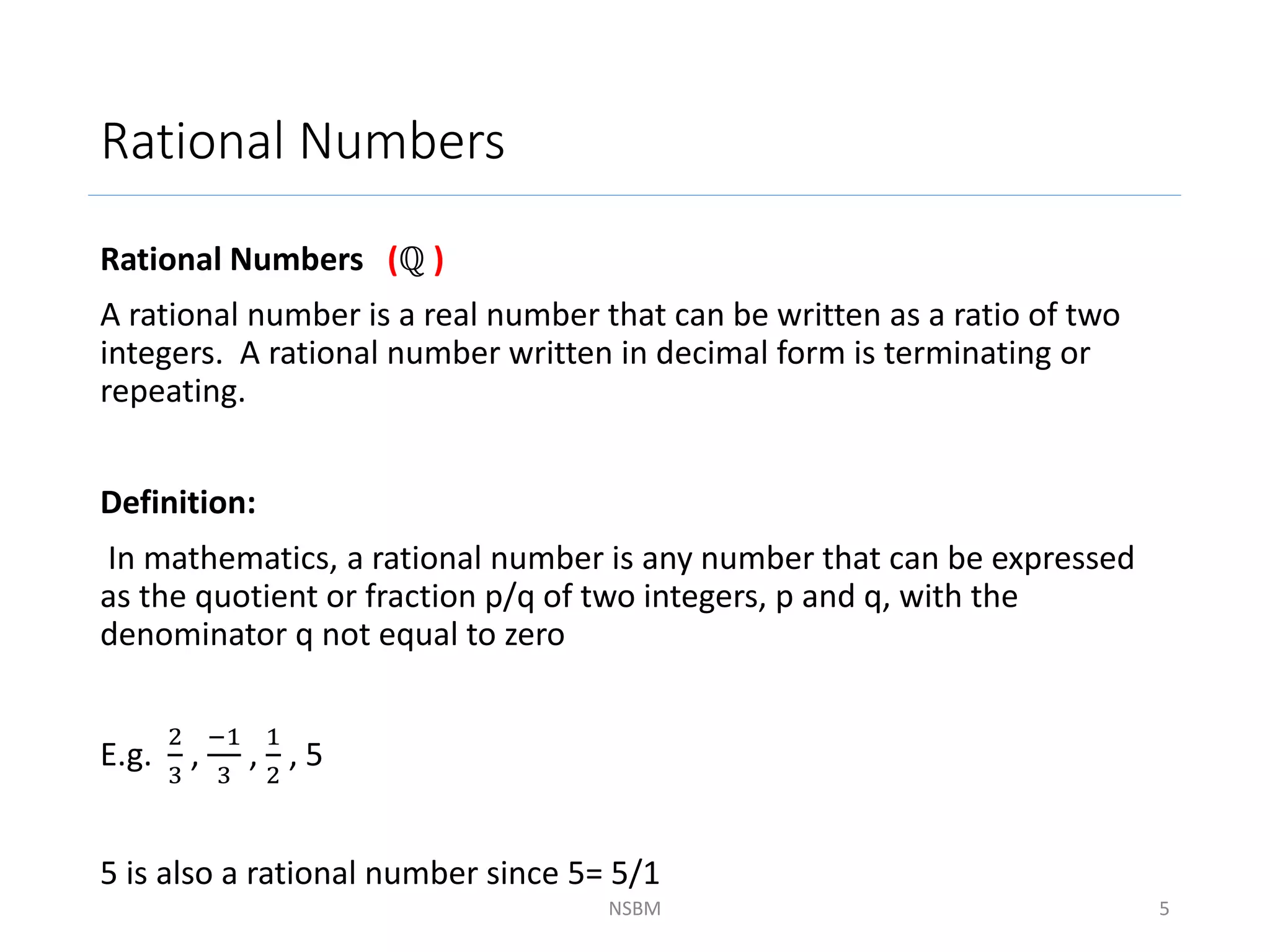
Rational Numbers (ℚ )
A rational number is a real number that can be written as a ratio of two
integers. A rational number written in decimal form is terminating or
repeating.
Definition:
In mathematics, a rational number is any number that can be expressed
as the quotient or fraction p/q of two integers, p and q, with the
denominator q not equal to zero
E.g.
2
3
,
−1
3
,
1
2
, 5
5 is also a rational number since 5= 5/1
NSBM 5
Rational Numbers
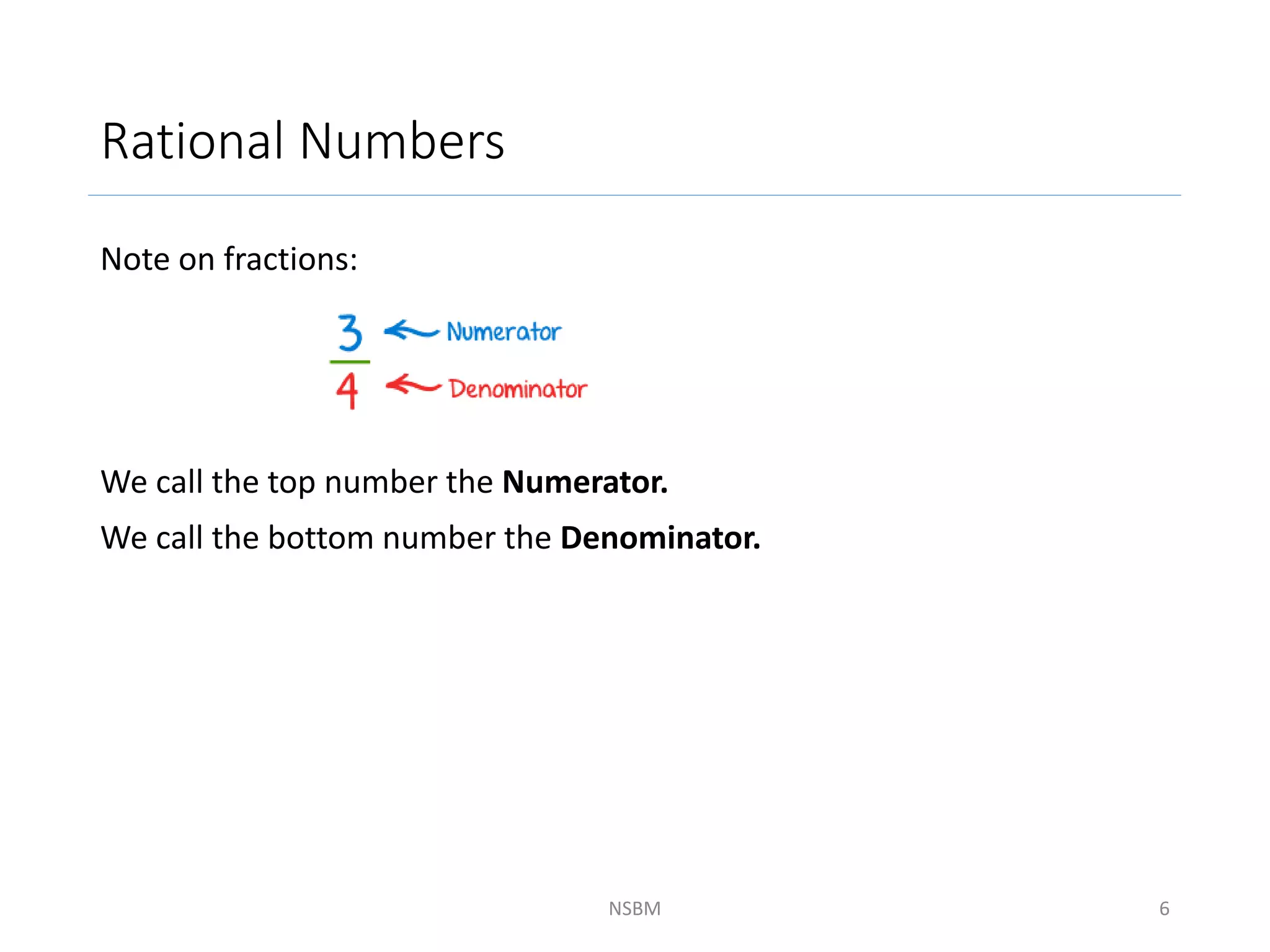
Note on fractions:
We call the top number the Numerator.
We call the bottom number the Denominator.
NSBM 6
Irrational Numbers
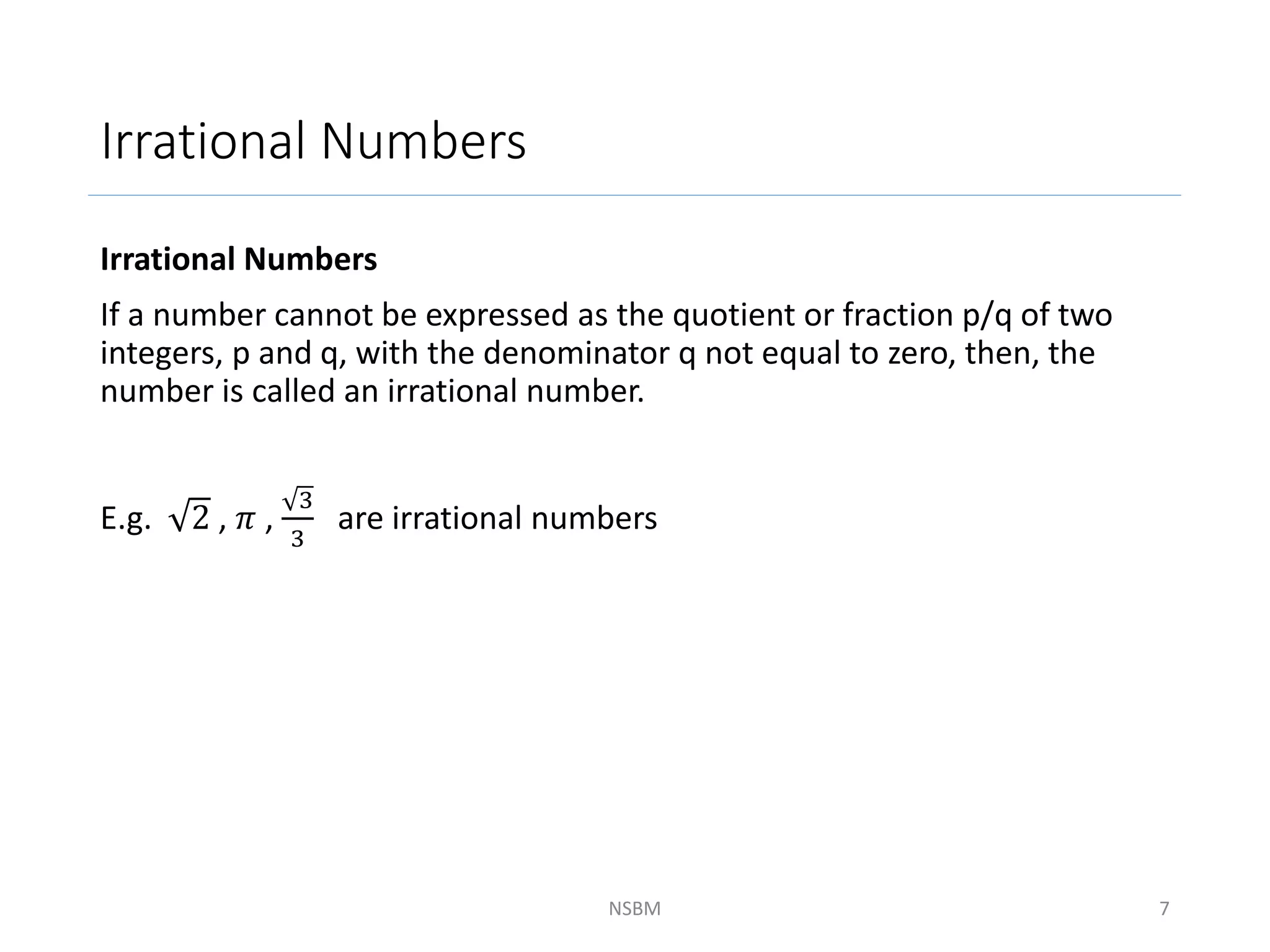
Irrational Numbers
If a number cannot be expressed as the quotient or fraction p/q of two
integers, p and q, with the denominator q not equal to zero, then, the
number is called an irrational number.
E.g. 2 , 𝜋 ,
3
3
are irrational numbers
NSBM 7
Questions
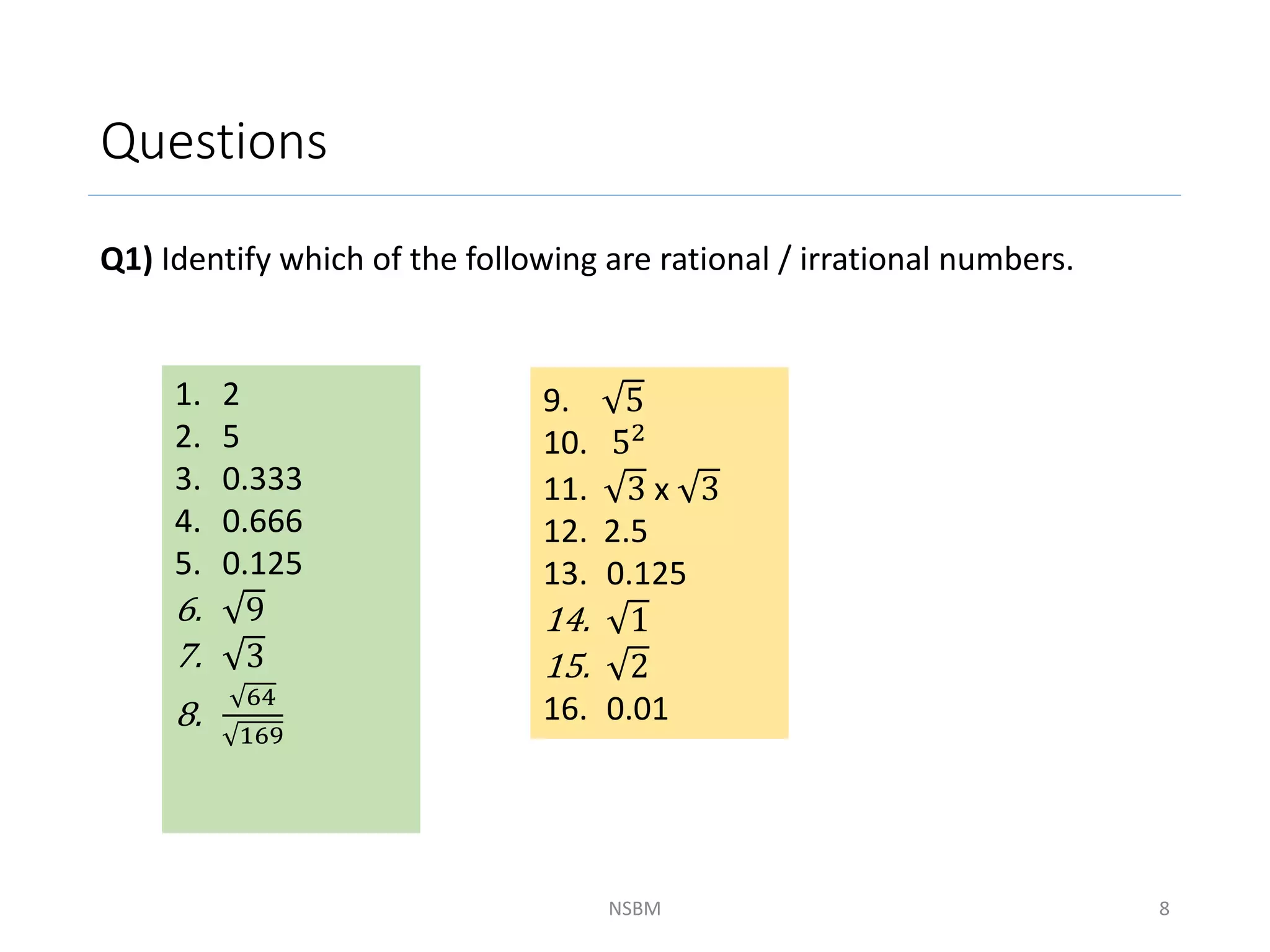
Q1) Identify which of the following are rational / irrational numbers.
NSBM 8
1. 2
2. 5
3. 0.333
4. 0.666
5. 0.125
6. 9
7. 3
8.
64
169
9. 5
10. 52
11. 3 x 3
12. 2.5
13. 0.125
14. 1
15. 2
16. 0.01
Integers
Set of numbers that consists of positive and negative whole numbers
including zero is called Integers. Integers are denoted by (ℤ)
Includes:
• the counting numbers {1, 2, 3, ...},
• zero {0},
• and the negative of the counting numbers {-1, -2, -3, ...}
We can write them as ℤ = {..., -3, -2, -1, 0, 1, 2, 3, ...}
Examples of integers: -16, -3, 0, 1, 198
NSBM 9
Natural Numbers
Positive integers including zero are called Natural Numbers. Integers are
denoted by (ℕ)
Includes:
• the counting numbers {0, 1, 2, 3, 4 ...},
NSBM 10
Prime Numbers
If a natural number r excluding 1 is divisible by r alone, then r is known as
a Prime Number.
• Example { 2, 3, 5, 7, 11, 13, 17 ...},
Q2) Find all the prime numbers less than 50.
Note: Apart from two are there any even-numbers that could be treated
as Prime Numbers?
NSBM 11
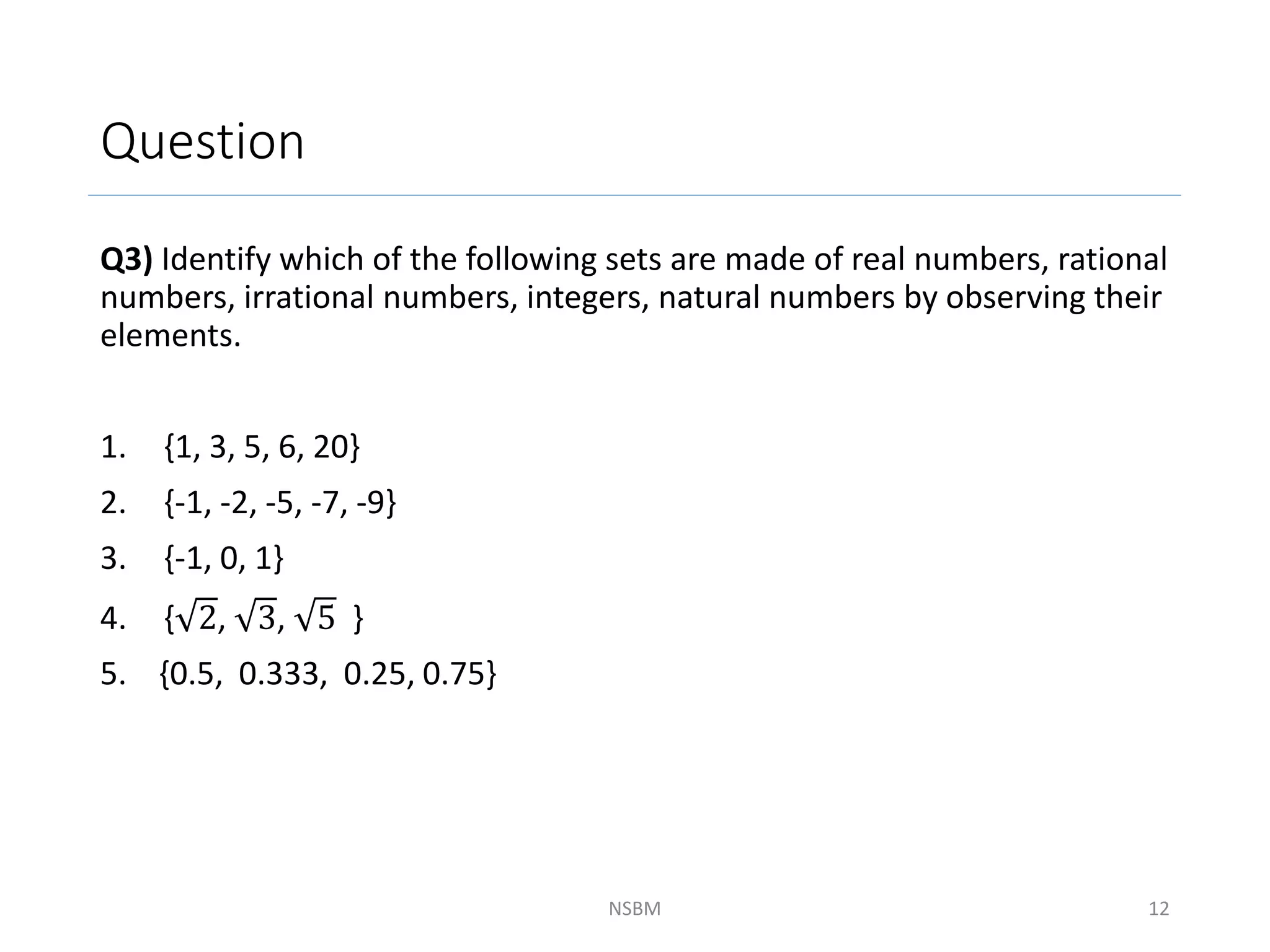
Question
Q3) Identify which of the following sets are made of real numbers, rational
numbers, irrational numbers, integers, natural numbers by observing their
elements.
1. {1, 3, 5, 6, 20}
2. {-1, -2, -5, -7, -9}
3. {-1, 0, 1}
4. { 2, 3, 5 }
5. {0.5, 0.333, 0.25, 0.75}
NSBM 12
NSBM 13
Surds and Indices
Surds
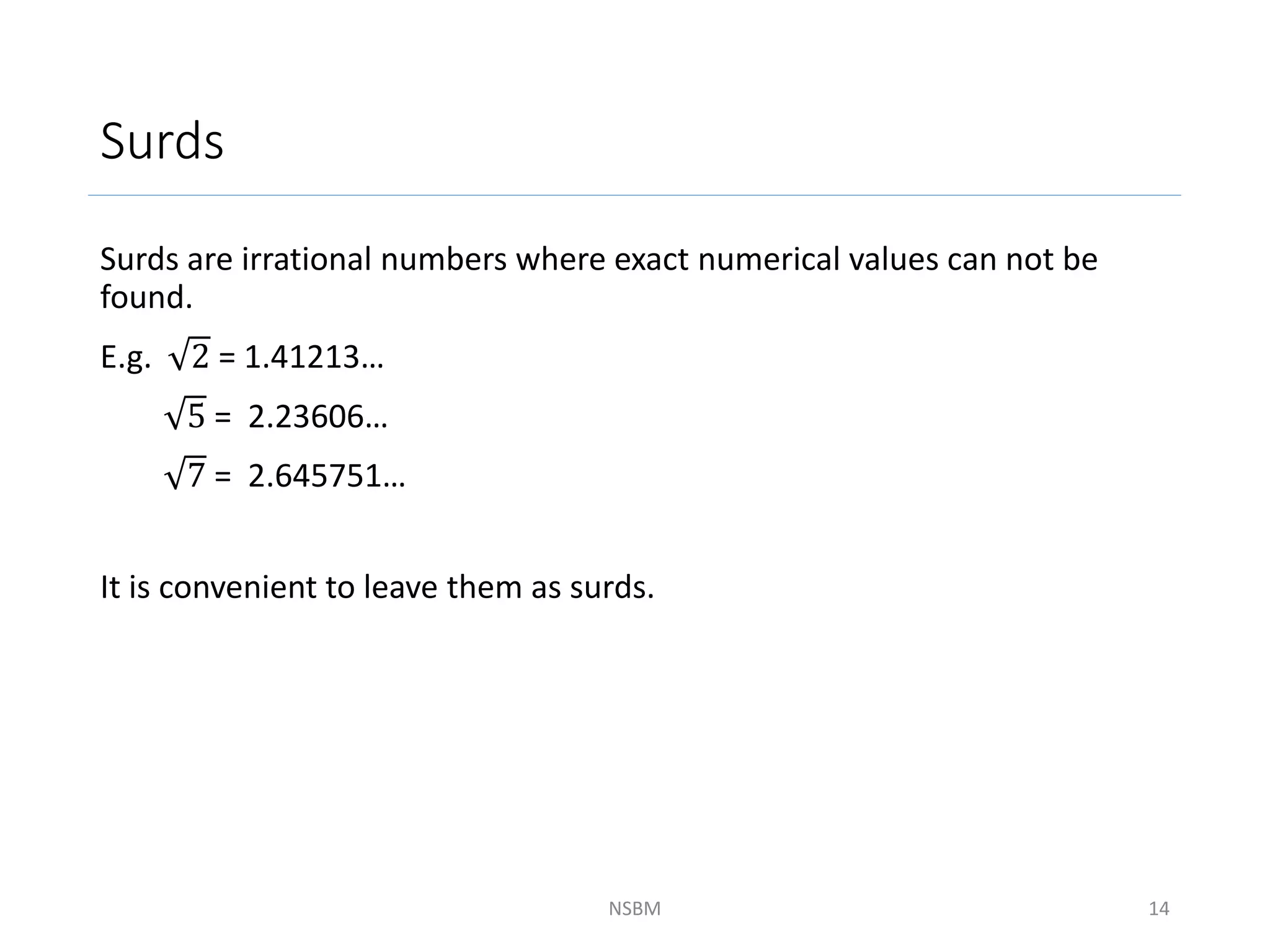
Surds are irrational numbers where exact numerical values can not be
found.
E.g. 2 = 1.41213…
5 = 2.23606…
7 = 2.645751…
It is convenient to leave them as surds.
NSBM 14
Question
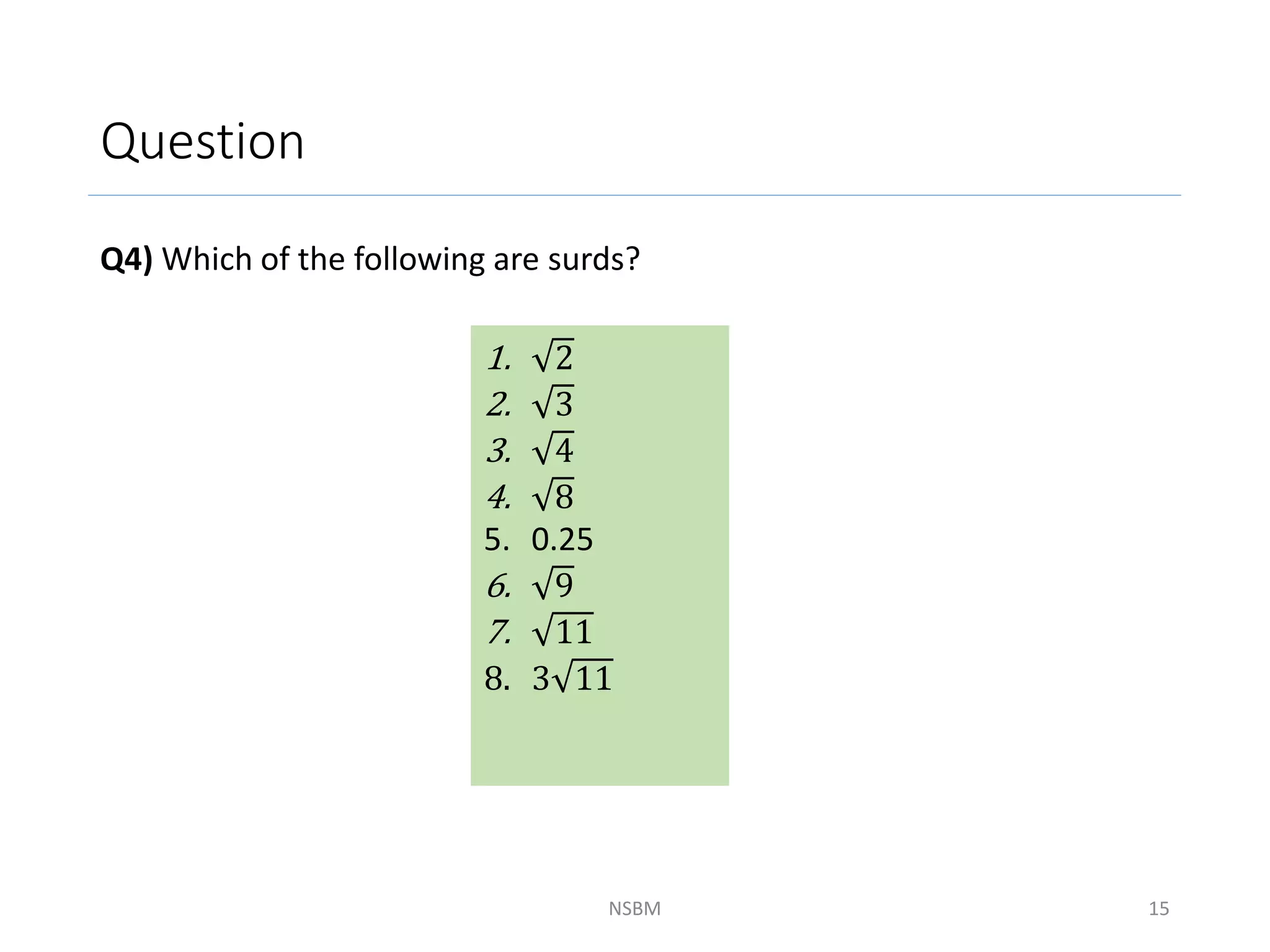
Q4) Which of the following are surds?
NSBM 15
1. 2
2. 3
3. 4
4. 8
5. 0.25
6. 9
7. 11
8. 3 11
Simplification of a surd
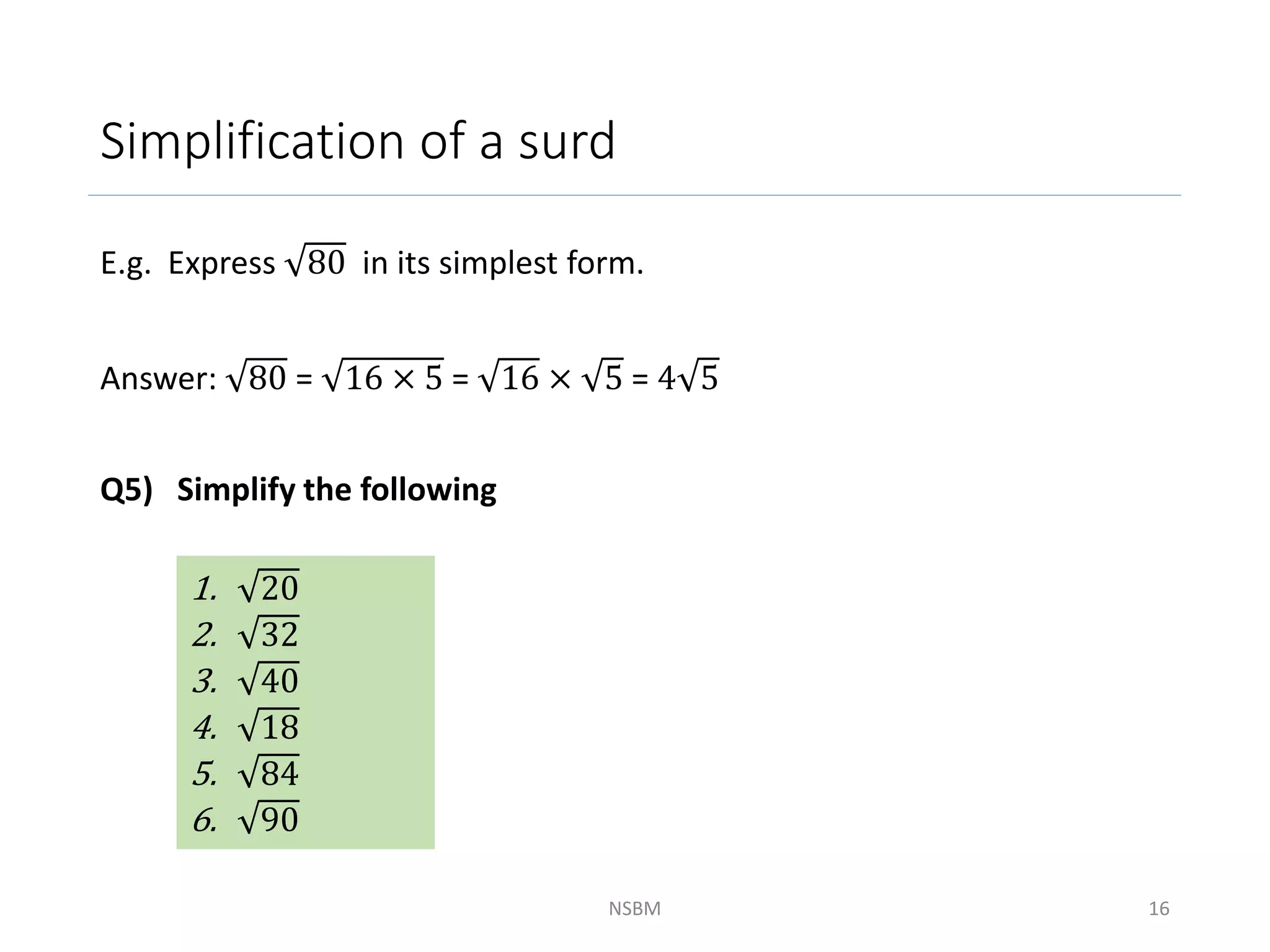
E.g. Express 80 in its simplest form.
Answer: 80 = 16 × 5 = 16 × 5 = 4 5
Q5) Simplify the following
NSBM 16
1. 20
2. 32
3. 40
4. 18
5. 84
6. 90
Rationalizing the denominator
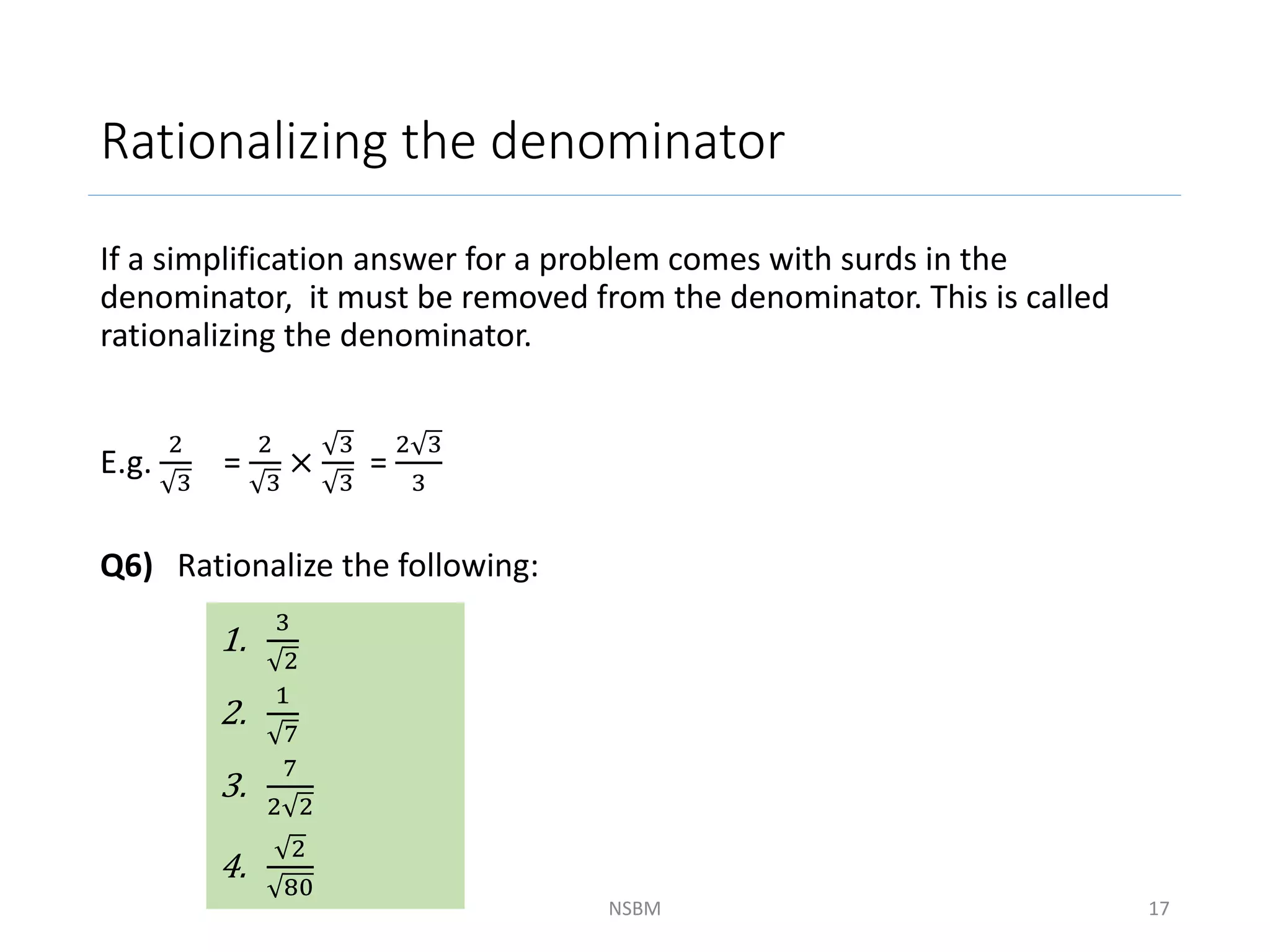
If a simplification answer for a problem comes with surds in the
denominator, it must be removed from the denominator. This is called
rationalizing the denominator.
E.g.
2
3
=
2
3
×
3
3
=
2 3
3
Q6) Rationalize the following:
NSBM 17
1.
3
2
2.
1
7
3.
7
2 2
4.
2
80
Indices / powers
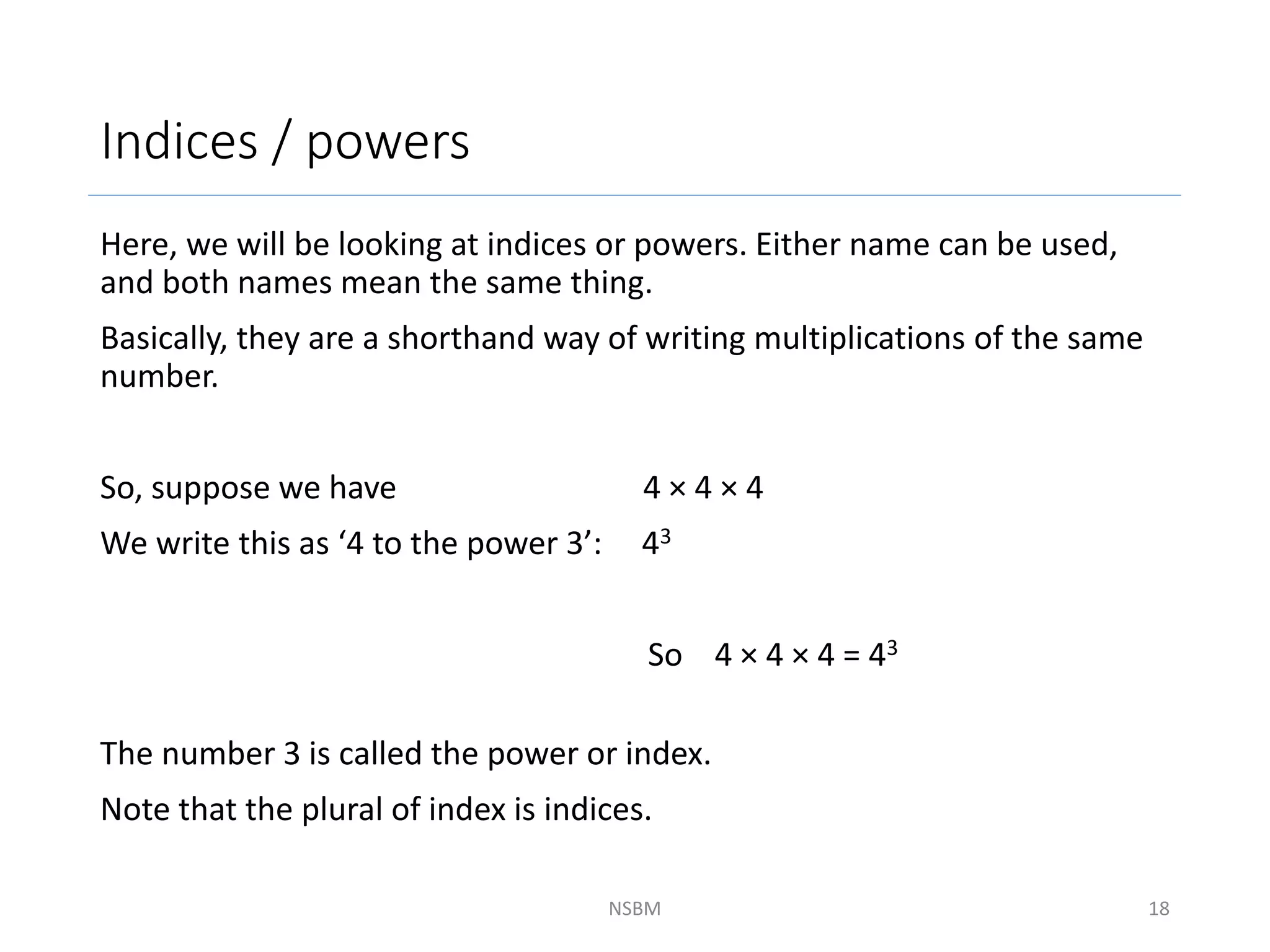
Here, we will be looking at indices or powers. Either name can be used,
and both names mean the same thing.
Basically, they are a shorthand way of writing multiplications of the same
number.
So, suppose we have 4 × 4 × 4
We write this as ‘4 to the power 3’: 43
So 4 × 4 × 4 = 43
The number 3 is called the power or index.
Note that the plural of index is indices.
NSBM 18
Indices / powers
NSBM 19
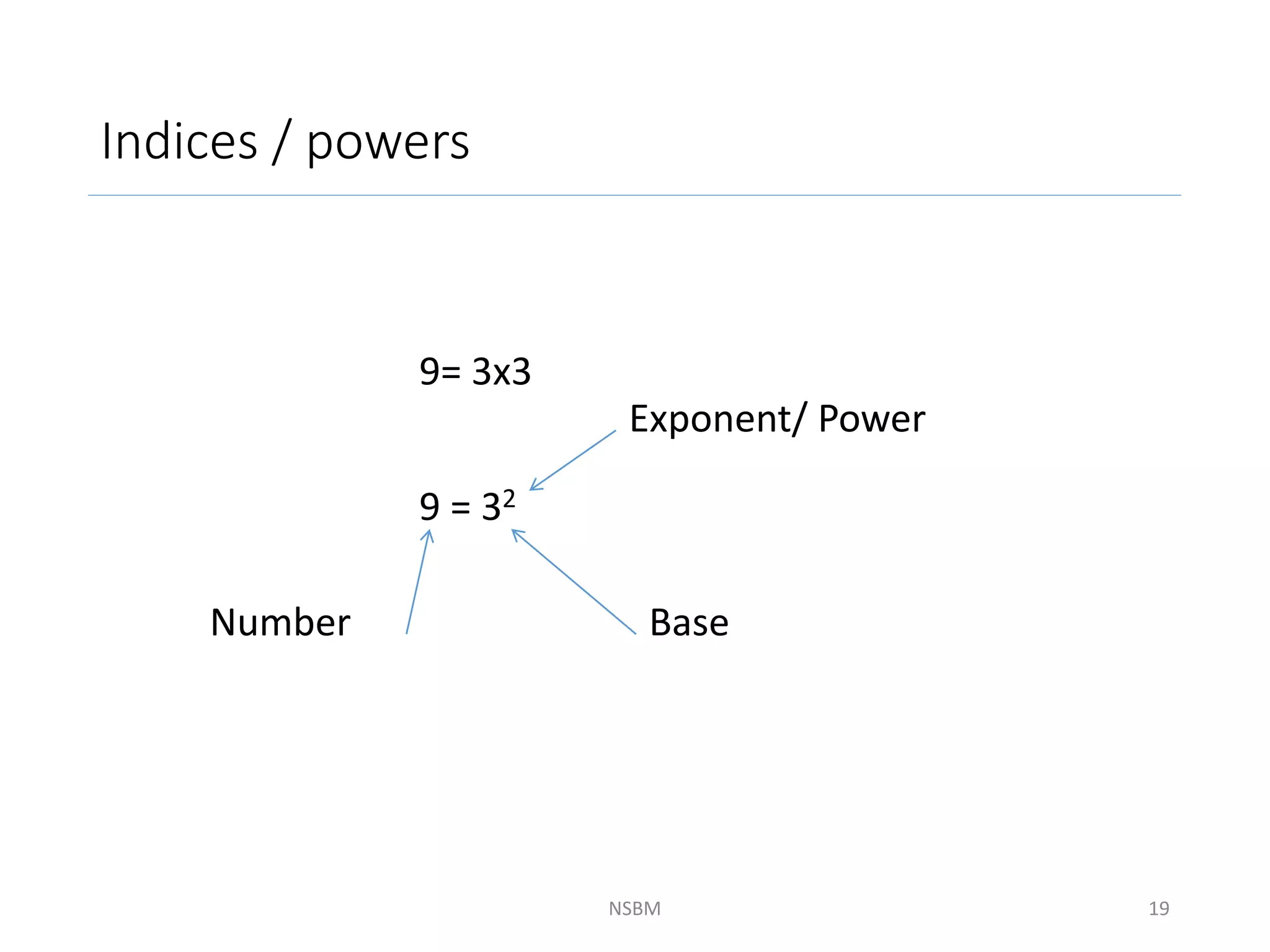
9= 3x3
9 = 32
Number
Exponent/ Power
Base
Indices / powers
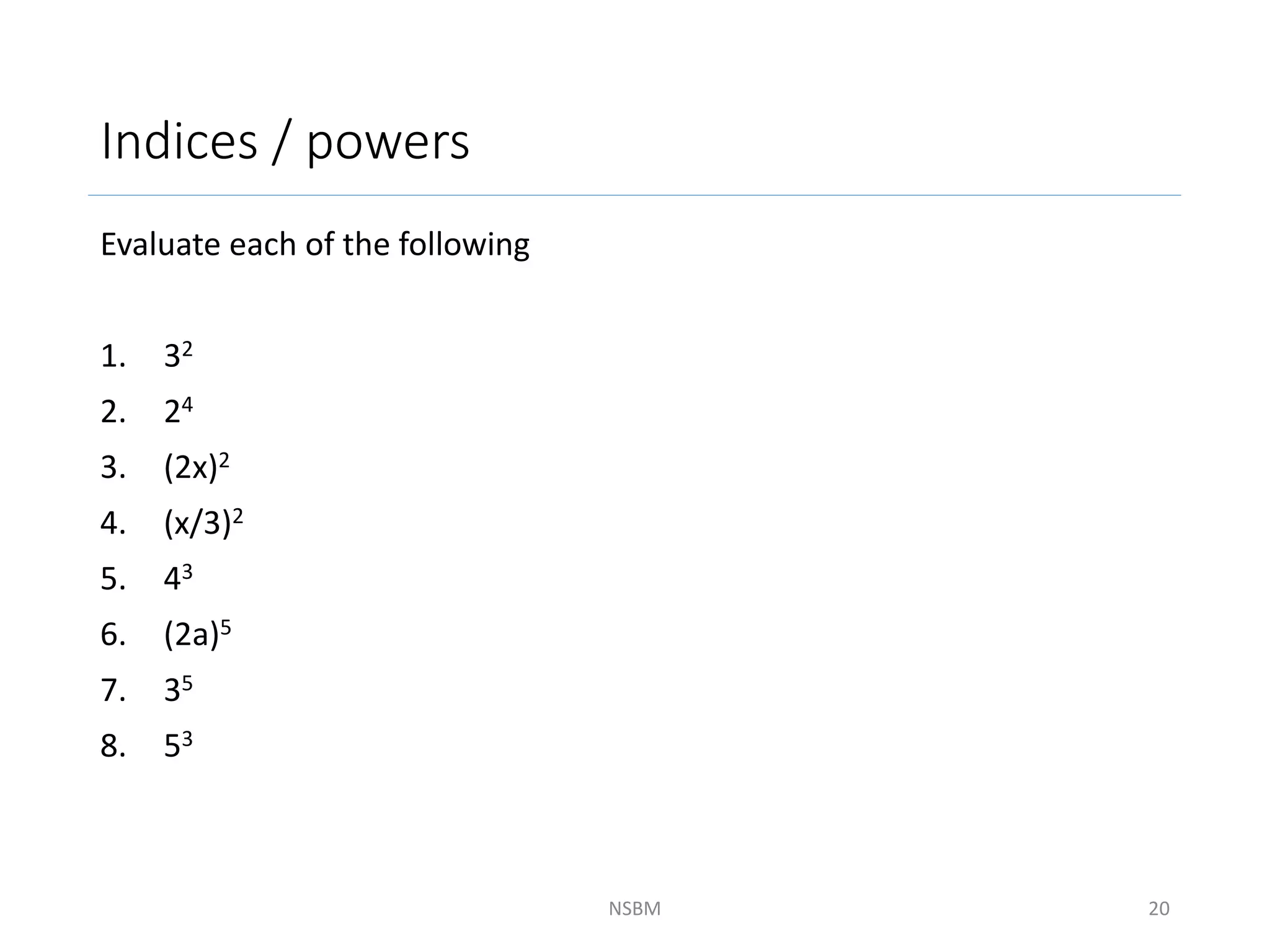
Evaluate each of the following
1. 32
2. 24
3. (2x)2
4. (x/3)2
5. 43
6. (2a)5
7. 35
8. 53
NSBM 20
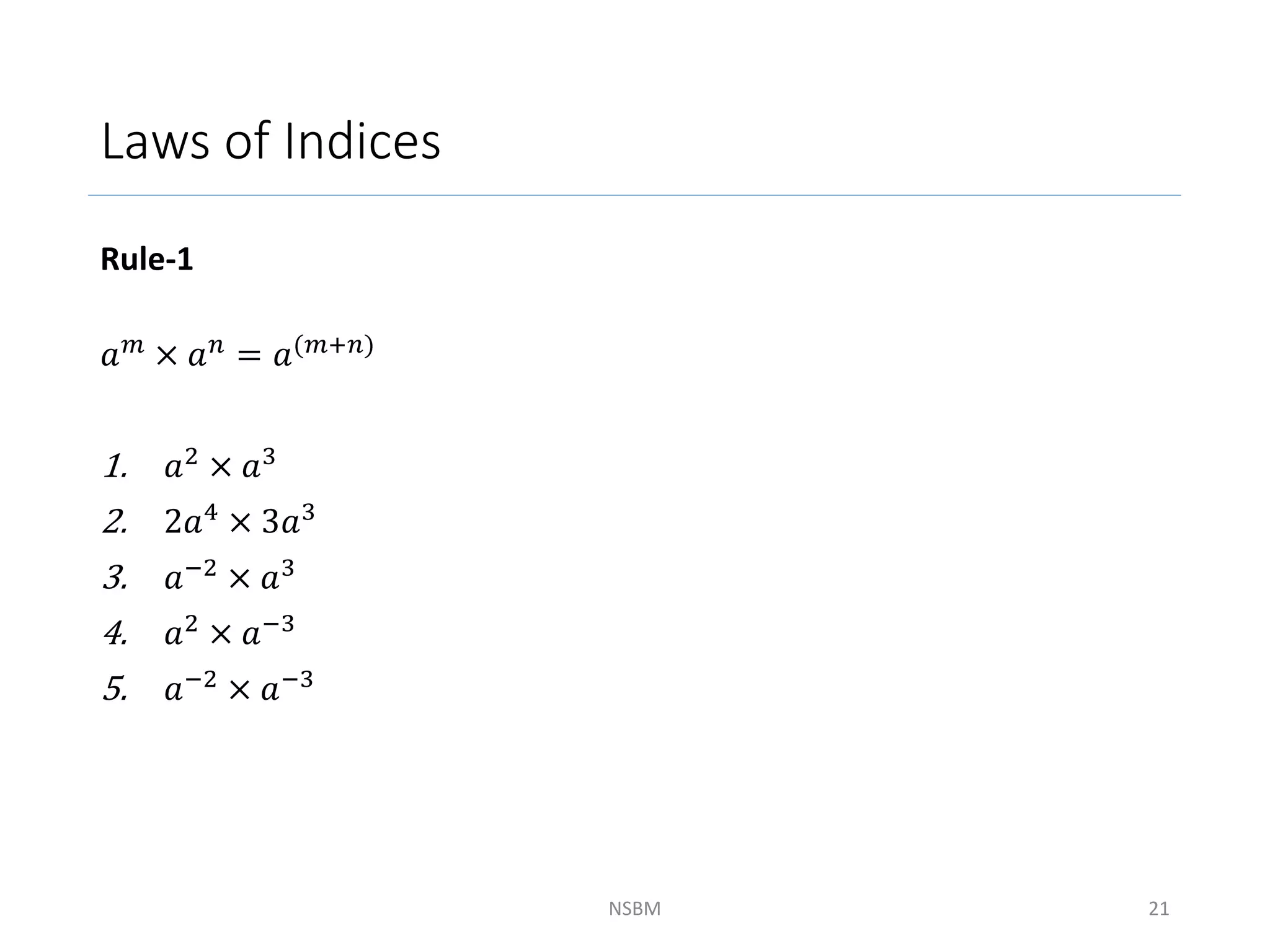
Laws of Indices
Rule-1
𝑎𝑚 × 𝑎𝑛 = 𝑎(𝑚+𝑛)
1. 𝑎2
× 𝑎3
2. 2𝑎4 × 3𝑎3
3. 𝑎−2
× 𝑎3
4. 𝑎2 × 𝑎−3
5. 𝑎−2
× 𝑎−3
NSBM 21
Laws of Indices
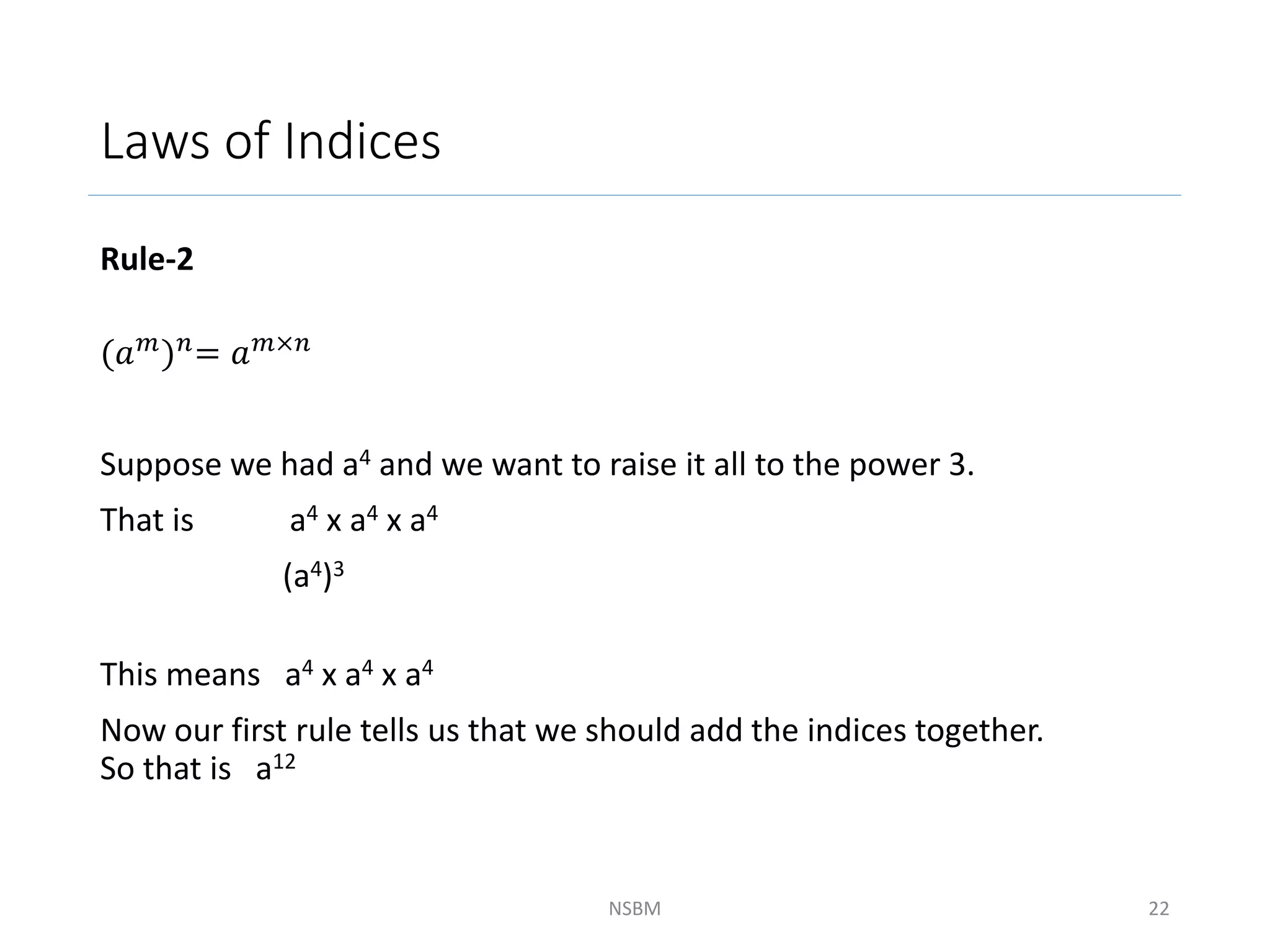
Rule-2
(𝑎𝑚)𝑛= 𝑎𝑚×𝑛
Suppose we had a4 and we want to raise it all to the power 3.
That is a4 x a4 x a4
(a4)3
This means a4 x a4 x a4
Now our first rule tells us that we should add the indices together.
So that is a12
NSBM 22
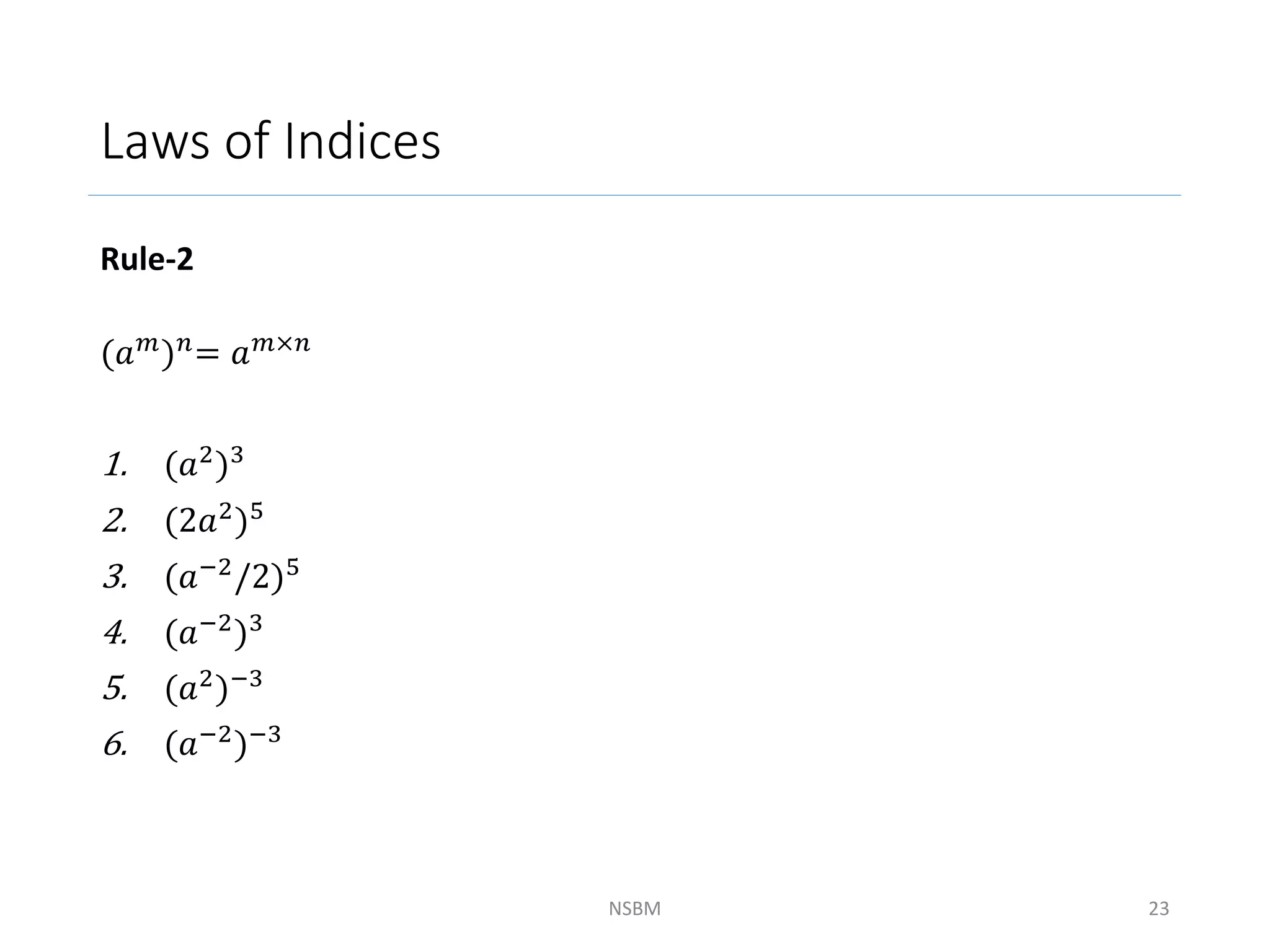
Laws of Indices
Rule-2
(𝑎𝑚)𝑛= 𝑎𝑚×𝑛
1. (𝑎2)3
2. (2𝑎2)5
3. (𝑎−2
/2)5
4. (𝑎−2)3
5. (𝑎2
)−3
6. (𝑎−2)−3
NSBM 23
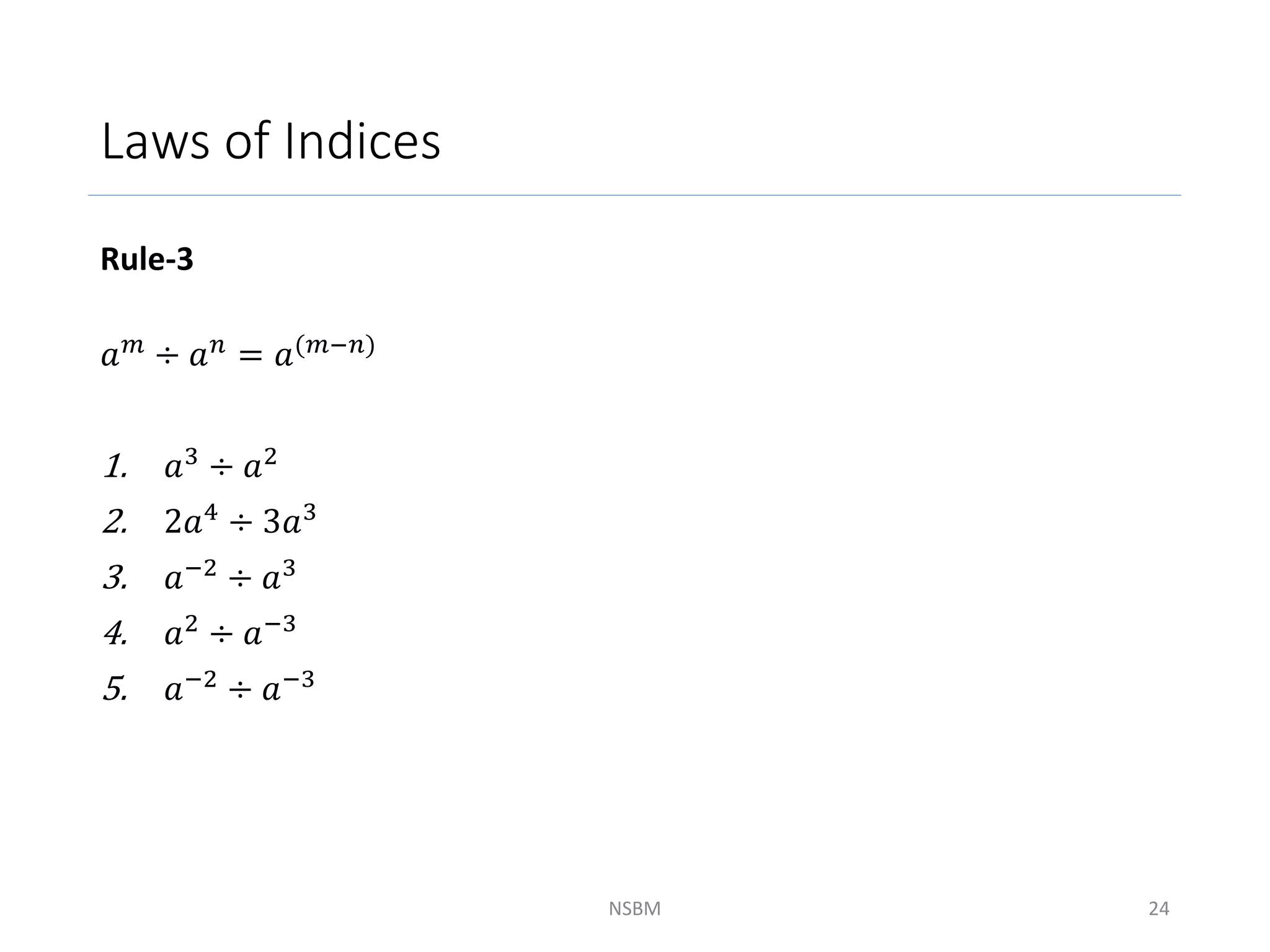
Laws of Indices
Rule-3
𝑎𝑚 ÷ 𝑎𝑛 = 𝑎(𝑚−𝑛)
1. 𝑎3
÷ 𝑎2
2. 2𝑎4 ÷ 3𝑎3
3. 𝑎−2
÷ 𝑎3
4. 𝑎2 ÷ 𝑎−3
5. 𝑎−2
÷ 𝑎−3
NSBM 24
Laws of Indices
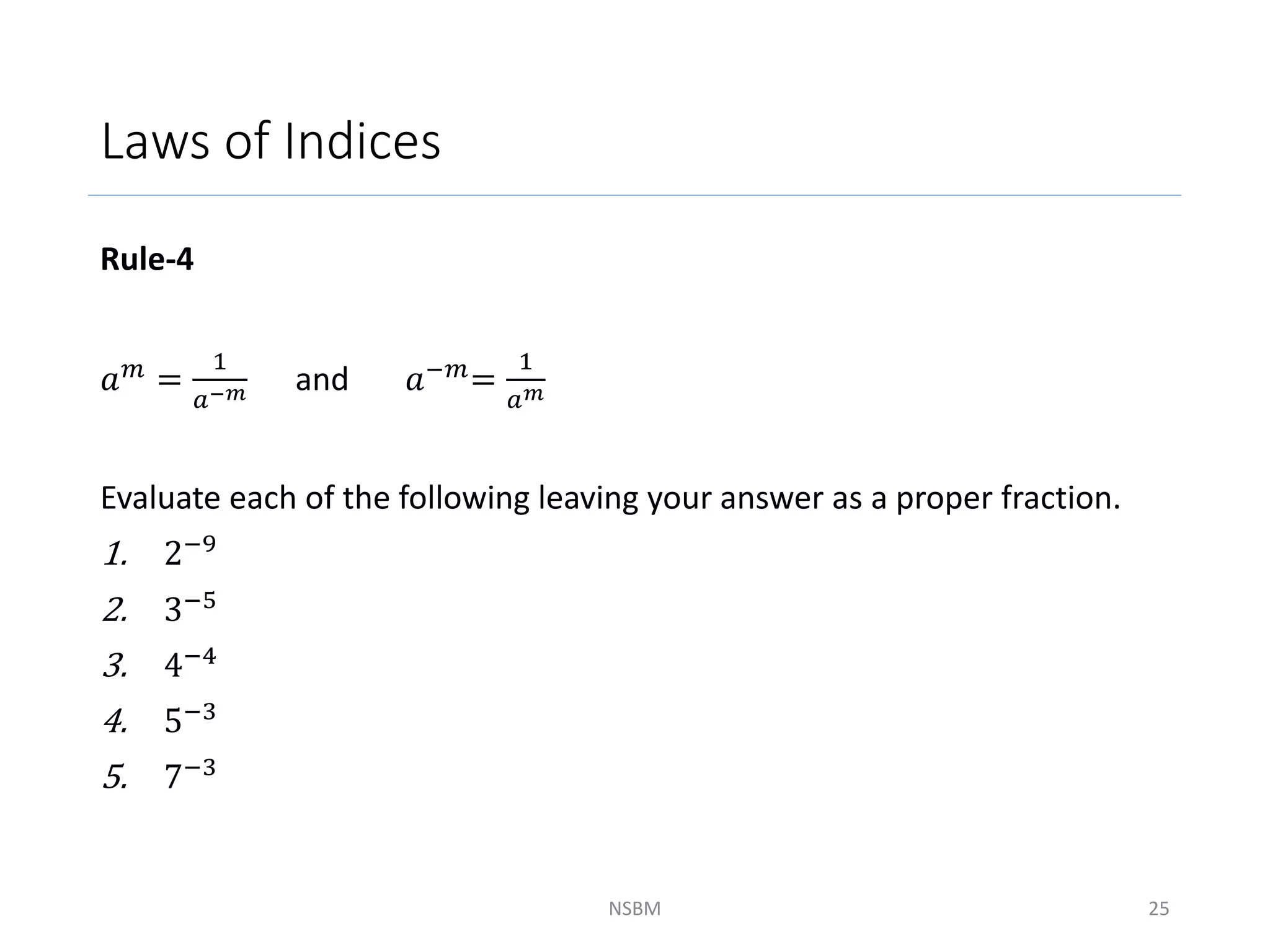
Rule-4
𝑎𝑚 =
1
𝑎−𝑚 and 𝑎−𝑚=
1
𝑎𝑚
Evaluate each of the following leaving your answer as a proper fraction.
1. 2−9
2. 3−5
3. 4−4
4. 5−3
5. 7−3
NSBM 25
Laws of Indices
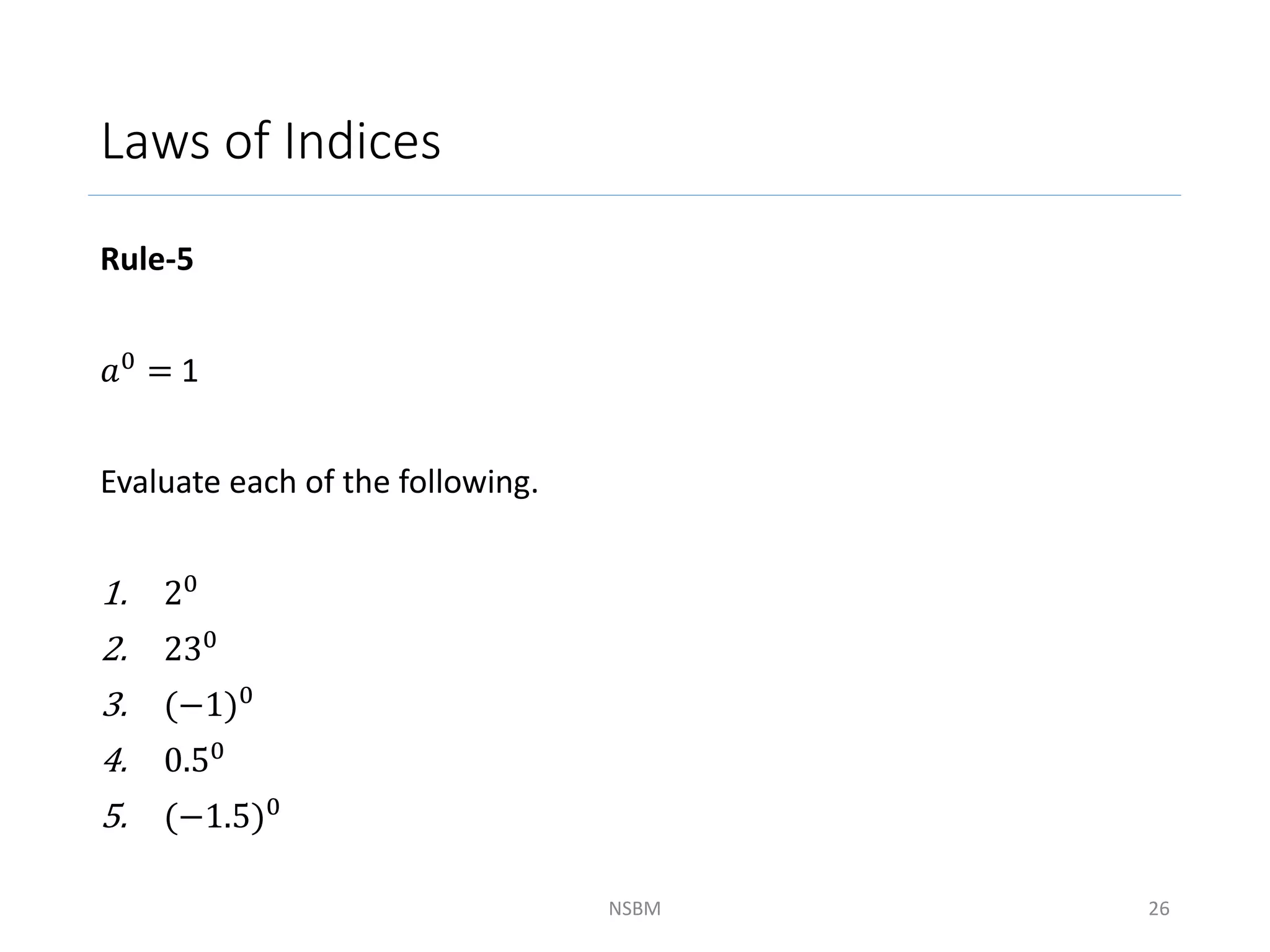
Rule-5
𝑎0 = 1
Evaluate each of the following.
1. 20
2. 230
3. (−1)0
4. 0.50
5. (−1.5)0
NSBM 26
Laws of Indices
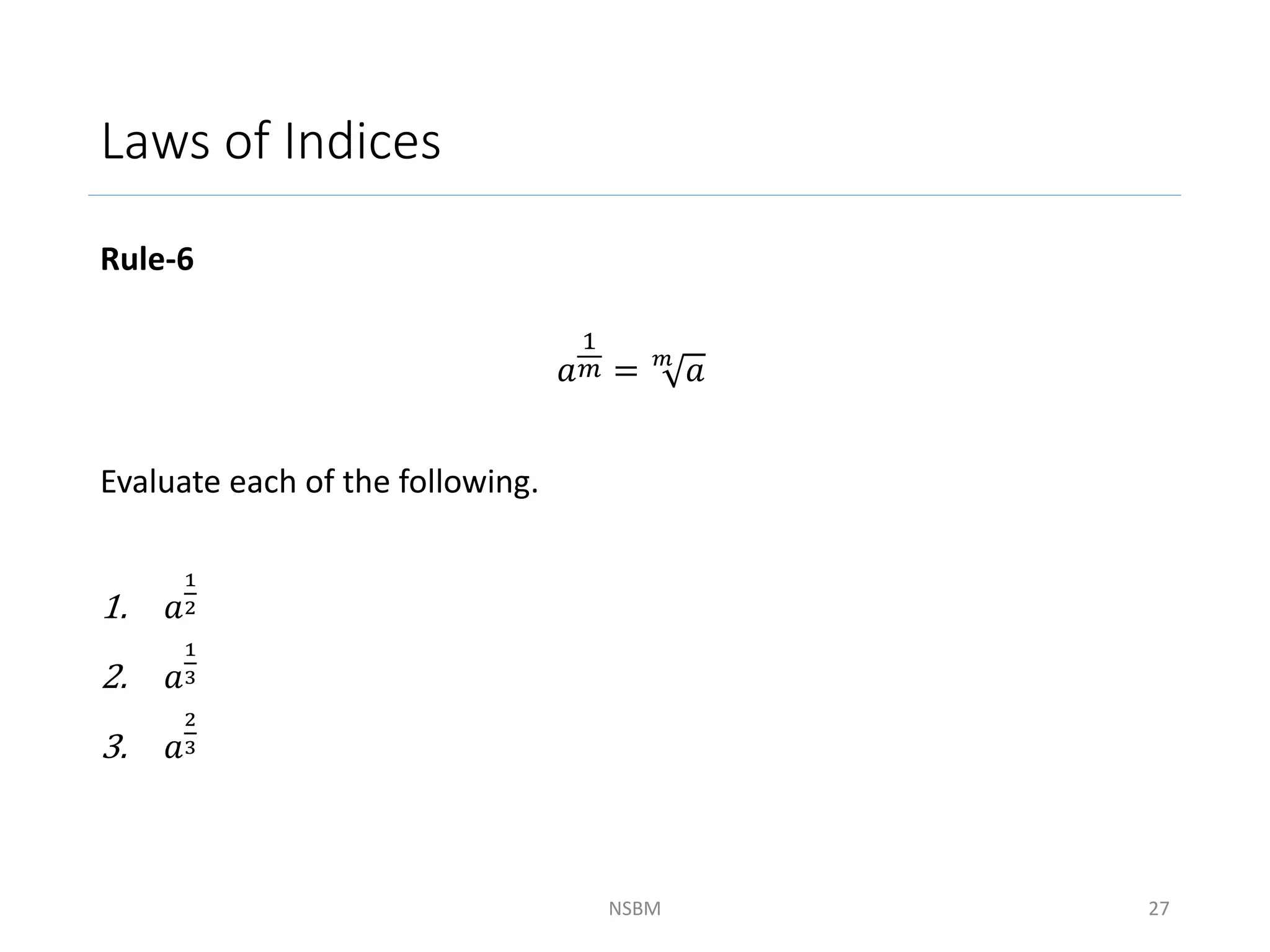
Rule-6
𝑎
1
𝑚 = 𝑚
𝑎
Evaluate each of the following.
1. 𝑎
1
2
2. 𝑎
1
3
3. 𝑎
2
3
NSBM 27

Lecture 1 (numbers and laws of indices)

  • 1.
    D. J. Jayamanne NSBM1 Numbers & Indices
  • 2.
    Outline: NSBM 2 • RealNumbers • Rational Numbers • Irrational Numbers • Integers • Natural Numbers • Prime Numbers Surds Indices / Powers – Rules of Indices
  • 3.
    Real Numbers (ℝ) InMathematics a real number is a value that represents a quantity along a continuous line. The Symbol of the set of real numbers is denoted by: ℝ Positive or negative, large or small, whole numbers or decimal numbers are all Real Numbers. NSBM 3
  • 4.
    Real Numbers Real numberscan be represented geometrically by points on an infinitely long straight line called the Real Number line. Each point on this line represents a unique real number and each real number can be represented by a unique point on this line. There are two kinds of real numbers: 1. Rational Numbers 2. Irrational Numbers NSBM 4
  • 5.
    Rational Numbers Rational Numbers(ℚ ) A rational number is a real number that can be written as a ratio of two integers. A rational number written in decimal form is terminating or repeating. Definition: In mathematics, a rational number is any number that can be expressed as the quotient or fraction p/q of two integers, p and q, with the denominator q not equal to zero E.g. 2 3 , −1 3 , 1 2 , 5 5 is also a rational number since 5= 5/1 NSBM 5
  • 6.
    Rational Numbers Note onfractions: We call the top number the Numerator. We call the bottom number the Denominator. NSBM 6
  • 7.
    Irrational Numbers Irrational Numbers Ifa number cannot be expressed as the quotient or fraction p/q of two integers, p and q, with the denominator q not equal to zero, then, the number is called an irrational number. E.g. 2 , 𝜋 , 3 3 are irrational numbers NSBM 7
  • 8.
    Questions Q1) Identify whichof the following are rational / irrational numbers. NSBM 8 1. 2 2. 5 3. 0.333 4. 0.666 5. 0.125 6. 9 7. 3 8. 64 169 9. 5 10. 52 11. 3 x 3 12. 2.5 13. 0.125 14. 1 15. 2 16. 0.01
  • 9.
    Integers Set of numbersthat consists of positive and negative whole numbers including zero is called Integers. Integers are denoted by (ℤ) Includes: • the counting numbers {1, 2, 3, ...}, • zero {0}, • and the negative of the counting numbers {-1, -2, -3, ...} We can write them as ℤ = {..., -3, -2, -1, 0, 1, 2, 3, ...} Examples of integers: -16, -3, 0, 1, 198 NSBM 9
  • 10.
    Natural Numbers Positive integersincluding zero are called Natural Numbers. Integers are denoted by (ℕ) Includes: • the counting numbers {0, 1, 2, 3, 4 ...}, NSBM 10
  • 11.
    Prime Numbers If anatural number r excluding 1 is divisible by r alone, then r is known as a Prime Number. • Example { 2, 3, 5, 7, 11, 13, 17 ...}, Q2) Find all the prime numbers less than 50. Note: Apart from two are there any even-numbers that could be treated as Prime Numbers? NSBM 11
  • 12.
    Question Q3) Identify whichof the following sets are made of real numbers, rational numbers, irrational numbers, integers, natural numbers by observing their elements. 1. {1, 3, 5, 6, 20} 2. {-1, -2, -5, -7, -9} 3. {-1, 0, 1} 4. { 2, 3, 5 } 5. {0.5, 0.333, 0.25, 0.75} NSBM 12
  • 13.
  • 14.
    Surds Surds are irrationalnumbers where exact numerical values can not be found. E.g. 2 = 1.41213… 5 = 2.23606… 7 = 2.645751… It is convenient to leave them as surds. NSBM 14
  • 15.
    Question Q4) Which ofthe following are surds? NSBM 15 1. 2 2. 3 3. 4 4. 8 5. 0.25 6. 9 7. 11 8. 3 11
  • 16.
    Simplification of asurd E.g. Express 80 in its simplest form. Answer: 80 = 16 × 5 = 16 × 5 = 4 5 Q5) Simplify the following NSBM 16 1. 20 2. 32 3. 40 4. 18 5. 84 6. 90
  • 17.
    Rationalizing the denominator Ifa simplification answer for a problem comes with surds in the denominator, it must be removed from the denominator. This is called rationalizing the denominator. E.g. 2 3 = 2 3 × 3 3 = 2 3 3 Q6) Rationalize the following: NSBM 17 1. 3 2 2. 1 7 3. 7 2 2 4. 2 80
  • 18.
    Indices / powers Here,we will be looking at indices or powers. Either name can be used, and both names mean the same thing. Basically, they are a shorthand way of writing multiplications of the same number. So, suppose we have 4 × 4 × 4 We write this as ‘4 to the power 3’: 43 So 4 × 4 × 4 = 43 The number 3 is called the power or index. Note that the plural of index is indices. NSBM 18
  • 19.
    Indices / powers NSBM19 9= 3x3 9 = 32 Number Exponent/ Power Base
  • 20.
    Indices / powers Evaluateeach of the following 1. 32 2. 24 3. (2x)2 4. (x/3)2 5. 43 6. (2a)5 7. 35 8. 53 NSBM 20
  • 21.
    Laws of Indices Rule-1 𝑎𝑚× 𝑎𝑛 = 𝑎(𝑚+𝑛) 1. 𝑎2 × 𝑎3 2. 2𝑎4 × 3𝑎3 3. 𝑎−2 × 𝑎3 4. 𝑎2 × 𝑎−3 5. 𝑎−2 × 𝑎−3 NSBM 21
  • 22.
    Laws of Indices Rule-2 (𝑎𝑚)𝑛=𝑎𝑚×𝑛 Suppose we had a4 and we want to raise it all to the power 3. That is a4 x a4 x a4 (a4)3 This means a4 x a4 x a4 Now our first rule tells us that we should add the indices together. So that is a12 NSBM 22
  • 23.
    Laws of Indices Rule-2 (𝑎𝑚)𝑛=𝑎𝑚×𝑛 1. (𝑎2)3 2. (2𝑎2)5 3. (𝑎−2 /2)5 4. (𝑎−2)3 5. (𝑎2 )−3 6. (𝑎−2)−3 NSBM 23
  • 24.
    Laws of Indices Rule-3 𝑎𝑚÷ 𝑎𝑛 = 𝑎(𝑚−𝑛) 1. 𝑎3 ÷ 𝑎2 2. 2𝑎4 ÷ 3𝑎3 3. 𝑎−2 ÷ 𝑎3 4. 𝑎2 ÷ 𝑎−3 5. 𝑎−2 ÷ 𝑎−3 NSBM 24
  • 25.
    Laws of Indices Rule-4 𝑎𝑚= 1 𝑎−𝑚 and 𝑎−𝑚= 1 𝑎𝑚 Evaluate each of the following leaving your answer as a proper fraction. 1. 2−9 2. 3−5 3. 4−4 4. 5−3 5. 7−3 NSBM 25
  • 26.
    Laws of Indices Rule-5 𝑎0= 1 Evaluate each of the following. 1. 20 2. 230 3. (−1)0 4. 0.50 5. (−1.5)0 NSBM 26
  • 27.
    Laws of Indices Rule-6 𝑎 1 𝑚= 𝑚 𝑎 Evaluate each of the following. 1. 𝑎 1 2 2. 𝑎 1 3 3. 𝑎 2 3 NSBM 27