Function and
Relation
Prepared by: Engr. Nora G. Yulo, BSChE , MS in Math, LPT
RELATION
01
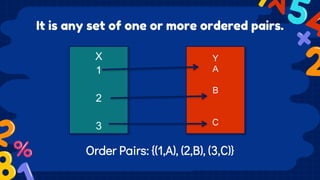
It is any set of one or more ordered pairs.
X
1
2
3
Y
A
B
C
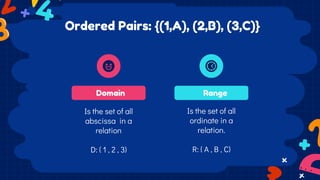
Order Pairs: {(1,A), (2,B), (3,C)}
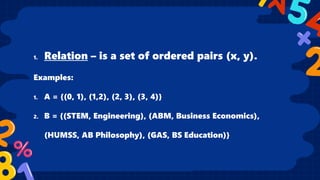
1. Relation – is a set of ordered pairs (x, y).
Examples:
1. A = {(0, 1), (1,2), (2, 3), (3, 4)}
2. B = {(STEM, Engineering), (ABM, Business Economics),
(HUMSS, AB Philosophy), (GAS, BS Education)}
Ordered Pairs: {(1,A), (2,B), (3,C)}
Range
Is the set of all
abscissa in a
relation
D: ( 1 , 2 , 3)
Is the set of all
ordinate in a
relation.
R: ( A , B , C)
Domain
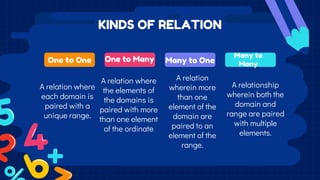
KINDS OF RELATION
One to One One to Many Many to One
Many to
Many
A relation where
each domain is
paired with a
unique range.
A relation where
the elements of
the domains is
paired with more
than one element
of the ordinate
A relation
wherein more
than one
element of the
domain are
paired to an
element of the
range.
A relationship
wherein both the
domain and
range are paired
with multiple
elements.
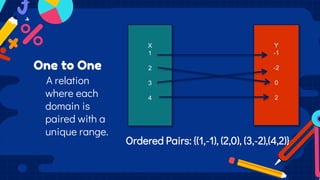
One to One
A relation
where each
domain is
paired with a
unique range.
X
1
2
3
4
Y
-1
-2
0
2
Ordered Pairs: {(1,-1), (2,0), (3,-2),(4,2)}
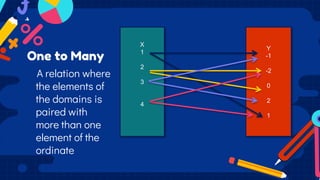
One to Many
A relation where
the elements of
the domains is
paired with
more than one
element of the
ordinate
X
1
2
3
4
Y
-1
-2
0
2
1
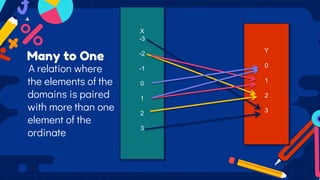
Many to One
A relation where
the elements of the
domains is paired
with more than one
element of the
ordinate
X
-3
-2
-1
0
1
2
3
Y
0
1
2
3
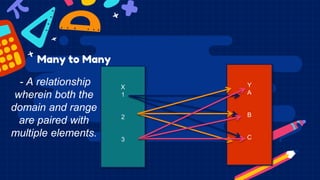
Many to Many
- A relationship
wherein both the
domain and range
are paired with
multiple elements.
X
1
2
3
Y
A
B
C
FUNCTION 02
In mathematics, a function is a set of inputs with a
single output in each case.
Every function has a domain and range. The
domain is the set of independent values of the
variable x for a relation or a function is defined.
In simple words, the domain is a set of x-
values that generate the real values of y when
substituted in the function.
FUNCTIONS
- Is a correspondence between two sets
in which each element of the domain
corresponds to exactly one range.
- In other words, it may be described as a
special type of relation wherein no two
ordered pairs have the same abscissa.
What is a Function?
It is a relation in which repetition
of any element of its domain is not
allowed. Examples:
C = {(0, 0), (-1,1), (1, 1), (-2, 4), (2, 4)} is a function.
D = {(0, 0), (1, -1)), (1, 1), (4, -2), (4, 2)} is not a function.
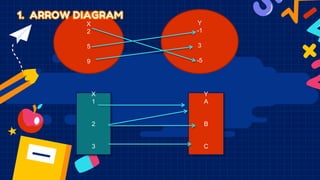
WAYS IN PRESENTING A FUNCTION OR RELATION
Arrow diagram Tabular method
Graphical method
Order Pair
X
2
5
9
Y
-1
3
-5
X
1
2
3
Y
A
B
C
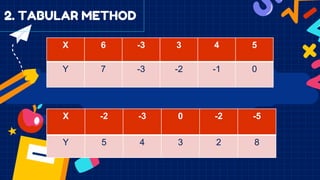
2. TABULAR METHOD
X 6 -3 3 4 5
Y 7 -3 -2 -1 0
X -2 -3 0 -2 -5
Y 5 4 3 2 8
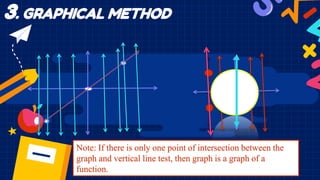
3. GRAPHICAL METHOD
Note: If there is only one point of intersection between the
graph and vertical line test, then graph is a graph of a
function.
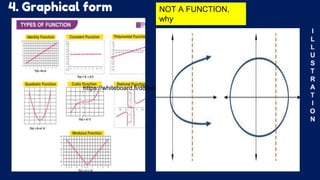
4. Graphical form NOT A FUNCTION,
why
https://whiteboard.fi/d83ye
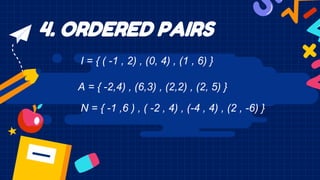
4. ORDERED PAIRS
I = { ( -1 , 2) , (0, 4) , (1 , 6) }
A = { -2,4) , (6,3) , (2,2) , (2, 5) }
N = { -1 ,6 ) , ( -2 , 4) , (-4 , 4) , (2 , -6) }
Its your
time to
practice…
Write F if function and NF in not a
function
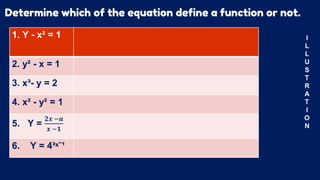
Determine which of the equation define a function or not.
1. Y - x² = 1
2. y² - x = 1
3. x³- y = 2
4. x² - y² = 1
5. Y =
𝟐𝒙 −𝒂
𝒙 −𝟏
6. Y = 4³ˣˉ¹
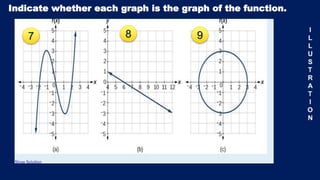
Indicate whether each graph is the graph of the function.
7 8 9
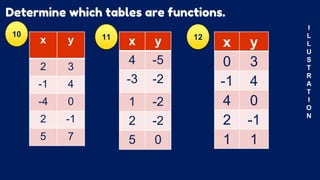
Determine which tables are functions.
x y
4 -5
-3 -2
1 -2
2 -2
5 0
x y
2 3
-1 4
-4 0
2 -1
5 7
x y
0 3
-1 4
4 0
2 -1
1 1
10 11 12
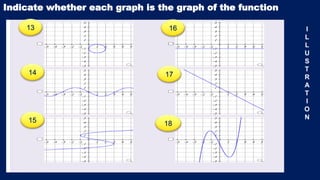
Indicate whether each graph is the graph of the function
13
14
15
16
17
18
FUNCTION NOTATI0N
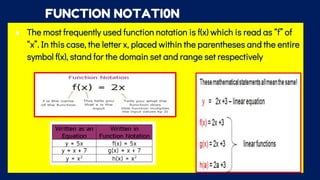
● The most frequently used function notation is f(x) which is read as “f” of
“x”. In this case, the letter x, placed within the parentheses and the entire
symbol f(x), stand for the domain set and range set respectively.
Evaluation of Function
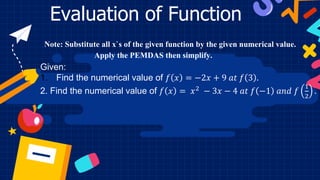
Note: Substitute all x`s of the given function by the given numerical value.
Apply the PEMDAS then simplify.
Given:
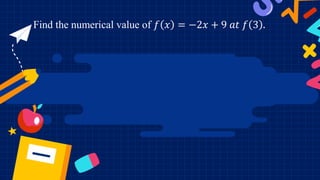
1. Find the numerical value of 𝑓 𝑥 = −2𝑥 + 9 𝑎𝑡 𝑓 3 .
2. Find the numerical value of 𝑓 𝑥 = 𝑥2
− 3𝑥 − 4 𝑎𝑡 𝑓 −1 𝑎𝑛𝑑 𝑓
1
2
.
Find the numerical value of 𝑓 𝑥 = −2𝑥 + 9 𝑎𝑡 𝑓 3 .
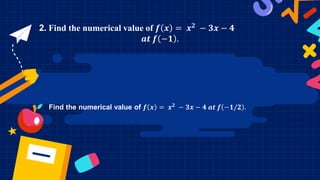
2. Find the numerical value of 𝒇 𝒙 = 𝒙𝟐 − 𝟑𝒙 − 𝟒
𝒂𝒕 𝒇 −𝟏 .
Find the numerical value of 𝒇 𝒙 = 𝒙𝟐
− 𝟑𝒙 − 𝟒 𝒂𝒕 𝒇 −𝟏/𝟐 .
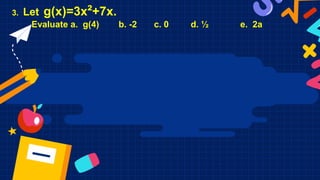
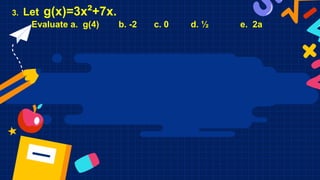
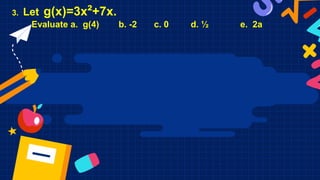
3. Let g(x)=3x²+7x.
Evaluate a. g(4) b. -2 c. 0 d. ½ e. 2a
3. Let g(x)=3x²+7x.
Evaluate a. g(4) b. -2 c. 0 d. ½ e. 2a
3. Let g(x)=3x²+7x.
Evaluate a. g(4) b. -2 c. 0 d. ½ e. 2a
THANK YOU
AND
GODBLESS

WEEK-2-FUNCTION-AND-RELATION-EVALAUTION-OF-A-FUNCTIONS.pptx

  • 1.
    Function and Relation Prepared by:Engr. Nora G. Yulo, BSChE , MS in Math, LPT
  • 2.
  • 3.
    It is anyset of one or more ordered pairs. X 1 2 3 Y A B C Order Pairs: {(1,A), (2,B), (3,C)}
  • 4.
    1. Relation –is a set of ordered pairs (x, y). Examples: 1. A = {(0, 1), (1,2), (2, 3), (3, 4)} 2. B = {(STEM, Engineering), (ABM, Business Economics), (HUMSS, AB Philosophy), (GAS, BS Education)}
  • 5.
    Ordered Pairs: {(1,A),(2,B), (3,C)} Range Is the set of all abscissa in a relation D: ( 1 , 2 , 3) Is the set of all ordinate in a relation. R: ( A , B , C) Domain
  • 6.
    KINDS OF RELATION Oneto One One to Many Many to One Many to Many A relation where each domain is paired with a unique range. A relation where the elements of the domains is paired with more than one element of the ordinate A relation wherein more than one element of the domain are paired to an element of the range. A relationship wherein both the domain and range are paired with multiple elements.
  • 7.
    One to One Arelation where each domain is paired with a unique range. X 1 2 3 4 Y -1 -2 0 2 Ordered Pairs: {(1,-1), (2,0), (3,-2),(4,2)}
  • 8.
    One to Many Arelation where the elements of the domains is paired with more than one element of the ordinate X 1 2 3 4 Y -1 -2 0 2 1
  • 9.
    Many to One Arelation where the elements of the domains is paired with more than one element of the ordinate X -3 -2 -1 0 1 2 3 Y 0 1 2 3
  • 10.
    Many to Many -A relationship wherein both the domain and range are paired with multiple elements. X 1 2 3 Y A B C
  • 11.
    FUNCTION 02 In mathematics,a function is a set of inputs with a single output in each case. Every function has a domain and range. The domain is the set of independent values of the variable x for a relation or a function is defined. In simple words, the domain is a set of x- values that generate the real values of y when substituted in the function.
  • 12.
    FUNCTIONS - Is acorrespondence between two sets in which each element of the domain corresponds to exactly one range. - In other words, it may be described as a special type of relation wherein no two ordered pairs have the same abscissa. What is a Function? It is a relation in which repetition of any element of its domain is not allowed. Examples: C = {(0, 0), (-1,1), (1, 1), (-2, 4), (2, 4)} is a function. D = {(0, 0), (1, -1)), (1, 1), (4, -2), (4, 2)} is not a function.
  • 13.
    WAYS IN PRESENTINGA FUNCTION OR RELATION Arrow diagram Tabular method Graphical method Order Pair
  • 14.
  • 15.
    2. TABULAR METHOD X6 -3 3 4 5 Y 7 -3 -2 -1 0 X -2 -3 0 -2 -5 Y 5 4 3 2 8
  • 16.
    3. GRAPHICAL METHOD Note:If there is only one point of intersection between the graph and vertical line test, then graph is a graph of a function.
  • 17.
    4. Graphical formNOT A FUNCTION, why https://whiteboard.fi/d83ye
  • 18.
    4. ORDERED PAIRS I= { ( -1 , 2) , (0, 4) , (1 , 6) } A = { -2,4) , (6,3) , (2,2) , (2, 5) } N = { -1 ,6 ) , ( -2 , 4) , (-4 , 4) , (2 , -6) }
  • 19.
    Its your time to practice… WriteF if function and NF in not a function
  • 20.
    Determine which ofthe equation define a function or not. 1. Y - x² = 1 2. y² - x = 1 3. x³- y = 2 4. x² - y² = 1 5. Y = 𝟐𝒙 −𝒂 𝒙 −𝟏 6. Y = 4³ˣˉ¹
  • 21.
    Indicate whether eachgraph is the graph of the function. 7 8 9
  • 22.
    Determine which tablesare functions. x y 4 -5 -3 -2 1 -2 2 -2 5 0 x y 2 3 -1 4 -4 0 2 -1 5 7 x y 0 3 -1 4 4 0 2 -1 1 1 10 11 12
  • 23.
    Indicate whether eachgraph is the graph of the function 13 14 15 16 17 18
  • 24.
    FUNCTION NOTATI0N ● Themost frequently used function notation is f(x) which is read as “f” of “x”. In this case, the letter x, placed within the parentheses and the entire symbol f(x), stand for the domain set and range set respectively.
  • 25.
    Evaluation of Function Note:Substitute all x`s of the given function by the given numerical value. Apply the PEMDAS then simplify. Given: 1. Find the numerical value of 𝑓 𝑥 = −2𝑥 + 9 𝑎𝑡 𝑓 3 . 2. Find the numerical value of 𝑓 𝑥 = 𝑥2 − 3𝑥 − 4 𝑎𝑡 𝑓 −1 𝑎𝑛𝑑 𝑓 1 2 .
  • 26.
    Find the numericalvalue of 𝑓 𝑥 = −2𝑥 + 9 𝑎𝑡 𝑓 3 .
  • 27.
    2. Find thenumerical value of 𝒇 𝒙 = 𝒙𝟐 − 𝟑𝒙 − 𝟒 𝒂𝒕 𝒇 −𝟏 . Find the numerical value of 𝒇 𝒙 = 𝒙𝟐 − 𝟑𝒙 − 𝟒 𝒂𝒕 𝒇 −𝟏/𝟐 .
  • 28.
    3. Let g(x)=3x²+7x. Evaluatea. g(4) b. -2 c. 0 d. ½ e. 2a
  • 29.
    3. Let g(x)=3x²+7x. Evaluatea. g(4) b. -2 c. 0 d. ½ e. 2a
  • 30.
    3. Let g(x)=3x²+7x. Evaluatea. g(4) b. -2 c. 0 d. ½ e. 2a
  • 31.

Editor's Notes

  • #21 1. functions(parabola downward) 2. Not (parabola open left) 3. function( 3rd degree 4. not (circle) 5. function (rational) 6. function exponent
  • #22 Function function not function
  • #23 Not function function function
  • #25 Therefore, function notation is a way in which a function can be represented using symbols and signs. Function notation is a simpler method of describing a function without a lengthy written explanation. The most frequently used function notation is f(x) which is read as “f” of “x”. In this case, the letter x, placed within the parentheses and the entire symbol f(x), stand for the domain set and range set respectively. Although f is the most popular letter used when writing function notation, any other letter of the alphabet can also be used either in upper or lower case. Advantages of using function notation Since most functions are represented with various variables such as; a, f, g, h, k etc., we use f(x) in order avoid confusion as to which function is being evaluated. Function notation allows to identify the independent variable with ease. Function notation also helps us to identify the element of a function which has to be examined. Consider a linear function y = 3x + 7. To write such function in function notation, we simply replace the variable y with the phrase f(x) to get;
  • #27 F(3) =3
  • #28 F(-1) =0 F(1/2) = -9/4
  • #29 G(4 ) = 76 G(-2) = -2
  • #30 G(0)=0 G(1/2= 17/4 E. G(2A) = 12A^2 +14A
  • #31 G(0)=0 G(1/2= 17/4 E. G(2A) = 12A^2 +14A