Method Development for Dynamic
                         Light Scattering


                                           Jeffrey Bodycomb, Ph.D.
                                              HORIBA Scientific
                                          www.horiba.com/us/particle


© 2013HORIBA, Ltd. All rights reserved.
Outline
         Introduction
         Suspension
         Filtration/clarification
         Sample cell choice
         Concentration
         Duration
         Number of Repeats


© 2013 HORIBA, Ltd. All rights reserved.
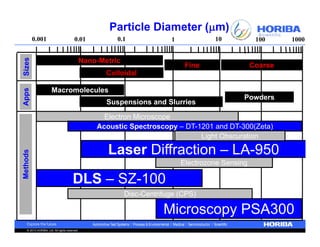
Particle Diameter (m)
          0.001                         0.01             0.1              1            10            100     1000


                                               Nano-Metric
Sizes


                                                                               Fine                 Coarse
                                                      Colloidal

                       Macromolecules
Apps


                                                                                                Powders
                                                      Suspensions and Slurries

                                                     Electron Microscope
                                                   Acoustic Spectroscopy – DT-1201 and DT-300(Zeta)
                                                                               Light Obscuration

                                                      Laser Diffraction – LA-950
Methods


                                                                              Electrozone Sensing

                                       DLS – SZ-100
                                                             Disc-Centrifuge (CPS)

                                                                        Microscopy PSA300
    © 2013 HORIBA, Ltd. All rights reserved.
Brownian Motion
Particles in suspension undergo Brownian motion due to solvent
molecule bombardment in random thermal motion.


                                            Brownian Motion
                                              Random
                                              Related to Size
                                              Related to viscosity
                                              Related to temperature

 © 2013 HORIBA, Ltd. All rights reserved.
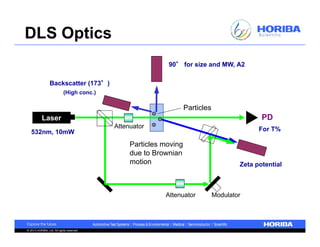
DLS Optics
                                                           90° for size and MW, A2

                 Backscatter (173°)
                            (High conc.)

                                                                   Particles
           Laser                                                                              PD
                                           Attenuator                                        For T%
   532nm, 10mW
                                                Particles moving
                                                due to Brownian
                                                motion                                 Zeta potential


                                                          Attenuator           Modulator


© 2013 HORIBA, Ltd. All rights reserved.
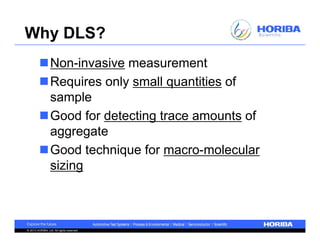
Why DLS?
         Non-invasive measurement
         Requires only small quantities of
          sample
         Good for detecting trace amounts of
          aggregate
         Good technique for macro-molecular
          sizing


© 2013 HORIBA, Ltd. All rights reserved.
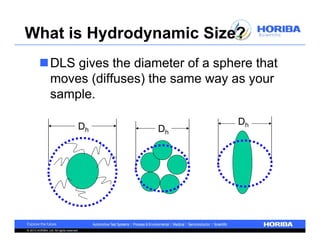
What is Hydrodynamic Size?
         DLS gives the diameter of a sphere that
          moves (diffuses) the same way as your
          sample.

                                                 Dh
                                       Dh   Dh


© 2013 HORIBA, Ltd. All rights reserved.
The SZ-100
         Single compact unit that performs size,
          zeta potential, and molecular weight
          measurements.


© 2013 HORIBA, Ltd. All rights reserved.
Suspension


© 2013HORIBA, Ltd. All rights reserved.
Measurement Error Sources
    SMALL PARTICLES
         POTENTIALLY SMALL                     C SAMPLE PREPARATION       SAMPLE EXTRACTION
          EXTRACTION ERRORS (A)
                                            %
         POTENTIALLY LARGE                                                            B
                                            E
          SAMPLE PREP ERRORS (C)
                                            R
    LARGE PARTICLES                        R

         POTENTIALLY LARGE                 O
          EXTRACTION ERRORS (B)             R   A                                      D
         POTENTIALLY SMALL                             INSTRUMENT ERROR
          SAMPLE PREP ERRORS (D)

                                                           PARTICLE SIZE


                         INSTRUMENT ERROR IS SMALL AND RELATIVELY
                                        CONSTANT


 © 2013 HORIBA, Ltd. All rights reserved.
Dispersion Strategies
          Powders
                     Choose liquid (avoid dissolution)
                     Wet powder (surfactant)
                     Dispersing aid to avoid re-agglomeration
                     Energy to break agglomerates into primary
                      particles - ultrasound
          Suspensions
                     Choose diluent
                     Energy to break agglomerates into primary
                      particles - ultrasound


© 2013 HORIBA, Ltd. All rights reserved.
Particle Wetting
                                                               PARTICLE
         Surface
          Tension must                     Small Contact
                                                           q                  q
                                                                                   Large
                                                                                  Contact
          be lowered so                       Angle                                Angle

                                           Good Wetting                   Bad Wetting
          liquid will                                        LIQUID
                                                   GOAL IS TO COMPLETELY COAT
          adhere to                                  PARTICLE WITH LIQUID
                                                             +
                                                                   +
          particles.                                    +
                                                                          +
                                                      +

                                                                          +
                                                           +
                                                               +     +


© 2013 HORIBA, Ltd. All rights reserved.
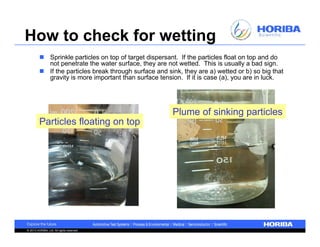
How to check for wetting
          Sprinkle particles on top of target dispersant. If the particles float on top and do
           not penetrate the water surface, they are not wetted. This is usually a bad sign.
          If the particles break through surface and sink, they are a) wetted or b) so big that
           gravity is more important than surface tension. If it is case (a), you are in luck.


                                                        Plume of sinking particles
         Particles floating on top


© 2013 HORIBA, Ltd. All rights reserved.
Changing solvents
          Working with aqueous systems is
           usually easier for many reasons.
          But don’t forget to try a less polar
           solvent such as isopropyl alcohol.
          And, don’t forget that organic solvents
           are more difficult to handle due to fire
           and health hazards.


 © 2013 HORIBA, Ltd. All rights reserved.
If the going gets tough…
          Check the literature and the web and see
           what other people use.
          Here I use Google to get the idea to use MEK
           with lead.


© 2013 HORIBA, Ltd. All rights reserved.
If the going gets tough…
         Try a series of options.
         Here I make a series of suspensions
          and check them by eye, then measure.


© 2013 HORIBA, Ltd. All rights reserved.
Effect of Surfactant
                    Addition
 Addition of surfactant to a sample         MEAN

  will disperse the particles so a          PARTICLE

  proper measurement may be                   SIZE

  made. However, addition of too
  much surfactant will cause
  agglomeration.                                       SURFACTANT CONCENTRATION


  The graph illustrates that there is an optimum amount of surfactant to effect
   optimum dispersion. The Particle Size Analyzer can determine when the
   amount of surfactant exceeds the proper concentration.
  As initial surfactant is added, the mean particle size will decrease. It will
   reach a minimum as the proper surfactant concentration is reached.
  As additional surfactant is added, the apparent mean particle size will
   increase, indicating agglomeration of particles.
  Common concentration: 0.01-0.1%


 © 2013 HORIBA, Ltd. All rights reserved.
Dispersion: Ultrasonic
                 Energy
          Ultrasonic waves generate                          Ultrasonic Bath
           microscopic bubbles or cavities
           (cavitation) which produce shearing
           action causing the liquid and
           suspended particles to become
           intensely agitated.

            Agglomerates are broken apart.
            In some cases fragile particles are shattered.
            The selection of appropriate type and level of
             ultrasonic energy must be made carefully.


                                                               Ultrasonic Probe


© 2013 HORIBA, Ltd. All rights reserved.
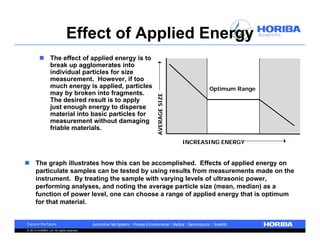
Effect of Applied Energy
          The effect of applied energy is to
           break up agglomerates into
           individual particles for size
           measurement. However, if too
           much energy is applied, particles                          Optimum Range
           may by broken into fragments.


                                                AVERAGE SIZE
           The desired result is to apply
           just enough energy to disperse
           material into basic particles for
           measurement without damaging
           friable materials.

                                                               INCREASING ENERGY


 The graph illustrates how this can be accomplished. Effects of applied energy on
  particulate samples can be tested by using results from measurements made on the
  instrument. By treating the sample with varying levels of ultrasonic power,
  performing analyses, and noting the average particle size (mean, median) as a
  function of power level, one can choose a range of applied energy that is optimum
  for that material.


© 2013 HORIBA, Ltd. All rights reserved.
Filtration/Clarification

                                      Because large dust particles scatter more than
                                                     nanoparticles


© 2013HORIBA, Ltd. All rights reserved.
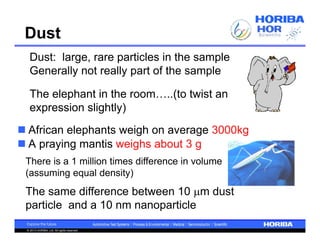
Dust
   Dust: large, rare particles in the sample
   Generally not really part of the sample

   The elephant in the room…..(to twist an
   expression slightly)
 African elephants weigh on average 3000kg
 A praying mantis weighs about 3 g
 There is a 1 million times difference in volume
 (assuming equal density)
 The same difference between 10 m dust
 particle and a 10 nm nanoparticle

 © 2013 HORIBA, Ltd. All rights reserved.
What happens?
 If you see elephants
  (dust), it is hard to notice
  the praying mantis’
  (nanoparticles).


 Use a fence (filter) to keep
  out the elephants….


  © 2013 HORIBA, Ltd. All rights reserved.
Filtering Sample
         If sample has large particle
          contamination and particle is small
          enough to pass through a filter, then
          filter entire suspension.
         If filtering sample, be careful! Filtering
          can remove large particle contamination
          that is important.
         Choose filter with pore size twice the
          size of the largest particle of interest.
         I generally use 0.1 or 0.2 micron filters
© 2013 HORIBA, Ltd. All rights reserved.
Choosing Filters
    Syringe type filters stay sealed (less
     introduction of dust from outside)
    Diameter
                10 mm diameter – cheaper, good for small volumes,
                 less holdup
                25 mm diameter – a little more expensive, more
                 holdup, but last for larger volumes (e.g., diluent)


© 2013 HORIBA, Ltd. All rights reserved.
Choosing Filters
         Material: Many                   Whatman filter materials:
          materials are
          available
         Choose material
          based on
          compatibility with
          your sample and
          liquid.
         Pay attention to
          price
© 2013 HORIBA, Ltd. All rights reserved.
Sample Cell Choice
 Material
            Plastic
                      – Much less expensive (disposable)
                      – Not very chemically resistant
            Glass
                      – More expensive
                      – Good chemical resistance.

 As cell volume decreases:
            More expensive
            More difficult to clean
            Less sample required


© 2013 HORIBA, Ltd. All rights reserved.
Concentration


© 2013HORIBA, Ltd. All rights reserved.
Sample Concentration
         Too low
                    Noisy data
                    Too few particles for Siegert relationship
                     (usually not an issue)
                    Theory assumes limit of near- zero
                     concentration (and zero particle-particle
                     interactions.
         Too high
                    Particle – Particle Interactions
                    Multiple Scattering

© 2013 HORIBA, Ltd. All rights reserved.
Measurement
      Make a plot like this to learn range of concentrations for your sample.
      Tails of distribution have an effect..


                                           Error bar is 1 SD in repeated
                                           measurements


© 2013 HORIBA, Ltd. All rights reserved.
Eyeballing it
         Samples up to little bit cloudy are OK.
         I tend to pick samples that are clear or
          just slightly cloudy.


                                           Best range for this material
© 2013 HORIBA, Ltd. All rights reserved.
Diluent and Concentration
Note that when we suppress effect of charges by adding
salt, the effect of concentration is suppressed.


  © 2013 HORIBA, Ltd. All rights reserved.
Eyeballing it
         Clear samples are better (smaller
          particle size)


                          Best range for this material
© 2013 HORIBA, Ltd. All rights reserved.
Measurement Duration
         Time to reach thermal equilibrium after
          inserting cell into instrument.

         How long to measure?
                    1 to 2 minutes per repeat is typical
         Number of repeats?
                    3 to 6 is typical


© 2013 HORIBA, Ltd. All rights reserved.
How Many Repeats?
         Confidence interval, C, on mean
          (assume normal distribution)
                                   t / 2,n 1S              C I t / 2,n 1S         t / 2,n 1
                CI                                                           COV *
                                           n                 M    M n                       n
                   n (num                      t(0.10,n-1)    t/sqrt(n)     0.05*t/sqrt(n)
                   repeats)
                   2                           6.31           4.46          22%
                   3                           2.92           1.68          8.4%
                   4                           2.35           1.18          5.9%
                                                                                              typical
                   5                           2.13           0.95          4.8%
                   6                           2.01           0.82          4.1%


© 2013 HORIBA, Ltd. All rights reserved.
Q&A
           Ask a question at labinfo@horiba.com

           Keep reading the monthly HORIBA Particle
           e-mail newsletter!

           Visit the Download Center to find the video and slides
           from this webinar.

           Jeff Bodycomb, Ph.D.
           P: 866-562-4698
           E: jeff.bodycomb@horiba.com


© 2013 HORIBA, Ltd. All rights reserved.
Thank you


© 2013 HORIBA, Ltd. All rights reserved.
ありがとうございました
                                                                              Cảm ơn
      Dziękuję                                         ขอบคุณครับ
                                                                       谢谢
                                           Gracias
                                                                                Grazie
                       ُْ
                      ‫اشكر‬                      Σας ευχαριστούμε    धन्यवाद
Tacka                                                                         நன்ற
                                             Danke
                                                                                Obrigado
              감사합니다                                  Большое спасибо


© 2013 HORIBA, Ltd. All rights reserved.

Method Development for Dynamic Light Scattering

  • 1.
    Method Development forDynamic Light Scattering Jeffrey Bodycomb, Ph.D. HORIBA Scientific www.horiba.com/us/particle © 2013HORIBA, Ltd. All rights reserved.
  • 2.
    Outline Introduction Suspension Filtration/clarification Sample cell choice Concentration Duration Number of Repeats © 2013 HORIBA, Ltd. All rights reserved.
  • 3.
    Particle Diameter (m) 0.001 0.01 0.1 1 10 100 1000 Nano-Metric Sizes Fine Coarse Colloidal Macromolecules Apps Powders Suspensions and Slurries Electron Microscope Acoustic Spectroscopy – DT-1201 and DT-300(Zeta) Light Obscuration Laser Diffraction – LA-950 Methods Electrozone Sensing DLS – SZ-100 Disc-Centrifuge (CPS) Microscopy PSA300 © 2013 HORIBA, Ltd. All rights reserved.
  • 4.
    Brownian Motion Particles insuspension undergo Brownian motion due to solvent molecule bombardment in random thermal motion. Brownian Motion Random Related to Size Related to viscosity Related to temperature © 2013 HORIBA, Ltd. All rights reserved.
  • 5.
    DLS Optics 90° for size and MW, A2 Backscatter (173°) (High conc.) Particles Laser PD Attenuator For T% 532nm, 10mW Particles moving due to Brownian motion Zeta potential Attenuator Modulator © 2013 HORIBA, Ltd. All rights reserved.
  • 6.
    Why DLS? Non-invasive measurement Requires only small quantities of sample Good for detecting trace amounts of aggregate Good technique for macro-molecular sizing © 2013 HORIBA, Ltd. All rights reserved.
  • 7.
    What is HydrodynamicSize? DLS gives the diameter of a sphere that moves (diffuses) the same way as your sample. Dh Dh Dh © 2013 HORIBA, Ltd. All rights reserved.
  • 8.
    The SZ-100 Single compact unit that performs size, zeta potential, and molecular weight measurements. © 2013 HORIBA, Ltd. All rights reserved.
  • 9.
    Suspension © 2013HORIBA, Ltd.All rights reserved.
  • 10.
    Measurement Error Sources  SMALL PARTICLES  POTENTIALLY SMALL C SAMPLE PREPARATION SAMPLE EXTRACTION EXTRACTION ERRORS (A) %  POTENTIALLY LARGE B E SAMPLE PREP ERRORS (C) R  LARGE PARTICLES R  POTENTIALLY LARGE O EXTRACTION ERRORS (B) R A D  POTENTIALLY SMALL INSTRUMENT ERROR SAMPLE PREP ERRORS (D) PARTICLE SIZE  INSTRUMENT ERROR IS SMALL AND RELATIVELY CONSTANT © 2013 HORIBA, Ltd. All rights reserved.
  • 11.
    Dispersion Strategies  Powders  Choose liquid (avoid dissolution)  Wet powder (surfactant)  Dispersing aid to avoid re-agglomeration  Energy to break agglomerates into primary particles - ultrasound  Suspensions  Choose diluent  Energy to break agglomerates into primary particles - ultrasound © 2013 HORIBA, Ltd. All rights reserved.
  • 12.
    Particle Wetting PARTICLE Surface Tension must Small Contact q q Large Contact be lowered so Angle Angle Good Wetting Bad Wetting liquid will LIQUID GOAL IS TO COMPLETELY COAT adhere to PARTICLE WITH LIQUID + + particles. + + + + + + + © 2013 HORIBA, Ltd. All rights reserved.
  • 13.
    How to checkfor wetting  Sprinkle particles on top of target dispersant. If the particles float on top and do not penetrate the water surface, they are not wetted. This is usually a bad sign.  If the particles break through surface and sink, they are a) wetted or b) so big that gravity is more important than surface tension. If it is case (a), you are in luck. Plume of sinking particles Particles floating on top © 2013 HORIBA, Ltd. All rights reserved.
  • 14.
    Changing solvents Working with aqueous systems is usually easier for many reasons. But don’t forget to try a less polar solvent such as isopropyl alcohol. And, don’t forget that organic solvents are more difficult to handle due to fire and health hazards. © 2013 HORIBA, Ltd. All rights reserved.
  • 15.
    If the goinggets tough…  Check the literature and the web and see what other people use.  Here I use Google to get the idea to use MEK with lead. © 2013 HORIBA, Ltd. All rights reserved.
  • 16.
    If the goinggets tough… Try a series of options. Here I make a series of suspensions and check them by eye, then measure. © 2013 HORIBA, Ltd. All rights reserved.
  • 17.
    Effect of Surfactant Addition  Addition of surfactant to a sample MEAN will disperse the particles so a PARTICLE proper measurement may be SIZE made. However, addition of too much surfactant will cause agglomeration. SURFACTANT CONCENTRATION  The graph illustrates that there is an optimum amount of surfactant to effect optimum dispersion. The Particle Size Analyzer can determine when the amount of surfactant exceeds the proper concentration.  As initial surfactant is added, the mean particle size will decrease. It will reach a minimum as the proper surfactant concentration is reached.  As additional surfactant is added, the apparent mean particle size will increase, indicating agglomeration of particles.  Common concentration: 0.01-0.1% © 2013 HORIBA, Ltd. All rights reserved.
  • 18.
    Dispersion: Ultrasonic Energy  Ultrasonic waves generate Ultrasonic Bath microscopic bubbles or cavities (cavitation) which produce shearing action causing the liquid and suspended particles to become intensely agitated.  Agglomerates are broken apart.  In some cases fragile particles are shattered.  The selection of appropriate type and level of ultrasonic energy must be made carefully. Ultrasonic Probe © 2013 HORIBA, Ltd. All rights reserved.
  • 19.
    Effect of AppliedEnergy  The effect of applied energy is to break up agglomerates into individual particles for size measurement. However, if too much energy is applied, particles Optimum Range may by broken into fragments. AVERAGE SIZE The desired result is to apply just enough energy to disperse material into basic particles for measurement without damaging friable materials. INCREASING ENERGY  The graph illustrates how this can be accomplished. Effects of applied energy on particulate samples can be tested by using results from measurements made on the instrument. By treating the sample with varying levels of ultrasonic power, performing analyses, and noting the average particle size (mean, median) as a function of power level, one can choose a range of applied energy that is optimum for that material. © 2013 HORIBA, Ltd. All rights reserved.
  • 20.
    Filtration/Clarification Because large dust particles scatter more than nanoparticles © 2013HORIBA, Ltd. All rights reserved.
  • 21.
    Dust Dust: large, rare particles in the sample Generally not really part of the sample The elephant in the room…..(to twist an expression slightly)  African elephants weigh on average 3000kg  A praying mantis weighs about 3 g There is a 1 million times difference in volume (assuming equal density) The same difference between 10 m dust particle and a 10 nm nanoparticle © 2013 HORIBA, Ltd. All rights reserved.
  • 22.
    What happens?  Ifyou see elephants (dust), it is hard to notice the praying mantis’ (nanoparticles).  Use a fence (filter) to keep out the elephants…. © 2013 HORIBA, Ltd. All rights reserved.
  • 23.
    Filtering Sample If sample has large particle contamination and particle is small enough to pass through a filter, then filter entire suspension. If filtering sample, be careful! Filtering can remove large particle contamination that is important. Choose filter with pore size twice the size of the largest particle of interest. I generally use 0.1 or 0.2 micron filters © 2013 HORIBA, Ltd. All rights reserved.
  • 24.
    Choosing Filters  Syringe type filters stay sealed (less introduction of dust from outside)  Diameter  10 mm diameter – cheaper, good for small volumes, less holdup  25 mm diameter – a little more expensive, more holdup, but last for larger volumes (e.g., diluent) © 2013 HORIBA, Ltd. All rights reserved.
  • 25.
    Choosing Filters Material: Many Whatman filter materials: materials are available Choose material based on compatibility with your sample and liquid. Pay attention to price © 2013 HORIBA, Ltd. All rights reserved.
  • 26.
    Sample Cell Choice Material  Plastic – Much less expensive (disposable) – Not very chemically resistant  Glass – More expensive – Good chemical resistance.  As cell volume decreases:  More expensive  More difficult to clean  Less sample required © 2013 HORIBA, Ltd. All rights reserved.
  • 27.
  • 28.
    Sample Concentration Too low Noisy data Too few particles for Siegert relationship (usually not an issue) Theory assumes limit of near- zero concentration (and zero particle-particle interactions. Too high Particle – Particle Interactions Multiple Scattering © 2013 HORIBA, Ltd. All rights reserved.
  • 29.
    Measurement  Make a plot like this to learn range of concentrations for your sample.  Tails of distribution have an effect.. Error bar is 1 SD in repeated measurements © 2013 HORIBA, Ltd. All rights reserved.
  • 30.
    Eyeballing it Samples up to little bit cloudy are OK. I tend to pick samples that are clear or just slightly cloudy. Best range for this material © 2013 HORIBA, Ltd. All rights reserved.
  • 31.
    Diluent and Concentration Notethat when we suppress effect of charges by adding salt, the effect of concentration is suppressed. © 2013 HORIBA, Ltd. All rights reserved.
  • 32.
    Eyeballing it Clear samples are better (smaller particle size) Best range for this material © 2013 HORIBA, Ltd. All rights reserved.
  • 33.
    Measurement Duration Time to reach thermal equilibrium after inserting cell into instrument. How long to measure? 1 to 2 minutes per repeat is typical Number of repeats? 3 to 6 is typical © 2013 HORIBA, Ltd. All rights reserved.
  • 34.
    How Many Repeats? Confidence interval, C, on mean (assume normal distribution) t / 2,n 1S C I t / 2,n 1S t / 2,n 1 CI    COV * n M M n n n (num t(0.10,n-1) t/sqrt(n) 0.05*t/sqrt(n) repeats) 2 6.31 4.46 22% 3 2.92 1.68 8.4% 4 2.35 1.18 5.9% typical 5 2.13 0.95 4.8% 6 2.01 0.82 4.1% © 2013 HORIBA, Ltd. All rights reserved.
  • 35.
    Q&A Ask a question at labinfo@horiba.com Keep reading the monthly HORIBA Particle e-mail newsletter! Visit the Download Center to find the video and slides from this webinar. Jeff Bodycomb, Ph.D. P: 866-562-4698 E: jeff.bodycomb@horiba.com © 2013 HORIBA, Ltd. All rights reserved.
  • 36.
    Thank you © 2013HORIBA, Ltd. All rights reserved.
  • 37.
    ありがとうございました Cảm ơn Dziękuję ขอบคุณครับ 谢谢 Gracias Grazie ُْ ‫اشكر‬ Σας ευχαριστούμε धन्यवाद Tacka நன்ற Danke Obrigado 감사합니다 Большое спасибо © 2013 HORIBA, Ltd. All rights reserved.