HYDROGELS
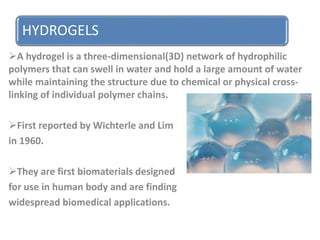
A hydrogel is a three-dimensional(3D) network of hydrophilic
polymers that can swell in water and hold a large amount of water
while maintaining the structure due to chemical or physical cross-
linking of individual polymer chains.
First reported by Wichterle and Lim
in 1960.
They are first biomaterials designed
for use in human body and are finding
widespread biomedical applications.
SOME IMPORTANT POINTS:
• By definition, water must constitute at least 10% of the total
weight (or volume) for a material to be a hydrogel.
• Hydrogels on exposed in a thermodynamically compatible solvent
(water or any biological fluid), can entrap a large fraction of
solvent within the pores or interstitial spaces and can achieve a
fully swollen state.
• The hydrophilicity of the network is due to the presence of
hydrophilic groups such as –NH2, -COOH, -OH, -CONH2, -CONH-
and SO3H.
• The presence of cross-links makes it resistant to dissolution in the
aqueous medium.
Classification
 On the basis of Preparation :
- Homo-polymer
- Copolymer
- Semi-interpenetrating network
- Interpenetrating network
 On the basis of cross linking :
- Chemical hydrogels
- Physical hydrogels
Application of Hydrogels :
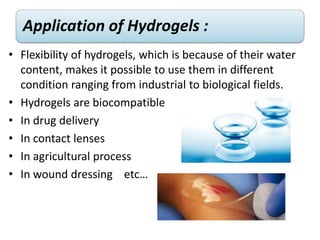
• Flexibility of hydrogels, which is because of their water
content, makes it possible to use them in different
condition ranging from industrial to biological fields.
• Hydrogels are biocompatible
• In drug delivery
• In contact lenses
• In agricultural process
• In wound dressing etc…
Disadvantages of Hydrogels :
• Hydrogels are expensive
• Hydrogels have low mechanical strength
• Difficulty in handling
• They are non-adherent and may need to be
secured by a secondary dressing
• Difficulty in loading
• Difficult to be sterilized

HYDROGEL PPT.pptx

  • 1.
    HYDROGELS A hydrogel isa three-dimensional(3D) network of hydrophilic polymers that can swell in water and hold a large amount of water while maintaining the structure due to chemical or physical cross- linking of individual polymer chains. First reported by Wichterle and Lim in 1960. They are first biomaterials designed for use in human body and are finding widespread biomedical applications.
  • 2.
    SOME IMPORTANT POINTS: •By definition, water must constitute at least 10% of the total weight (or volume) for a material to be a hydrogel. • Hydrogels on exposed in a thermodynamically compatible solvent (water or any biological fluid), can entrap a large fraction of solvent within the pores or interstitial spaces and can achieve a fully swollen state. • The hydrophilicity of the network is due to the presence of hydrophilic groups such as –NH2, -COOH, -OH, -CONH2, -CONH- and SO3H. • The presence of cross-links makes it resistant to dissolution in the aqueous medium.
  • 3.
    Classification  On thebasis of Preparation : - Homo-polymer - Copolymer - Semi-interpenetrating network - Interpenetrating network  On the basis of cross linking : - Chemical hydrogels - Physical hydrogels
  • 4.
    Application of Hydrogels: • Flexibility of hydrogels, which is because of their water content, makes it possible to use them in different condition ranging from industrial to biological fields. • Hydrogels are biocompatible • In drug delivery • In contact lenses • In agricultural process • In wound dressing etc…
  • 5.
    Disadvantages of Hydrogels: • Hydrogels are expensive • Hydrogels have low mechanical strength • Difficulty in handling • They are non-adherent and may need to be secured by a secondary dressing • Difficulty in loading • Difficult to be sterilized