Atomic Force Microscope
Fundamental Principles
-Joy Bhattacharjee
IIT Kanpur.
Co-Founder & Director,
Kanopy Techno Solutions
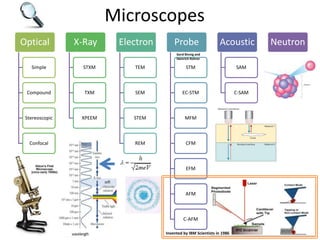
Microscopes
Optical
Simple
Compound
Stereoscopic
Confocal
X-Ray
STXM
TXM
XPEEM
Electron
TEM
SEM
STEM
REM
Probe
STM
EC-STM
MFM
CFM
EFM
AFM
C-AFM
Acoustic
SAM
C-SAM
Neutron
Invented by IBM Scientists in 1986
Gerd Binnig and
Heinrich Rohrer
AFM
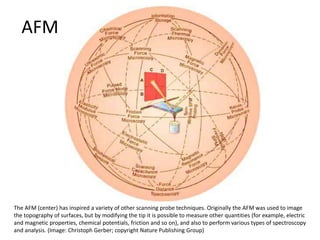
The AFM (center) has inspired a variety of other scanning probe techniques. Originally the AFM was used to image
the topography of surfaces, but by modifying the tip it is possible to measure other quantities (for example, electric
and magnetic properties, chemical potentials, friction and so on), and also to perform various types of spectroscopy
and analysis. (Image: Christoph Gerber; copyright Nature Publishing Group)
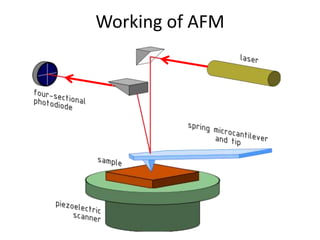
Working of AFM
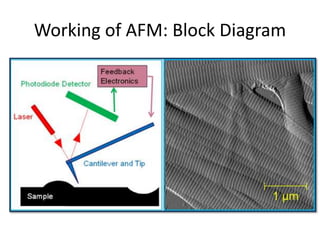
Working of AFM: Block Diagram
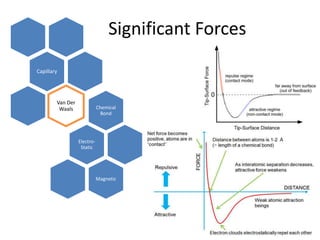
Significant Forces
Capillary
Van Der
Waals Chemical
Bond
Electro-
Static
Magnetic
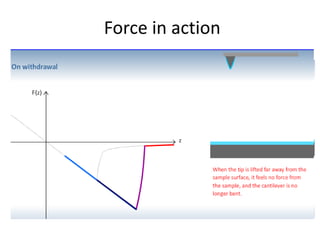
Force in action
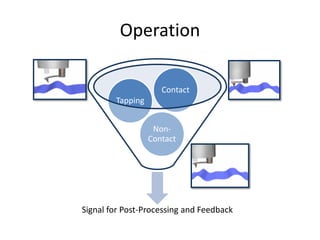
Operation
Signal for Post-Processing and Feedback
Non-
Contact
Tapping
Contact
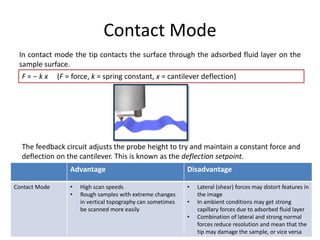
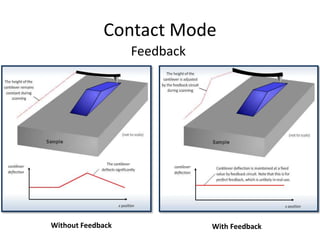
Contact Mode
In contact mode the tip contacts the surface through the adsorbed fluid layer on the
sample surface.
The feedback circuit adjusts the probe height to try and maintain a constant force and
deflection on the cantilever. This is known as the deflection setpoint.
F = − k x (F = force, k = spring constant, x = cantilever deflection)
Advantage Disadvantage
Contact Mode • High scan speeds
• Rough samples with extreme changes
in vertical topography can sometimes
be scanned more easily
• Lateral (shear) forces may distort features in
the image
• In ambient conditions may get strong
capillary forces due to adsorbed fluid layer
• Combination of lateral and strong normal
forces reduce resolution and mean that the
tip may damage the sample, or vice versa
Feedback
Without Feedback With Feedback
Contact Mode
Tapping Mode
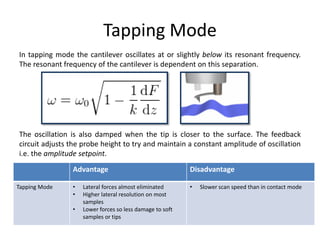
In tapping mode the cantilever oscillates at or slightly below its resonant frequency.
The resonant frequency of the cantilever is dependent on this separation.
The oscillation is also damped when the tip is closer to the surface. The feedback
circuit adjusts the probe height to try and maintain a constant amplitude of oscillation
i.e. the amplitude setpoint.
Advantage Disadvantage
Tapping Mode • Lateral forces almost eliminated
• Higher lateral resolution on most
samples
• Lower forces so less damage to soft
samples or tips
• Slower scan speed than in contact mode
Non-Contact Mode
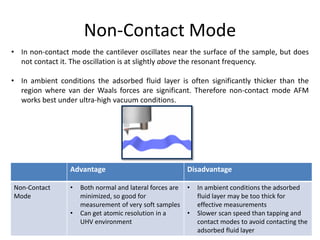
• In non-contact mode the cantilever oscillates near the surface of the sample, but does
not contact it. The oscillation is at slightly above the resonant frequency.
• In ambient conditions the adsorbed fluid layer is often significantly thicker than the
region where van der Waals forces are significant. Therefore non-contact mode AFM
works best under ultra-high vacuum conditions.
Advantage Disadvantage
Non-Contact
Mode
• Both normal and lateral forces are
minimized, so good for
measurement of very soft samples
• Can get atomic resolution in a
UHV environment
• In ambient conditions the adsorbed
fluid layer may be too thick for
effective measurements
• Slower scan speed than tapping and
contact modes to avoid contacting the
adsorbed fluid layer
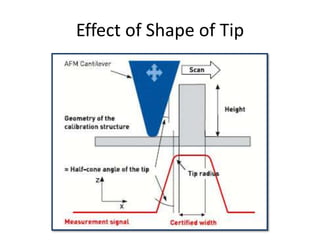
Effect of Shape of Tip
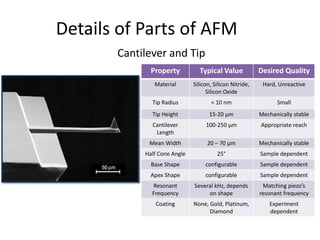
Details of Parts of AFM
Property Typical Value Desired Quality
Material Silicon, Silicon Nitride,
Silicon Oxide
Hard, Unreactive
Tip Radius < 10 nm Small
Tip Height 15-20 µm Mechanically stable
Cantilever
Length
100-250 µm Appropriate reach
Mean Width 20 – 70 µm Mechanically stable
Half Cone Angle 25° Sample dependent
Base Shape configurable Sample dependent
Apex Shape configurable Sample dependent
Resonant
Frequency
Several kHz, depends
on shape
Matching piezo’s
resonant frequency
Coating None, Gold, Platinum,
Diamond
Experiment
dependent
Cantilever and Tip
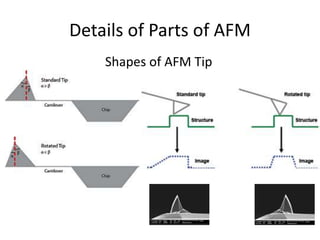
Details of Parts of AFM
Shapes of AFM Tip
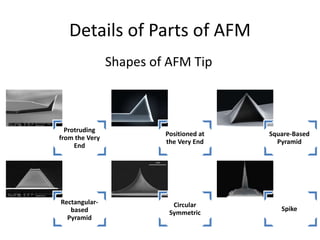
Details of Parts of AFM
Shapes of AFM Tip
Protruding
from the Very
End
Positioned at
the Very End
Square-Based
Pyramid
Rectangular-
based
Pyramid
Circular
Symmetric
Spike
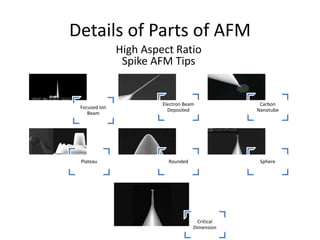
Details of Parts of AFM
High Aspect Ratio
Spike AFM Tips
Focused Ion
Beam
Electron Beam
Deposited
Carbon
Nanotube
Plateau Rounded Sphere
Critical
Dimension
Details of Parts of AFM
Scanner
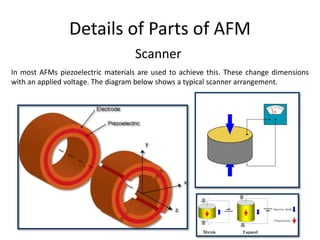
In most AFMs piezoelectric materials are used to achieve this. These change dimensions
with an applied voltage. The diagram below shows a typical scanner arrangement.
Details of Parts of AFM
Scanner
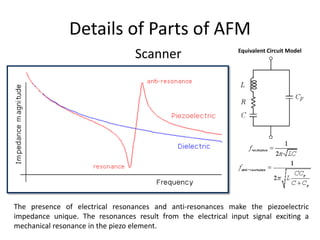
The presence of electrical resonances and anti-resonances make the piezoelectric
impedance unique. The resonances result from the electrical input signal exciting a
mechanical resonance in the piezo element.
Equivalent Circuit Model
Details of Parts of AFM
Feedback
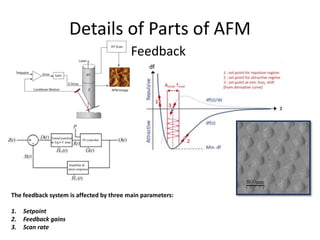
The feedback system is affected by three main parameters:
1. Setpoint
2. Feedback gains
3. Scan rate
Optical AFM
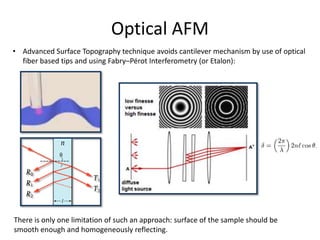
• Advanced Surface Topography technique avoids cantilever mechanism by use of optical
fiber based tips and using Fabry–Pérot Interferometry (or Etalon):
There is only one limitation of such an approach: surface of the sample should be
smooth enough and homogeneously reflecting.
Artefacts in AFM
Scanner Related
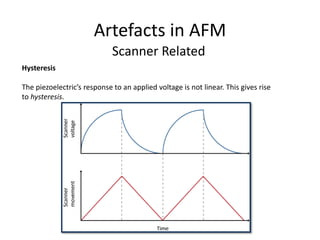
Hysteresis
The piezoelectric’s response to an applied voltage is not linear. This gives rise
to hysteresis.
Artefacts in AFM
Scanner Related
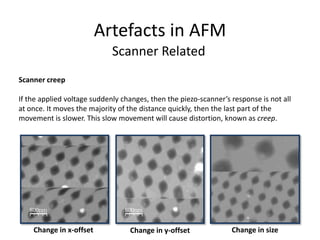
Scanner creep
If the applied voltage suddenly changes, then the piezo-scanner’s response is not all
at once. It moves the majority of the distance quickly, then the last part of the
movement is slower. This slow movement will cause distortion, known as creep.
Change in x-offset Change in y-offset Change in size
Artefacts in AFM
Scanner Related
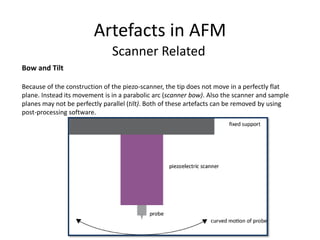
Bow and Tilt
Because of the construction of the piezo-scanner, the tip does not move in a perfectly flat
plane. Instead its movement is in a parabolic arc (scanner bow). Also the scanner and sample
planes may not be perfectly parallel (tilt). Both of these artefacts can be removed by using
post-processing software.
Artefacts in AFM
Tip Related
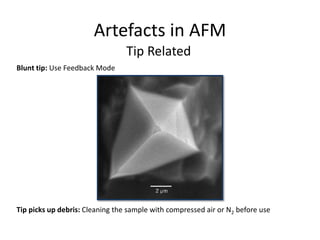
Blunt tip: Use Feedback Mode
Tip picks up debris: Cleaning the sample with compressed air or N2 before use
Artefacts in AFM
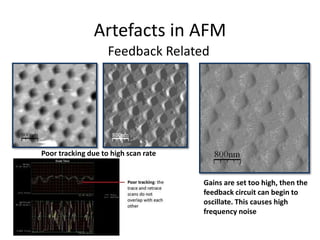
Feedback Related
Poor tracking due to high scan rate
Gains are set too high, then the
feedback circuit can begin to
oscillate. This causes high
frequency noise
Artefacts in AFM
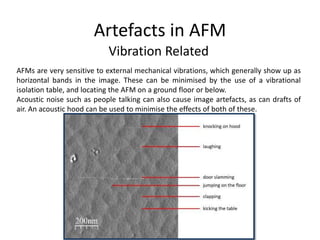
Vibration Related
AFMs are very sensitive to external mechanical vibrations, which generally show up as
horizontal bands in the image. These can be minimised by the use of a vibrational
isolation table, and locating the AFM on a ground floor or below.
Acoustic noise such as people talking can also cause image artefacts, as can drafts of
air. An acoustic hood can be used to minimise the effects of both of these.
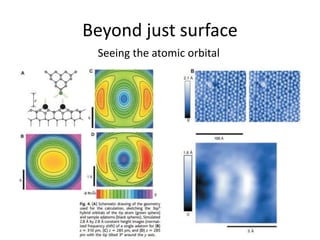
Beyond just surface
Seeing the atomic orbital
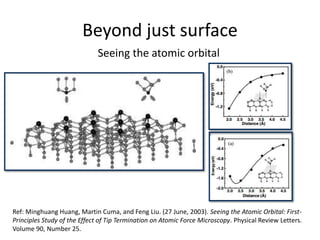
Beyond just surface
Seeing the atomic orbital
Ref: Minghuang Huang, Martin Cuma, and Feng Liu. (27 June, 2003). Seeing the Atomic Orbital: First-
Principles Study of the Effect of Tip Termination on Atomic Force Microscopy. Physical Review Letters.
Volume 90, Number 25.
Beyond just surface
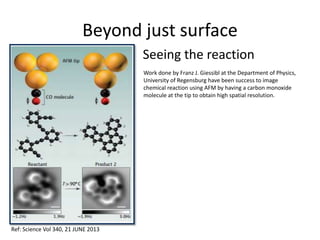
Seeing the reaction
Work done by Franz J. Giessibl at the Department of Physics,
University of Regensburg have been success to image
chemical reaction using AFM by having a carbon monoxide
molecule at the tip to obtain high spatial resolution.
Ref: Science Vol 340, 21 JUNE 2013
Atomic Force Microscope: Fundamental Principles

Atomic Force Microscope: Fundamental Principles

  • 1.
    Atomic Force Microscope FundamentalPrinciples -Joy Bhattacharjee IIT Kanpur. Co-Founder & Director, Kanopy Techno Solutions
  • 2.
  • 3.
    AFM The AFM (center)has inspired a variety of other scanning probe techniques. Originally the AFM was used to image the topography of surfaces, but by modifying the tip it is possible to measure other quantities (for example, electric and magnetic properties, chemical potentials, friction and so on), and also to perform various types of spectroscopy and analysis. (Image: Christoph Gerber; copyright Nature Publishing Group)
  • 4.
  • 5.
    Working of AFM:Block Diagram
  • 6.
    Significant Forces Capillary Van Der WaalsChemical Bond Electro- Static Magnetic
  • 7.
  • 8.
    Operation Signal for Post-Processingand Feedback Non- Contact Tapping Contact
  • 9.
    Contact Mode In contactmode the tip contacts the surface through the adsorbed fluid layer on the sample surface. The feedback circuit adjusts the probe height to try and maintain a constant force and deflection on the cantilever. This is known as the deflection setpoint. F = − k x (F = force, k = spring constant, x = cantilever deflection) Advantage Disadvantage Contact Mode • High scan speeds • Rough samples with extreme changes in vertical topography can sometimes be scanned more easily • Lateral (shear) forces may distort features in the image • In ambient conditions may get strong capillary forces due to adsorbed fluid layer • Combination of lateral and strong normal forces reduce resolution and mean that the tip may damage the sample, or vice versa
  • 10.
    Feedback Without Feedback WithFeedback Contact Mode
  • 11.
    Tapping Mode In tappingmode the cantilever oscillates at or slightly below its resonant frequency. The resonant frequency of the cantilever is dependent on this separation. The oscillation is also damped when the tip is closer to the surface. The feedback circuit adjusts the probe height to try and maintain a constant amplitude of oscillation i.e. the amplitude setpoint. Advantage Disadvantage Tapping Mode • Lateral forces almost eliminated • Higher lateral resolution on most samples • Lower forces so less damage to soft samples or tips • Slower scan speed than in contact mode
  • 12.
    Non-Contact Mode • Innon-contact mode the cantilever oscillates near the surface of the sample, but does not contact it. The oscillation is at slightly above the resonant frequency. • In ambient conditions the adsorbed fluid layer is often significantly thicker than the region where van der Waals forces are significant. Therefore non-contact mode AFM works best under ultra-high vacuum conditions. Advantage Disadvantage Non-Contact Mode • Both normal and lateral forces are minimized, so good for measurement of very soft samples • Can get atomic resolution in a UHV environment • In ambient conditions the adsorbed fluid layer may be too thick for effective measurements • Slower scan speed than tapping and contact modes to avoid contacting the adsorbed fluid layer
  • 13.
  • 14.
    Details of Partsof AFM Property Typical Value Desired Quality Material Silicon, Silicon Nitride, Silicon Oxide Hard, Unreactive Tip Radius < 10 nm Small Tip Height 15-20 µm Mechanically stable Cantilever Length 100-250 µm Appropriate reach Mean Width 20 – 70 µm Mechanically stable Half Cone Angle 25° Sample dependent Base Shape configurable Sample dependent Apex Shape configurable Sample dependent Resonant Frequency Several kHz, depends on shape Matching piezo’s resonant frequency Coating None, Gold, Platinum, Diamond Experiment dependent Cantilever and Tip
  • 15.
    Details of Partsof AFM Shapes of AFM Tip
  • 16.
    Details of Partsof AFM Shapes of AFM Tip Protruding from the Very End Positioned at the Very End Square-Based Pyramid Rectangular- based Pyramid Circular Symmetric Spike
  • 17.
    Details of Partsof AFM High Aspect Ratio Spike AFM Tips Focused Ion Beam Electron Beam Deposited Carbon Nanotube Plateau Rounded Sphere Critical Dimension
  • 18.
    Details of Partsof AFM Scanner In most AFMs piezoelectric materials are used to achieve this. These change dimensions with an applied voltage. The diagram below shows a typical scanner arrangement.
  • 19.
    Details of Partsof AFM Scanner The presence of electrical resonances and anti-resonances make the piezoelectric impedance unique. The resonances result from the electrical input signal exciting a mechanical resonance in the piezo element. Equivalent Circuit Model
  • 20.
    Details of Partsof AFM Feedback The feedback system is affected by three main parameters: 1. Setpoint 2. Feedback gains 3. Scan rate
  • 21.
    Optical AFM • AdvancedSurface Topography technique avoids cantilever mechanism by use of optical fiber based tips and using Fabry–Pérot Interferometry (or Etalon): There is only one limitation of such an approach: surface of the sample should be smooth enough and homogeneously reflecting.
  • 22.
    Artefacts in AFM ScannerRelated Hysteresis The piezoelectric’s response to an applied voltage is not linear. This gives rise to hysteresis.
  • 23.
    Artefacts in AFM ScannerRelated Scanner creep If the applied voltage suddenly changes, then the piezo-scanner’s response is not all at once. It moves the majority of the distance quickly, then the last part of the movement is slower. This slow movement will cause distortion, known as creep. Change in x-offset Change in y-offset Change in size
  • 24.
    Artefacts in AFM ScannerRelated Bow and Tilt Because of the construction of the piezo-scanner, the tip does not move in a perfectly flat plane. Instead its movement is in a parabolic arc (scanner bow). Also the scanner and sample planes may not be perfectly parallel (tilt). Both of these artefacts can be removed by using post-processing software.
  • 25.
    Artefacts in AFM TipRelated Blunt tip: Use Feedback Mode Tip picks up debris: Cleaning the sample with compressed air or N2 before use
  • 26.
    Artefacts in AFM FeedbackRelated Poor tracking due to high scan rate Gains are set too high, then the feedback circuit can begin to oscillate. This causes high frequency noise
  • 27.
    Artefacts in AFM VibrationRelated AFMs are very sensitive to external mechanical vibrations, which generally show up as horizontal bands in the image. These can be minimised by the use of a vibrational isolation table, and locating the AFM on a ground floor or below. Acoustic noise such as people talking can also cause image artefacts, as can drafts of air. An acoustic hood can be used to minimise the effects of both of these.
  • 28.
    Beyond just surface Seeingthe atomic orbital
  • 29.
    Beyond just surface Seeingthe atomic orbital Ref: Minghuang Huang, Martin Cuma, and Feng Liu. (27 June, 2003). Seeing the Atomic Orbital: First- Principles Study of the Effect of Tip Termination on Atomic Force Microscopy. Physical Review Letters. Volume 90, Number 25.
  • 30.
    Beyond just surface Seeingthe reaction Work done by Franz J. Giessibl at the Department of Physics, University of Regensburg have been success to image chemical reaction using AFM by having a carbon monoxide molecule at the tip to obtain high spatial resolution. Ref: Science Vol 340, 21 JUNE 2013