8/10/2015 Mannu Kaur 1
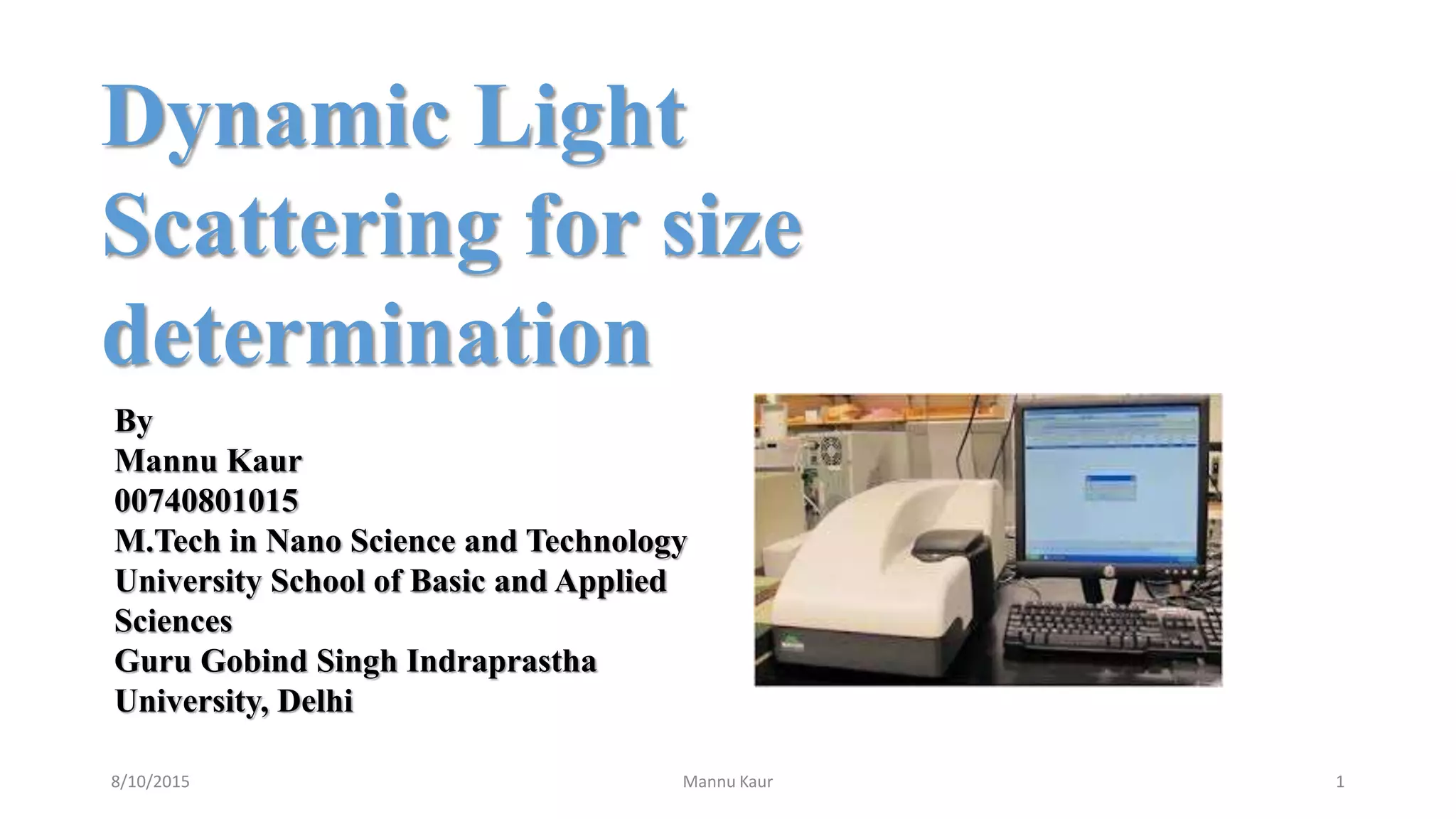
Dynamic Light
Scattering for size
determination
By
Mannu Kaur
00740801015
M.Tech in Nano Science and Technology
University School of Basic and Applied
Sciences
Guru Gobind Singh Indraprastha
University, Delhi
Outline
• Colloids
• Properties that colloids exhibit
• The Electrical double layer
• Light Scattering
• DLS measurement
• Stoke-Einstein equation
• Sample Preparation
• Applications
• Limitations
8/10/2015 Mannu Kaur 2
The Colloidal System
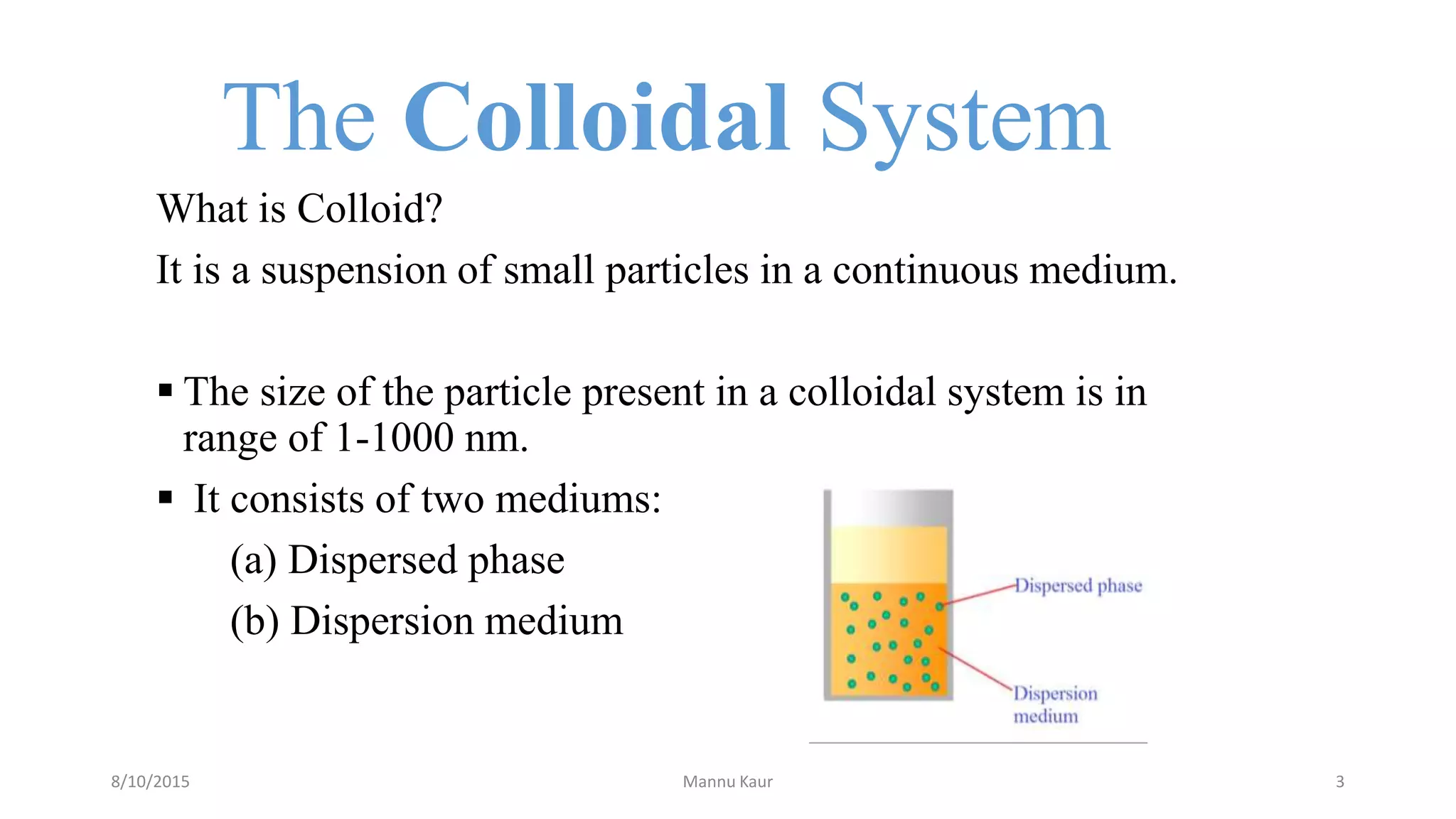
What is Colloid?
It is a suspension of small particles in a continuous medium.
 The size of the particle present in a colloidal system is in
range of 1-1000 nm.
 It consists of two mediums:
(a) Dispersed phase
(b) Dispersion medium
8/10/2015 Mannu Kaur 3
Properties of Colloids
• Heterogeneous Character
• Diffusibility
• Visibility
• Colligative Properties
• Optical properties
• The Brownian movement
8/10/2015 Mannu Kaur 4
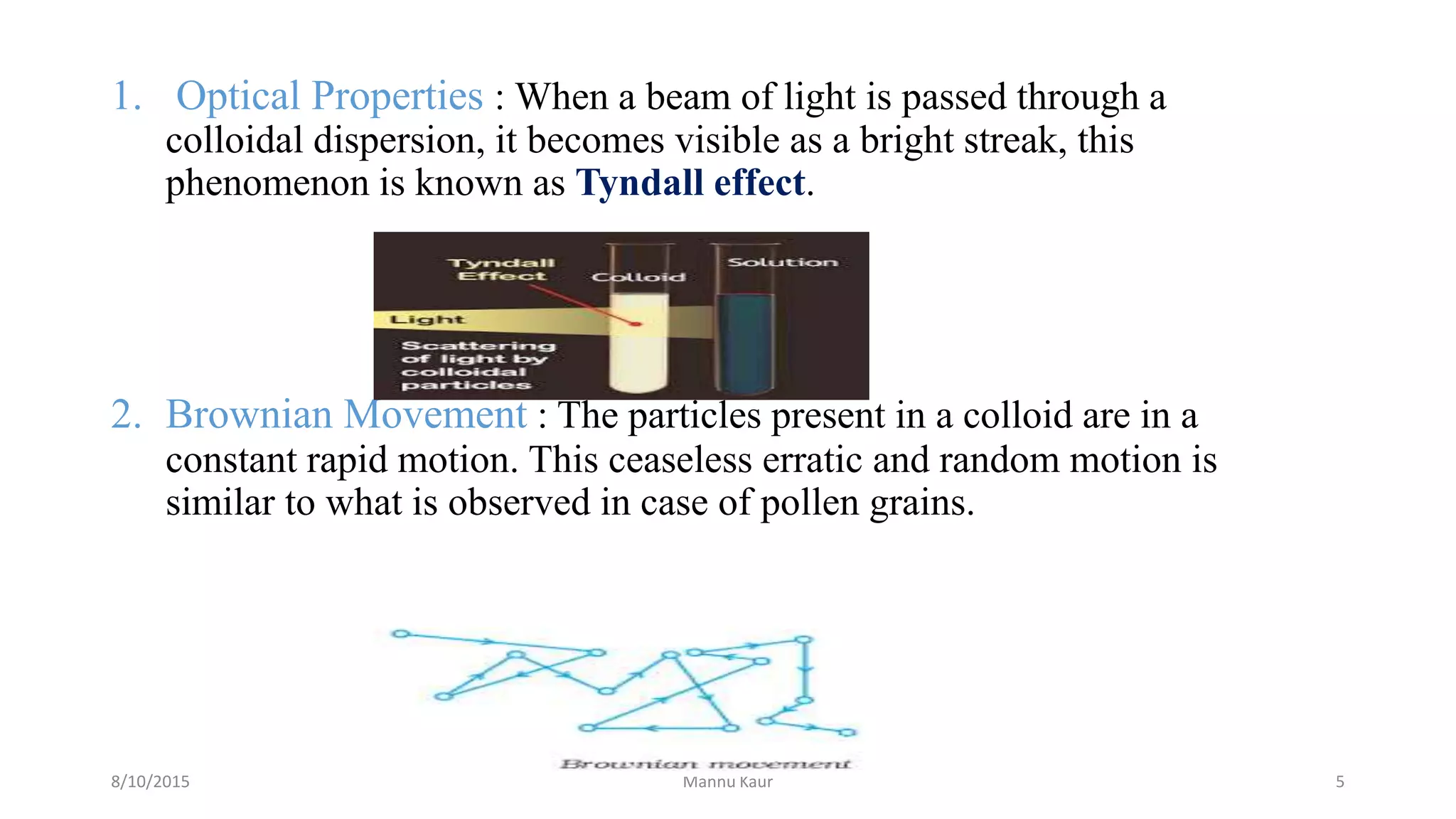
1. Optical Properties : When a beam of light is passed through a
colloidal dispersion, it becomes visible as a bright streak, this
phenomenon is known as Tyndall effect.
2. Brownian Movement : The particles present in a colloid are in a
constant rapid motion. This ceaseless erratic and random motion is
similar to what is observed in case of pollen grains.
8/10/2015 Mannu Kaur 5
The Electrical Double Layer
8/10/2015 Mannu Kaur 6
Variation in the ion
density near a charged
surface.
When a charged particle
is present in an aqueous
solution it is influenced
by the ionic strength in
the solution.
• Counter-Ion: Ion of
opposite charge
• Co-Ion: Ion of equal
charge
Zeta Potential
Describing Colloidal Stability
8/10/2015 Mannu Kaur 7
Henry´s Equation:
Used to calculate the Zeta Potential
ζ : Zeta potential.
μ : Electrophoretic mobility.
ε : Dielectric constant.
η: Viscosity
(Zetasizer Nano Series )
Light Scattering
The interaction of light with the electric field of a small particle or
molecule results in scattering of light.
Types of Scattering
 Rayleigh Scattering
 Mie Scattering
8/10/2015 Mannu Kaur 8
Dynamic Light Scattering
It is technique for measuring the size of particles and
molecules in suspension.
This technique basically measures the speed of the
particles going under Brownian Motion.
Brownian motion is influenced by :
Particle size
Sample viscosity
Temperature
8/10/2015 Mannu Kaur 9
How DLS works ?
8/10/2015 Mannu Kaur 10
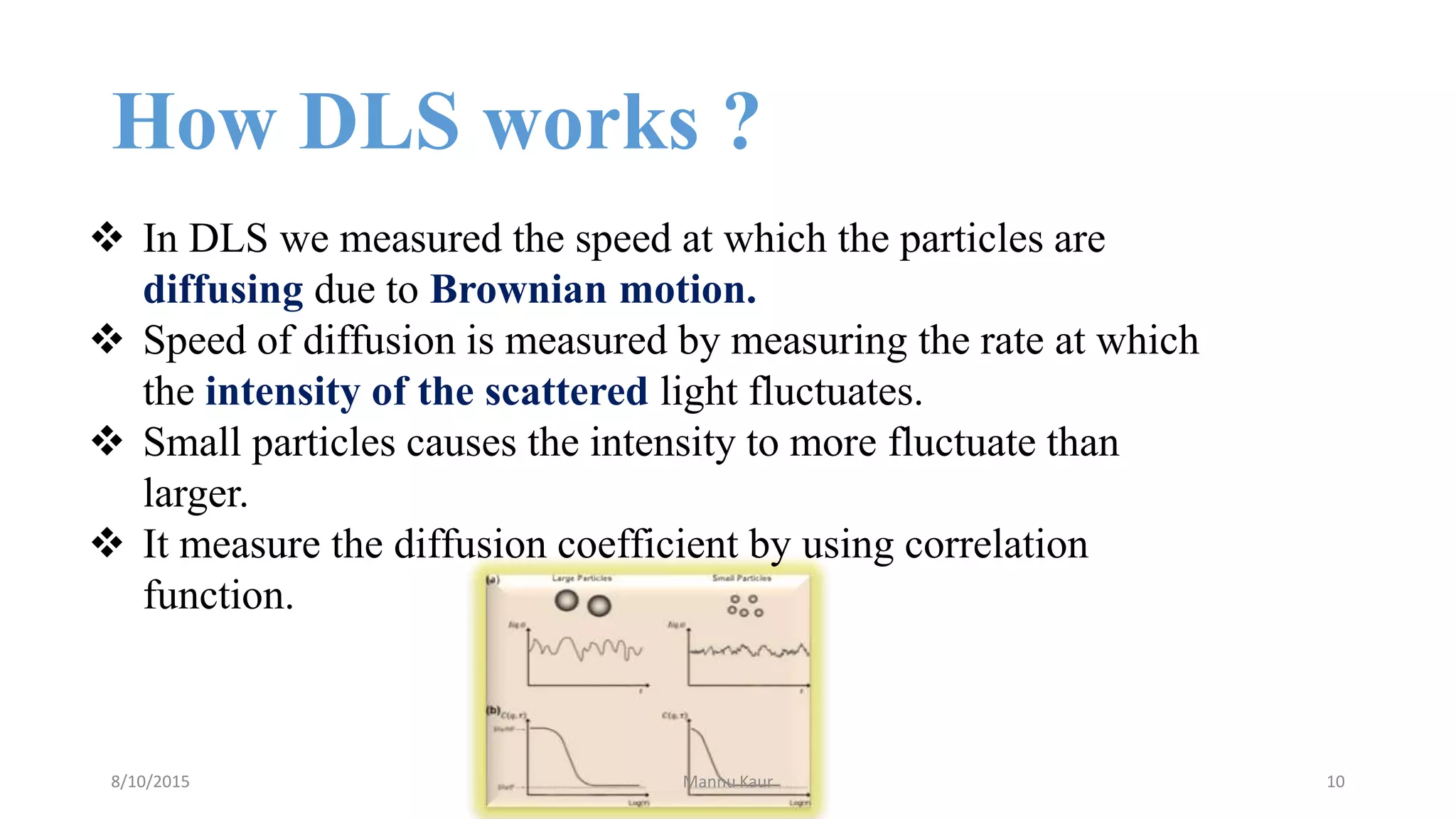
 In DLS we measured the speed at which the particles are
diffusing due to Brownian motion.
 Speed of diffusion is measured by measuring the rate at which
the intensity of the scattered light fluctuates.
 Small particles causes the intensity to more fluctuate than
larger.
 It measure the diffusion coefficient by using correlation
function.
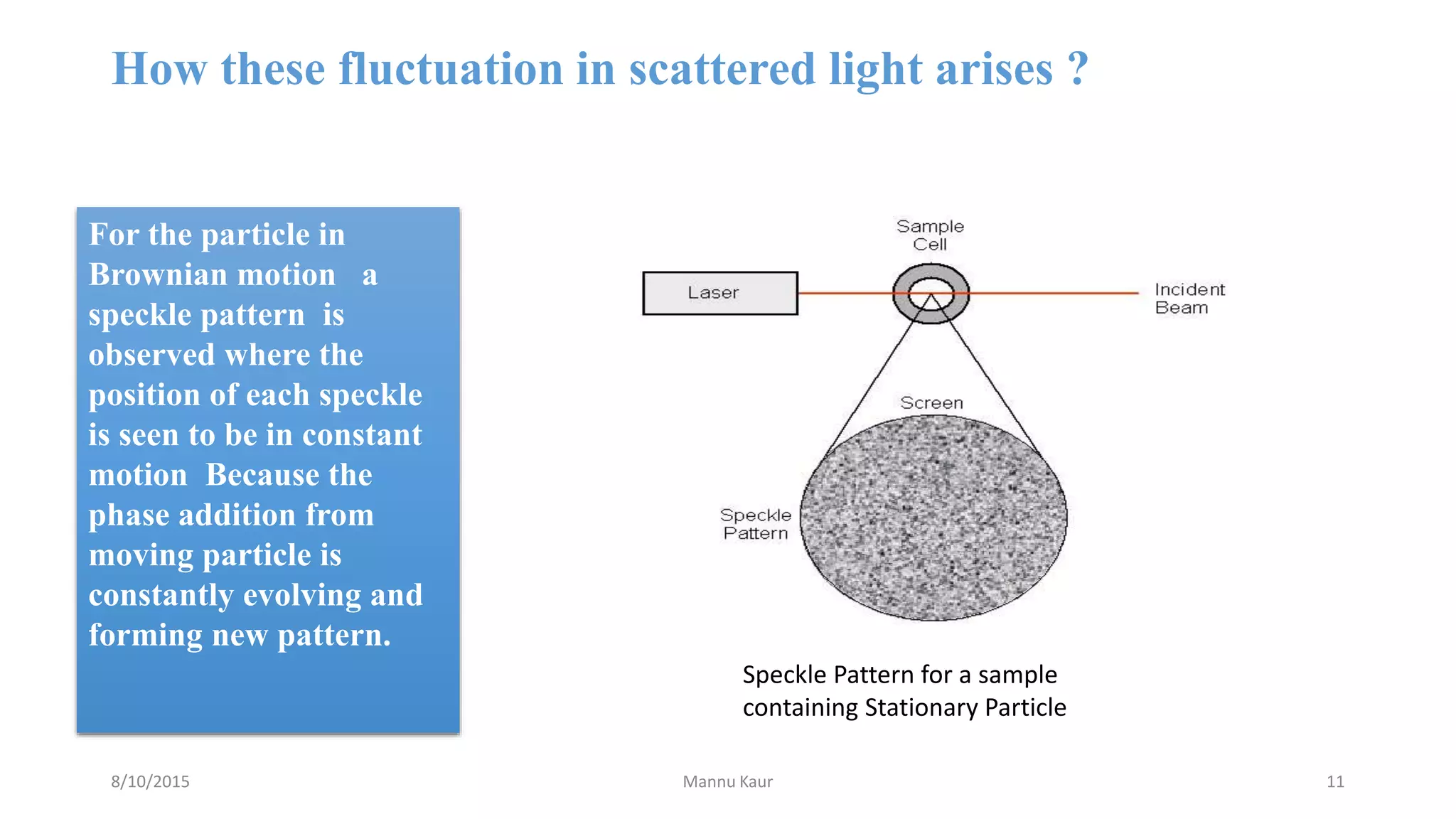
How these fluctuation in scattered light arises ?
8/10/2015 Mannu Kaur 11
Speckle Pattern for a sample
containing Stationary Particle
For the particle in
Brownian motion a
speckle pattern is
observed where the
position of each speckle
is seen to be in constant
motion Because the
phase addition from
moving particle is
constantly evolving and
forming new pattern.
Instrumentation of DLS
8/10/2015 Mannu Kaur 12
DLS signal
8/10/2015 Mannu Kaur 13
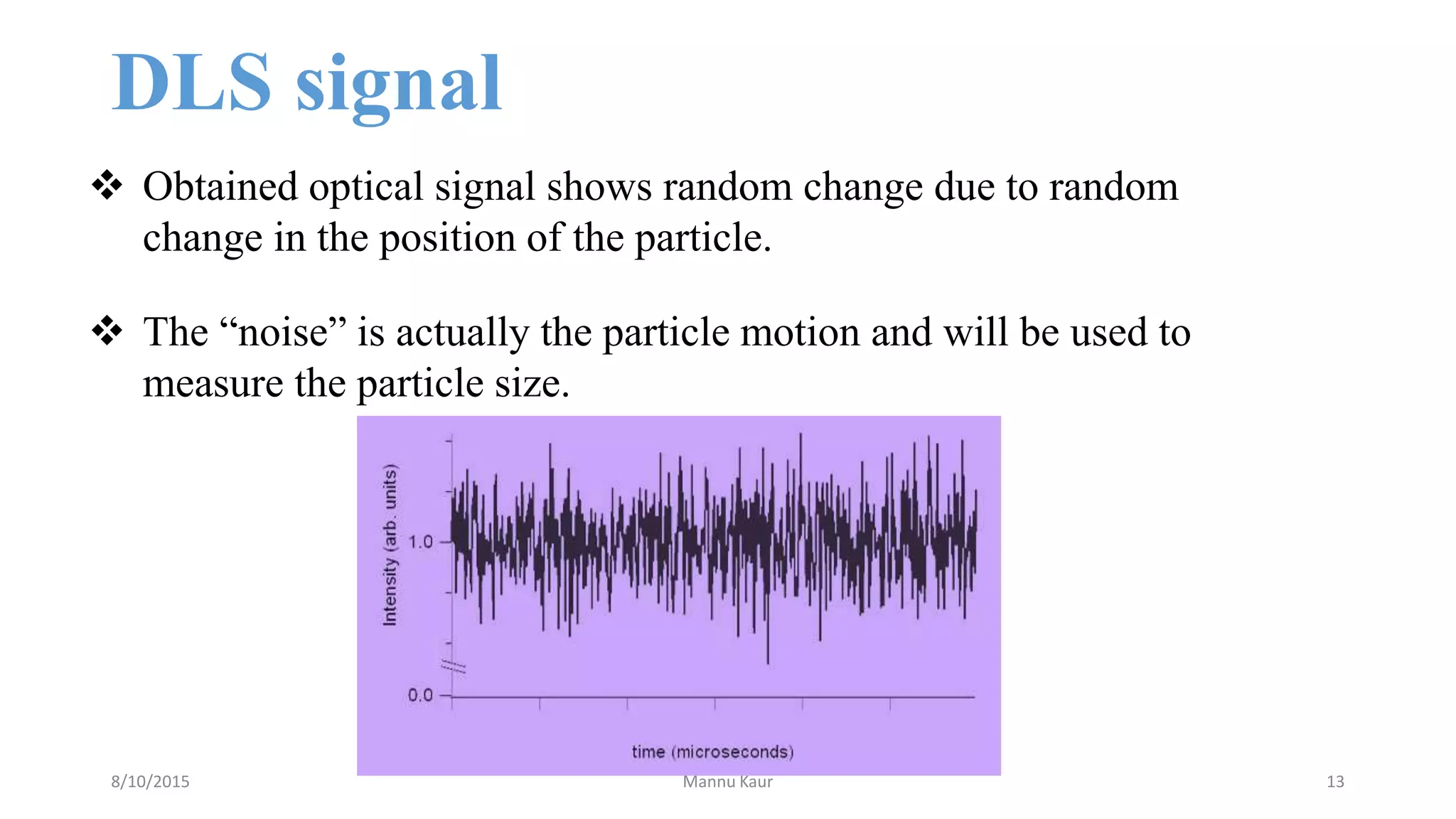
 Obtained optical signal shows random change due to random
change in the position of the particle.
 The “noise” is actually the particle motion and will be used to
measure the particle size.
Correlation function
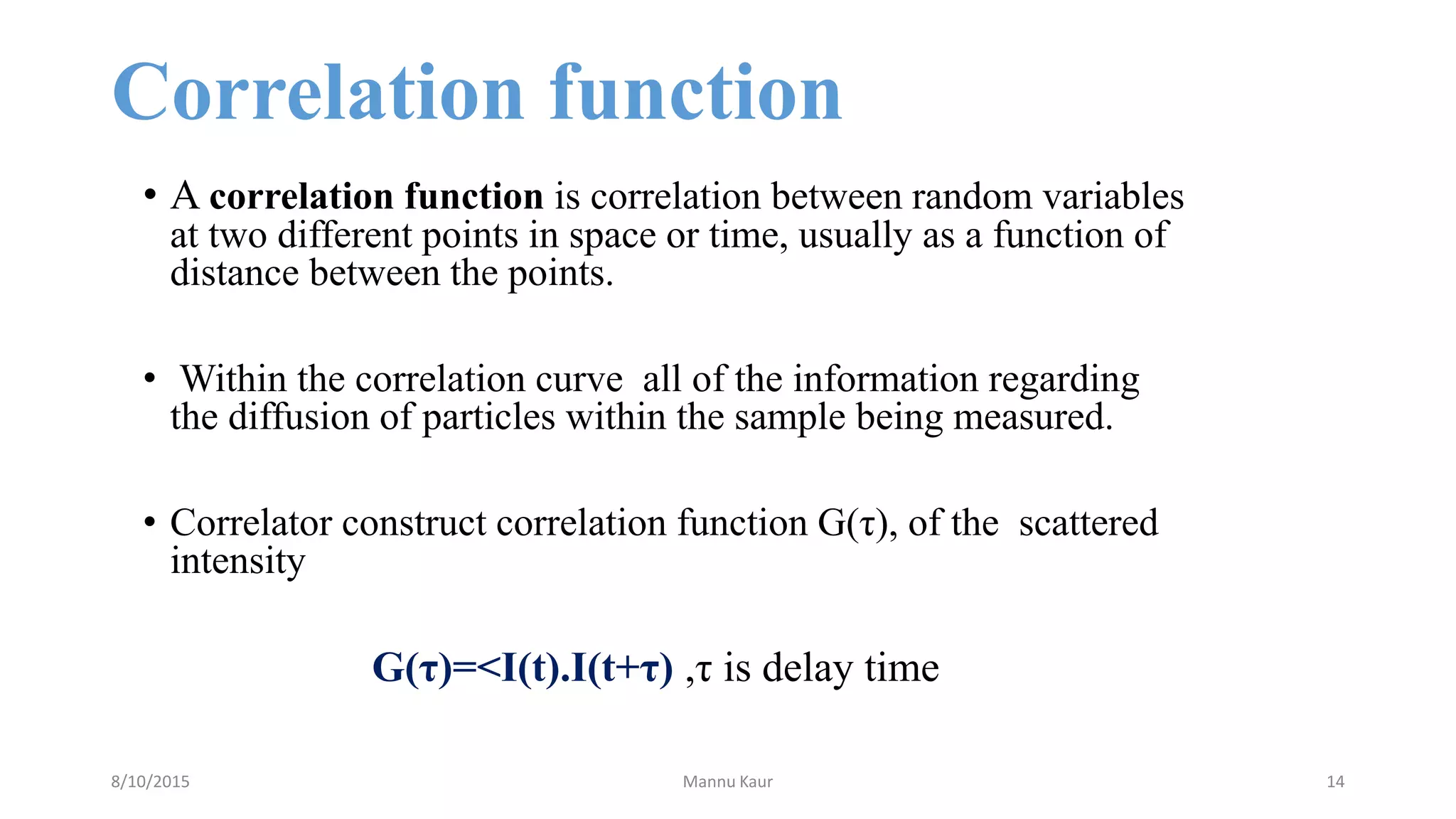
• A correlation function is correlation between random variables
at two different points in space or time, usually as a function of
distance between the points.
• Within the correlation curve all of the information regarding
the diffusion of particles within the sample being measured.
• Correlator construct correlation function G(τ), of the scattered
intensity
G(τ)=<I(t).I(t+τ) ,τ is delay time
8/10/2015 Mannu Kaur 14
Correlation function
8/10/2015 Mannu Kaur 15
Stoke-Einstein equation
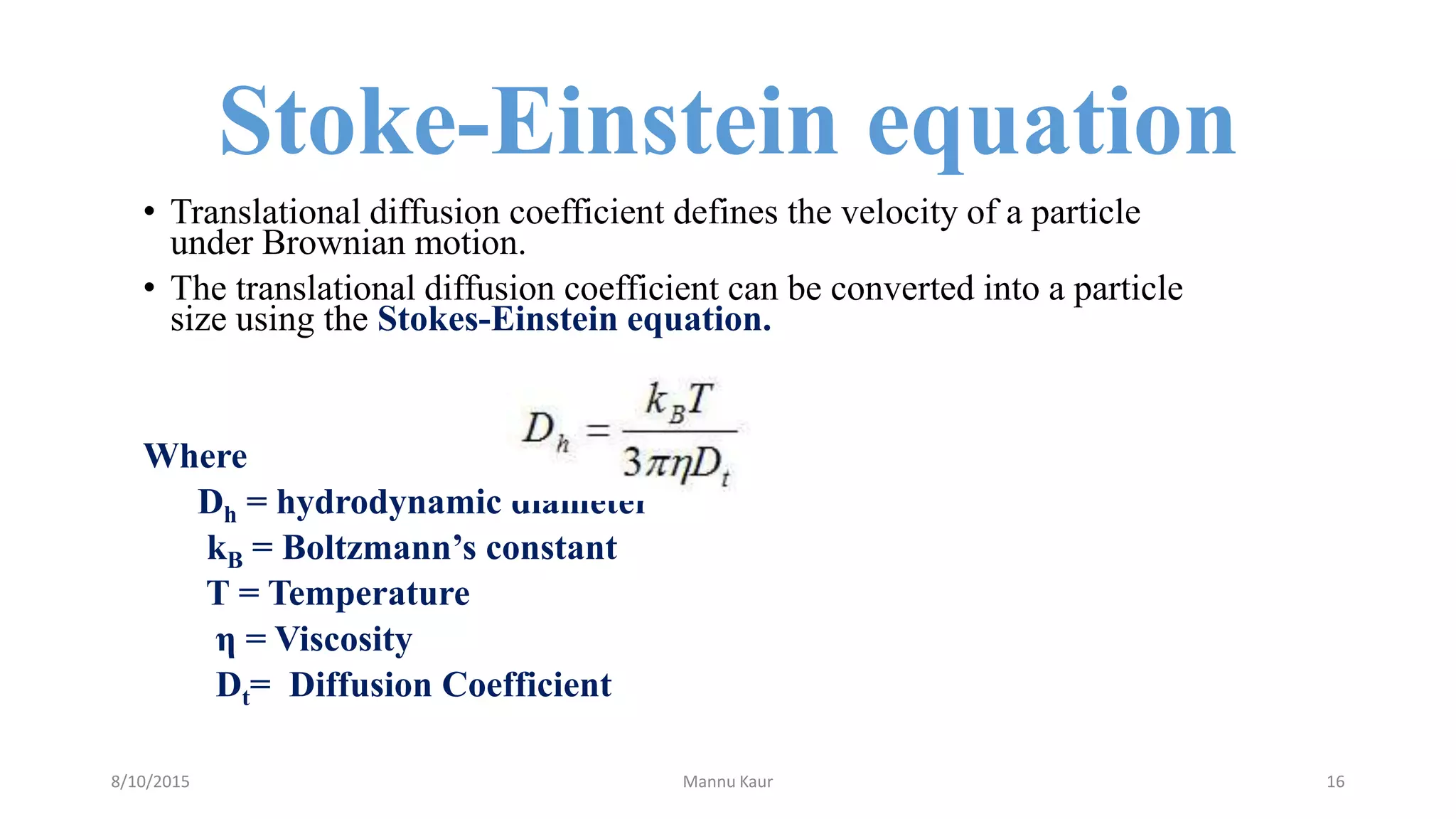
• Translational diffusion coefficient defines the velocity of a particle
under Brownian motion.
• The translational diffusion coefficient can be converted into a particle
size using the Stokes-Einstein equation.
Where
Dh = hydrodynamic diameter
kB = Boltzmann’s constant
T = Temperature
η = Viscosity
Dt= Diffusion Coefficient
8/10/2015 Mannu Kaur 16
Hydrodynamic diameter
• The diameter of a hard sphere that diffuses at the same speed as the
particle or molecule being measured.
8/10/2015 Mannu Kaur 17
Sample Preparation
The sample should consist of a dispersion of particles in a
liquid medium
The dispersant should meet the following requirements:
(a) It should be transparent
(b) Refractive Index should be different from particles
(c) Viscosity should be known with accuracy better
than 0.5%
(d) Should be compatible with the particles (i.e. not
cause swelling, dissolution or aggregation)
(e) It should be clean.
8/10/2015 Mannu Kaur 18
Applications
• DLS is used to characterize size of various particles including
proteins, polymers, micelles, carbohydrates, and nanoparticles.
• Stability studies can be done conveniently using DLS.
Periodical DLS measurements of a sample can show whether
the particles aggregate over time by seeing whether the
hydrodynamic radius of the particle increases.
8/10/2015 Mannu Kaur 19
Limitations
• We measure the hydrodynamic radius of the particle, not able to
measure the actual size of the particle.
• The particles having size greater than 1000nm are not measured by
this method.
8/10/2015 Mannu Kaur 20
8/10/2015 Mannu Kaur 21

Dynamic light scattering

  • 1.
    8/10/2015 Mannu Kaur1 Dynamic Light Scattering for size determination By Mannu Kaur 00740801015 M.Tech in Nano Science and Technology University School of Basic and Applied Sciences Guru Gobind Singh Indraprastha University, Delhi
  • 2.
    Outline • Colloids • Propertiesthat colloids exhibit • The Electrical double layer • Light Scattering • DLS measurement • Stoke-Einstein equation • Sample Preparation • Applications • Limitations 8/10/2015 Mannu Kaur 2
  • 3.
    The Colloidal System Whatis Colloid? It is a suspension of small particles in a continuous medium.  The size of the particle present in a colloidal system is in range of 1-1000 nm.  It consists of two mediums: (a) Dispersed phase (b) Dispersion medium 8/10/2015 Mannu Kaur 3
  • 4.
    Properties of Colloids •Heterogeneous Character • Diffusibility • Visibility • Colligative Properties • Optical properties • The Brownian movement 8/10/2015 Mannu Kaur 4
  • 5.
    1. Optical Properties: When a beam of light is passed through a colloidal dispersion, it becomes visible as a bright streak, this phenomenon is known as Tyndall effect. 2. Brownian Movement : The particles present in a colloid are in a constant rapid motion. This ceaseless erratic and random motion is similar to what is observed in case of pollen grains. 8/10/2015 Mannu Kaur 5
  • 6.
    The Electrical DoubleLayer 8/10/2015 Mannu Kaur 6 Variation in the ion density near a charged surface. When a charged particle is present in an aqueous solution it is influenced by the ionic strength in the solution. • Counter-Ion: Ion of opposite charge • Co-Ion: Ion of equal charge
  • 7.
    Zeta Potential Describing ColloidalStability 8/10/2015 Mannu Kaur 7 Henry´s Equation: Used to calculate the Zeta Potential ζ : Zeta potential. μ : Electrophoretic mobility. ε : Dielectric constant. η: Viscosity (Zetasizer Nano Series )
  • 8.
    Light Scattering The interactionof light with the electric field of a small particle or molecule results in scattering of light. Types of Scattering  Rayleigh Scattering  Mie Scattering 8/10/2015 Mannu Kaur 8
  • 9.
    Dynamic Light Scattering Itis technique for measuring the size of particles and molecules in suspension. This technique basically measures the speed of the particles going under Brownian Motion. Brownian motion is influenced by : Particle size Sample viscosity Temperature 8/10/2015 Mannu Kaur 9
  • 10.
    How DLS works? 8/10/2015 Mannu Kaur 10  In DLS we measured the speed at which the particles are diffusing due to Brownian motion.  Speed of diffusion is measured by measuring the rate at which the intensity of the scattered light fluctuates.  Small particles causes the intensity to more fluctuate than larger.  It measure the diffusion coefficient by using correlation function.
  • 11.
    How these fluctuationin scattered light arises ? 8/10/2015 Mannu Kaur 11 Speckle Pattern for a sample containing Stationary Particle For the particle in Brownian motion a speckle pattern is observed where the position of each speckle is seen to be in constant motion Because the phase addition from moving particle is constantly evolving and forming new pattern.
  • 12.
  • 13.
    DLS signal 8/10/2015 MannuKaur 13  Obtained optical signal shows random change due to random change in the position of the particle.  The “noise” is actually the particle motion and will be used to measure the particle size.
  • 14.
    Correlation function • Acorrelation function is correlation between random variables at two different points in space or time, usually as a function of distance between the points. • Within the correlation curve all of the information regarding the diffusion of particles within the sample being measured. • Correlator construct correlation function G(τ), of the scattered intensity G(τ)=<I(t).I(t+τ) ,τ is delay time 8/10/2015 Mannu Kaur 14
  • 15.
  • 16.
    Stoke-Einstein equation • Translationaldiffusion coefficient defines the velocity of a particle under Brownian motion. • The translational diffusion coefficient can be converted into a particle size using the Stokes-Einstein equation. Where Dh = hydrodynamic diameter kB = Boltzmann’s constant T = Temperature η = Viscosity Dt= Diffusion Coefficient 8/10/2015 Mannu Kaur 16
  • 17.
    Hydrodynamic diameter • Thediameter of a hard sphere that diffuses at the same speed as the particle or molecule being measured. 8/10/2015 Mannu Kaur 17
  • 18.
    Sample Preparation The sampleshould consist of a dispersion of particles in a liquid medium The dispersant should meet the following requirements: (a) It should be transparent (b) Refractive Index should be different from particles (c) Viscosity should be known with accuracy better than 0.5% (d) Should be compatible with the particles (i.e. not cause swelling, dissolution or aggregation) (e) It should be clean. 8/10/2015 Mannu Kaur 18
  • 19.
    Applications • DLS isused to characterize size of various particles including proteins, polymers, micelles, carbohydrates, and nanoparticles. • Stability studies can be done conveniently using DLS. Periodical DLS measurements of a sample can show whether the particles aggregate over time by seeing whether the hydrodynamic radius of the particle increases. 8/10/2015 Mannu Kaur 19
  • 20.
    Limitations • We measurethe hydrodynamic radius of the particle, not able to measure the actual size of the particle. • The particles having size greater than 1000nm are not measured by this method. 8/10/2015 Mannu Kaur 20
  • 21.