A.P. Dr Mohd Khan Ayob
PPSKTM, FST,
UKM,
43600 Bangi
25/05/2010 1Kursus Toksikologi Makanan IKU 31Mei-4Jun 2010
INTRODUCTION
The science of toxicology is based on the principle that
there is a relationship between a toxic reaction (the
response) and the amount of poison received (the dose).
“The right dose differentiates a poison from a remedy.”
Important assumptions in this relationship
there is almost always a dose below which no response
occurs or can be measured.
once a maximum response is reached any further increases
in the dose will not result in any increased effect.
25/05/2010 2Kursus Toksikologi Makanan IKU 31Mei-4Jun 2010
Dose-response relationship = the cause and effect
relationship between chemical exposure and illness.
Allergic reactions are special kinds of changes in the
immune system; they are not really toxic responses.
 Not always comply with D-R assumptions
Allergies vs. toxic reactions
 A toxic effect : results of the toxic chemical acting on cells.
 Allergic responses : result of a chemical stimulating the body
to release natural chemicals which are in turn directly
responsible for the effects seen.
MEASURES OF EXPOSURE
Exposure to poisons can be intentional or
unintentional.
The effects of exposure to poisons vary with the
amount of exposure, "the dose.“
Contamination of food or water with chemicals can also
provide doses of chemicals each time we eat or drink.
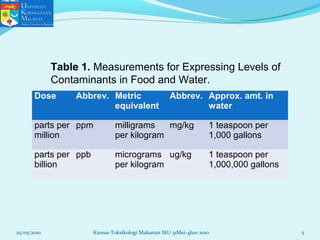
Some commonly used measures for expressing levels
of contaminants are listed in Table 1.
25/05/2010 4Kursus Toksikologi Makanan IKU 31Mei-4Jun 2010
Table 1. Measurements for Expressing Levels of
Contaminants in Food and Water.
Dose Abbrev. Metric
equivalent
Abbrev. Approx. amt. in
water
parts per
million
ppm milligrams
per kilogram
mg/kg 1 teaspoon per
1,000 gallons
parts per
billion
ppb micrograms
per kilogram
ug/kg 1 teaspoon per
1,000,000 gallons
25/05/2010 5Kursus Toksikologi Makanan IKU 31Mei-4Jun 2010
25/05/2010 6
Dose
the amount of a substance administered at one
time.
other parameters - to characterize the exposure to
xenobiotics.
the number of doses, frequency, and total time period
of the treatment.
For example:
650 mg Tylenol as a single dose
500 mg Penicillin every 8 hours for 10 days
10 mg DDT per day for 90 days
Kursus Toksikologi Makanan IKU 31Mei-4Jun 2010
25/05/2010 7
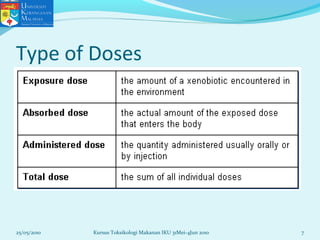
Type of Doses
Kursus Toksikologi Makanan IKU 31Mei-4Jun 2010
25/05/2010 8
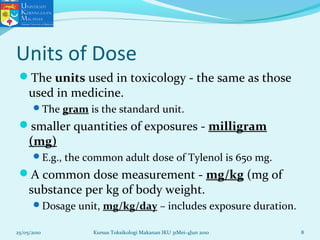
Units of Dose
The units used in toxicology - the same as those
used in medicine.
The gram is the standard unit.
smaller quantities of exposures - milligram
(mg)
E.g., the common adult dose of Tylenol is 650 mg.
A common dose measurement - mg/kg (mg of
substance per kg of body weight.
Dosage unit, mg/kg/day – includes exposure duration.
Kursus Toksikologi Makanan IKU 31Mei-4Jun 2010
25/05/2010 9
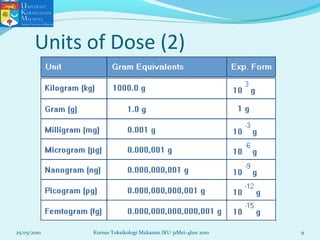
Units of Dose (2)
Kursus Toksikologi Makanan IKU 31Mei-4Jun 2010
25/05/2010 10
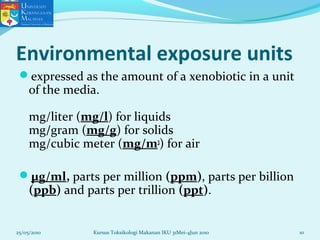
Environmental exposure units
expressed as the amount of a xenobiotic in a unit
of the media.
mg/liter (mg/l) for liquids
mg/gram (mg/g) for solids
mg/cubic meter (mg/m3
) for air
µg/ml, parts per million (ppm), parts per billion
(ppb) and parts per trillion (ppt).
Kursus Toksikologi Makanan IKU 31Mei-4Jun 2010
25/05/2010 11
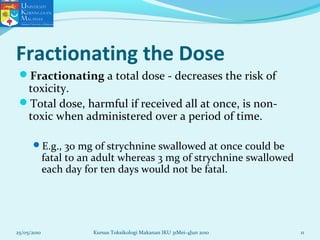
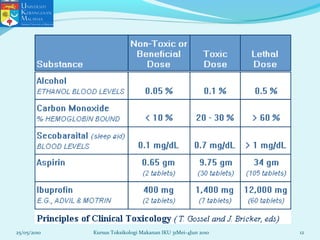
Fractionating the Dose
Fractionating a total dose - decreases the risk of
toxicity.
Total dose, harmful if received all at once, is non-
toxic when administered over a period of time.
E.g., 30 mg of strychnine swallowed at once could be
fatal to an adult whereas 3 mg of strychnine swallowed
each day for ten days would not be fatal.
Kursus Toksikologi Makanan IKU 31Mei-4Jun 2010
25/05/2010 12Kursus Toksikologi Makanan IKU 31Mei-4Jun 2010
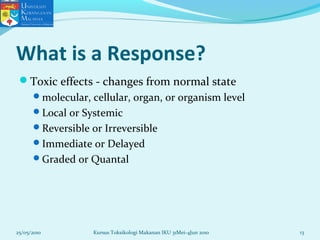
What is a Response?
Toxic effects - changes from normal state
molecular, cellular, organ, or organism level
Local or Systemic
Reversible or Irreversible
Immediate or Delayed
Graded or Quantal
25/05/2010 13Kursus Toksikologi Makanan IKU 31Mei-4Jun 2010
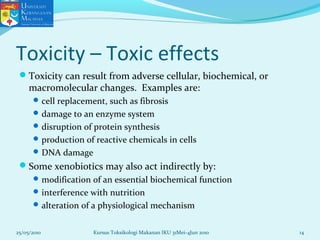
Toxicity – Toxic effects
Toxicity can result from adverse cellular, biochemical, or
macromolecular changes. Examples are:
cell replacement, such as fibrosis
damage to an enzyme system
disruption of protein synthesis
production of reactive chemicals in cells
DNA damage
Some xenobiotics may also act indirectly by:
modification of an essential biochemical function
interference with nutrition
alteration of a physiological mechanism
25/05/2010 14Kursus Toksikologi Makanan IKU 31Mei-4Jun 2010
Dose and Dose-Response
Relationship
Dose-response relationship - a fundamental concept
in toxicology which describes the quantitative
relationship between the amount of exposure
(dose) to a toxicant and the incidence of adverse
effects (response).
Sources of Information::
Animal studies
Human epidemiology studies
Generally, the higher the dose, the more severe the
response
25/05/2010 15Kursus Toksikologi Makanan IKU 31Mei-4Jun 2010
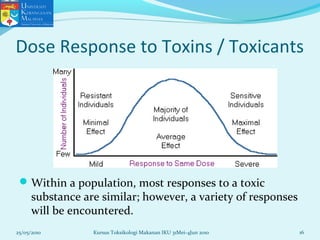
Dose Response to Toxins / Toxicants
Within a population, most responses to a toxic
substance are similar; however, a variety of responses
will be encountered.
25/05/2010 16Kursus Toksikologi Makanan IKU 31Mei-4Jun 2010
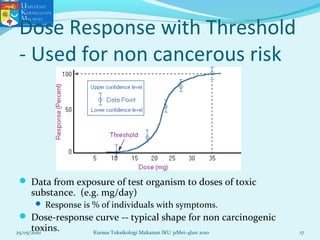
Dose Response with Threshold
- Used for non cancerous risk
 Data from exposure of test organism to doses of toxic
substance. (e.g. mg/day)
 Response is % of individuals with symptoms.
 Dose-response curve -- typical shape for non carcinogenic
toxins.25/05/2010 17Kursus Toksikologi Makanan IKU 31Mei-4Jun 2010
Threshold dose: where toxicity first appears; this
occurs where body’s ability to detoxify or repair
effects is exceeded.
25/05/2010 18Kursus Toksikologi Makanan IKU 31Mei-4Jun 2010
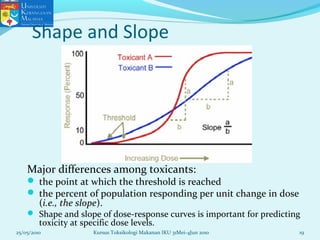
Shape and Slope
Major differences among toxicants:
 the point at which the threshold is reached
 the percent of population responding per unit change in dose
(i.e., the slope).
 Shape and slope of dose-response curves is important for predicting
toxicity at specific dose levels.
25/05/2010 19Kursus Toksikologi Makanan IKU 31Mei-4Jun 2010
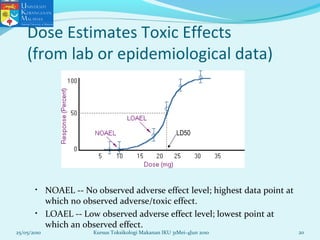
Dose Estimates Toxic Effects
(from lab or epidemiological data)
• NOAEL -- No observed adverse effect level; highest data point at
which no observed adverse/toxic effect.
• LOAEL -- Low observed adverse effect level; lowest point at
which an observed effect.
LD50
25/05/2010 20Kursus Toksikologi Makanan IKU 31Mei-4Jun 2010
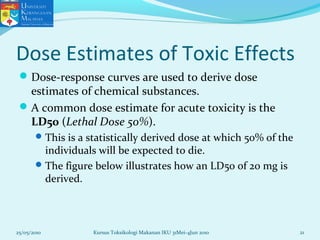
Dose Estimates of Toxic Effects
Dose-response curves are used to derive dose
estimates of chemical substances.
A common dose estimate for acute toxicity is the
LD50 (Lethal Dose 50%).
This is a statistically derived dose at which 50% of the
individuals will be expected to die.
The figure below illustrates how an LD50 of 20 mg is
derived.
25/05/2010 21Kursus Toksikologi Makanan IKU 31Mei-4Jun 2010
Toxic Thresholds
25/05/2010 22Kursus Toksikologi Makanan IKU 31Mei-4Jun 2010
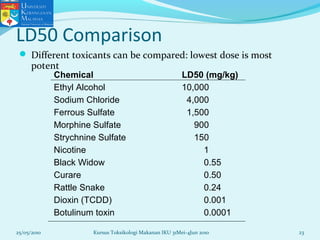
LD50 Comparison
 Different toxicants can be compared: lowest dose is most
potent
Chemical LD50 (mg/kg)
Ethyl Alcohol 10,000
Sodium Chloride 4,000
Ferrous Sulfate 1,500
Morphine Sulfate 900
Strychnine Sulfate 150
Nicotine 1
Black Widow 0.55
Curare 0.50
Rattle Snake 0.24
Dioxin (TCDD) 0.001
Botulinum toxin 0.0001
25/05/2010 23Kursus Toksikologi Makanan IKU 31Mei-4Jun 2010
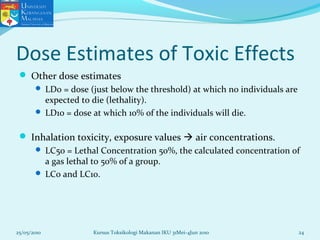
Dose Estimates of Toxic Effects
 Other dose estimates
 LD0 = dose (just below the threshold) at which no individuals are
expected to die (lethality).
 LD10 = dose at which 10% of the individuals will die.
 Inhalation toxicity, exposure values  air concentrations.
 LC50 = Lethal Concentration 50%, the calculated concentration of
a gas lethal to 50% of a group.
 LC0 and LC10.
25/05/2010 24Kursus Toksikologi Makanan IKU 31Mei-4Jun 2010
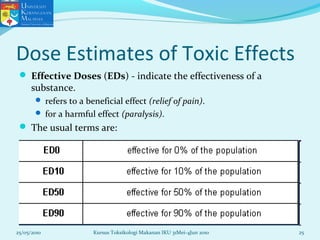
Dose Estimates of Toxic Effects
 Effective Doses (EDs) - indicate the effectiveness of a
substance.
 refers to a beneficial effect (relief of pain).
 for a harmful effect (paralysis).
 The usual terms are:
25/05/2010 25Kursus Toksikologi Makanan IKU 31Mei-4Jun 2010
 Toxic Doses (TDs) are utilized to indicate doses that cause adverse
toxic effects. The usual dose estimates are listed below:
25/05/2010 26Kursus Toksikologi Makanan IKU 31Mei-4Jun 2010
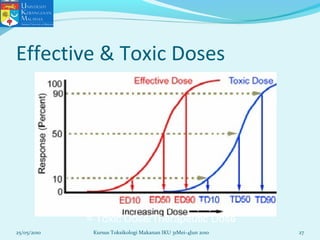
Effective & Toxic Doses
Therapeutic Index (TI)
= Toxic Dose/Therapeutic Dose
25/05/2010 27Kursus Toksikologi Makanan IKU 31Mei-4Jun 2010
Therapeutic Index (TI)
a statement of relative safety of a drug.
to compare the therapeutically effective dose to the
toxic dose.
the ratio, toxic dose : therapeutic dose.
to derive the TI
use the 50% dose-response points.
Eg: LD50 is 200, ED50 = 20 mg;  TI = 10 (200/20).
 A clinician would consider a drug safer if it had a TI of
10 than if it had a TI of 3.
25/05/2010 28Kursus Toksikologi Makanan IKU 31Mei-4Jun 2010
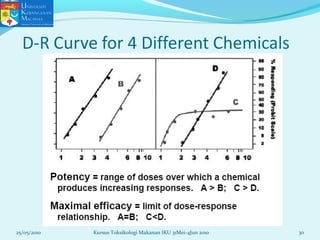
Comparison of toxic effects -
Potency and Efficacy
Potency
Range of doses over which a chemical produces
increasing responses
Efficacy
Maximum response
Limit / plateau of dose-response curve on the
response axis.
25/05/2010 29Kursus Toksikologi Makanan IKU 31Mei-4Jun 2010
25/05/2010 30Kursus Toksikologi Makanan IKU 31Mei-4Jun 2010
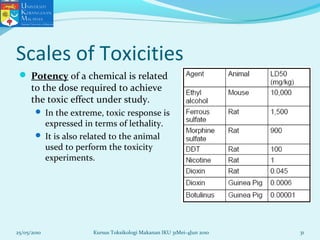
Scales of Toxicities
 Potency of a chemical is related
to the dose required to achieve
the toxic effect under study.
 In the extreme, toxic response is
expressed in terms of lethality.
 It is also related to the animal
used to perform the toxicity
experiments.
25/05/2010 31Kursus Toksikologi Makanan IKU 31Mei-4Jun 2010
Potency of a poison
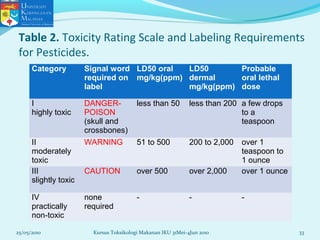
The potencies of poisons are often compared using
signal words or categories as shown in the example in
Table 2.
25/05/2010 Kursus Toksikologi Makanan IKU 31Mei-4Jun 2010 32
Table 2. Toxicity Rating Scale and Labeling Requirements
for Pesticides.
Category Signal word
required on
label
LD50 oral
mg/kg(ppm)
LD50
dermal
mg/kg(ppm)
Probable
oral lethal
dose
I
highly toxic
DANGER-
POISON
(skull and
crossbones)
less than 50 less than 200 a few drops
to a
teaspoon
II
moderately
toxic
WARNING 51 to 500 200 to 2,000 over 1
teaspoon to
1 ounce
III
slightly toxic
CAUTION over 500 over 2,000 over 1 ounce
IV
practically
non-toxic
none
required
- - -
25/05/2010 33Kursus Toksikologi Makanan IKU 31Mei-4Jun 2010
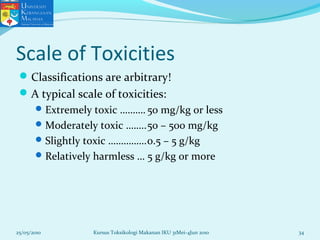
Scale of Toxicities
Classifications are arbitrary!
A typical scale of toxicities:
Extremely toxic ………. 50 mg/kg or less
Moderately toxic ……..50 – 500 mg/kg
Slightly toxic ……………0.5 – 5 g/kg
Relatively harmless … 5 g/kg or more
25/05/2010 34Kursus Toksikologi Makanan IKU 31Mei-4Jun 2010
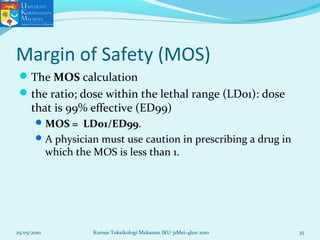
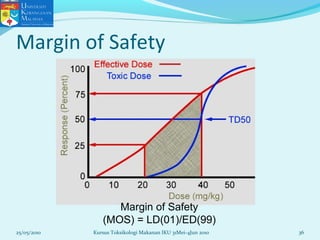
Margin of Safety (MOS)
The MOS calculation
the ratio; dose within the lethal range (LD01): dose
that is 99% effective (ED99)
MOS = LD01/ED99.
A physician must use caution in prescribing a drug in
which the MOS is less than 1.
25/05/2010 35Kursus Toksikologi Makanan IKU 31Mei-4Jun 2010
Margin of Safety
Margin of Safety
(MOS) = LD(01)/ED(99)
25/05/2010 36Kursus Toksikologi Makanan IKU 31Mei-4Jun 2010
Dose-Response Relationship
Previous curves are examples of traditional dose
responses (monotonic)
Non-traditional dose response curves (non-
monotonic)
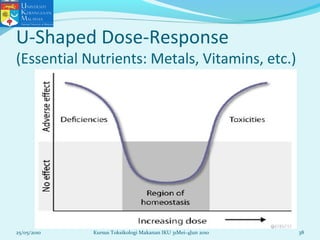
U-shaped dose response - essential nutrients
Hormesis - hormones/hormonally active chemicals;
various other chemicals
25/05/2010 37Kursus Toksikologi Makanan IKU 31Mei-4Jun 2010
U-Shaped Dose-Response
(Essential Nutrients: Metals, Vitamins, etc.)
25/05/2010 38Kursus Toksikologi Makanan IKU 31Mei-4Jun 2010
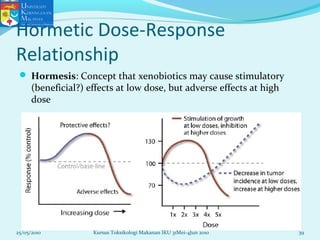
Hormetic Dose-Response
Relationship
 Hormesis: Concept that xenobiotics may cause stimulatory
(beneficial?) effects at low dose, but adverse effects at high
dose
25/05/2010 39Kursus Toksikologi Makanan IKU 31Mei-4Jun 2010
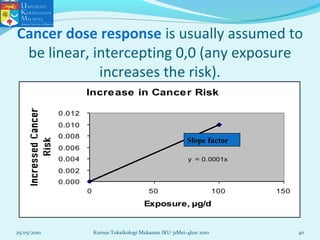
Cancer dose response is usually assumed to
be linear, intercepting 0,0 (any exposure
increases the risk).
Increase in Cancer Risk
y = 0.0001x
0.000
0.002
0.004
0.006
0.008
0.010
0.012
0 50 100 150
Exposure, µg/d
Slope factor
25/05/2010 40Kursus Toksikologi Makanan IKU 31Mei-4Jun 2010
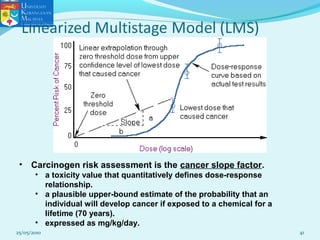
• Carcinogen risk assessment is the cancer slope factor.
• a toxicity value that quantitatively defines dose-response
relationship.
• a plausible upper-bound estimate of the probability that an
individual will develop cancer if exposed to a chemical for a
lifetime (70 years).
• expressed as mg/kg/day.
25/05/2010 41
25/05/2010 42Kursus Toksikologi Makanan IKU 31Mei-4Jun 2010

Dose response relationship

  • 1.
    A.P. Dr MohdKhan Ayob PPSKTM, FST, UKM, 43600 Bangi 25/05/2010 1Kursus Toksikologi Makanan IKU 31Mei-4Jun 2010
  • 2.
    INTRODUCTION The science oftoxicology is based on the principle that there is a relationship between a toxic reaction (the response) and the amount of poison received (the dose). “The right dose differentiates a poison from a remedy.” Important assumptions in this relationship there is almost always a dose below which no response occurs or can be measured. once a maximum response is reached any further increases in the dose will not result in any increased effect. 25/05/2010 2Kursus Toksikologi Makanan IKU 31Mei-4Jun 2010
  • 3.
    Dose-response relationship =the cause and effect relationship between chemical exposure and illness. Allergic reactions are special kinds of changes in the immune system; they are not really toxic responses.  Not always comply with D-R assumptions Allergies vs. toxic reactions  A toxic effect : results of the toxic chemical acting on cells.  Allergic responses : result of a chemical stimulating the body to release natural chemicals which are in turn directly responsible for the effects seen.
  • 4.
    MEASURES OF EXPOSURE Exposureto poisons can be intentional or unintentional. The effects of exposure to poisons vary with the amount of exposure, "the dose.“ Contamination of food or water with chemicals can also provide doses of chemicals each time we eat or drink. Some commonly used measures for expressing levels of contaminants are listed in Table 1. 25/05/2010 4Kursus Toksikologi Makanan IKU 31Mei-4Jun 2010
  • 5.
    Table 1. Measurementsfor Expressing Levels of Contaminants in Food and Water. Dose Abbrev. Metric equivalent Abbrev. Approx. amt. in water parts per million ppm milligrams per kilogram mg/kg 1 teaspoon per 1,000 gallons parts per billion ppb micrograms per kilogram ug/kg 1 teaspoon per 1,000,000 gallons 25/05/2010 5Kursus Toksikologi Makanan IKU 31Mei-4Jun 2010
  • 6.
    25/05/2010 6 Dose the amountof a substance administered at one time. other parameters - to characterize the exposure to xenobiotics. the number of doses, frequency, and total time period of the treatment. For example: 650 mg Tylenol as a single dose 500 mg Penicillin every 8 hours for 10 days 10 mg DDT per day for 90 days Kursus Toksikologi Makanan IKU 31Mei-4Jun 2010
  • 7.
    25/05/2010 7 Type ofDoses Kursus Toksikologi Makanan IKU 31Mei-4Jun 2010
  • 8.
    25/05/2010 8 Units ofDose The units used in toxicology - the same as those used in medicine. The gram is the standard unit. smaller quantities of exposures - milligram (mg) E.g., the common adult dose of Tylenol is 650 mg. A common dose measurement - mg/kg (mg of substance per kg of body weight. Dosage unit, mg/kg/day – includes exposure duration. Kursus Toksikologi Makanan IKU 31Mei-4Jun 2010
  • 9.
    25/05/2010 9 Units ofDose (2) Kursus Toksikologi Makanan IKU 31Mei-4Jun 2010
  • 10.
    25/05/2010 10 Environmental exposureunits expressed as the amount of a xenobiotic in a unit of the media. mg/liter (mg/l) for liquids mg/gram (mg/g) for solids mg/cubic meter (mg/m3 ) for air µg/ml, parts per million (ppm), parts per billion (ppb) and parts per trillion (ppt). Kursus Toksikologi Makanan IKU 31Mei-4Jun 2010
  • 11.
    25/05/2010 11 Fractionating theDose Fractionating a total dose - decreases the risk of toxicity. Total dose, harmful if received all at once, is non- toxic when administered over a period of time. E.g., 30 mg of strychnine swallowed at once could be fatal to an adult whereas 3 mg of strychnine swallowed each day for ten days would not be fatal. Kursus Toksikologi Makanan IKU 31Mei-4Jun 2010
  • 12.
    25/05/2010 12Kursus ToksikologiMakanan IKU 31Mei-4Jun 2010
  • 13.
    What is aResponse? Toxic effects - changes from normal state molecular, cellular, organ, or organism level Local or Systemic Reversible or Irreversible Immediate or Delayed Graded or Quantal 25/05/2010 13Kursus Toksikologi Makanan IKU 31Mei-4Jun 2010
  • 14.
    Toxicity – Toxiceffects Toxicity can result from adverse cellular, biochemical, or macromolecular changes. Examples are: cell replacement, such as fibrosis damage to an enzyme system disruption of protein synthesis production of reactive chemicals in cells DNA damage Some xenobiotics may also act indirectly by: modification of an essential biochemical function interference with nutrition alteration of a physiological mechanism 25/05/2010 14Kursus Toksikologi Makanan IKU 31Mei-4Jun 2010
  • 15.
    Dose and Dose-Response Relationship Dose-responserelationship - a fundamental concept in toxicology which describes the quantitative relationship between the amount of exposure (dose) to a toxicant and the incidence of adverse effects (response). Sources of Information:: Animal studies Human epidemiology studies Generally, the higher the dose, the more severe the response 25/05/2010 15Kursus Toksikologi Makanan IKU 31Mei-4Jun 2010
  • 16.
    Dose Response toToxins / Toxicants Within a population, most responses to a toxic substance are similar; however, a variety of responses will be encountered. 25/05/2010 16Kursus Toksikologi Makanan IKU 31Mei-4Jun 2010
  • 17.
    Dose Response withThreshold - Used for non cancerous risk  Data from exposure of test organism to doses of toxic substance. (e.g. mg/day)  Response is % of individuals with symptoms.  Dose-response curve -- typical shape for non carcinogenic toxins.25/05/2010 17Kursus Toksikologi Makanan IKU 31Mei-4Jun 2010
  • 18.
    Threshold dose: wheretoxicity first appears; this occurs where body’s ability to detoxify or repair effects is exceeded. 25/05/2010 18Kursus Toksikologi Makanan IKU 31Mei-4Jun 2010
  • 19.
    Shape and Slope Majordifferences among toxicants:  the point at which the threshold is reached  the percent of population responding per unit change in dose (i.e., the slope).  Shape and slope of dose-response curves is important for predicting toxicity at specific dose levels. 25/05/2010 19Kursus Toksikologi Makanan IKU 31Mei-4Jun 2010
  • 20.
    Dose Estimates ToxicEffects (from lab or epidemiological data) • NOAEL -- No observed adverse effect level; highest data point at which no observed adverse/toxic effect. • LOAEL -- Low observed adverse effect level; lowest point at which an observed effect. LD50 25/05/2010 20Kursus Toksikologi Makanan IKU 31Mei-4Jun 2010
  • 21.
    Dose Estimates ofToxic Effects Dose-response curves are used to derive dose estimates of chemical substances. A common dose estimate for acute toxicity is the LD50 (Lethal Dose 50%). This is a statistically derived dose at which 50% of the individuals will be expected to die. The figure below illustrates how an LD50 of 20 mg is derived. 25/05/2010 21Kursus Toksikologi Makanan IKU 31Mei-4Jun 2010
  • 22.
    Toxic Thresholds 25/05/2010 22KursusToksikologi Makanan IKU 31Mei-4Jun 2010
  • 23.
    LD50 Comparison  Differenttoxicants can be compared: lowest dose is most potent Chemical LD50 (mg/kg) Ethyl Alcohol 10,000 Sodium Chloride 4,000 Ferrous Sulfate 1,500 Morphine Sulfate 900 Strychnine Sulfate 150 Nicotine 1 Black Widow 0.55 Curare 0.50 Rattle Snake 0.24 Dioxin (TCDD) 0.001 Botulinum toxin 0.0001 25/05/2010 23Kursus Toksikologi Makanan IKU 31Mei-4Jun 2010
  • 24.
    Dose Estimates ofToxic Effects  Other dose estimates  LD0 = dose (just below the threshold) at which no individuals are expected to die (lethality).  LD10 = dose at which 10% of the individuals will die.  Inhalation toxicity, exposure values  air concentrations.  LC50 = Lethal Concentration 50%, the calculated concentration of a gas lethal to 50% of a group.  LC0 and LC10. 25/05/2010 24Kursus Toksikologi Makanan IKU 31Mei-4Jun 2010
  • 25.
    Dose Estimates ofToxic Effects  Effective Doses (EDs) - indicate the effectiveness of a substance.  refers to a beneficial effect (relief of pain).  for a harmful effect (paralysis).  The usual terms are: 25/05/2010 25Kursus Toksikologi Makanan IKU 31Mei-4Jun 2010
  • 26.
     Toxic Doses(TDs) are utilized to indicate doses that cause adverse toxic effects. The usual dose estimates are listed below: 25/05/2010 26Kursus Toksikologi Makanan IKU 31Mei-4Jun 2010
  • 27.
    Effective & ToxicDoses Therapeutic Index (TI) = Toxic Dose/Therapeutic Dose 25/05/2010 27Kursus Toksikologi Makanan IKU 31Mei-4Jun 2010
  • 28.
    Therapeutic Index (TI) astatement of relative safety of a drug. to compare the therapeutically effective dose to the toxic dose. the ratio, toxic dose : therapeutic dose. to derive the TI use the 50% dose-response points. Eg: LD50 is 200, ED50 = 20 mg;  TI = 10 (200/20).  A clinician would consider a drug safer if it had a TI of 10 than if it had a TI of 3. 25/05/2010 28Kursus Toksikologi Makanan IKU 31Mei-4Jun 2010
  • 29.
    Comparison of toxiceffects - Potency and Efficacy Potency Range of doses over which a chemical produces increasing responses Efficacy Maximum response Limit / plateau of dose-response curve on the response axis. 25/05/2010 29Kursus Toksikologi Makanan IKU 31Mei-4Jun 2010
  • 30.
    25/05/2010 30Kursus ToksikologiMakanan IKU 31Mei-4Jun 2010
  • 31.
    Scales of Toxicities Potency of a chemical is related to the dose required to achieve the toxic effect under study.  In the extreme, toxic response is expressed in terms of lethality.  It is also related to the animal used to perform the toxicity experiments. 25/05/2010 31Kursus Toksikologi Makanan IKU 31Mei-4Jun 2010
  • 32.
    Potency of apoison The potencies of poisons are often compared using signal words or categories as shown in the example in Table 2. 25/05/2010 Kursus Toksikologi Makanan IKU 31Mei-4Jun 2010 32
  • 33.
    Table 2. ToxicityRating Scale and Labeling Requirements for Pesticides. Category Signal word required on label LD50 oral mg/kg(ppm) LD50 dermal mg/kg(ppm) Probable oral lethal dose I highly toxic DANGER- POISON (skull and crossbones) less than 50 less than 200 a few drops to a teaspoon II moderately toxic WARNING 51 to 500 200 to 2,000 over 1 teaspoon to 1 ounce III slightly toxic CAUTION over 500 over 2,000 over 1 ounce IV practically non-toxic none required - - - 25/05/2010 33Kursus Toksikologi Makanan IKU 31Mei-4Jun 2010
  • 34.
    Scale of Toxicities Classificationsare arbitrary! A typical scale of toxicities: Extremely toxic ………. 50 mg/kg or less Moderately toxic ……..50 – 500 mg/kg Slightly toxic ……………0.5 – 5 g/kg Relatively harmless … 5 g/kg or more 25/05/2010 34Kursus Toksikologi Makanan IKU 31Mei-4Jun 2010
  • 35.
    Margin of Safety(MOS) The MOS calculation the ratio; dose within the lethal range (LD01): dose that is 99% effective (ED99) MOS = LD01/ED99. A physician must use caution in prescribing a drug in which the MOS is less than 1. 25/05/2010 35Kursus Toksikologi Makanan IKU 31Mei-4Jun 2010
  • 36.
    Margin of Safety Marginof Safety (MOS) = LD(01)/ED(99) 25/05/2010 36Kursus Toksikologi Makanan IKU 31Mei-4Jun 2010
  • 37.
    Dose-Response Relationship Previous curvesare examples of traditional dose responses (monotonic) Non-traditional dose response curves (non- monotonic) U-shaped dose response - essential nutrients Hormesis - hormones/hormonally active chemicals; various other chemicals 25/05/2010 37Kursus Toksikologi Makanan IKU 31Mei-4Jun 2010
  • 38.
    U-Shaped Dose-Response (Essential Nutrients:Metals, Vitamins, etc.) 25/05/2010 38Kursus Toksikologi Makanan IKU 31Mei-4Jun 2010
  • 39.
    Hormetic Dose-Response Relationship  Hormesis:Concept that xenobiotics may cause stimulatory (beneficial?) effects at low dose, but adverse effects at high dose 25/05/2010 39Kursus Toksikologi Makanan IKU 31Mei-4Jun 2010
  • 40.
    Cancer dose responseis usually assumed to be linear, intercepting 0,0 (any exposure increases the risk). Increase in Cancer Risk y = 0.0001x 0.000 0.002 0.004 0.006 0.008 0.010 0.012 0 50 100 150 Exposure, µg/d Slope factor 25/05/2010 40Kursus Toksikologi Makanan IKU 31Mei-4Jun 2010
  • 41.
    • Carcinogen riskassessment is the cancer slope factor. • a toxicity value that quantitatively defines dose-response relationship. • a plausible upper-bound estimate of the probability that an individual will develop cancer if exposed to a chemical for a lifetime (70 years). • expressed as mg/kg/day. 25/05/2010 41
  • 42.
    25/05/2010 42Kursus ToksikologiMakanan IKU 31Mei-4Jun 2010

Editor's Notes

  • #28 The knowledge of the effective and toxic dose levels aides the toxicologist and clinician in determining the relative safety of pharmaceuticals.  As shown above, two dose-response curves are presented for the same drug, one for effectiveness and the other for toxicity.  In this case, a dose that is 50-75% effective does not cause toxicity whereas a 90% effective dose may result in a small amount of toxicity.
  • #36 The use of the ED50 and LD50 doses to derive the TI may be misleading as to safety, depending on the slope of the dose-response curves for therapeutic and lethal effects.  To overcome this deficiency, toxicologists often use another term to denote the safety of a drug – the MOS
  • #42 carcinogen risk assessment is the cancer slope factor. This is a toxicity value that quantitatively defines the relationship between dose and response. The cancer slope factor is a plausible upper-bound estimate of the probability that an individual will develop cancer if exposed to a chemical for a lifetime of 70 years. The cancer slope factor is expressed as mg/kg/day.