TOXICOLOGY…
…the DOSE makes the POISON
Toxicology vs. Toxicity
● Toxicology
– the study of chemical or
physical agents that interact
with biological systems to
produce a response in the
organism
● Toxicity
– The relative ability of a
substance to cause injury to
biological tissue
Dose Units
expressed in terms of quantity administered
• Per unit of weight
• mg/kg
• ug/kg
• ppm
• ppb
• Skin Surface
• mg/cm2
● In the air/Inhaled
• ppmv (parts of vapor/gas PER
million parts of air BY volume)
• mg/m3
Toxicity vs. Hazard
● Toxicity –
– CAPACITY of a material to
produce an injury or do
harm….like RISK
● Hazard –
– POSSIBILITY or potential
of exposure to a material that
will cause injury when a
specific amount is used
under specified conditions
Effects of exposure are dependent on:
● Dose
● Rate of exposure
● Physical state of material
● Temperature
● Site of absorption/exposure
● Diet
● General state of health
Dose/Response relationship
● The dose makes the poison…
…the characteristics of exposure to a chemical and the type of
effect caused by the chemical
…in other words HOW exposed and HOW MUCH exposed to
that causes the effect being studied.
Types of Dose Response Curves
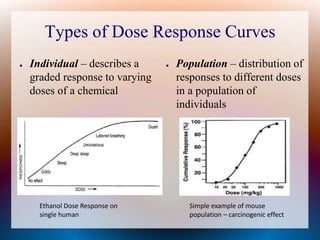
● Individual – describes a
graded response to varying
doses of a chemical
● Population – distribution of
responses to different doses
in a population of
individuals
Ethanol Dose Response on
single human
Simple example of mouse
population – carcinogenic effect
What is….
● NOAEL – No Observable Adverse Effect Level
● Threshold – the DOSE at which there are no ill
effects from exposure
● LOAEL – Lowest Observable Adverse Effect Level
The body is able to eliminate toxins fast and efficiently enough not to see
adverse effects…NOAEL. Eventually the body reaches a point where
toxins IN = toxins OUT…THRESHOLD. Finally beyond this point the
body can’t metabolize & eliminate toxins fast enough and we start to see
adverse effects…LOAEL.
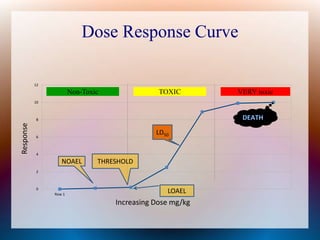
Dose Response Curve
Row 1
0
2
4
6
8
10
12
Increasing Dose mg/kg
Response
Non-Toxic TOXIC VERY toxic
NOAEL THRESHOLD
LOAEL
LD50
Dose Response Acronyms
● TDLO – Toxic Dose Low – lowest dose by any route EXCEPT
inhalation.
– mg/kg; mg/cm2; ppm
- Over ANY given period of time
- Reported to produce ANY toxic effect in humans OR to produce any
tumors or reproductive effects in animals
• TCLO – Toxic Concentration Low – lowest concentration in
air.
• ppmv; mg/m3
• Over ANY period of time that produces any toxic effect in humans
• Reported to produce ANY toxic effect in humans OR to produce any
tumors or reproductive effects in animals
• LDLO – Lethal Dose Low – lowest dose of a substance (other than the LD50)
by ANY route EXCEPT inhalation that has caused death in a humans or
animals
• LD50 – Lethal Dose Fifty – calculated dose expected to kill 50% of a test
population by ANY route EXCEPT inhalation.
• LCLO – Lethal Concentration Low – lowest concentration (other than LC50)
IN AIR reported to have caused death in animal or human.
• LC50 – Lethal Concentration Fifty – calculated concentration IN AIR over a
specified period of time that kills 50% of a test population
• See table 6.1 in text
● Comparing LD50 values….what value?
● Just how BAD is it?
● The lower the # the more toxic the chemical
● Multiply the LD50 by the average mass of man (in
kg) – gives a rough estimate of toxic potential of a
substance for an “average” male weighing 70kg
Benzene LD50 = Acute oral toxicity (LD50): 930 mg/kg [Rat]
930mg/kg x 70 kg = 65,100 mg or 65.1 g or 0.0651 kg
OR
approximately 2.3 ounces or 75mL
Factors that influence toxicity
Chemical Factors
● Composition
● Physical characteristics
● Physical properties
● Presence of impurities
● Breakdown products
● Carrier
Exposure Factors
● Dose, concentration
● Route of exposure
● Duration of exposure
Factors continued…
Person exposed
● Heredity
● Immune system
● Nutrition
● Hormones
● Age
● Gender
● Health status
● Pre-existing conditions
Environmental
● Carrier
● Additional chemicals
● Temperature
● Air pressure
ROUTES OF EXPOSURE!
● Ingestion
● Injection
● Inhalation
● Absorption
Combined Effects
● Synergism - certain chemicals, when COMBINED, cause a
greater additive effect
– Ethanol + Carbon Tetrachloride = enhanced hepatotoxicity
(both are KNOWN hapatotoxins)
● Potentiation – where the added chemical is a potentiator but not
necessarily toxic by itself…can INCREASE the toxicity
– Isopropanol + Carbon Tetrachloride = increased hepatotoxicity
(not hepatotoxic) (hepatotoxic)
 Antagonists - when combined LESSEN the predicted effect
Four types of
Antagonists
● Functional – have opposite effect on some
physiological function
● Chemical - react with toxic compound and make
it a less toxic product
● Dispositional – alters the absorption,
metabolism, distribution or excretion of the toxin
● Receptor – binds with same tissue as toxin OR
same receptor and blocks or reduces toxic effect
Types of Toxicity
● Acute – effects usually within 24 to 72 hours after exposure,
however should occur within 14 days of exposure
● May be as serious as death or temporary as drunkenness
● Chronic – effects manifest several weeks, months or years
after exposure
● May have been an isolated exposure or repeated over many years
● Local – action of toxic substance on specific area of contact
● Such as skin, mucous membranes, eyes, throat
● Systemic – effect or action is distributed through the body
● Inhalation of chloroform effects the brain
Few more definitions
● Carcinogen – substance that will induce a malignant
tumor in a person following reasonable exposure
● Mutagen – affects the genetic system of exposed people or
animals and may cause cancer or undesirable mutations in
future generations
● Teratogen – compound that affects the fetus through the
mother causing death or significant deformities
● (may have no effect on mother!)
Common Classifications of Materials
at Waste Sites
● Irritants
● Corrosives
● Hepatotoxins
● Nephrotoxins
● Braintoxins
● Cardiotoxins
● Neurotoxins
● Ocular toxins
● Pulmonary toxins
● Bone toxins
● Behavioral toxins
*Many of these may actually overlap
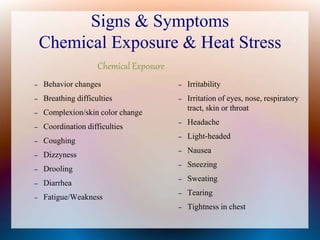
Signs & Symptoms
Chemical Exposure & Heat Stress
– Behavior changes
– Breathing difficulties
– Complexion/skin color change
– Coordination difficulties
– Coughing
– Dizzyness
– Drooling
– Diarrhea
– Fatigue/Weakness
– Irritability
– Irritation of eyes, nose, respiratory
tract, skin or throat
– Headache
– Light-headed
– Nausea
– Sneezing
– Sweating
– Tearing
– Tightness in chest
Chemical Exposure
Signs & Symptoms
Chemical Exposure & Heat Stress
● Heat Exhaustion
– Clammy skin
– Confusion
– Dizziness
– Fainting
– Heat rash
– Light-headedness
– Nausea
– Profuse sweating
– Slurred Speech
– Weak Pulse
• Heat Stroke (may be fatal)
― Confusion
― Convulsions
― Hot skin, high temperature
― Incoherent speech
― Convulsions
― Sweating stops (residual
sweat may still be present)
― Unconsciousness
Heat Exhaustion & Heat Stroke

Toxicity

  • 1.
  • 2.
    Toxicology vs. Toxicity ●Toxicology – the study of chemical or physical agents that interact with biological systems to produce a response in the organism ● Toxicity – The relative ability of a substance to cause injury to biological tissue
  • 3.
    Dose Units expressed interms of quantity administered • Per unit of weight • mg/kg • ug/kg • ppm • ppb • Skin Surface • mg/cm2 ● In the air/Inhaled • ppmv (parts of vapor/gas PER million parts of air BY volume) • mg/m3
  • 4.
    Toxicity vs. Hazard ●Toxicity – – CAPACITY of a material to produce an injury or do harm….like RISK ● Hazard – – POSSIBILITY or potential of exposure to a material that will cause injury when a specific amount is used under specified conditions
  • 5.
    Effects of exposureare dependent on: ● Dose ● Rate of exposure ● Physical state of material ● Temperature ● Site of absorption/exposure ● Diet ● General state of health
  • 6.
    Dose/Response relationship ● Thedose makes the poison… …the characteristics of exposure to a chemical and the type of effect caused by the chemical …in other words HOW exposed and HOW MUCH exposed to that causes the effect being studied.
  • 7.
    Types of DoseResponse Curves ● Individual – describes a graded response to varying doses of a chemical ● Population – distribution of responses to different doses in a population of individuals Ethanol Dose Response on single human Simple example of mouse population – carcinogenic effect
  • 8.
    What is…. ● NOAEL– No Observable Adverse Effect Level ● Threshold – the DOSE at which there are no ill effects from exposure ● LOAEL – Lowest Observable Adverse Effect Level The body is able to eliminate toxins fast and efficiently enough not to see adverse effects…NOAEL. Eventually the body reaches a point where toxins IN = toxins OUT…THRESHOLD. Finally beyond this point the body can’t metabolize & eliminate toxins fast enough and we start to see adverse effects…LOAEL.
  • 9.
    Dose Response Curve Row1 0 2 4 6 8 10 12 Increasing Dose mg/kg Response Non-Toxic TOXIC VERY toxic NOAEL THRESHOLD LOAEL LD50
  • 10.
    Dose Response Acronyms ●TDLO – Toxic Dose Low – lowest dose by any route EXCEPT inhalation. – mg/kg; mg/cm2; ppm - Over ANY given period of time - Reported to produce ANY toxic effect in humans OR to produce any tumors or reproductive effects in animals • TCLO – Toxic Concentration Low – lowest concentration in air. • ppmv; mg/m3 • Over ANY period of time that produces any toxic effect in humans • Reported to produce ANY toxic effect in humans OR to produce any tumors or reproductive effects in animals
  • 11.
    • LDLO –Lethal Dose Low – lowest dose of a substance (other than the LD50) by ANY route EXCEPT inhalation that has caused death in a humans or animals • LD50 – Lethal Dose Fifty – calculated dose expected to kill 50% of a test population by ANY route EXCEPT inhalation. • LCLO – Lethal Concentration Low – lowest concentration (other than LC50) IN AIR reported to have caused death in animal or human. • LC50 – Lethal Concentration Fifty – calculated concentration IN AIR over a specified period of time that kills 50% of a test population • See table 6.1 in text
  • 12.
    ● Comparing LD50values….what value? ● Just how BAD is it? ● The lower the # the more toxic the chemical
  • 13.
    ● Multiply theLD50 by the average mass of man (in kg) – gives a rough estimate of toxic potential of a substance for an “average” male weighing 70kg Benzene LD50 = Acute oral toxicity (LD50): 930 mg/kg [Rat] 930mg/kg x 70 kg = 65,100 mg or 65.1 g or 0.0651 kg OR approximately 2.3 ounces or 75mL
  • 14.
    Factors that influencetoxicity Chemical Factors ● Composition ● Physical characteristics ● Physical properties ● Presence of impurities ● Breakdown products ● Carrier Exposure Factors ● Dose, concentration ● Route of exposure ● Duration of exposure
  • 15.
    Factors continued… Person exposed ●Heredity ● Immune system ● Nutrition ● Hormones ● Age ● Gender ● Health status ● Pre-existing conditions Environmental ● Carrier ● Additional chemicals ● Temperature ● Air pressure
  • 16.
    ROUTES OF EXPOSURE! ●Ingestion ● Injection ● Inhalation ● Absorption
  • 17.
    Combined Effects ● Synergism- certain chemicals, when COMBINED, cause a greater additive effect – Ethanol + Carbon Tetrachloride = enhanced hepatotoxicity (both are KNOWN hapatotoxins) ● Potentiation – where the added chemical is a potentiator but not necessarily toxic by itself…can INCREASE the toxicity – Isopropanol + Carbon Tetrachloride = increased hepatotoxicity (not hepatotoxic) (hepatotoxic)  Antagonists - when combined LESSEN the predicted effect
  • 18.
    Four types of Antagonists ●Functional – have opposite effect on some physiological function ● Chemical - react with toxic compound and make it a less toxic product ● Dispositional – alters the absorption, metabolism, distribution or excretion of the toxin ● Receptor – binds with same tissue as toxin OR same receptor and blocks or reduces toxic effect
  • 19.
    Types of Toxicity ●Acute – effects usually within 24 to 72 hours after exposure, however should occur within 14 days of exposure ● May be as serious as death or temporary as drunkenness ● Chronic – effects manifest several weeks, months or years after exposure ● May have been an isolated exposure or repeated over many years ● Local – action of toxic substance on specific area of contact ● Such as skin, mucous membranes, eyes, throat ● Systemic – effect or action is distributed through the body ● Inhalation of chloroform effects the brain
  • 20.
    Few more definitions ●Carcinogen – substance that will induce a malignant tumor in a person following reasonable exposure ● Mutagen – affects the genetic system of exposed people or animals and may cause cancer or undesirable mutations in future generations ● Teratogen – compound that affects the fetus through the mother causing death or significant deformities ● (may have no effect on mother!)
  • 21.
    Common Classifications ofMaterials at Waste Sites ● Irritants ● Corrosives ● Hepatotoxins ● Nephrotoxins ● Braintoxins ● Cardiotoxins ● Neurotoxins ● Ocular toxins ● Pulmonary toxins ● Bone toxins ● Behavioral toxins *Many of these may actually overlap
  • 22.
    Signs & Symptoms ChemicalExposure & Heat Stress – Behavior changes – Breathing difficulties – Complexion/skin color change – Coordination difficulties – Coughing – Dizzyness – Drooling – Diarrhea – Fatigue/Weakness – Irritability – Irritation of eyes, nose, respiratory tract, skin or throat – Headache – Light-headed – Nausea – Sneezing – Sweating – Tearing – Tightness in chest Chemical Exposure
  • 23.
    Signs & Symptoms ChemicalExposure & Heat Stress ● Heat Exhaustion – Clammy skin – Confusion – Dizziness – Fainting – Heat rash – Light-headedness – Nausea – Profuse sweating – Slurred Speech – Weak Pulse • Heat Stroke (may be fatal) ― Confusion ― Convulsions ― Hot skin, high temperature ― Incoherent speech ― Convulsions ― Sweating stops (residual sweat may still be present) ― Unconsciousness Heat Exhaustion & Heat Stroke

Editor's Notes