© 2019 HORIBA, Ltd. All rights reserved. 2© 2019 HORIBA, Ltd. All rights reserved. 2
System Verification
Horiba Instruments Inc.
Particle Characterization
Jeff Bodycomb, Ph.D.
August 6, 2019
© 2019 HORIBA, Ltd. All rights reserved. 3
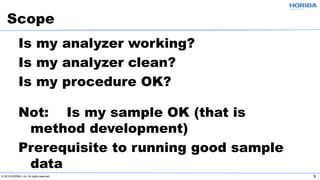
Is my analyzer working?
Is my analyzer clean?
Is my procedure OK?
Not: Is my sample OK (that is
method development)
Prerequisite to running good sample
data
Scope
© 2019 HORIBA, Ltd. All rights reserved. 4
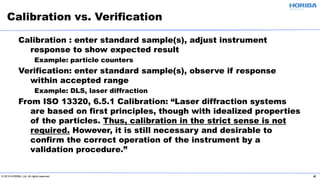
Calibration : enter standard sample(s), adjust instrument
response to show expected result
Example: particle counters
Verification: enter standard sample(s), observe if response
within accepted range
Example: DLS, laser diffraction
From ISO 13320, 6.5.1 Calibration: “Laser diffraction systems
are based on first principles, though with idealized properties
of the particles. Thus, calibration in the strict sense is not
required. However, it is still necessary and desirable to
confirm the correct operation of the instrument by a
validation procedure.”
Calibration vs. Verification
© 2019 HORIBA, Ltd. All rights reserved. 5
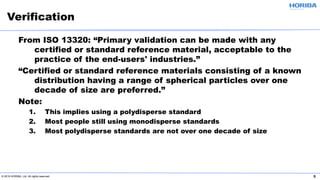
From ISO 13320: “Primary validation can be made with any
certified or standard reference material, acceptable to the
practice of the end-users' industries.”
“Certified or standard reference materials consisting of a known
distribution having a range of spherical particles over one
decade of size are preferred.”
Note:
1. This implies using a polydisperse standard
2. Most people still using monodisperse standards
3. Most polydisperse standards are not over one decade of size
Verification
© 2019 HORIBA, Ltd. All rights reserved. 6
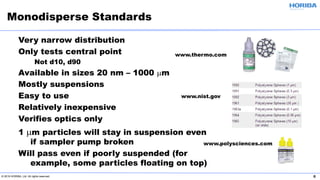
Very narrow distribution
Only tests central point
Not d10, d90
Available in sizes 20 nm – 1000 µm
Mostly suspensions
Easy to use
Relatively inexpensive
Verifies optics only
1 µm particles will stay in suspension even
if sampler pump broken
Will pass even if poorly suspended (for
example, some particles floating on top)
Monodisperse Standards
www.polysciences.com
www.thermo.com
www.nist.gov
© 2019 HORIBA, Ltd. All rights reserved. 7
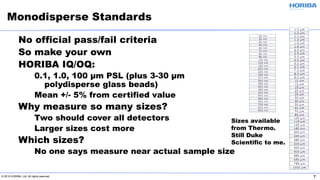
No official pass/fail criteria
So make your own
HORIBA IQ/OQ:
0.1, 1.0, 100 µm PSL (plus 3-30 µm
polydisperse glass beads)
Mean +/- 5% from certified value
Why measure so many sizes?
Two should cover all detectors
Larger sizes cost more
Which sizes?
No one says measure near actual sample size
Monodisperse Standards
Sizes available
from Thermo.
Still Duke
Scientific to me.
© 2019 HORIBA, Ltd. All rights reserved. 8
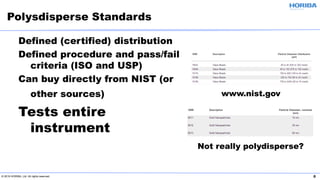
Defined (certified) distribution
Defined procedure and pass/fail
criteria (ISO and USP)
Can buy directly from NIST (or
other sources)
Tests entire
instrument
Polysdisperse Standards
www.nist.gov
Not really polydisperse?
© 2019 HORIBA, Ltd. All rights reserved. 9
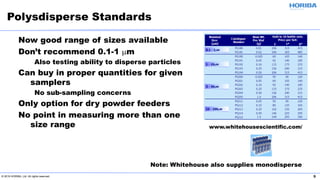
Now good range of sizes available
Don’t recommend 0.1-1 µm
Also testing ability to disperse particles
Can buy in proper quantities for given
samplers
No sub-sampling concerns
Only option for dry powder feeders
No point in measuring more than one
size range
Polysdisperse Standards
www.whitehousescientific.com/
Note: Whitehouse also supplies monodisperse
© 2019 HORIBA, Ltd. All rights reserved. 10
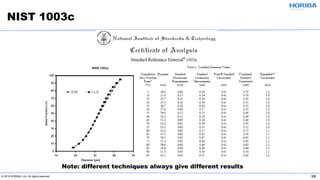
NIST 1003c
Note: different techniques always give different results
© 2019 HORIBA, Ltd. All rights reserved. 11
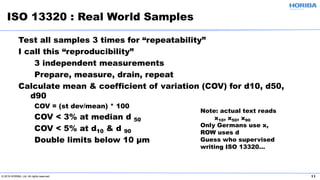
Test all samples 3 times for “repeatability”
I call this “reproducibility”
3 independent measurements
Prepare, measure, drain, repeat
Calculate mean & coefficient of variation (COV) for d10, d50,
d90
COV = (st dev/mean) * 100
COV < 3% at median d 50
COV < 5% at d10 & d 90
Double limits below 10 µm
ISO 13320 : Real World Samples
Note: actual text reads
x10, x50, x90
Only Germans use x,
ROW uses d
Guess who supervised
writing ISO 13320…
© 2019 HORIBA, Ltd. All rights reserved. 12
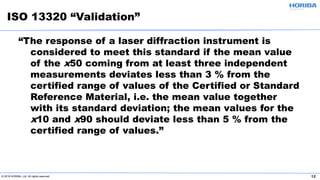
“The response of a laser diffraction instrument is
considered to meet this standard if the mean value
of the x50 coming from at least three independent
measurements deviates less than 3 % from the
certified range of values of the Certified or Standard
Reference Material, i.e. the mean value together
with its standard deviation; the mean values for the
x10 and x90 should deviate less than 5 % from the
certified range of values.”
ISO 13320 “Validation”
© 2019 HORIBA, Ltd. All rights reserved. 13
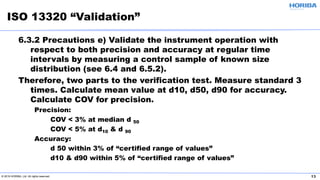
6.3.2 Precautions e) Validate the instrument operation with
respect to both precision and accuracy at regular time
intervals by measuring a control sample of known size
distribution (see 6.4 and 6.5.2).
Therefore, two parts to the verification test. Measure standard 3
times. Calculate mean value at d10, d50, d90 for accuracy.
Calculate COV for precision.
Precision:
COV < 3% at median d 50
COV < 5% at d10 & d 90
Accuracy:
d 50 within 3% of “certified range of values”
d10 & d90 within 5% of “certified range of values”
ISO 13320 “Validation”
© 2019 HORIBA, Ltd. All rights reserved. 14
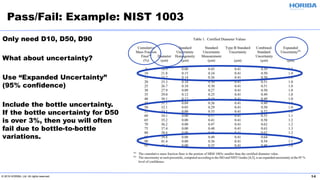
Pass/Fail: Example: NIST 1003
Only need D10, D50, D90
What about uncertainty?
Use “Expanded Uncertainty”
(95% confidence)
Include the bottle uncertainty.
If the bottle uncertainty for D50
is over 3%, then you will often
fail due to bottle-to-bottle
variations.
© 2019 HORIBA, Ltd. All rights reserved. 15
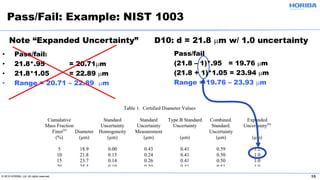
Pass/Fail: Example: NIST 1003
• Pass/fail:
• 21.8*.95 = 20.71µm
• 21.8*1.05 = 22.89 µm
• Range = 20.71 – 22.89 µm
Note “Expanded Uncertainty” D10: d = 21.8 µm w/ 1.0 uncertainty
Pass/fail
(21.8 – 1)*.95 = 19.76 µm
(21.8 + 1)*1.05 = 23.94 µm
Range = 19.76 – 23.93 µm
© 2019 HORIBA, Ltd. All rights reserved. 16
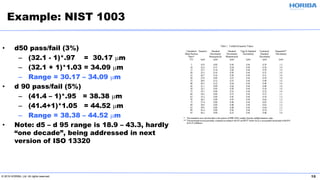
Example: NIST 1003
• d50 pass/fail (3%)
– (32.1 - 1)*.97 = 30.17 µm
– (32.1 + 1)*1.03 = 34.09 µm
– Range = 30.17 – 34.09 µm
• d 90 pass/fail (5%)
– (41.4 – 1)*.95 = 38.38 µm
– (41.4+1)*1.05 = 44.52 µm
– Range = 38.38 – 44.52 µm
• Note: d5 – d 95 range is 18.9 – 43.3, hardly
“one decade”, being addressed in next
version of ISO 13320
© 2019 HORIBA, Ltd. All rights reserved. 17
Had a customer that was measuring a 100 micron
polystyrene bead.
Needed a LOT of sample (1/2 of a bottle) for a test and
scattering was very weak.
Agitation was set low and beads floated to top of cup.
Set agitation higher to ensure that beads were
entrained.
Also should have considered some surfactant.
Watch your mixing!
© 2019 HORIBA, Ltd. All rights reserved. 18
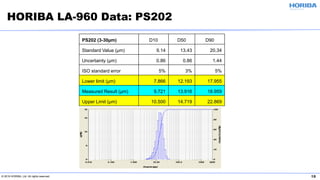
HORIBA LA-960 Data: PS202
PS202 (3-30µm) D10 D50 D90
Standard Value (µm) 9.14 13.43 20.34
Uncertainty (µm) 0.86 0.86 1.44
ISO standard error 5% 3% 5%
Lower limit (µm) 7.866 12.193 17.955
Measured Result (µm) 9.721 13.916 18.959
Upper Limit (µm) 10.500 14.719 22.869
© 2019 HORIBA, Ltd. All rights reserved. 19
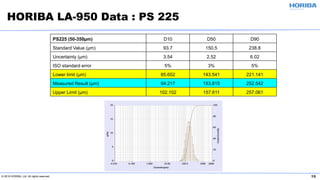
HORIBA LA-950 Data : PS 225
PS225 (50-350µm) D10 D50 D90
Standard Value (µm) 93.7 150.5 238.8
Uncertainty (µm) 3.54 2.52 6.02
ISO standard error 5% 3% 5%
Lower limit (µm) 85.652 143.541 221.141
Measured Result (µm) 94.217 153.815 252.542
Upper Limit (µm) 102.102 157.611 257.061
© 2019 HORIBA, Ltd. All rights reserved. 20
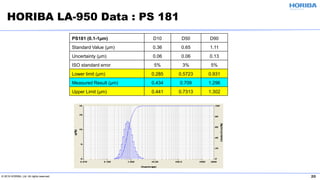
HORIBA LA-950 Data : PS 181
PS181 (0.1-1µm) D10 D50 D90
Standard Value (µm) 0.36 0.65 1.11
Uncertainty (µm) 0.06 0.06 0.13
ISO standard error 5% 3% 5%
Lower limit (µm) 0.285 0.5723 0.931
Measured Result (µm) 0.434 0.709 1.296
Upper Limit (µm) 0.441 0.7313 1.302
© 2019 HORIBA, Ltd. All rights reserved. 21
Used only in the pharmaceutical
industry
Based on ISO 13320
Broader limits for reproducibility
Same limits for verification
USP<429>
© 2019 HORIBA, Ltd. All rights reserved. 22
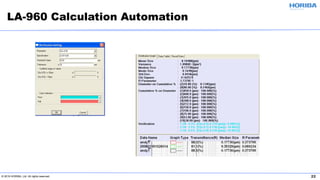
LA-960 Calculation Automation
© 2019 HORIBA, Ltd. All rights reserved. 23
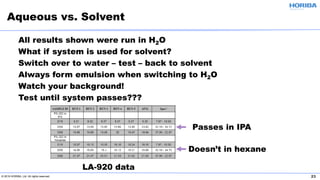
All results shown were run in H2O
What if system is used for solvent?
Switch over to water – test – back to solvent
Always form emulsion when switching to H2O
Watch your background!
Test until system passes???
Aqueous vs. Solvent
LA-920 data
Passes in IPA
Doesn’t in hexane
© 2019 HORIBA, Ltd. All rights reserved. 24
Verify system on a regular basis
Current practice: daily to annually
Should be risk based decision
Run plant on particle size = daily
Use for research 3 times/year = annually
Switch to using polydisperse standards to also
test samplers
Most companies still using monodisperse latex –
but be aware of risk and “paper trail” not
strong
Conclusions
© 2019 HORIBA, Ltd. All rights reserved. 25© 2019 HORIBA, Ltd. All rights reserved. 25
© 2019 HORIBA, Ltd. All rights reserved. 26
Danke
Большое спасибо
Grazie
Σας ευχαριστούμε
감사합니다
Obrigado
谢谢
ขอบคุณครับ
ありがとうございました
धन्यवाद
நன்ற
Cảm ơn
Dziękuję
Tack ska ni ha
Thank you
Merci
Gracias

Particle Classroom Series IV: System Verification

  • 1.
    © 2019 HORIBA,Ltd. All rights reserved. 2© 2019 HORIBA, Ltd. All rights reserved. 2 System Verification Horiba Instruments Inc. Particle Characterization Jeff Bodycomb, Ph.D. August 6, 2019
  • 2.
    © 2019 HORIBA,Ltd. All rights reserved. 3 Is my analyzer working? Is my analyzer clean? Is my procedure OK? Not: Is my sample OK (that is method development) Prerequisite to running good sample data Scope
  • 3.
    © 2019 HORIBA,Ltd. All rights reserved. 4 Calibration : enter standard sample(s), adjust instrument response to show expected result Example: particle counters Verification: enter standard sample(s), observe if response within accepted range Example: DLS, laser diffraction From ISO 13320, 6.5.1 Calibration: “Laser diffraction systems are based on first principles, though with idealized properties of the particles. Thus, calibration in the strict sense is not required. However, it is still necessary and desirable to confirm the correct operation of the instrument by a validation procedure.” Calibration vs. Verification
  • 4.
    © 2019 HORIBA,Ltd. All rights reserved. 5 From ISO 13320: “Primary validation can be made with any certified or standard reference material, acceptable to the practice of the end-users' industries.” “Certified or standard reference materials consisting of a known distribution having a range of spherical particles over one decade of size are preferred.” Note: 1. This implies using a polydisperse standard 2. Most people still using monodisperse standards 3. Most polydisperse standards are not over one decade of size Verification
  • 5.
    © 2019 HORIBA,Ltd. All rights reserved. 6 Very narrow distribution Only tests central point Not d10, d90 Available in sizes 20 nm – 1000 µm Mostly suspensions Easy to use Relatively inexpensive Verifies optics only 1 µm particles will stay in suspension even if sampler pump broken Will pass even if poorly suspended (for example, some particles floating on top) Monodisperse Standards www.polysciences.com www.thermo.com www.nist.gov
  • 6.
    © 2019 HORIBA,Ltd. All rights reserved. 7 No official pass/fail criteria So make your own HORIBA IQ/OQ: 0.1, 1.0, 100 µm PSL (plus 3-30 µm polydisperse glass beads) Mean +/- 5% from certified value Why measure so many sizes? Two should cover all detectors Larger sizes cost more Which sizes? No one says measure near actual sample size Monodisperse Standards Sizes available from Thermo. Still Duke Scientific to me.
  • 7.
    © 2019 HORIBA,Ltd. All rights reserved. 8 Defined (certified) distribution Defined procedure and pass/fail criteria (ISO and USP) Can buy directly from NIST (or other sources) Tests entire instrument Polysdisperse Standards www.nist.gov Not really polydisperse?
  • 8.
    © 2019 HORIBA,Ltd. All rights reserved. 9 Now good range of sizes available Don’t recommend 0.1-1 µm Also testing ability to disperse particles Can buy in proper quantities for given samplers No sub-sampling concerns Only option for dry powder feeders No point in measuring more than one size range Polysdisperse Standards www.whitehousescientific.com/ Note: Whitehouse also supplies monodisperse
  • 9.
    © 2019 HORIBA,Ltd. All rights reserved. 10 NIST 1003c Note: different techniques always give different results
  • 10.
    © 2019 HORIBA,Ltd. All rights reserved. 11 Test all samples 3 times for “repeatability” I call this “reproducibility” 3 independent measurements Prepare, measure, drain, repeat Calculate mean & coefficient of variation (COV) for d10, d50, d90 COV = (st dev/mean) * 100 COV < 3% at median d 50 COV < 5% at d10 & d 90 Double limits below 10 µm ISO 13320 : Real World Samples Note: actual text reads x10, x50, x90 Only Germans use x, ROW uses d Guess who supervised writing ISO 13320…
  • 11.
    © 2019 HORIBA,Ltd. All rights reserved. 12 “The response of a laser diffraction instrument is considered to meet this standard if the mean value of the x50 coming from at least three independent measurements deviates less than 3 % from the certified range of values of the Certified or Standard Reference Material, i.e. the mean value together with its standard deviation; the mean values for the x10 and x90 should deviate less than 5 % from the certified range of values.” ISO 13320 “Validation”
  • 12.
    © 2019 HORIBA,Ltd. All rights reserved. 13 6.3.2 Precautions e) Validate the instrument operation with respect to both precision and accuracy at regular time intervals by measuring a control sample of known size distribution (see 6.4 and 6.5.2). Therefore, two parts to the verification test. Measure standard 3 times. Calculate mean value at d10, d50, d90 for accuracy. Calculate COV for precision. Precision: COV < 3% at median d 50 COV < 5% at d10 & d 90 Accuracy: d 50 within 3% of “certified range of values” d10 & d90 within 5% of “certified range of values” ISO 13320 “Validation”
  • 13.
    © 2019 HORIBA,Ltd. All rights reserved. 14 Pass/Fail: Example: NIST 1003 Only need D10, D50, D90 What about uncertainty? Use “Expanded Uncertainty” (95% confidence) Include the bottle uncertainty. If the bottle uncertainty for D50 is over 3%, then you will often fail due to bottle-to-bottle variations.
  • 14.
    © 2019 HORIBA,Ltd. All rights reserved. 15 Pass/Fail: Example: NIST 1003 • Pass/fail: • 21.8*.95 = 20.71µm • 21.8*1.05 = 22.89 µm • Range = 20.71 – 22.89 µm Note “Expanded Uncertainty” D10: d = 21.8 µm w/ 1.0 uncertainty Pass/fail (21.8 – 1)*.95 = 19.76 µm (21.8 + 1)*1.05 = 23.94 µm Range = 19.76 – 23.93 µm
  • 15.
    © 2019 HORIBA,Ltd. All rights reserved. 16 Example: NIST 1003 • d50 pass/fail (3%) – (32.1 - 1)*.97 = 30.17 µm – (32.1 + 1)*1.03 = 34.09 µm – Range = 30.17 – 34.09 µm • d 90 pass/fail (5%) – (41.4 – 1)*.95 = 38.38 µm – (41.4+1)*1.05 = 44.52 µm – Range = 38.38 – 44.52 µm • Note: d5 – d 95 range is 18.9 – 43.3, hardly “one decade”, being addressed in next version of ISO 13320
  • 16.
    © 2019 HORIBA,Ltd. All rights reserved. 17 Had a customer that was measuring a 100 micron polystyrene bead. Needed a LOT of sample (1/2 of a bottle) for a test and scattering was very weak. Agitation was set low and beads floated to top of cup. Set agitation higher to ensure that beads were entrained. Also should have considered some surfactant. Watch your mixing!
  • 17.
    © 2019 HORIBA,Ltd. All rights reserved. 18 HORIBA LA-960 Data: PS202 PS202 (3-30µm) D10 D50 D90 Standard Value (µm) 9.14 13.43 20.34 Uncertainty (µm) 0.86 0.86 1.44 ISO standard error 5% 3% 5% Lower limit (µm) 7.866 12.193 17.955 Measured Result (µm) 9.721 13.916 18.959 Upper Limit (µm) 10.500 14.719 22.869
  • 18.
    © 2019 HORIBA,Ltd. All rights reserved. 19 HORIBA LA-950 Data : PS 225 PS225 (50-350µm) D10 D50 D90 Standard Value (µm) 93.7 150.5 238.8 Uncertainty (µm) 3.54 2.52 6.02 ISO standard error 5% 3% 5% Lower limit (µm) 85.652 143.541 221.141 Measured Result (µm) 94.217 153.815 252.542 Upper Limit (µm) 102.102 157.611 257.061
  • 19.
    © 2019 HORIBA,Ltd. All rights reserved. 20 HORIBA LA-950 Data : PS 181 PS181 (0.1-1µm) D10 D50 D90 Standard Value (µm) 0.36 0.65 1.11 Uncertainty (µm) 0.06 0.06 0.13 ISO standard error 5% 3% 5% Lower limit (µm) 0.285 0.5723 0.931 Measured Result (µm) 0.434 0.709 1.296 Upper Limit (µm) 0.441 0.7313 1.302
  • 20.
    © 2019 HORIBA,Ltd. All rights reserved. 21 Used only in the pharmaceutical industry Based on ISO 13320 Broader limits for reproducibility Same limits for verification USP<429>
  • 21.
    © 2019 HORIBA,Ltd. All rights reserved. 22 LA-960 Calculation Automation
  • 22.
    © 2019 HORIBA,Ltd. All rights reserved. 23 All results shown were run in H2O What if system is used for solvent? Switch over to water – test – back to solvent Always form emulsion when switching to H2O Watch your background! Test until system passes??? Aqueous vs. Solvent LA-920 data Passes in IPA Doesn’t in hexane
  • 23.
    © 2019 HORIBA,Ltd. All rights reserved. 24 Verify system on a regular basis Current practice: daily to annually Should be risk based decision Run plant on particle size = daily Use for research 3 times/year = annually Switch to using polydisperse standards to also test samplers Most companies still using monodisperse latex – but be aware of risk and “paper trail” not strong Conclusions
  • 24.
    © 2019 HORIBA,Ltd. All rights reserved. 25© 2019 HORIBA, Ltd. All rights reserved. 25
  • 25.
    © 2019 HORIBA,Ltd. All rights reserved. 26 Danke Большое спасибо Grazie Σας ευχαριστούμε 감사합니다 Obrigado 谢谢 ขอบคุณครับ ありがとうございました धन्यवाद நன்ற Cảm ơn Dziękuję Tack ska ni ha Thank you Merci Gracias