© 2020 HORIBA, Ltd. All rights reserved. 1
© 2020 HORIBA, Ltd. All rights reserved. 2© 2020 HORIBA, Ltd. All rights reserved. 2
How and Why to Analyze Ceramic
Powder Particles
HORIBA Instruments Incorporated
Particle Characterization
Jeffrey Bodycomb, Ph.D.
Feb. 4, 2020
© 2020 HORIBA, Ltd. All rights reserved. 3
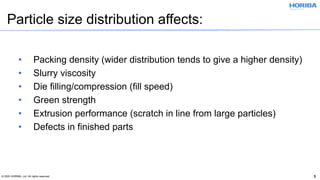
• Packing density (wider distribution tends to give a higher density)
• Slurry viscosity
• Die filling/compression (fill speed)
• Green strength
• Extrusion performance (scratch in line from large particles)
• Defects in finished parts
Particle size distribution affects:
© 2020 HORIBA, Ltd. All rights reserved. 4
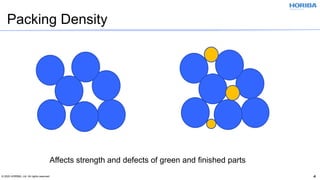
Packing Density
Affects strength and defects of green and finished parts
© 2020 HORIBA, Ltd. All rights reserved. 5
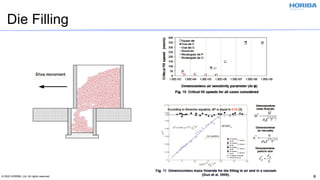
Die Filling
© 2020 HORIBA, Ltd. All rights reserved. 6
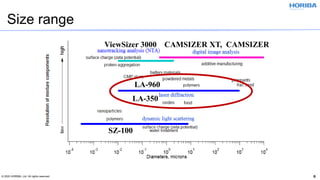
Size range
SZ-100
LA-960
LA-350
ViewSizer 3000 CAMSIZER XT, CAMSIZER
© 2020 HORIBA, Ltd. All rights reserved. 7
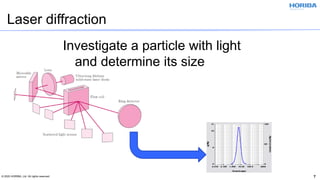
Laser diffraction
Investigate a particle with light
and determine its size
© 2020 HORIBA, Ltd. All rights reserved. 8
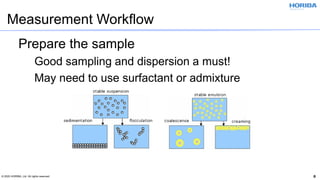
Measurement Workflow
Prepare the sample
Good sampling and dispersion a must!
May need to use surfactant or admixture
© 2020 HORIBA, Ltd. All rights reserved. 9
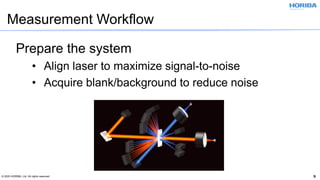
Measurement Workflow
Prepare the system
• Align laser to maximize signal-to-noise
• Acquire blank/background to reduce noise
© 2020 HORIBA, Ltd. All rights reserved. 10
Measurement Workflow
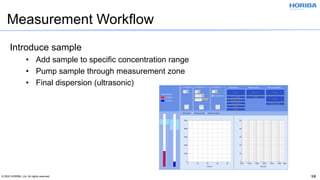
Introduce sample
• Add sample to specific concentration range
• Pump sample through measurement zone
• Final dispersion (ultrasonic)
© 2020 HORIBA, Ltd. All rights reserved. 11
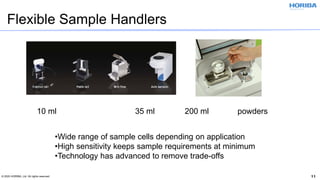
10 ml 35 ml 200 ml powders
•Wide range of sample cells depending on application
•High sensitivity keeps sample requirements at minimum
•Technology has advanced to remove trade-offs
Flexible Sample Handlers
© 2020 HORIBA, Ltd. All rights reserved. 12
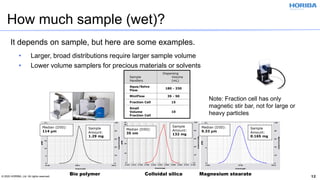
How much sample (wet)?
• Larger, broad distributions require larger sample volume
• Lower volume samplers for precious materials or solvents
Sample
Handlers
Dispersing
Volume
(mL)
Aqua/Solvo
Flow
180 - 330
MiniFlow 35 - 50
Fraction Cell 15
Small
Volume
Fraction Cell
10
Median (D50):
35 nm
Sample
Amount:
132 mg
Median (D50):
114 µm
Sample
Amount:
1.29 mg
Median (D50):
9.33 µm
Sample
Amount:
0.165 mg
Note: Fraction cell has only
magnetic stir bar, not for large or
heavy particles
Bio polymer Colloidal silica Magnesium stearate
It depends on sample, but here are some examples.
© 2020 HORIBA, Ltd. All rights reserved. 13
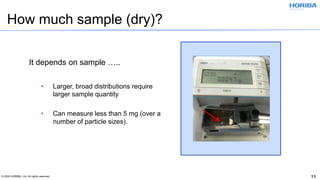
How much sample (dry)?
• Larger, broad distributions require
larger sample quantity
• Can measure less than 5 mg (over a
number of particle sizes).
It depends on sample …..
© 2020 HORIBA, Ltd. All rights reserved. 14
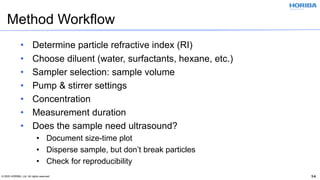
Method Workflow
• Determine particle refractive index (RI)
• Choose diluent (water, surfactants, hexane, etc.)
• Sampler selection: sample volume
• Pump & stirrer settings
• Concentration
• Measurement duration
• Does the sample need ultrasound?
• Document size-time plot
• Disperse sample, but don’t break particles
• Check for reproducibility
© 2020 HORIBA, Ltd. All rights reserved. 15
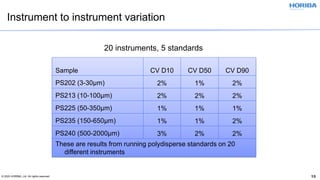
Instrument to instrument variation
Sample CV D10 CV D50 CV D90
PS202 (3-30µm) 2% 1% 2%
PS213 (10-100µm) 2% 2% 2%
PS225 (50-350µm) 1% 1% 1%
PS235 (150-650µm) 1% 1% 2%
PS240 (500-2000µm) 3% 2% 2%
These are results from running polydisperse standards on 20
different instruments
20 instruments, 5 standards
© 2020 HORIBA, Ltd. All rights reserved. 16
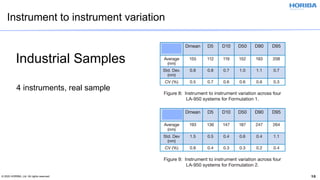
Instrument to instrument variation
Industrial Samples
4 instruments, real sample
© 2020 HORIBA, Ltd. All rights reserved. 17
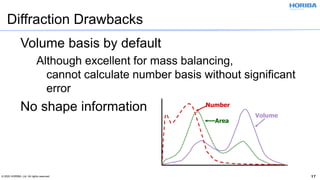
Diffraction Drawbacks
Volume basis by default
Although excellent for mass balancing,
cannot calculate number basis without significant
error
No shape information
Volume
Area
Number
© 2020 HORIBA, Ltd. All rights reserved. 18
Benefits
Wide size range
Most advanced analyzer measures from 10 nano to 5 milli
Flexible sample handlers
Powders, suspensions, emulsions, pastes, creams
Very fast
Allows for high throughput, 100’s of samples/day
Easy to use
Many instruments are highly automated with self-guided software
Good design = Excellent precision
Reduces unnecessary investigation/downtime
First principle measurement
No calibration necessary
Massive global install base/history
© 2020 HORIBA, Ltd. All rights reserved. 19
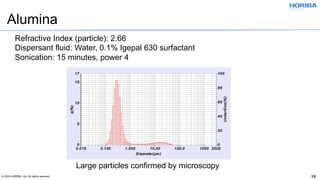
Alumina
Refractive Index (particle): 2.66
Dispersant fluid: Water, 0.1% Igepal 630 surfactant
Sonication: 15 minutes, power 4
Large particles confirmed by microscopy
© 2020 HORIBA, Ltd. All rights reserved. 20
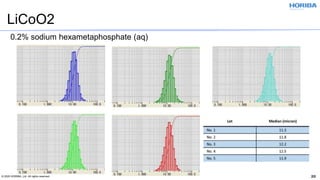
LiCoO2
0.2% sodium hexametaphosphate (aq)
© 2020 HORIBA, Ltd. All rights reserved. 21
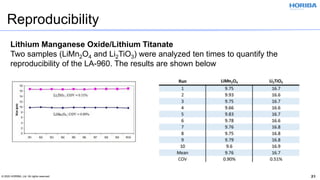
Reproducibility
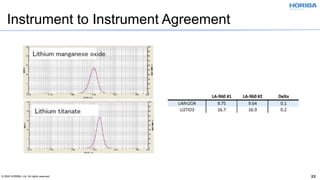
Lithium Manganese Oxide/Lithium Titanate
Two samples (LiMn2O4 and Li2TiO3) were analyzed ten times to quantify the
reproducibility of the LA-960. The results are shown below
© 2020 HORIBA, Ltd. All rights reserved. 22
Instrument to Instrument Agreement
© 2020 HORIBA, Ltd. All rights reserved. 23
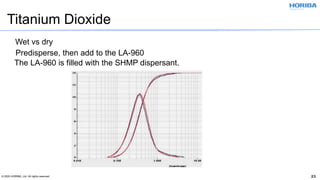
Titanium Dioxide
Wet vs dry
The LA-960 is filled with the SHMP dispersant.
Predisperse, then add to the LA-960
© 2020 HORIBA, Ltd. All rights reserved. 24
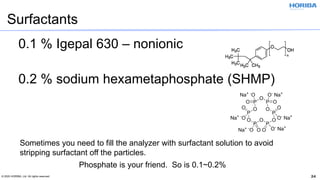
0.1 % Igepal 630 – nonionic
0.2 % sodium hexametaphosphate (SHMP)
Surfactants
Phosphate is your friend. So is 0.1~0.2%
Sometimes you need to fill the analyzer with surfactant solution to avoid
stripping surfactant off the particles.
© 2020 HORIBA, Ltd. All rights reserved. 25
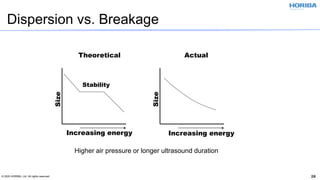
Ultrasonic Dispersion
• Adding energy to break up agglomerates – disperse to primary particles, without breaking
particles
• Similar to changing air pressure on dry powder feeder
• Typically set to 100% energy, vary time (sec) on
• Investigate tails of distribution
• High end to see if agglomerates removed
• Small end to see if new, smaller particles appear (breakage)
• Test reproducibility, consider robustness
• Note:
• Do not use on emulsions
• Can cause thermal mixing trouble w/solvents - wait
• Use external probe if t> 2-5 minutes
© 2020 HORIBA, Ltd. All rights reserved. 26
Size
Increasing energy
Stability
Theoretical Actual
Size
Increasing energy
Higher air pressure or longer ultrasound duration
Dispersion vs. Breakage
© 2020 HORIBA, Ltd. All rights reserved. 27
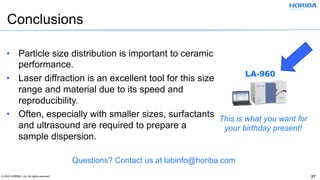
• Particle size distribution is important to ceramic
performance.
• Laser diffraction is an excellent tool for this size
range and material due to its speed and
reproducibility.
• Often, especially with smaller sizes, surfactants
and ultrasound are required to prepare a
sample dispersion.
Conclusions
This is what you want for
your birthday present!
LA-960
Questions? Contact us at labinfo@horiba.com
© 2020 HORIBA, Ltd. All rights reserved. 28© 2020 HORIBA, Ltd. All rights reserved. 28
© 2020 HORIBA, Ltd. All rights reserved. 29

How and Why to Analyze Ceramic Powder Particles

  • 1.
    © 2020 HORIBA,Ltd. All rights reserved. 1
  • 2.
    © 2020 HORIBA,Ltd. All rights reserved. 2© 2020 HORIBA, Ltd. All rights reserved. 2 How and Why to Analyze Ceramic Powder Particles HORIBA Instruments Incorporated Particle Characterization Jeffrey Bodycomb, Ph.D. Feb. 4, 2020
  • 3.
    © 2020 HORIBA,Ltd. All rights reserved. 3 • Packing density (wider distribution tends to give a higher density) • Slurry viscosity • Die filling/compression (fill speed) • Green strength • Extrusion performance (scratch in line from large particles) • Defects in finished parts Particle size distribution affects:
  • 4.
    © 2020 HORIBA,Ltd. All rights reserved. 4 Packing Density Affects strength and defects of green and finished parts
  • 5.
    © 2020 HORIBA,Ltd. All rights reserved. 5 Die Filling
  • 6.
    © 2020 HORIBA,Ltd. All rights reserved. 6 Size range SZ-100 LA-960 LA-350 ViewSizer 3000 CAMSIZER XT, CAMSIZER
  • 7.
    © 2020 HORIBA,Ltd. All rights reserved. 7 Laser diffraction Investigate a particle with light and determine its size
  • 8.
    © 2020 HORIBA,Ltd. All rights reserved. 8 Measurement Workflow Prepare the sample Good sampling and dispersion a must! May need to use surfactant or admixture
  • 9.
    © 2020 HORIBA,Ltd. All rights reserved. 9 Measurement Workflow Prepare the system • Align laser to maximize signal-to-noise • Acquire blank/background to reduce noise
  • 10.
    © 2020 HORIBA,Ltd. All rights reserved. 10 Measurement Workflow Introduce sample • Add sample to specific concentration range • Pump sample through measurement zone • Final dispersion (ultrasonic)
  • 11.
    © 2020 HORIBA,Ltd. All rights reserved. 11 10 ml 35 ml 200 ml powders •Wide range of sample cells depending on application •High sensitivity keeps sample requirements at minimum •Technology has advanced to remove trade-offs Flexible Sample Handlers
  • 12.
    © 2020 HORIBA,Ltd. All rights reserved. 12 How much sample (wet)? • Larger, broad distributions require larger sample volume • Lower volume samplers for precious materials or solvents Sample Handlers Dispersing Volume (mL) Aqua/Solvo Flow 180 - 330 MiniFlow 35 - 50 Fraction Cell 15 Small Volume Fraction Cell 10 Median (D50): 35 nm Sample Amount: 132 mg Median (D50): 114 µm Sample Amount: 1.29 mg Median (D50): 9.33 µm Sample Amount: 0.165 mg Note: Fraction cell has only magnetic stir bar, not for large or heavy particles Bio polymer Colloidal silica Magnesium stearate It depends on sample, but here are some examples.
  • 13.
    © 2020 HORIBA,Ltd. All rights reserved. 13 How much sample (dry)? • Larger, broad distributions require larger sample quantity • Can measure less than 5 mg (over a number of particle sizes). It depends on sample …..
  • 14.
    © 2020 HORIBA,Ltd. All rights reserved. 14 Method Workflow • Determine particle refractive index (RI) • Choose diluent (water, surfactants, hexane, etc.) • Sampler selection: sample volume • Pump & stirrer settings • Concentration • Measurement duration • Does the sample need ultrasound? • Document size-time plot • Disperse sample, but don’t break particles • Check for reproducibility
  • 15.
    © 2020 HORIBA,Ltd. All rights reserved. 15 Instrument to instrument variation Sample CV D10 CV D50 CV D90 PS202 (3-30µm) 2% 1% 2% PS213 (10-100µm) 2% 2% 2% PS225 (50-350µm) 1% 1% 1% PS235 (150-650µm) 1% 1% 2% PS240 (500-2000µm) 3% 2% 2% These are results from running polydisperse standards on 20 different instruments 20 instruments, 5 standards
  • 16.
    © 2020 HORIBA,Ltd. All rights reserved. 16 Instrument to instrument variation Industrial Samples 4 instruments, real sample
  • 17.
    © 2020 HORIBA,Ltd. All rights reserved. 17 Diffraction Drawbacks Volume basis by default Although excellent for mass balancing, cannot calculate number basis without significant error No shape information Volume Area Number
  • 18.
    © 2020 HORIBA,Ltd. All rights reserved. 18 Benefits Wide size range Most advanced analyzer measures from 10 nano to 5 milli Flexible sample handlers Powders, suspensions, emulsions, pastes, creams Very fast Allows for high throughput, 100’s of samples/day Easy to use Many instruments are highly automated with self-guided software Good design = Excellent precision Reduces unnecessary investigation/downtime First principle measurement No calibration necessary Massive global install base/history
  • 19.
    © 2020 HORIBA,Ltd. All rights reserved. 19 Alumina Refractive Index (particle): 2.66 Dispersant fluid: Water, 0.1% Igepal 630 surfactant Sonication: 15 minutes, power 4 Large particles confirmed by microscopy
  • 20.
    © 2020 HORIBA,Ltd. All rights reserved. 20 LiCoO2 0.2% sodium hexametaphosphate (aq)
  • 21.
    © 2020 HORIBA,Ltd. All rights reserved. 21 Reproducibility Lithium Manganese Oxide/Lithium Titanate Two samples (LiMn2O4 and Li2TiO3) were analyzed ten times to quantify the reproducibility of the LA-960. The results are shown below
  • 22.
    © 2020 HORIBA,Ltd. All rights reserved. 22 Instrument to Instrument Agreement
  • 23.
    © 2020 HORIBA,Ltd. All rights reserved. 23 Titanium Dioxide Wet vs dry The LA-960 is filled with the SHMP dispersant. Predisperse, then add to the LA-960
  • 24.
    © 2020 HORIBA,Ltd. All rights reserved. 24 0.1 % Igepal 630 – nonionic 0.2 % sodium hexametaphosphate (SHMP) Surfactants Phosphate is your friend. So is 0.1~0.2% Sometimes you need to fill the analyzer with surfactant solution to avoid stripping surfactant off the particles.
  • 25.
    © 2020 HORIBA,Ltd. All rights reserved. 25 Ultrasonic Dispersion • Adding energy to break up agglomerates – disperse to primary particles, without breaking particles • Similar to changing air pressure on dry powder feeder • Typically set to 100% energy, vary time (sec) on • Investigate tails of distribution • High end to see if agglomerates removed • Small end to see if new, smaller particles appear (breakage) • Test reproducibility, consider robustness • Note: • Do not use on emulsions • Can cause thermal mixing trouble w/solvents - wait • Use external probe if t> 2-5 minutes
  • 26.
    © 2020 HORIBA,Ltd. All rights reserved. 26 Size Increasing energy Stability Theoretical Actual Size Increasing energy Higher air pressure or longer ultrasound duration Dispersion vs. Breakage
  • 27.
    © 2020 HORIBA,Ltd. All rights reserved. 27 • Particle size distribution is important to ceramic performance. • Laser diffraction is an excellent tool for this size range and material due to its speed and reproducibility. • Often, especially with smaller sizes, surfactants and ultrasound are required to prepare a sample dispersion. Conclusions This is what you want for your birthday present! LA-960 Questions? Contact us at labinfo@horiba.com
  • 28.
    © 2020 HORIBA,Ltd. All rights reserved. 28© 2020 HORIBA, Ltd. All rights reserved. 28
  • 29.
    © 2020 HORIBA,Ltd. All rights reserved. 29