© 2019 HORIBA, Ltd. All rights reserved. 1
© 2019 HORIBA, Ltd. All rights reserved. 2© 2019 HORIBA, Ltd. All rights reserved. 2
Refractive Index and Laser
Diffraction
HORIBA Instruments
Particle Analysis
Jeff Bodycomb, Ph.D.
March 6, 2019
© 2019 HORIBA, Ltd. All rights reserved. 3
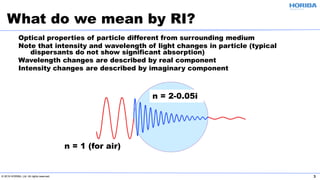
Optical properties of particle different from surrounding medium
Note that intensity and wavelength of light changes in particle (typical
dispersants do not show significant absorption)

Wavelength changes are described by real component
Intensity changes are described by imaginary component
What do we mean by RI?
n = 1 (for air)
n = 2-0.05i
© 2019 HORIBA, Ltd. All rights reserved. 4
Light scattering is an optical measurement. Under certain
conditions, one must include behavior of light inside the
particulate material.
For larger particles; i. e., above approx. 26 micrometers,
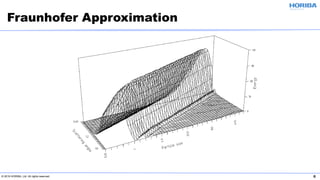
Fraunhofer Diffraction may be adequate to describe particle
size and refractive index is less important.
When particle diameter is of the same approximate size as the
wavelength of light used to make the measurement, a
complex theory known as Mie Scattering Theory must be
invoked. Refractive index describes the behavior of light
inside the particle.
Why Worry about Refractive Index?
© 2019 HORIBA, Ltd. All rights reserved. 5
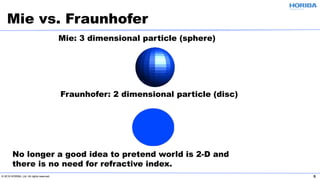
Mie vs. Fraunhofer
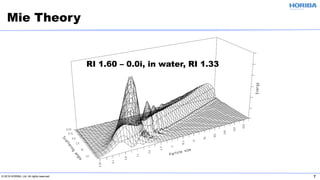
Mie: 3 dimensional particle (sphere)
Fraunhofer: 2 dimensional particle (disc)
No longer a good idea to pretend world is 2-D and
there is no need for refractive index.
© 2019 HORIBA, Ltd. All rights reserved. 6
Fraunhofer Approximation
© 2019 HORIBA, Ltd. All rights reserved. 7
Mie Theory
RI 1.60 – 0.0i, in water, RI 1.33
© 2019 HORIBA, Ltd. All rights reserved. 8
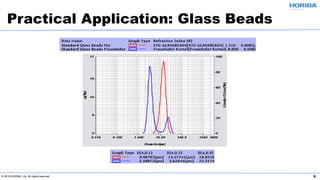
Practical Application: Glass Beads
© 2019 HORIBA, Ltd. All rights reserved. 9
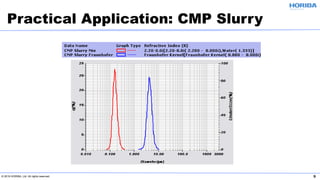
Practical Application: CMP Slurry
© 2019 HORIBA, Ltd. All rights reserved. 10
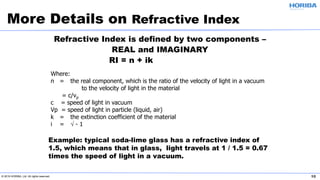
Refractive Index is defined by two components –
REAL and IMAGINARY
RI = n + ik
More Details on Refractive Index
Where:
n = the real component, which is the ratio of the velocity of light in a vacuum
to the velocity of light in the material
= c/vp
c = speed of light in vacuum
Vp = speed of light in particle (liquid, air)
k = the extinction coefficient of the material
i = √ - 1
Example: typical soda-lime glass has a refractive index of
1.5, which means that in glass, light travels at 1 / 1.5 = 0.67
times the speed of light in a vacuum.
© 2019 HORIBA, Ltd. All rights reserved. 11
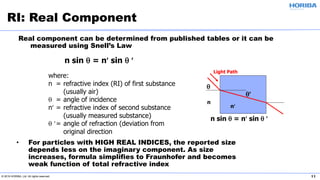
Real component can be determined from published tables or it can be
measured using Snell’s Law
RI: Real Component
• For particles with HIGH REAL INDICES, the reported size
depends less on the imaginary component. As size
increases, formula simplifies to Fraunhofer and becomes
weak function of total refractive index
n sin θ = n′ sin θ ′
where:
n = refractive index (RI) of first substance
(usually air)
θ = angle of incidence
n′ = refractive index of second substance
(usually measured substance)
θ ′= angle of refraction (deviation from
original direction
θ′
θ
Light Path
n
n′
n sin θ = n′ sin θ ′
© 2019 HORIBA, Ltd. All rights reserved. 12
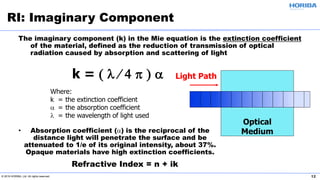
The imaginary component (k) in the Mie equation is the extinction coefficient
of the material, defined as the reduction of transmission of optical
radiation caused by absorption and scattering of light
RI: Imaginary Component
• Absorption coefficient (α) is the reciprocal of the
distance light will penetrate the surface and be
attenuated to 1/e of its original intensity, about 37%.
Opaque materials have high extinction coefficients.
k = ( λ ⁄ 4 π ) α
Where:
k = the extinction coefficient
α = the absorption coefficient
λ = the wavelength of light used
Light Path
Optical
Medium
Refractive Index = n + ik
© 2019 HORIBA, Ltd. All rights reserved. 13
1 / d = α
k = (λ ⁄ 4 π ) α
Example: for a value of k = 0.1
k = ( λ ⁄ 4 π ) [α] = 0.05 x [1 / d] = 0.1 = k
d = 0.05 / 0.1 = 0.5 micron
RI: Imaginary Component
100%
Intensity
1 / e = 37%
d Distance into medium
© 2019 HORIBA, Ltd. All rights reserved. 14
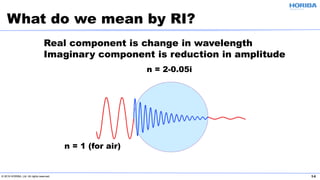
Real component is change in wavelength
Imaginary component is reduction in amplitude
What do we mean by RI?
n = 1 (for air)
n = 2-0.05i
© 2019 HORIBA, Ltd. All rights reserved. 15
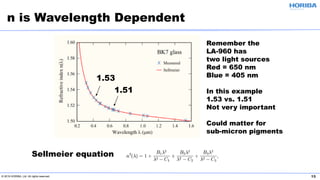
n is Wavelength Dependent
Remember the
LA-960 has
two light sources
Red = 650 nm
Blue = 405 nm
In this example
1.53 vs. 1.51
Not very important
Could matter for
sub-micron pigments
1.53
1.51
Sellmeier equation
© 2019 HORIBA, Ltd. All rights reserved. 16
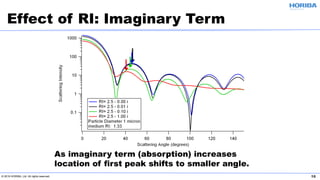
Effect of RI: Imaginary Term
As imaginary term (absorption) increases
location of first peak shifts to smaller angle.
© 2019 HORIBA, Ltd. All rights reserved. 17
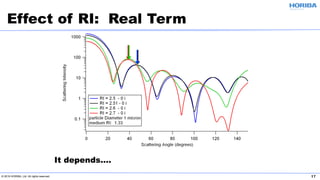
Effect of RI: Real Term
It depends….
© 2019 HORIBA, Ltd. All rights reserved. 18
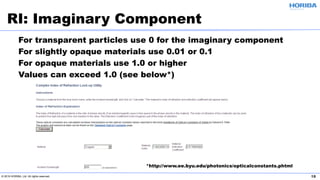
For transparent particles use 0 for the imaginary component
For slightly opaque materials use 0.01 or 0.1
For opaque materials use 1.0 or higher
Values can exceed 1.0 (see below*)
RI: Imaginary Component
*http://www.ee.byu.edu/photonics/opticalconstants.phtml
© 2019 HORIBA, Ltd. All rights reserved. 19
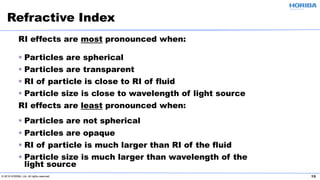
RI effects are most pronounced when:
 Particles are spherical
 Particles are transparent
 RI of particle is close to RI of fluid
 Particle size is close to wavelength of light source
Refractive Index
RI effects are least pronounced when:
 Particles are not spherical
 Particles are opaque
 RI of particle is much larger than RI of the fluid
 Particle size is much larger than wavelength of the
light source
© 2019 HORIBA, Ltd. All rights reserved. 20
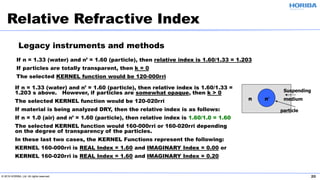
If n = 1.33 (water) and n’ = 1.60 (particle), then relative index is 1.60/1.33 = 1.203
If particles are totally transparent, then k = 0
The selected KERNEL function would be 120-000rri
Relative Refractive Index
• If n = 1.33 (water) and n’ = 1.60 (particle), then relative index is 1.60/1.33 =
1.203 s above. However, if particles are somewhat opaque, then k > 0
• The selected KERNEL function would be 120-020rri
• If material is being analyzed DRY, then the relative index is as follows:
• If n = 1.0 (air) and n’ = 1.60 (particle), then relative index is 1.60/1.0 = 1.60
• The selected KERNEL function would 160-000rri or 160-020rri depending
on the degree of transparency of the particles.
• In these last two cases, the KERNEL Functions represent the following:
• KERNEL 160-000rri is REAL Index = 1.60 and IMAGINARY Index = 0.00 or
• KERNEL 160-020rri is REAL Index = 1.60 and IMAGINARY Index = 0.20
Suspending
mediumn n′
particle
Legacy instruments and methods
© 2019 HORIBA, Ltd. All rights reserved. 21
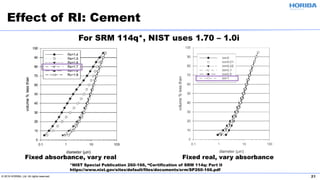
Effect of RI: Cement
Fixed absorbance, vary real Fixed real, vary absorbance
For SRM 114q*, NIST uses 1.70 – 1.0i
*NIST Special Publication 260-166, “Certification of SRM 114q: Part II
https://www.nist.gov/sites/default/files/documents/srm/SP260-166.pdf
© 2019 HORIBA, Ltd. All rights reserved. 22
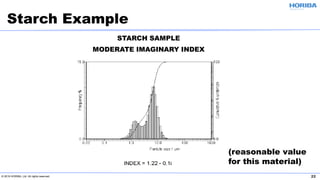
STARCH SAMPLE
MODERATE IMAGINARY INDEX
Starch Example
(reasonable value
for this material)
© 2019 HORIBA, Ltd. All rights reserved. 23
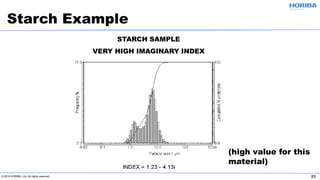
STARCH SAMPLE
VERY HIGH IMAGINARY INDEX
Starch Example
(high value for this
material)
© 2019 HORIBA, Ltd. All rights reserved. 24
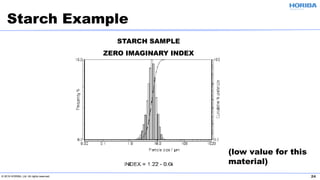
STARCH SAMPLE
ZERO IMAGINARY INDEX
Starch Example
(low value for this
material)
© 2019 HORIBA, Ltd. All rights reserved. 25
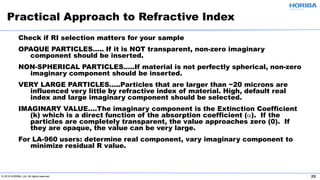
Check if RI selection matters for your sample
OPAQUE PARTICLES….. If it is NOT transparent, non-zero imaginary
component should be inserted.
NON-SPHERICAL PARTICLES…..If material is not perfectly spherical, non-zero
imaginary component should be inserted.
VERY LARGE PARTICLES…..Particles that are larger than ~20 microns are
influenced very little by refractive index of material. High, default real
index and large imaginary component should be selected.
IMAGINARY VALUE….The imaginary component is the Extinction Coefficient
(k) which is a direct function of the absorption coefficient (α). If the
particles are completely transparent, the value approaches zero (0). If
they are opaque, the value can be very large.
For LA-960 users: determine real component, vary imaginary component to
minimize residual R value.
Practical Approach to Refractive Index
© 2019 HORIBA, Ltd. All rights reserved. 26
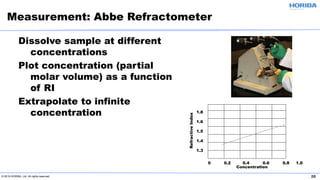
Dissolve sample at different
concentrations
Plot concentration (partial
molar volume) as a function
of RI
Extrapolate to infinite
concentration
Measurement: Abbe Refractometer
0 0.2 0.4 0.6 0.8 1.0
1.8
1.6
1.5
1.4
1.3
Concentration
RefractiveIndex
© 2019 HORIBA, Ltd. All rights reserved. 27
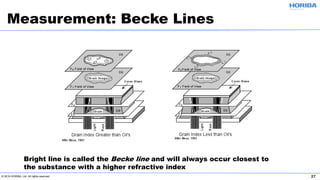
Measurement: Becke Lines
Bright line is called the Becke line and will always occur closest to
the substance with a higher refractive index
© 2019 HORIBA, Ltd. All rights reserved. 28
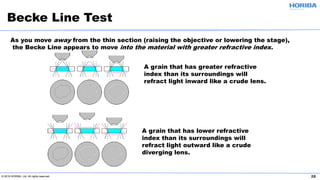
Becke Line Test
A grain that has greater refractive
index than its surroundings will
refract light inward like a crude lens.
A grain that has lower refractive
index than its surroundings will
refract light outward like a crude
diverging lens.
As you move away from the thin section (raising the objective or lowering the stage),
the Becke Line appears to move into the material with greater refractive index.
© 2019 HORIBA, Ltd. All rights reserved. 29
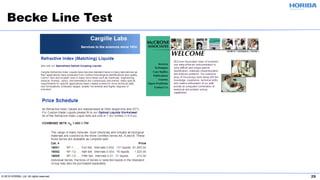
Becke Line Test
© 2019 HORIBA, Ltd. All rights reserved. 30
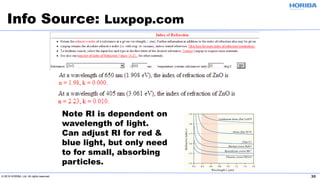
Info Source: Luxpop.com
Note RI is dependent on
wavelength of light.
Can adjust RI for red &
blue light, but only need
to for small, absorbing
particles.
© 2019 HORIBA, Ltd. All rights reserved. 31
Info Search: Google Search
© 2019 HORIBA, Ltd. All rights reserved. 32
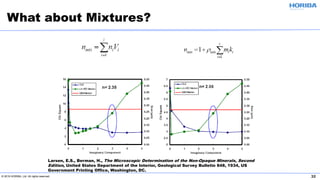
What about Mixtures?
Larsen, E.S., Berman, H., The Microscopic Determination of the Non-Opaque Minerals, Second
Edition, United States Department of the Interior, Geological Survey Bulletin 848, 1934, US
Government Printing Office, Washington, DC.
© 2019 HORIBA, Ltd. All rights reserved. 33
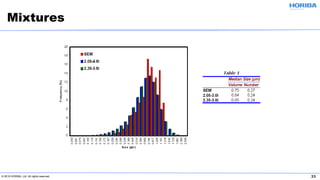
Mixtures
© 2019 HORIBA, Ltd. All rights reserved. 34
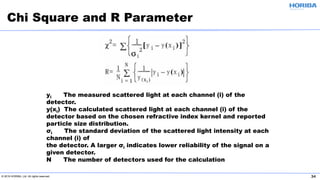
Chi Square and R Parameter
yi The measured scattered light at each channel (i) of the
detector.
y(xi) The calculated scattered light at each channel (i) of the
detector based on the chosen refractive index kernel and reported
particle size distribution.
σi The standard deviation of the scattered light intensity at each
channel (i) of
the detector. A larger σi indicates lower reliability of the signal on a
given detector.
N The number of detectors used for the calculation
© 2019 HORIBA, Ltd. All rights reserved. 35
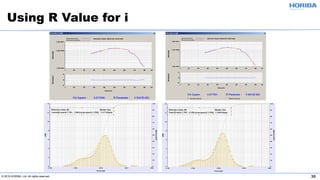
Using R Value for i
© 2019 HORIBA, Ltd. All rights reserved. 36
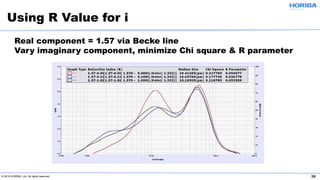
Using R Value for i
Real component = 1.57 via Becke line
Vary imaginary component, minimize Chi square & R parameter
© 2019 HORIBA, Ltd. All rights reserved. 37
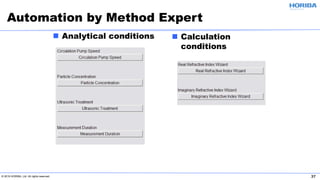
Automation by Method Expert
 Analytical conditions  Calculation
conditions
© 2019 HORIBA, Ltd. All rights reserved. 38
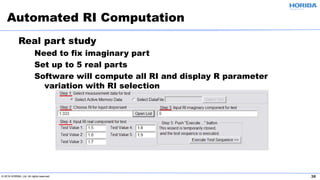
Real part study
Need to fix imaginary part
Set up to 5 real parts
Software will compute all RI and display R parameter
variation with RI selection
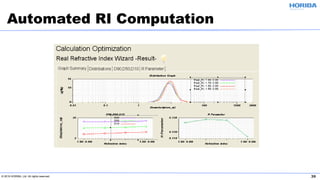
Automated RI Computation
© 2019 HORIBA, Ltd. All rights reserved. 39
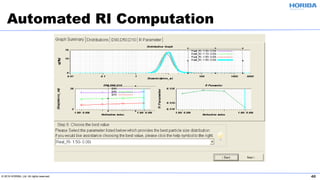
Automated RI Computation
© 2019 HORIBA, Ltd. All rights reserved. 40
Automated RI Computation
© 2019 HORIBA, Ltd. All rights reserved. 41
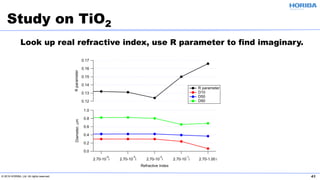
Study on TiO2
Look up real refractive index, use R parameter to find imaginary.
© 2019 HORIBA, Ltd. All rights reserved. 42
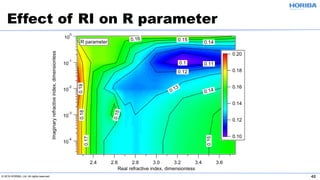
Effect of RI on R parameter
© 2019 HORIBA, Ltd. All rights reserved. 43
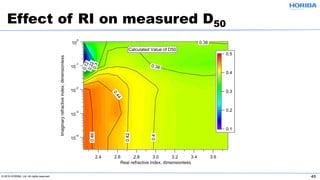
Effect of RI on measured D50
© 2019 HORIBA, Ltd. All rights reserved. 44
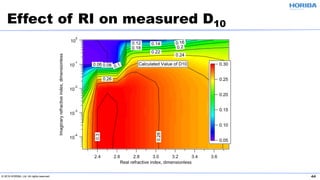
Effect of RI on measured D10
© 2019 HORIBA, Ltd. All rights reserved. 45
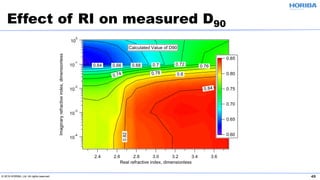
Effect of RI on measured D90
© 2019 HORIBA, Ltd. All rights reserved. 46
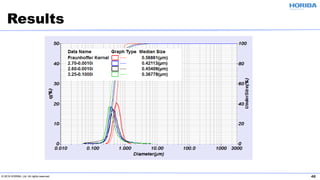
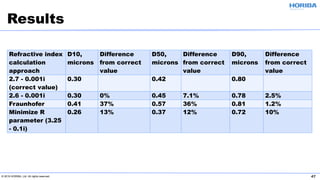
Results
© 2019 HORIBA, Ltd. All rights reserved. 47
Results
Refractive index
calculation
approach
D10,
microns
Difference
from correct
value
D50,
microns
Difference
from correct
value
D90,
microns
Difference
from correct
value
2.7 - 0.001i
(correct value)
0.30 0.42 0.80
2.6 - 0.001i 0.30 0% 0.45 7.1% 0.78 2.5%
Fraunhofer 0.41 37% 0.57 36% 0.81 1.2%
Minimize R
parameter (3.25
- 0.1i)
0.26 13% 0.37 12% 0.72 10%
© 2019 HORIBA, Ltd. All rights reserved. 48
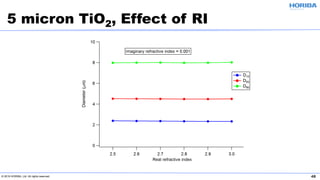
5 micron TiO2, Effect of RI
© 2019 HORIBA, Ltd. All rights reserved. 49
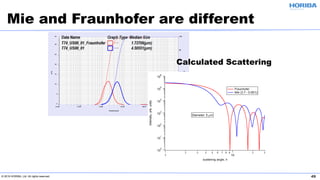
Mie and Fraunhofer are different
Calculated Scattering
© 2019 HORIBA, Ltd. All rights reserved. 50
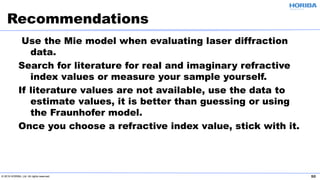
Use the Mie model when evaluating laser diffraction
data.
Search for literature for real and imaginary refractive
index values or measure your sample yourself.
If literature values are not available, use the data to
estimate values, it is better than guessing or using
the Fraunhofer model.
Once you choose a refractive index value, stick with it.
Recommendations
© 2019 HORIBA, Ltd. All rights reserved. 51
Measure sample, recalculate w/different RI – see how
important it is
Use one of the described approaches to determine the
real component
Recalculate using different imaginary component
Choose result that minimizes R parameter, but also
check if result makes sense
Summary
© 2019 HORIBA, Ltd. All rights reserved. 52© 2019 HORIBA, Ltd. All rights reserved. 52
© 2019 HORIBA, Ltd. All rights reserved. 53

Particle Classroom Series III: Refractive Index and Laser Diffraction

  • 1.
    © 2019 HORIBA,Ltd. All rights reserved. 1
  • 2.
    © 2019 HORIBA,Ltd. All rights reserved. 2© 2019 HORIBA, Ltd. All rights reserved. 2 Refractive Index and Laser Diffraction HORIBA Instruments Particle Analysis Jeff Bodycomb, Ph.D. March 6, 2019
  • 3.
    © 2019 HORIBA,Ltd. All rights reserved. 3 Optical properties of particle different from surrounding medium Note that intensity and wavelength of light changes in particle (typical dispersants do not show significant absorption) Wavelength changes are described by real component Intensity changes are described by imaginary component What do we mean by RI? n = 1 (for air) n = 2-0.05i
  • 4.
    © 2019 HORIBA,Ltd. All rights reserved. 4 Light scattering is an optical measurement. Under certain conditions, one must include behavior of light inside the particulate material. For larger particles; i. e., above approx. 26 micrometers, Fraunhofer Diffraction may be adequate to describe particle size and refractive index is less important. When particle diameter is of the same approximate size as the wavelength of light used to make the measurement, a complex theory known as Mie Scattering Theory must be invoked. Refractive index describes the behavior of light inside the particle. Why Worry about Refractive Index?
  • 5.
    © 2019 HORIBA,Ltd. All rights reserved. 5 Mie vs. Fraunhofer Mie: 3 dimensional particle (sphere) Fraunhofer: 2 dimensional particle (disc) No longer a good idea to pretend world is 2-D and there is no need for refractive index.
  • 6.
    © 2019 HORIBA,Ltd. All rights reserved. 6 Fraunhofer Approximation
  • 7.
    © 2019 HORIBA,Ltd. All rights reserved. 7 Mie Theory RI 1.60 – 0.0i, in water, RI 1.33
  • 8.
    © 2019 HORIBA,Ltd. All rights reserved. 8 Practical Application: Glass Beads
  • 9.
    © 2019 HORIBA,Ltd. All rights reserved. 9 Practical Application: CMP Slurry
  • 10.
    © 2019 HORIBA,Ltd. All rights reserved. 10 Refractive Index is defined by two components – REAL and IMAGINARY RI = n + ik More Details on Refractive Index Where: n = the real component, which is the ratio of the velocity of light in a vacuum to the velocity of light in the material = c/vp c = speed of light in vacuum Vp = speed of light in particle (liquid, air) k = the extinction coefficient of the material i = √ - 1 Example: typical soda-lime glass has a refractive index of 1.5, which means that in glass, light travels at 1 / 1.5 = 0.67 times the speed of light in a vacuum.
  • 11.
    © 2019 HORIBA,Ltd. All rights reserved. 11 Real component can be determined from published tables or it can be measured using Snell’s Law RI: Real Component • For particles with HIGH REAL INDICES, the reported size depends less on the imaginary component. As size increases, formula simplifies to Fraunhofer and becomes weak function of total refractive index n sin θ = n′ sin θ ′ where: n = refractive index (RI) of first substance (usually air) θ = angle of incidence n′ = refractive index of second substance (usually measured substance) θ ′= angle of refraction (deviation from original direction θ′ θ Light Path n n′ n sin θ = n′ sin θ ′
  • 12.
    © 2019 HORIBA,Ltd. All rights reserved. 12 The imaginary component (k) in the Mie equation is the extinction coefficient of the material, defined as the reduction of transmission of optical radiation caused by absorption and scattering of light RI: Imaginary Component • Absorption coefficient (α) is the reciprocal of the distance light will penetrate the surface and be attenuated to 1/e of its original intensity, about 37%. Opaque materials have high extinction coefficients. k = ( λ ⁄ 4 π ) α Where: k = the extinction coefficient α = the absorption coefficient λ = the wavelength of light used Light Path Optical Medium Refractive Index = n + ik
  • 13.
    © 2019 HORIBA,Ltd. All rights reserved. 13 1 / d = α k = (λ ⁄ 4 π ) α Example: for a value of k = 0.1 k = ( λ ⁄ 4 π ) [α] = 0.05 x [1 / d] = 0.1 = k d = 0.05 / 0.1 = 0.5 micron RI: Imaginary Component 100% Intensity 1 / e = 37% d Distance into medium
  • 14.
    © 2019 HORIBA,Ltd. All rights reserved. 14 Real component is change in wavelength Imaginary component is reduction in amplitude What do we mean by RI? n = 1 (for air) n = 2-0.05i
  • 15.
    © 2019 HORIBA,Ltd. All rights reserved. 15 n is Wavelength Dependent Remember the LA-960 has two light sources Red = 650 nm Blue = 405 nm In this example 1.53 vs. 1.51 Not very important Could matter for sub-micron pigments 1.53 1.51 Sellmeier equation
  • 16.
    © 2019 HORIBA,Ltd. All rights reserved. 16 Effect of RI: Imaginary Term As imaginary term (absorption) increases location of first peak shifts to smaller angle.
  • 17.
    © 2019 HORIBA,Ltd. All rights reserved. 17 Effect of RI: Real Term It depends….
  • 18.
    © 2019 HORIBA,Ltd. All rights reserved. 18 For transparent particles use 0 for the imaginary component For slightly opaque materials use 0.01 or 0.1 For opaque materials use 1.0 or higher Values can exceed 1.0 (see below*) RI: Imaginary Component *http://www.ee.byu.edu/photonics/opticalconstants.phtml
  • 19.
    © 2019 HORIBA,Ltd. All rights reserved. 19 RI effects are most pronounced when:  Particles are spherical  Particles are transparent  RI of particle is close to RI of fluid  Particle size is close to wavelength of light source Refractive Index RI effects are least pronounced when:  Particles are not spherical  Particles are opaque  RI of particle is much larger than RI of the fluid  Particle size is much larger than wavelength of the light source
  • 20.
    © 2019 HORIBA,Ltd. All rights reserved. 20 If n = 1.33 (water) and n’ = 1.60 (particle), then relative index is 1.60/1.33 = 1.203 If particles are totally transparent, then k = 0 The selected KERNEL function would be 120-000rri Relative Refractive Index • If n = 1.33 (water) and n’ = 1.60 (particle), then relative index is 1.60/1.33 = 1.203 s above. However, if particles are somewhat opaque, then k > 0 • The selected KERNEL function would be 120-020rri • If material is being analyzed DRY, then the relative index is as follows: • If n = 1.0 (air) and n’ = 1.60 (particle), then relative index is 1.60/1.0 = 1.60 • The selected KERNEL function would 160-000rri or 160-020rri depending on the degree of transparency of the particles. • In these last two cases, the KERNEL Functions represent the following: • KERNEL 160-000rri is REAL Index = 1.60 and IMAGINARY Index = 0.00 or • KERNEL 160-020rri is REAL Index = 1.60 and IMAGINARY Index = 0.20 Suspending mediumn n′ particle Legacy instruments and methods
  • 21.
    © 2019 HORIBA,Ltd. All rights reserved. 21 Effect of RI: Cement Fixed absorbance, vary real Fixed real, vary absorbance For SRM 114q*, NIST uses 1.70 – 1.0i *NIST Special Publication 260-166, “Certification of SRM 114q: Part II https://www.nist.gov/sites/default/files/documents/srm/SP260-166.pdf
  • 22.
    © 2019 HORIBA,Ltd. All rights reserved. 22 STARCH SAMPLE MODERATE IMAGINARY INDEX Starch Example (reasonable value for this material)
  • 23.
    © 2019 HORIBA,Ltd. All rights reserved. 23 STARCH SAMPLE VERY HIGH IMAGINARY INDEX Starch Example (high value for this material)
  • 24.
    © 2019 HORIBA,Ltd. All rights reserved. 24 STARCH SAMPLE ZERO IMAGINARY INDEX Starch Example (low value for this material)
  • 25.
    © 2019 HORIBA,Ltd. All rights reserved. 25 Check if RI selection matters for your sample OPAQUE PARTICLES….. If it is NOT transparent, non-zero imaginary component should be inserted. NON-SPHERICAL PARTICLES…..If material is not perfectly spherical, non-zero imaginary component should be inserted. VERY LARGE PARTICLES…..Particles that are larger than ~20 microns are influenced very little by refractive index of material. High, default real index and large imaginary component should be selected. IMAGINARY VALUE….The imaginary component is the Extinction Coefficient (k) which is a direct function of the absorption coefficient (α). If the particles are completely transparent, the value approaches zero (0). If they are opaque, the value can be very large. For LA-960 users: determine real component, vary imaginary component to minimize residual R value. Practical Approach to Refractive Index
  • 26.
    © 2019 HORIBA,Ltd. All rights reserved. 26 Dissolve sample at different concentrations Plot concentration (partial molar volume) as a function of RI Extrapolate to infinite concentration Measurement: Abbe Refractometer 0 0.2 0.4 0.6 0.8 1.0 1.8 1.6 1.5 1.4 1.3 Concentration RefractiveIndex
  • 27.
    © 2019 HORIBA,Ltd. All rights reserved. 27 Measurement: Becke Lines Bright line is called the Becke line and will always occur closest to the substance with a higher refractive index
  • 28.
    © 2019 HORIBA,Ltd. All rights reserved. 28 Becke Line Test A grain that has greater refractive index than its surroundings will refract light inward like a crude lens. A grain that has lower refractive index than its surroundings will refract light outward like a crude diverging lens. As you move away from the thin section (raising the objective or lowering the stage), the Becke Line appears to move into the material with greater refractive index.
  • 29.
    © 2019 HORIBA,Ltd. All rights reserved. 29 Becke Line Test
  • 30.
    © 2019 HORIBA,Ltd. All rights reserved. 30 Info Source: Luxpop.com Note RI is dependent on wavelength of light. Can adjust RI for red & blue light, but only need to for small, absorbing particles.
  • 31.
    © 2019 HORIBA,Ltd. All rights reserved. 31 Info Search: Google Search
  • 32.
    © 2019 HORIBA,Ltd. All rights reserved. 32 What about Mixtures? Larsen, E.S., Berman, H., The Microscopic Determination of the Non-Opaque Minerals, Second Edition, United States Department of the Interior, Geological Survey Bulletin 848, 1934, US Government Printing Office, Washington, DC.
  • 33.
    © 2019 HORIBA,Ltd. All rights reserved. 33 Mixtures
  • 34.
    © 2019 HORIBA,Ltd. All rights reserved. 34 Chi Square and R Parameter yi The measured scattered light at each channel (i) of the detector. y(xi) The calculated scattered light at each channel (i) of the detector based on the chosen refractive index kernel and reported particle size distribution. σi The standard deviation of the scattered light intensity at each channel (i) of the detector. A larger σi indicates lower reliability of the signal on a given detector. N The number of detectors used for the calculation
  • 35.
    © 2019 HORIBA,Ltd. All rights reserved. 35 Using R Value for i
  • 36.
    © 2019 HORIBA,Ltd. All rights reserved. 36 Using R Value for i Real component = 1.57 via Becke line Vary imaginary component, minimize Chi square & R parameter
  • 37.
    © 2019 HORIBA,Ltd. All rights reserved. 37 Automation by Method Expert  Analytical conditions  Calculation conditions
  • 38.
    © 2019 HORIBA,Ltd. All rights reserved. 38 Real part study Need to fix imaginary part Set up to 5 real parts Software will compute all RI and display R parameter variation with RI selection Automated RI Computation
  • 39.
    © 2019 HORIBA,Ltd. All rights reserved. 39 Automated RI Computation
  • 40.
    © 2019 HORIBA,Ltd. All rights reserved. 40 Automated RI Computation
  • 41.
    © 2019 HORIBA,Ltd. All rights reserved. 41 Study on TiO2 Look up real refractive index, use R parameter to find imaginary.
  • 42.
    © 2019 HORIBA,Ltd. All rights reserved. 42 Effect of RI on R parameter
  • 43.
    © 2019 HORIBA,Ltd. All rights reserved. 43 Effect of RI on measured D50
  • 44.
    © 2019 HORIBA,Ltd. All rights reserved. 44 Effect of RI on measured D10
  • 45.
    © 2019 HORIBA,Ltd. All rights reserved. 45 Effect of RI on measured D90
  • 46.
    © 2019 HORIBA,Ltd. All rights reserved. 46 Results
  • 47.
    © 2019 HORIBA,Ltd. All rights reserved. 47 Results Refractive index calculation approach D10, microns Difference from correct value D50, microns Difference from correct value D90, microns Difference from correct value 2.7 - 0.001i (correct value) 0.30 0.42 0.80 2.6 - 0.001i 0.30 0% 0.45 7.1% 0.78 2.5% Fraunhofer 0.41 37% 0.57 36% 0.81 1.2% Minimize R parameter (3.25 - 0.1i) 0.26 13% 0.37 12% 0.72 10%
  • 48.
    © 2019 HORIBA,Ltd. All rights reserved. 48 5 micron TiO2, Effect of RI
  • 49.
    © 2019 HORIBA,Ltd. All rights reserved. 49 Mie and Fraunhofer are different Calculated Scattering
  • 50.
    © 2019 HORIBA,Ltd. All rights reserved. 50 Use the Mie model when evaluating laser diffraction data. Search for literature for real and imaginary refractive index values or measure your sample yourself. If literature values are not available, use the data to estimate values, it is better than guessing or using the Fraunhofer model. Once you choose a refractive index value, stick with it. Recommendations
  • 51.
    © 2019 HORIBA,Ltd. All rights reserved. 51 Measure sample, recalculate w/different RI – see how important it is Use one of the described approaches to determine the real component Recalculate using different imaginary component Choose result that minimizes R parameter, but also check if result makes sense Summary
  • 52.
    © 2019 HORIBA,Ltd. All rights reserved. 52© 2019 HORIBA, Ltd. All rights reserved. 52
  • 53.
    © 2019 HORIBA,Ltd. All rights reserved. 53