Miniaturized Devices - Nanotechnology
and Biomedical Devices
Course Name: Biophysics and Nanosciences
Course Code: SIAS BT 1 3 02 C 4004
Submitted By -
Versha Rai
221254
MSc. Biotechnology
Submitted To -
Dr. Ram Gopal Nitharwal
Dept. of Biotechnology
Central University of Haryana
Table of contents:
01 Introduction
02 Miniaturized Devices
03 Examples
INTRODUCTION:
Nanotechnology
❖ A nanometer is one-billionth of a meter.
❖ Nanotechnology is the DESIGN, FABRICATION and UTILIZATION of MATERIALS, STRUCTURES and
DEVICES which are less than 100 nm.
Why Nanotechnology?
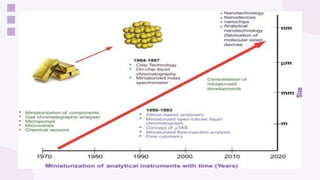
❖ ULTRASMALL (miniaturized) sensors, communication and navigation systems with very LOW MASS,
VOLUME and POWER CONSUMPTION are NEEDED.
MINIATURIZED DEVICES:
❖ Miniaturized devices are small-scale electronic or mechanical systems that have been designed
and manufactured to be significantly smaller.
❖ They have applications in various fields, including electronics, medicine, and engineering.
Examples: microchips, microsensors.
❖ Nanotechnology plays a crucial role in the development and functioning of miniaturized
devices.

Here are some ways nanotechnology is involved in miniaturized devices:
1. Nano-scale Manufacturing: Nanotechnology enables the fabrication of tiny components with extraordinary
precision, allowing for the assembly of miniaturized devices with high levels of integration and performance.
2. Improved Materials: Nanomaterials, such as carbon nanotubes and nanoparticles, can be used to create
stronger, lighter and more conductive materials, which are essential for miniaturized devices.
3.Energy Efficiency: Nanotechnology can help reduce power consumption in miniaturized electronic devices,
extending battery life and making them more efficient.
4. Biomedical Applications: Nanotechnology has enabled the development of miniaturized medical devices
for drug delivery, diagnostics, and imaging at the cellular and molecular levels.
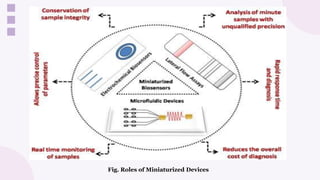
Fig. Roles of Miniaturized Devices
Examples of Biomedical Devices:
1. Nanoparticles for Drug Delivery:
❖ Made of biocompatible materials like lipids or polymers, can carry drugs to specific cells or tissues.
Ex - liposomal doxorubicin is used to treat cancer.
2. Nanobiosensors:
❖ Nanoscale biosensors can detect specific biomolecules or pathogens.
Ex - carbon nanotubes with antibodies can be used to detect proteins associated with diseases
3. Nanorobots for Targeted Therapy:
❖ Nanorobots, controlled remotely or autonomously, can navigate through the body to deliver drugs
or perform specific tasks, such as removing clots or cancer cells.
4. Nanoparticles for Gene Therapy:
❖ Nanotechnology is used to deliver genetic material to correct or replace faulty genes. Lipid
nanoparticles and viral vectors at the nanoscale are employed in gene therapy applications.
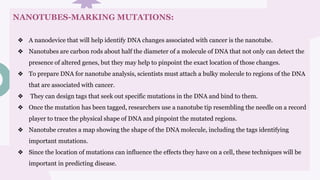
NANOTUBES-MARKING MUTATIONS:
❖ A nanodevice that will help identify DNA changes associated with cancer is the nanotube.
❖ Nanotubes are carbon rods about half the diameter of a molecule of DNA that not only can detect the
presence of altered genes, but they may help to pinpoint the exact location of those changes.
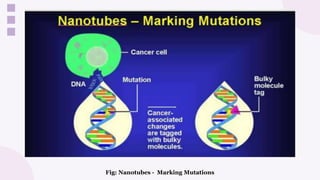
❖ To prepare DNA for nanotube analysis, scientists must attach a bulky molecule to regions of the DNA
that are associated with cancer.
❖ They can design tags that seek out specific mutations in the DNA and bind to them.
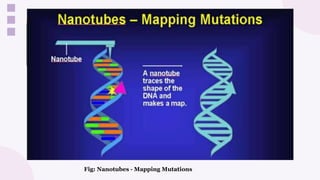
❖ Once the mutation has been tagged, researchers use a nanotube tip resembling the needle on a record
player to trace the physical shape of DNA and pinpoint the mutated regions.
❖ Nanotube creates a map showing the shape of the DNA molecule, including the tags identifying
important mutations.
❖ Since the location of mutations can influence the effects they have on a cell, these techniques will be
important in predicting disease.
Fig: Nanotubes - Marking Mutations
Fig: Nanotubes - Mapping Mutations
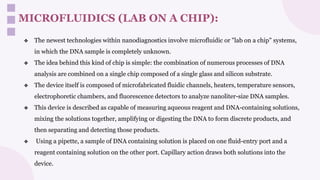
MICROFLUIDICS (LAB ON A CHIP):
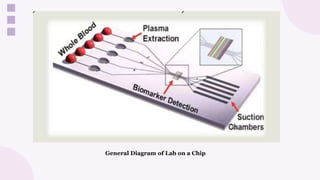
❖ The newest technologies within nanodiagnostics involve microfluidic or "lab on a chip" systems,
in which the DNA sample is completely unknown.
❖ The idea behind this kind of chip is simple: the combination of numerous processes of DNA
analysis are combined on a single chip composed of a single glass and silicon substrate.
❖ The device itself is composed of microfabricated fluidic channels, heaters, temperature sensors,
electrophoretic chambers, and fluorescence detectors to analyze nanoliter-size DNA samples.
❖ This device is described as capable of measuring aqueous reagent and DNA-containing solutions,
mixing the solutions together, amplifying or digesting the DNA to form discrete products, and
then separating and detecting those products.
❖ Using a pipette, a sample of DNA containing solution is placed on one fluid-entry port and a
reagent containing solution on the other port. Capillary action draws both solutions into the
device.
General Diagram of Lab on a Chip
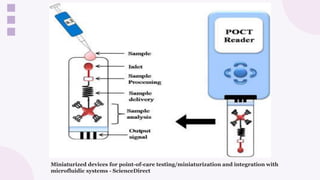
Miniaturized devices for point-of-care testing/miniaturization and integration with
microfluidic systems - ScienceDirect
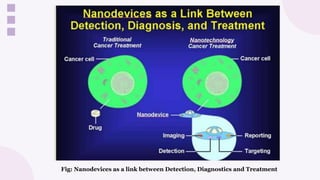
Fig: Nanodevices as a link between Detection, Diagnostics and Treatment
REFERENCES:
❖ Nanoelectronics | PPTSlideSharehttps://www.slideshare.net › nanoelectronics-63718699
❖ NanotechnologyWikipediahttps://en.wikipedia.org › wiki › Nanotechnology
❖ GoogleGooglehttps://www.google.com
THANK YOU

Nanotechnology ppt.pptx

  • 1.
    Miniaturized Devices -Nanotechnology and Biomedical Devices Course Name: Biophysics and Nanosciences Course Code: SIAS BT 1 3 02 C 4004 Submitted By - Versha Rai 221254 MSc. Biotechnology Submitted To - Dr. Ram Gopal Nitharwal Dept. of Biotechnology Central University of Haryana
  • 2.
    Table of contents: 01Introduction 02 Miniaturized Devices 03 Examples
  • 3.
    INTRODUCTION: Nanotechnology ❖ A nanometeris one-billionth of a meter. ❖ Nanotechnology is the DESIGN, FABRICATION and UTILIZATION of MATERIALS, STRUCTURES and DEVICES which are less than 100 nm. Why Nanotechnology? ❖ ULTRASMALL (miniaturized) sensors, communication and navigation systems with very LOW MASS, VOLUME and POWER CONSUMPTION are NEEDED.
  • 4.
    MINIATURIZED DEVICES: ❖ Miniaturizeddevices are small-scale electronic or mechanical systems that have been designed and manufactured to be significantly smaller. ❖ They have applications in various fields, including electronics, medicine, and engineering. Examples: microchips, microsensors. ❖ Nanotechnology plays a crucial role in the development and functioning of miniaturized devices.
  • 6.
    Here are someways nanotechnology is involved in miniaturized devices: 1. Nano-scale Manufacturing: Nanotechnology enables the fabrication of tiny components with extraordinary precision, allowing for the assembly of miniaturized devices with high levels of integration and performance. 2. Improved Materials: Nanomaterials, such as carbon nanotubes and nanoparticles, can be used to create stronger, lighter and more conductive materials, which are essential for miniaturized devices. 3.Energy Efficiency: Nanotechnology can help reduce power consumption in miniaturized electronic devices, extending battery life and making them more efficient. 4. Biomedical Applications: Nanotechnology has enabled the development of miniaturized medical devices for drug delivery, diagnostics, and imaging at the cellular and molecular levels.
  • 7.
    Fig. Roles ofMiniaturized Devices
  • 8.
    Examples of BiomedicalDevices: 1. Nanoparticles for Drug Delivery: ❖ Made of biocompatible materials like lipids or polymers, can carry drugs to specific cells or tissues. Ex - liposomal doxorubicin is used to treat cancer. 2. Nanobiosensors: ❖ Nanoscale biosensors can detect specific biomolecules or pathogens. Ex - carbon nanotubes with antibodies can be used to detect proteins associated with diseases 3. Nanorobots for Targeted Therapy: ❖ Nanorobots, controlled remotely or autonomously, can navigate through the body to deliver drugs or perform specific tasks, such as removing clots or cancer cells. 4. Nanoparticles for Gene Therapy: ❖ Nanotechnology is used to deliver genetic material to correct or replace faulty genes. Lipid nanoparticles and viral vectors at the nanoscale are employed in gene therapy applications.
  • 9.
    NANOTUBES-MARKING MUTATIONS: ❖ Ananodevice that will help identify DNA changes associated with cancer is the nanotube. ❖ Nanotubes are carbon rods about half the diameter of a molecule of DNA that not only can detect the presence of altered genes, but they may help to pinpoint the exact location of those changes. ❖ To prepare DNA for nanotube analysis, scientists must attach a bulky molecule to regions of the DNA that are associated with cancer. ❖ They can design tags that seek out specific mutations in the DNA and bind to them. ❖ Once the mutation has been tagged, researchers use a nanotube tip resembling the needle on a record player to trace the physical shape of DNA and pinpoint the mutated regions. ❖ Nanotube creates a map showing the shape of the DNA molecule, including the tags identifying important mutations. ❖ Since the location of mutations can influence the effects they have on a cell, these techniques will be important in predicting disease.
  • 10.
    Fig: Nanotubes -Marking Mutations
  • 11.
    Fig: Nanotubes -Mapping Mutations
  • 12.
    MICROFLUIDICS (LAB ONA CHIP): ❖ The newest technologies within nanodiagnostics involve microfluidic or "lab on a chip" systems, in which the DNA sample is completely unknown. ❖ The idea behind this kind of chip is simple: the combination of numerous processes of DNA analysis are combined on a single chip composed of a single glass and silicon substrate. ❖ The device itself is composed of microfabricated fluidic channels, heaters, temperature sensors, electrophoretic chambers, and fluorescence detectors to analyze nanoliter-size DNA samples. ❖ This device is described as capable of measuring aqueous reagent and DNA-containing solutions, mixing the solutions together, amplifying or digesting the DNA to form discrete products, and then separating and detecting those products. ❖ Using a pipette, a sample of DNA containing solution is placed on one fluid-entry port and a reagent containing solution on the other port. Capillary action draws both solutions into the device.
  • 13.
    General Diagram ofLab on a Chip
  • 14.
    Miniaturized devices forpoint-of-care testing/miniaturization and integration with microfluidic systems - ScienceDirect
  • 15.
    Fig: Nanodevices asa link between Detection, Diagnostics and Treatment
  • 16.
    REFERENCES: ❖ Nanoelectronics |PPTSlideSharehttps://www.slideshare.net › nanoelectronics-63718699 ❖ NanotechnologyWikipediahttps://en.wikipedia.org › wiki › Nanotechnology ❖ GoogleGooglehttps://www.google.com
  • 17.