Sampling and Dispersion
                                                 The Key to Precision


                                                Jeffrey Bodycomb, Ph.D.
                                               jeff.bodycomb@horiba.com
                                                 www.horiba.com/particle


© 2012 HORIBA, Ltd. All rights reserved.
What we’ll talk about

         Sampling techniques

         Particle wetting, surfactant use

         Dispersing agglomerates

         Tips for HORIBA size analyzers

© 2012 HORIBA, Ltd. All rights reserved.
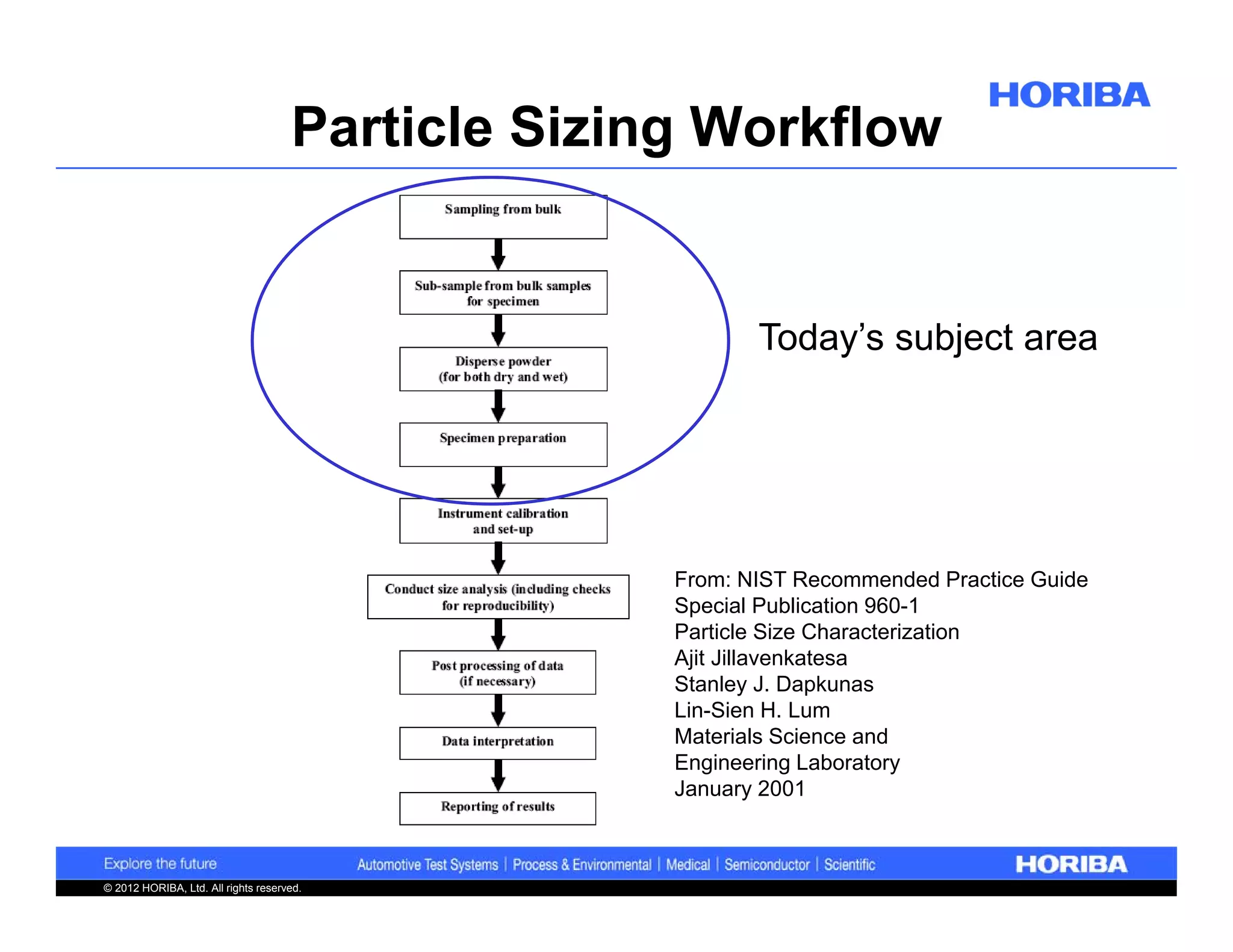
Particle Sizing Workflow


                                                          Today’s subject area


                                                   From: NIST Recommended Practice Guide
                                                   Special Publication 960-1
                                                   Particle Size Characterization
                                                   Ajit Jillavenkatesa
                                                   Stanley J. Dapkunas
                                                   Lin-Sien H. Lum
                                                   Materials Science and
                                                   Engineering Laboratory
                                                   January 2001


© 2012 HORIBA, Ltd. All rights reserved.
Measurement Error Sources
   SMALL PARTICLES
        POTENTIALLY SMALL                       C SAMPLE PREPARATION       SAMPLE EXTRACTION
         EXTRACTION ERRORS (A)
                                             %
        POTENTIALLY LARGE                                                              B
                                             E
         SAMPLE PREP ERRORS (C)
                                             R
   LARGE PARTICLES                          R

        POTENTIALLY LARGE                   O
         EXTRACTION ERRORS (B)               R   A                                      D
        POTENTIALLY SMALL                               INSTRUMENT ERROR
         SAMPLE PREP ERRORS (D)

                                                            PARTICLE SIZE


                                 INSTRUMENT ERROR IS SMALL AND
                                       RELATIVELY CONSTANT

© 2012 HORIBA, Ltd. All rights reserved.
Question?

         What size particles do you analyze?


© 2012 HORIBA, Ltd. All rights reserved.
Section Overview

         Sampling from bulk
         Sub-sample for measurement
         Disperse sample
                    Wet powders, apply air pressure or
                     ultrasound
         Sometimes second sub-sampling
                    From beaker to instrument
         Perform measurement


© 2012 HORIBA, Ltd. All rights reserved.
Sampling from Flowing Powder


© 2012 HORIBA, Ltd. All rights reserved.
Sampling from Flowing Powder


Cross-cut sampling: w = L W b = Wb
                          L      
 = sampling speed (m/s)                     Cross-cut sampler
W = sample mass
L = width of powder stream     *Masuda, H, Powder Technology Handbook, CRC
b = sample cutter width*       Press, p 771


© 2012 HORIBA, Ltd. All rights reserved.
Sampling from Drums

                                               Powder Thief


                                              www.samplingsystems.com


© 2012 HORIBA, Ltd. All rights reserved.
Sampling from Drums


                                              www.samplingsystems.com


© 2012 HORIBA, Ltd. All rights reserved.
Sub-sampling for Measurement


         Not all of sample brought to lab is
          analyzed
         Must sub-divide sample
         How to introduce representative sample
          into instrument

© 2012 HORIBA, Ltd. All rights reserved.
Technique: Grab Sampling

 PLACE SPATULA INTO POWDER
 EXTRACT SMALL AMOUNT FOR ANALYSIS
 ACCEPTABLE FOR NARROW DISTRIBUTIONS


 SEGREGATE LARGE AND SMALL WHEN POLYDISPERSE
         LARGE PARTICLES PERCOLATE UPWARD
         SMALL PARTICLES GRAVITATE DOWNWARD
 EASY METHOD
 MOST USED METHOD


 © 2012 HORIBA, Ltd. All rights reserved.
Grab Sampling from Bottle

 When a powder is stored in a
  container, it can be mixed by rolling
  and tumbling the container. The
  container should not be more than
  half to two-thirds full. It is important
  to perform this action before
  “grabbing” a sample with a spatula.


 Then pull sample with a spatula…..


 © 2012 HORIBA, Ltd. All rights reserved.
Technique: Coning & Quartering
         Pile of powder is divided into 4
         sections.
         Two diagonal sections are
         discarded, and two are retained
         and mixed together.
         Mixture is again divided into 4
         sections, and two diagonal
         sections are mixed.
         Process is repeated until
         remaining sample is correct
         amount for analysis.
         Can be carried out with very
         small sample amount or very large
         samples.


© 2012 HORIBA, Ltd. All rights reserved.
Technique: Chute Riffling

         Chute splitting allows sample to
         vibrate down a chute to vanes
         which separate the mass into two
         portions. Each portion moves
         further where they each are
         divided into two parts, now giving
         four parts. This may be continued
         until usually 8 or 16 portions are
         obtained.


© 2012 HORIBA, Ltd. All rights reserved.
Technique: Rotary Riffling
              The best method of representative
               splitting of powders is the ROTARY
               RIFFLER. The complete sample to be
               split is directed down a chute into open
               containers. Each container will receive a
               sample which is representative of the
               original bulk material because the
               distribution of material is averaged over
               time. The complete amount of the
               original bulk sample must be consumed.


 These splitters are commercially available from companies that market
  various types of sample splitters.
 See: www.retsch.com
                www.quantachrome.com
                www.microscal.com


    © 2012 HORIBA, Ltd. All rights reserved.
Sample Dividers


© 2012 HORIBA, Ltd. All rights reserved.
Sampling Technique Error Levels

                                    Standard Deviation () in % Sugar-Sand Mixture
                           SCOOP SAMPLING                                                              6.31
                           TABLE SAMPLING                                                              2.11
                           CHUTE RIFFLER                                                               1.10
                           SPINNING RIFFLER                                                            0.27
                                                Density of sand and sugar respectively 2.65 and 1.64 g/ml
                                          Reference: Allen, T. and Khan, A.A. (1934), Chem Eng, 238, CE 108-112


© 2012 HORIBA, Ltd. All rights reserved.
Technique: Sampling from Beaker

Liquid should be in motion
 vertically and horizontally
 to insure good mixing.
Pipette should be about
 one-third of the way from
 the bottom when
 extracting sample.
Alternative: When mixing                  IMPELLER   PIPETTE

 powders into a slurry:
 make paste, pipette from
 paste
© 2012 HORIBA, Ltd. All rights reserved.
Summary


                                                 From: NIST Recommended Practice Guide
                                                 Special Publication 960-1
                                                 Particle Size Characterization
                                                 Ajit Jillavenkatesa
                                                 Stanley J. Dapkunas
                                                 Lin-Sien H. Lum
                                                 Materials Science and
                                                 Engineering Laboratory
                                                 January 2001


© 2012 HORIBA, Ltd. All rights reserved.
What we’ll talk about

         Sampling techniques

         Particle wetting, surfactant use

         Dispersing agglomerates

         Tips for HORIBA size analyzers

© 2012 HORIBA, Ltd. All rights reserved.
Dispersion Strategies
          Powders
                     When measuring powder as suspension
                     Choose solvent (avoid dissolution)
                     Wet powder (surfactant)
                     Dispersing aid to avoid re-agglomeration
                     Energy to break agglomerates into primary
                      particles
                                – Pump & stirrer or ultrasound
          Suspensions
                     Dilute
                     Energy

© 2012 HORIBA, Ltd. All rights reserved.
Measurement Error Sources
   SMALL PARTICLES
        POTENTIALLY SMALL                     C SAMPLE PREPARATION       SAMPLE EXTRACTION
         EXTRACTION ERRORS (A)
                                           %
        POTENTIALLY LARGE                                                            B
                                           E
         SAMPLE PREP ERRORS (C)
                                           R
   LARGE PARTICLES                        R

        POTENTIALLY LARGE                 O
         EXTRACTION ERRORS (B)             R   A                                      D
        POTENTIALLY SMALL                             INSTRUMENT ERROR
         SAMPLE PREP ERRORS (D)

                                                          PARTICLE SIZE


                        INSTRUMENT ERROR IS SMALL AND RELATIVELY
                                       CONSTANT


© 2012 HORIBA, Ltd. All rights reserved.
Dispersion Definitions


               WELL DISPERSED                     AGGLOMERATED     AGGREGATED
          WELL DISPERSED particles can be easily detected under a
           microscope. They are separated from one another and show no
           tendency to cling together.
          AGGLOMERATED particles appear in clumps that can be separated
           easily by the application of moderate amounts of energy, such as
           ultrasonics.
          AGGREGATED particles are tightly bound and must be treated with
           higher levels of energy. Usually an ultrasonic probe applied directly to
           the sample slurry will disperse the particles. If they are very tightly
           bound, they may fracture before they can be separated.


© 2012 HORIBA, Ltd. All rights reserved.
Particle Wetting
                       MEASUREMENT OF
                       CONTACT ANGLE (  )
                                                                            
                                                                                     LARGE
 The contact angle is a measure of
  how well the liquid drop adheres to                                               (Phobic)
  the surface of a solid
 Large angles indicate poor wetting                                 
  ability.
 Small angles indicate good wetting
  ability.
 Surfactants reduce surface tension
  and thereby are conducive to good
  wetting.                                                       
                                                                         SMALL (Phylic)
 (Instruments are available for
  measuring contact angle)                             DROP OF LIQUID ON A SOLID


  © 2012 HORIBA, Ltd. All rights reserved.
Particle Wetting
                                                                     PARTICLE
         Surface
                                                                                         Large
          Tension must                           Small Contact
                                                                 q                  q
                                                                                        Contact
                                                                                         Angle
          be lowered so                             Angle
                                                 Good Wetting                   Bad Wetting
          liquid will                                              LIQUID
                                                         GOAL IS TO COMPLETELY COAT
          adhere to                                        PARTICLE WITH LIQUID
                                                                   +
                                                                         +
          particles.                                          +
                                                                                +
                                                            +

                                                                                +
                                                                 +
                                                                     +     +


© 2012 HORIBA, Ltd. All rights reserved.
How to check for wetting
          Sprinkle particles on of target dispersant. If the particles float on top and do not
           penetrate the water surface, they are not wetted. This is usually a bad sign.
          If the particles break through surface and sink, they are a) wetted or b) so big that
           gravity is more important than surface tension. If it is case a, you are in luck.


                                                        Plume of sinking particles
         Particles floating on top


© 2012 HORIBA, Ltd. All rights reserved.
Don’t forget changing solvents

         Working with aqueous systems is
          usually easier for many reasons.
         But don’t forget to try a less polar
          solvent such as isopropyl alcohol.
         And, don’t forget that organic solvents
          are more difficult to handle due to fire
          and health hazards.


© 2012 HORIBA, Ltd. All rights reserved.
If the going gets tough…
          Check the literature and the web and see
           what other people use.
          Here I use Google to get the idea to use MEK
           with lead.


© 2012 HORIBA, Ltd. All rights reserved.
If the going gets tough…
         Try a series of options.
         Here I make a series of suspensions
          and check them by eye, then measure.


© 2012 HORIBA, Ltd. All rights reserved.
Effect of Surfactant Addition

 Addition of surfactant to a sample         MEAN

  will disperse the particles so a          PARTICLE

  proper measurement may be                   SIZE

  made. However, addition of too
  much surfactant will cause
  agglomeration.                                       SURFACTANT CONCENTRATION


  The graph illustrates that there is an optimum amount of surfactant to effect
   optimum dispersion. The Particle Size Analyzer can determine when the
   amount of surfactant exceeds the proper concentration.
  As initial surfactant is added, the mean particle size will decrease. It will
   reach a minimum as the proper surfactant concentration is reached.
  As additional surfactant is added, the apparent mean particle size will
   increase, indicating agglomeration of particles.
  Common concentration: 0.01-0.1%


 © 2012 HORIBA, Ltd. All rights reserved.
Surfactant Mechanism


EQUILIBRIUM
established between
SURFACTANT ON
PARTICLES and
SURFACTANT IN
SOLUTION.


                                                       NON-POLAR HYDROCARBON
                                                       POLAR IONIC DIPOLE


© 2012 HORIBA, Ltd. All rights reserved.
Critical Micelle Concentration

                                                -   -
                                           -    +   +
                                            +                -
                                                             +    -
                                                                 +
                                  - +                                 + -
                                     +          +                           + Cationic Surface
                                     -          -                  +-
                                                         +   +
                                                        -                   - Anionic Surfactant
                                                             -


                                                        MICELLES

            As more surfactant is added, equilibrium shifts. Surfactant leaves
             surfaces to start formation of MICELLES. This is called CRITICAL
                            MICELLE CONCENTRATION (CMC).
          Particle surfaces are no longer repulsed, and energy of the system
                              favors REAGGLOMORATION.


© 2012 HORIBA, Ltd. All rights reserved.
Effect of Surfactant Addition
                                              NO SURFACTANT -
                                           AGGLOMERATED PARTICLES


                                                OPTIMUM CONCENTRATION –
                                               PROPER PARTICLE DISPERSION


                                                EXCESS SURFACTANT -
                                                 REAGGLOMERATION
                                                    OF PARTICLES


© 2012 HORIBA, Ltd. All rights reserved.
Common Surfactants
 Nonionic surfactants adsorb to charged and neutral surfaces,
  create steric barrier
 Igepal CA630 Ethoxylated octyl phenol                Nonionic
 Triton X100     Octylphenoxypolyethoxy ethanol       Nonionic
 Tween 20        Polyoxyethylene sorbitan             Nonionic
 Aerosol-OT      Dioctyl ester Na Sulfo succinic acid Anionic
 Cationic surfactants often used for biological samples,
  stringly bonds to negatively charged surfaces
                                             non-polar chain
                                                               polar head


                                            Hyrdophobic surface
                                            Polar groups orient to aqueous phase
                                      Anionic surfactant
 © 2012 HORIBA, Ltd. All rights reserved.
Sodium Hexametaphosphate

 Most common stabilizer
 Abbreviated NaHMP
 Keeps particles from re-
  agglomerating
 Disperse sample in 0.01 – 1.0%
  (NaPO3)6 rather than DI water
 Tetrasodium pyrophosphate
  also used (sodium
  pyrophosphate, NaPP)


© 2012 HORIBA, Ltd. All rights reserved.
What we’ll talk about

         Sampling techniques

         Particle wetting, surfactant use

         Dispersing agglomerates

         Tips for HORIBA size analyzers

© 2012 HORIBA, Ltd. All rights reserved.
Particle Interactions
                                                        ATTRACTIVE FORCES
                                                            (VAN DER WAALS)


                                           REPULSIVE FORCES           REPULSIVE FORCES
                                              (CHARGE)                        (CHARGE)


             Particles are constantly moving with respect to one another. When they
               approach close enough to cross the potential barrier (when attractive
                forces exceed repulsive forces), they come together (agglomerate).


              The object is to provide repulsive forces strong enough to keep particles
                  apart, even during close approach. This can be accomplished by
                                 surfactant coating of particle surfaces.

                                                    + +                   +
                                                +                     +       +
                                               +        +             +        +
                                           CHARGE   +                     + CHARGE

© 2012 HORIBA, Ltd. All rights reserved.
Particle Interactions
                                            Inter-particle distance is LARGE.
                                              Van der Waals forces WEAK


                                                      Decreasing particle distance
                                                      Increasing Van der Waals forces


                                                               Particle distance very small
If surfactant charge is      Van der Waals forces strong
sufficiently high, it will
overcome Van der Waals forces
before the particles approach
                                  +
closely.                            +
                                                                     ++         ++
                                                                                +
                                                                                 +

 © 2012 HORIBA, Ltd. All rights reserved.
Energy of Interaction
                             INTERACTION
                                                                                             Stability of a system depends on
                              OF TWO                                                          forces between particles. Random
                              CHARGED     Electrical forces                                   motion brings them into close
                              SURFACES    cause particles                                     proximity. Whether two particles will
                                                                   to remain apart.           combine depends on potential barrier
                                                                                              between them. Potential energy
                                                                   Van der Waals              consists of two forces, the
                                       Repulsion                   forces cause               ATTRACTIVE one due to Van der
                                                         VR        particles to               Waals, and the REPULSIVE one due to
                                                                   come together.             electrical double layers around
                                                                                              particles.
Potential Energy


                                                               Total Potential Energy
                                                                                   VT        If height of the barrier, VT, is lower
                                          Vmax                                                than average thermal energy, KT, then
                   0                                                                          probability is high that two adjacent
                                                                Distance Between Surfaces     particles will eventually collide. They
                                                          VA                                  will probably remain attached to each
                                                                                              other due to strong Van der Waals
                                       Attraction                   VT = VA + VR              forces at very close distances.


                   © 2012 HORIBA, Ltd. All rights reserved.
Dispersion Stability
                                                         steric stabilization


                                                       electrostatic stabilization


© 2012 HORIBA, Ltd. All rights reserved.
Zeta Potential
         A double layer exists around
         each particle. If a particle is                       -
         negatively charged, a thin layer          +                       Diffuse Layer        Stern Layer
         of positive charge forms around                                        +       +
                                               -
         the particle (the Stern Layer).                                    + - -+
         Beyond the Stern Layer, there is                              -      -      -+           -
                                                       -
                                                                           + -Particle + -
         a wider layer of mostly opposite
         charge known as the DIFFUSE                                                 -
                                                                                 -               REPRESENTATION
         Layer.                                    +                         + +                + OF ATTRACTED
         The potential at the surface of                                                        LAYERS AND ZETA
         the particle is designated the                                        -   +                  POTENTIAL
         NERNST Potential, and the                         +
         potential at the shear plane is                           -                                  +
         designated the ZETA Potential.                                    +
         ZETA Potential is a useful
         measurement quantity because
         it is a measure of surface                               electric
         activity in colloidal particles.                        potential
                                                                                                            Nernst
                                                               (millivolts)                               Potential


                                                                                                   Zeta
                                                                                               Potential
                                                                                       Distance (Angstroms)

© 2012 HORIBA, Ltd. All rights reserved.
Pop Quiz

         As particle size distribution becomes
          wider….


© 2012 HORIBA, Ltd. All rights reserved.
What we’ll talk about

         Sampling techniques

         Particle wetting, surfactant use

         Dispersing agglomerates

         Tips for HORIBA size analyzers

© 2012 HORIBA, Ltd. All rights reserved.
Dispersion: Mechanical Energy
               The purpose of applying energy is to separate particles for a
                 sufficient period to allow surfactants to develop a coating.
          TYPES OF ENERGY DEVICES
                          Blenders
                          Stirrers
                          Ultrasonic Devices
                                   • Ultrasonic Bath
                                   • Ultrasonic Probe          ENERGY
                                                                          Surfactant


 Dilute surfactant is mixed with suspending liquid before particulate sample
  is added. As energy is applied, the surfactant is able to attach to the
  particles, providing sufficient charge to keep individual particles apart.


© 2012 HORIBA, Ltd. All rights reserved.
Dispersion: Ultrasonic Energy
          Ultrasonic waves generate                          Ultrasonic Bath
           microscopic bubbles or cavities
           (cavitation) which produce shearing
           action causing the liquid and
           suspended particles to become
           intensely agitated.

            Agglomerates are broken apart.
            In some cases fragile particles are shattered.
            The selection of appropriate type and level of
             ultrasonic energy must be made carefully.


                                                               Ultrasonic Probe


© 2012 HORIBA, Ltd. All rights reserved.
Effect of Applied Energy
          The effect of applied energy is to
           break up agglomerates into
           individual particles for size
           measurement. However, if too
           much energy is applied, particles                          Optimum Range
           may by broken into fragments.


                                                AVERAGE SIZE
           The desired result is to apply
           just enough energy to disperse
           material into basic particles for
           measurement without damaging
           friable materials.

                                                               INCREASING ENERGY


 The graph illustrates how this can be accomplished. Effects of applied energy on
  particulate samples can be tested by using results from measurements made on the
  instrument. By treating the sample with varying levels of ultrasonic power,
  performing analyses, and noting the average particle size (mean, median) as a
  function of power level, one can choose a range of applied energy that is optimum
  for that material.


© 2012 HORIBA, Ltd. All rights reserved.
Dispersion vs. Breakage

    Dispersion and breakage can both occur


Ideal World


Real World


© 2012 HORIBA, Ltd. All rights reserved.
What we’ll talk about

         Sampling techniques

         Particle wetting, surfactant use

         Dispersing agglomerates

         Tips for HORIBA size analyzers

© 2012 HORIBA, Ltd. All rights reserved.
Laser Diffraction

         Starting from a powder…
                    Solubility issues? Can measure dry!
                                – Sampling critical
                                – Air pressure only dispersion choice
                                – Take a look at webinar TE016: Optimizing Dry
                                  Powder Measurements
                    Solubility OK? Many options
                                – Make paste w/ surfactant to wet
                                – Sample from paste


© 2012 HORIBA, Ltd. All rights reserved.
Laser Diffraction

         Starting from an emulsion…
                    Sampling typically less critical
                    Dispersion stable upon dilution?
                                – pH, shear forces, temperature, surfactant conc.
                    Avoid high pumping speeds, avoid high
                     ultrasonic


© 2012 HORIBA, Ltd. All rights reserved.
Dynamic Light Scattering

         Starting from a powder…
                    Very few nanopowders 
                    Dispersion very critical
                    Use filters to remove agglomerates/dust
                    Dispersion conditions directly affect zeta
                     potential
         Starting from a suspension/emulsion…
                    Visually inspect for “crud”
                    Use filters to remove agglomerates/dust

© 2012 HORIBA, Ltd. All rights reserved.
Dynamic Image Analysis

         Vast majority are powder applications
                    Sampling critical
                                – Recommend Retsch PT100 rotary splitter for
                                  CAMSIZER
                                – Recommend Retsch chute rifflers for
                                  CAMSIZER XT
                                – Measure every particle on the chute
                                – If comparing with sieving, then same good
                                  sampling practices need to be applied to sieves
         Suspensions (XT only) follow diffraction

© 2012 HORIBA, Ltd. All rights reserved.
Summary
  Surfactants wet powders
  Use admixture to alter surface chemistry
             Sodium hexametaphosphate
             Sodium pyrophosphate
  Ultrasound reduces size
             De-agglomeration                  %
                                                    SAMPLE PREPARATION SAMPLE EXTRACTION


              and/or breakage                   E
                                                R
                                                R

  REMEMBER!                                    O
                                                R         INSTRUMENT ERROR

                                                             PARTICLE SIZE

© 2012 HORIBA, Ltd. All rights reserved.
For More Details

           Visit www.horiba.com/particle

           Contact us directly at labinfo@horiba.com

           Visit the Download Center to find this recorded
           presentation and many more on other topics


© 2012 HORIBA, Ltd. All rights reserved.
ありがとうございました
                                                       ขอบคุณครับ
                                                                       谢谢
                                           Gracias
   ُْ
  ‫اشكر‬                                                                         Grazie
                                 Σας ευχαριστούμε                   धन्यवाद
Tacka dig                                                                     நன்ற
                                             Danke
                                                                                Obrigado
              감사합니다                                  Большое спасибо


© 2012 HORIBA, Ltd. All rights reserved.

The Importance of Sampling & Dispersion for Particle Size Analysis

  • 1.
    Sampling and Dispersion The Key to Precision Jeffrey Bodycomb, Ph.D. jeff.bodycomb@horiba.com www.horiba.com/particle © 2012 HORIBA, Ltd. All rights reserved.
  • 2.
    What we’ll talkabout Sampling techniques Particle wetting, surfactant use Dispersing agglomerates Tips for HORIBA size analyzers © 2012 HORIBA, Ltd. All rights reserved.
  • 3.
    Particle Sizing Workflow Today’s subject area From: NIST Recommended Practice Guide Special Publication 960-1 Particle Size Characterization Ajit Jillavenkatesa Stanley J. Dapkunas Lin-Sien H. Lum Materials Science and Engineering Laboratory January 2001 © 2012 HORIBA, Ltd. All rights reserved.
  • 4.
    Measurement Error Sources  SMALL PARTICLES  POTENTIALLY SMALL C SAMPLE PREPARATION SAMPLE EXTRACTION EXTRACTION ERRORS (A) %  POTENTIALLY LARGE B E SAMPLE PREP ERRORS (C) R  LARGE PARTICLES R  POTENTIALLY LARGE O EXTRACTION ERRORS (B) R A D  POTENTIALLY SMALL INSTRUMENT ERROR SAMPLE PREP ERRORS (D) PARTICLE SIZE  INSTRUMENT ERROR IS SMALL AND RELATIVELY CONSTANT © 2012 HORIBA, Ltd. All rights reserved.
  • 5.
    Question? What size particles do you analyze? © 2012 HORIBA, Ltd. All rights reserved.
  • 6.
    Section Overview Sampling from bulk Sub-sample for measurement Disperse sample Wet powders, apply air pressure or ultrasound Sometimes second sub-sampling From beaker to instrument Perform measurement © 2012 HORIBA, Ltd. All rights reserved.
  • 7.
    Sampling from FlowingPowder © 2012 HORIBA, Ltd. All rights reserved.
  • 8.
    Sampling from FlowingPowder Cross-cut sampling: w = L W b = Wb  L   = sampling speed (m/s) Cross-cut sampler W = sample mass L = width of powder stream *Masuda, H, Powder Technology Handbook, CRC b = sample cutter width* Press, p 771 © 2012 HORIBA, Ltd. All rights reserved.
  • 9.
    Sampling from Drums Powder Thief www.samplingsystems.com © 2012 HORIBA, Ltd. All rights reserved.
  • 10.
    Sampling from Drums www.samplingsystems.com © 2012 HORIBA, Ltd. All rights reserved.
  • 11.
    Sub-sampling for Measurement Not all of sample brought to lab is analyzed Must sub-divide sample How to introduce representative sample into instrument © 2012 HORIBA, Ltd. All rights reserved.
  • 12.
    Technique: Grab Sampling PLACE SPATULA INTO POWDER  EXTRACT SMALL AMOUNT FOR ANALYSIS  ACCEPTABLE FOR NARROW DISTRIBUTIONS  SEGREGATE LARGE AND SMALL WHEN POLYDISPERSE  LARGE PARTICLES PERCOLATE UPWARD  SMALL PARTICLES GRAVITATE DOWNWARD  EASY METHOD  MOST USED METHOD © 2012 HORIBA, Ltd. All rights reserved.
  • 13.
    Grab Sampling fromBottle  When a powder is stored in a container, it can be mixed by rolling and tumbling the container. The container should not be more than half to two-thirds full. It is important to perform this action before “grabbing” a sample with a spatula.  Then pull sample with a spatula….. © 2012 HORIBA, Ltd. All rights reserved.
  • 14.
    Technique: Coning &Quartering Pile of powder is divided into 4 sections. Two diagonal sections are discarded, and two are retained and mixed together. Mixture is again divided into 4 sections, and two diagonal sections are mixed. Process is repeated until remaining sample is correct amount for analysis. Can be carried out with very small sample amount or very large samples. © 2012 HORIBA, Ltd. All rights reserved.
  • 15.
    Technique: Chute Riffling Chute splitting allows sample to vibrate down a chute to vanes which separate the mass into two portions. Each portion moves further where they each are divided into two parts, now giving four parts. This may be continued until usually 8 or 16 portions are obtained. © 2012 HORIBA, Ltd. All rights reserved.
  • 16.
    Technique: Rotary Riffling  The best method of representative splitting of powders is the ROTARY RIFFLER. The complete sample to be split is directed down a chute into open containers. Each container will receive a sample which is representative of the original bulk material because the distribution of material is averaged over time. The complete amount of the original bulk sample must be consumed.  These splitters are commercially available from companies that market various types of sample splitters.  See: www.retsch.com  www.quantachrome.com  www.microscal.com © 2012 HORIBA, Ltd. All rights reserved.
  • 17.
    Sample Dividers © 2012HORIBA, Ltd. All rights reserved.
  • 18.
    Sampling Technique ErrorLevels  Standard Deviation () in % Sugar-Sand Mixture  SCOOP SAMPLING 6.31  TABLE SAMPLING 2.11  CHUTE RIFFLER 1.10  SPINNING RIFFLER 0.27  Density of sand and sugar respectively 2.65 and 1.64 g/ml  Reference: Allen, T. and Khan, A.A. (1934), Chem Eng, 238, CE 108-112 © 2012 HORIBA, Ltd. All rights reserved.
  • 19.
    Technique: Sampling fromBeaker Liquid should be in motion vertically and horizontally to insure good mixing. Pipette should be about one-third of the way from the bottom when extracting sample. Alternative: When mixing IMPELLER PIPETTE powders into a slurry: make paste, pipette from paste © 2012 HORIBA, Ltd. All rights reserved.
  • 20.
    Summary From: NIST Recommended Practice Guide Special Publication 960-1 Particle Size Characterization Ajit Jillavenkatesa Stanley J. Dapkunas Lin-Sien H. Lum Materials Science and Engineering Laboratory January 2001 © 2012 HORIBA, Ltd. All rights reserved.
  • 21.
    What we’ll talkabout Sampling techniques Particle wetting, surfactant use Dispersing agglomerates Tips for HORIBA size analyzers © 2012 HORIBA, Ltd. All rights reserved.
  • 22.
    Dispersion Strategies  Powders  When measuring powder as suspension  Choose solvent (avoid dissolution)  Wet powder (surfactant)  Dispersing aid to avoid re-agglomeration  Energy to break agglomerates into primary particles – Pump & stirrer or ultrasound  Suspensions  Dilute  Energy © 2012 HORIBA, Ltd. All rights reserved.
  • 23.
    Measurement Error Sources  SMALL PARTICLES  POTENTIALLY SMALL C SAMPLE PREPARATION SAMPLE EXTRACTION EXTRACTION ERRORS (A) %  POTENTIALLY LARGE B E SAMPLE PREP ERRORS (C) R  LARGE PARTICLES R  POTENTIALLY LARGE O EXTRACTION ERRORS (B) R A D  POTENTIALLY SMALL INSTRUMENT ERROR SAMPLE PREP ERRORS (D) PARTICLE SIZE  INSTRUMENT ERROR IS SMALL AND RELATIVELY CONSTANT © 2012 HORIBA, Ltd. All rights reserved.
  • 24.
    Dispersion Definitions WELL DISPERSED AGGLOMERATED AGGREGATED  WELL DISPERSED particles can be easily detected under a microscope. They are separated from one another and show no tendency to cling together.  AGGLOMERATED particles appear in clumps that can be separated easily by the application of moderate amounts of energy, such as ultrasonics.  AGGREGATED particles are tightly bound and must be treated with higher levels of energy. Usually an ultrasonic probe applied directly to the sample slurry will disperse the particles. If they are very tightly bound, they may fracture before they can be separated. © 2012 HORIBA, Ltd. All rights reserved.
  • 25.
    Particle Wetting  MEASUREMENT OF CONTACT ANGLE (  )  LARGE  The contact angle is a measure of how well the liquid drop adheres to (Phobic) the surface of a solid  Large angles indicate poor wetting  ability.  Small angles indicate good wetting ability.  Surfactants reduce surface tension and thereby are conducive to good wetting.  SMALL (Phylic)  (Instruments are available for measuring contact angle) DROP OF LIQUID ON A SOLID © 2012 HORIBA, Ltd. All rights reserved.
  • 26.
    Particle Wetting PARTICLE Surface Large Tension must Small Contact q q Contact Angle be lowered so Angle Good Wetting Bad Wetting liquid will LIQUID GOAL IS TO COMPLETELY COAT adhere to PARTICLE WITH LIQUID + + particles. + + + + + + + © 2012 HORIBA, Ltd. All rights reserved.
  • 27.
    How to checkfor wetting  Sprinkle particles on of target dispersant. If the particles float on top and do not penetrate the water surface, they are not wetted. This is usually a bad sign.  If the particles break through surface and sink, they are a) wetted or b) so big that gravity is more important than surface tension. If it is case a, you are in luck. Plume of sinking particles Particles floating on top © 2012 HORIBA, Ltd. All rights reserved.
  • 28.
    Don’t forget changingsolvents Working with aqueous systems is usually easier for many reasons. But don’t forget to try a less polar solvent such as isopropyl alcohol. And, don’t forget that organic solvents are more difficult to handle due to fire and health hazards. © 2012 HORIBA, Ltd. All rights reserved.
  • 29.
    If the goinggets tough…  Check the literature and the web and see what other people use.  Here I use Google to get the idea to use MEK with lead. © 2012 HORIBA, Ltd. All rights reserved.
  • 30.
    If the goinggets tough… Try a series of options. Here I make a series of suspensions and check them by eye, then measure. © 2012 HORIBA, Ltd. All rights reserved.
  • 31.
    Effect of SurfactantAddition  Addition of surfactant to a sample MEAN will disperse the particles so a PARTICLE proper measurement may be SIZE made. However, addition of too much surfactant will cause agglomeration. SURFACTANT CONCENTRATION  The graph illustrates that there is an optimum amount of surfactant to effect optimum dispersion. The Particle Size Analyzer can determine when the amount of surfactant exceeds the proper concentration.  As initial surfactant is added, the mean particle size will decrease. It will reach a minimum as the proper surfactant concentration is reached.  As additional surfactant is added, the apparent mean particle size will increase, indicating agglomeration of particles.  Common concentration: 0.01-0.1% © 2012 HORIBA, Ltd. All rights reserved.
  • 32.
    Surfactant Mechanism EQUILIBRIUM established between SURFACTANTON PARTICLES and SURFACTANT IN SOLUTION. NON-POLAR HYDROCARBON POLAR IONIC DIPOLE © 2012 HORIBA, Ltd. All rights reserved.
  • 33.
    Critical Micelle Concentration - - - + + + - + - + - + + - + + + Cationic Surface - - +- + + - - Anionic Surfactant - MICELLES  As more surfactant is added, equilibrium shifts. Surfactant leaves surfaces to start formation of MICELLES. This is called CRITICAL MICELLE CONCENTRATION (CMC).  Particle surfaces are no longer repulsed, and energy of the system favors REAGGLOMORATION. © 2012 HORIBA, Ltd. All rights reserved.
  • 34.
    Effect of SurfactantAddition NO SURFACTANT - AGGLOMERATED PARTICLES OPTIMUM CONCENTRATION – PROPER PARTICLE DISPERSION EXCESS SURFACTANT - REAGGLOMERATION OF PARTICLES © 2012 HORIBA, Ltd. All rights reserved.
  • 35.
    Common Surfactants  Nonionicsurfactants adsorb to charged and neutral surfaces, create steric barrier  Igepal CA630 Ethoxylated octyl phenol Nonionic  Triton X100 Octylphenoxypolyethoxy ethanol Nonionic  Tween 20 Polyoxyethylene sorbitan Nonionic  Aerosol-OT Dioctyl ester Na Sulfo succinic acid Anionic  Cationic surfactants often used for biological samples, stringly bonds to negatively charged surfaces non-polar chain polar head Hyrdophobic surface Polar groups orient to aqueous phase Anionic surfactant © 2012 HORIBA, Ltd. All rights reserved.
  • 36.
    Sodium Hexametaphosphate  Mostcommon stabilizer  Abbreviated NaHMP  Keeps particles from re- agglomerating  Disperse sample in 0.01 – 1.0% (NaPO3)6 rather than DI water  Tetrasodium pyrophosphate also used (sodium pyrophosphate, NaPP) © 2012 HORIBA, Ltd. All rights reserved.
  • 37.
    What we’ll talkabout Sampling techniques Particle wetting, surfactant use Dispersing agglomerates Tips for HORIBA size analyzers © 2012 HORIBA, Ltd. All rights reserved.
  • 38.
    Particle Interactions ATTRACTIVE FORCES (VAN DER WAALS) REPULSIVE FORCES REPULSIVE FORCES (CHARGE) (CHARGE)  Particles are constantly moving with respect to one another. When they approach close enough to cross the potential barrier (when attractive forces exceed repulsive forces), they come together (agglomerate).  The object is to provide repulsive forces strong enough to keep particles apart, even during close approach. This can be accomplished by surfactant coating of particle surfaces. + + + + + + + + + + CHARGE + + CHARGE © 2012 HORIBA, Ltd. All rights reserved.
  • 39.
    Particle Interactions Inter-particle distance is LARGE. Van der Waals forces WEAK Decreasing particle distance Increasing Van der Waals forces Particle distance very small If surfactant charge is Van der Waals forces strong sufficiently high, it will overcome Van der Waals forces before the particles approach + closely. + ++ ++ + + © 2012 HORIBA, Ltd. All rights reserved.
  • 40.
    Energy of Interaction  INTERACTION  Stability of a system depends on OF TWO forces between particles. Random CHARGED Electrical forces motion brings them into close SURFACES cause particles proximity. Whether two particles will to remain apart. combine depends on potential barrier between them. Potential energy Van der Waals consists of two forces, the Repulsion forces cause ATTRACTIVE one due to Van der VR particles to Waals, and the REPULSIVE one due to come together. electrical double layers around particles. Potential Energy Total Potential Energy VT  If height of the barrier, VT, is lower Vmax than average thermal energy, KT, then 0 probability is high that two adjacent Distance Between Surfaces particles will eventually collide. They VA will probably remain attached to each other due to strong Van der Waals Attraction VT = VA + VR forces at very close distances. © 2012 HORIBA, Ltd. All rights reserved.
  • 41.
    Dispersion Stability steric stabilization electrostatic stabilization © 2012 HORIBA, Ltd. All rights reserved.
  • 42.
    Zeta Potential A double layer exists around each particle. If a particle is - negatively charged, a thin layer + Diffuse Layer Stern Layer of positive charge forms around + + - the particle (the Stern Layer). + - -+ Beyond the Stern Layer, there is - - -+ - - + -Particle + - a wider layer of mostly opposite charge known as the DIFFUSE - - REPRESENTATION Layer. + + + + OF ATTRACTED The potential at the surface of LAYERS AND ZETA the particle is designated the - + POTENTIAL NERNST Potential, and the + potential at the shear plane is - + designated the ZETA Potential. + ZETA Potential is a useful measurement quantity because it is a measure of surface electric activity in colloidal particles. potential Nernst (millivolts) Potential Zeta Potential Distance (Angstroms) © 2012 HORIBA, Ltd. All rights reserved.
  • 43.
    Pop Quiz As particle size distribution becomes wider…. © 2012 HORIBA, Ltd. All rights reserved.
  • 44.
    What we’ll talkabout Sampling techniques Particle wetting, surfactant use Dispersing agglomerates Tips for HORIBA size analyzers © 2012 HORIBA, Ltd. All rights reserved.
  • 45.
    Dispersion: Mechanical Energy  The purpose of applying energy is to separate particles for a sufficient period to allow surfactants to develop a coating.  TYPES OF ENERGY DEVICES  Blenders  Stirrers  Ultrasonic Devices • Ultrasonic Bath • Ultrasonic Probe ENERGY Surfactant  Dilute surfactant is mixed with suspending liquid before particulate sample is added. As energy is applied, the surfactant is able to attach to the particles, providing sufficient charge to keep individual particles apart. © 2012 HORIBA, Ltd. All rights reserved.
  • 46.
    Dispersion: Ultrasonic Energy  Ultrasonic waves generate Ultrasonic Bath microscopic bubbles or cavities (cavitation) which produce shearing action causing the liquid and suspended particles to become intensely agitated.  Agglomerates are broken apart.  In some cases fragile particles are shattered.  The selection of appropriate type and level of ultrasonic energy must be made carefully. Ultrasonic Probe © 2012 HORIBA, Ltd. All rights reserved.
  • 47.
    Effect of AppliedEnergy  The effect of applied energy is to break up agglomerates into individual particles for size measurement. However, if too much energy is applied, particles Optimum Range may by broken into fragments. AVERAGE SIZE The desired result is to apply just enough energy to disperse material into basic particles for measurement without damaging friable materials. INCREASING ENERGY  The graph illustrates how this can be accomplished. Effects of applied energy on particulate samples can be tested by using results from measurements made on the instrument. By treating the sample with varying levels of ultrasonic power, performing analyses, and noting the average particle size (mean, median) as a function of power level, one can choose a range of applied energy that is optimum for that material. © 2012 HORIBA, Ltd. All rights reserved.
  • 48.
    Dispersion vs. Breakage  Dispersion and breakage can both occur Ideal World Real World © 2012 HORIBA, Ltd. All rights reserved.
  • 49.
    What we’ll talkabout Sampling techniques Particle wetting, surfactant use Dispersing agglomerates Tips for HORIBA size analyzers © 2012 HORIBA, Ltd. All rights reserved.
  • 50.
    Laser Diffraction Starting from a powder… Solubility issues? Can measure dry! – Sampling critical – Air pressure only dispersion choice – Take a look at webinar TE016: Optimizing Dry Powder Measurements Solubility OK? Many options – Make paste w/ surfactant to wet – Sample from paste © 2012 HORIBA, Ltd. All rights reserved.
  • 51.
    Laser Diffraction Starting from an emulsion… Sampling typically less critical Dispersion stable upon dilution? – pH, shear forces, temperature, surfactant conc. Avoid high pumping speeds, avoid high ultrasonic © 2012 HORIBA, Ltd. All rights reserved.
  • 52.
    Dynamic Light Scattering Starting from a powder… Very few nanopowders  Dispersion very critical Use filters to remove agglomerates/dust Dispersion conditions directly affect zeta potential Starting from a suspension/emulsion… Visually inspect for “crud” Use filters to remove agglomerates/dust © 2012 HORIBA, Ltd. All rights reserved.
  • 53.
    Dynamic Image Analysis Vast majority are powder applications Sampling critical – Recommend Retsch PT100 rotary splitter for CAMSIZER – Recommend Retsch chute rifflers for CAMSIZER XT – Measure every particle on the chute – If comparing with sieving, then same good sampling practices need to be applied to sieves Suspensions (XT only) follow diffraction © 2012 HORIBA, Ltd. All rights reserved.
  • 54.
    Summary Surfactantswet powders Use admixture to alter surface chemistry Sodium hexametaphosphate Sodium pyrophosphate Ultrasound reduces size De-agglomeration % SAMPLE PREPARATION SAMPLE EXTRACTION and/or breakage E R R REMEMBER! O R INSTRUMENT ERROR PARTICLE SIZE © 2012 HORIBA, Ltd. All rights reserved.
  • 55.
    For More Details Visit www.horiba.com/particle Contact us directly at labinfo@horiba.com Visit the Download Center to find this recorded presentation and many more on other topics © 2012 HORIBA, Ltd. All rights reserved.
  • 56.
    ありがとうございました ขอบคุณครับ 谢谢 Gracias ُْ ‫اشكر‬ Grazie Σας ευχαριστούμε धन्यवाद Tacka dig நன்ற Danke Obrigado 감사합니다 Большое спасибо © 2012 HORIBA, Ltd. All rights reserved.