© 2017 HORIBA, Ltd. All rights reserved. 1© 2017 HORIBA, Ltd. All rights reserved. 1
Modern Laser Diffraction for
Particle Size Analysis, an
Introduction
Particle Analysis
Jeffrey Bodycomb, Ph.D.
September 7, 2017
HORIBA Instruments
© 2017 HORIBA, Ltd. All rights reserved. 2
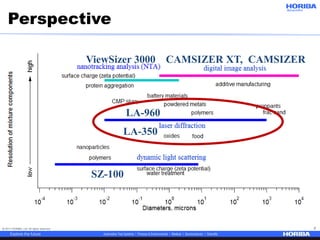
Perspective
SZ-100
LA-960
LA-350
ViewSizer 3000 CAMSIZER XT, CAMSIZER
© 2017 HORIBA, Ltd. All rights reserved. 3
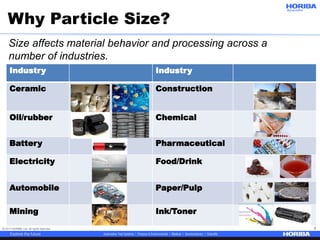
Why Particle Size?
Industry Industry
Ceramic Construction
Oil/rubber Chemical
Battery Pharmaceutical
Electricity Food/Drink
Automobile Paper/Pulp
Mining Ink/Toner
Size affects material behavior and processing across a
number of industries.
© 2017 HORIBA, Ltd. All rights reserved. 4
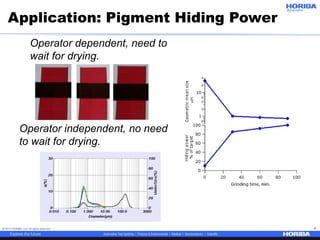
Application: Pigment Hiding Power
Operator dependent, need to
wait for drying.
Operator independent, no need
to wait for drying.
© 2017 HORIBA, Ltd. All rights reserved. 5
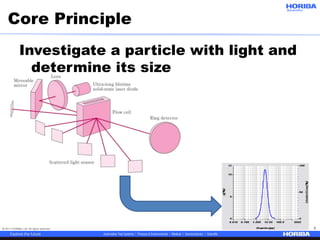
Core Principle
Investigate a particle with light and
determine its size
© 2017 HORIBA, Ltd. All rights reserved. 6
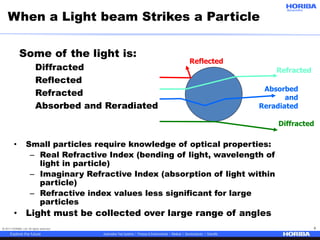
When a Light beam Strikes a Particle
Some of the light is:
Diffracted
Reflected
Refracted
Absorbed and Reradiated
• Small particles require knowledge of optical properties:
– Real Refractive Index (bending of light, wavelength of
light in particle)
– Imaginary Refractive Index (absorption of light within
particle)
– Refractive index values less significant for large
particles
• Light must be collected over large range of angles
Reflected
Refracted
Absorbed
and
Reradiated
Diffracted
© 2017 HORIBA, Ltd. All rights reserved. 7
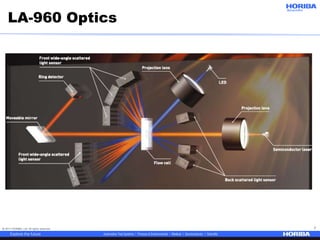
LA-960 Optics
© 2017 HORIBA, Ltd. All rights reserved. 8
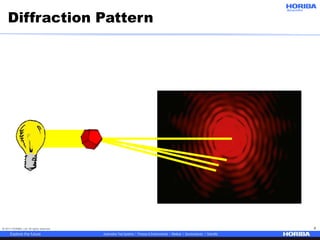
Diffraction Pattern
© 2017 HORIBA, Ltd. All rights reserved. 9
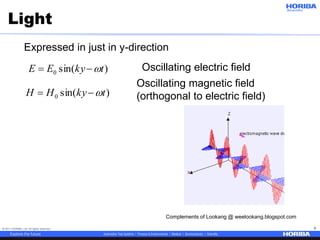
Light
)sin(0 tkyHH 
)sin(0 tkyEE  Oscillating electric field
Oscillating magnetic field
(orthogonal to electric field)
Expressed in just in y-direction
Complements of Lookang @ weelookang.blogspot.com
© 2017 HORIBA, Ltd. All rights reserved. 10
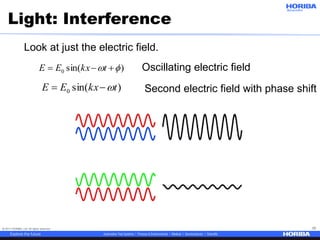
Light: Interference
)sin(0   tkxEE
)sin(0 tkxEE 
Oscillating electric field
Look at just the electric field.
Second electric field with phase shift
© 2017 HORIBA, Ltd. All rights reserved. 11
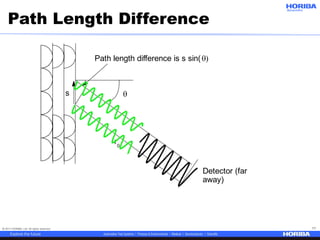

Path length difference is s sin(
s
Detector (far
away)
r0
Path Length Difference
© 2017 HORIBA, Ltd. All rights reserved. 12
Scattering data typically cannot be
inverted to find particle shape.
We use optical models to interpret
data and understand our
experiments.
Use models to interpret data
© 2017 HORIBA, Ltd. All rights reserved. 13
Large particles -> Fraunhofer
More straightforward math
Large, opaque particles as 2-D disks
Use this to develop intuition
All particle sizes -> Mie
Messy calculations
All particle sizes as 3-D spheres
Laser Diffraction Models
© 2017 HORIBA, Ltd. All rights reserved. 14
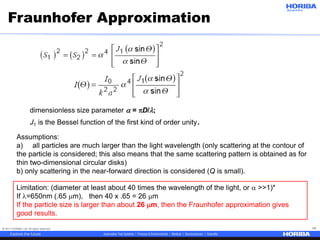
Fraunhofer Approximation
dimensionless size parameter a = pD/l;
J1 is the Bessel function of the first kind of order unity.
Assumptions:
a) all particles are much larger than the light wavelength (only scattering at the contour of
the particle is considered; this also means that the same scattering pattern is obtained as for
thin two-dimensional circular disks)
b) only scattering in the near-forward direction is considered (Q is small).
Limitation: (diameter at least about 40 times the wavelength of the light, or a >>1)*
If l=650nm (.65 mm), then 40 x .65 = 26 mm
If the particle size is larger than about 26 mm, then the Fraunhofer approximation gives
good results.
© 2017 HORIBA, Ltd. All rights reserved. 15
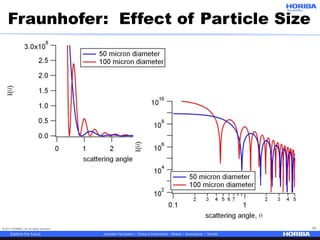
Fraunhofer: Effect of Particle Size
© 2017 HORIBA, Ltd. All rights reserved. 16
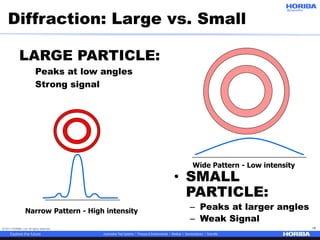
LARGE PARTICLE:
Peaks at low angles
Strong signal
• SMALL
PARTICLE:
– Peaks at larger angles
– Weak Signal
Wide Pattern - Low intensity
Narrow Pattern - High intensity
Diffraction: Large vs. Small
© 2017 HORIBA, Ltd. All rights reserved. 17
Poll
How many of you work with
particles with sizes over 1 mm?
How many of you work with
particles with sizes over 25
microns?
How many of you work with
particles with sizes less than 1
micron?
© 2017 HORIBA, Ltd. All rights reserved. 18
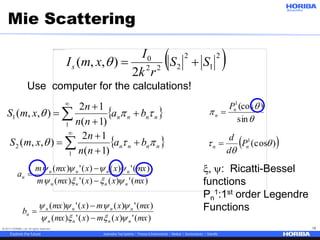
Mie Scattering
 nnnn ba
nn
n
xmS p 


 

1
2
)1(
12
),,(
 2
1
2
222
0
2
),,( SS
rk
I
xmIs 
)(')()(')(
)(')()(')(
mxxxmxm
mxxxmxm
a
nnnn
nnnn
n





 nnnn ba
nn
n
xmS p 


 

1
1
)1(
12
),,(
)(')()(')(
)(')()(')(
mxxmxmx
mxxmxmx
b
nnnn
nnnn
n





, : Ricatti-Bessel
functions
Pn
1:1st order Legendre
Functions


p
sin
)(cos1
n
n
P

 )(cos1


 nn P
d
d

Use computer for the calculations!
© 2017 HORIBA, Ltd. All rights reserved. 19
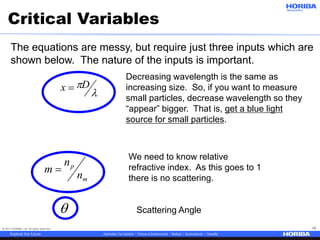
Critical Variables

l
pDx 
m
p
n
n
m 
Decreasing wavelength is the same as
increasing size. So, if you want to measure
small particles, decrease wavelength so they
“appear” bigger. That is, get a blue light
source for small particles.
The equations are messy, but require just three inputs which are
shown below. The nature of the inputs is important.
We need to know relative
refractive index. As this goes to 1
there is no scattering.
Scattering Angle
© 2017 HORIBA, Ltd. All rights reserved. 20
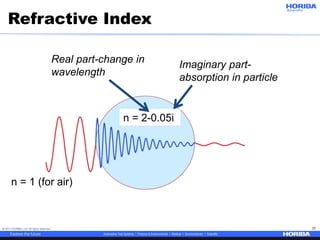
Refractive Index
n = 1 (for air)
n = 2-0.05i
Real part-change in
wavelength
Imaginary part-
absorption in particle
© 2017 HORIBA, Ltd. All rights reserved. 21
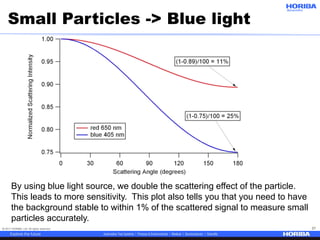
By using blue light source, we double the scattering effect of the particle.
This leads to more sensitivity. This plot also tells you that you need to have
the background stable to within 1% of the scattered signal to measure small
particles accurately.
Small Particles -> Blue light
© 2017 HORIBA, Ltd. All rights reserved. 22
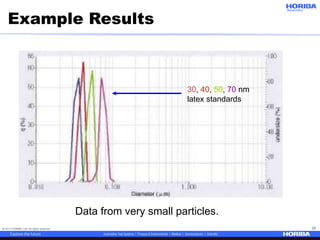
30, 40, 50, 70 nm
latex standards
Data from very small particles.
Example Results
© 2017 HORIBA, Ltd. All rights reserved. 23
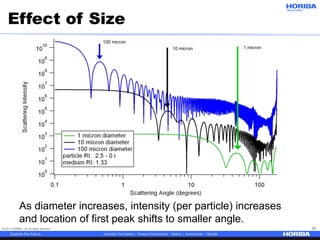
Effect of Size
As diameter increases, intensity (per particle) increases
and location of first peak shifts to smaller angle.
© 2017 HORIBA, Ltd. All rights reserved. 24
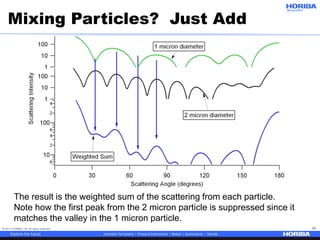
Mixing Particles? Just Add
The result is the weighted sum of the scattering from each particle.
Note how the first peak from the 2 micron particle is suppressed since it
matches the valley in the 1 micron particle.
© 2017 HORIBA, Ltd. All rights reserved. 25
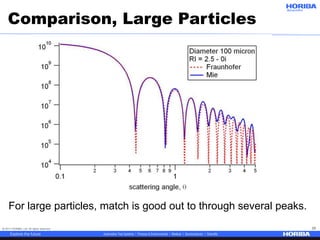
Comparison, Large Particles
For large particles, match is good out to through several peaks.
© 2017 HORIBA, Ltd. All rights reserved. 26
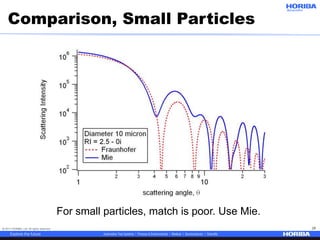
Comparison, Small Particles
For small particles, match is poor. Use Mie.
© 2017 HORIBA, Ltd. All rights reserved. 27
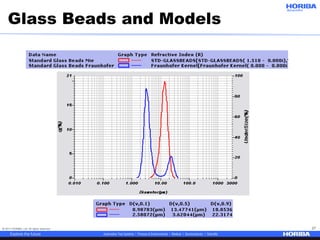
Glass Beads and Models
© 2017 HORIBA, Ltd. All rights reserved. 28
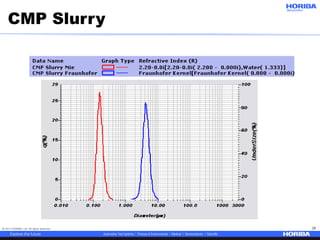
CMP Slurry
© 2017 HORIBA, Ltd. All rights reserved. 29
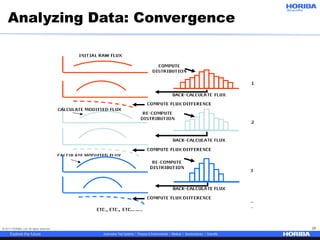
Analyzing Data: Convergence
© 2017 HORIBA, Ltd. All rights reserved. 30
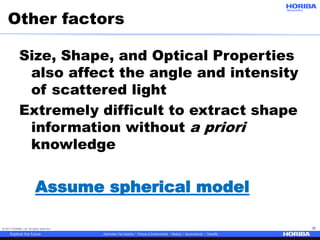
Other factors
Size, Shape, and Optical Properties
also affect the angle and intensity
of scattered light
Extremely difficult to extract shape
information without a priori
knowledge
Assume spherical model
© 2017 HORIBA, Ltd. All rights reserved. 31
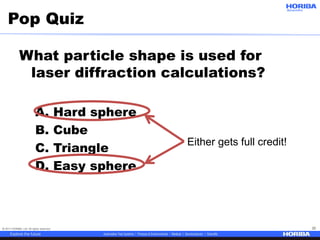
Pop Quiz
What particle shape is used for
laser diffraction calculations?
A. Hard sphere
B. Cube
C. Triangle
D. Easy sphere
© 2017 HORIBA, Ltd. All rights reserved. 32
Pop Quiz
What particle shape is used for
laser diffraction calculations?
A. Hard sphere
B. Cube
C. Triangle
D. Easy sphere
Either gets full credit!
© 2017 HORIBA, Ltd. All rights reserved. 33
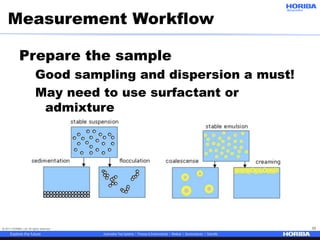
Measurement Workflow
Prepare the sample
Good sampling and dispersion a must!
May need to use surfactant or
admixture
© 2017 HORIBA, Ltd. All rights reserved. 34
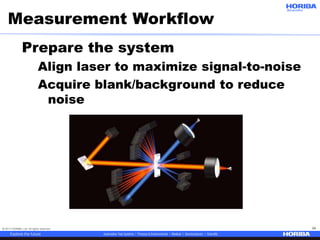
Measurement Workflow
Prepare the system
Align laser to maximize signal-to-noise
Acquire blank/background to reduce
noise
© 2017 HORIBA, Ltd. All rights reserved. 35
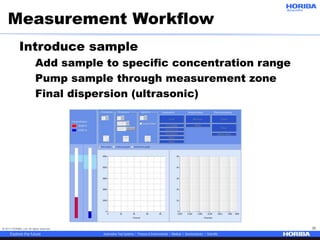
Measurement Workflow
Introduce sample
Add sample to specific concentration range
Pump sample through measurement zone
Final dispersion (ultrasonic)
© 2017 HORIBA, Ltd. All rights reserved. 36
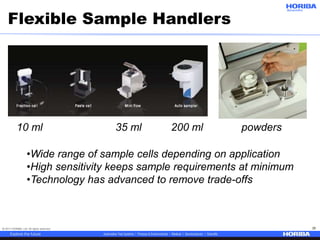
10 ml 35 ml 200 ml powders
•Wide range of sample cells depending on application
•High sensitivity keeps sample requirements at minimum
•Technology has advanced to remove trade-offs
Flexible Sample Handlers
© 2017 HORIBA, Ltd. All rights reserved. 37
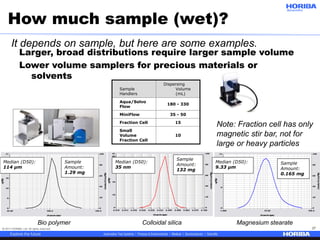
How much sample (wet)?
Larger, broad distributions require larger sample volume
Lower volume samplers for precious materials or
solvents
Sample
Handlers
Dispersing
Volume
(mL)
Aqua/Solvo
Flow
180 - 330
MiniFlow 35 - 50
Fraction Cell 15
Small
Volume
Fraction Cell
10
Median (D50):
35 nm
Sample
Amount:
132 mg
Median (D50):
114 µm
Sample
Amount:
1.29 mg
Median (D50):
9.33 µm
Sample
Amount:
0.165 mg
Note: Fraction cell has only
magnetic stir bar, not for
large or heavy particles
Bio polymer Colloidal silica Magnesium stearate
It depends on sample, but here are some examples.
© 2017 HORIBA, Ltd. All rights reserved. 38
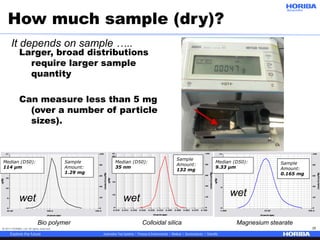
How much sample (dry)?
Larger, broad distributions
require larger sample
quantity
Can measure less than 5 mg
(over a number of particle
sizes).
Median (D50):
35 nm
Sample
Amount:
132 mg
Median (D50):
114 µm
Sample
Amount:
1.29 mg
Median (D50):
9.33 µm
Sample
Amount:
0.165 mg
Bio polymer Colloidal silica Magnesium stearate
It depends on sample …..
wet wet
wet
© 2017 HORIBA, Ltd. All rights reserved. 39
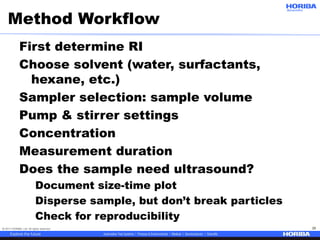
Method Workflow
First determine RI
Choose solvent (water, surfactants,
hexane, etc.)
Sampler selection: sample volume
Pump & stirrer settings
Concentration
Measurement duration
Does the sample need ultrasound?
Document size-time plot
Disperse sample, but don’t break particles
Check for reproducibility
© 2017 HORIBA, Ltd. All rights reserved. 40
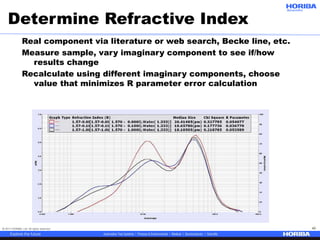
Determine Refractive Index
Real component via literature or web search, Becke line, etc.
Measure sample, vary imaginary component to see if/how
results change
Recalculate using different imaginary components, choose
value that minimizes R parameter error calculation
© 2017 HORIBA, Ltd. All rights reserved. 41
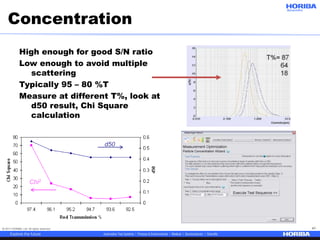
Concentration
High enough for good S/N ratio
Low enough to avoid multiple
scattering
Typically 95 – 80 %T
Measure at different T%, look at
d50 result, Chi Square
calculation
d50
Chi2
© 2017 HORIBA, Ltd. All rights reserved. 42
Ultrasonic Dispersion
Adding energy to break up agglomerates – disperse to
primary particles, without breaking particles
Similar to changing air pressure on dry powder feeder
Typically set to 100% energy, vary time (sec) on
Investigate tails of distribution
High end to see if agglomerates removed
Small end to see if new, smaller particles appear (breakage)
Test reproducibility, consider robustness
Note:
Do not use on emulsions
Can cause thermal mixing trouble w/solvents - wait
Use external probe if t> 2-5 minutes
© 2017 HORIBA, Ltd. All rights reserved. 43
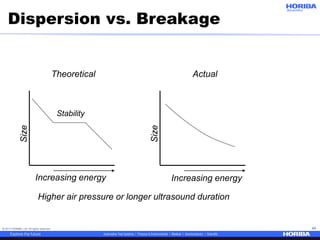
Size
Increasing energy
Stability
Theoretical Actual
Size
Increasing energy
Higher air pressure or longer ultrasound duration
Dispersion vs. Breakage
© 2017 HORIBA, Ltd. All rights reserved. 44
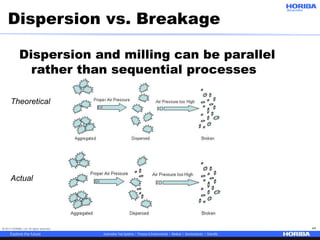
Dispersion vs. Breakage
Dispersion and milling can be parallel
rather than sequential processes
Theoretical
Actual
© 2017 HORIBA, Ltd. All rights reserved. 45
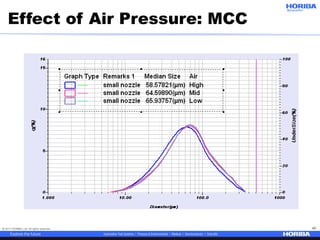
Effect of Air Pressure: MCC
© 2017 HORIBA, Ltd. All rights reserved. 46
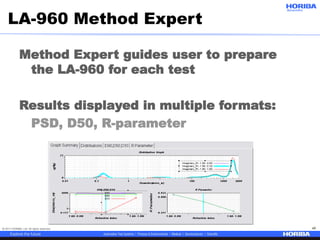
LA-960 Method Expert
Method Expert guides user to prepare
the LA-960 for each test
Results displayed in multiple formats:
PSD, D50, R-parameter
© 2017 HORIBA, Ltd. All rights reserved. 47
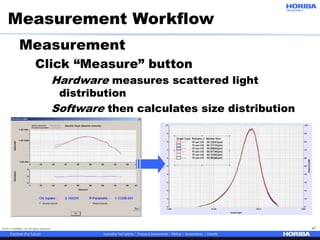
Measurement Workflow
Measurement
Click “Measure” button
Hardware measures scattered light
distribution
Software then calculates size distribution
© 2017 HORIBA, Ltd. All rights reserved. 48
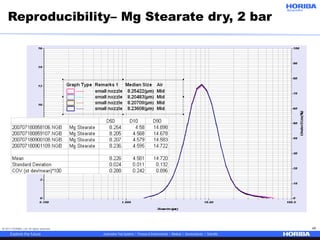
Reproducibility– Mg Stearate dry, 2 bar
© 2017 HORIBA, Ltd. All rights reserved. 49
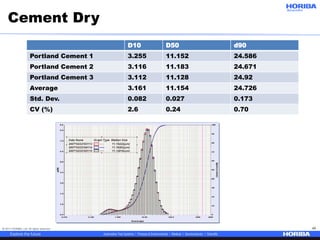
Cement Dry
D10 D50 d90
Portland Cement 1 3.255 11.152 24.586
Portland Cement 2 3.116 11.183 24.671
Portland Cement 3 3.112 11.128 24.92
Average 3.161 11.154 24.726
Std. Dev. 0.082 0.027 0.173
CV (%) 2.6 0.24 0.70
© 2017 HORIBA, Ltd. All rights reserved. 50
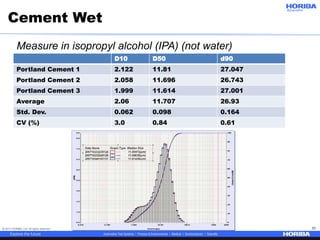
Cement Wet
D10 D50 d90
Portland Cement 1 2.122 11.81 27.047
Portland Cement 2 2.058 11.696 26.743
Portland Cement 3 1.999 11.614 27.001
Average 2.06 11.707 26.93
Std. Dev. 0.062 0.098 0.164
CV (%) 3.0 0.84 0.61
Measure in isopropyl alcohol (IPA) (not water)
© 2017 HORIBA, Ltd. All rights reserved. 51
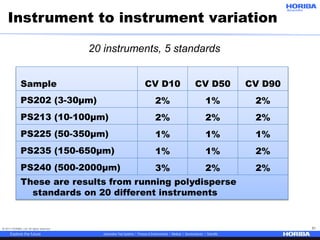
Instrument to instrument variation
Sample CV D10 CV D50 CV D90
PS202 (3-30µm) 2% 1% 2%
PS213 (10-100µm) 2% 2% 2%
PS225 (50-350µm) 1% 1% 1%
PS235 (150-650µm) 1% 1% 2%
PS240 (500-2000µm) 3% 2% 2%
These are results from running polydisperse
standards on 20 different instruments
20 instruments, 5 standards
© 2017 HORIBA, Ltd. All rights reserved. 52
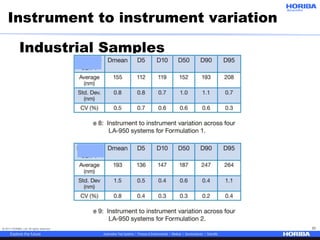
Instrument to instrument variation
Industrial Samples
4 instruments, real sample
© 2017 HORIBA, Ltd. All rights reserved. 53
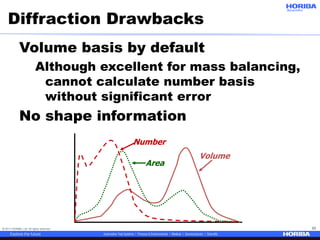
Diffraction Drawbacks
Volume basis by default
Although excellent for mass balancing,
cannot calculate number basis
without significant error
No shape information
Volume
Area
Number
© 2017 HORIBA, Ltd. All rights reserved. 54
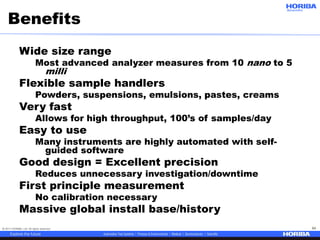
Benefits
Wide size range
Most advanced analyzer measures from 10 nano to 5
milli
Flexible sample handlers
Powders, suspensions, emulsions, pastes, creams
Very fast
Allows for high throughput, 100’s of samples/day
Easy to use
Many instruments are highly automated with self-
guided software
Good design = Excellent precision
Reduces unnecessary investigation/downtime
First principle measurement
No calibration necessary
Massive global install base/history
© 2017 HORIBA, Ltd. All rights reserved. 55
Q&A
Ask a question at labinfo@horiba.com
Keep reading the monthly HORIBA Particle
e-mail newsletter!
Visit the Download Center to find the video
and slides from this webinar.
www.horiba.com/us/particle
Jeff Bodycomb, Ph.D.
P: 866-562-4698
E: jeff.bodycomb@horiba.com

Modern Laser Diffraction for Particle Analysis

  • 1.
    © 2017 HORIBA,Ltd. All rights reserved. 1© 2017 HORIBA, Ltd. All rights reserved. 1 Modern Laser Diffraction for Particle Size Analysis, an Introduction Particle Analysis Jeffrey Bodycomb, Ph.D. September 7, 2017 HORIBA Instruments
  • 2.
    © 2017 HORIBA,Ltd. All rights reserved. 2 Perspective SZ-100 LA-960 LA-350 ViewSizer 3000 CAMSIZER XT, CAMSIZER
  • 3.
    © 2017 HORIBA,Ltd. All rights reserved. 3 Why Particle Size? Industry Industry Ceramic Construction Oil/rubber Chemical Battery Pharmaceutical Electricity Food/Drink Automobile Paper/Pulp Mining Ink/Toner Size affects material behavior and processing across a number of industries.
  • 4.
    © 2017 HORIBA,Ltd. All rights reserved. 4 Application: Pigment Hiding Power Operator dependent, need to wait for drying. Operator independent, no need to wait for drying.
  • 5.
    © 2017 HORIBA,Ltd. All rights reserved. 5 Core Principle Investigate a particle with light and determine its size
  • 6.
    © 2017 HORIBA,Ltd. All rights reserved. 6 When a Light beam Strikes a Particle Some of the light is: Diffracted Reflected Refracted Absorbed and Reradiated • Small particles require knowledge of optical properties: – Real Refractive Index (bending of light, wavelength of light in particle) – Imaginary Refractive Index (absorption of light within particle) – Refractive index values less significant for large particles • Light must be collected over large range of angles Reflected Refracted Absorbed and Reradiated Diffracted
  • 7.
    © 2017 HORIBA,Ltd. All rights reserved. 7 LA-960 Optics
  • 8.
    © 2017 HORIBA,Ltd. All rights reserved. 8 Diffraction Pattern
  • 9.
    © 2017 HORIBA,Ltd. All rights reserved. 9 Light )sin(0 tkyHH  )sin(0 tkyEE  Oscillating electric field Oscillating magnetic field (orthogonal to electric field) Expressed in just in y-direction Complements of Lookang @ weelookang.blogspot.com
  • 10.
    © 2017 HORIBA,Ltd. All rights reserved. 10 Light: Interference )sin(0   tkxEE )sin(0 tkxEE  Oscillating electric field Look at just the electric field. Second electric field with phase shift
  • 11.
    © 2017 HORIBA,Ltd. All rights reserved. 11  Path length difference is s sin( s Detector (far away) r0 Path Length Difference
  • 12.
    © 2017 HORIBA,Ltd. All rights reserved. 12 Scattering data typically cannot be inverted to find particle shape. We use optical models to interpret data and understand our experiments. Use models to interpret data
  • 13.
    © 2017 HORIBA,Ltd. All rights reserved. 13 Large particles -> Fraunhofer More straightforward math Large, opaque particles as 2-D disks Use this to develop intuition All particle sizes -> Mie Messy calculations All particle sizes as 3-D spheres Laser Diffraction Models
  • 14.
    © 2017 HORIBA,Ltd. All rights reserved. 14 Fraunhofer Approximation dimensionless size parameter a = pD/l; J1 is the Bessel function of the first kind of order unity. Assumptions: a) all particles are much larger than the light wavelength (only scattering at the contour of the particle is considered; this also means that the same scattering pattern is obtained as for thin two-dimensional circular disks) b) only scattering in the near-forward direction is considered (Q is small). Limitation: (diameter at least about 40 times the wavelength of the light, or a >>1)* If l=650nm (.65 mm), then 40 x .65 = 26 mm If the particle size is larger than about 26 mm, then the Fraunhofer approximation gives good results.
  • 15.
    © 2017 HORIBA,Ltd. All rights reserved. 15 Fraunhofer: Effect of Particle Size
  • 16.
    © 2017 HORIBA,Ltd. All rights reserved. 16 LARGE PARTICLE: Peaks at low angles Strong signal • SMALL PARTICLE: – Peaks at larger angles – Weak Signal Wide Pattern - Low intensity Narrow Pattern - High intensity Diffraction: Large vs. Small
  • 17.
    © 2017 HORIBA,Ltd. All rights reserved. 17 Poll How many of you work with particles with sizes over 1 mm? How many of you work with particles with sizes over 25 microns? How many of you work with particles with sizes less than 1 micron?
  • 18.
    © 2017 HORIBA,Ltd. All rights reserved. 18 Mie Scattering  nnnn ba nn n xmS p       1 2 )1( 12 ),,(  2 1 2 222 0 2 ),,( SS rk I xmIs  )(')()(')( )(')()(')( mxxxmxm mxxxmxm a nnnn nnnn n       nnnn ba nn n xmS p       1 1 )1( 12 ),,( )(')()(')( )(')()(')( mxxmxmx mxxmxmx b nnnn nnnn n      , : Ricatti-Bessel functions Pn 1:1st order Legendre Functions   p sin )(cos1 n n P   )(cos1    nn P d d  Use computer for the calculations!
  • 19.
    © 2017 HORIBA,Ltd. All rights reserved. 19 Critical Variables  l pDx  m p n n m  Decreasing wavelength is the same as increasing size. So, if you want to measure small particles, decrease wavelength so they “appear” bigger. That is, get a blue light source for small particles. The equations are messy, but require just three inputs which are shown below. The nature of the inputs is important. We need to know relative refractive index. As this goes to 1 there is no scattering. Scattering Angle
  • 20.
    © 2017 HORIBA,Ltd. All rights reserved. 20 Refractive Index n = 1 (for air) n = 2-0.05i Real part-change in wavelength Imaginary part- absorption in particle
  • 21.
    © 2017 HORIBA,Ltd. All rights reserved. 21 By using blue light source, we double the scattering effect of the particle. This leads to more sensitivity. This plot also tells you that you need to have the background stable to within 1% of the scattered signal to measure small particles accurately. Small Particles -> Blue light
  • 22.
    © 2017 HORIBA,Ltd. All rights reserved. 22 30, 40, 50, 70 nm latex standards Data from very small particles. Example Results
  • 23.
    © 2017 HORIBA,Ltd. All rights reserved. 23 Effect of Size As diameter increases, intensity (per particle) increases and location of first peak shifts to smaller angle.
  • 24.
    © 2017 HORIBA,Ltd. All rights reserved. 24 Mixing Particles? Just Add The result is the weighted sum of the scattering from each particle. Note how the first peak from the 2 micron particle is suppressed since it matches the valley in the 1 micron particle.
  • 25.
    © 2017 HORIBA,Ltd. All rights reserved. 25 Comparison, Large Particles For large particles, match is good out to through several peaks.
  • 26.
    © 2017 HORIBA,Ltd. All rights reserved. 26 Comparison, Small Particles For small particles, match is poor. Use Mie.
  • 27.
    © 2017 HORIBA,Ltd. All rights reserved. 27 Glass Beads and Models
  • 28.
    © 2017 HORIBA,Ltd. All rights reserved. 28 CMP Slurry
  • 29.
    © 2017 HORIBA,Ltd. All rights reserved. 29 Analyzing Data: Convergence
  • 30.
    © 2017 HORIBA,Ltd. All rights reserved. 30 Other factors Size, Shape, and Optical Properties also affect the angle and intensity of scattered light Extremely difficult to extract shape information without a priori knowledge Assume spherical model
  • 31.
    © 2017 HORIBA,Ltd. All rights reserved. 31 Pop Quiz What particle shape is used for laser diffraction calculations? A. Hard sphere B. Cube C. Triangle D. Easy sphere
  • 32.
    © 2017 HORIBA,Ltd. All rights reserved. 32 Pop Quiz What particle shape is used for laser diffraction calculations? A. Hard sphere B. Cube C. Triangle D. Easy sphere Either gets full credit!
  • 33.
    © 2017 HORIBA,Ltd. All rights reserved. 33 Measurement Workflow Prepare the sample Good sampling and dispersion a must! May need to use surfactant or admixture
  • 34.
    © 2017 HORIBA,Ltd. All rights reserved. 34 Measurement Workflow Prepare the system Align laser to maximize signal-to-noise Acquire blank/background to reduce noise
  • 35.
    © 2017 HORIBA,Ltd. All rights reserved. 35 Measurement Workflow Introduce sample Add sample to specific concentration range Pump sample through measurement zone Final dispersion (ultrasonic)
  • 36.
    © 2017 HORIBA,Ltd. All rights reserved. 36 10 ml 35 ml 200 ml powders •Wide range of sample cells depending on application •High sensitivity keeps sample requirements at minimum •Technology has advanced to remove trade-offs Flexible Sample Handlers
  • 37.
    © 2017 HORIBA,Ltd. All rights reserved. 37 How much sample (wet)? Larger, broad distributions require larger sample volume Lower volume samplers for precious materials or solvents Sample Handlers Dispersing Volume (mL) Aqua/Solvo Flow 180 - 330 MiniFlow 35 - 50 Fraction Cell 15 Small Volume Fraction Cell 10 Median (D50): 35 nm Sample Amount: 132 mg Median (D50): 114 µm Sample Amount: 1.29 mg Median (D50): 9.33 µm Sample Amount: 0.165 mg Note: Fraction cell has only magnetic stir bar, not for large or heavy particles Bio polymer Colloidal silica Magnesium stearate It depends on sample, but here are some examples.
  • 38.
    © 2017 HORIBA,Ltd. All rights reserved. 38 How much sample (dry)? Larger, broad distributions require larger sample quantity Can measure less than 5 mg (over a number of particle sizes). Median (D50): 35 nm Sample Amount: 132 mg Median (D50): 114 µm Sample Amount: 1.29 mg Median (D50): 9.33 µm Sample Amount: 0.165 mg Bio polymer Colloidal silica Magnesium stearate It depends on sample ….. wet wet wet
  • 39.
    © 2017 HORIBA,Ltd. All rights reserved. 39 Method Workflow First determine RI Choose solvent (water, surfactants, hexane, etc.) Sampler selection: sample volume Pump & stirrer settings Concentration Measurement duration Does the sample need ultrasound? Document size-time plot Disperse sample, but don’t break particles Check for reproducibility
  • 40.
    © 2017 HORIBA,Ltd. All rights reserved. 40 Determine Refractive Index Real component via literature or web search, Becke line, etc. Measure sample, vary imaginary component to see if/how results change Recalculate using different imaginary components, choose value that minimizes R parameter error calculation
  • 41.
    © 2017 HORIBA,Ltd. All rights reserved. 41 Concentration High enough for good S/N ratio Low enough to avoid multiple scattering Typically 95 – 80 %T Measure at different T%, look at d50 result, Chi Square calculation d50 Chi2
  • 42.
    © 2017 HORIBA,Ltd. All rights reserved. 42 Ultrasonic Dispersion Adding energy to break up agglomerates – disperse to primary particles, without breaking particles Similar to changing air pressure on dry powder feeder Typically set to 100% energy, vary time (sec) on Investigate tails of distribution High end to see if agglomerates removed Small end to see if new, smaller particles appear (breakage) Test reproducibility, consider robustness Note: Do not use on emulsions Can cause thermal mixing trouble w/solvents - wait Use external probe if t> 2-5 minutes
  • 43.
    © 2017 HORIBA,Ltd. All rights reserved. 43 Size Increasing energy Stability Theoretical Actual Size Increasing energy Higher air pressure or longer ultrasound duration Dispersion vs. Breakage
  • 44.
    © 2017 HORIBA,Ltd. All rights reserved. 44 Dispersion vs. Breakage Dispersion and milling can be parallel rather than sequential processes Theoretical Actual
  • 45.
    © 2017 HORIBA,Ltd. All rights reserved. 45 Effect of Air Pressure: MCC
  • 46.
    © 2017 HORIBA,Ltd. All rights reserved. 46 LA-960 Method Expert Method Expert guides user to prepare the LA-960 for each test Results displayed in multiple formats: PSD, D50, R-parameter
  • 47.
    © 2017 HORIBA,Ltd. All rights reserved. 47 Measurement Workflow Measurement Click “Measure” button Hardware measures scattered light distribution Software then calculates size distribution
  • 48.
    © 2017 HORIBA,Ltd. All rights reserved. 48 Reproducibility– Mg Stearate dry, 2 bar
  • 49.
    © 2017 HORIBA,Ltd. All rights reserved. 49 Cement Dry D10 D50 d90 Portland Cement 1 3.255 11.152 24.586 Portland Cement 2 3.116 11.183 24.671 Portland Cement 3 3.112 11.128 24.92 Average 3.161 11.154 24.726 Std. Dev. 0.082 0.027 0.173 CV (%) 2.6 0.24 0.70
  • 50.
    © 2017 HORIBA,Ltd. All rights reserved. 50 Cement Wet D10 D50 d90 Portland Cement 1 2.122 11.81 27.047 Portland Cement 2 2.058 11.696 26.743 Portland Cement 3 1.999 11.614 27.001 Average 2.06 11.707 26.93 Std. Dev. 0.062 0.098 0.164 CV (%) 3.0 0.84 0.61 Measure in isopropyl alcohol (IPA) (not water)
  • 51.
    © 2017 HORIBA,Ltd. All rights reserved. 51 Instrument to instrument variation Sample CV D10 CV D50 CV D90 PS202 (3-30µm) 2% 1% 2% PS213 (10-100µm) 2% 2% 2% PS225 (50-350µm) 1% 1% 1% PS235 (150-650µm) 1% 1% 2% PS240 (500-2000µm) 3% 2% 2% These are results from running polydisperse standards on 20 different instruments 20 instruments, 5 standards
  • 52.
    © 2017 HORIBA,Ltd. All rights reserved. 52 Instrument to instrument variation Industrial Samples 4 instruments, real sample
  • 53.
    © 2017 HORIBA,Ltd. All rights reserved. 53 Diffraction Drawbacks Volume basis by default Although excellent for mass balancing, cannot calculate number basis without significant error No shape information Volume Area Number
  • 54.
    © 2017 HORIBA,Ltd. All rights reserved. 54 Benefits Wide size range Most advanced analyzer measures from 10 nano to 5 milli Flexible sample handlers Powders, suspensions, emulsions, pastes, creams Very fast Allows for high throughput, 100’s of samples/day Easy to use Many instruments are highly automated with self- guided software Good design = Excellent precision Reduces unnecessary investigation/downtime First principle measurement No calibration necessary Massive global install base/history
  • 55.
    © 2017 HORIBA,Ltd. All rights reserved. 55 Q&A Ask a question at labinfo@horiba.com Keep reading the monthly HORIBA Particle e-mail newsletter! Visit the Download Center to find the video and slides from this webinar. www.horiba.com/us/particle Jeff Bodycomb, Ph.D. P: 866-562-4698 E: jeff.bodycomb@horiba.com