
BASIC
EMBEDDED SYSTEMS & DESIGN
Gaurav Verma
Assistant Professor
Department of Electronics and Communication Engineering
Jaypee Institute of Information and Technology
Sector-62, Noida, Uttar Pradesh, India
1 Copyright to gaurav verma
Course Content
2
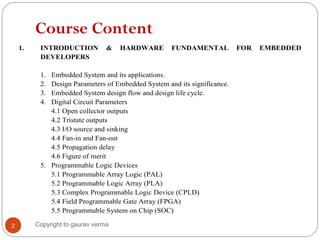
1. INTRODUCTION & HARDWARE FUNDAMENTAL FOR EMBEDDED
DEVELOPERS
1. Embedded System and its applications.
2. Design Parameters of Embedded System and its significance.
3. Embedded System design flow and design life cycle.
4. Digital Circuit Parameters
4.1 Open collector outputs
4.2 Tristate outputs
4.3 I/O source and sinking
4.4 Fan-in and Fan-out
4.5 Propagation delay
4.6 Figure of merit
5. Programmable Logic Devices
5.1 Programmable Array Logic (PAL)
5.2 Programmable Logic Array (PLA)
5.3 Complex Programmable Logic Device (CPLD)
5.4 Field Programmable Gate Array (FPGA)
5.5 Programmable System on Chip (SOC)
Copyright to gaurav verma
Course Content cont…
2. INTRODUCTION TO MICROPROCESSORS AND MICROCONTROLLERS
1. Introduction
1.1 Microprocessor Versus Microcontrollers
1.2 Microcontrollers for Embedded Systems
1.3 Embedded Versus External Memory Devices
1.4 CISC Versus RISC Processors
1.5 Harvard Versus Von-Neumann architecture
1.6 Superscalar Versus VLIW architecture
2. 8051/8031/8052 Microcontroller
2.1 Basic architecture
2.2 Pin configuration
2.3 Memory organization (registers and i/o ports)
2.4 Assembly language programming ( addressing modes and instruction set)
2.5 Timers and Interrupts
2.6 Serial Communication
3 Copyright to gaurav verma
Course Content cont…
4 Copyright to gaurav verma
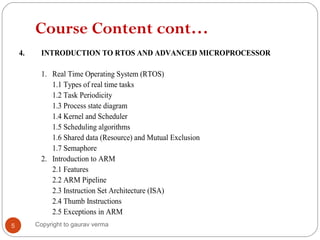
Course Content cont…
4. INTRODUCTION TO RTOS AND ADVANCED MICROPROCESSOR
1. Real Time Operating System (RTOS)
1.1 Types of real time tasks
1.2 Task Periodicity
1.3 Process state diagram
1.4 Kernel and Scheduler
1.5 Scheduling algorithms
1.6 Shared data (Resource) and Mutual Exclusion
1.7 Semaphore
2. Introduction to ARM
2.1 Features
2.2 ARM Pipeline
2.3 Instruction Set Architecture (ISA)
2.4 Thumb Instructions
2.5 Exceptions in ARM
5 Copyright to gaurav verma
Course Content cont…
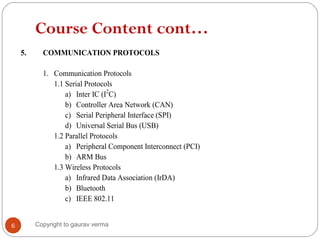
5. COMMUNICATION PROTOCOLS
1. Communication Protocols
1.1 Serial Protocols
a) Inter IC (I2
C)
b) Controller Area Network (CAN)
c) Serial Peripheral Interface (SPI)
d) Universal Serial Bus (USB)
1.2 Parallel Protocols
a) Peripheral Component Interconnect (PCI)
b) ARM Bus
1.3 Wireless Protocols
a) Infrared Data Association (IrDA)
b) Bluetooth
c) IEEE 802.11
6 Copyright to gaurav verma
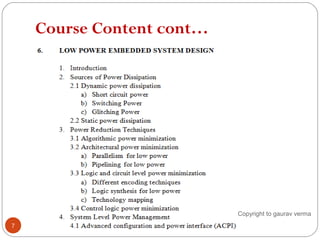
Course Content cont…
7
Copyright to gaurav verma
UNIT 1: Introduction and Hardware
Fundamentals for Embedded Developers
8 Copyright to gaurav verma
Embedded System & its Applications
What is system?
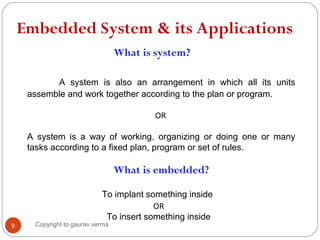
A system is also an arrangement in which all its units
assemble and work together according to the plan or program.
OR
A system is a way of working, organizing or doing one or many
tasks according to a fixed plan, program or set of rules.
9
What is embedded?
To implant something inside
OR
To insert something inside
Copyright to gaurav verma
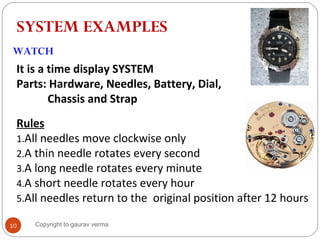
SYSTEM EXAMPLES
WATCH
It is a time display SYSTEM
Parts: Hardware, Needles, Battery, Dial,
Chassis and Strap
Rules
1.All needles move clockwise only
2.A thin needle rotates every second
3.A long needle rotates every minute
4.A short needle rotates every hour
5.All needles return to the original position after 12 hours
10 Copyright to gaurav verma
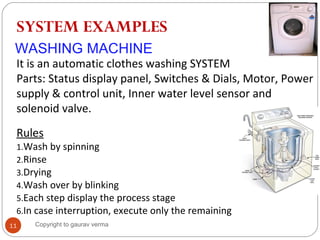
WASHING MACHINE
It is an automatic clothes washing SYSTEM
Parts: Status display panel, Switches & Dials, Motor, Power
supply & control unit, Inner water level sensor and
solenoid valve.
Rules
1.Wash by spinning
2.Rinse
3.Drying
4.Wash over by blinking
5.Each step display the process stage
6.In case interruption, execute only the remaining
SYSTEM EXAMPLES
11 Copyright to gaurav verma
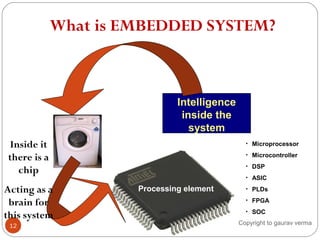
What is EMBEDDED SYSTEM?
Intelligence
inside the
system
Processing element
12
Inside it
there is a
chip
Acting as a
brain for
this system
• Microprocessor
• Microcontroller
• DSP
• ASIC
• PLDs
• FPGA
• SOC
Copyright to gaurav verma
EMBEDDED SYSTEM DEFINITIONS
13
Definition 1: Combination of Hardware & Software in general
SOFTWARE PROGRAM
Definition 2: An embedded system is a special-purpose computer system designed
to perform a dedicated function & Any system where the user doesn’t want to or
need to know that it includes a processor by Chandandeep Singh PABLA (Sr. Manager ST
Microelectronics)
Definition 3: An embedded system can be defined as a processing element based
computing or controlling system embed within a larger electronic device,
performing a single (or a small set of) function(s) repeatedly, following certain time
constraints and often going unnoticed by device user by Prof. Santanu Chattopadyay (IIT
Kharagpur)
Is Desktop, Laptop, Mobile and Tablets are embedded systems
as per the above definition????????
Copyright to gaurav verma
14
EMBEDDED SYSTEM DEFINITIONS
Definition 5: An embedded system is a processing element (Microprocessor,
Microcontroller, DSP, PLD, FPGA, ASIC, SOC) based computing/controlling
electronic system designed to do one or a few dedicated and/or specific functions
often with real-time computing constraints. It is embedded as part of a complete
device often unnoticed by the device user by Gaurav Verma (Asst. Prof. JIIT Noida)
This definition, being a bit technical, may not be very precise.
However, it should be noted that giving a precise definition of
embedded system is quite difficult.
Definition 4: An embedded system is a computer system designed to do one or a few
dedicated and/or specific functions often with real-time computing constraints. It
is embedded as part of a complete device often including hardware and mechanical
parts by Abhishek Tiwari (Sr. Technical officer CDAC Noida)
Copyright to gaurav verma
Examples of embedded systems
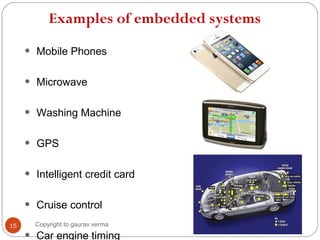
• Mobile Phones
• Microwave
• Washing Machine
• GPS
• Intelligent credit card
• Cruise control
Car engine timing
15 Copyright to gaurav verma
Examples of embedded systems
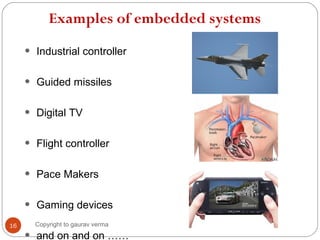
• Industrial controller
• Guided missiles
• Digital TV
• Flight controller
• Pace Makers
• Gaming devices
and on and on ……
16 Copyright to gaurav verma
How many do we use?
Average middle-class American home has 40 to 50
embedded processors in it
 Microwave, washer, dryer, dishwasher, TV, VCR, stereo, hair dryer, coffee maker,
remote control, humidifier, heater, toys, etc.
Luxury cars have over 60 embedded processors
 Brakes, steering, windows, locks, ignition, dashboard displays, transmission,
mirrors, etc.
Personal computers have over 10 embedded processors
 Graphics accelerator, mouse, keyboard, hard-drive, CD-ROM, bus interface,
network card, etc.
Pentium/x86 holds largest processor volume share!
 True/False?
17 Copyright to gaurav verma
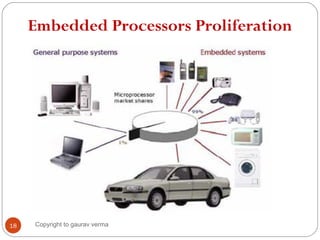
Embedded Processors Proliferation
18 Copyright to gaurav verma
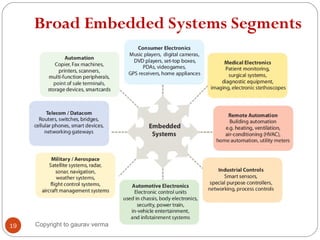
Broad Embedded Systems Segments
19 Copyright to gaurav verma
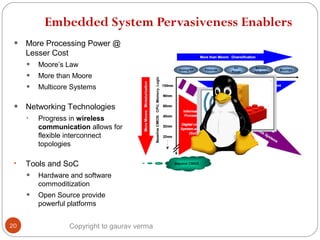
Embedded System Pervasiveness Enablers
• More Processing Power @
Lesser Cost
• Moore’s Law
• More than Moore
• Multicore Systems
• Networking Technologies
• Progress in wireless
communication allows for
flexible interconnect
topologies
• Tools and SoC
• Hardware and software
commoditization
• Open Source provide
powerful platforms
1981 1984 1987 1990 1993 1996 1999 2002
Leading edge
chip in 1981
10,000
transistors
Leading edge
chip in 2002
150,000,000
transistors
20 Copyright to gaurav verma
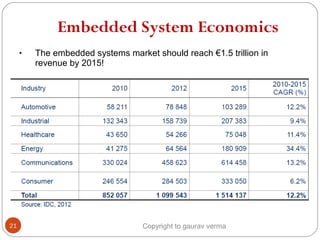
Embedded System Economics
• The embedded systems market should reach €1.5 trillion in
revenue by 2015!
21 Copyright to gaurav verma
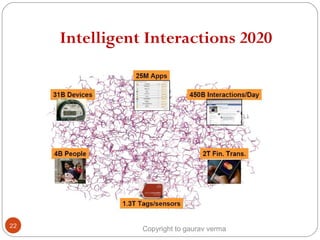
Intelligent Interactions 2020
22
Copyright to gaurav verma
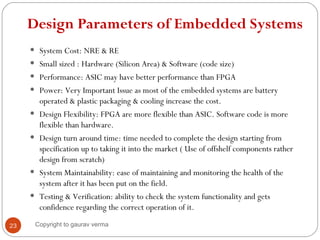
Design Parameters of Embedded Systems
• System Cost: NRE & RE
• Small sized : Hardware (Silicon Area) & Software (code size)
• Performance: ASIC may have better performance than FPGA
• Power: Very Important Issue as most of the embedded systems are battery
operated & plastic packaging & cooling increase the cost.
• Design Flexibility: FPGA are more flexible than ASIC. Software code is more
flexible than hardware.
• Design turn around time: time needed to complete the design starting from
specification up to taking it into the market ( Use of offshelf components rather
design from scratch)
• System Maintainability: ease of maintaining and monitoring the health of the
system after it has been put on the field.
• Testing & Verification: ability to check the system functionality and gets
confidence regarding the correct operation of it.
23 Copyright to gaurav verma
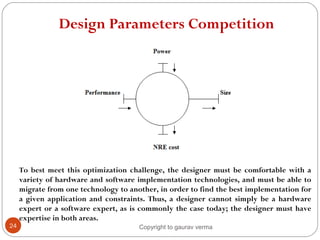
Design Parameters Competition
24
To best meet this optimization challenge, the designer must be comfortable with a
variety of hardware and software implementation technologies, and must be able to
migrate from one technology to another, in order to find the best implementation for
a given application and constraints. Thus, a designer cannot simply be a hardware
expert or a software expert, as is commonly the case today; the designer must have
expertise in both areas.
Copyright to gaurav verma
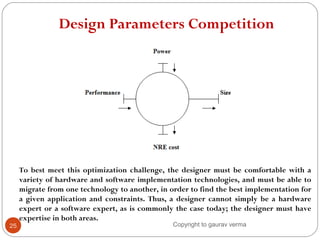
Design Parameters Competition
25
To best meet this optimization challenge, the designer must be comfortable with a
variety of hardware and software implementation technologies, and must be able to
migrate from one technology to another, in order to find the best implementation for
a given application and constraints. Thus, a designer cannot simply be a hardware
expert or a software expert, as is commonly the case today; the designer must have
expertise in both areas.
Copyright to gaurav verma
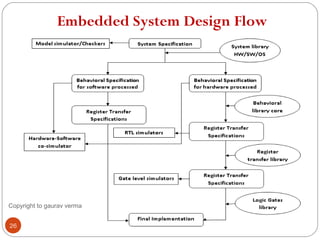
Embedded System Design Flow
26
Copyright to gaurav verma
Digital Circuit Parameters
27
1. Open collector outputs
2. Tristate outputs
3. I/O source and sinking
4. Fan-in and Fan-out
5. Propagation delay
6. Figure of merit
Copyright to gaurav verma
Why Programmable Logic Devices?
28
• We know about different ICs such as multiplexers, comparators,
adders, code converters, demultiplexers etc. Such ICs are called fixed
function ICs.
• The advantage of designing the fixed function ICs are low development
cost and easy testing. But the disadvantage are requirement of large
board space, large power requirements, no security, additional costs
are required if the existing circuit is to be modified.
• The remedy to this problem is application specific integrated circuit
(ASICs). These ICs are designed to meet specific requirements of a user
or application. But the design of ASICs is too complex, enormous initial
development cost, new testing methods will add to the cost and efforts.
• The third approach to the problem of digital circuit design is to use
programmable logic devices (PLDs). This method has the advantages of
both the approaches discussed earlier. PLD are special type of ICs
which can be programmed by the users as per their requirements.
Copyright to gaurav verma
PLD’s options available with us
29
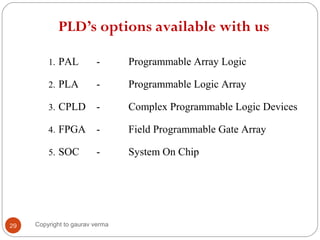
1. PAL - Programmable Array Logic
2. PLA - Programmable Logic Array
3. CPLD - Complex Programmable Logic Devices
4. FPGA - Field Programmable Gate Array
5. SOC - System On Chip
Copyright to gaurav verma
Programmable Array Logic
30
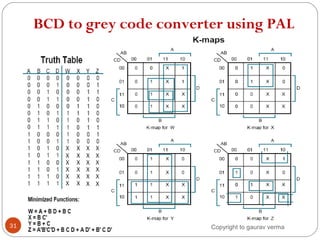
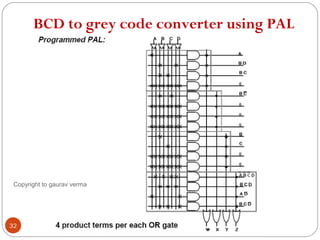
• PAL is the most commonly used type of PLD. It is a programmable array of logic gates.
The array of logic gates is on the single chip and it is in the AND-OR configuration.
• The special feature of PAL is that it has a programmable AND array and a fixed OR
array.
• Also note that each OR gate in the OR array gets inputs from some of the AND gates.
That means Outputs of all the AND gates are not applied to any of the OR gates. Figure
below shows the configuration for a PAL with 4 inputs, 4 AND gate (programmable) and
2 fixed OR gates.
Copyright to gaurav verma
BCD to grey code converter using PAL
31 Copyright to gaurav verma
BCD to grey code converter using PAL
32
Copyright to gaurav verma
Programmable Logic Array
33
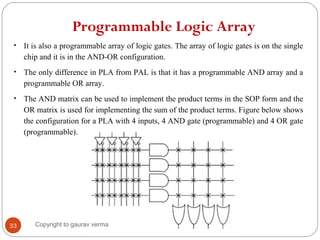
• It is also a programmable array of logic gates. The array of logic gates is on the single
chip and it is in the AND-OR configuration.
• The only difference in PLA from PAL is that it has a programmable AND array and a
programmable OR array.
• The AND matrix can be used to implement the product terms in the SOP form and the
OR matrix is used for implementing the sum of the product terms. Figure below shows
the configuration for a PLA with 4 inputs, 4 AND gate (programmable) and 4 OR gate
(programmable).
Copyright to gaurav verma
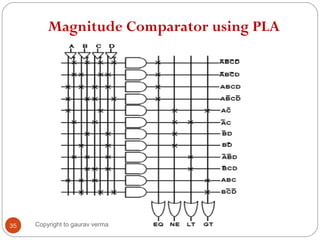
Magnitude Comparator using PLA
34 Copyright to gaurav verma
Magnitude Comparator using PLA
35 Copyright to gaurav verma
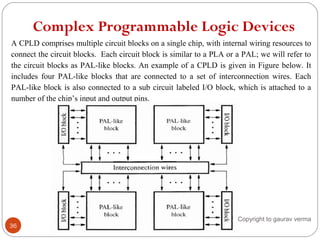
Complex Programmable Logic Devices
36
A CPLD comprises multiple circuit blocks on a single chip, with internal wiring resources to
connect the circuit blocks. Each circuit block is similar to a PLA or a PAL; we will refer to
the circuit blocks as PAL-like blocks. An example of a CPLD is given in Figure below. It
includes four PAL-like blocks that are connected to a set of interconnection wires. Each
PAL-like block is also connected to a sub circuit labeled I/O block, which is attached to a
number of the chip’s input and output pins.
Copyright to gaurav verma
Field Programmable Gate Array
37 Copyright to gaurav verma
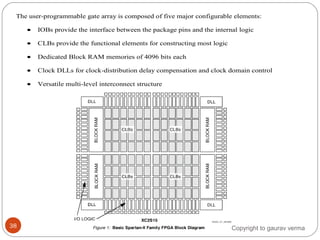
38
The user-programmable gate array is composed of five major configurable elements:
• IOBs provide the interface between the package pins and the internal logic
• CLBs provide the functional elements for constructing most logic
• Dedicated Block RAM memories of 4096 bits each
• Clock DLLs for clock-distribution delay compensation and clock domain control
• Versatile multi-level interconnect structure
Copyright to gaurav verma
39
Antifuse FPGAs
Devices are configured by burning a set of fuses. Once the chip is configured, it cannot be
altered any more. The Bug fixes and updates possible for new PCBs, but hardly for already
manufactured boards.
Flash FPGAs
Devices may be re-programmed several thousand times and are non-volatile, i.e. keep their
configuration after power-off and- with only marginal additional effort, the chips may be updated
in the field. Their re-configuration takes several seconds
SRAM FPGAs
It is currently the dominating technology having unlimited re-programming and additional
circuitry is required to load the configuration into the FPGA after power on.
FPGAs are chips, which are programmed by the customer to perform the desired functionality.
The chips may be programmed either
Once: Antifuse technology, e.g. devices manufactured by Quick logic.
Several times: Flash based, e.g. devices manufactures by Actel.
Dynamically: SRAM based, e.g. devices manufactured by Actel, Altera, Atmel,
Cypress, Lucent, Xilinx.
Each technology has its own advantages, which shall be discussed only very briefly:
Copyright to gaurav verma
40 Copyright to gaurav verma
41 Copyright to gaurav verma
System On Chip
42 Copyright to gaurav verma
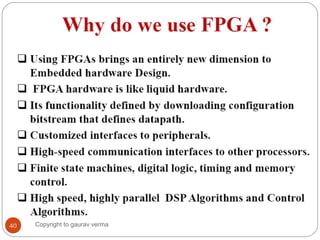
43 Copyright to gaurav verma
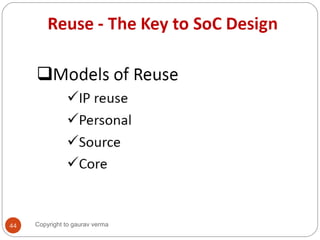
44 Copyright to gaurav verma
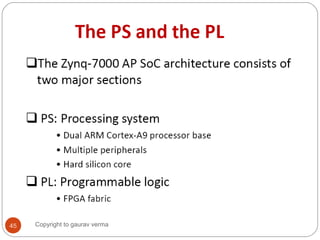
45 Copyright to gaurav verma
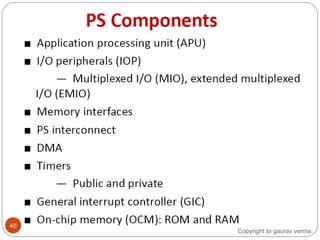
46
Copyright to gaurav verma
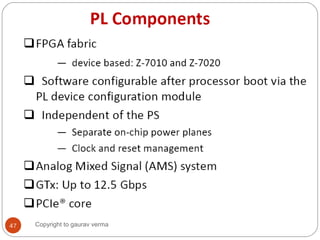
47 Copyright to gaurav verma
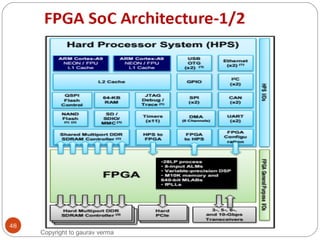
48
Copyright to gaurav verma
49
Copyright to gaurav verma
Acquire skills and get employed
Update skills and stay employed
THANK YOU
50 Copyright to gaurav verma

Introduction to Embedded Systems and its Applications

  • 1.
    BASIC EMBEDDED SYSTEMS &DESIGN Gaurav Verma Assistant Professor Department of Electronics and Communication Engineering Jaypee Institute of Information and Technology Sector-62, Noida, Uttar Pradesh, India 1 Copyright to gaurav verma
  • 2.
    Course Content 2 1. INTRODUCTION& HARDWARE FUNDAMENTAL FOR EMBEDDED DEVELOPERS 1. Embedded System and its applications. 2. Design Parameters of Embedded System and its significance. 3. Embedded System design flow and design life cycle. 4. Digital Circuit Parameters 4.1 Open collector outputs 4.2 Tristate outputs 4.3 I/O source and sinking 4.4 Fan-in and Fan-out 4.5 Propagation delay 4.6 Figure of merit 5. Programmable Logic Devices 5.1 Programmable Array Logic (PAL) 5.2 Programmable Logic Array (PLA) 5.3 Complex Programmable Logic Device (CPLD) 5.4 Field Programmable Gate Array (FPGA) 5.5 Programmable System on Chip (SOC) Copyright to gaurav verma
  • 3.
    Course Content cont… 2.INTRODUCTION TO MICROPROCESSORS AND MICROCONTROLLERS 1. Introduction 1.1 Microprocessor Versus Microcontrollers 1.2 Microcontrollers for Embedded Systems 1.3 Embedded Versus External Memory Devices 1.4 CISC Versus RISC Processors 1.5 Harvard Versus Von-Neumann architecture 1.6 Superscalar Versus VLIW architecture 2. 8051/8031/8052 Microcontroller 2.1 Basic architecture 2.2 Pin configuration 2.3 Memory organization (registers and i/o ports) 2.4 Assembly language programming ( addressing modes and instruction set) 2.5 Timers and Interrupts 2.6 Serial Communication 3 Copyright to gaurav verma
  • 4.
    Course Content cont… 4Copyright to gaurav verma
  • 5.
    Course Content cont… 4.INTRODUCTION TO RTOS AND ADVANCED MICROPROCESSOR 1. Real Time Operating System (RTOS) 1.1 Types of real time tasks 1.2 Task Periodicity 1.3 Process state diagram 1.4 Kernel and Scheduler 1.5 Scheduling algorithms 1.6 Shared data (Resource) and Mutual Exclusion 1.7 Semaphore 2. Introduction to ARM 2.1 Features 2.2 ARM Pipeline 2.3 Instruction Set Architecture (ISA) 2.4 Thumb Instructions 2.5 Exceptions in ARM 5 Copyright to gaurav verma
  • 6.
    Course Content cont… 5.COMMUNICATION PROTOCOLS 1. Communication Protocols 1.1 Serial Protocols a) Inter IC (I2 C) b) Controller Area Network (CAN) c) Serial Peripheral Interface (SPI) d) Universal Serial Bus (USB) 1.2 Parallel Protocols a) Peripheral Component Interconnect (PCI) b) ARM Bus 1.3 Wireless Protocols a) Infrared Data Association (IrDA) b) Bluetooth c) IEEE 802.11 6 Copyright to gaurav verma
  • 7.
  • 8.
    UNIT 1: Introductionand Hardware Fundamentals for Embedded Developers 8 Copyright to gaurav verma
  • 9.
    Embedded System &its Applications What is system? A system is also an arrangement in which all its units assemble and work together according to the plan or program. OR A system is a way of working, organizing or doing one or many tasks according to a fixed plan, program or set of rules. 9 What is embedded? To implant something inside OR To insert something inside Copyright to gaurav verma
  • 10.
    SYSTEM EXAMPLES WATCH It isa time display SYSTEM Parts: Hardware, Needles, Battery, Dial, Chassis and Strap Rules 1.All needles move clockwise only 2.A thin needle rotates every second 3.A long needle rotates every minute 4.A short needle rotates every hour 5.All needles return to the original position after 12 hours 10 Copyright to gaurav verma
  • 11.
    WASHING MACHINE It isan automatic clothes washing SYSTEM Parts: Status display panel, Switches & Dials, Motor, Power supply & control unit, Inner water level sensor and solenoid valve. Rules 1.Wash by spinning 2.Rinse 3.Drying 4.Wash over by blinking 5.Each step display the process stage 6.In case interruption, execute only the remaining SYSTEM EXAMPLES 11 Copyright to gaurav verma
  • 12.
    What is EMBEDDEDSYSTEM? Intelligence inside the system Processing element 12 Inside it there is a chip Acting as a brain for this system • Microprocessor • Microcontroller • DSP • ASIC • PLDs • FPGA • SOC Copyright to gaurav verma
  • 13.
    EMBEDDED SYSTEM DEFINITIONS 13 Definition1: Combination of Hardware & Software in general SOFTWARE PROGRAM Definition 2: An embedded system is a special-purpose computer system designed to perform a dedicated function & Any system where the user doesn’t want to or need to know that it includes a processor by Chandandeep Singh PABLA (Sr. Manager ST Microelectronics) Definition 3: An embedded system can be defined as a processing element based computing or controlling system embed within a larger electronic device, performing a single (or a small set of) function(s) repeatedly, following certain time constraints and often going unnoticed by device user by Prof. Santanu Chattopadyay (IIT Kharagpur) Is Desktop, Laptop, Mobile and Tablets are embedded systems as per the above definition???????? Copyright to gaurav verma
  • 14.
    14 EMBEDDED SYSTEM DEFINITIONS Definition5: An embedded system is a processing element (Microprocessor, Microcontroller, DSP, PLD, FPGA, ASIC, SOC) based computing/controlling electronic system designed to do one or a few dedicated and/or specific functions often with real-time computing constraints. It is embedded as part of a complete device often unnoticed by the device user by Gaurav Verma (Asst. Prof. JIIT Noida) This definition, being a bit technical, may not be very precise. However, it should be noted that giving a precise definition of embedded system is quite difficult. Definition 4: An embedded system is a computer system designed to do one or a few dedicated and/or specific functions often with real-time computing constraints. It is embedded as part of a complete device often including hardware and mechanical parts by Abhishek Tiwari (Sr. Technical officer CDAC Noida) Copyright to gaurav verma
  • 15.
    Examples of embeddedsystems • Mobile Phones • Microwave • Washing Machine • GPS • Intelligent credit card • Cruise control Car engine timing 15 Copyright to gaurav verma
  • 16.
    Examples of embeddedsystems • Industrial controller • Guided missiles • Digital TV • Flight controller • Pace Makers • Gaming devices and on and on …… 16 Copyright to gaurav verma
  • 17.
    How many dowe use? Average middle-class American home has 40 to 50 embedded processors in it  Microwave, washer, dryer, dishwasher, TV, VCR, stereo, hair dryer, coffee maker, remote control, humidifier, heater, toys, etc. Luxury cars have over 60 embedded processors  Brakes, steering, windows, locks, ignition, dashboard displays, transmission, mirrors, etc. Personal computers have over 10 embedded processors  Graphics accelerator, mouse, keyboard, hard-drive, CD-ROM, bus interface, network card, etc. Pentium/x86 holds largest processor volume share!  True/False? 17 Copyright to gaurav verma
  • 18.
    Embedded Processors Proliferation 18Copyright to gaurav verma
  • 19.
    Broad Embedded SystemsSegments 19 Copyright to gaurav verma
  • 20.
    Embedded System PervasivenessEnablers • More Processing Power @ Lesser Cost • Moore’s Law • More than Moore • Multicore Systems • Networking Technologies • Progress in wireless communication allows for flexible interconnect topologies • Tools and SoC • Hardware and software commoditization • Open Source provide powerful platforms 1981 1984 1987 1990 1993 1996 1999 2002 Leading edge chip in 1981 10,000 transistors Leading edge chip in 2002 150,000,000 transistors 20 Copyright to gaurav verma
  • 21.
    Embedded System Economics •The embedded systems market should reach €1.5 trillion in revenue by 2015! 21 Copyright to gaurav verma
  • 22.
  • 23.
    Design Parameters ofEmbedded Systems • System Cost: NRE & RE • Small sized : Hardware (Silicon Area) & Software (code size) • Performance: ASIC may have better performance than FPGA • Power: Very Important Issue as most of the embedded systems are battery operated & plastic packaging & cooling increase the cost. • Design Flexibility: FPGA are more flexible than ASIC. Software code is more flexible than hardware. • Design turn around time: time needed to complete the design starting from specification up to taking it into the market ( Use of offshelf components rather design from scratch) • System Maintainability: ease of maintaining and monitoring the health of the system after it has been put on the field. • Testing & Verification: ability to check the system functionality and gets confidence regarding the correct operation of it. 23 Copyright to gaurav verma
  • 24.
    Design Parameters Competition 24 Tobest meet this optimization challenge, the designer must be comfortable with a variety of hardware and software implementation technologies, and must be able to migrate from one technology to another, in order to find the best implementation for a given application and constraints. Thus, a designer cannot simply be a hardware expert or a software expert, as is commonly the case today; the designer must have expertise in both areas. Copyright to gaurav verma
  • 25.
    Design Parameters Competition 25 Tobest meet this optimization challenge, the designer must be comfortable with a variety of hardware and software implementation technologies, and must be able to migrate from one technology to another, in order to find the best implementation for a given application and constraints. Thus, a designer cannot simply be a hardware expert or a software expert, as is commonly the case today; the designer must have expertise in both areas. Copyright to gaurav verma
  • 26.
    Embedded System DesignFlow 26 Copyright to gaurav verma
  • 27.
    Digital Circuit Parameters 27 1.Open collector outputs 2. Tristate outputs 3. I/O source and sinking 4. Fan-in and Fan-out 5. Propagation delay 6. Figure of merit Copyright to gaurav verma
  • 28.
    Why Programmable LogicDevices? 28 • We know about different ICs such as multiplexers, comparators, adders, code converters, demultiplexers etc. Such ICs are called fixed function ICs. • The advantage of designing the fixed function ICs are low development cost and easy testing. But the disadvantage are requirement of large board space, large power requirements, no security, additional costs are required if the existing circuit is to be modified. • The remedy to this problem is application specific integrated circuit (ASICs). These ICs are designed to meet specific requirements of a user or application. But the design of ASICs is too complex, enormous initial development cost, new testing methods will add to the cost and efforts. • The third approach to the problem of digital circuit design is to use programmable logic devices (PLDs). This method has the advantages of both the approaches discussed earlier. PLD are special type of ICs which can be programmed by the users as per their requirements. Copyright to gaurav verma
  • 29.
    PLD’s options availablewith us 29 1. PAL - Programmable Array Logic 2. PLA - Programmable Logic Array 3. CPLD - Complex Programmable Logic Devices 4. FPGA - Field Programmable Gate Array 5. SOC - System On Chip Copyright to gaurav verma
  • 30.
    Programmable Array Logic 30 •PAL is the most commonly used type of PLD. It is a programmable array of logic gates. The array of logic gates is on the single chip and it is in the AND-OR configuration. • The special feature of PAL is that it has a programmable AND array and a fixed OR array. • Also note that each OR gate in the OR array gets inputs from some of the AND gates. That means Outputs of all the AND gates are not applied to any of the OR gates. Figure below shows the configuration for a PAL with 4 inputs, 4 AND gate (programmable) and 2 fixed OR gates. Copyright to gaurav verma
  • 31.
    BCD to greycode converter using PAL 31 Copyright to gaurav verma
  • 32.
    BCD to greycode converter using PAL 32 Copyright to gaurav verma
  • 33.
    Programmable Logic Array 33 •It is also a programmable array of logic gates. The array of logic gates is on the single chip and it is in the AND-OR configuration. • The only difference in PLA from PAL is that it has a programmable AND array and a programmable OR array. • The AND matrix can be used to implement the product terms in the SOP form and the OR matrix is used for implementing the sum of the product terms. Figure below shows the configuration for a PLA with 4 inputs, 4 AND gate (programmable) and 4 OR gate (programmable). Copyright to gaurav verma
  • 34.
    Magnitude Comparator usingPLA 34 Copyright to gaurav verma
  • 35.
    Magnitude Comparator usingPLA 35 Copyright to gaurav verma
  • 36.
    Complex Programmable LogicDevices 36 A CPLD comprises multiple circuit blocks on a single chip, with internal wiring resources to connect the circuit blocks. Each circuit block is similar to a PLA or a PAL; we will refer to the circuit blocks as PAL-like blocks. An example of a CPLD is given in Figure below. It includes four PAL-like blocks that are connected to a set of interconnection wires. Each PAL-like block is also connected to a sub circuit labeled I/O block, which is attached to a number of the chip’s input and output pins. Copyright to gaurav verma
  • 37.
    Field Programmable GateArray 37 Copyright to gaurav verma
  • 38.
    38 The user-programmable gatearray is composed of five major configurable elements: • IOBs provide the interface between the package pins and the internal logic • CLBs provide the functional elements for constructing most logic • Dedicated Block RAM memories of 4096 bits each • Clock DLLs for clock-distribution delay compensation and clock domain control • Versatile multi-level interconnect structure Copyright to gaurav verma
  • 39.
    39 Antifuse FPGAs Devices areconfigured by burning a set of fuses. Once the chip is configured, it cannot be altered any more. The Bug fixes and updates possible for new PCBs, but hardly for already manufactured boards. Flash FPGAs Devices may be re-programmed several thousand times and are non-volatile, i.e. keep their configuration after power-off and- with only marginal additional effort, the chips may be updated in the field. Their re-configuration takes several seconds SRAM FPGAs It is currently the dominating technology having unlimited re-programming and additional circuitry is required to load the configuration into the FPGA after power on. FPGAs are chips, which are programmed by the customer to perform the desired functionality. The chips may be programmed either Once: Antifuse technology, e.g. devices manufactured by Quick logic. Several times: Flash based, e.g. devices manufactures by Actel. Dynamically: SRAM based, e.g. devices manufactured by Actel, Altera, Atmel, Cypress, Lucent, Xilinx. Each technology has its own advantages, which shall be discussed only very briefly: Copyright to gaurav verma
  • 40.
    40 Copyright togaurav verma
  • 41.
    41 Copyright togaurav verma
  • 42.
    System On Chip 42Copyright to gaurav verma
  • 43.
    43 Copyright togaurav verma
  • 44.
    44 Copyright togaurav verma
  • 45.
    45 Copyright togaurav verma
  • 46.
  • 47.
    47 Copyright togaurav verma
  • 48.
  • 49.
  • 50.
    Acquire skills andget employed Update skills and stay employed THANK YOU 50 Copyright to gaurav verma