Subject – Computer Addied Design [CAD]
Topic - Geometric transformations
Presented By - Dhruv Shah
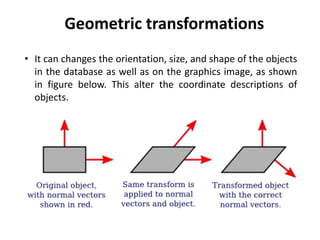
• It can changes the orientation, size, and shape of the objects
in the database as well as on the graphics image, as shown
in figure below. This alter the coordinate descriptions of
objects.
Geometric transformations
• Use of Geometric Transformations :-
The geometric transformations are used for the following
purposes:
i. In a construction of a model;
ii. In editing the model using the commands like : translate,
rotate, zoom, mirror, array, etc;
iii. For obtaining orthographic, isometric and prospective
views of the model;
iv. To view the model from different positions; and
v. In animations.
Basic geometric transformations :
The basic geometric transformations used in modelling
are:
1) Translation
2) Rotation
3) Scaling
4) Reflection
5) Shear
6) Concatenated (Composite) Transformation
Reflections :- These are like mirror images as seen
across a line or a point.
Translations :- This moves the figure to a new
location with no change to the looks of the
figure.
Rotations :- This turns the figure clockwise or
counter-clockwise but doesn’t change the
figure.
TRANSLATION
A translation is a transformation that slides
a figure across a plane or through space.
With translation all points of a figure move
the same distance and the same direction.
Translations
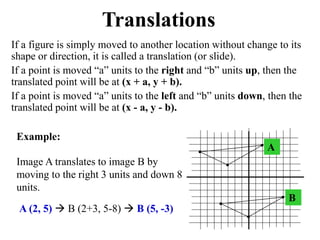
If a figure is simply moved to another location without change to its
shape or direction, it is called a translation (or slide).
If a point is moved “a” units to the right and “b” units up, then the
translated point will be at (x + a, y + b).
If a point is moved “a” units to the left and “b” units down, then the
translated point will be at (x - a, y - b).
A
B
Image A translates to image B by
moving to the right 3 units and down 8
units.
Example:
A (2, 5)  B (2+3, 5-8)  B (5, -3)
ROTATION
A rotation is a transformation that turns a
figure about (around) a point or a line.
The point a figure turns around is called the
center of rotation.
Basically, rotation means to spin a shape.
The center of rotation can be on or outside
the shape.
Rotations
• An image can be rotated about a fixed point.
• The blades of a fan rotate about a fixed point.
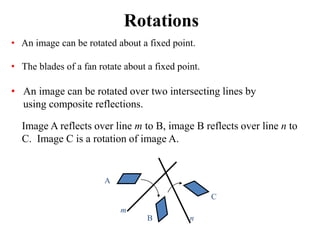
• An image can be rotated over two intersecting lines by
using composite reflections.
Image A reflects over line m to B, image B reflects over line n to
C. Image C is a rotation of image A.
A
B
C
m
n
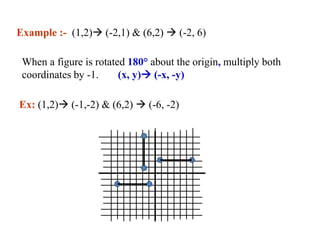
When a figure is rotated 180° about the origin, multiply both
coordinates by -1. (x, y) (-x, -y)
Ex: (1,2) (-1,-2) & (6,2)  (-6, -2)
Example :- (1,2) (-2,1) & (6,2)  (-2, 6)
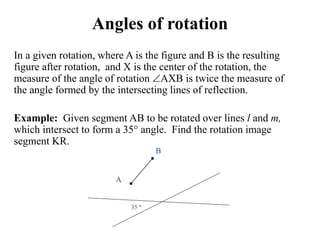
Angles of rotation
In a given rotation, where A is the figure and B is the resulting
figure after rotation, and X is the center of the rotation, the
measure of the angle of rotation AXB is twice the measure of
the angle formed by the intersecting lines of reflection.
Example: Given segment AB to be rotated over lines l and m,
which intersect to form a 35° angle. Find the rotation image
segment KR.
A
B
35 °
Since the angle formed by the lines is 35°, the angle of rotation
is 70°.
1. Draw AXK so that its measure is 70° and AX = XK.
2. Draw BXR to measure 70° and BX = XR.
3. Connect K to R to form the rotation image of segment AB.
A
B
35 °
X
K
R
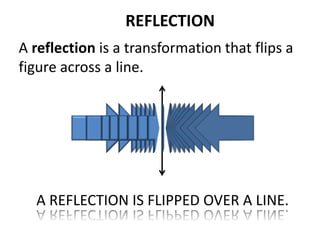
REFLECTION
A REFLECTION IS FLIPPED OVER A LINE.
A reflection is a transformation that flips a
figure across a line.
Reflections
You could fold the picture along line l and
the left figure would coincide with the
corresponding parts of right figure. l
You can reflect a figure using a line or a point. All measures
(lines and angles) are preserved but in a mirror image.
Example: The figure is reflected across line l .
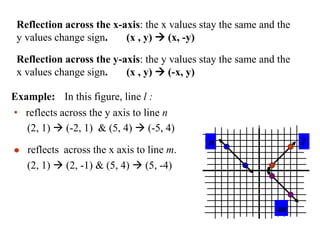
• reflects across the y axis to line n
(2, 1)  (-2, 1) & (5, 4)  (-5, 4)
Reflection across the x-axis: the x values stay the same and the
y values change sign. (x , y)  (x, -y)
Reflection across the y-axis: the y values stay the same and the
x values change sign. (x , y)  (-x, y)
Example: In this figure, line l :
 reflects across the x axis to line m.
(2, 1)  (2, -1) & (5, 4)  (5, -4)
ln
m
(-3, 6)  (-3, -4)
(-6, 2)  (-6, 0)
(2, 3)  (2, -1).
Example: Reflect the fig. across the line y = 1.
Geometric transformation

Geometric transformation

  • 1.
    Subject – ComputerAddied Design [CAD] Topic - Geometric transformations Presented By - Dhruv Shah
  • 2.
    • It canchanges the orientation, size, and shape of the objects in the database as well as on the graphics image, as shown in figure below. This alter the coordinate descriptions of objects. Geometric transformations
  • 3.
    • Use ofGeometric Transformations :- The geometric transformations are used for the following purposes: i. In a construction of a model; ii. In editing the model using the commands like : translate, rotate, zoom, mirror, array, etc; iii. For obtaining orthographic, isometric and prospective views of the model; iv. To view the model from different positions; and v. In animations.
  • 4.
    Basic geometric transformations: The basic geometric transformations used in modelling are: 1) Translation 2) Rotation 3) Scaling 4) Reflection 5) Shear 6) Concatenated (Composite) Transformation
  • 5.
    Reflections :- Theseare like mirror images as seen across a line or a point. Translations :- This moves the figure to a new location with no change to the looks of the figure. Rotations :- This turns the figure clockwise or counter-clockwise but doesn’t change the figure.
  • 6.
    TRANSLATION A translation isa transformation that slides a figure across a plane or through space. With translation all points of a figure move the same distance and the same direction.
  • 7.
    Translations If a figureis simply moved to another location without change to its shape or direction, it is called a translation (or slide). If a point is moved “a” units to the right and “b” units up, then the translated point will be at (x + a, y + b). If a point is moved “a” units to the left and “b” units down, then the translated point will be at (x - a, y - b). A B Image A translates to image B by moving to the right 3 units and down 8 units. Example: A (2, 5)  B (2+3, 5-8)  B (5, -3)
  • 8.
    ROTATION A rotation isa transformation that turns a figure about (around) a point or a line. The point a figure turns around is called the center of rotation. Basically, rotation means to spin a shape. The center of rotation can be on or outside the shape.
  • 9.
    Rotations • An imagecan be rotated about a fixed point. • The blades of a fan rotate about a fixed point. • An image can be rotated over two intersecting lines by using composite reflections. Image A reflects over line m to B, image B reflects over line n to C. Image C is a rotation of image A. A B C m n
  • 10.
    When a figureis rotated 180° about the origin, multiply both coordinates by -1. (x, y) (-x, -y) Ex: (1,2) (-1,-2) & (6,2)  (-6, -2) Example :- (1,2) (-2,1) & (6,2)  (-2, 6)
  • 11.
    Angles of rotation Ina given rotation, where A is the figure and B is the resulting figure after rotation, and X is the center of the rotation, the measure of the angle of rotation AXB is twice the measure of the angle formed by the intersecting lines of reflection. Example: Given segment AB to be rotated over lines l and m, which intersect to form a 35° angle. Find the rotation image segment KR. A B 35 °
  • 12.
    Since the angleformed by the lines is 35°, the angle of rotation is 70°. 1. Draw AXK so that its measure is 70° and AX = XK. 2. Draw BXR to measure 70° and BX = XR. 3. Connect K to R to form the rotation image of segment AB. A B 35 ° X K R
  • 13.
    REFLECTION A REFLECTION ISFLIPPED OVER A LINE. A reflection is a transformation that flips a figure across a line.
  • 14.
    Reflections You could foldthe picture along line l and the left figure would coincide with the corresponding parts of right figure. l You can reflect a figure using a line or a point. All measures (lines and angles) are preserved but in a mirror image. Example: The figure is reflected across line l .
  • 15.
    • reflects acrossthe y axis to line n (2, 1)  (-2, 1) & (5, 4)  (-5, 4) Reflection across the x-axis: the x values stay the same and the y values change sign. (x , y)  (x, -y) Reflection across the y-axis: the y values stay the same and the x values change sign. (x , y)  (-x, y) Example: In this figure, line l :  reflects across the x axis to line m. (2, 1)  (2, -1) & (5, 4)  (5, -4) ln m
  • 16.
    (-3, 6) (-3, -4) (-6, 2)  (-6, 0) (2, 3)  (2, -1). Example: Reflect the fig. across the line y = 1.